• Skip to main content
  • Skip to primary sidebar

Nexa Collections

  • Home
  • Serving
    • Medical
    • Dental
    • Small Business
    • Large Business
    • Commercial Collections
    • Government
    • Utilities
    • Fitness Clubs
    • Schools
    • Senior Care Facility
  • Contact Us
    • About us
    • Cost

Debt Recovery

Statute of Limitations in Debt Collection

Statute of Limitations (SOL) is a time period after which a debt collector loses the right to sue the debtor or take any legal action against him. Statute of limitations laws vary from state to state, for example in California it is 4 years while in Rhode Island it is 10 years.

In most states, it’s between 3 to 6 years. Debts that have passed the statute of limitations are also known as “time-barred debts“.

Q1. If the statutes of limitations have passed, is the debtor free from debt?

No, the debtor still has the moral obligation to pay. The debt has not disappeared just that the debt collector can no longer force a debtor to pay or sue him in court.

Q2. If a debt collector contacts a debtor after the Statute of limitations has passed, has he broken a law?

Not necessarily. Let us look at these scenarios.

– A debt collector may have a wrong “Date of Debt” in his system. It is also possible that the debtor has wrongly calculated it, and the Statute of Limitations has not yet expired. Both parties should clarify this amicably, so there is no confusion. Present the proof if necessary.

– A Debt Collector can still try to collect money by sending a letter and calling over the phone. The debtor can tell the collector that he has no intention to pay. The guidelines on the Statute of Limitations vary by each state (and sometimes cities too), a collection agency must be very careful while trying to collect on these time-barred debts.

Q3. What are the consequences of not paying the debt after the Statute of Limitations have passed?
The debt collector can report the bad debt to the credit bureau reporting agencies like Experian, Transunion and Equifax (if permitted by the state laws). That unpaid debt will appear on the debtor’s credit history for seven years. This will greatly lower the chances of a debtor taking more loans and sometimes even make harder for him to get a good job for many years to come.

But wait, the debtor may be on the hook for paying taxes on the forgiven debt.
There is another consequence of not paying the debt. If the financial institution forgives or writes off a debt over $600, they may send a Form 1099-C to the IRS and a copy to the debtor as well. This only applies to the principal amount, and interests and other fees cannot be added. IRS will ensure that this amount is added to the debtor’s income. There are some exceptions when this is not applicable, like the discharge of debt due to bankruptcy or debtor’s insolvency etc. Since the debtor took the money and did not pay it back, IRS treats this as an income and demands tax on it. If the debtor claims insolvency, then IRS form 982 may apply. The debtor should consult a tax professional to handle this scenario.

Q4. How is the Statute of Limitations date calculated?
First, let’s understand the “Date of Debt” concept. It is the date when the debtor made some activity on that account. It could be the date when the item was purchased, or when the payment was due, or when the last payment was made, or even when the debtor re-agreed to pay the debt (which means the debtor has agreed again to the ownership of the debt). The most recent date is called the “Date of Debt” and the SOL is calculated from that date.

A debtor may have agreed to pay in 4 different ways
a) Oral Contract – Debtor agreed to pay orally (ex: an orally recorded phone message)
b) Written Contract – This could be a signed contract or an invoice. ( ex: A medical bill plus a written agreement)
c) Promissory Note – In this, the details of repayments are spelled out – For example, mortgages or car loans.
d) Open-ended– Here the balance and repayment terms can change- Ex: Credit cards, line of credit etc.

Following are some examples of Statute of Limitations by each state (in the number of years).

State Oral Contracts Written Contracts Promissory Notes Open-Ended
Alabama 6 years 6 years 6 years 3 years
Alaska 6 years 6 years 6 years 3 years
Arizona 3 years 6 years 6 years 3 years
Arkansas 3 years 5 years 5 years 3 years
California 2 years 4 years 4 years 4 years
Colorado 3 years 6 years 6 years 6 years
Connecticut 3 years 6 years 6 years 6 years
Delaware 3 years 3 years 3 years 4 years
Florida 4 years 5 years 5 years 4 years
Georgia 4 years 6 years 6 years 4 years
Hawaii 6 years 6 years 6 years 6 years
Idaho 4 years 5 years 5 years 4 years
Illinois 5 years 10 years 10 years 5 years
Indiana 6 years 6 years 10 years 6 years
Iowa 5 years 10 years 5 years 5 years
Kansas 3 years 5 years 5 years 3 years
Kentucky 5 years 10 years 15 years 5 years
Louisiana 10 years 10 years 10 years 3 years
Maine 6 years 6 years 6 years 6 years
Maryland 3 years 3 years 6 years 3 years
Massachusetts 6 years 6 years 6 years 6 years
Michigan 6 years 6 years 6 years 6 years
Minnesota 6 years 6 years 6 years 6 years
Mississippi 3 years 3 years 3 years 3 years
Missouri 5 years 10 years 10 years 5 years
Montana 5 years 8 years 8 years 5 years
Nebraska 4 years 5 years 5 years 4 years
Nevada 4 years 6 years 6 years 4 years
New Hampshire 3 years 3 years 6 years 3 years
New Jersey 6 years 6 years 6 years 6 years
New Mexico 4 years 6 years 6 years 4 years
New York 6 years 6 years 6 years 6 years
North Carolina 3 years 3 years 5 years 3 years
North Dakota 6 years 6 years 6 years 6 years
Ohio 6 years 8 years 15 years 6 years
Oklahoma 3 years 5 years 5 years 3 years
Oregon 6 years 6 years 6 years 6 years
Pennsylvania 4 years 4 years 4 years 4 years
Rhode Island 10 years 10 years 10 years 10 years
South Carolina 3 years 3 years 3 years 3 years
South Dakota 6 years 6 years 6 years 6 years
Tennessee 6 years 6 years 6 years 6 years
Texas 4 years 4 years 4 years 4 years
Utah 4 years 6 years 6 years 4 years
Vermont 6 years 6 years 5 years 3 years
Virginia 3 years 5 years 6 years 3 years
Washington 3 years 6 years 6 years 3 years
West Virginia 5 years 10 years 6 years 5 years
Wisconsin 6 years 6 years 10 years 6 years
Wyoming 8 years 10 years 10 years 8 years

A state may alter the Statute of Limitations from time to time therefore do not rely on the table above. Your collection agency should have the most up-to-date information on this. Proof of last activity may be a copy of a check, credit card statement, and other forms of communication that may have happened with the debtor.

Q5. What can Restart the Statute of Limitations?

If a debtor makes even a small payment ( say even $10) after the Statute of Limitations has passed or agrees to make payment under a new arrangement, it can potentially reset the “Date of Debt” again. In other words, the Statute of Limitations will reset and the debt collector can sue the debtor in the near future.

Q6. Can the old debts be removed from the debtor’s credit report once the Statute of Limitations has passed?

It can be removed only if the debt is inaccurate or legally disputable or has been resolved. Statute of Limitations has nothing to do with credit bureau reporting and affects the credit score for 7 years. Medical debts are removed from credit reports when paid.

Q7. Why is there a concept of Statute of Limitations after all?

It’s a kind of fairness doctrine. A debtor cannot be harassed all his life for a debt he could not pay. After all, even a creditor risks if he does not take the full payment immediately. As the debt gets older, circumstances change, documents are lost and important evidence can be misinterpreted. The objective is to encourage diligent collections while evidence is available and fresh. Considering all these factors, the Statute of Limitations came into existence.

Most collection agencies will stop collecting on a debt once the SOL is reached. They just lost the biggest tool ( read it “soft scare tactic”) used to recover unpaid debts.

Are you looking for a collection agency? Get in touch with us by visiting our “Contact us” section.

Video: 

Filed Under: Debt Recovery Tagged With: Debt Recovery, Statute of limitations, Time barred debts

How to Choose a Collection Agency: 14-Point Checklist (With Red Flags)

collection services


Choosing the right collection agency can lift recovery on aged A/R, protect your online reputation, and keep you compliant. Use this field-tested checklist to compare agencies across price, compliance, data security, and results.

Quick Comparison Table

Criterion Why it matters What “good” looks like Ask this
Industry fit Workflows vary by vertical Playbooks for medical, dental, commercial, education, utilities “Show vertical benchmarks and 2 references like us.”
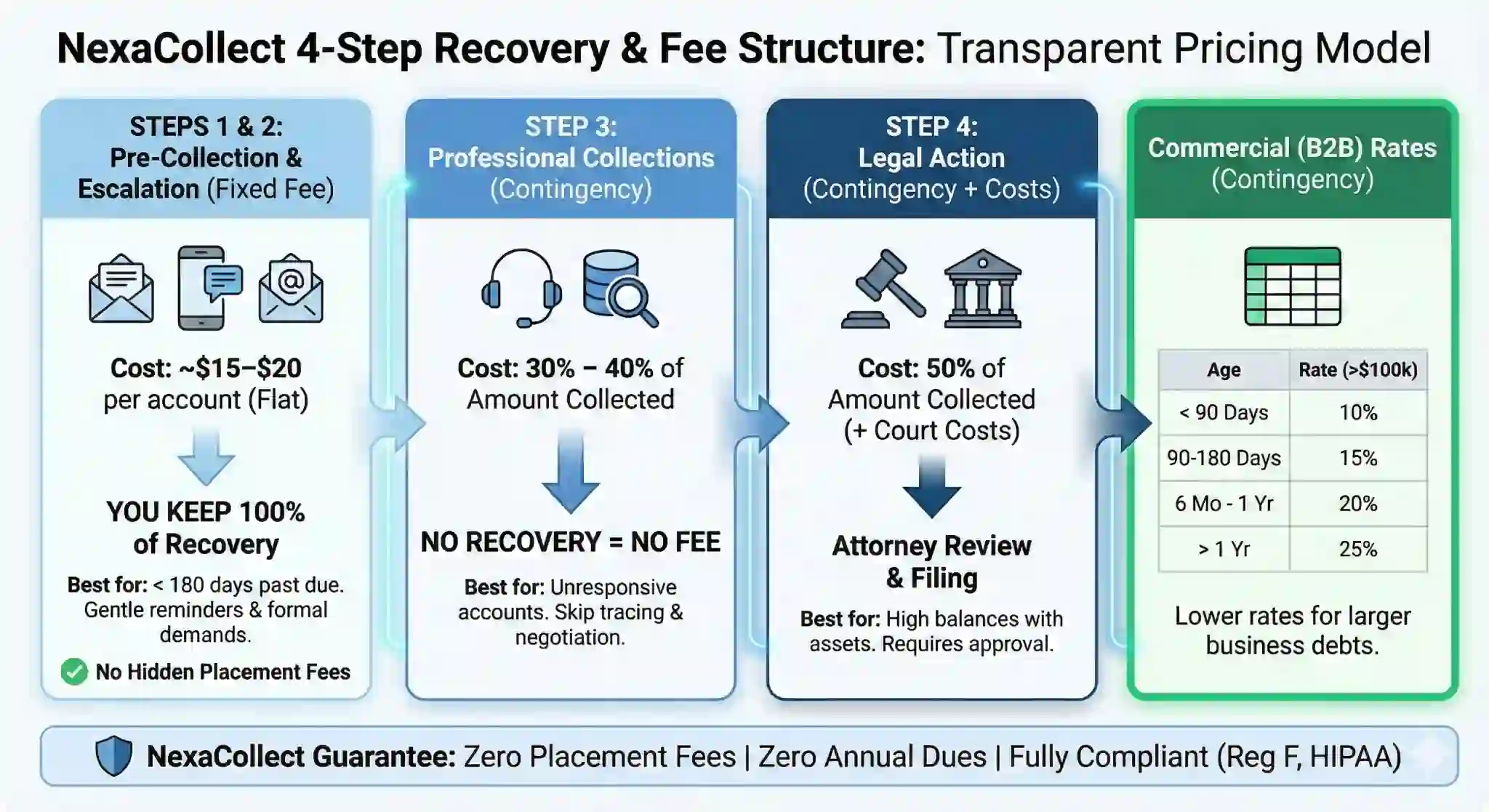
Pricing model Misaligned fees cut net recovery Clear fixed-fee vs contingency; sample invoices; see Pricing & Fees “Provide fee tiers and an example invoice.”
Compliance Avoid fines and brand damage Written FDCPA policies; HIPAA/GLBA where applicable (see Medical / Dental) “Share policies and training logs.”
Data security Protect PHI/PII and vendor risk Documented controls; MFA; encryption; cyber insurance “Provide attestations and cyber policy limits.”
Skip-tracing Drives right-party contacts Multi-source data; documented hit rates; included fees “What are your hit rates by segment?”
Reputation protection Tone affects complaints/reviews Scripted empathy, QA, complaint workflow, call recordings “Share scripts and QA scorecards.”
Reporting & portal Visibility = control Dashboard, notes, cohort analytics, exports “Show a sample weekly/monthly report.”
Credit reporting Powerful but regulated Clear criteria; dispute-friendly; compliant timing “When do you report and when not?”
Legal escalation Needed for select cases Nationwide attorney network; pre-suit success gates “List pre-suit thresholds and costs.”
Onboarding speed Faster start = faster cash List load < 3 days; custom letters/dialer SLAs “Give me a timeline with owners.”
Service levels Predictable CX SLAs for response, dispute TAT, call-recording access “Include SLAs in the contract.”
Results & benchmarks Proof over promises Cohort data by age bucket and balance size “Share anonymized performance by segment.”
References & reviews Third-party validation Industry-matched references and public reviews “Can I speak with two similar clients?”

14-Point Checklist (Actionable)

1) Industry fit

Choose an agency with proven workflows for your vertical: Medical, Dental, Commercial, Education, Utilities.
Ask this: “Show vertical benchmarks and two references like us.”

2) Pricing clarity: fixed-fee vs contingency

Match fees to account age and balance; avoid hidden add-ons. Compare options on our Pricing & Fees page.
Ask this: “Share fee tiers and a sample invoice.”

3) Compliance program

Verify FDCPA adherence and, where applicable, HIPAA/GLBA safeguards and TCPA-safe communications (see how we handle this in Medical and Dental).
Ask this: “Provide written policies and training cadence.”

4) Data security

Look for documented security controls (MFA, encryption at rest/in transit, least-privilege access) and cyber insurance.
Ask this: “Send attestations and cyber policy limits.”

5) Skip-tracing quality

Better data sources = higher right-party contacts and faster resolution. Relevant for both Commercial and consumer verticals.
Ask this: “What are your hit rates by segment? Is it included in fees?”

6) First-party vs third-party workflows

Early-out brand-safe touches vs firm third-party demands; both should be configurable. See examples within our services overview.
Ask this: “Show cadence and channels (email/SMS/IVR/letters).”

7) Reputation protection

Scripted empathy + QA reduces complaints and protects reviews—critical in Dental and Senior Living.
Ask this: “Share call scripts, QA scores, and complaint process.”

8) Reporting & transparency

Demand a portal with account notes, dashboards, cohort analytics, and exports. For what we report, see our services overview.
Ask this: “Send a sample weekly/monthly report.”

9) Credit-bureau reporting

Use carefully, lawfully, and with consumer-friendly dispute handling. Policy differs by vertical—e.g., Utilities versus Commercial).
Ask this: “When do you report and when is it withheld?”

10) Legal escalation

Seek a nationwide attorney network with pre-suit success gates and transparent costs. This is particularly relevant on older balances in Commercial.
Ask this: “Share thresholds for suit and cost schedule.”

11) Results & benchmarks

Insist on anonymized performance by age bucket (<90, 90–180, >180 days) and balance size—see case patterns across Medical, Dental, and Commercial.
Ask this: “Provide cohort outcomes for accounts like ours.”

12) Onboarding time

Clear milestones: list-load, custom letters, dialer setup, portal training. We outline this in our services overview.
Ask this: “Map the timeline with owners for each step.”

13) Service levels

Contractual SLAs for response, dispute TAT, complaint handling, and call-recording access.
Ask this: “Add SLAs to the MSA/SOW.”

14) References & reviews

Validate with industry-matched references and public reviews; you can also review outcomes by vertical: Medical, Dental, Utilities, Schools.
Ask this: “Can I speak to two similar clients?”


Red Flags to Avoid

  • No written compliance program or training logs

  • No security attestations (e.g., SOC 2) or cyber insurance

  • Complaints about aggressive tactics or sudden review spikes

  • Opaque pricing, “per-hit” skip fees, or surprise add-ons — compare with our Pricing & Fees

  • No reporting cadence or portal access

  • One-size-fits-all approach; no industry references


FAQs

Q: What recovery rates should I expect by account age?
A: Newer accounts (<90 days) recover the most via first-party/fixed-fee. Older balances often perform better on contingency with targeted outreach and (when appropriate) credit reporting or legal options. Explore by vertical: Medical, Dental, Commercial.

Q: How do I choose between fixed-fee and contingency?
A: Use fixed-fee for fresh, lower-balance accounts where reminders work (you keep 100% of payments). Move older/harder debt to contingency with transparent tiers. See examples on Pricing & Fees.

Q: How are patient/customer complaints handled?
A: Ask for the complaint workflow, response-time SLA, sample responses, and how QA audits calls to prevent issues. For sensitivity in senior care, review our guidance for Senior & Assisted Living.

Q: Do I need credit reporting?
A: Not always. It’s powerful but regulated. Your agency should document when it’s used, validate accounts, and handle disputes promptly (see Utilities vs. Commercial).

Q: What legal costs might I incur?
A: Pre-suit demand is typically included. Court filing and process-server fees are usually client-approved pass-throughs. Get costs in writing before escalation. Learn how we approach this in Commercial Collections.


Talk to Us

Want a side-by-side agency comparison tailored to your industry? We’ll map fees, workflows, and expected recovery by age bucket.

Get a comparison → https://nexacollect.com/contact/
See our services → https://nexacollect.com/debt-recovery/

Filed Under: Debt Recovery Tagged With: Debt Recovery, Good Collection Agency

What is Skip Tracing? Find the latest contact information of a person

What is Skip Tracing?

Skip tracing is a specialized service to locate a debtor’s current address, employer, phone number, and financial status. Advanced skip tracing services can reveal further details like assets, spouse information, Social Security Number (SSN), and date of birth. Typically, skip tracing costs between $50 to $175 per lookup, though collection agencies often pay mere cents per search due to their bulk usage.

Why Use a Collection Agency for Skip Tracing?

Hiring a collection agency is significantly cheaper—usually around $15 per account. They provide:

  • Free skip tracing to locate the debtor.
  • Multiple demand letters sent to your debtor.
  • Checks for bankruptcy or deceased status.
  • Direct payments to your account without extra costs.

Collection agencies achieve lower rates because they subscribe to skip tracing databases in large volumes, dramatically cutting costs.

Caution: Skip tracing can sometimes yield outdated or incorrect data, particularly phone numbers and emails, so use results judiciously.

Who Uses Skip Tracing?

  • Debt collectors
  • Private investigators
  • Bail bondsmen
  • Process servers
  • Repossession agents
  • Journalists

These professionals use skip tracing ethically within legal privacy limits to locate individuals who have “skipped” their obligations.

Common Information Uncovered by Skip Tracing:

  • Addresses: Current and previous residences.
  • Phone Numbers: Mobile and landline.
  • Employment History: Current and past jobs.
  • Relatives & Associates: Contacts who might provide leads.
  • Business & Property Records: Ownership details.
  • Social Media Profiles: Locations, behaviors, and connections.
  • Vehicle Registrations: Details on owned vehicles.

Importance of Skip Tracing in Debt Collection:

When your debtor’s phone number is inactive or their mail is returned undeliverable, immediate skip tracing is critical. Every day delayed significantly reduces recovery odds:

  • After 90 days, recovery rates drop below 70%.
  • After 180 days, recoverability drops to around 50%.

Common Reasons Debtors Are Unreachable:

  • Changed phone number: Debtors often switch to mobile numbers without informing creditors.
  • Relocation: Due to job changes, divorce, or retirement, debtors move without updating creditors.
  • Intentional hiding: Debtors avoiding legal or financial obligations, making them extremely difficult to trace.

Why Let a Collection Agency Handle Skip Tracing?

Using a collection agency saves your business significant time, cost, and stress. Agencies have trained professionals using advanced databases, making their success rate notably higher than in-house efforts. The savings from employee hours and resources far outweigh the minimal cost of agency services.

Additional Insights:

Skip tracing can also uncover if debtors:

  • Declared bankruptcy
  • Are deceased
  • On active military duty
  • Regularly file lawsuits against collectors (a critical consideration for debt recovery)

Moreover, modern skip tracing includes an automated feature called “triggering,” notifying collectors instantly when new debtor information emerges.

Popular Skip-Tracing Providers:

  • USPS (basic address checks)
  • Accurint for Collections by LexisNexis
  • TransUnion’s TLOxp
  • Experian’s MetroNet
  • Equifax’s FirstSearch

Efficient skip tracing significantly increases debt recovery effectiveness, making it indispensable for creditors and collection agencies alike.

Video: What is skip tracing?

Filed Under: Debt Recovery

Top Excuses Debtors give during Collection Calls

Debtor excuses are the biggest hurdle in debt collection. Sometimes their claims may be genuine, but more often they are simply delay tactics to postpone or avoid making payment altogether.

An aggressive approach will force the debtor to hide things from you, lowering your chances of getting paid. Try to work with the debtor, rather than working against them.

Financial Problems How to negotiate
• Job Loss.
• Divorce.
• I am waiting for my customers to pay me first.
• Cash flow problem.
• Spent money on a medical emergency.
• Lost money in gambling.
• No money to pay, no special reason.
• Medical emergency expenses.
When does he/she expect to be employed again? Is the debtor receiving unemployment benefits? How are their other expenses being met? Understand the debtor’s situation and ask when he expects the situation to improve. Contact the debtor at a later date again. Maybe the debtor is more comfortable paying in installments or settling for a lesser amount.
Delay Tactic How to negotiate
• Need a copy of the invoice or statement.
• Prove me that I actually owe this amount.
• Never received an invoice asking me to pay.
• Check is in the mail. You will get it soon.
• No time for this right now. I have other priorities.
• Our accounting department works only 1 hour a day or once a month, please call during that time.  Our accounting department sits elsewhere.
• No time to go to the bank due to my work schedule.- Changing banks or checkbooks not received yet.
• Signatory is not available.
• Lost the bill. Can you send the invoice again?
• Really, I haven’t paid it yet? Give me time to check my bank statement.
• I know nothing about this.
• Debtor returns the bill to the sender and tries to become untraceable.
• I did not expect my bill to be that high.
• Someone else handles my billing ( ok .. ask if they can add that person to this call now?)
Provide information/ documentation if the debtor had requested verification of the debt. This could be resending the invoice or documentation to prove that the debt is actually owed. Even better – fax or email it to them immediately while you have them on the phone.

However, most of the time, debt collectors have to actually call the debtor on a later date/time that is convenient for the debtor, and then communicate that he has already been given enough time.  An experienced debt collector knows how to work around these delay tactics. Ex: He may ask the debtor to give the check number and date when the check was written. The debtor will usually fumble badly if they are lying.

Dispute or Denial to pay How to negotiate
• I do not owe anything
• I will send you legal notice for harassing me.
• Let’s go to the court.
• Invoice is disputed.
• Never received the goods or service.
• Goods were defective, or service provided was bad.
• I am being overcharged, or I did not expect my bill to be that high
• My insurance company did not cover my entire bill as I thought.
• Over my dead body.
• Threats: Dude, I have connections; will have someone visit you !!
 If the debtor continues to resist and there is adequate proof that the debtor owes the debt, it may be time to check with the attorneys if a legal suit is advisable.

However, it is quite possible that the debtor really owns nothing. The data in your systems could be incorrect or outdated.

Other Reasons How to negotiate
 • Statute of limitations
• Person you need to talk to is not here right now.
• Bankruptcy
• Debtor has expired
• I have already paid.
• Wrong number.
 A debt collector needs to get the facts straight and get further information on the case. Take a call if further collection activity is even possible or not.
Possible Genuine Reasons What to do?
• I am disabled and have no money.


•  I am an armed service member ( Military, Navy, Air-force, etc.) and am currently posted overseas.

Check with your supervisor if an asset check/search is advisable or not. Most companies will not do this unless the balance is very high.

Service Members Civil Relief Act and Fair Debt Collection Practices for Servicemembers Act (HR 5003) give some extra rights to military personnel deployed overseas, ensuring their rights are not violated.

A debt collector should insist on proof or an explanation about what the debtor is saying. The debt collector may even give an option to the debtor to pay the outstanding amount in installments or renegotiate to settle the debt for a slightly lower amount ( provided they have authorization from their client to settle debts for that lower amount).

A Debt Collector should deal with great patience yet sound confident and assertive. Using abusive or unprofessional language is not only illegal; it can also take the debtor to a point where he becomes completely non-cooperative.

It is very important to hire a good Collection Agency which employs top-of-the-line debt collectors, even if they charge slightly more than other agencies. Not every debt collector can make a perfect collections call. They get better and groomed over time.


Filed Under: Debt Recovery Tagged With: Collection Agency, debtor excuses

Consumer vs Commercial Collection Agency : Differences

Aspect Commercial Collection Agency Consumer Collection Agency
Type of Debt Business-to-Business (B2B) Business-to-Consumer (B2C)
Debtor Profile Businesses, Companies, Corporations Individual consumers
Average Debt Amount Higher amounts (often thousands to millions) Lower amounts (usually hundreds to thousands)
Collection Approach Professional, negotiation-based, relationship-focused Often more regulated, consumer protection-focused
Governing Regulations Primarily UCC (Uniform Commercial Code) FDCPA, FCRA, TCPA, CFPB
Reporting to Credit Bureaus Less common, typically commercial bureaus (D&B, Experian Business) Common, personal credit bureaus (Experian, Equifax, TransUnion)
Legal Action Frequency Higher likelihood due to higher amounts Lower likelihood, reserved for significant cases
Collection Methods Negotiations, structured payments, relationship maintenance Calls, letters, credit bureau reporting, sometimes legal threats
Emotional Aspect Lower, usually professional relationship Higher, personal and sensitive situations
Account Complexity Typically more complex (contracts, invoices, disputes) Usually simpler (credit cards, medical bills, loans)
Settlement Flexibility Higher, frequent negotiation and settlements Moderate, subject to stricter legal constraints
Impact of Nonpayment Business disruptions, cash flow issues Credit score impact, personal financial distress
Cost Structure Often contingency-based (15%-50%) Typically contingency-based (20%-50%), occasionally fixed fee for smaller debts
  • Bankruptcy laws are different for individuals and companies.
  • The way Credit Check is run on individuals vs companies is vastly different.
  • A good commercial collection agency would likely be registered with the International Association of Commercial Collectors (IACC). Collection agencies dealing with consumer debt are affiliated with the Association of Credit Collection Professionals (ACA)

Need a collection agency with 20 years of experience? Contact Us

One may wonder, when a “debt is a debt, ” why do we classify it as a Commercial or a Consumer debt? When it comes to debt collections, they are treated quite differently, primarily due to the difference in debt recovery laws instituted by the US Government.

 A commercial debt collection agency treats every case differently. Scenarios change depending on the type of business. For example, the approach involved in collecting money from a hospital will differ from that of a car dealership. Collection Agencies maintain a delicate balance between recovering the debt and maintaining good business terms between the parties. The average balance of commercial accounts is generally much higher when compared to consumer debts. Commercial collection agencies are highly specialized in their field.

A 30-day dispute period does not apply to Commercial Collections
When the debtor is a consumer, a collection agency has to provide a 30-day dispute period regarding the debt.  During the dispute period, a consumer can also ask the Collection Agency to prove that he indeed owns the debt (also called as the “verification of debt”). However, a commercial collection agency can start the recovery process right away.

The commission fee is lower for Commercial Collections:
The contingency fees of a commercial collection agency vary from 10% to 50%. For accounts over $500K you can negotiate a collection fee of about 10%. For accounts about $50K, the fee is around 20%; for accounts lower than $1K, it’s around 50%.  It is always around 35% to 50% for Consumer Collections and averages around 40%. Even with lower contingency fees, a Commercial Agency can make more money per case due to higher balances. If a commercial debt is over one year, 5% extra fees may be charged.

Filed Under: Debt Recovery Tagged With: business debt, commercial debt

What is a Debt Collection Agency?

Collection Agency is an organization that attempts to collect money from individuals (or businesses) who have not paid their bills on time. Accounts are typically transferred to them after they have been over 60-90 days past due.

What kind of debt can be assigned to a debt collection agency?

1. Unpaid medical bills of a doctor or hospital.
2. Services or products which were sold but were not fully paid.
3. Mortgage debt, credit cards bill or other forms of bank delinquencies.
4. Unpaid phone bills, gym bills or other recurring membership fees.
5. Unpaid installments of car loan, student loan or bank loans.
6. Other interest and penalties.

Overall, you can initiate collection activity for almost any past due account for which you are legally entitled to get paid for and have sufficient proof to back your claim.

Example

Let us assume, you are a ‘dentist’, and your patient agreed to pay for your services in 5 installments. But the patient has stopped paying after the 2nd installment. Your gentle reminders to the patient have not resulted in any success. Would you write off the unpaid amount or would you go after the patient by trying harsher measures? It is advisable to avoid both. Taking intensive measures could even result in counterproductive action against you.

Now you approach a Collection Agency to collect your past due amount from your patient (or say, Debtor). Depending on the type of service you select, a Collection agency will attempt to collect the outstanding debt and charge you a fixed fee or the percentage of the debt collected. (Read: Services that Collection Agencies offer).

Should I try to collect the debt myself?

Sure, if your staff has time to do a few polite reminder calls or send bills to the debtor, and then time to do the follow-up for the same, try it out. But be extremely careful, respectful, polite and patient during your communication with the debtor. Most likely you will realize that too many man-hours are being spent and your staff is probably trained adequately to handle these situations.

Collection agencies are not only experts in collecting debt, the moment your debtors get to know that a professional debt collection agency is involved, but they are also more inclined to pay off the outstanding debt at the earliest.

Documents to prove you legally own the debt:

There are thousands of collection agencies in the United States, big and small, and each has a different way of working and the services they offer. In most cases, the collection agency will not ask you to submit all proof (or paperwork) of the outstanding debt initially, they will ask you to provide that if and when needed. For example: If the debtor disputes the charges. A collection agency will normally start the collection activity by asking only the basic information like Debtor Name, address, phone, amount due, bill/reference number, date of debt and sometimes debtor’s SSN. At all times you should maintain sufficient proof of the outstanding debt.

Additional information:

As mentioned earlier, collection agencies are experts in collecting debt, that’s what they do all year long. They ensure that the demand notices being sent out with maximum impact (collection letters, collection calls or legal notices), and that debt collection laws are followed, it includes “Fair debt collection practices act” specified by each state.

Before a collection agency signs you up as a client or starts accepting your past due accounts for collections, they will ask you to sign a legal agreement (on paper or an online contract). This agreement authorizes them to start collection activity on your behalf. Their agreement also includes important disclaimers and some standard legal stuff.

It is normally advisable to start collection activity after it has been over 60 days from the Date of debt, or that date when the payment was due. The sooner you submit an account for collections, the chances of recovering your money are significantly higher.

Defaulted debts are often reported on the debtor’s credit history, and it stays there for several years.


Watch this video:

Image source:
http://www.creative-commons-images.com/clipboard/collection-agency.html
Creator attribution: Nick Youngson – link to – http://nyphotographic.com/

Filed Under: Debt Recovery Tagged With: Bad Debt, Collection Agency

  • « Go to Previous Page
  • Page 1
  • Interim pages omitted …
  • Page 47
  • Page 48
  • Page 49
  • Page 50
  • Go to Next Page »

Primary Sidebar


accounts receivable

Need a Collection Agency?
Kindly fill this form.
We’ll get in touch with you

    Please prove you are human by selecting the cup.

    Recent Posts

    • Federal Government Shutdown: Impact on Collections
    • 2025-2026 ROI & Opportunity Matrix for Collection Agencies
    • Collection Agency to Recover Timeshare Unpaid Bills
    • When Should I Send Dental Accounts to Collections? A Guide for a Healthy Practice
    • 10 Signs You Need to Hire a Medical Debt Collection Agency
    • Debt Collection for Telehealth Providers: Proven Strategies & Best Practices
    • The Rise of Mobile Payment Solutions in Debt Collection
    • Why Cybersecurity Matters for Collection Agencies

    Featured Posts

    • Guide for Mergers and Acquisitions of Credit Unions
    • Collection Agency: Tax Preparers & Enrolled Agents Fee Recovery
    • Risky Things that Restoration Companies Should Never Do
    Directory of collection agencies
    Collections

    Featured Agencies

    • Collection Agencies in Zion, IL
    • Collection Agencies in Saginaw, MI
    • Collection Agencies in West Chester, PA

    Copyright © 2025 NEXACOLLECT.COM | All information on this website is for general information only and is not an experts advice. We do not own any responsibility for correctness or authenticity of the information, or any loss or injury resulting from it.

    X
    Need a Collection Agency?
    Contact Us