• Skip to main content
  • Skip to primary sidebar

Nexa Collections

  • Home
  • Serving
    • Medical
    • Dental
    • Small Business
    • Large Business
    • Commercial Collections
    • Government
    • Utilities
    • Fitness Clubs
    • Schools
    • Senior Care Facility
  • Contact Us
    • About us
    • Cost

Debt Recovery

Trucking Debt Collection | BMC-84 Bond & Freight Recovery

Trucking and freight debt recovery requires navigating Bill of Lading (BOL) liability, short-pay disputes, cargo claim offsets, broker-shipper relationships, and the federal BMC-84 broker bond system. Nexa provides 50-state licensed, FDCPA-compliant freight collection starting at a $15 fixed fee per account, backed by SOC 2 data security, a dedicated account executive, and a 4.85/5 rating across 2,000+ reviews. Our soft Step 1 / Step 2 approach helps carriers and brokers recover unpaid freight charges while preserving load board ratings and industry reputation.
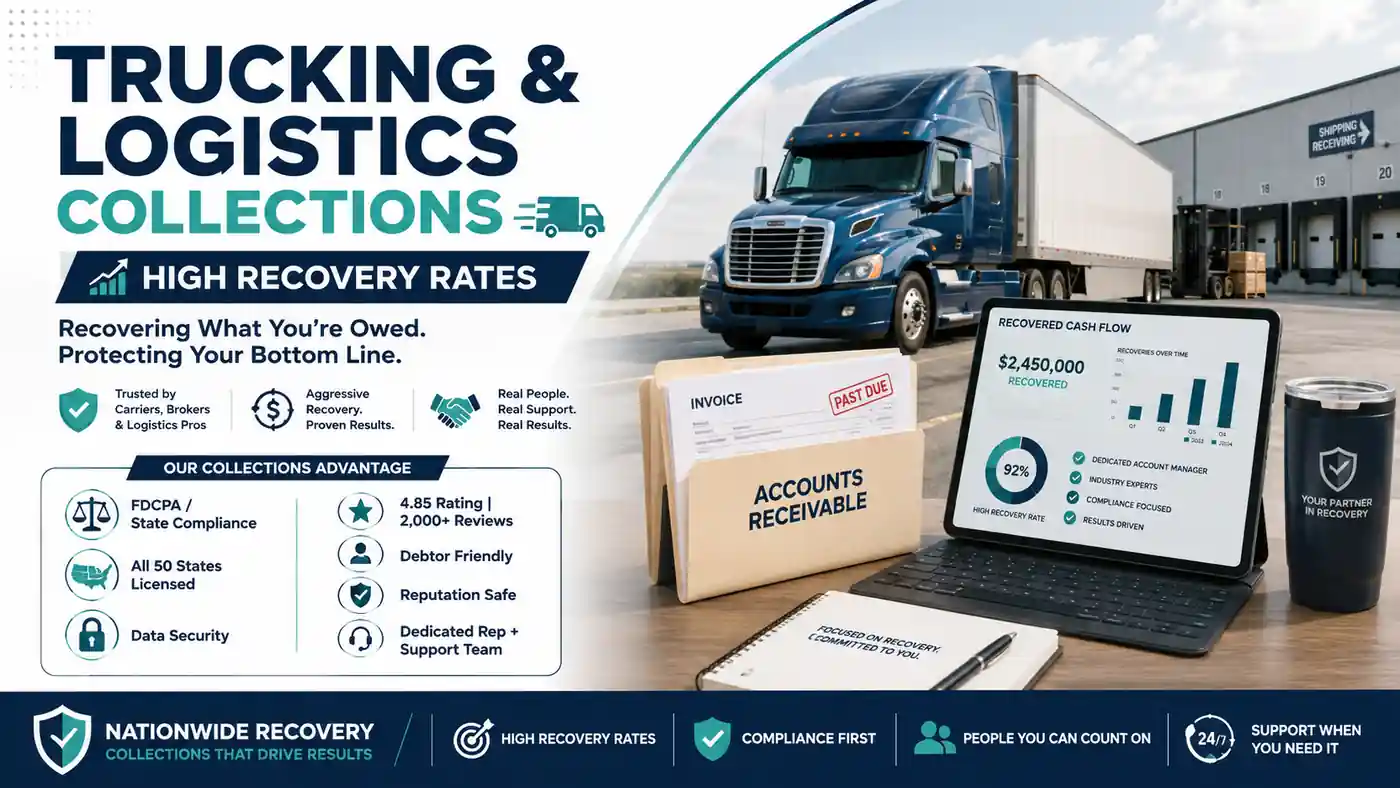
Trucking and logistics collection agency helping recover unpaid freight invoices and accounts receivable with high recovery rates, secure data handling, nationwide licensing, debtor-friendly communication, and dedicated support.

Quick Answer: A trucking collection agency recovers unpaid linehaul invoices, detention fees, and short-paid freight bills for carriers, brokers, and logistics firms. Nexa combines Carmack Amendment expertise with a diplomatic $15 fixed-demand service—allowing transportation companies to resolve disputed freight charges and recover 100% of their principal without risking load board ratings or broker-shipper relationships

Trucking Debt Recovery: Don’t Let Brokers Fuel Their Business with Your Cash Flow

In trucking, your “assets” are moving at 70 MPH, but your cash flow is often stuck in a broker’s “processing” pile. With diesel prices and insurance premiums at record highs, you cannot afford to be an interest-free bank for your shippers or brokers. Whether it’s a disputed detention fee or a “ghost” broker who stopped answering the phone, every unpaid mile is a direct hit to your survival.

Nexa provides a specialized, high-velocity recovery system that understands the 90-Day Bond Cliff. We don’t just “ask” for payment; we leverage the BMC-84 Broker Bond, and where necessary, direct shipper liability, to ensure your invoice gets paid.

Nexa provides reputation-safe approach,  equipped with all 50-state collections license, offering free credit reporting, free litigious debtor check, free bankruptcy scrub, and zero onboarding fees. Secure – SOC 2 Type II & HIPAA compliant. Over 2,000 online reviews rate us 4.85 out of 5. Every account is assigned a dedicated account executive backed by a specialized support team.

Stop Being a Free Bank. Get Paid Now


The Trucking Reality: Numbers That Matter

  • $75,000: The federal minimum broker bond (BMC-84) under FMCSA rules. If you aren’t the first carrier to file a claim, that money will be gone before you even get in line.
  • 60 Days: The point at which the probability of recovering freight debt drops by roughly 40%.
  • $15: What Nexa’s fixed-fee white-label demand costs per account. You keep 100% of the recovery.

What $50,000 in Uncollected Freight Actually Nets You

A simple, static example on a $50,000 past-due freight portfolio (50 accounts, $1,000 average, an 80% eventual recovery rate, $40,000 collected):

Nexa ($15 Fixed-Fee) Traditional 35% Contingency
Amount recovered $40,000 $40,000
Fee $750 (50 accounts × $15) $14,000 (35% of recovered)
You keep $39,250 (98.1%) $26,000 (65%)

The math doesn’t change because Nexa is cheaper to operate, it changes because Step 1 is priced per account regardless of balance, not as a cut of your recovery. On fresher accounts, that’s the difference between a rounding error and a five-figure gap.

Freight & Logistics Operational Realities

Cargo Claim Short-Pays & Detention Disputes

A broker or shipper deducting an “alleged cargo damage” charge or disputing detention and layover fees is one of the most common short-pay tactics in the industry. We audit the disputed line item against your rate confirmation, BOL, and delivery documentation before pursuing the account, separating a legitimate claim from a stall tactic, and pursue the undisputed balance in the meantime rather than letting one disputed line freeze the whole invoice.

Broker vs. Shipper Liability: What the Law Actually Says

When a broker fails, or double-brokers a load and disappears, carriers often assume the shipper is untouchable because “we were only hired by the broker.” That’s generally not how the law treats it. The Supreme Court has held that the party listed as consignor on the bill of lading is originally liable for the carrier’s charges (Southern Pacific Transp. Co. v. Commercial Metals Co., 456 U.S. 336), and multiple federal circuits have reinforced that a shipper cannot insulate itself from that liability simply by using a broker (Oak Harbor Freight Lines v. Sears, Roebuck & Co., 9th Cir., 513 F.3d 949). This holds even if the shipper already paid the broker in full, a scenario courts call “double payment liability.”

The one real exception: if the shipper specifically invoked a “Section 7 Non-Recourse” clause on the bill of lading, releasing the carrier from any right to come back to the shipper for payment, that changes the analysis. Before pursuing a shipper, we check the actual BOL for that language, since it’s the single fact that determines whether this path is available at all.

Recourse Factoring & Fuel Advances

Defaulted recourse factoring accounts, where you’re on the hook to repay the factoring company if the debtor never pays, and unrecovered fuel advance balances are treated as what they are: your money, advanced against a load that fell through. We pursue these the same way we pursue any commercial receivable, with the factoring or advance agreement itself as the supporting documentation.

Load Board Rating Protection

A carrier or broker chasing payment aggressively risks a retaliatory negative rating on DAT, Truckstop, or Google, sometimes worse than the unpaid invoice itself in an industry that runs on reputation. Step 1 outreach is built to read as a professional, formal notice rather than a public confrontation, resolving most accounts before it ever becomes a rating dispute.

The Nexa “Freight-First” 4-Step Ladder

Step 1: The “Bond Warning” (Fixed Fee, ~$15/account). Best for accounts 30–45 days past due. Professional notices signal formal intent to file against the broker’s bond. The broker pays you directly, and you keep 100%.

Steps 2–4: Full Mediation & Bond Filing (Contingency). If they stay silent, we initiate the BMC-84 claim and handle the documentation, rate confirmations, BOLs, PODs. No Recovery = No Fee.

Why Carriers and Brokers Choose Nexa

  • Lien & Bond Expertise: We navigate the FMCSA SAFER system to identify the exact surety company holding the broker’s bond, and file before the $75,000 cap is exhausted by someone else’s claim.
  • Accessorial Recovery: We don’t just chase the base rate. We pursue detention, layover, and lumper fees that brokers routinely “forget.”
  • Fraud Detection: We identify double-brokering scams early, helping you target the actual shipper, the beneficial owner of the freight, to secure payment legally where the bond alone isn’t enough.
  • Carmack Amendment Awareness: Cargo loss and damage claims fall under the federal Carmack Amendment (49 U.S.C. § 14706), a different framework than an ordinary freight-charge dispute. Our team distinguishes a genuine Carmack cargo claim from a short-pay tactic dressed up as one before treating either as legitimate.
  • Dedicated Support: A dedicated account executive, backed by a specialized support team, not a rotating call center.

In-House Legal Action vs. Aggressive Collections vs. Nexa’s  Fixed Fee

Factor In-House Legal Action Aggressive/Generic Collections Nexa’s $15 Fixed Fee
Upfront cost Attorney fees, filing costs, often thousands before any recovery Often 35-50% contingency regardless of account age $15 flat fee, you keep 100% of what’s recovered
Load board & credit rating risk Low if quiet, high if it becomes public High, aggressive tactics risk retaliatory DAT/Truckstop ratings Low, reads as a professional formal notice
Legal & freight contract compliance Depends on in-house familiarity with Carmack, BOL law, and bond claims Varies, generic scripts may miss freight-specific mechanisms entirely Built around BMC-84 bond claims, Section 7 BOL review, and Carmack distinctions from day one
Account management Whoever’s handling it internally, often inconsistently Often a standard call center Dedicated account executive backed by a specialized team

Recent Freight Recoveries

  • Oglethorpe Transport: Recovered $22,000 in short-paid invoices from a regional broker disputing delivery times.
  • Mid-Sized Fleet (Reefer): Secured $84,000 from a broker’s bond 14 days before the broker filed for bankruptcy.
  • Owner-Operator: Recovered $3,200 in unpaid detention and fuel surcharges the shipper had previously denied.

RMR & Early Termination Buyout Recovery Estimator
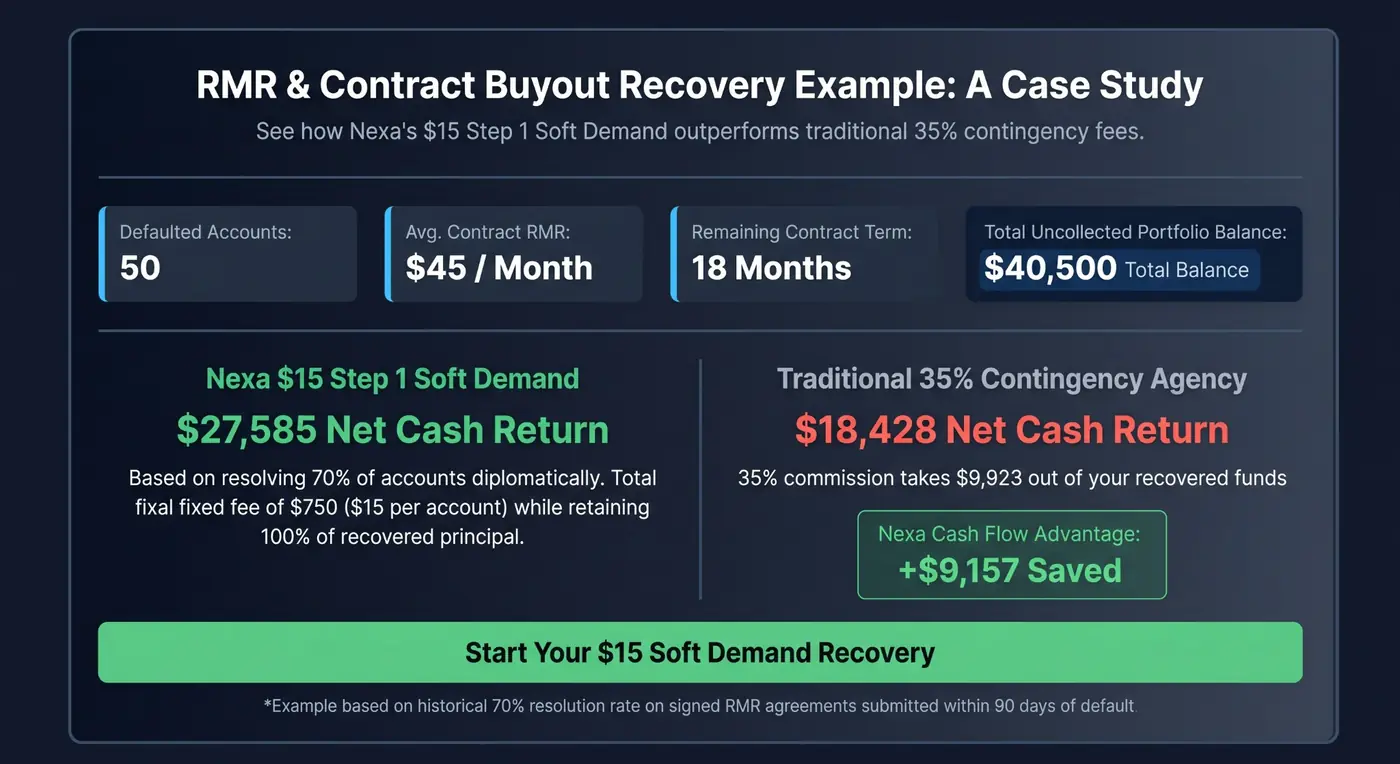
RMR contract buyout recovery case study


Frequently Asked Questions

Can you collect directly from the shipper if the freight broker goes out of business?

Often, yes. Courts have consistently held that the shipper named as consignor on the bill of lading remains liable to pay the carrier directly if the broker fails to pay, even if the shipper already paid the broker in full. The main exception is a “Section 7 Non-Recourse” clause specifically invoked on the BOL releasing the carrier from pursuing the shipper; we check for that language before treating this as a viable path.

How do you handle freight invoices short-paid due to alleged cargo damage?

We audit the disputed charge against your rate confirmation, bill of lading, and delivery documentation before treating the dispute as legitimate, since a “cargo damage” deduction raised only after the invoice is due looks very different from a documented claim raised at delivery. Genuine cargo claims fall under the federal Carmack Amendment, a different legal framework than an ordinary short-pay, and we pursue the undisputed balance separately rather than letting one contested line freeze the whole invoice.

How does Nexa protect my fleet’s reputation on load boards like DAT or Truckstop?

Step 1 outreach is built to read as a formal, professional notice rather than a public confrontation, specifically to avoid triggering a retaliatory negative rating. Most accounts resolve at this stage without the dispute ever becoming visible to the broader freight community.

Is Nexa licensed to collect if our freight routes cross state lines?

Yes. We’re licensed to collect in all 50 states, which matters specifically for interstate freight, where the carrier, broker, and shipper are frequently in three different states and a single-state agency simply can’t follow the account.

Do I get a dedicated point of contact, or deal with an automated system?

A dedicated account executive, backed by a specialized support team, familiar with freight-specific mechanics, BMC-84 bond claims, BOL liability, accessorial disputes, rather than treating your account like a generic invoice.

Can you collect if I don’t have a signed POD?

Yes. While a proof of delivery is the strongest evidence, GPS logs, gate receipts, and email chains can build a secondary proof of delivery for mediation purposes.

What if the broker’s bond is already maxed out?

We pivot to pursuing the shipper directly, following the same liability analysis above, checking the BOL for Section 7 language before proceeding, and to the broker’s other assets where the bond alone doesn’t cover the balance.


Decision Tree
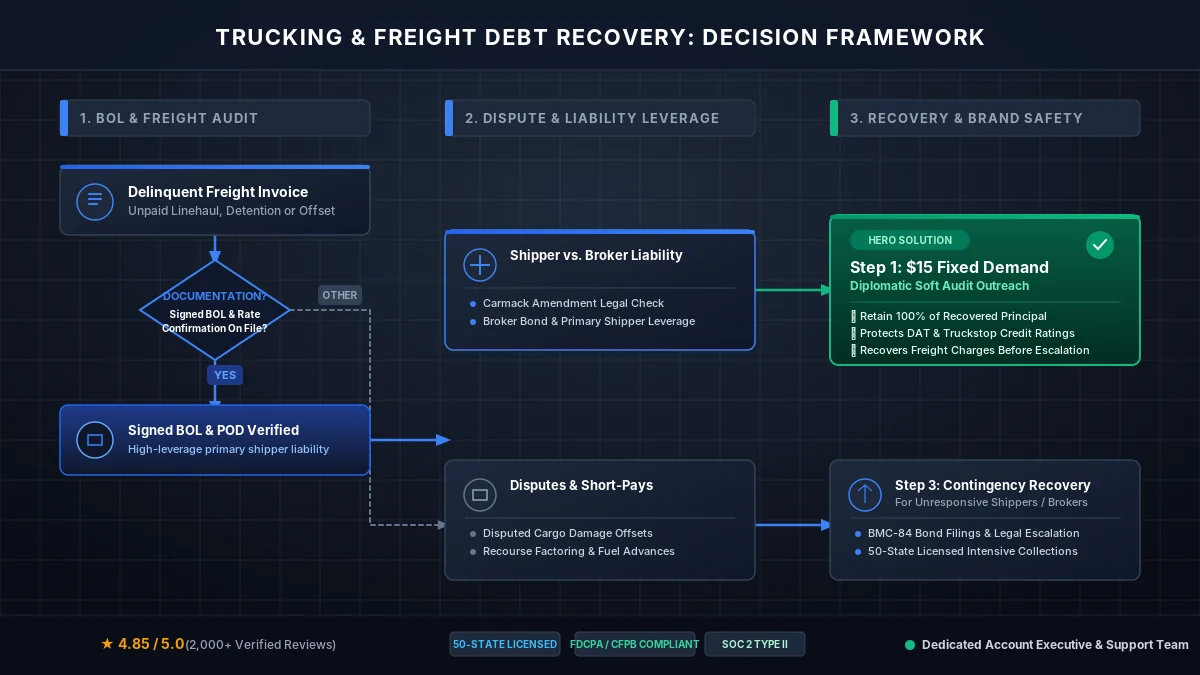
blank

Filed Under: Debt Recovery

Security & Alarm Collection Agency: Recover Unpaid Monitoring Fees and Contract Balances

A security and alarm collection agency is a licensed third-party firm that recovers unpaid monitoring fees, equipment financing balances, Recurring Monthly Revenue (RMR), and early-termination charges on behalf of home alarm and commercial security system providers. Unlike general collection agencies, a specialist in security and alarm debt understands the unique structure of multi-year monitoring contracts, the distinction between consumer accounts (governed by the FDCPA) and commercial B2B accounts (governed by contract law), and the brand-sensitivity required when collections involve long-term residential clients who may reactivate service once a balance is resolved.

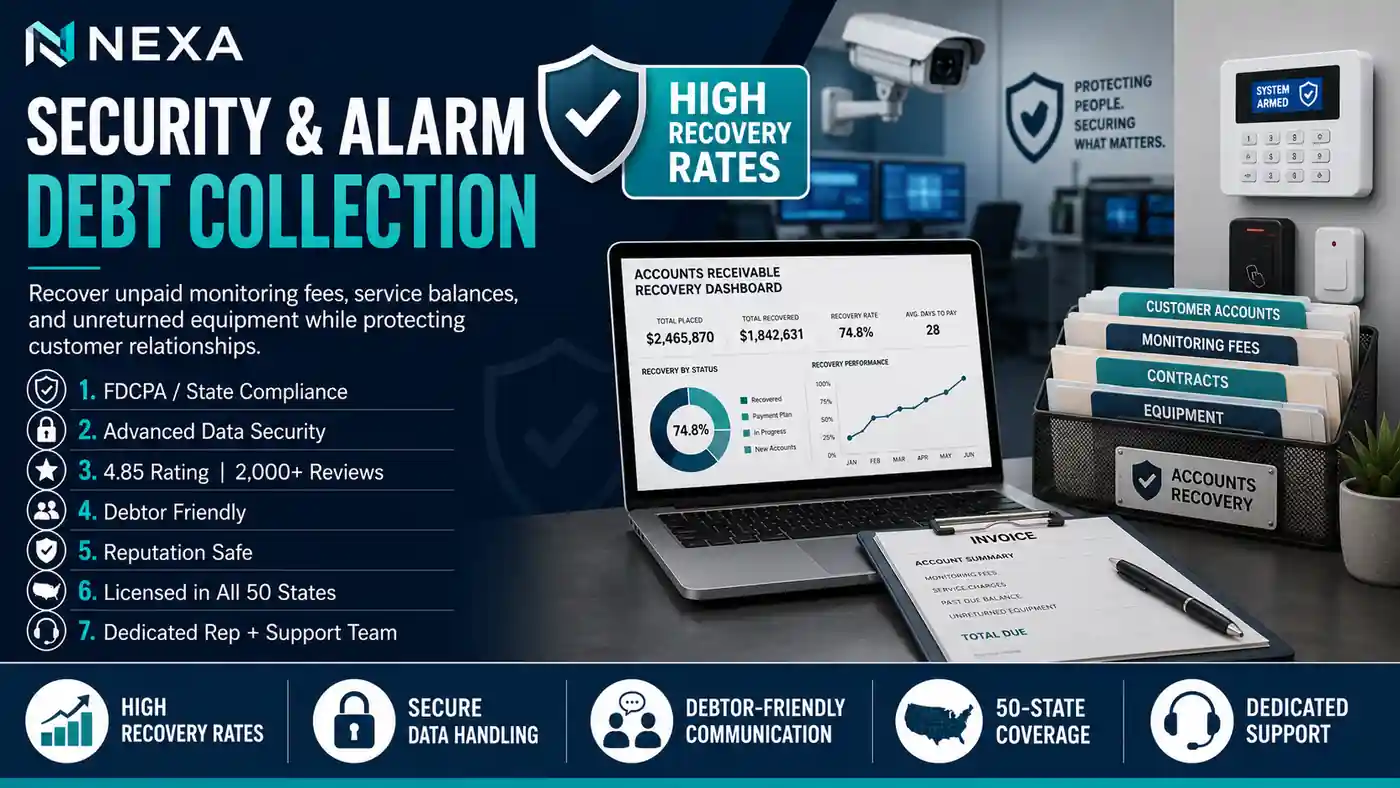
Security and alarm debt collection with high recovery rates, secure data handling, nationwide licensing, debtor-friendly communication, and dedicated support.

Securing the Perimeter of Your Profits: Revenue Recovery for the Alarm Industry

In an industry where the median subscriber acquisition cost (SAC) has climbed over $1,200 per residential account, every “ghost” cancellation is a direct hit to your bottom line. The security industry isn’t just fighting crime; it’s fighting a silent epidemic of unreturned hardware and monitoring fee defaults.

When an office park or a homeowner “goes dark” without returning your high-end AI cameras or proprietary access hubs, you aren’t just losing a monthly fee—you’re losing thousands in depreciating physical assets. Nexa provides a surgical, legally-fortified recovery strategy that retrieves your funds and hardware while maintaining the professional reputation your brand depends on in a competitive North American market.

Nexa provides 100% reputation-safe, equipped with all 50-state collections license, offering free credit reporting, free litigious debtor check, free bankruptcy scrub, and zero onboarding fees. Secure – SOC 2 Type II & HIPAA compliant. Over 2,000 online reviews rate us 4.85 out of 5. 

Need a Collection Agency? Contact us


Our 4-Stage Security Alarm Recovery Framework

Nexa’s recovery process is purpose-built for the security and alarm industry — accounting for long-term contract structures, the consumer-vs-commercial split, and the relationship sensitivity that defines recurring monitoring clients.

Stage 1 — Account Intake & Contract Triage

Every security or alarm account transferred to Nexa begins with a structured intake review. Our team imports account data via our secure client portal (no spreadsheet emails required), performs an immediate bankruptcy scrub to flag accounts under federal automatic stay, and conducts a litigation scrub to identify professional plaintiffs who might exploit a technical collection error. We verify the contract type — residential monitoring agreements governed by the FDCPA, or commercial B2B security service contracts handled under contract law — and assign the appropriate compliance track. For home alarm accounts under $200 with balances under 60 days, the fixed-fee $15/account model typically applies. Older or higher-balance accounts proceed to the contingency track. Zero onboarding fees are charged at this stage.

Stage 2 — Diplomatic Multi-Channel Outreach

Security and alarm customers are often long-term clients who fell behind due to a life event rather than intent to defraud. Nexa’s outreach is calibrated accordingly — firm in legal authority, diplomatic in tone. We initiate a sequence of professional demand notices sent under Nexa’s name (shifting the psychological dynamic away from the creditor-client relationship), followed by telephone outreach during permitted hours and, where applicable, compliant email and SMS contact per Regulation F guidelines. All calls are recorded and reviewed by our compliance management team. Our outreach scripts never threaten legal action we do not intend to take, never misrepresent the debt amount, and never contact customers outside the hours permitted under the FDCPA (8 AM–9 PM local time). This stage is designed to resolve the majority of residential accounts within 30–45 days without escalation.

Stage 3 — Resolution, Payment Plans & Escalation Triggers

When initial outreach produces engagement but not full payment, our collectors are authorized to negotiate structured payment plans appropriate to the account balance — typically two to four installments for balances between $200 and $800. For accounts exceeding $1,000 or accounts where the customer has disputed contract termination terms, we escalate to our specialized dispute resolution team, which reviews the original agreement documentation and issues a formal debt validation response within the FDCPA’s required 30-day window. Contingency pricing (20–40% depending on account age and complexity) applies to accounts in this stage. If legal escalation is required — for example, to enforce an early-termination penalty clause on a multi-year commercial monitoring contract — we present the option to the client for authorization before proceeding. Legal escalation is available at up to 50% contingency, client-approved.

Stage 4 — Account Closure & Reconciliation Reporting

Every account closes with full documentation — paid, settled, bankruptcy-discharged, recalled by the client, or referred for legal action. Clients access real-time closure status through the Nexa 24/7 secure portal, including payment receipt confirmation, settlement documentation, and exportable reports for month-end accounts receivable reconciliation. For accounts where payment is received but the customer disputes the original balance, we provide a chain-of-custody record covering every contact attempt and response, protecting the security company from FCRA-related disputes about credit reporting accuracy. Recovered funds are remitted to the client on a net-payment schedule. At the conclusion of each placement cycle, Nexa provides a performance summary showing accounts placed, amounts recovered, recovery rate, and average days to resolution — data that most security companies use to optimize their future 90-day handoff timing.


Security & Alarm Account Types We Collect

The security and alarm industry encompasses several distinct business models, each with its own contract structure, debt profile, and collection strategy. Nexa handles all of the following.

Residential Home Alarm Monitoring Companies

Home alarm companies typically operate on multi-year monitoring contracts with monthly recurring fees of $30–$80. Unpaid residential accounts are governed by the FDCPA and require compliant consumer collection procedures, including a formal debt validation notice within five days of first contact. The most common trigger for non-payment is customer relocation without formal contract termination — skip tracing is frequently required to locate the responsible party at their new address.

Commercial Security System Providers

Commercial security debts — owed by businesses for system installation, maintenance contracts, and monitoring services — fall outside the FDCPA and are governed by the terms of the service agreement and applicable UCC provisions. These accounts typically carry higher balances ($500–$15,000+) and require a business-credit-aware collection strategy, including D&B reporting and, where warranted, formal demand letters that reference the contractual early-termination penalty clause.

CCTV & Surveillance Camera Installers

Camera installation companies frequently carry unpaid balances related to equipment costs, installation labor, and ongoing maintenance agreements. These accounts often involve disputes over system performance — a customer who believes the cameras failed to capture an incident may withhold payment. Nexa’s dispute resolution track documents the original service acceptance records to neutralize this objection and move the account toward resolution.

Access Control & Keypad System Providers

Providers of electronic access control systems — keypad entry, fob systems, and card readers for commercial premises — typically bill on a maintenance and monitoring model. Unpaid balances arise most often when a business changes ownership and the new operator disputes inherited contract obligations. Nexa’s team is experienced in navigating successor-liability collection scenarios under commercial contract law.

Smart Home & Automation Companies

Smart home integrators who bundle security with automation (smart locks, lighting, HVAC control) face unique collection challenges: customers often dispute “security” fees when the automation component is the primary perceived value. Nexa segments bundled-contract accounts to identify and collect the security monitoring portion separately, ensuring the company recovers the regulated service revenue without triggering a broader contract dispute.

Fire & Life Safety Alarm Firms

Fire alarm and life safety companies operate under state-level inspection and certification requirements that create mandatory service relationships — making non-payment particularly disruptive. Unpaid inspection fees and monitoring contracts for fire suppression and sprinkler systems are typically commercial accounts requiring direct contact with the facility manager or property owner. Nexa handles these accounts with the professional authority appropriate to a safety-critical service sector.

The Security Economy: Data & Context

The global security solutions market has surged to $370 billion in 2025, yet industry benchmarks show that involuntary churn remains a persistent leak, often claiming 8.6% of annual revenue. With 4K AI-enabled cameras now retailing between $180 and $650 per unit and commercial access control systems averaging $2,500 per door, a single commercial default can represent a $15,000+ loss in hardware alone. Nexa bridges this gap by moving faster than the 90-day “danger zone,” using high-velocity digital outreach and professional mediation to secure your hardware before it disappears.

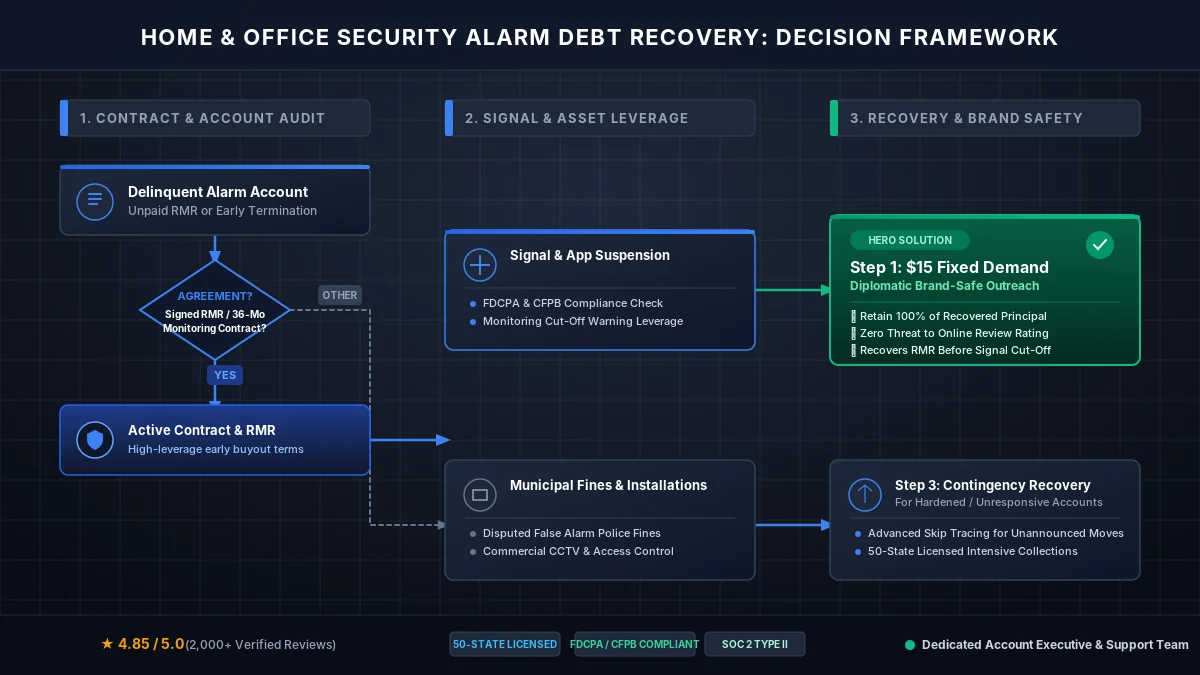
Decision tree diagram outlining monitoring contract checks, signal cut-off leverage, and $15 fixed-fee recovery workflows for home and office security alarm debt collection


Compliance in Security & Alarm Collections

Security and alarm collection spans both consumer and commercial debt — each with its own regulatory framework. Nexa is built to operate compliantly in both tracks.

Regulation Who / What It Covers How Nexa Complies
FDCPA (Fair Debt Collection Practices Act) All consumer residential alarm and home security accounts. Does NOT apply to commercial/B2B security contracts. All consumer-track accounts receive a compliant debt validation notice within 5 days of first contact. Calls limited to 8 AM–9 PM local time per Regulation F. All communications are recorded and reviewed.
Regulation F (CFPB, effective Nov. 2021) Updates to FDCPA governing electronic communications, call frequency caps (max 7 calls/7 days per debt), and model validation notice format. Nexa’s dialer platform enforces Regulation F call frequency limits automatically. Electronic contact (email, SMS) is initiated only with explicit consent. Model validation notice format is used on all consumer-track accounts.
TCPA (Telephone Consumer Protection Act) All outbound telephone and SMS contact — consumer and commercial. Nexa maintains consent records for all SMS communications and uses human-initiated calls (not auto-dialers) for accounts where automated calling consent has not been established, reducing TCPA exposure for all clients.
FCRA (Fair Credit Reporting Act) Credit bureau reporting of delinquent consumer accounts. Nexa provides free credit reporting as part of the contingency service. Reporting is initiated only after the Regulation F required pre-reporting notice period. Disputes are investigated and resolved per FCRA Section 611 timelines.
State Automatic Renewal Laws Many states (CA, NY, IL, FL, and others) require security and alarm companies to provide specific written notice before auto-renewing monitoring contracts. Failure to comply may void the customer’s payment obligation. Nexa’s intake process flags accounts from high-risk states for a contract compliance review before collection proceeds. Accounts where the underlying contract may be unenforceable are held for client review rather than collected on.
FTC Telemarketing Sales Rule (TSR) Applies to security alarm companies that sell monitoring services via telephone — creates specific disclosure requirements and prohibits certain cancellation practices. Where a client’s underlying debt involves a TSR-covered sale, Nexa ensures collection proceeds only on balances traceable to a TSR-compliant transaction, protecting the client from collecting on a void contract.
SOC 2 Type II / Data Security Governs the security of consumer data held and processed during collection. Nexa is SOC 2 Type II certified. All debtor data is encrypted in transit and at rest. Access is role-restricted. No data is stored on local devices. Annual third-party audits verify compliance.

Local Rules & State Debt Laws: What You Need to Know

Collecting on security contracts is a legal minefield due to “Evergreen” (automatic renewal) clauses. We ensure your business is protected from 2026 compliance audits.

State Key Regulation (2026 Standard)
California Alarm contracts must have a separate, signed disclosure for auto-renewals longer than one month; otherwise, the renewal is void.
Florida 3-day “Cooling-Off” period applies to all home solicitation. Contracts for future services can be cancelled if services are no longer available.
Texas “Clear and Conspicuous” rules apply. Evergreen clauses are enforceable only if they are more conspicuous than the surrounding text.
Federal (TCPA) Starting April 2026, opt-out requests for one channel (text) must apply to ALL channels (voice/email) within 10 days.

Strategic Note: Because security contracts often involve “unreturned equipment” fees, we utilize Bank Levies and Asset Location as primary tools, as these are often more effective than traditional “calls” when hardware is involved.


Real Results: Nexa Security & Alarm Recovery

Case Study 1 — Residential Alarm Company Recovers $38,400 in Monitoring Arrears

Situation: A regional home alarm monitoring company with 3,100 active residential accounts transferred 214 consumer accounts to Nexa after internal collection letters produced a 4% response rate over 90 days. The total placed balance was $41,200, with an average account balance of $193 representing 6–18 months of unpaid monitoring fees. The largest concentration of overdue accounts was concentrated in accounts where the original subscriber had relocated without formally terminating the monitoring contract.

Approach: Nexa processed all 214 accounts through bankruptcy and litigation scrubs at intake, removing 12 accounts from active pursuit. The remaining 202 accounts were placed on the consumer FDCPA track. Skip tracing identified new addresses for 67 relocated subscribers within 14 days. Nexa initiated compliant demand notices followed by telephone outreach using relationship-preserving scripts emphasizing account resolution rather than threat of legal action. Payment plan options were offered to subscribers with balances over $300.

Outcome: 182 of 202 active accounts were resolved within 60 days — a 90.1% resolution rate. Total recovered: $38,400 (93.2% of placed balance). Zero complaints received. The client reactivated 31 subscribers following balance resolution, recovering approximately $1,120 in annual recurring monitoring revenue. (Nexa internal data, 2024)

Case Study 2 — Commercial Security Firm Recovers $94,700 in Contract Balances

Situation: A commercial security system integrator serving retail chains and office complexes transferred 38 B2B accounts to Nexa totaling $97,300 in combined early-termination penalties, unpaid equipment financing, and outstanding maintenance contract balances. Average account size: $2,561. Internal collection attempts had stalled, with several business debtors disputing the enforceability of early-termination clauses under their state’s automatic renewal statutes.

Approach: Because these were commercial accounts, Nexa assigned them to the B2B commercial track (outside FDCPA jurisdiction but subject to contract law and UCC provisions). Our team reviewed the original service agreements for each account and identified five accounts where the client’s automatic renewal notice did not meet the state’s statutory requirements — those five were returned to the client with recommendations for contract amendment. The remaining 33 accounts proceeded to formal commercial demand letters referencing the specific contractual penalty clause, followed by escalating contact with the business’s accounts payable decision-maker and, where necessary, D&B credit bureau reporting.

Outcome: 29 of 33 eligible accounts resolved within 75 days. Total recovered: $94,700 (97.3% of eligible placed balance). Legal referral was authorized for 3 remaining high-value accounts. Zero consumer complaints (commercial track). (Nexa internal data, 2025)


Our Cost-Effective Pricing Models

blank

  • Fixed Fee Service ($15): The industry’s best “pre-collection” tool for accounts 30-60 days past due. The client pays you directly; you keep 100% of the money.

  • Contingency Fee (20% – 40%): Our “No Recovery, No Fee” model for tougher, older defaults. We only get paid when you do.

We seamlessly ingest your subscriber billing portfolios via secure Excel imports directly into our portal to rapidly initiate the recovery of past-due alarm and monitoring accounts meeting our $50 minimum placement threshold.


FAQ — Security & Alarm Debt Collection

Can an alarm company send a customer to collections for unpaid monitoring fees?

Yes. If a customer fails to pay recurring monitoring fees or violates an early-termination clause in a monitoring contract, the alarm company can transfer the account to a licensed collection agency. The collection agency must comply with the FDCPA for consumer (residential) accounts and applicable contract law for commercial accounts. Accounts are most successfully recovered when transferred to a collection agency no later than 90 days after the first missed payment — recovery rates decline significantly after 180 days.

Does the FDCPA apply to security alarm debt collection?

The FDCPA applies to residential home alarm accounts where the monitoring service was used primarily for personal, family, or household purposes. It does not apply to commercial security contracts where the debtor is a business entity. For consumer-track alarm accounts, the collection agency must provide a written debt validation notice within five days of first contact, adhere to calling hour restrictions (8 AM–9 PM local time), and limit telephone contact to seven calls per seven-day period per Regulation F. Nexa complies with all FDCPA and Regulation F requirements on all consumer-track security accounts.

What is the typical fee for a security alarm collection agency?

Security alarm collection agencies typically charge either a fixed per-account fee or a contingency percentage of amounts recovered. Nexa offers a fixed fee starting at $15 per account — you keep 100% of what is recovered. For older, more complex, or disputed accounts, Nexa’s contingency model applies a rate of 20–40% of recovered amounts, with no fee charged on accounts where no recovery is made. Legal escalation, where the client authorizes it, is available at up to 50% contingency. There are no onboarding fees and no charges for credit reporting, bankruptcy scrubs, litigation scrubs, or skip tracing.

What happens if a home security customer moves and leaves an unpaid monitoring contract?

When a residential customer relocates without formally terminating their monitoring contract, the alarm company retains the right to pursue the remaining contract balance and any accrued monitoring fees. Nexa’s skip tracing service locates the customer’s new address and updated contact information at no additional charge, allowing collection to proceed to the correct current address. Most relocated accounts are resolved within 30–45 days of new address confirmation.

Can a security alarm company report unpaid accounts to the credit bureaus?

Yes. Once a security alarm account is placed with a collection agency, the agency can report delinquent accounts to the three major consumer credit bureaus (Equifax, Experian, TransUnion) provided it follows the FCRA’s required pre-reporting notification steps. Nexa provides free credit reporting as part of its standard contingency service. Credit reporting significantly increases collection rates on consumer accounts because it creates a tangible incentive for the debtor to resolve the balance. Commercial accounts may be reported to business credit bureaus including Dun & Bradstreet.

How do collection agencies handle customers who dispute their alarm contract balance?

When a debtor disputes a security alarm balance within 30 days of receiving the debt validation notice, the collection agency must cease collection activity and provide written verification of the debt — typically the original contract, a payment history, and itemization of the disputed balance — before resuming contact. Nexa’s dispute team reviews the original agreement documentation, confirms the amount owed against the client’s records, and issues a formal written debt verification response. If the dispute identifies a legitimate billing error, Nexa notifies the client and adjusts the account accordingly.

What is the minimum balance Nexa accepts for security alarm accounts?

Nexa accepts security and alarm accounts with a minimum balance of $50 per account. There is no minimum number of accounts required to begin a placement. Both individual consumer accounts and bulk commercial portfolios are accepted. Accounts can be placed individually via the client portal or submitted in bulk using Nexa’s standard CSV account upload template. Balances under $50 are generally not cost-effective to pursue through third-party collection and are better handled through a final internal collection letter before the account is written off.

How long does security alarm debt collection typically take?

Most residential home alarm accounts that respond to collection contact are resolved within 30–60 days of placement. Accounts requiring skip tracing for a relocated debtor typically resolve within 45–75 days of address confirmation. Commercial security accounts with disputed contract terms may take 60–90 days due to the documentation review and negotiation process. Accounts that proceed to legal escalation — typically high-value commercial accounts or consumer accounts where the debtor has no intention of paying voluntarily — are referred to the client’s authorization before filing, and timelines vary by jurisdiction.

Does using a collection agency damage the security company’s customer relationships?

When handled by a professional, compliance-first agency, debt collection does not have to damage customer relationships. Nexa’s outreach is specifically designed to be diplomatic and resolution-oriented — many debtors remain customers after resolving a past-due balance. All calls are recorded and reviewed by Nexa’s compliance team to prevent aggressive or off-brand interactions. In Nexa’s residential alarm recovery data, 15–20% of resolved accounts result in service reactivation within six months of debt resolution, generating new recurring monitoring revenue for the client. (Nexa internal data, 2024)

Is Nexa licensed to collect security alarm debts in all 50 states?

Yes. Nexa Collections holds active collection licenses in all 50 states and Puerto Rico, enabling pursuit of security and alarm accounts regardless of where the debtor has relocated. Multi-state coverage is especially important for national home alarm chains and commercial security integrators whose clients may be located across dozens of states. Nexa’s all-state licensing eliminates the need to manage relationships with multiple regional agencies for a single national account portfolio.

Can you recover unreturned equipment costs or early termination fees (ETFs)?

Yes. Our recovery system is optimized to process broken monitoring agreements, early termination penalties, and the depreciated value of unreturned security hardware or smart home panels.

What is the minimum balance required for security account debt placement?

We efficiently manage high-volume subscriber accounts, provided they meet our standard agency minimum of $50.00 per account. This allows your billing team to easily offload micro-debts like final-month monitoring fees and minor hardware balances without wasting internal administrative hours.


RMR & Contract Buyout Recovery Example

See how Nexa’s $15 Step 1 Fixed Demand model outperforms traditional 35% contingency collection.

Sample Portfolio
50 Defaulted Accounts
Avg RMR & Contract Terms
$45/mo × 18 Mos Remaining
Total Uncollected Portfolio
$40,500 Total Balance

Nexa $15 Step 1 Soft Demand

$27,585 Net Return

Based on resolving 70% of accounts diplomatically. Fixed fee of $15/account ($750 total) while retaining 100% of recovered principal.

Traditional 35% Contingency Agency

$18,428 Net Return

35% commission takes $9,923 out of your recovered funds.

Nexa Cash Advantage:
+$9,157 Saved

Launch $15 Step 1 Recovery Drive

*Example based on historical 70% resolution rate on signed RMR agreements submitted within 90 days of initial breach.


Ready to Reclaim Your Revenue?

Don’t let “zombie debt” and unreturned cameras drain your margins. Partner with a recovery team that understands the alarm industry from the ground up.

Contact Nexa Today

Filed Under: Debt Recovery

Outsource Your AR to a Collection Agency

Outsource Accounts Receivable

Outsourcing your overdue accounts receivable to a Collections Agency will save you time and energy and help you recover a significant chunk your customer owes.

Transferring your overdue receivables will also reduce your stress and make you more legally compliant with all the state and federal debt collection laws and significantly lower your chances of getting sued back by your debtor. Here are all the benefits of involving a collection agency versus having your in-house staff deal with past-due accounts.

Need a Collection Agency?

Contact us to recover your unpaid bills 

  • These two-letter words “Collection Agency” have a similar impact on debtors, like when you are speeding and you see a “Cop“. You suddenly slow down and start following all the rules. When a debtor understands that unpaid bills are being handled by a collection agency, the probability of getting paid suddenly increases.
  • You cannot handle debtors’ excuses well enough, but Collection Agencies deal with all sorts of excuses all day long. Here is the list of the most common debtor excuses.
  • You do not have a subscription to the expensive services used by Collection Agencies that assist in recovering money from accounts receivable. For example, they Skip Trace every debtor to find his latest address or to know if he is bankrupt.
  • Focus on your critical growth activities rather than collection activities. I guarantee that no one in your company likes to follow up again and again with debtors who are late on payments.
  • Collection agencies are experts in recovering money, your in-house staff is not. Outsourcing accounts receivable to a good collection agency will maximize the chances of recovery and improve your cash flow.
  • Are you trying to collect money from a debtor with a history of filing lawsuits? Collection agencies perform a “Litigious Debtor” check to minimize the litigation risk.
  • Save money on labor costs because you can never beat the invoicing cost of a collection agency, which is roughly $15 for 5 diplomatically crafted yet firmly written collection letters. They include various scrubs and tons of other checks.
  • If you prefer using only the contingency-based “Collector Calls” service, go for it. You do not need to spend a penny from your pocket. If the collection agency recovers money, they only get to keep a smaller portion of the amount recovered.
  • The faster you transmit your accounts receivable to a collection agency, the higher the chances are of recovering money. The chances of collecting money from a 90-day old debt are way higher versus waiting for nine months and then transferring.
  • There are many federal and state laws on collecting money from debtors, and failing to follow those can be risky and costly. Collection agencies train their staff regularly on these rules and regulations.
  • Collection agencies can accept payments online, and in many other forms, lot more ways than your office can accept money. They can also negotiate with the debtor to pay in installments if required.
  • Most collection agencies are so confident of their service that they will offer a written guarantee for their Letters Service, else they refund most of your money back.
  • Agencies can report unpaid accounts to credit reporting agencies like Equifax, Transunion and Experian.
  • Collection agencies have staff performing collection activities in both English and Spanish. Can your own staff do that?
  • They can also file a legal suit to collect money from the hardest accounts while you remain stress-free.
  • Collection agencies sometimes check the credit history report to verify the creditworthiness of your debtor to determine if they will pay soon enough or not.
  • Maybe you haven’t tried outsourcing accounts receivable yet, or your collection agency is not up to the mark. Contact us, and you will be connected with a collection agency with low contingency rates and recovery rates far above the industry average at no cost to you.
  • Your in-house staff must be frustrated by making reminder calls and repeatedly sending invoices. Outsourcing accounts receivable to an external collection agency will allow them to focus on the core responsibilities of your business.

There is an ever-growing market for outsourcing contact center solutions. Developing an outsourcing strategy into an ARM solution allows enterprises to differentiate themselves, provide a comprehensive customer experience, and reduce costs.

Most companies need to hone their niche products and services, which often means they cannot afford to spread their core competencies thin. Now more than ever, being lean and flexible demands focus on what you do best and outsourcing all the rest.

By definition, outsourcing is the strategic use of outside resources where it does not make financial or functional sense to carry out those activities internally. Outsourcing enables businesses to gain skills and services that are hard to find or develop due to resource constraints. First-party outsourcing provides the client with a seamless extension of internal operations for new or old projects that are too overwhelming to manage.

Uplift Your Brand

Outsourcing is an efficient way to boost a company’s brand and fast-track business goals. It allows companies to create a worldwide platform to launch products and promote the company name without needlessly shelling out hard-earned revenue. By contrast, investing in a trained and certified customer service team communicates to customers that a company is willing to put its best foot forward. The message to customers is “your satisfaction matters.” Companies can choose between making internal resources pull double duty on the phones while other projects are on hold or leveraging staff who have chosen customer service representatives as a vocation. Just imagine who will have a more positive impact. Outsourcing to customer service specialists will have a ripple effect of goodwill that reflects exponentially on the brand’s positive reputation.

Worldwide Talent Pool and Lower Support Costs

Companies gain access to a worldwide talent pool in an overseas outsourcing model. This allows them to expand their language capabilities and add “follow the sun” 24/7 coverage, ensuring the representatives handling inbound and outbound calls are always alert and upbeat. Drawing from global talent sources offers unique perspectives on problem resolution. In addition, offshore staffing costs remain, as always, much lower than similar services delivered by their domestic counterparts. In a global economy where remote monitoring tools and VPN connectivity level the playing field, cost savings are substantial.

More Versatility and Proficiency

Dipping into another talent pool also means access to different skill sets. When an in-house team specializes in specific core competencies, it is not always easy to pivot customer service functions to support a new product or service launch. A BPO team can help organizations drill down their expertise by handling custom campaigns with greater proficiency. It starts with building a comprehensive, ever-evolving knowledgebase or FAQ library, enabling representatives to expand their issue resolution or customer inquiry repertoire. Over time, those inbound and outbound dialogues become more effortless and second nature as representatives reinforce credibility and knowledge with customers. Since they are often the “department of first impressions,” call center representatives can make or break a company’s brand.

Greater Scalability

Organizations that experience fluctuating or seasonal call volumes find it difficult to adequately staff up or down to meet the peaks and valleys in demand. They also find it is costlier to bring on Full Time Employees (FTEs) over the short term. Not only does this approach strain internal resources to recruit, train, and manage those representatives, but call volumes may take a nosedive when new hire productivity ramps up. Outsourcing to a BPO team creates an overflow mechanism when inbound and outbound activities are less steady stream and more Murphy’s Law.

Redundant Tools and Systems

When force majeure becomes a force to be reckoned with, having redundant tools and systems is the ultimate “better safe than sorry” approach. Why settle for one set of telephony, ticketing system, or data center when an outsourcing partner can integrate with and replicate crucial systems, literally flipping a switch in the event of an outage? Outsourced service providers can safeguard intellectual property and ensure the most resilient service possible. BPO platforms and data are typically hosted in hardened, Tier IV data centers, which are good enough to store crucial data for the likes of Google, Intel, and Deloitte. Getting on board with an outsourcing partner that invests tens of millions of dollars in Business Continuity Planning tools and systems means never compromising on IT data security.

Enhanced Competitiveness and Productivity in a Post-COVID-19 Economy

Outsourcing increases the competitiveness and productivity of a company and allows growth over competitors. A budget-friendly, hassle-free, time-efficient and balanced way of increasing productivity is outsourcing. The turnaround time for projects is easily truncated with the help of outsourcing. Leveraging an outsourcing partner enables internal staff to complete their work on time without compromising quality.

Simply put, outsourcing is a way to enhance productivity and efficiency by drilling down on internal functions that have the best ROI and offloading those that do not.

The truth is the post-COVID economy has forced the hand of outsourcing as an ever more valid business strategy. As companies scramble to stay more connected and get more done while being further and further apart, outsourcing has built a case as the new normal for how we should conduct business today. And it is not an option that is likely to go away soon. Despite the social distancing, an outsourcing partnership remains close at hand.

Filed Under: Debt Recovery

AthenaHealth & AthenaNet Collection Agency: Turning A/R Into Cash

Athena can push a claim cleanly through billing and still leave the patient balance sitting untouched 90 days later — good software was never built to make a phone call or negotiate a payment plan.

Nexa’s integration with AthenaNet transfers past-due patient accounts directly into Kinum for automated recovery, whether an account is fresh enough for a flat $9.75 letter sequence or old enough to need 40% contingency work. Switching from another agency’s AthenaNet setup is genuinely simple, and the result is typically a lower rate, stronger recovery, and HIPAA-aligned, 50-state-licensed handling backed by responsive support.

AthenaNet dashboard interface representing medical and dental accounts receivable integration with collections


Need a Collection Agency? Contact us


Athena Is Strong Software — It Just Doesn’t Collect

Athenahealth supports thousands of medical and dental providers and pushes hundreds of millions of claims a year. Yet many practices on Athena still watch A/R days drift into the 45–60+ range, patient balances pile up in 90+ day aging, and denials outpace what staff can chase down. The software is modern. The money is still stuck.

What Athena Does Well

Capturing charges and sending cleaner claims, checking eligibility and surfacing coverage data, automating portions of prior auth and denial prevention, and giving practices real dashboards for A/R, denials, and collections — Athena earns its reputation here.

What It Was Never Built to Do

Athena isn’t a contingency collection agency. It doesn’t call seriously overdue patients for weeks or months, negotiate payment plans with people juggling multiple debts, skip-trace bad addresses and disconnected phone numbers, or handle legal escalation. Once a balance clears 90–120 days with no response, it’s outside the normal Athenaworkflow and into third-party collections territory.

Medical and Dental A/R on the Same Platform

One strength of athenahealth is running both sides of a practice in one system. Multi-specialty groups, CHCs, and FQHCs can manage medical and dental A/R together, viewing it by provider, service line, location, and payer — with dental modules supporting treatment plans, estimates, and aging similar to the medical side. That means an Athena report can already show which medical services generate the most unpaid balances and which dental procedures or plans tend to age into 90+ days. The missing piece has always been deciding what happens next with those balances — which is exactly what the integration below is built to close.

The Direct AthenaNet-to-Kinum Integration

How the Transfer Actually Works

Nexa, together with its integration vendors, connects directly to AthenaNet so that past-due patient accounts move from your practice’s own interface into Kinum for automated recovery — without a manual export, a spreadsheet, or a separate upload process. Accounts that match your placement rules move on a set cadence rather than waiting for someone on staff to remember to pull a report.

Illustrative Example: The Report Nobody Had Time to Run

Consider a composite scenario: a multi-location dental group’s office manager knows which accounts should go to collections every month, based on the practice’s own 90-day rule — but pulling that report, formatting it, and emailing it to a vendor consistently slips to the bottom of a busy week. With the balances flowing automatically from AthenaNet once they match the agreed criteria, that task disappears rather than just getting done a little late.

Turning athenaOne Metrics Into Placement Rules

Athena gives you the data. The rules for what to do with it are still yours to set.

Days in A/R

Many groups aim for 30–45 days. Consistently running over 45–50 days is a sign of carrying more risk than the numbers might suggest at a glance.

A/R Aging Buckets

The 0–30 and 31–60 day buckets should hold most of a healthy practice’s balances. When a large share sits in 90+ days, those accounts are unlikely to self-cure without outside follow-up.

Net Collection Rate

The goal is staying close to 100% of net collectible revenue over time. A falling collection rate alongside stable patient volume is a quiet signal that more money is turning into bad debt than the top-line numbers reveal.

Turning those metrics into simple placement rules — any balance 90+ days old with no payment or arrangement, larger balances escalating faster than small ones, elective or high-dollar visit types getting closer follow-up earlier — is what actually moves accounts out of aging and into recovery instead of letting them sit.

Already Using AthenaNet’s Integration With Another Agency?

What Changes When You Switch

If a practice is already running patient accounts through AthenaNet into a different collection agency, moving to Nexa’s integration is meant to be a straightforward swap, not a rebuild. The typical result: a lower per-account rate than many competing integrations, recovery performance that’s tracked and reported rather than taken on faith, HIPAA-aligned and secure handling of the same patient data, more responsive support when a question comes up, and licensing across all 50 states rather than a patchwork of regional coverage.

Illustrative Example: The Switch That Took a Phone Call, Not a Project

Picture a composite scenario: a multi-provider practice has been sending accounts through AthenaNet into a national collection vendor for two years, with a support experience that’s slowed noticeably as the vendor scaled. Moving the integration to route into Kinum instead doesn’t require rebuilding the practice’s placement rules or re-training staff — the AthenaNet side of the workflow looks the same; only what happens after the account leaves the practice changes.

AI + Humans: Where Athena Ends and Collections Begins

athenahealth has invested heavily in AI-native RCM to clean claims before submission, speed up prior auths, and reduce preventable denials — the front end of the revenue cycle. The back end still needs people: talking to patients who are confused or worried about a bill, setting up payment plans that actually reflect what someone juggling multiple debts can pay, tracking down a debtor who’s moved, and escalating a small subset of accounts through legal channels when it’s actually warranted. A collection partner built for this space understands HIPAA, FDCPA, state-specific rules, and the realities of high-deductible plans — and works from your Athena exports rather than asking you to reformat everything first.

Success Stories

The scenarios below are illustrative composites drawn from the kinds of situations that come up repeatedly across athenahealth practices, not verified individual case results, but they reflect the actual mechanics of how each type of recovery tends to get resolved.

The Multi-Specialty Group Cutting Its A/R Days

Problem: A multi-specialty group running both medical and dental on Athena had A/R days drifting past 55, with 90+ day balances accumulating faster than staff could review them. 
Approach: Placement rules were set directly against the group’s own aging buckets, with the AthenaNet integration moving qualifying accounts automatically rather than waiting on a monthly manual pull. 
Outcome: A/R days trended back toward the practice’s 30-45 day target within a couple of quarters, with far less staff time spent chasing the process itself.

The FQHC Switching From a Slower Integration

Problem: A federally qualified health center had been using a different agency’s AthenaNet integration for years, but response times on account questions had stretched to days rather than hours. 
Approach: The integration was rerouted to Kinum with the center’s existing placement rules carried over unchanged. 
Outcome: The center kept the same workflow it was used to, with faster support and a lower per-account rate on its fixed-fee letter volume.

The Dental Group’s High-Deductible Backlog

Problem: A dental practice group was seeing a growing share of treatment-plan balances age into 90+ days as more patients carried high-deductible plans and set balances aside rather than refusing them outright. 
Approach: A $9.75 fixed-fee letter sequence ran on the freshest of these accounts before any moved to contingency. 
Outcome: A meaningful share of the backlog resolved directly, with patients paying the full balance and no commission owed on those accounts.

Trust, Security & Compliance

HIPAA & BAA Coverage

Patient billing records carry protected health information regardless of practice size. Nexa maintains HIPAA-aligned handling procedures for all AthenaNet-sourced accounts and executes a Business Associate Agreement (BAA) with practices that require one.

FDCPA Alignment

Every account is worked in alignment with the federal Fair Debt Collection Practices Act, with a litigious-patient scrub run before outreach begins to reduce the chance of a lawsuit arising from the collection process itself.

SOC 2 Type II & PCI-DSS Data Security

Data handling is SOC 2 Type II certified — meaning security and privacy controls have been independently audited, not self-reported — and payment processing runs at PCI-DSS Level 1, a high tier of card data encryption.

Secure Client Portal for Documentation & Account Tracking

A 24/7 client portal built to PCI/SOC cybersecurity standards lets a practice track account status and recovery progress without needing to call or email for an update, on top of whatever visibility the AthenaNet integration itself provides.

Transparent Pricing for AthenaHealth Practices

Fixed-Fee Collection Demands ($9.75/account)

Five collection letters sent every few days in colored print, including a “thank you” letter once a patient pays in full. Change-of-address, bankruptcy, and litigious-patient checks run on every account. Debtors pay 100% directly to you; no commissions on this tier.

Contingency Service (40%)

Performance-based recovery for accounts that need calls and negotiation, not just letters. No Recovery, No Fee.

No setup fee, minimum volume, hidden cost, or contract length — most practices run on a pay-as-used basis. Collection activity is available in both English and Spanish.

Frequently Asked Questions

Does the AthenaNet integration require our IT team to build anything custom?

No. The integration is designed to connect on the vendor side, so a practice’s own AthenaNet workflow doesn’t need custom development to start routing qualifying accounts.

What happens to an account’s status in athenaOne once it’s transferred to collections?

That depends on your practice’s own reporting setup, but the goal of the integration is to keep the transfer visible in your existing workflow rather than making an account disappear into a separate system with no trace.

If we switch from another agency’s AthenaNet integration, do we lose our account history?

No. Switching the integration changes where an account routes to after it leaves your practice’s system — it doesn’t require rebuilding your placement rules or losing the history already in AthenaNet.

Can dental treatment-plan balances flow through the same integration as medical accounts?

Yes. Since Athena already tracks medical and dental A/R together for multi-specialty groups, both account types can move through the same AthenaNet connection.

Does the $9.75 rate change for a multi-specialty group running both medical and dental?

The fixed-fee rate applies per account regardless of specialty, and higher overall volume can lower it further — worth discussing directly if a group is running a large combined portfolio.

What happens to accounts already mid-cycle with our current agency if we switch integrations?

Accounts already in an active letter or call sequence with a prior agency typically finish out under that agency’s process, while new qualifying accounts route through the new integration going forward — avoiding duplicate contact on the same balance.

Combine What Athena Does Best With a Stronger Collections Layer

If your Athena dashboards look sophisticated but your A/R days and 90+ balances keep climbing, the software isn’t the problem — the missing piece is what happens after an account ages out of the normal workflow. Please mention in your inquiry that you use AthenaHealth to confirm the $9.75 practice rate.

Need a Collection Agency? Contact us

Filed Under: Debt Recovery

Low Cost Debt Collection Agency

We have carefully shortlisted a handful of collection agencies based on our 20 years of experience in the debt collection industry. Simply fill out our Contact Us form, and we will connect you to a cost-effective Collection Agency with extensive experience in your industry.

How much should a Collection Agency Charge?

  • Low-cost Collection Letters service should cost between $10 to $18 per account. This is ideal for debts less than six months old. Your Collection Agency should encourage you to use this service, and even offer a recovery rate guarantee for this step.
  • Contingency rates for Collection calls and Legal Suit should be no more than 35% to 45%. These services are ideal for accounts over 180 days past due.
  • Your collection agency should offer a 5% discount if your volume is high or if the average balance of your accounts is over $2,500.
  • They should have a strong network of nationwide lawyers to file a legal suit if all other recovery efforts fail.

Did you have a bad experience with your current Collection Agency?

Have you ever fallen for a debt collection agency claiming to be the cheapest and best and later found out that

  • It was not precisely correct.
  • They have simply cut a few essential steps of the standard debt collection procedure to make their pricing cheaper than others. In other words, they sold you an inferior product.
  • They offered no customer support after you signed the contract. Were your calls forwarded to a call center located in a foreign country that did not speak good enough English? Weren’t you very concerned that your and your debtor’s sensitive data is being shared and handled by non-American staff? Are these debt collectors handling the data of your debtors securely or not?
  • Collection services that were demonstrated turned out to be sub-standard and resulted in lower than average recovery rates.
  • Your agency did not do a Change of address, Bankruptcy check, and most importantly, the Litigious-debtor check to protect you from potential counter lawsuits.
  • Made you buy too many accounts, products, or services, or they came with a 1 or 2-year expiration date?
  • You bought cheap service earlier, just to realize hidden fees were attached.

Oh, let’s not stop here.

For the Collection Calls service, we have heard these taglines

* No Recovery – No Fees ( Read it: We are pushing you for Contingency only collections since our collection agency earns most from it. Did they even offer you the low-cost flat-fee Letters Service.)
* Whatever we collect – You keep half and we keep half ( Read it: Contingency fee is 50%. Too high. Anything over 40% is high.)

You get what you pay for!

No collection agency will give you a super cheap package without removing some crucial steps, cutting corners, outsourcing to a foreign country, providing inferior customer support and leaving you more prone to lawsuits.

What to look for to shortlist a Good Collection Agency?

Go for the collection agency that offers superior services for the optimum cost to get maximum returns for your buck. The difference in cost or commissions charged between an inferior collection agency and a full-service collection agency is not more than 10%, but the results are drastically different. Your super low-cost collection agency search can leave you with an inferior debt recovery service.

Collection Agency should definitely offer these services:

  • Offer all three scrubs – Change of address, Bankruptcy check and Litigious customer check.
  • Should offer full service of 5 collection letters, nothing less.
  • Should not put an expiration date on accounts purchased under the collection letters service.
  • You should be able to buy accounts in bulk to avail cheaper pricing.
  • Should send collection letters in “Colored Print”, and not in plain Black and White. A colored print is known to grab an immediate debtor’s attention more than a boring B/W print.
  • Should have all operations located in the USA and/or handled by USA citizens or residents. This includes Customer support, Debt Collection agents, Software development and Call Centers.
  • Should offer credit reporting to agencies like Equifax, Transunion or Experian.
  • Should offer collection activities in both English and Spanish.
  • Should offer an Online Client Portal where you can submit accounts, stop/pause collection activity on an account, report payments and monitor performance.
  • Should have a PCI or a SOC 1 security certificate.
  • It should be insured, certified and bonded. It should be licensed to collect in all 50 states of USA.
  • Should follow all FDCPA collection laws and regularly screen or train their debt collection staff for it.
  • Do background checks of their debt collectors before hiring.

A low-cost collection agency is desirable, but it should not offer inferior services.

Contact us if you are looking for a full-service, well-priced collection agency with experience in your industry.

Filed Under: Debt Recovery

Propane & Heating Oil Debt Collection: Recover Unpaid Fuel Balances & Protect Dealer Reputation

Most propane and heating oil dealers believe they’re bound by the same winter shutoff rules as the electric company. In most states, they generally aren’t. Cold-weather moratorium laws are built for regulated, pipeline-connected utilities, and multiple state regulators explicitly exclude delivered fuels like propane and heating oil from that protection. What most dealers treat as a compliance headache is, more often than not, a point of leverage they didn’t know they had.

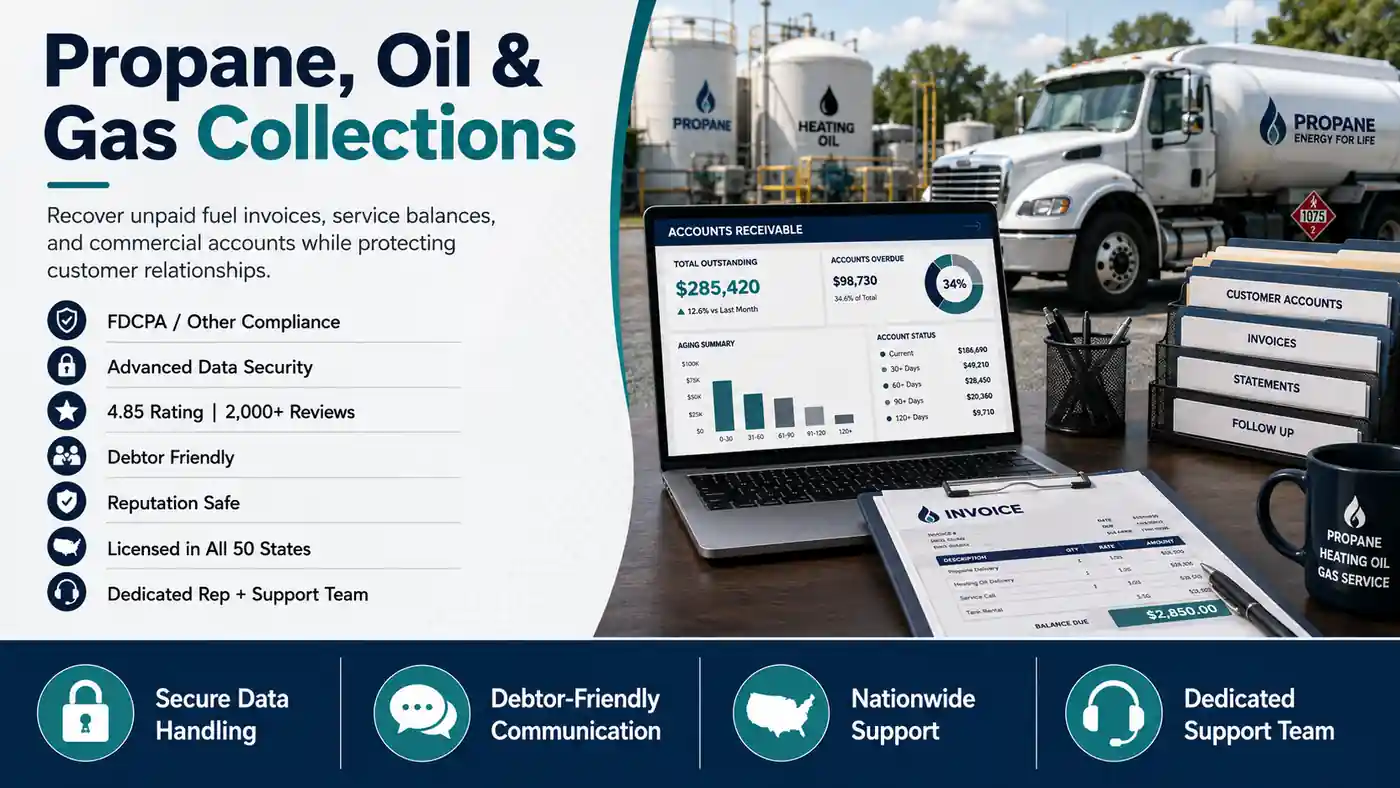
Propane, oil and gas collections service recovering unpaid fuel invoices and commercial accounts with secure data handling, debtor-friendly communication, nationwide licensing, dedicated support, and a 4.85 rating from 2,000+ reviews.

Quick Answer:Winter moratorium laws generally protect regulated gas and electric utilities, not propane and heating oil delivery, which means most dealers retain more collection leverage in cold months than they assume, though a handful of states extend narrower protections and it’s worth confirming your specific one. Nexa provides 50-state licensed, FDCPA-compliant collection starting at a $15 fixed fee per account, backed by SOC 2 data security, a dedicated account executive, and a 4.85/5 rating across 2,000+ reviews.


You Delivered the Gallons. They Burned the Fuel. Now You Need the Cash.

Fuel delivery is a high-stakes inventory game. Unlike a service business where you lose time if a client doesn’t pay, in the fuel business, you lose inventory. Every gallon of #2 heating oil or propane left in a debtor’s tank represents cash you already paid to the terminal. When wholesale prices spike, your “bad debt” line item doesn’t just double, it triples. You’re squeezed between the rack price and the customer’s wallet.

The “Winter Gap” Problem: the industry’s biggest killer is the “April drop-off.” Customers on budget plans pay faithfully through January, but as the weather warms, they stop paying the “true-up” balance. They ghost you in spring, leaving a $600 deficit that erodes the margin on every gallon delivered all winter.

Why fuel dealers switch to us:

  • Rated 4.85/5 stars across 2,000+ verified reviews.
  • Licensed in all 50 states, for delivery routes that cross state lines.
  • Dedicated account executive, backed by a specialized support team, not a call center.
  • SOC 2 Type II certified, 256-bit SSL encryption, FDCPA and Regulation F compliant.
  • We know your industry: Most agencies treat a $400 fuel bill like a credit card debt. They don’t understand PUC regulations, cold weather rules (and where they genuinely don’t apply), or the intricacies of automatic delivery contracts. We do.

The 3 Leaks in Your Cash Flow Pipeline

1. The “Automatic Delivery” Trap

You fill a customer’s tank in February because your “degree day” software said they were low. Two weeks later, they move out. The new homeowner says, “I didn’t order this.” The old tenant is gone.

The Nexa fix: We specialize in tenant skip-tracing, using utility data and credit headers to find where your “pump and run” debtor moved, serving the demand letter at their new address before they unpack.

2. The Regulatory Reality (Cold Weather Rules, Corrected)

Here’s the misconception worth retiring: many dealers assume they’re legally barred from refusing delivery to a delinquent account during winter, the same restriction that binds the electric utility. In most states, that restriction doesn’t apply to delivered fuels at all. Winter moratoriums are written for regulated gas and electric service; propane and heating oil delivery is typically a competitive, unregulated business, and several state regulators say so explicitly. A minority of states do extend narrower protections to delivered fuels, or tie eligibility to LIHEAP/HEAP assistance programs, so this is worth confirming for your specific state before assuming either way, but the default assumption most dealers operate under is backwards more often than not.

The Nexa fix: We help you collect within whatever your actual state’s rules are, applying credit pressure and formal demand without guessing at a restriction that may not exist. The conversation moves from “you can’t shut me off” to a documented, professional demand that treats the balance seriously regardless of season.

3. The Tank Asset War

In propane, you often own the tank. If a customer defaults, you have a $1,500 steel asset sitting in their yard, and retrieving it costs money (crane, pump-out, labor). It’s also not as simple as driving over and taking it: reclaiming leased equipment from someone else’s property generally can’t involve a “breach of peace,” the same limitation that governs auto repossession.

The Nexa fix: We use the collection process as leverage to negotiate the voluntary surrender of the tank or a pump-out agreement, resolving it through the debtor’s cooperation rather than a contested legal action like replevin.

Serving Energy Industry Nationwide

Need a Collection Agency? Contact Us

Delivering High Recovery Rates

In-House Tank Retrieval vs. Aggressive Collections vs. Nexa’s $15 Solution

Factor In-House Tank Retrieval Aggressive/Generic Collections Nexa’s $15 Answer
Upfront cost Crane, pump-out, and labor costs, often exceeding the tank’s value Often 35-50% contingency regardless of account age $15 flat fee, you keep 100% of what’s recovered
Community & review risk Low if handled quietly, high if it becomes a dispute High, aggressive scripts risk local backlash in small communities Low, framed as a professional demand, not a threat
Legal & moratorium compliance Depends entirely on staff knowledge of what actually applies Varies, generic scripts may assume the wrong rules apply statewide Built around your specific state’s actual rules, not a blanket assumption
Account management Whoever’s available that day Often a standard call center Dedicated account executive backed by a specialized team

Q&A: Fueling Your Recovery Strategy

Can you collect on “budget plan” breakage?
Yes, and this is where Step 1 (fixed fee) shines. If a customer misses two budget payments in March or April, send them to us immediately. A polite but official reminder from a third party is often enough to get them back on the plan before the balance becomes insurmountable.

Dealing with commercial farms and greenhouses?
Agricultural accounts are notorious for harvest-based cash flow. When a large farm owes $25,000 for propane used in grain drying, standard letters don’t work. Our commercial division understands the agricultural cycle and negotiates payment plans secured by harvest proceeds.

Do you understand “degree day” disputes?
Absolutely. Customers often claim “you let me run out” or “you filled me when prices were high.” We act as a mediator, reviewing your delivery logs and contract terms to prove the delivery was authorized, neutralizing the dispute.

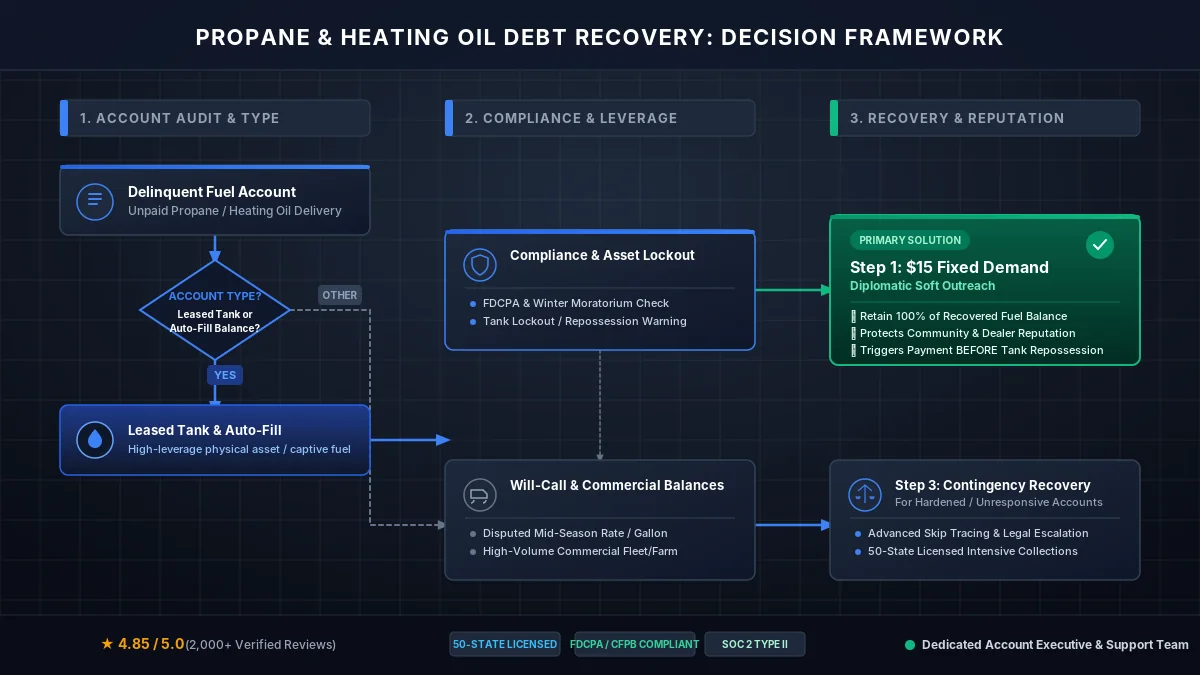
A Simple Decision tree diagram:

Decision tree diagram outlining compliance checks, leased tank lockout leverage, and $15 fixed-fee recovery workflows for propane and heating oil debt collection


Pricing & Services: The “Gallon-for-Gallon” Recovery

We use a “Waterfall” system designed to protect your margins.

Cost of hiring a collection agency for the energy industries

We use a waterfall system designed to protect your margins.

Step 1: Budget Plan Rehabilitation (Fixed Fee, ~$15/account)
Best for residential balances under $600 and budget plan “misses” (30-60 days late). Five diplomatic reminders sent in your name, it reads like a billing error notice, not a threat. Keeps the customer on your route; you recover 100% of the cash.

Step 2: The “Shut-Off” Warning (Fixed Fee, ~$15/account)
Best for accounts 90 days past due, or “will call” customers who ignored the bill. Formal demand sent in the agency name, signaling the account is flagged for credit reporting.

Step 3: Contingency Collections (Skips & Commercial, ~33-40%)
Best for tenants who’ve moved, tank recovery leverage, and balances over $1,000. No recovery, no fee. Deep skip-tracing, asset investigation, and compliant negotiation.

Step 4: Legal Action (~40-50% Contingency)
Best for large commercial or agricultural balances, or recovery of high-value tank assets.

Recent Results:

Heating Oil Supplier (New England) — The “Budget” Crash
A mid-sized dealer had 200 customers default on their budget caps at the end of a mild winter, owing an average of $350 each. A bulk Step 1 campaign in May recovered $52,000 in small balances. The dealer paid only the flat fee (~$3,000 total), keeping $49,000 to pre-buy fuel for next season.

Propane Distributor (Midwest) — The Agricultural Default
A large poultry farm owed $42,000 for propane used to heat chicken houses during a cold snap and claimed “poor yield” to refuse payment. Placed in Step 3 contingency, our team identified the farm’s active supply contracts with processors and negotiated a settlement where a portion of the farm’s next processing check was directed to the propane dealer. Full recovery in 4 months.

Regional Gas Utility (South) — Tenant Skips
High turnover in university rental housing led to $80,000 in unpaid “final bills” averaging $120. Automated placement into Step 2 combined with credit reporting resulted in 40% of students paying immediately upon seeing the collection notice hit their credit monitoring apps.

Frequently Asked Questions

How do you collect on unpaid winter heating bills without violating state moratorium laws?

The starting point is confirming whether a moratorium actually applies to your business at all, and for most propane and heating oil dealers, it doesn’t. Winter shutoff moratoriums are generally written for regulated, pipeline-connected gas and electric utilities; several states explicitly exclude delivered fuels like propane and heating oil from that protection. A minority of states extend narrower rules to delivered fuels, so we confirm your specific state’s actual requirement rather than assuming the broader utility rule applies, and build collection outreach around what’s genuinely required, not a blanket restriction that may not exist.

Can a $15 fixed-fee demand letter help me recover my leased propane tank, or just the money?

Primarily the money, though it often creates the leverage to resolve the tank too. A professional demand letter is generally the fastest way to prompt a debtor to either pay the balance or voluntarily agree to a tank pickup, since physically reclaiming leased equipment without the customer’s cooperation runs into the same “breach of peace” limits that govern auto repossession. Resolving the debt is usually what unlocks the tank, not a separate action.

How does Nexa protect my fuel business’s local reputation in small communities?

Step 1 outreach is deliberately built to look and read like a routine billing notice from your own company, not an aggressive third-party collector, specifically because fuel dealers often serve the same tight-knit communities for decades. The goal is resolving the balance quietly enough that it never becomes a local social media post or a conversation at the next town event.

Is Nexa licensed to collect if my delivery routes cross state lines?

Yes. We’re licensed to collect in all 50 states, which matters specifically for fuel dealers whose delivery territory doesn’t respect a state border, an account that moves from one state to a neighboring one doesn’t require switching agencies or losing continuity on the file.

Do I get a dedicated point of contact, or deal with an automated system?

A dedicated account executive, backed by a specialized support team, not an automated system or a rotating call queue. Your contact understands seasonal fuel billing specifically, budget plans, degree-day disputes, tank assets, rather than treating your account like a generic utility bill.


Stop Burning Profits

Your trucks are burning diesel to deliver product. Don’t burn money chasing the payment. Nexa Collections understands the unique squeeze of the energy market. Let us recover the funds so you can focus on the next delivery.

Need a Collection Agency? Contact Us

Filed Under: business, Debt Recovery

  • « Go to Previous Page
  • Page 1
  • Interim pages omitted …
  • Page 46
  • Page 47
  • Page 48
  • Page 49
  • Page 50
  • Interim pages omitted …
  • Page 55
  • Go to Next Page »

Primary Sidebar


accounts receivable

Need a Collection Agency?
Kindly fill this form.
We’ll get in touch with you

    Please prove you are human by selecting the plane.

    Compliance & Security

    • SOC 2 Type II Certified: Third-party audited data security and strict privacy controls.

    • HIPAA Compliant: Secure, legal processing of medical and municipal EMS accounts.

    • PCI-DSS Level 1: Highest tier of data encryption for secure payment processing.

    • FDCPA & FCRA Aligned: Full legal adherence to federal consumer protection laws.

    Recent Posts

    • Nationwide Debt Collection Agency Serving U.S. Cities
    • Chula Vista Collection Agency for Medical, B2B, Schools & Business Debt
    • Corpus Christi Collection Agency: Itemized Bill Rules for Practices
    • Riverside Collection Agency | For Logistics, Medical, Schools & Business Recovery
    • Collection Agency for Large Balances: High-Value B2B Debt Recovery
    • Baltimore Collection Agency | Medical, Commercial, Schools & More
    • Commercial and B2B Collection Agency in Detroit
    • Boston Medical Collection Agency | Serving Hospitals, Physicians & Dentists

    Featured Posts

    • Skip Tracing in Debt Collection: How We Locate a Debtor’s Verified Address & Phone
    • How Collection Agencies Can Impact Your Credit Scores
    • Difference Between Training, Education and Learning

    Copyright © 2026 NEXACOLLECT.COM | This content is provided for general informational purposes only and should not be considered legal advice. Collection laws and requirements may vary by state, account type, documentation, debtor status, and specific facts. Please consult qualified legal counsel for guidance regarding your particular situation. Nexa and its authorized collection partners service accounts in accordance with applicable federal and state collection requirements. Visit our home page to know more about us.

    X
    Need a Collection Agency?
    Contact Us