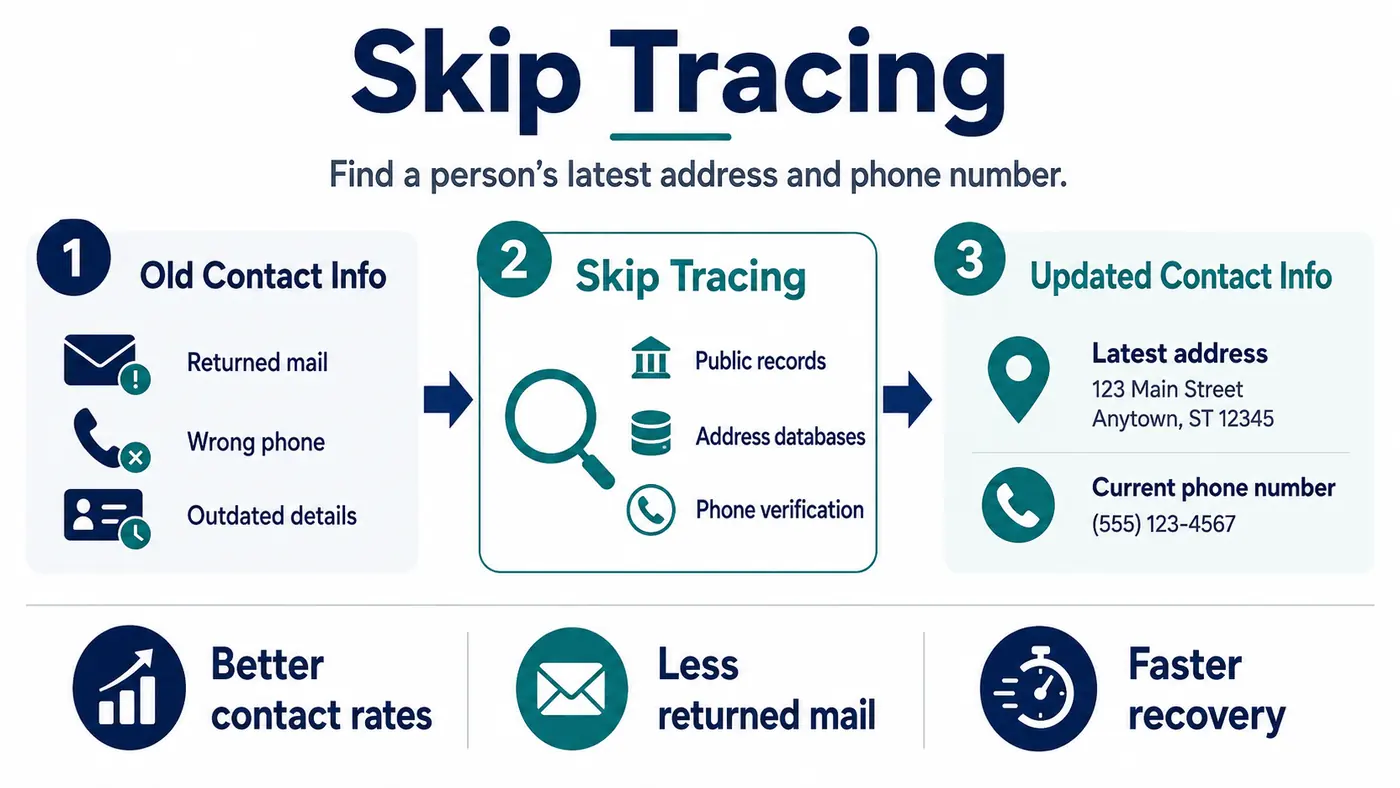
A debtor doesn’t have to disappear to become unreachable. A disconnected phone, mail returned to sender, a new job in a new city, and suddenly a perfectly good account is stuck. Skip tracing is the process that solves this: locating a debtor’s current, verified contact information using data sources that a quick Google search simply doesn’t have access to.
Quick Answer: What Is Skip Tracing in Debt Collection?
Skip tracing is the process of locating a debtor’s current address, phone number, and other contact details using GLBA-compliant access to credit header data, utility connection records, and USPS National Change of Address (NCOA) files, sources not available through ordinary public search. It’s used the moment a debtor’s contact information stops working, and Nexa includes it free with every account placed.
Why DIY Searches Fail
A free people-search site or a quick social media check feels like a reasonable first step, but it usually returns exactly what you’d expect from free data: outdated addresses, disconnected “burner” numbers, and profiles that haven’t been updated in years. These tools pull from public, low-cost sources with no obligation to keep the data current.
Professional skip tracing works differently because it’s legally allowed to use data public sites can’t touch. The Gramm-Leach-Bliley Act (GLBA) and the Driver’s Privacy Protection Act (DPPA) restrict access to non-public personal information, credit header data, DMV records, and similar sources, to licensed entities with a legitimate permissible purpose, which includes debt collection. That’s precisely why a licensed collection agency’s results are consistently more current than what a free consumer tool can legally access.
DIY vs. People-Search Sites vs. Agency Skip Tracing
| Factor | DIY (Google/Social Media) | Consumer People-Search Sites | Professional Agency Skip Tracing |
|---|---|---|---|
| Data sources | Public web, social profiles | Aggregated public records, often stale | Credit headers, utility connects, NCOA, DMV records (where permitted) |
| Accuracy | Low, frequently outdated | Moderate, but often months or years old | High, cross-verified across multiple sources |
| Legal access to NPI | None | None | Yes, under GLBA/DPPA permissible-purpose rules |
| Typical cost | Free | $10–$40 per report | $50–$175 for a one-off manual lookup; as low as $5–$25 per account at bulk/batch volume |
| With Nexa | — | — | Free, included with every account starting at the $15 fixed-fee stage |
The 4-Step Triangulation Workflow
Professional skip tracing doesn’t rely on a single database, it cross-references multiple sources to confirm an address or number is actually current:
- NCOA Scrub. The USPS National Change of Address database is checked first, the fastest way to catch a debtor who simply moved and filed a forwarding address.
- Credit Header & Utility Connect Matching. Tier-1 credit bureau header data (name, address, SSN portion, without the credit history itself) and utility connection records are cross-matched to confirm a current residence.
- Bankruptcy & Litigious Debtor Scrubbing. Every account is also checked against bankruptcy filings and a litigious-debtor database, protecting your business from accidentally pursuing an account that’s legally off-limits or escalating against someone with a documented history of suing collectors.
- TCPA-Compliant Wireless Verification. Any phone number located is checked to confirm whether it’s a wireless line before it’s called, since the Telephone Consumer Protection Act restricts autodialed or prerecorded calls to cell phones without prior consent.
Free With Nexa, Not a Standalone Cost
A standalone professional skip trace can run $50 to $175 for a single manual lookup, or, at bulk volume through a data provider directly, as low as $5 to $25 per account. Hiring a collection agency instead is usually far cheaper overall, generally around $15 per account for the entire fixed-fee service, not skip tracing alone. That’s because Nexa includes:
- Free skip tracing on every account placed.
- Free bankruptcy and litigious-debtor checks.
- Multiple demand letters sent to the debtor.
- Direct payment to your account with no extra recovery costs on the fixed-fee tier.
Collection agencies get this rate because they subscribe to skip-tracing databases at bulk volume, the same triangulation workflow above, at a fraction of the retail cost.
Key Strength: We elevate standard skip tracing content beyond basic definitions into a powerful, B2B and B2C compliance-driven utility that builds trust while driving low-friction conversions.
Who Actually Uses Skip Tracing
Beyond collection agencies, skip tracing is used by private investigators, bail bondsmen, process servers, repossession agents, and journalists, generally within the same legal permissible-purpose limits that govern debt collection use.
What Skip Tracing Can (and Can’t) Reliably Find
Common results include current and past addresses, mobile and landline numbers, employment history, relatives or associates who might help locate someone, and business or property ownership records. A caution worth taking seriously: results can still be outdated, especially phone numbers and email addresses, so findings should be verified rather than acted on blindly. This is also why letting a collection agency handle it in-house generally outperforms a business trying it alone, trained staff know which results to trust and which need a second confirmation pass.
Why Debtors Go Quiet in the First Place
- A changed phone number. Many debtors switch to a new mobile number without ever notifying a creditor.
- Relocation. A job change, divorce, or retirement move often happens without an update to the original address on file.
- Intentional avoidance. Some debtors are actively avoiding contact, which is exactly the scenario the triangulation workflow above is built to overcome.
Frequently Asked Questions
Is skip tracing legal for debt collection?
Yes, when it’s done through the correct legal channels. GLBA and DPPA restrict access to non-public personal information to entities with a legitimate permissible purpose, and debt collection qualifies. What’s not legal is using deceptive means to obtain information, skip tracing itself, done properly, is a standard, compliant part of the collection process.
How do collection agencies find a debtor’s new phone number?
Through a combination of credit header data, utility connection records, and cross-referenced database matching, sources not available through a free public search. Any number located is also checked to confirm whether it’s a wireless line before being called, to stay compliant with TCPA calling rules.
What happens if a debtor moves out of state?
Skip tracing works the same way regardless of state lines, an NCOA scrub and credit header matching will typically catch an interstate move. Since Nexa is licensed to collect in all 50 states, locating a debtor out of state doesn’t create a jurisdiction problem the way it might for a business trying to collect entirely on its own.
Does Nexa charge extra fees for skip tracing or address verification?
No. Skip tracing, address verification, and bankruptcy screening are included at no additional cost with every account, starting at the $15 fixed-fee letter stage. There’s no separate per-lookup charge the way there would be using a standalone provider.
Can skip tracing find someone who’s deliberately hiding?
Often, yes, though it can take longer and require more of the triangulation steps above. Someone actively avoiding contact will usually still leave a trail somewhere, a new utility connection, a relative’s address, an employment record, and the multi-source cross-referencing approach exists specifically to catch what a single database search would miss.