In New York, overdue accounts can lose legal leverage fast. From Manhattan and Long Island to Buffalo, Rochester and Albany, NexaCollect helps businesses and medical providers recover past-due balances while navigating New York’s 3-year deadlines for consumer-credit and medical-debt actions, the statewide ban on medical-debt credit reporting, and increasingly strict New York City collection rules.
And for NYC accounts, the compliance bar gets even higher on September 1, 2026, when the new SHIELD Collection Rule takes effect. The strategy is simple: act early, document the debt and use the right compliant recovery path before your options narrow.
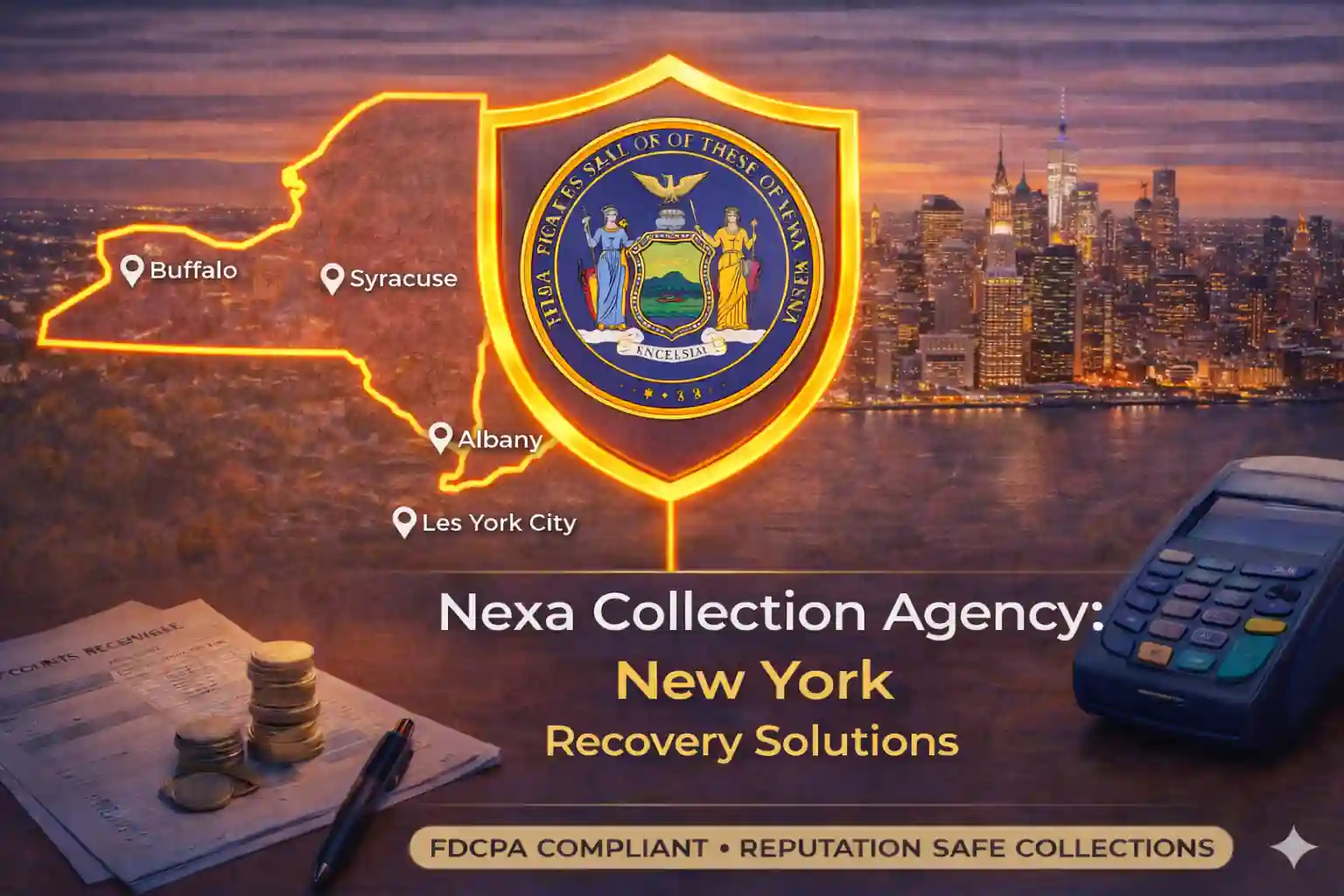
Navigating the 3-Year “Drop-Off”
In New York—from the global financial hubs of Manhattan and the industrial centers of Buffalo and Rochester to the tech corridors of Albany—doing business requires a level of compliance that most national agencies simply cannot reach. In 2026, the stakes are higher than ever. With the Consumer Credit Fairness Act slashing the window to sue for consumer debt to just 3 years and the total ban on medical debt credit reporting, the old “wait and see” approach is a recipe for total loss. You don’t just need a collector; you need a New York-licensed strategist who can secure your revenue before it becomes legally uncollectible “zombie debt.”
Nexa provides reputation-safe, equipped with all 50-state collections license, offering free credit reporting, free litigation/bankruptcy scrubs, and zero onboarding fees. Secure – SOC 2 Type II & HIPAA compliant.
Need a Collection Agency? Contact us
The New York Legal Landscape (2026 Summary)
New York laws are designed to protect the debtor. If your agency doesn’t hit the 3-year deadline or fails to provide the mandatory Notice of Lawsuit, your claim is dead on arrival.
| Debt Category | Statute of Limitations | New York Statute (CPLR) |
| Consumer/Credit Card | 3 Years | CPLR § 214-i |
| Medical Debt | 3 Years | CPLR § 213-d |
| B2B / Commercial | 6 Years | CPLR § 213(2) |
| Wage Garnishment | 10% Cap (Strict) | CPLR § 5231 |
| Judgments | 20 Years | CPLR § 211(b) |
Critical New York Rules for 2026:
-
The 3-Year Consumer Trap: Under the CCFA, consumer debt (including medical) expires in just 3 years. Making a partial payment no longer “restarts” the clock. Nexa’s high-speed “Step 1” demand service is essential to identify solvent debtors before the 36-month cliff.
-
Fair Medical Debt Reporting Act: New York hospitals and providers are prohibited from reporting medical debt to credit agencies. Nexa utilizes judicial judgments and bank levies to maintain “teeth” where credit threats no longer exist.
-
The $17.00 Wage Shield: As of Jan 1, 2026, the NYC/Long Island/Westchester minimum wage is $17.00/hr. Under New York law, you cannot garnish a debtor’s wages unless they earn more than 30x the minimum wage ($510/week). Nexa scrubs your accounts to ensure you aren’t suing “judgment-proof” individuals.
-
NYC-Specific Restrictions: New York City has its own set of restrictive laws that complicate collections. With the new 2026 mayor-elect signaling even tougher enforcement through the DCWP, NYC clients should avoid collecting money themselves. The regulatory climate is so pro-debtor that professional mediation is the only safe path. Note: NYC pressure is limited by law; therefore, our Step 2 Fixed-Fee service is the most strategic entry point to trigger payment without the risk of high-commission litigation.
Cost-Effectiveness: The Nexa Advantage

-
Fixed-Fee Recovery ($15/account): Ideal for early-stage and high-volume accounts. Debtors pay 100% directly to you. No commissions.
-
Contingency Service (20%–40%): Performance-based recovery. No Recovery, No Fee.
Industries We Serve in New York
-
Manufacturing & Logistics: B2B recovery for the automotive and industrial sectors in Upstate New York. We handle high-value freight brokerage and warehousing disputes, utilizing the 6-year commercial statute to your advantage.
-
Healthcare & Medical: 100% HIPAA-compliant. We specialize in navigating the 3-year medical statute and the total reporting ban, using mediation to preserve patient trust across the Mount Sinai, NYU Langone, and Northwell regional footprints.
-
Colleges & Universities: From the SUNY system to private Ivy League institutions, we manage tuition and bursar recovery with a focus on student-first mediation and institutional reputation.
-
K-12 Private & Charter Schools: Managing unpaid enrollment fees with a sensitive, diplomatic approach tailored for New York’s competitive educational landscape.
-
Accountants & CPA Firms: Recovery of professional service fees. We understand the “net-30” billing cycle and use professional mediation to ensure you get paid without damaging client rapport.
-
Banks & Credit Unions: Expert handling of delinquent consumer loans and deficiency balances using New York’s strict CCFA compliance frameworks.
-
Construction & Trades: Revenue recovery for HVAC, electrical, and general contractors. We are experts in New York Lien Law Article 2 and the strict 8-month filing window for private projects.
-
B2B Commercial, Restoration & Waste Management: High-speed recovery for service providers in the Tri-State area who need immediate cash flow to manage high operational and labor costs.
Recent New York Recovery Results
Case 1: Manhattan-Area Specialty Surgical Center (Medical)
-
The Problem: $165,000 in aging patient debt approaching the 3-year statute. The clinic could no longer report to credit bureaus due to the new NY ban.
-
The Result: Nexa implemented a legal-forward mediation strategy, recovering $112,000 in 70 days via bank levies and professional settlements.
Case 2: Buffalo-Based Industrial Supplier (B2B)
-
The Problem: A $58,000 unpaid invoice from a vendor who claimed “supply chain insolvency.”
-
The Result: Utilizing New York’s 6-year contract statute and a formal pre-legal demand, Nexa secured a full $58,000 recovery plus interest in just 32 days.
Frequently Asked Questions (FAQ)
1. What is the statute of limitations on consumer debt in New York?
New York generally provides a three-year limitation period for actions arising from consumer credit transactions under CPLR § 214-i, shortened from six years by the Consumer Credit Fairness Act. The CCFA also imposes additional pleading, proof and notice requirements on consumer credit lawsuits, so documentation quality matters as much as timing. Both points push in the same direction: aging consumer accounts lose options quickly in New York, and thin files lose them faster.
2. How is medical debt treated differently in New York?
Several ways. An action on medical debt by a qualifying New York hospital or healthcare professional generally must be commenced within three years of treatment under CPLR § 213-d. Separately, CPLR § 5231 provides that no amount may be imposed through an income execution on a judgment arising from a medical-debt action brought by a qualifying hospital or healthcare professional — meaning wage garnishment is generally unavailable as a remedy on those judgments. Medical accounts are also subject to the credit reporting prohibition described below. Taken together, these narrow the enforcement toolkit considerably, which is why documentation and compliant communication carry more of the load on New York medical files.
3. Can medical debt be reported to credit bureaus in New York?
No. New York law prohibits consumer reporting agencies from reporting or maintaining medical debt in a consumer’s credit file. For healthcare providers, this removes credit reporting as a recovery lever entirely, making professional communication, accurate documentation and workable payment resolution the practical path on unpaid patient balances.
4. What changes under New York City’s SHIELD Rule on September 1, 2026?
The SHIELD Rule (6 RCNY § 5-77) takes effect September 1, 2026 and is among the most significant municipal debt collection changes in the country. Key provisions:
- Original creditors are covered, not only third-party collectors, once account servicing ends and collection activity begins. Hospitals and businesses collecting their own NYC receivables should assess whether they are in scope.
- Communication cap: no more than three communications or attempted communications per account in any seven consecutive days, counting phone, text and email together, with limited-content messages included. A collector generally may not contact the consumer again in that period once the consumer has responded.
- Disputes at any time: consumers may dispute or request verification at any point in the collection lifecycle, not only within the federal 30-day window.
- Verification with a deadline: documentation must be produced within 60 days of a request — at minimum a charge-off account statement, a signed contract or application, and a final balance statement, with a default judgment alone insufficient. If it isn’t produced, the collector must send a Notice of Unverified Debt and generally loses the ability to collect the account.
- Medical debt carries additional dispute protections.
The most stringent dispute and verification provisions apply to accounts for which a validation notice is required on or after September 1, 2026, excluding accounts purchased before that date.
5. Does a collection agency need a license to collect debts in New York City?
Yes, for covered consumer collections. A business that regularly collects or attempts to collect personal or household debts from New York City residents generally needs a Debt Collection Agency License from the NYC Department of Consumer and Worker Protection, and that requirement applies even where the agency is located outside New York State. Creditors placing NYC consumer accounts should confirm their agency’s licensure before placement.
6. How long can a business collect B2B debt in New York?
Many contractual B2B claims are subject to a six-year limitation period under CPLR § 213. The applicable deadline depends on the transaction, though — New York’s UCC generally provides a four-year period for contracts for the sale of goods. A supplier and a service provider with similar-looking invoices can therefore be working against different clocks, so commercial accounts are best evaluated against the underlying agreement rather than by category.
7. How much of a debtor’s wages can be garnished in New York?
An income execution generally cannot exceed 10% of a judgment debtor’s gross income, with further limits applying based on disposable earnings. New York also protects earnings below the greater of 30 times the applicable federal or state minimum hourly wage, and other statutory restrictions may reduce the amount available further. Note the separate rule for medical-debt judgments described above, where income execution is generally unavailable.
8. How much does a collection agency cost in New York?
Nexa offers a $15 fixed-fee recovery option for qualifying earlier-stage accounts, under which recovered payments go directly to the client, alongside contingency collection for accounts requiring more intensive effort. The appropriate program and contingency rate depend on account type, age, balance and complexity.
Get a Free Analysis? Contact us
- New York City
- Bohemia
- Poughkeepsie
- Mount Sinai
- Geneseo
- Westbury
- Commack
- Arcade
- Syosset
- Buffalo
- Valhalla
- Babylon
- Thornwood
- Amherst
- Bellmore
- Staten Island
- Baldwin
- Bath
- Tonawanda
- Cheektowaga
- Coram
- East Northport
- Elmsford
- Fairport
- Farmingdale
- Flushing
- Plainview
- New York
- Hewlett
- Hicksville
- Hornell
- Inwood
- Lindenhurst
- Nesconset
- Newburg
- Patchogue
- Syracuse
- Tarrytown
- Garden City
- Melville
- White Plains