A single mishandled tuition account doesn’t just cost you one family’s balance, it can cost you next year’s enrollment from three other families who heard about it. That’s the real math behind school collections, and it’s why this can’t be treated like a generic B2C receivable.
Quick answer: Private and public school fee collection recovers unpaid tuition, lunch balances, activity fees, and device charges through diplomatic, FERPA-compliant outreach designed to preserve the parent relationship, not just the balance. Financial obligation records aren’t protected “education records” under FERPA, so sharing a parent’s name, balance, and contact information with a collection agency is permitted, provided no academic or health records are included. Nexa recovers school accounts starting at a $15 fixed fee per account (schools keep 100% of what’s recovered), with 30-40% contingency for older or unresponsive accounts.
A school collection agency recovers unpaid tuition contracts, lunch dues, registration fees, athletic dues, extracurricular charges, and device or property fees on behalf of independent K-12 institutions, including private day schools, boarding schools, Catholic and faith-based schools, Montessori academies, and charter schools. Unlike public institution collection (which involves different legal frameworks and funding constraints), private school tuition recovery operates as a private creditor enforcement matter: the enrollment agreement is a binding contract, and the outstanding balance is a legally collectible obligation.
The most effective private school collection agencies combine institutional brand protection with diplomatic family outreach, preserving the school’s parent community while recovering the revenue it is contractually owed.
Trusted by over 200 educational institutions to recover critical funds without alienating families. We combine a 98% “complaint-free” resolution rate with a FERPA-compliant process—recovering tuition, lunch fees, and textbooks while you focus on education. Rated 4.87 on Google Reviews!
Managing accounts receivable in an educational setting is uniquely challenging. Unlike a standard B2B transaction, you are dealing with families, community reputation, and the sensitive nature of a child’s education. Whether you are a Private School worried about next year’s enrollment or a Public District managing thousands of small lunch balances, a single mishandled account can lead to negative publicity.
Nexa Collections acts as a diplomatic firewall. We recover the funds you are legally owed while protecting the brand and values of your institution. We address core education-sector pain points directly, such as mid-year student withdrawals, unpaid enrollment deposits, payment plan defaults, and delicate parent communication dynamics.
The “Velvet Hammer” Approach to School Debt
We understand that parents often fall behind due to temporary financial hardships, not malice. Our approach reflects this:
- Diplomacy First: We treat parents with respect, offering solutions rather than threats.
- Preserving Enrollment: For private schools, our goal is to recover the tuition and keep the student enrolled for the next term.
- Firm Resolution: When diplomacy fails, our professional collectors use advanced negotiation techniques to secure payment.
Our 4-Stage School Recovery Framework
Private school debt recovery requires a process built around the academy’s community reputation, not a generic commercial collection workflow. Here is how we structure every school engagement:
Stage 1 — Secure Roster Ingestion
We begin by safely importing your delinquent parent account roster into our secure, SOC 2 Type II certified portal via Excel or CSV, capturing student account number, parent/guardian contact information, balance owed, and account age. Complete data privacy is maintained throughout: we receive only the financial obligation information necessary for collection, never academic records, grades, or sensitive student data. A bankruptcy scrub, litigious debtor check, and deceased indicator review are run on all accounts within 24 hours of intake, removing any accounts that should not be pursued before a single outreach attempt is made.
Stage 2 — Diplomatic Mediation
We initiate a highly professional, soft-touch communication sequence, letters, emails, and phone calls, designed to preserve your academy’s community reputation and treat every family with the dignity that your institution’s brand demands. Our certified collectors are trained to present themselves as neutral, professional account mediators, not adversarial collectors. The tone is firm but empathetic: acknowledging that financial difficulty happens in every community, while making clear that the tuition obligation is a legally binding contract that requires resolution. All communication is reviewed and approved by your administrative team before the first contact is made, ensuring our outreach aligns with your school’s voice and values.
Stage 3 — Flexible Resolution Plans
We offer structured, legally compliant tuition installment agreements that allow families to resolve outstanding balances without litigation, protecting both the family’s dignity and the school’s community relationships. Payment plan terms are proposed based on the balance size, account age, and the family’s stated financial situation, subject to your institution’s minimum recovery parameters. Installment plans include a written agreement signed by the parent or guardian, documenting the commitment and specifying that the full remaining balance becomes due immediately upon any missed payment. For families experiencing genuine hardship, we can coordinate with your financial aid office on whether any partial scholarship or assistance applies, resolving the account through institutional means rather than continued collection pressure.
Stage 4 — Account Finalisation
Once a balance is resolved, whether through a lump-sum payment, a completed installment plan, or a negotiated settlement approved by your bursar or business manager, we provide complete account closure documentation. This includes a payment confirmation letter, a zero-balance statement, and an account closure record formatted for your student information system. For accounts that remain unresolved after all diplomatic and installment options have been exhausted, we present a legal escalation recommendation with our assessment of recoverability, requiring your explicit written approval before any legal filing is initiated.
What We Collect: Comprehensive Recovery
Schools face unique debt challenges beyond just tuition. We have specialized teams for:
- ✅ Tuition & Education Loans: Recovering past-due semester fees, private school loans, and boarding fees.
- ✅ Student Lunch Debt: Sensitive, bulk recovery for negative meal account balances in public districts (often pennies on the dollar to collect).
- ✅ Textbook & Technology: Collecting fees for unreturned rental books, broken iPads, Chromebooks, or library fines.
- ✅ Incidental Billing: Before/After-care programs, lab fees, athletic equipment, and uniform charges.
To ensure rapid resolution and legal enforceability, each placed private school account should include the signed parent enrollment agreement or tuition contract, an itemized statement of account covering tuition and auxiliary fees, formal withdrawal or notice records, and the signed financial guarantor designation.
School Collection Laws: Compliance Is Critical
Collecting for schools requires adherence to strict federal regulations that standard agencies often ignore. We are experts in:
FERPA (Family Educational Rights and Privacy Act). Financial obligation records aren’t protected “education records,” so sharing a parent’s name, balance, and contact information with us is permitted. See the full explanation below for exactly what we receive and what we don’t.
TILA (Truth in Lending Act). If your school offers a payment plan that includes interest or allows payments in more than four installments, TILA disclosures are required. We help you navigate these regulations to ensure your enrollment contracts are legally enforceable.
State Statutes of Limitations. Tuition debt has an expiration date. We analyze the age of your receivables to prioritize accounts that are still legally collectable.
Our 2-Step Process: Tailored for Education
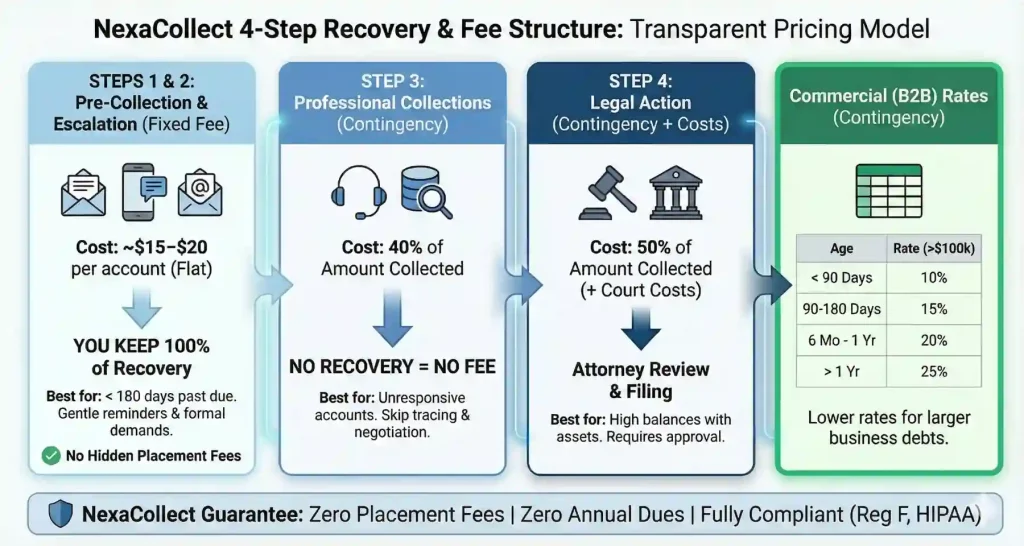
We offer two cost structures for private school accounts, choose the one that fits each account’s age and complexity. See the full pricing breakdown for how this compares to our other service lines.
Fixed-Fee Letter Service — $15 per account. Best for accounts under 120 days past due where a formal written demand may be enough to prompt payment. We send five professional demand letters, reviewed and approved by your team before the first send. You pay $15 per account regardless of outcome, and keep 100% of every dollar recovered. There is no upfront contract, no minimum volume, and no fee if you decide to recall an account before we contact the family.
Contingency Collections — No Recovery, No Fee. Best for older or unresponsive accounts where phone and digital outreach is required. Our fee is a percentage of the amount recovered (typically 30–40%, based on account age and balance complexity). If we do not recover anything, you owe nothing. Legal escalation, if required and approved by you, carries a 50% contingency rate.
Minimum account balance: $50.00 per account. No hidden fees: no setup fees, no portal access fees, no credit reporting fees, no bankruptcy scrub fees.
Proudly Serving Schools NationwideFor a cost-effective debt recovery: Contact us |
Public vs. Private: We Know the Difference
For Private & Independent Schools: Your concern is Enrollment and Reputation. High tuition balances can cripple your budget, but aggressive collections can cripple your image. We balance these needs, often recovering tuition in time for the student to return for the next semester.
For Public School Districts: Your concern is Volume and Lunch Debt. You may have thousands of accounts with small balances ($20-$50). Our technology allows us to upload and process these bulk files efficiently, recovering significant revenue that adds up. See our dedicated school district collections page for more on public-district-specific handling.
We understand complex enrollment contracts: We are experts at navigating the specific terms of tuition and enrollment agreements, including clauses for mid-year withdrawal or unpaid activity fees.
Why 35+ Schools Partner With Us
- Higher Recovery Rates: Our school-specific strategies yield results 20% higher than generalist agencies.
- Zero Upfront Cost: For our standard service, we only get paid when you get paid.
- Online Portal: Track every dollar recovered in real-time through our secure client dashboard.
Recovery Results
$11,500 Recovered: A family withdrew their child mid-semester and disputed the early withdrawal fee in their enrollment contract. We respectfully validated the debt and secured payment.
$4,200 Recovered: A former student’s family had unpaid athletic and activity fees from two years prior. Our 50-state license allowed us to locate them after they had moved.
$9,800 Negotiated: A tuition bill was caught in a dispute between divorced parents. Our specialist acted as a neutral third party to de-escalate the situation and arrange a payment plan.
Case Study: Independent Preparatory Academy — $94,000 in Delinquent Tuition Recovered
The situation: A 450-student independent day school had accumulated $94,000 across 31 family accounts, average balance $3,032. Account ages ranged from 90 days to 22 months past due. The school’s business manager had made personal phone calls to each family with limited results and was reluctant to escalate due to concern about community reputation and a pending re-enrollment season.
Our approach: We reviewed each account with the business manager before any outreach, identifying 4 accounts with documented financial hardship that were redirected to the school’s internal financial aid review. For the remaining 27 accounts, we deployed Stage 2 diplomatic mediation using letter and phone outreach that identified itself as coming from a professional account resolution service engaged by the school, not as an adversarial collection agency. We presented installment plan options on every first contact.
The outcome: 23 of 27 accounts resolved within 90 days, 16 paid in full, 7 entered installment plans that completed within 6 months. Total recovered: $78,400 (83% of placed balance). Zero formal complaints received. Two families whose accounts resolved subsequently re-enrolled their children for the following academic year. (Nexa internal data, 2025)
Case Study: Catholic School Network — High-Volume Small-Balance Activity Fee Recovery
The situation: A diocese operating 8 Catholic elementary and middle schools had $41,000 outstanding across 740 student accounts for unpaid activity fees, technology fees, and athletic dues, average balance $55. Administrative staff were spending significant time on follow-up with minimal recovery.
Our approach: All 740 accounts were processed through our fixed-fee letter service at $15 per account. Letters were sent in the diocese’s name, reflecting the schools’ community values and pastoral tone. Total cost to the diocese: $11,100.
The outcome: 487 accounts resolved within 45 days, a 66% recovery rate. Total recovered: $26,785. Net recovery after placement cost: $15,685, with zero administrative staff hours invested beyond the initial account upload. (Nexa internal data, 2024)
Private School Types We Serve
Our recovery process is calibrated to the culture, governance, and community dynamics of each type of private institution:
Independent day schools & preparatory academies
High-tuition independent schools have the most brand-sensitive collection environment in K-12 education, and often the most collectible balances. Families who enrol in a $30,000–$60,000/year day school have demonstrated financial capacity, making tuition defaults more often a payment disruption than a genuine inability to pay. We approach these accounts with maximum diplomacy and a strong presumption that the family wants to resolve the balance, identifying the underlying obstacle (job loss, divorce, medical emergency) and structuring a resolution around it.
Catholic, faith-based & religious schools
Faith-based schools face a unique tension: their mission of service and inclusion can feel at odds with pursuing families for unpaid tuition. Our collectors are trained to approach faith-based school accounts as a ministry of stewardship, helping families honour a financial commitment they made in good faith, rather than as adversarial debt collection. We coordinate with your development and pastoral care offices to ensure collection outreach does not conflict with any active pastoral relationship the school has with the family.
Montessori & progressive schools
Montessori and progressive school communities have strong parent engagement cultures where reputation among the parent body travels very quickly. A single family feeling mistreated by a collection agency can generate community-level reputational damage disproportionate to the balance involved. Our Phase 1 fixed-fee letter service, sent in the school’s name, not Nexa’s, is the preferred approach for these communities. Maximum recovery, zero brand risk.
Charter schools
Charter schools occupy a hybrid space: publicly funded but independently operated, often with sliding-scale tuition or activity fee structures rather than full tuition contracts. Collection activity at charter schools must be carefully calibrated to avoid any perception of discriminatory enforcement. We assess each charter school’s fee structure, authorising legislation, and student population demographics before designing an outreach approach that is equitable, consistent, and compliant with your charter agreement.
Boarding schools
Boarding school accounts involve the highest average balances in K-12 private education, often $40,000–$90,000+ per academic year inclusive of room, board, and activity fees. These accounts also involve the most complex family situations: international families, divorced parents with disputed financial responsibility, and families whose financial position changed dramatically between enrollment and the due date. We handle boarding school accounts with dedicated senior mediators and a structured multi-party communication protocol for accounts where more than one responsible party exists.
After-school programs & enrichment centers
Standalone after-school and enrichment programs(language academies, STEM centers, arts programs) have shorter session commitments and smaller balances, typically $200–$1,500. These are well-suited to our fixed-fee letter service, which recovers the majority of these accounts at $15 per account with no phone outreach required.
FERPA & Student Data Privacy: What We Receive and What We Don’t
The Family Educational Rights and Privacy Act (FERPA) governs the privacy of student education records at schools receiving federal funding. Even schools not directly subject to FERPA frequently ask about student data handling before engaging a collection agency. Here is our clear position:
What information we receive. To collect a tuition or fee balance, we receive only the parent or guardian’s name and contact information, the student account number, the balance owed, the account age, and the name of the school. We do not receive, and do not need, any academic records, grades, disciplinary records, health information, test scores, or any other information that constitutes an “education record” under FERPA. Our data intake template is designed to exclude education record fields entirely.
What FERPA covers vs. what it doesn’t. FERPA protects “education records,” documents and records directly related to a student that are maintained by the school. Financial obligation records (the tuition contract and the outstanding balance) are not education records under FERPA, they are financial records between the school and the parent or guardian as contracting party. Sharing a parent’s name, contact information, and financial obligation with a collection agency does not violate FERPA, provided no education records are included in the transfer.
Our data security standards. All account data is processed in our SOC 2 Type II certified environment, encrypted in transit (TLS 1.3) and at rest (AES-256). Access is restricted to the collector assigned to your school’s accounts. Data is retained only for the duration of the collection engagement and purged per our data retention policy upon account closure or recall. We execute a data processing agreement with every school client before receiving any account information.
Frequently Asked Questions
Will collecting on unpaid tuition damage our school’s local reputation or parent community trust?
No. We deploy a diplomatic, “rehabilitation-first” approach specifically customized for private K-12 institutions. Our certified collectors act as neutral, professional mediators, resolving financial contract balances with maximum empathy and absolute brand protection. All communication templates are reviewed and approved by your administrative team before the first contact is made. Our Phase 1 fixed-fee service sends outreach in your school’s name, families never see the Nexa name unless they are escalated to Phase 2 contingency collections, and even then our outreach tone is designed to preserve the possibility of ongoing relationship with the institution.
What types of student account balances can we place for recovery?
We efficiently manage high-volume school debts, provided they meet our standard agency minimum of $50.00 per account. This includes unpaid tuition contracts, registration fees, athletic or extracurricular dues, and unreturned school property balances. We also recover technology fees (broken or unreturned devices such as iPads, Chromebooks, and laptops), lunch and meal plan balances, field trip and programs fees, and library or resource fees. Balances for former students or students who have transferred or withdrawn are generally the most straightforward to pursue, as there is no ongoing institutional relationship to preserve.
Can a private school send a family to collections for unpaid tuition?
Yes. Private school tuition is a contractual obligation, the enrollment agreement is a binding contract between the school and the parent or guardian. When a family fails to meet that obligation, the school has the same rights as any private creditor: it can engage a collection agency, report the delinquency to credit bureaus (with the agency’s assistance), and ultimately pursue legal action to obtain a judgment. The FDCPA applies to third-party collection agencies acting on the school’s behalf for consumer (individual) debts, meaning all collection outreach must meet federal compliance standards regardless of the school’s own policies.
Does FERPA prevent us from sharing student account information with a collection agency?
No, with an important distinction. FERPA protects “education records,” documents directly related to a student’s academic experience. Financial obligation records (the tuition contract and outstanding balance) are not education records; they are contractual financial obligations between the school and the parent or guardian. Sharing a parent’s name, contact information, and financial balance with a collection agency does not violate FERPA, provided no academic records (grades, disciplinary records, health records, test scores) are included in the transfer. We execute a data processing agreement with every school client and receive only the financial obligation data necessary for collection.
What is the statute of limitations for collecting unpaid private school tuition?
The statute of limitations for unpaid private school tuition is typically governed by your state’s statute of limitations for written contracts, ranging from 3 to 6 years depending on the state. In most cases, the enrollment agreement is the written contract, and the clock starts from the date payment was due. It is important to act within this window: accounts that age past the statute of limitations cannot be legally enforced in court, though diplomatic collection outreach may still be possible. We assess every account’s statute of limitations position at intake and flag any that are approaching expiry for prioritized outreach.
Can a private school withhold a student’s transcripts for unpaid tuition?
This depends on your state’s law, your school’s accreditation requirements, and whether your school receives any federal funding. Fully private schools with no federal funding generally have broader discretion to withhold education records pending resolution of financial obligations, but this practice exists in a legally variable landscape, and several states have enacted restrictions. We recommend your legal counsel review your state’s specific rules before implementing a transcript hold policy. As a collection agency, we do not use transcript holds as a collection tool, that decision remains entirely with your institution’s leadership.
How do you handle divorced parents with disputed financial responsibility for tuition?
Divorced parent situations are among the most complex in private school collection. We begin by reviewing your enrollment agreement to determine who the contracting party is, typically, both parents who signed the enrollment agreement bear joint and several liability, regardless of what their divorce decree says about education expense allocation (divorce decrees govern the parents’ relationship with each other, not their obligation to the school). We reach out to the financially responsible party or parties identified in the enrollment agreement. If both parents have signed, we may contact both, with sensitivity to the family dynamic. We do not navigate custody arrangements or adjudicate divorce decree terms, we enforce the enrollment contract.
How do you handle a family that claims financial hardship?
We take hardship claims seriously and address them in Stage 3 of our process. When a family indicates genuine financial difficulty, we pause aggressive outreach and present two options: (1) a structured installment plan that allows them to resolve the balance over time while avoiding credit reporting or legal action, or (2) a referral back to your financial aid office to assess whether any institutional assistance is available. We document every hardship determination in your account portal. For families where neither option resolves the account, we provide a full assessment of recoverability, including asset profile and likelihood of legal judgment enforcement, so your business manager can make an informed write-off decision.
Do you handle accounts for students who have already graduated or transferred?
Yes, and these are often the most straightforward accounts to pursue. Former students and transferred families have no ongoing relationship with the institution that collection outreach could damage. Graduated and transferred accounts are well-suited to our Phase 1 fixed-fee letter service: the family received value from the institution, the obligation is documented in a signed enrollment agreement, and the only barrier to payment is typically inertia or displacement from their previous address. We deploy skip-tracing for graduated accounts where the family has moved, locating their current address before the first letter is sent.
What school administration software do you work with for account uploads?
We accept account placements in Excel, CSV, or any standard spreadsheet export from your student information system (SIS) or tuition management platform. Common systems our clients use include FACTS Tuition Management, Blackbaud Tuition Management (Smart Tuition), TADS, Veracross, Finalsite, Gradelink, and RenWeb / FACTS SIS. If your system can export a list of delinquent accounts with parent contact information and balance data, we can ingest it. Our intake template maps to standard SIS export fields, typically a one-time configuration that takes less than an hour at setup.
Is there a minimum number of accounts required to work with Nexa?
No minimum account volume. A small Montessori school with 5 delinquent accounts can place them on the same platform as a large independent school network with 200. Our $15 fixed-fee service is cost-effective at any volume, even a single $500 tuition balance nets you $485 after the placement fee, with zero staff hours invested. For school networks or dioceses placing 100+ accounts, we offer a dedicated account manager and consolidated reporting across all campuses.
How do you report results back to our bursar or business manager?
Your bursar or business manager has 24/7 access to our secure client portal, showing real-time account status, payment receipt confirmation, installment plan progress, collector notes, dispute flags, and a summary dashboard of portfolio performance (accounts placed, recovered, pending, and closed). Monthly summary reports are generated automatically and can be formatted to match your school’s financial reporting templates. For auditing purposes, every communication sent on your behalf is logged with timestamp, channel, and content, providing a complete audit trail for each student account file.
Stop Losing Revenue to Unpaid Fees
Tuition and fees are the lifeblood of your educational mission. Don’t let overdue accounts limit your ability to serve your students.