The resident who received care is almost never the person legally responsible for the bill. That single fact makes senior living collections unlike anything else in accounts receivable: the person you’re actually contacting is usually an adult child managing grief, probate paperwork, and a Medicaid application all at once, not someone who simply forgot to pay.
Quick answer: Senior living collections require treating the Responsible Party, typically an adult child or family guarantor, as a family liaison rather than a debtor, since aggressive tactics here don’t just risk one account, they risk your community’s local reputation. Nexa recovers private-pay arrears, Applied Income (Patient Liability), and post-death estate claims through dignity-first mediation, starting at a $15 fixed fee per account, with specialized handling for Medicaid spend-down timing and state-specific probate filing deadlines.

An assisted living collection agency recovers unpaid private-pay balances, Medicaid spend-down arrears, and final-bill estate claims for senior care communities, including assisted living facilities (ALFs), memory care communities, skilled nursing facilities (SNFs), independent living communities, and home health agencies. Senior care collection is uniquely complex: liability typically rests with a Responsible Party, usually an adult child or family member, who may be simultaneously managing grief, estate paperwork, Medicaid applications, and their own financial obligations. The most effective assisted living collection agencies treat Responsible Parties as family liaisons, not debtors, recovering revenue through mediation and education rather than demand and pressure.
In senior care, you aren’t just managing a facility; you are managing a legacy. But when a resident’s Responsible Party stops responding, your mission to provide high-quality care is put at financial risk. The complexity of estate settlements and Medicaid spend-downs has made traditional, aggressive collections obsolete. If your approach feels like a cold demand, families will retreat or lash out. If it feels like a continuation of the care you provided, your community moves to the top of the payment priority list.
Nexa is equipped with all 50-state collections license, offering free credit reporting, free litigation check, free bankruptcy scrubs, and zero onboarding fees. Secure – SOC 2 Type II & HIPAA compliant. Over 2,000 online reviews rate us 4.85 out of 5.
Protect Your Reputation & Recover Your Revenue
The Senior Care Financial Reality
- The Sandwich Generation Is a Real, Measurable Phenomenon. According to AARP’s 2025 Caregiving in the U.S. report, approximately 63 million American adults provided unpaid care to a family member in the prior 12 months. A meaningful share of unpaid assisted living balances aren’t a refusal to pay, they’re a Responsible Party genuinely overwhelmed by probate, Medicaid paperwork, and caregiving obligations at the same time.
- The Reputation Risk Is Structural, Not Hypothetical. A single family’s negative account of a “harsh” collections experience, shared on social media or with other prospective families, can affect a community’s census for months. This risk is specific to senior living in a way it isn’t for most industries, since referrals and reputation among local families are core to how communities fill beds.
- The Spend-Down Clock. Once a resident moves toward Medicaid eligibility, the window to recover private-pay arrears closes rapidly. Timely, diplomatic intervention is the only way to secure these funds before that window shuts.
Why Senior Living Collections Is an Emotional Landmine
The “Responsible Party” vs. The Resident
We understand that the resident is almost never the one handling the checkbook. Our mediators are trained to engage the Responsible Party (often a grieving or stressed adult child) as a Family Liaison, not a debt collector. We bridge the gap between “I can’t pay” and “I won’t pay” by acting as a professional buffer.
Medicaid Pending & Estate Complexity
Generic agencies get lost in the weeds of Medicaid. We don’t. We understand the “Medicaid Pending” status and the estate settlement process. We speak the language of executors and probate attorneys, ensuring your facility is recognized as a priority creditor without causing a family feud.
The Reputation Shield
One disgruntled family member on social media can damage your census for months. Our Minimal Stress Policy ensures every interaction is recorded and randomly reviewed to maintain your community’s standing. We protect your brand while we recover your bottom line.
The Nexa “Dignity-First” Recovery Ladder
We separate “administrative confusion” from “bad debt” to maximize your recovery.
- Step 1: The Account Reconciliation (Fixed Fee – $15). Ideal for accounts 60–90 days past due. A soft, third-party “nudge” that identifies simple misunderstandings or missing paperwork before they become legal disputes. You keep 100% of the money recovered.
- Step 2: Specialized Mediation (Contingency). For high-balance aged debt or unresponsive estates. We perform deep-data bankruptcy and estate scrubs to find the path to payment. No Recovery = No Fee.
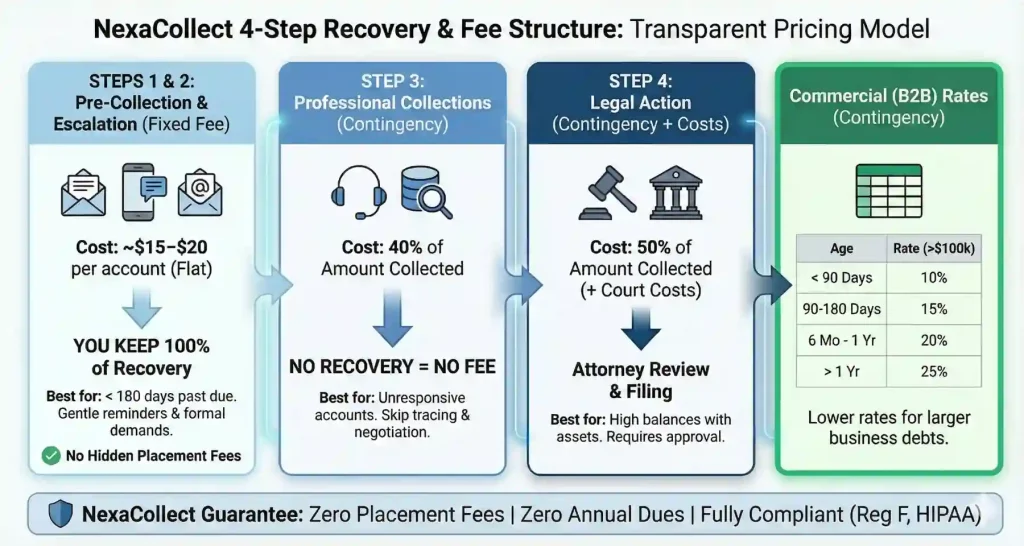
See the full pricing breakdown for how these tiers compare across account types.
To ensure swift resolution and complete legal enforceability, each placed senior care account should include the signed resident admission agreement, financial guarantor or Power of Attorney (POA) designation, itemized level-of-care billing statements, and current Medicaid pending or spend-down records.
Our 4-Stage Compassionate Recovery Framework
- Secure Ingest & Audit: Safely import delinquent resident accounts via Excel into our secure portal, ensuring full data privacy.
- Responsible Party Identification: Review enrollment documentation to accurately identify and contact the designated responsible party or executor.
- Empathic Mediation: Initiate a highly professional, soft-touch communication sequence focused on clear financial mediation rather than aggressive collection.
- Structured Resolution: Establish flexible, legally compliant payment schedules to cleanly resolve outstanding private pay balances while protecting your facility’s community standing.
Key strength: We address core senior care billing friction directly, transition to Medicaid, power of attorney communication, family guarantor confusion, and probate/estate balance resolution.
Recent Recovery Results
Regional Memory Care Community: A facility carrying $86,000 in aged private-pay and Medicaid spend-down arrears across 40 accounts implemented Nexa’s dignity-first mediation approach. $61,000 recovered (71%) within 75 days, with zero negative family reviews and two Responsible Parties who later referred new residents to the community.
Multi-Facility SNF Operator: A three-location skilled nursing operator had $52,000 in unfiled estate claims where the probate window was at risk of closing. Nexa’s estate-monitoring process identified and filed creditor claims for all 18 accounts within statutory deadlines, recovering $38,500 through negotiated estate distributions.
Handling POA & Probate Cases
Power of Attorney (POA)
- Verify & Direct: We confirm financial POA authority, then direct all outreach to the agent, never the incapacitated debtor.
- Target Correct Assets: Pursue the principal’s funds, not the agent’s (unless the agent signed a personal guarantee).
Probate (Deceased Debtor)
- POA Ends at Death: We stop contacting the POA agent immediately when the debtor dies.
- File Court Claims: Identify the estate’s court-appointed Executor and file a formal Creditor’s Claim before state statutory deadlines.
Medicaid Spend-Down & Private-Pay Recovery: The Collection Window You Cannot Miss
The Medicaid spend-down is the most complex and most consequential billing scenario in assisted living finance. Understanding it, and acting within the right window, is the difference between recovering significant private-pay revenue and writing it off permanently.
What is a Medicaid spend-down?
Before a senior becomes eligible for Medicaid long-term care benefits, they must reduce their countable assets below the state’s Medicaid asset threshold (typically $2,000 for the applicant, with spousal protections for a community spouse). The process of depleting assets to this threshold is called the “spend-down.” During this period, the resident is paying privately, and those private-pay invoices are your most collectible accounts. Once Medicaid eligibility is established, the state begins covering room-and-board costs, but only from the eligibility date forward. Any private-pay arrears accrued before that date are not covered by Medicaid and must be collected separately.
The collection window and why timing matters
The private-pay collection window closes the moment Medicaid eligibility is established. Once the state begins paying, families often assume the pre-Medicaid arrears are “wiped out”, they are not, but recovering them becomes significantly harder after Medicaid kicks in. We intervene during the Medicaid pending period, typically 30–90 days, to:
- Collect monthly applied income (patient liability) due during the pending period
- Document and formally claim all pre-Medicaid private-pay arrears
- Assist Responsible Parties in gathering spend-down documentation to avoid denial and delays that extend the private-pay period
- Ensure the facility is notified immediately when Medicaid eligibility is established, closing the private-pay period cleanly on the billing ledger
Applied Income / Patient Liability, the most commonly missed revenue
Once Medicaid is active, most residents owe a monthly “Patient Liability” amount, sometimes called Applied Income, which is the portion of their income (typically Social Security and pension) that must be paid to the facility each month after deducting a small personal needs allowance. This amount is set by the state Medicaid agency and is legally obligatory. Despite this, many facilities routinely fail to collect Applied Income because families treat it as discretionary. We specialize in Applied Income education and collection, recovering monthly co-pays that internal teams consistently write off as too awkward to pursue.
Estate Claims & Probate: Recovering the Final Bill
When a resident passes away with an outstanding balance, collecting the final bill requires sensitivity, legal knowledge, and timeliness. Most facilities handle this internally, and most do it incorrectly, either too aggressively (damaging the family relationship and the community’s reputation) or too passively (missing the probate filing window and losing the claim entirely).
The probate filing window
Every state has a specific deadline for creditors to file claims against a deceased person’s estate, typically 3 to 6 months from the date of the executor’s appointment (which occurs when the will is filed with the probate court). Missing this window can permanently bar the facility from recovering the balance, even if the estate has sufficient assets. We monitor probate proceedings for accounts in our care and file creditor claims within the required window, never missing a filing deadline.
How we handle families in grief
Our estate claim process begins with a condolence acknowledgment, a formal, warm communication that expresses the facility’s sympathy for the family’s loss before any mention of the outstanding balance. This is not a collection tactic; it is a reflection of the relationship the facility had with the resident and family. The financial discussion follows only after the condolence has been acknowledged and the family has had time to understand the probate process. In our experience, families who feel respected during the estate process settle the facility’s claim at a significantly higher rate than those who receive an immediate demand letter.
Priority of claims in probate
State probate law establishes the priority in which creditors are paid from an estate. In most states, funeral and burial expenses are paid first, followed by estate administration costs, then priority creditors (which may include federal and state government claims), and then general unsecured creditors. Assisted living and skilled nursing facility claims are typically treated as general unsecured creditors, meaning the facility is paid after higher-priority claims are satisfied. We assess the estate’s asset profile and likely distribution before filing to give your business office a realistic recovery probability estimate.
Medicaid Estate Recovery Programs (MERP)
When a Medicaid-covered resident passes away, the state Medicaid agency has the right to recover its costs from the resident’s estate through the Medicaid Estate Recovery Program (MERP). In states with aggressive MERP enforcement, the Medicaid program’s estate recovery claim may compete with or take priority over the facility’s private-pay arrears claim. We are familiar with each state’s MERP rules and help your facility understand the interaction between the Medicaid estate claim and your facility’s private-pay arrears before filing, maximizing your net recovery position.
Specialized Recovery for the Full Continuum of Care
We provide expert-level recovery across all senior care sectors:
- Assisted Living & Memory Care: Navigating the sensitivity of long-term cognitive care billing.
- Skilled Nursing Facilities (SNF): Specialized handling of complex room-and-board arrears.
- Independent Living: Maintaining a professional “neighborly” tone for active senior communities.
- Hospice & Home Health: Treating the final stages of care with the absolute highest level of empathy and respect.
Frequently Asked Questions
Does this affect our standing with the state or local community?
No. We act as a professional mediator. Our goal is to solve the family’s billing confusion. By acting as a third party, we take the “heat” off your Executive Director, allowing your team to remain the “caring face” of the facility. Every call is recorded and randomly reviewed to ensure our collectors maintain your community’s reputation standards. Our Minimal Stress Policy governs every interaction, we are problem-solvers, not aggressors.
How do you handle “Involuntary Discharge” situations?
We aim to resolve the debt before it reaches that point. By establishing payment plans early, often during Stage 2 Medicaid mediation, we help families avoid the trauma of discharge while ensuring your facility gets paid. Where an involuntary discharge has already occurred, we pursue the outstanding balance through our standard mediation process with the Responsible Party, independent of the discharge status.
What about residents who have passed away?
We handle “Estate Claims” with extreme sensitivity. We offer condolences first and then work with the executor to ensure the facility’s final bill is included in the probate distribution. We file creditor claims within all state-specific probate deadlines and monitor the estate proceedings until the facility’s claim is resolved, whether through payment from estate assets, a negotiated settlement, or a documented determination that the estate is insolvent.
Who is legally responsible for an assisted living bill if the resident cannot pay?
Liability flows from the admission agreement. The person who signed as “Responsible Party” or “Guarantor” is personally accountable for the resident’s financial obligations, even if the resident’s own assets are insufficient to cover the bill. We review every admission agreement before pursuing a Responsible Party to confirm the legal basis for the claim. If the admission agreement does not contain a clear personal guarantee, we assess alternative recovery paths (estate claim, Medicaid Applied Income) rather than pursuing the family member on an unsupported basis.
Can you sue a family member for an unpaid assisted living bill?
Yes, if they signed as a guarantor or Responsible Party in the admission agreement. A signed admission agreement with a clear personal guarantee is a binding contract, and the Responsible Party is personally liable for unpaid balances regardless of their own financial relationship to the resident. We pursue legal escalation only with your explicit written approval and only where our legal team assesses that the Responsible Party has verifiable assets that can satisfy a judgment.
What is Applied Income / Patient Liability and why is it so hard to collect?
Applied Income (also called Patient Liability) is the monthly contribution that a Medicaid-covered resident must make toward their care costs, typically most of their Social Security and pension income after a small personal needs deduction. It is legally mandatory, set by the state Medicaid agency, and owed to the facility every month. Despite this, many facilities collect less than half of the Applied Income they are owed, because internal staff are uncomfortable pursuing it from families who believe Medicaid is “covering everything.” We specialize in Applied Income education and collection, explaining the obligation clearly, empathetically, and compliantly, and recovering monthly amounts that facilities have historically written off.
What is Medicaid spend-down and how does it affect collections?
Medicaid spend-down is the process by which a senior depletes their countable assets below the state Medicaid eligibility threshold (typically $2,000). During this period, the resident is paying privately, and those private-pay invoices are your most collectible accounts. Once Medicaid eligibility is established, the state covers costs going forward but not the pre-Medicaid private-pay arrears. The collection window for those arrears closes at the Medicaid eligibility date. We intervene during the Medicaid pending period to collect monthly Applied Income, claim pre-Medicaid arrears, and assist families with documentation to avoid delays that extend the private-pay period.
How do you handle a Responsible Party who claims they cannot afford to pay?
We distinguish between “I cannot pay” and “I am not prioritizing this payment.” For genuine hardship, we offer structured monthly installment plans calibrated to the Responsible Party’s stated financial capacity, keeping the account active and the relationship functional while recovering incrementally. For Responsible Parties who have resources but are deprioritizing the facility’s bill, we escalate gradually: credit bureau reporting (with your approval), formal demand correspondence citing the admission agreement’s personal guarantee provisions, and ultimately legal referral if appropriate. We never pursue a Responsible Party for more than they are legally obligated to pay under the admission agreement.
What happens when the Responsible Party and the estate executor are the same person?
This is common and requires careful navigation. We engage them simultaneously in two capacities: as the personal guarantor under the admission agreement (if applicable) and as the estate administrator responsible for ensuring creditors are paid before assets are distributed to heirs. We file a formal creditor claim with the probate court and separately assess personal guarantor liability under the admission agreement, pursuing whichever path yields the highest recovery while managing the dual-role relationship diplomatically.
Do you handle collections for senior living management companies with multiple facilities?
Yes. We serve single facilities and large senior living chains alike. For multi-facility operators, we provide consolidated corporate-level reporting across all locations, showing portfolio performance by facility, account stage, and recovery rate, while maintaining facility-level account management with the local team. Our 24/7 client portal supports multi-facility dashboard views and individual facility drill-downs. There is no minimum account volume and no additional setup fee for multi-facility onboarding.
How does Medicaid Estate Recovery (MERP) interact with our facility’s estate claim?
When a Medicaid-covered resident passes away, the state Medicaid agency has the right to recover its costs from the resident’s estate through the Medicaid Estate Recovery Program (MERP). In states with aggressive MERP enforcement, the Medicaid claim may compete with or take priority over your facility’s private-pay arrears. We assess each state’s MERP rules before filing, advise on priority positioning, and ensure your facility’s claim is filed in the correct form and timeframe to maximize recovery in the context of any competing Medicaid estate claim.
What billing and EMR systems do you integrate with for account placement?
We accept account placements via Excel/CSV export from any senior living management system or EMR. Common platforms our clients use include PointClickCare, MatrixCare, Eldermark, Yardi Senior Living, and AL Advantage. Our intake template maps to standard export fields, capturing resident name, Responsible Party contact information, account balance, account age, and payer source (private pay, Medicaid pending, estate). Most facilities complete onboarding and place their first accounts within one business day.
What is the minimum balance required for senior living debt placement?
We efficiently recover high-volume, small-balance ancillary charges and private pay balances, provided they meet our standard agency minimum of $50.00 per account. This allows your administrative staff to easily offload micro-debts without draining facility hours.
Hire a Senior Living collection agency: Contact us References Available |