Portland doesn’t run on one industry the way some cities do. A licensing dispute between an apparel brand and a manufacturing partner, a patient balance tied to Oregon’s only academic medical center, a restoration company waiting on a wildfire-driven insurance surge, a private school tuition account, these are genuinely different problems that happen to share the same city, and a collections partner that treats them identically is missing what actually makes each one resolvable.
Quick answer: Portland businesses and institutions across commercial, medical, restoration, and education sectors all operate under the same Oregon framework: a uniform 6-year statute of limitations covering written contracts, oral agreements, and open accounts alike (ORS 12.080), standard wage garnishment capped at 25% of disposable earnings with a phased-in $400/week protection by July 2026, and revival rules that restart the clock on a partial payment or signed written acknowledgment, but not an oral one. Nexa recovers Portland accounts starting at a $15 fixed fee per account, with contingency options for older balances, tailored to whichever of these industries the account actually comes from.
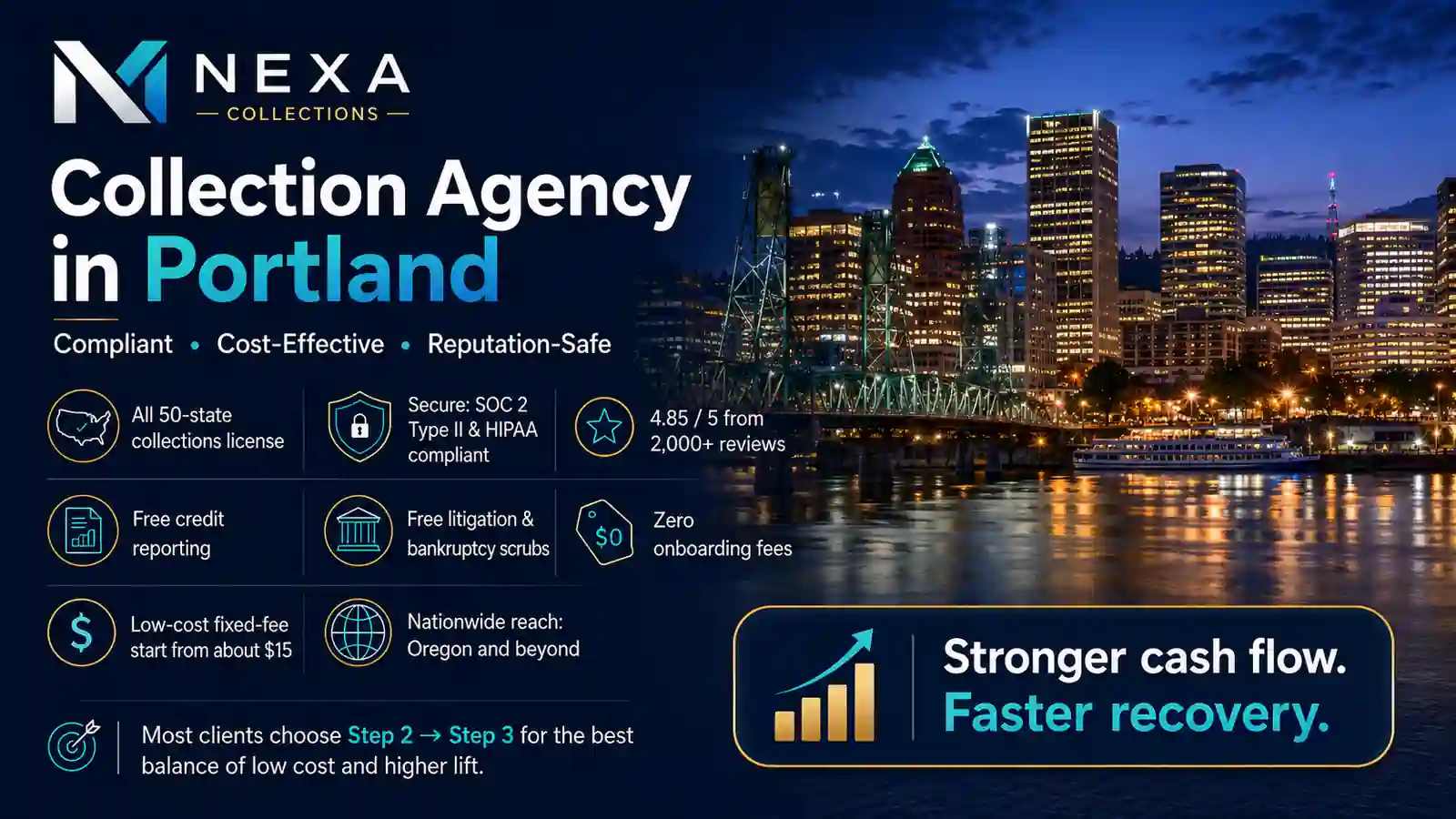
Nexa provides a reputation-safe approach, equipped with all 50-state collections license, offering free credit reporting, free litigious debtor check, free bankruptcy scrub, and zero onboarding fees. Secure – SOC 2 Type II & HIPAA compliant. Over 2,000 online reviews rate us 4.85 out of 5.
Need a Collection Agency? Contact us
The Oregon Legal Landscape
Oregon’s rules apply uniformly across every industry below, which makes them worth understanding once rather than per account type.
| Statute of Limitations (all contract types) | 6 years — ORS 12.080 |
| SOL Revival | Restarts on partial payment or written acknowledgment; not on oral acknowledgment alone — ORS 12.230, 12.240 |
| Wage Garnishment | 25% of disposable earnings, phased-in $400/week protected minimum by July 2026 — ORS 18.385 |
| Small Claims Threshold | Claims of $750 or less generally must file in Small Claims Court (up to $10,000) |
| Judgment Life | 10 years, renewable |
Oregon’s statute of limitations is simpler than most states, and that’s genuinely useful to know precisely.
Rather than splitting written contracts, oral agreements, and open accounts into different limitation periods the way many states do, Oregon applies the same 6-year window across all three. What does vary is revival: a partial payment or a signed written acknowledgment restarts that clock, but an oral acknowledgment alone does not.
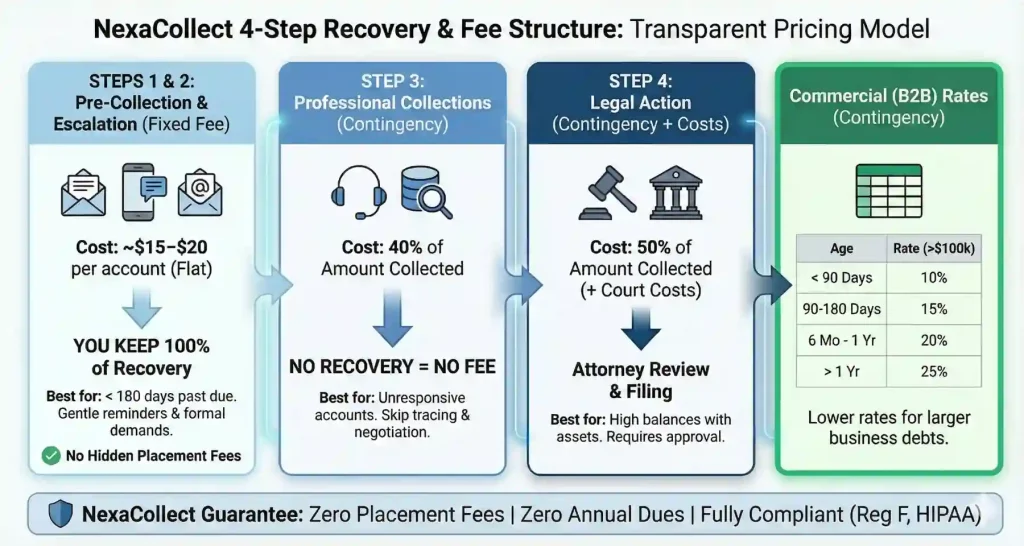
What This Costs
Step 1 & 2: Fixed-Fee Recovery (~$15/account). Professional demand sequences for accounts under roughly 60-90 days. Payments go directly to you. See the full pricing breakdown.
Step 3: Contingency Collection (~40%). For older or unresponsive accounts, no recovery, no fee.
Step 4: Legal Referral (client-approved, ~50%). Filing fees reimbursed from the first recovery.
Who We Collect For Across Portland
- Commercial, B2B & Apparel Licensing: Trade credit and commercial receivables for the metro’s dense athletic and footwear industry cluster, home to a major athletic footwear headquarters, Adidas America’s US operations, and Columbia Sportswear, where licensing and royalty disputes are a genuine, distinct account category requiring the actual license agreement and royalty statements, not just a purchase order. Portland’s “Silicon Forest” technology manufacturing base, anchored by Intel’s significant Hillsboro operations, adds a second, more conventional trade-credit layer on top.
- Medical & Healthcare: HIPAA-compliant patient balance recovery for a healthcare landscape shaped unusually strongly by Oregon Health & Science University, the state’s only academic medical center, whose referral and billing patterns influence independent practices across the region even when they aren’t part of the OHSU network directly.
- Dental: Patient-first dental debt recovery for practices across the metro.
- Restoration Companies: Recovery for water, fire, and smoke damage restoration contractors navigating Oregon’s increasingly severe wildfire seasons, which create genuine demand surges that can, counterintuitively, slow insurance payment cycles at exactly the moment volume is highest, and private-pay balances and deductibles that need a structured follow-up process once internal collection stalls.
- Schools & Higher Education: Tuition and program fee recovery for the metro’s private schools, colleges, and universities, and meal and activity fee recovery for public school districts, both handled with the diplomatic, reputation-first approach these institutions’ family and community relationships require.
- Senior Living: Recovery for the region’s assisted living and skilled nursing communities.
Recent Recoveryin Portland-Area
-
Healthcare corridor (Marquam Hill/OHSU & Inner Eastside): many self-pay balances clear in Steps 1–2 with reminder-style tone.
-
Professional services (Downtown, Lloyd District): older invoices respond to Step 3 plans that match cash-flow cycles.
-
Membership/fitness & trades (SE Division, NE Broadway, Tigard): steady wins using short, respectful follow-ups.
Frequently Asked Questions
Does Portland’s apparel and footwear industry create different B2B collections challenges than a typical commercial account?
Yes. With a major athletic footwear headquarters, Adidas America’s US operations, and Columbia Sportswear all based in the metro, a meaningful share of local commercial disputes involve licensing terms and royalty calculations rather than a simple delivered-goods invoice. Resolving these requires the actual license agreement and royalty statements, documentation that a generic commercial collections approach wouldn’t necessarily know to request.
Why does OHSU’s presence matter for medical collections across Portland, not just its own patients?
Because it functions as Oregon’s only academic medical center, a large share of specialty referrals and complex-case insurance coordination for the entire region flow through or relate to its network, shaping billing patterns for independent practices across the metro in a way a multi-hospital-system city doesn’t experience the same way.
How does Oregon’s wildfire exposure actually affect restoration company receivables?
Severe fire seasons create demand surges where claim volume spikes sharply, and insurers processing that surge don’t necessarily move faster, sometimes the opposite. A restoration company doing significantly more business during a bad season can still face a worse cash position if payment cycles lag further behind at the same time volume increases, making proactive follow-up on aging balances more important during these periods, not less.
How long does a Portland business or institution have to collect on an unpaid account?
Generally six years under ORS 12.080, and unusually, this same period applies whether the underlying obligation is a written contract, an oral agreement, or an open account, a simpler structure than most states, which set different, often shorter periods for unwritten claims.
Does a partial payment restart the clock on an old Oregon debt?
Yes, generally. A partial payment restarts the six-year limitations period under ORS 12.240, and a written acknowledgment signed by the debtor does too under ORS 12.230. An oral acknowledgment alone, without a signed writing or an actual payment, does not have the same effect.
Can a Portland school or district place tuition or meal debt accounts without damaging family relationships?
Yes, when handled diplomatically. Professional demand sequences that read as formal reminders rather than threats, along with payment plan options and a genuine dispute resolution path, resolve most accounts without the kind of confrontation that damages the community trust these institutions depend on, whether the account is private school tuition or a public district’s meal balance.