• Skip to main content
  • Skip to primary sidebar

Nexa Collections

  • Home
  • Serving
    • Medical
    • Dental
    • Small Business
    • Large Business
    • Commercial Collections
    • Government
    • Utilities
    • Fitness Clubs
    • Schools
    • Senior Care Facility
  • Contact Us
    • About us
    • Cost

Debt Recovery

Glass Repair & Glazing Collection Agency: Tired of Unpaid Invoices?

A glass-repair and glazing collection agency helps auto-glass shops, storefront contractors and commercial glaziers recover unpaid residential and business invoices after internal reminders have failed. The agency may verify the balance, contact customers or commercial account holders, negotiate payment plans, locate missing debtors and escalate eligible accounts under applicable collection laws.
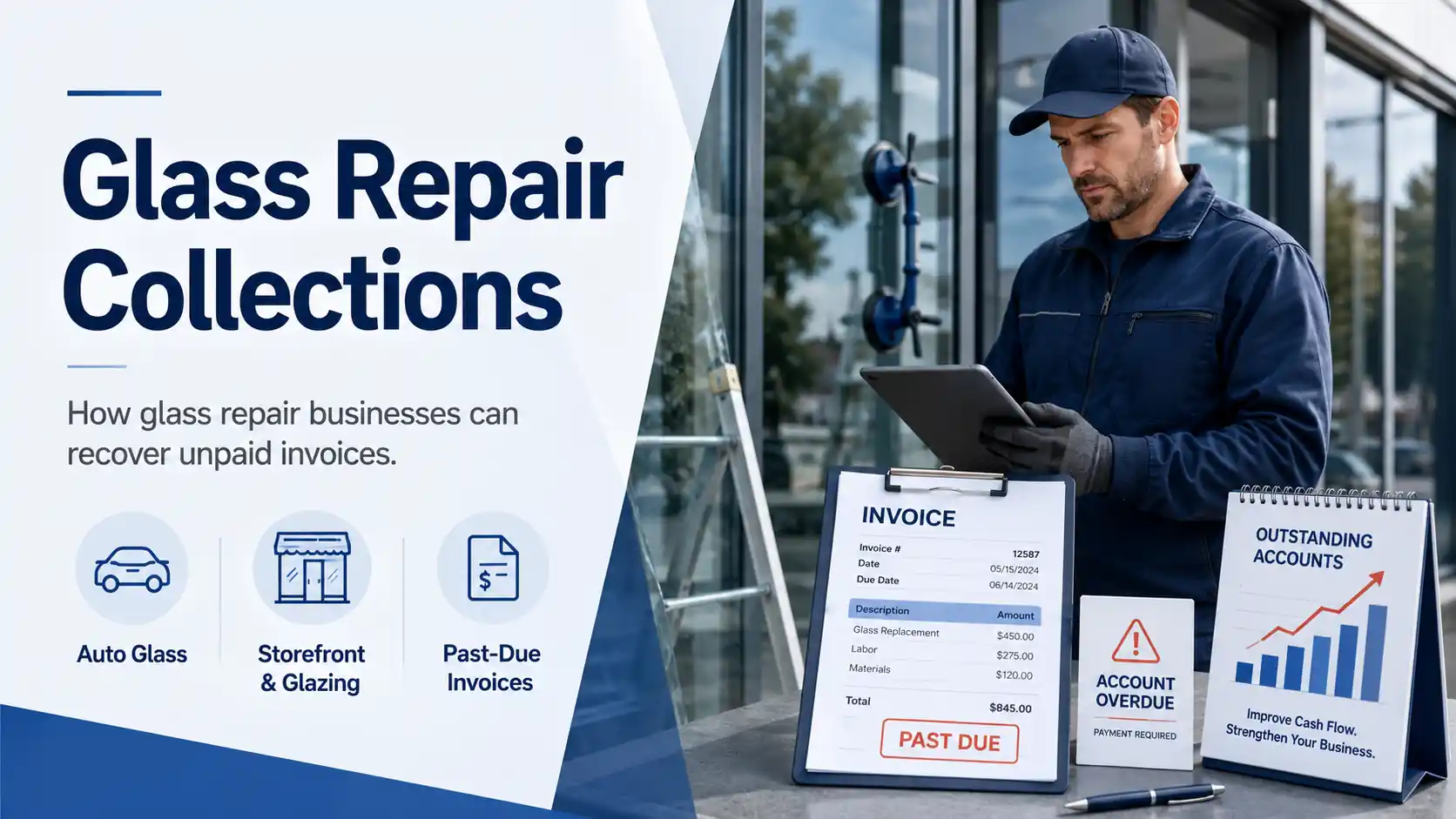
Glass repair contractor reviewing overdue auto-glass and storefront invoices

If you run a glass shop or glazing company, you already know the pattern: your crew rushes out for an emergency board-up, a windscreen gets replaced in a driveway at 7 a.m., a storefront door is fixed before the store opens. The work is done on time, the customer is happy, and then you spend the next 60-90 days chasing the money. Glass repair and replacement is a multi-billion-dollar industry, but plenty of shops are still writing off a painful share of small and mid-sized jobs every year.

Nexa provides a reputation-safe approach, backed by a comprehensive 50-state collections licensing infrastructure, offering free credit reporting,  free litigation/bankruptcy scrubs, and zero onboarding fees. Secure – SOC 2 Type II & HIPAA compliant. 

Need a Collection Agency? Contact us


Why glass repair invoices fall through the cracks

On paper, most glass jobs look simple: send an estimate, do the work, send an invoice, get paid. In the real world, several things go wrong.

“Insurance will pay, right?” Customers often assume insurance covers everything and are caught off guard by a high deductible or a coverage gap; once the glass is in, they stop taking calls. Mobile jobs leave no one ready to pay: a tech finishes the work at home or on site, but the person with the card or the authority isn’t there, and “just invoice me” turns into silence. Construction payment games swallow invoices into the Net 30, Net 60, or retainage cycle, leaving glaziers waiting on money the GC or owner hasn’t released yet. Quality disputes, real or imagined, like noise, distortion, leaks, or a door that doesn’t close quite right, can delay payment even when the work itself is sound. Weak paperwork, with no signed work orders or vague scope language, hands customers an easy excuse to stall.

None of these problems fix themselves. Left alone, aging A/R starts to look like a suggestion instead of an obligation.

The real cost of slow-paying glass customers

A lot of glass owners shrug off a few unpaid tickets. But run the math: an average auto glass job runs $250-$600, ADAS or high-end windshields run $800-$1,500+, small commercial or storefront work runs $1,500-$5,000, and larger glazing packages run $10,000-$50,000+.

Now imagine losing three auto glass jobs at $400 each and two small commercial invoices at $2,500 each in a single month. That’s $7,700 a month, or over $90,000 a year, quietly leaking out of the business. Add the office time spent sending statements, making reminder calls, and arguing with adjusters, and it’s not just revenue disappearing. It’s hours that could go toward booking profitable jobs instead.

Auto glass vs. commercial glazing: two very different A/R headaches

Glass businesses usually sit in one or both of these worlds, and each comes with its own A/R traps.

Auto glass and mobile glass services

Insurance-driven work bills directly to the carrier with the customer owing only the deductible, and trouble starts when coverage isn’t what the customer expected, deductibles run higher than assumed, or claims get denied or delayed. Retail and fleet work brings its own friction: retail customers sometimes ask to be billed later for mobile jobs, while dealers, body shops, and fleet accounts demand Net 30 or Net 60 terms and pay on their own schedule. Once the glass is in, urgency disappears for the customer. For the shop, the clock just started.

Flat glass, storefronts, and glazing contractors

Construction payment chains mean subs often don’t get paid until the GC or owner gets paid, and “paid when paid” language can push invoices out for months. Retainage commonly holds back 5-10% of every draw until final completion and sign-off, tying up real money over punch-list delays. Change orders for extra openings, upgraded glass, or faster lead times get approved verbally on site, installed, and then disputed later because nobody captured the paperwork. Some customers simply treat contractors as a free line of credit; without firmness, the contractor ends up financing the project.

Why unpaid glass invoices keep stacking up

A few root causes show up again and again. No clear payment policy leaves terms, deposits, and late-payment consequences vague or missing from estimates and invoices. Too much trust, too little structure turns “we’ve worked with them for years” into months of chasing an account once that customer hits a cash crunch. Slow follow-up lets invoices age quietly because nobody owns the process, with calls starting at 60 or 90 days instead of 5-7 days past due. Fear of losing the customer delays firm action, even though that client is already costing money. And with no escalation path, staff keep repeating the same friendly reminder long after it stops working.

Legal tools glass companies can use (without becoming a lawyer)

You don’t need to practice law, but understanding the outline of your options helps.

Mechanic’s liens on buildings and storefronts

For commercial and construction work, a mechanic’s lien creates a legal claim against the property improved, whether a storefront, office, or building, and owners usually can’t refinance or sell easily without dealing with a recorded lien. Lien rules are very state-specific: a preliminary notice and strict filing deadlines are typically required, and missing those dates or filing incorrectly can invalidate the lien. Talk to a construction attorney or lien service in your state, and treat lien deadlines as non-negotiable.

Vehicle liens and possessory rights

Some states give auto repair shops a form of mechanic’s or artisan’s lien on vehicles, including, in some places, the right to hold a vehicle until paid or auction it after following proper steps. Rules are more limited or heavily regulated elsewhere. Because this area is sensitive, keep messaging high level and confirm specifics with a local attorney.

Small claims court and judgments

For smaller jobs, small claims court is often the most practical legal option once reminders and collections have failed. A resulting judgment can sometimes be enforced through wage garnishment or bank levies, depending on state law. Legal tools are the last mile of a recovery strategy, not the first step, but it helps to know they exist.

When it’s time to hand glass invoices to a collection agency

A good collection partner doesn’t just chase people. They know how to speak to consumers, property owners, and contractors in a firm but professional way, understand how glass jobs, construction draw schedules, and insurance claims actually work, and have tools like skip-tracing, structured call campaigns, and payment plan management that a busy office doesn’t have time to run.

Typical triggers for placement: no response after 2-3 solid follow-ups, disconnected phone numbers or returned mail, customers making endless promises but never paying, or commercial clients happy with the work but consistently paying 60-90+ days late. By the time an invoice is 120 days old, the odds of getting paid drop sharply. Moving accounts to collections earlier, while they’re still relatively fresh, usually means higher recovery and fewer total write-offs.

How your documentation is handled

Signed estimates, work orders, and proof-of-completion records move through a secure client portal, not scattered email threads. Collection activity on consumer and homeowner accounts follows FDCPA guidelines alongside applicable state debt collection laws; commercial accounts involving general contractors or property owners are handled under standard contract and construction law instead, since the FDCPA specifically covers consumer debt. Whatever you provide stays tied to the accounts placed and isn’t used beyond that.

Where Nexa fits in

Once an account has been through reminders, follow-up calls, and still gone nowhere, Nexa takes it from there. You send the job file; we handle the rest.

What we do:

  • Work directly from your estimates, work orders, and completion records to support recovery.
  • Contact customers, adjusters, property owners, or GCs with a firm, professional tone that fits construction and insurance-driven work.
  • Track lien, vehicle-lien, and small-claims deadlines where relevant, so options don’t quietly expire on aging accounts.
  • Set up payment plans or negotiate settlements where that’s faster than an all-or-nothing standoff.

What this actually costs

Nexa Collections fixed-fee and contingency pricing for glass repair and glazing invoice recovery

Fixed-Fee Recovery ($15/account): ideal for early-stage receivables. Debtors pay 100% directly to you, with no commission taken out.

Contingency Service (20%-40%): performance-based recovery for older or harder accounts. No recovery, no fee.

You focus on making glass look perfect. Let a defined recovery process turn more of that finished work into collected cash. This same approach covers how Nexa’s commercial collections process works for B2B invoices, whether that’s a single client who keeps not paying, commercial lease and property-related defaults, or how other trade contractors, like electricians and HVAC companies, handle the same problem. For exact rates on every tier, see the full breakdown of Nexa’s fixed-fee and contingency pricing.

Need help recovering unpaid glass invoices? Speak with a collection specialist: Contact us.


FAQ

How long should I wait before sending a glass invoice to collections?

For most consumer and small commercial jobs, many glass businesses aim to send accounts to collections around 60-90 days past due if reminders haven’t worked. For larger construction jobs, timing may be tied to mechanic’s lien deadlines and contract terms.

Can I file a lien if a customer doesn’t pay for window or storefront work?

In many places, yes, if you’ve supplied and installed glass or glazing that improved the property and you follow your state’s notice and filing rules. Because lien law is technical and state-specific, talk to a construction attorney or lien service before relying on this.

What should I send to a collection agency for a glass invoice?

Signed estimates or work orders, invoices and statements, proof of completion such as photos, delivery notes, or job tickets, and any emails or texts about changes or warranty work. Stronger documentation makes collection easier.

Will using a collection agency scare off my good customers?

Handled poorly, yes. Handled well, no. A professional agency focuses on firm, respectful communication and payment solutions, not harassment. Most serious customers understand that ignoring multiple reminders leads to escalation.

Should I sue or use collections for small auto glass jobs?

For small tickets, under a few thousand dollars, collections or small claims court are usually more practical than a full lawsuit. Many shops reserve lawsuits for larger commercial or construction disputes and rely on collections for smaller, repeat-pattern debts.

Does the FDCPA apply to unpaid glass repair invoices?

It depends on the customer. The FDCPA governs consumer debt, so residential and homeowner jobs are covered. Invoices to general contractors, insurers, or property management companies are handled under commercial and construction law instead.

What’s the difference between the fixed-fee and contingency pricing options?

Fixed-Fee Recovery, at $15 per account, suits early-stage receivables; debtors pay 100% directly to you with no commission. Contingency Service, at 20-40%, is performance-based for older or harder accounts, with no recovery meaning no fee.

Can a collection agency track my mechanic’s lien or vehicle lien deadlines?

Yes. Tracking those deadlines is part of the value, since missing a preliminary notice or filing window can eliminate lien rights entirely before an account would otherwise reach a legal escalation point.

Is my job documentation kept secure during the collections process?

Yes. Estimates, work orders, and completion records move through a secure client portal rather than scattered emails, and documentation is used only for the accounts you’ve placed.
Filed Under: Debt Recovery

Restoration Collection Agency | Recover Deductibles, Insurance Checks & Invoices

Restoration contractors shouldn’t have to finance an insurance claim after the work is already finished. You may have paid the crews, equipment and material costs weeks ago while an unpaid deductible, homeowner-held insurance check, mortgage endorsement, supplement dispute or final reconstruction invoice remains stuck for 60, 90 or even 120 days.

Nexa helps water, fire, mold and reconstruction companies recover these restoration-specific receivables using Xactimate and AOB-aware collection strategies, skip tracing, reputation-safe communication and timely escalation before valuable lien rights or recovery opportunities disappear. Fresher accounts can start with low-cost fixed-fee recovery, while older or disputed balances can move to contingency collections.

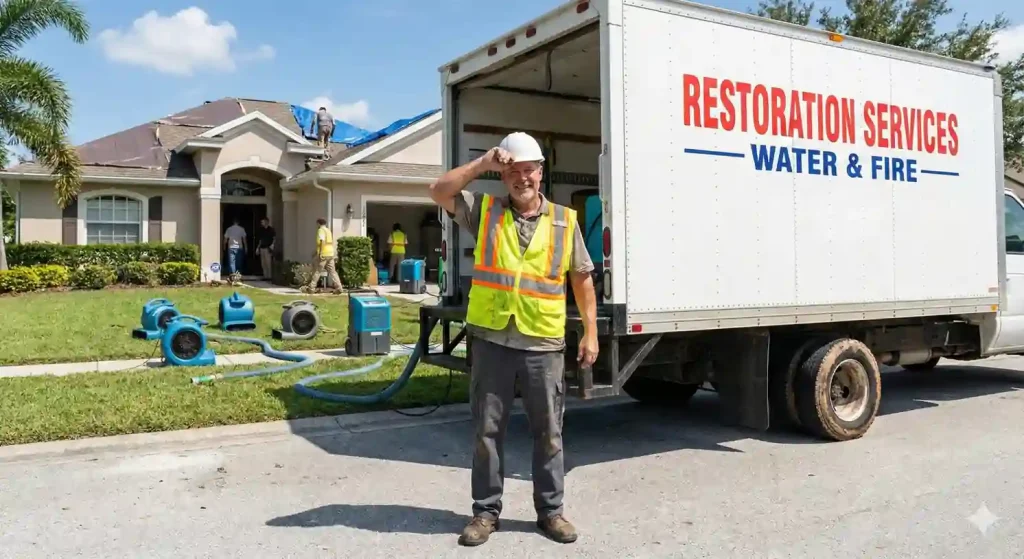
Restoration company technicians drying a water-damaged home during an insurance claim

Key Strength: We address core property restoration pain points directly—such as delayed insurance checks, mortgage company endorsement delays, deductible collection friction, and AOB/claim coverage disputes.

The Restoration Industry’s Built-In Cash Flow Problem

Restoration is the only trade where the job finishes before the money question is even settled. You mobilize crews and equipment on a call at 2 a.m., dry out a structure over the next 72 hours, and then wait — sometimes 60, 90, or 120 days — for a claims process you don’t control to release funds you already spent to earn.

The “Float” Between Mitigation and Payment

Unlike most service businesses, restoration contractors front the cost of the job before the payer — an insurance carrier, an adjuster, or a homeowner — has even finished evaluating the claim. That gap is where bad debt is born: not from bad customers, necessarily, but from a payment chain with too many hands in it.

When the Insurance Check Never Makes It to You

The single most damaging failure point in restoration billing is the co-payable insurance check. Carriers frequently mail the settlement directly to the policyholder rather than the contractor, and industry data suggests that over 30% of restoration bad debt stems from homeowners simply keeping that money instead of forwarding it. Nexa treats this scenario differently than a standard past-due invoice: it is framed and pursued as misappropriation of funds paid for a specific purpose, which carries more legal weight — and more urgency for the homeowner to resolve — than an ordinary unpaid bill.

Practical Example: The Check That Took a Detour

Consider a composite scenario typical of the industry: a Class 3 water loss at a single-family home results in a $22,000 mitigation and drying invoice. The carrier approves the claim and issues a check made out jointly to the homeowner and their mortgage servicer. Instead of endorsing it over to the contractor, the homeowner deposits it toward an unrelated renovation and stops responding. Ninety days pass. In a case like this, the leverage isn’t a polite reminder — it’s making clear, in writing, that the funds were designated for a specific repair and that retaining them changes the nature of the dispute entirely.

Serving Restoration Companies Nationwide

Need a Debt Collection Agency? Contact Us

Higher Recovery Rates : Restoration collection experts!

Why Restoration Contractors Partner With Nexa

Generic collection agencies treat every account the same way: a name, a balance, a form letter. Restoration receivables need a collector who already understands the paperwork before the file lands on their desk.

We Read Xactimate Estimates and AOB Contracts Like Native Speakers

A demand letter that references “Class 1” versus “Class 4” water categories, or that correctly cites an Assignment of Benefits (AOB) agreement, lands very differently with a debtor than a generic notice. Nexa’s collectors are trained on restoration-specific documentation so the paper trail proving your debt is valid gets used effectively from the first contact.

We Untangle Mortgage Endorsement Delays

One of the most common — and most avoidable — delays in restoration payment is a check that requires a mortgage company’s endorsement before it can be cashed or forwarded. Nexa helps push that process along so funds already approved by the carrier don’t sit idle in a drawer for months.

We Protect the Reputation You Built in Your Own Backyard

Your restoration customer is frequently a neighbor, a referral source, or someone whose friends are your next lead. Recovery has to be firm enough to get paid and professional enough that your name in the local market stays intact. That balance is the whole job.

Serving Restoration Companies Nationwide — Need a Debt Collection Agency? Contact Us

The Restoration Receivables We Recover

Unpaid Deductibles

The $500–$2,500 gap that homeowners are contractually responsible for but frequently try to avoid, often assuming the contractor will absorb it rather than chase a small balance.

Ghosted Insurance Checks

Funds a carrier already released — and a homeowner already cashed — that never made it to the contractor who did the work.

Emergency Mitigation Invoices

Water extraction, board-ups, tarping, and other first-24-hours work performed under emergency conditions, often before a signed contract was even possible.

Reconstruction Final Payments

The back-end balance due once a rebuild is complete and the homeowner has moved back in — and has far less urgency to settle the last invoice.

Supplement Disputes

Cases where the carrier approves additional work beyond the original scope, but the homeowner keeps the supplemental payment instead of passing it to the contractor who performed it.

Our Process: Beating the Mechanic’s Lien Clock

A mechanic’s lien deadline is a hard stop. Filing one protects your right to payment, but it also means legal fees, paperwork, and a slower path to cash than most contractors want. Nexa’s process is built to resolve the account before that deadline forces your hand.

Step 1 — Verification & Skip Tracing

Before any contact is made, Nexa confirms whether the insurance carrier has actually issued payment on the claim. If the homeowner has relocated — common after a major fire or flood displaces a family — skip-tracing tools are used to locate current contact information quickly.

Step 2 — Strategic Demand & Credit Bureau Reporting

Outreach happens across multiple channels, and eligible accounts can be reported to major credit bureaus. A negative mark on a credit file is a strong motivator for a homeowner who is mid-refinance or preparing to sell the property that was just restored.

Step 3 — Negotiation & Certificate of Satisfaction Mediation

Disputes over “dry logs,” moisture readings, or a homeowner refusing to sign a Certificate of Satisfaction are common late-stage sticking points. Nexa’s specialists mediate these directly to move the account to resolution rather than letting it stall indefinitely.

Trust, Security & Compliance

FDCPA & FCRA Alignment

Every account is worked in alignment with the Fair Debt Collection Practices Act and Fair Credit Reporting Act, so recovery efforts stay within federal consumer protection boundaries — protecting both the homeowner’s rights and your business’s legal standing.

HIPAA & BAA Coverage for Healthcare-Facility Restoration Jobs

Restoration work isn’t limited to private homes — clinics, dental offices, and senior living facilities call for emergency mitigation too, and those jobs can involve documentation that touches protected health information. For those accounts, Nexa maintains HIPAA-aligned handling procedures and executes a Business Associate Agreement (BAA) where the engagement requires one, so a clinic or facility restoration receivable is handled with the same data safeguards as a medical billing account.

SOC 2 Type II & PCI-DSS Data Security

Nexa’s data handling is SOC 2 Type II certified, meaning security and privacy controls have been independently audited rather than self-reported. Payment processing runs at PCI-DSS Level 1, the highest available tier of card data encryption.

Secure Client Portal for Documentation & Account Tracking

Xactimate estimates, AOB agreements, dry logs, and photos are exactly the kind of sensitive project documentation you don’t want sitting in an email thread. Nexa’s secure client portal lets you upload that documentation, track account status, and monitor recovery progress without exposing client or project data to unnecessary risk.

Transparent, Restoration-Friendly Pricing

Restoration receivables don’t all look the same, so the fee model shouldn’t either.

Fixed-Fee Recovery ($15/account)

Best suited to early-stage receivables — invoices where the debtor relationship is still fresh and a firm, professional nudge is likely enough. Debtors pay 100% directly to you. There are no commissions taken from what’s recovered.

Contingency Service (20%–40%)

Built for older, disputed, or “ghosted” accounts that need sustained investigation, skip tracing, and negotiation. No Recovery, No Fee — Nexa is paid only when the account is successfully collected.

Nexa Collections fixed-fee and contingency pricing structure for restoration company debt recovery

See the full breakdown on the collection agency fee schedule page.

Frequently Asked Questions

Can you collect if I never got a signed contract?

It’s harder, but far from impossible. Text messages, emails, before/after photos, and dry logs showing the homeowner allowed the work to proceed can support an “unjust enrichment” claim even without a signature.

Do you charge upfront fees?

Only under the fixed-fee option, which is a flat $15 per account regardless of outcome. Under the contingency option, there’s no upfront cost at all — payment is a percentage of what’s actually recovered, and nothing is owed if nothing is collected.

Can you help with small deductible balances?

Yes. Restoration companies often write off sub-$1,000 balances because chasing them individually doesn’t feel worth the effort — but ten of those add up to real money fast, and a dedicated low-balance process is exactly where volume recovery pays off.

What happens when the insurance check was made out jointly to the homeowner and their mortgage company?

This is one of the most common restoration payment delays. Nexa works to move the endorsement process along so funds the carrier already approved aren’t stuck indefinitely because of a missing signature.

Will pursuing collection damage my relationship with the insurance carrier?

No — the dispute here is almost always with the homeowner who received or withheld funds, not with the carrier who already paid the claim. The carrier’s involvement in the claim is typically already finished by the time collection begins.

How fast do I need to act before a mechanic’s lien deadline?

Lien deadlines vary by state and project type, so timing matters. The sooner an account is placed, the more room there is to resolve it through collection before a lien filing becomes the only remaining option.

Stop Financing Your Customers

Your crews restore homes. They shouldn’t also be financing the insurance payouts that pay for it. Let Nexa handle the recovery so cash flow doesn’t depend on how quickly a homeowner decides to forward a check.

Get a Free Restoration Quote

Filed Under: Debt Recovery

Selecting a Collection Agency Just Because It’s Cheap? Never.

blank

A collection agency is not a “low-bid vendor.”
It’s a business partner trusted with your brand, your customer relationships, and your cash flow.

Choosing an agency the way you’d choose the lowest-priced plumber is one of the fastest ways to lose money twice:
first in unpaid balances… and then in bad recovery performance.

Here’s the reality: collection agencies know exactly what their competitors charge.
So when you see an agency offering rock-bottom contingency fees, ask the obvious question:

How are they funding the work it takes to actually recover your money?

Because the fee is not the goal.
The recovery is the goal.


Why “Low Fee” Can Mean “Low Recovery”

Agencies that charge higher contingency fees aren’t foolish.
There’s a reason they can justify it: they invest more effort and better talent into recovering accounts.

A good collector is in high demand.
They don’t work harder for less. That’s not how the world works.

When an agency agrees to collect at too-low contingency fees, it often signals one of these problems:

  • They can’t afford strong collectors

  • They don’t devote enough time per account

  • They run a “volume machine” (quantity over quality)

  • They cut corners on compliance and supervision

  • They create reputation risk for you

  • Their data security is not up to mark. Collection agencies are required to have bank level GLBA secure systems. Unfortunately, not all collections can effort it, putting them and you at risk.

And if the agency uses inferior-quality collectors, your business reputation becomes the collateral damage.


Collection Agencies Have High Overhead Costs (For Good Reason)

Let’s break down what a serious collection operation actually costs.

  • Experienced, top-tier collectors are expensive.
    Most collectors are commission-based contractors. They earn a percentage of what they collect.
    If the agency’s contingency fee is too low, the collector’s earnings shrink—so the best collectors won’t stay.

  • Supervision + professional workspace matters.
    A well-run operation needs oversight, support staff, training structure, and the right equipment.
    Ask yourself: do you want low-wage collectors working from home, or overseas, handling your accounts?

  • Ongoing training on Federal + State laws is non-negotiable.
    Collection laws change. Scripts change. Call practices change.
    Agencies that don’t train regularly risk violations—and your brand absorbs the blowback.

  • Secure data handling + annual security audits are not cheap.
    You share sensitive customer information. Secure systems means money, hiring an inhouse IT security engineer.
    If a third-party agency gets breached, imagine the liability and chaos for your company.

  • Skip tracing and recovery tools cost money.
    Effective recovery requires subscriptions to real services—advanced skip tracing, not “basic tracing for the namesake.”

  • Being licensed, bonded, and insured costs money.
    Protection against counter-lawsuits isn’t optional—it’s operational hygiene.

  • Client portals, reporting, document uploads = IT costs.
    A professional system for submitting accounts, monitoring progress, and running performance reports requires investment.

Bottom line:
Hiring a collection agency just because it offers rock-bottom fees—without investigating further—can be costly.
You often get what you pay for.


Optimum Collection Fees (What’s “Too High,” “Too Low,” and “Just Right”)

This is what we consider generally healthy contingency pricing.

For Consumer Collections (B2C)

  • Over 50% contingency is usually unacceptable and too high
    (unless the debt is more than 2 years old and extremely difficult to collect)

  • 50% is slightly on the higher side

  • 45% to 50% is considered acceptable

  • 35% to 45% is typically the sweet spot for a strong agency

  • Below 35% may be too low unless the balance is over $10,000


Performance Beats Fees (Simple Math, No Drama)

Let’s say you assign a balance of $10,000 to a collection agency.
You have two options: Agency A and Agency B.

Agency A

  • Charges 40% contingency

  • Recovers 50% of the balance (recovers $5,000)

  • You receive $3,000 after fees

Agency B

  • Charges 25% contingency (sounds amazing on paper)

  • Recovers 30% of the balance (recovers $3,000)

  • You receive $2,250 after fees

Performance wins.
Any business owner would pick Agency A.

Because you don’t deposit “low contingency fees” in your bank account.
You deposit recovered dollars.


Let Me Repeat (Because This Is Where People Get Tricked)

Collection agencies know their competitors’ pricing.
They don’t charge higher fees “just because.”

They charge higher because:

  • the work is harder than it looks

  • good collectors cost more

  • compliance requires constant investment

  • recovery performance takes time and talent

Now, to be fair:
Not every low-fee agency is automatically bad.
And not every higher-fee agency is automatically great.

But if an agency is offering a rock-bottom rate, ask why.
Ask what you’re getting for that price.
And make a mindful selection.


For Commercial Collections (B2B)

Commercial accounts typically involve higher balances and more complexity, so pricing works differently.

  • Contingency fees are typically between 15% and 35%

  • A collection agency will give you a quote depending on:

    • the balance size

    • the age of the account

    • the complexity of the case

  • There is no fixed fee in most B2B commercial scenarios


Final Thought

The cheapest agency is rarely the one that returns the most money.
In collections, “cheap” can quietly translate into:

  • fewer attempts

  • weaker collectors

  • lower recovery

  • higher reputation risk

  • bigger losses over time

So don’t hire based on fees alone.

Hire based on performance, professionalism, and protection of your brand.

Filed Under: Debt Recovery

Criteria to Hire a Collection Agency?

Is your company constantly losing money due to overdue accounts receivable? Several delinquent accounts have remained uncollectable despite your best efforts or even when you followed all your company-recommended procedures and policies. Furthermore, chasing customers to clear their bills wastes too much time. This keeps your team members away from the core business responsibilities they were hired for.

blank

Did you notice that 75% of the accounts which become over 90 days past due never get resolved unless outsourced to a professional collection agency?

Nexa provides a reputation-safe approach, equipped with all 50-state collections license, offering free credit reporting, free litigious debtor check, free bankruptcy scrub, and zero onboarding fees. Secure – SOC 2 Type II & HIPAA compliant. Over 2,000 online reviews rate us 4.85 out of 5.


  Simple Pricing 

  • $15 Fixed-Fee Recovery — you keep 100% of what we collect

  • 40% Contingency — no recovery, no fee

Why should your company hire a professional collection company?

We have prepared a list of “Frequently Asked Questions” that will help you genuinely address your concerns and also help you design a strong case for your company’s senior management.

1. What is the expense involved in hiring a collection agency?

>> None – Accounts can be submitted for contingency collections. Therefore there are no upfront costs. A collection agency returns 60% of the money recovered and keeps 40%.  Many collection agencies offer flat-fee services too, starting at $15 per account.

For commercial collections (B2B), contingency rates are lower. Collection agencies also offer first-party pre-collection services if your staff hardly gets time to follow up on delinquent accounts.

2. Which accounts would you transfer for collections?

>> Only those accounts that have not paid for more than 60 days should be transferred. In other words, you have given them at least two billing cycles to pay directly to you.

3. Any other financial benefit to the company?

>> Many. Almost 90% of these accounts over 90 days past due are written off as a loss. The effort and cost involved in following up offsets the recovery made on them. In short, our company is not gaining anything by following up on accounts over 90 days.

On the other hand, money recovered by a collection agency will be 100% profit for the company.

4. Would you need more people to follow up with a collection agency?

>> Not at all.  Employees will have more time in hand as they won’t have to waste time on these hard-to-collect accounts. Only 1-2 existing employees would spend 15-30 minutes daily submitting past-due accounts on the collections agency website.

In-house employees hate doing debt collections anyway. It will also alleviate the pressures on your billing department. 

5. Why can’t you do the same thing internally?

>> No, you cannot replicate what professional collection agencies can do. Collection agencies have advanced tools that assist in collecting money from hard-to-collect accounts.
They do Skip Tracing to locate missing debtors.
They also perform Bankruptcy checks and several other checks that assist in recovering money.
They do debt collections every day and can handle collections efficiently and effectively.
Collection agencies are also aware of the ever-changing Federal and local laws involved in debt collection.

6. Is there any security risk if you hire a collection agency?

>> Accounts are submitted using a secure website.

The agency will additionally provide security certifications to ensure the data is handled securely. Collection agencies are licensed, bonded, insured, and diplomatically perform collections. This dramatically reduces the company’s own risk against potential lawsuits.

7. A 40% contingency fee. Should you look for a cheaper agency?

>> 40% is a reasonable fee in the collections industry. All “good” collection agencies charge between 40%-50%. Moreover, if your average balance is over $1000, the contingency rate can be lowered to around 35%. Hiring a collection agency with better returns is more important than going for the cheapest. Lower-cost agencies do not spend enough time and tools required for higher returns. 

8. How long will it take to set up?

>> Just one business day after the contract with the agency is signed, another 1-2 days to train in-house employees to get used to the process. You will be up and running in less than 3-4 days. 

9. Why should you move fast?

>> The success rate of collecting from older accounts reduces significantly over time. The probability of collecting money falls about 10% every month. By waiting, our company is only losing money.

10. Would it upset our customers?

>> Chances are low. The Fair Debt Collection Practices Act (FDCPA) is the primary federal law that governs debt collection practices. The FDCPA prohibits debt collection companies from using abusive, unfair, or deceptive practices to collect debts from debtors. All collection efforts are made diplomatically with the intent to preserve relationships.

A collection agency will also try to build a positive relationship with your customer, which will help prevent non-payment issues from reoccurring in the future.

11. Why would a client pay a collection agency versus when you ask them to pay you directly?

>> That’s indeed a fact. People are much more fearful/concerned when a collection agency is involved. They know that a collection agency will not back off quickly. For reasons beyond the scope of this article, a simple fact is that people indeed dig their pockets deeper to pay off a collection agency.

12. Which agency should you select? With Local or National presence?

>> The location of a collection agency does not matter, but they should be licensed in your state and where your debtors reside. A collection agency with a nationwide presence should be preferred. If a debtor crosses state lines, you won’t have to look for a new agency to pursue that debt.

13. Do they keep your money collected in a Trust Account:

Always select a collection company that deposits all money collected for creditors in a separate bank Trust Account.

Fill out our “Contact us“, and we will simplify this process.

14. What documents or information do you need to place an account?

>> Typically the original invoice or signed agreement, an account statement or payment history, and current contact information for the debtor. The more documentation you have — a signed contract, delivery records, prior correspondence — the stronger the case if the account ever needs to escalate.

15. What happens if the debtor disputes the debt?

>> Collection activity pauses to investigate the dispute rather than continuing to press forward, consistent with FDCPA requirements. You may be asked for additional documentation to validate the debt. A legitimate dispute gets resolved on its merits — it isn’t something the agency pushes past.

16. Does “free litigation” mean the agency will sue on our behalf at no extra cost?

>> It means there’s no separate fee just to have an account reviewed for litigation potential and referred within the agency’s attorney network if it qualifies. Court costs and any attorney fees beyond the standard contingency are typically reviewed and approved by you before a suit is actually filed.

17. How do we track the status of accounts we’ve submitted?

>> Through a secure online portal showing account status, notes, and any payments received — no need to call or email for an update.

18. Can we recall an account if the customer decides to pay us directly?

>> Yes, most agencies allow an account to be recalled or closed if the debtor pays you directly. Some still expect a fee if their outreach contributed to that payment, so it’s worth confirming the specific terms before placing an account.

19. Is there a minimum balance or number of accounts required to get started?

>> Generally no. Single accounts and larger batches can both typically be submitted, and a fixed-fee option can make even smaller balances worth pursuing.

Conclusion:

Companies do not even realize that they often spend “more money” trying to collect. This is primarily due to the lost time of employees, resources, and many other hidden costs.

If you feel transferring an account to a professional debt collection agency after 60-90 days is cost-effective for your organization, you are 100% right. Collection agencies have been around for decades, and every year they recover billions of dollars for organizations like yours, which cannot collect money from those hard-to-deal-with customers.

It is common for organizations to focus only on getting new customers and mostly ignore their past-due accounts. Engaging an outside organization for debt collection requires approval from upper management, CEO, CFO, or business owner. The concept of transferring accounts to a collection company is prevalent. Even Fortune 500 companies hire a collection agency.

Filed Under: Debt Recovery

Insurance Recoupment Defense: Stop The “Clawback”

blank

Standard debt collectors dial phones. We fight audits.

If you have received a demand letter from an insurance payer asking for money money back—or worse, if they are already withholding funds from your current checks to pay off an “old debt”—you are facing Recoupment.

This is not a collections issue. It is a legal and compliance dispute. Treating it like standard bad debt is why most practices lose these battles.

At NexaCollect, we don’t just ask them to stop; we audit the auditors.

Need a Collection Agency? Contact us


Why Switch? The “Takeback” Letter is Not a Bill.

Most collection agencies operate on a simple model: they harass patients to pay $50 copays. But when UHC, Aetna, or a Medicare MAC demands $50,000 back because of an “alleged coding error” from two years ago, a standard agency is useless. They cannot argue ERISA law, and they cannot audit a CPT code.

The Landscape Has Changed in 2026:
Insurance payers are now using AI-driven “Predictive Overpayment” models. In 2024 alone, initial claim denial rates spiked to 11.8%, and automated recoupment demands increased by over 20% in the commercial sector. They are using algorithms to find patterns and demand bulk refunds, hoping you are too busy to fight back.

The Nexa Difference:

  • Force Multiplier for Billing Staff: Your billing team is built to submit new claims, not fight forensic legal battles on old ones. We handle the heavy lifting so they don’t burn out.

  • Reputation-Safe Dispute Resolution: We argue on regulatory and contractual grounds—never aggression. This preserves your contract status with the payer while protecting your bank account.

  • The “Investigation” Shield: Under the revised CMS 60-Day Rule (effective Jan 1, 2025), proper investigation protocols can pause the refund clock for up to 180 days. We know how to trigger these pauses to buy you time and leverage.

The “Takeback” Danger Zone: 3 Risks of Waiting

  1. Statute of Limitations: Many states have strict “clawback” windows (often 12–24 months). If you don’t initiate the recoupment professionally and quickly, the money is legally gone.

  2. Provider Resistance: Providers often view recoupment as a “hidden tax.” Our mediators bridge the gap, explaining the data clearly to reduce friction.

  3. Offsetting Complications: While future payment offsetting is common, it can lead to reconciliation nightmares. Direct recovery through Nexa keeps your books clean.


Q&A: The Executive Guide to Recoupment Defense

Q: Why does a collection agency letter work when my rebills failed?

A: It triggers a “Statutory Countdown.” When you simply resubmit a claim, it goes back into the automated claims queue—often to be denied by the same algorithm. A Legal Demand Letter is different. It is classified as a “Pertinent Communication” under state Unfair Claims Settlement Practices Acts.

  • The Shift: It forces the carrier to route your claim out of the automated queue and into the “Dispute Resolution” or “Legal” department.

  • The Timer: In most states, once this letter is received, the carrier is legally required to respond within a stipulated timeframe (typically 15 to 30 days). If they ignore it, they risk “Bad Faith” litigation penalties.

  • The Result: Your case is finally prioritized and reviewed by a human specialist, not a bot.

Q: Is it legal for them to just take money out of my current checks?

A: Often, yes—but they must follow strict procedural rules. This is called “offsetting.” However, under ERISA laws, if the original plan was self-funded (which many employer plans are), the insurer may not have the right to offset funds from a different patient’s claim to pay for the first one. We audit every offset to ensure they aren’t robbing Peter to pay Paul illegally.

Q: How far back can they go?

A: It depends on your state and your contract.

  • Commercial Payers: Usually limited by state “Lookback Periods.” For example, Florida generally limits recoupment to 30 months, while Texas prompt pay laws have a 180-day limit for certain clawbacks. If your contract is silent, general state statutes of limitation (often 4-6 years) might apply.

  • Medicare (RAC Audits): Generally 3 years, but can go back further if “fraud” is alleged (which they use loosely).

  • The Defense: We frequently get demands thrown out simply because they violate the “Lookback Period” by even one day.

Q: Can we fight a “Medical Necessity” recoupment?

A: Absolutely. These are the most common and the most beatable. Payers often use automated “black box” algorithms to deny care as “not medically necessary” without a human doctor ever reviewing the chart. We force them to produce the clinical credentials of the reviewer. If an algorithm made the decision, we challenge the validity of the audit itself.


Recent Results:

We do not use hypothetical examples. These are real scenarios handled by specialized defense teams.

Scenario A: The “AI Algorithm” Mass Sweep

  • The Threat: A mid-sized Surgical Center received a bulk demand for $420,000. A major commercial payer’s AI algorithm flagged every instance of a specific CPT modifier used over the last 18 months, claiming it was “unbundled” incorrectly.

  • The Defense: We utilized the No Surprises Act dispute framework and clinical coding guidelines to prove the AI failed to account for the specific anesthesia time units associated with the procedure.

  • The Result: The demand was reduced to $12,500 (a 97% reduction) after we proved the vast majority of claims were compliant.

Scenario B: The “Silent” Offset

  • The Threat: An Out-of-Network provider noticed their revenue dropped by 15% overnight. The payer had silently begun withholding $15,000 per month from current checks to satisfy a disputed overpayment from 2021 regarding “Usual and Customary” rates.

  • The Defense: We issued a legal demand citing a breach of ERISA procedural requirements, specifically the failure to provide a “Full and Fair Review” before commencing recoupment (citing Montanile v. Board of Trustees precedents).

  • The Result: The offsetting stopped immediately. The $85,000 already withheld was returned to the provider, and the original dispute was moved to mediation.


Ready to Stop the Bleeding?

A recoupment demand is a time-sensitive legal threat. Every day you wait is a day the “Lookback Period” might expire or the “60-Day Rule” might lock you in.

Do not let them audit you into the red.

Get a Free Audit Defense Consultation

Filed Under: Debt Recovery

Speed Up Medical Insurance Claims with a Collection Agency

Medical Insurance collection agency

Most medical and dental professionals struggle to recover money from insurance companies in a timely manner. While some insurers consistently process claims within 30 days, others can take up to 120 days to pay. This unpredictability in the reimbursement process leads to cash flow challenges and other operational issues.
 
Medical insurance claims submitted by doctors, dentists, and hospitals with proper documentation must be paid within established time limits, or the insurers may face penalties and other sanctions. These requirements, known as “prompt-pay statutes,” are primarily enforced within the healthcare industry.
 

Helping Medical Professionals to Recover Unpaid Insurance Claims !

Serving Nationwide: Contact Us

When a third-party collection agency contacts an insurance company, the insurer is reminded of its obligation to pay claims promptly. Failing to resolve medical insurance claims on time can result in a violation of state law.

Once an insurance company receives a collection notice from a professional collection agency, they are under pressure to act fast.

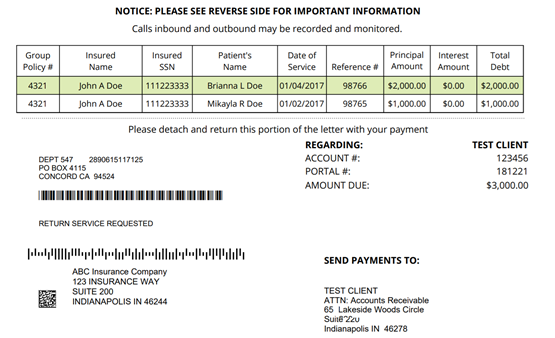
Collection Notice ( Sample)

We have made repeated attempts to resolve this matter with no response from your office. This leaves us no alternative but to pursue this debt through more intense collection methods.

We hope that further efforts will be avoided on this account by sending payment in full to the address in the bottom portion of the letter.

As of the date of this letter, the balance due and owing is stated above. Because of interest that may vary from day to day, the amount due on the day you pay may be greater. Hence, if you pay the amount shown above, an adjustment may be necessary after we receive your check, in which event we will inform you before depositing the check for collection. For further information, please write the undersigned.

THIS COMMUNICATION IS FROM A DEBT COLLECTOR. THIS IS AN ATTEMPT TO COLLECT A DEBT AND ANY INFORMATION OBTAINED WILL BE USED FOR THAT PURPOSE.

blank

These laws and payout periods vary from state to state in terms of operation, complexity, and severity. However, they all share the common goal of compelling insurers to promptly and fully pay all legitimate claims. Debt issues in the BSFI market are anticipated to grow significantly over the next 10 years.

Non-timely reimbursements is a leading cause of stress and burnout among medical professionals, then why not outsource unpaid medical insurance claims to a professional agency and get paid faster.

Examples of “prompt-pay statutes” law in some states.

Texas Insurance prompt payment statute:
The Texas Prompt Pay Act (“TPPA”) is codified in the Texas Insurance Code as Subchapter J of Chapter 843 (governing health maintenance organizations (HMOs)) and Subchapters C and C-1 of Chapter 1301 (governing preferred provider organizations (PPOs)).

California prompt payment statute:
California Health & Safety Code 1371. A health care service plan, including a specialized health care service plan, shall reimburse claims or a portion of a claim, whether in-state or out-of-state, as soon as practicable but no later than 30 working days after receipt of the claim by the health care service plan, or if the health care service plan is a health maintenance organization, 45 working days after receipt of the claim by the health care service plan.

Florida Insurance prompt payment statute:
Florida statute 627.6131, otherwise known as the “Prompt Pay Statute,” requires insurance companies to make decisions and pay out on claims quickly. The timeframe created by this legislation depends on how the claim was received, either electronically or physically.

New York State prompt payment law health insurance:
Law § 3224-a (McKinney 2000) requires payment of health claims by health insurance companies within 45 days of receipt of such claim; N.Y. Ins. Law § 5106 (McKinney 2000) requires motor vehicle no-fault providers to pay health claims arising from vehicular accidents to be paid within 30 days of receipt of such claim.

North Carolina: 30 days for payment or denial.

North Dakota, Georgia: 15 days

Ohio, Oregon, Delaware, Idaho, Kansas, Kentucky, Maine, Maryland, Massachusetts, Minnesota, Montana, Nevada, Wisconsin: 30 days

Oklahoma, Colorado, Pennsylvania, Missouri, Nebraska, Vermont, Virginia, Wyoming: 45 days

Alabama, Arkansas: 30-45 days

Arizona: 30 days after the claim is approved

Louisiana: 25 to 45 days

Mississippi: 25-35 days

( days refer to “working” days)

References:
www.tlrfoundation.com/sites/default/files/pdf/TLR_Prompt_Pay_PDF_V01.pdf
danahyandmurray.com/florida-prompt-payment-statute/
www.dfs.ny.gov/insurance/ogco2002/rg207242.htm

Filed Under: Debt Recovery

  • « Go to Previous Page
  • Page 1
  • Interim pages omitted …
  • Page 42
  • Page 43
  • Page 44
  • Page 45
  • Page 46
  • Interim pages omitted …
  • Page 55
  • Go to Next Page »

Primary Sidebar


accounts receivable

Need a Collection Agency?
Kindly fill this form.
We’ll get in touch with you

    Please prove you are human by selecting the flag.

    Compliance & Security

    • SOC 2 Type II Certified: Third-party audited data security and strict privacy controls.

    • HIPAA Compliant: Secure, legal processing of medical and municipal EMS accounts.

    • PCI-DSS Level 1: Highest tier of data encryption for secure payment processing.

    • FDCPA & FCRA Aligned: Full legal adherence to federal consumer protection laws.

    Recent Posts

    • Nationwide Debt Collection Agency Serving U.S. Cities
    • Chula Vista Collection Agency for Medical, B2B, Schools & Business Debt
    • Corpus Christi Collection Agency: Itemized Bill Rules for Practices
    • Riverside Collection Agency | For Logistics, Medical, Schools & Business Recovery
    • Collection Agency for Large Balances: High-Value B2B Debt Recovery
    • Baltimore Collection Agency | Medical, Commercial, Schools & More
    • Commercial and B2B Collection Agency in Detroit
    • Boston Medical Collection Agency | Serving Hospitals, Physicians & Dentists

    Featured Posts

    • Collection Agency for Lumber Companies: Reputation Safe Approach
    • Ambulance Debt Collection | EMS Patient Revenue Recovery
    • The Future-Proof Seller: Mastering the Impact of AI on Sales Jobs

    Copyright © 2026 NEXACOLLECT.COM | This content is provided for general informational purposes only and should not be considered legal advice. Collection laws and requirements may vary by state, account type, documentation, debtor status, and specific facts. Please consult qualified legal counsel for guidance regarding your particular situation. Nexa and its authorized collection partners service accounts in accordance with applicable federal and state collection requirements. Visit our home page to know more about us.

    X
    Need a Collection Agency?
    Contact Us