If you run a waste, recycling, or roll-off business, you already know this: picking up trash is the easy part, getting paid is harder. Fuel, tipping fees, trucks, carts, insurance, safety, everything costs more every year. Yet many customers treat your invoices like low-priority suggestions.
Quick Answer: Recovering Unpaid Waste Management Accounts
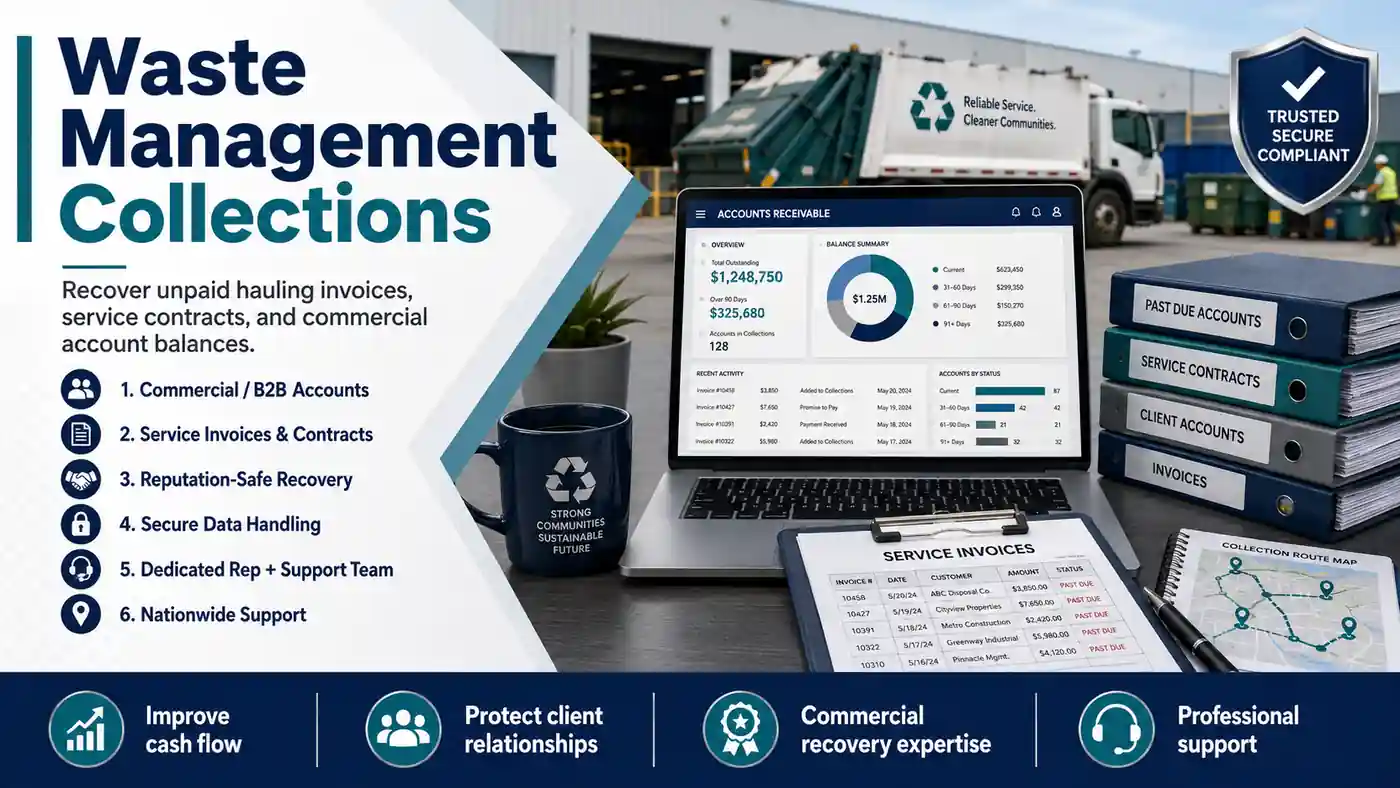
Waste and recycling companies recover unpaid accounts through fixed-fee demand letters for fresher balances (roughly 30-120 days) and contingency collection for older or larger accounts, both compliant with commercial vs. residential regulatory differences and municipal franchise rules where applicable. Nexa Collections is licensed in all 50 states and Puerto Rico, rated 4.85 stars across 2,000+ reviews, with over 20 years of collections experience, backed by a dedicated account representative and support team.
Why haulers trust us:
- Rated 4.85/5 stars across 2,000+ verified reviews.
- Over 20 years of collections experience.
- Licensed in all 50 states and Puerto Rico.
- Dedicated account representative, backed by a full support team.
- SOC 2 Type II certified, FDCPA and FCRA aligned.
The AR Problems Every Hauler Recognizes
1. Roll-off jobs that never get paid. You drop a box, haul the debris, send the invoice, and once the container leaves the property, the urgency to pay disappears. After 30-60 days, those balances are on life support.
2. Residential routes with “ghost” balances. Residential customers forget, move, or quietly switch providers. A few unpaid months on a low-rate cart service don’t look like much, until you multiply that across a whole route.
3. Commercial customers playing the float. Restaurants, small shops, and even some property managers treat your invoice as “whenever we can get to it.” You see partial payments, skipped months, and endless promises.
4. Confusing bills that invite disputes. Base fee, fuel surcharge, environmental fee, contamination charges, extra pulls, special pickups. If your billing is complex but your explanation is short, people stall instead of paying.
5. Staff who are too busy to chase money. CSRs and dispatch are buried in route changes, missed-pickup calls, cart swaps, and complaints. Serious AR follow-up slides to the bottom of the list until invoices are 90+ days late and much harder to collect.
The Rules Vary by Account Type
Commercial roll-off and route accounts are governed by whatever the service agreement actually says, weight limits, overage rates, contract minimums, and, increasingly, multi-year terms with auto-renewal clauses that surprise customers when they try to cancel early.
Residential trash service is often different, especially where a municipality has granted an exclusive franchise agreement to a single hauler. Franchise-based residential service can carry additional regulatory oversight that a private commercial contract doesn’t, and billing disputes here sometimes involve the municipality itself, not just the hauler and customer.
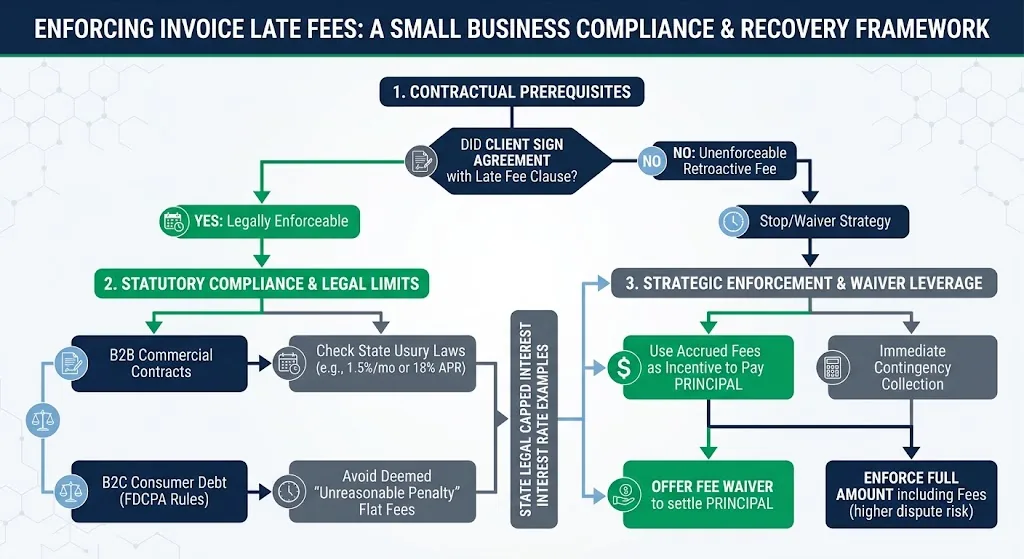
Auxiliary fees, contamination charges, overage fees, fuel surcharges, deserve special handling in collections: a debtor disputing the base service fee is a different conversation than one disputing a $180 contamination charge added to an otherwise-current account. Separating the two keeps a legitimate dispute from stalling collection of the undisputed balance.
What This Costs
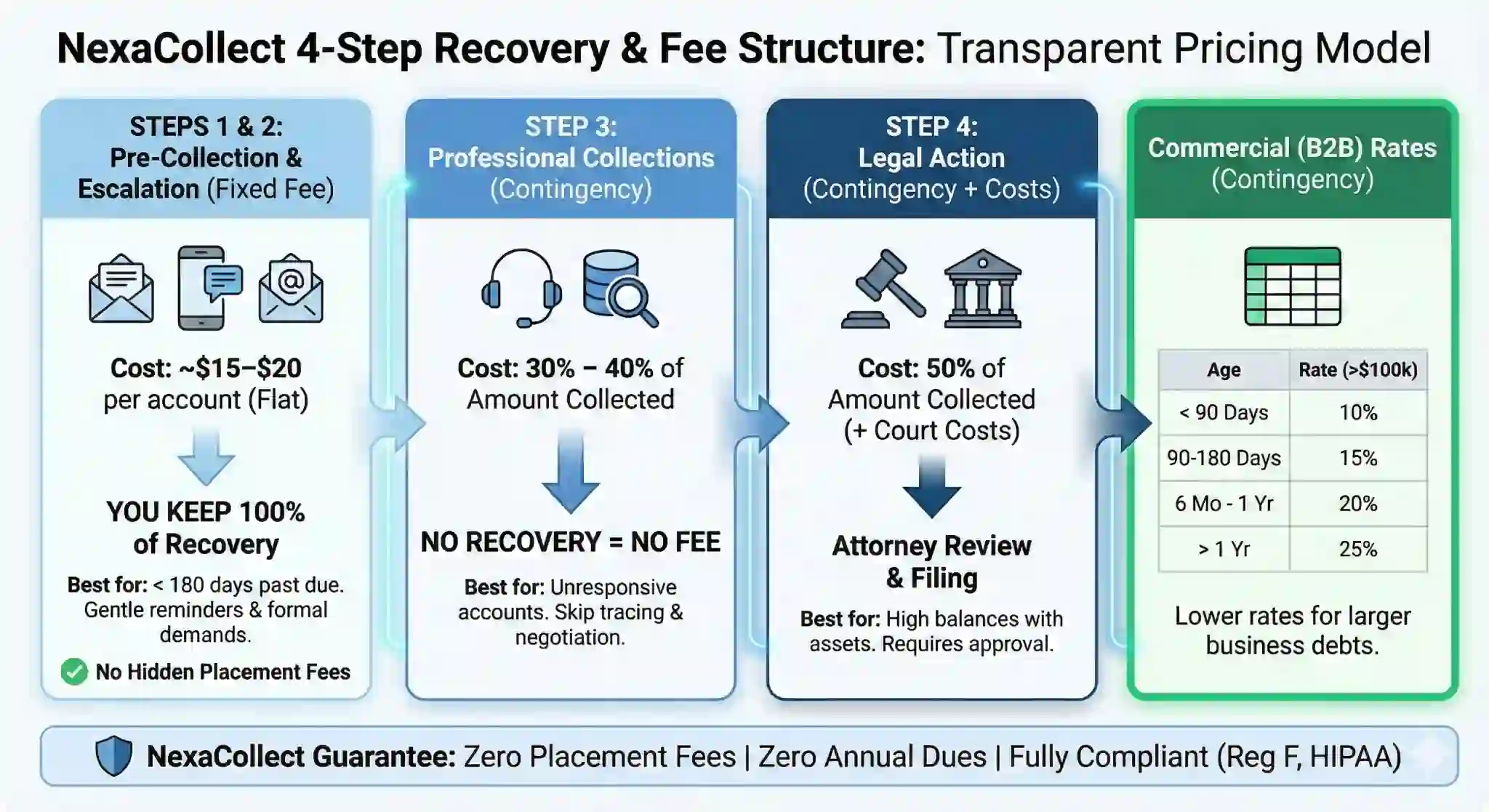
Low-Cost Fixed-Fee Letters (Around $15 per Account — Step 2)
For newer past-due accounts (roughly 30-120 days), Step 2 is usually the best starting point. For about $15 per account, up to five contacts (letters plus optional email/text) go out under our name, referencing service dates, sites, and balances. Because the cost is fixed and low, you can place a large batch of accounts and quickly see who resolves with a light push.
Contingency Collections (Typically 40% — Step 3)
For stubborn accounts, older balances, repeat offenders, higher-dollar invoices, we move to contingency: No recovery, no fee (typically 40% of what’s collected), handled by collectors who understand waste-industry specifics like contamination, overages, and contract minimums.
In-House Service Pull vs. Aggressive Collections vs. Nexa Step 1
| Factor | In-House Service Pull | Aggressive/Generic Collections | Nexa Step 1 ($15 Fixed-Fee) |
|---|---|---|---|
| Cost | Staff time, no direct outlay | Often 30%+ contingency regardless of age | $15 flat, you keep 100% recovered |
| Customer retention | Depends on CSR tone under pressure | Low, aggressive scripts drive customers to competitors | Higher, reads as a professional nudge, not a threat |
| Legal risk | Highest, staff often unaware of commercial vs. residential distinctions | Moderate, generic scripts may ignore franchise-specific rules | Lower, built around the specific account type from the start |
| Recovery speed | Slow, competes with dispatch and route priorities | Fast but relationship-costly | Days to a few weeks for fresh accounts |
Why Many Haulers Switch to Us
Companies come to us after trying to self-collect or after using another agency that treated them like “just another utility.” They’re looking for better recovery on 60-180-day accounts, cleaner communication with fewer complaints, a mix of fixed-fee and contingency that fits their budget, and a partner that understands routes, carts, roll-offs, and transfer or landfill costs, not just generic invoices.
Serving some of the biggest Waste Management Companies NationwideNeed a Collection Agency? Contact Us |
A Simple Way to Start
You don’t need to overhaul your entire process on day one. Many clients simply send a test batch of older accounts their team has stopped working, run those through Step 2 and Step 3, and compare what we recover versus what their in-house team or old agency produced. If you like the results, we help build a simple placement routine so every month your aging report looks cleaner, your DSO comes down, and your trucks are working for paying customers, not for free.
Frequently Asked Questions
Can a collection agency collect unpaid commercial waste management fees?
Yes. Commercial waste and recycling accounts, roll-off jobs, route service, contract minimums, are collected the same way any commercial B2B debt is, through documented demand letters escalating to contingency collection for older or larger balances. The service agreement itself, weight limits, overage terms, contract length, is the key document that determines what’s actually collectable.
How do haulers handle disputed overweight or contamination charges during collection?
By separating the disputed charge from the undisputed base balance rather than treating the whole account as contested. A customer disputing a $180 contamination fee usually isn’t disputing months of otherwise-current base service, and pursuing the undisputed portion while the specific charge gets reviewed against photos, weigh tickets, or inspection records keeps the account moving instead of stalling entirely over one line item.
Can unpaid residential trash bills result in property liens?
It depends heavily on how the service is structured. Where trash collection is billed as part of a municipal utility, often alongside water or sewer under an exclusive franchise agreement, many municipalities do have legal authority to attach unpaid balances as a lien on the property. A private hauler collecting under an ordinary customer contract, without that municipal utility structure, generally doesn’t have the same lien authority and instead pursues the balance as standard consumer debt.
Can you repossess a dumpster or roll-off container from a nonpaying customer’s property?
Not simply by driving over and taking it back, even though the hauler typically owns the container outright. Reclaiming company property from someone else’s property generally can’t involve a “breach of peace”, the same limitation that governs auto repossession and other leased-equipment recovery, so retrieving a container usually requires the customer’s cooperation or a proper legal process rather than unilateral action. Resolving the balance is almost always faster and lower-risk than a contested pickup.
How does Nexa help waste haulers recover debts without destroying customer contracts?
By starting with a firm but professional first touch, Step 1 and Step 2 reminders that read as a serious business follow-up rather than an aggressive collections threat, which is often enough to resolve fresher accounts without any relationship damage. For accounts that need real leverage, the same diplomatic tone carries through contingency collection, since a hauler that keeps a customer’s contract intact after resolving a balance is usually better off than one that recovers the money but loses the account entirely.