One Baltimore name sits at the center of two completely different revenue cycles: Johns Hopkins. On one side are hospital and medical patient balances; on the other are university tuition, research, and education-related receivables. They may share the Hopkins name, but they do not share the same collection playbook. That is Baltimore in a nutshell—a city where healthcare, higher education, logistics, government, contractors, and small businesses all create very different kinds of overdue accounts. Johns Hopkins Hospital remains one of the nation’s top-ranked hospitals, while Johns Hopkins University is America’s first research university.
Quick answer: Baltimore creditors generally have a three-year window for many civil claims, and for consumer debt, once the applicable limitation period expires, a later payment does not restart it. Meanwhile, the Port of Baltimore remains a national leader in roll-on/roll-off cargo, reinforcing the city’s major logistics and commercial base. Nexa helps Baltimore healthcare providers, schools, universities, contractors, logistics companies, and businesses recover overdue accounts starting at $15 per account, with contingency options for tougher balances.
Nexa provides a reputation-safe approach, equipped with all 50-state collections license, offering free credit reporting, free litigious debtor check, free bankruptcy scrub, and zero onboarding fees. Secure – SOC 2 Type II & HIPAA compliant. Over 2,000 online reviews rate us 4.85 out of 5.
Need a Collection Agency? Contact us
Why Baltimore’s Economy Doesn’t Fit One Category
Johns Hopkins is genuinely two account types in one institution.
Johns Hopkins Hospital consistently ranks among the top hospitals nationally, generating patient medical balances requiring HIPAA-compliant, sensitivity-aware handling. Johns Hopkins University, the same name, a distinct institution, generates tuition, program fee, and housing balances that follow an entirely different pattern, more like a standard educational receivable than a medical one. Treating every Hopkins-adjacent account the same way misses which set of rules and sensitivities actually applies.
The Port of Baltimore has recovered and is genuinely strong, distinct from the ongoing bridge rebuild.
The Port of Baltimore is the country’s leading port for automobile and farm equipment imports, and its shipping channel fully reopened within months of the 2024 Francis Scott Key Bridge collapse. The bridge itself is a separate, longer story: Maryland changed contractors in 2026 and is still procuring construction for a project now estimated at over $4 billion, with completion not expected until 2030. For a commercial creditor, this distinction matters, port-dependent businesses have been operating normally for some time, while construction, engineering, and supply firms tied to the bridge rebuild itself are engaging with a large, active, multi-year project.
Maryland’s non-revival rule is worth knowing precisely.
Under CJP § 5-101, once a consumer debt’s statute of limitations expires, a later payment or written acknowledgment does not restart the clock, the same non-revival pattern already confirmed for Maine, Minnesota, and D.C. This makes early placement more valuable in Maryland than in states where a partial payment can buy back time.
The Maryland Legal Landscape
| Statute of Limitations (general contracts) | 4 years (12 years for sealed instruments) |
| SOL Revival (consumer debt) | Non-revivable once expired — CJP § 5-101 |
| Medical Debt Credit Reporting | Generally barred (HB 1020), subject to an unresolved federal FCRA preemption question |
What This Costs
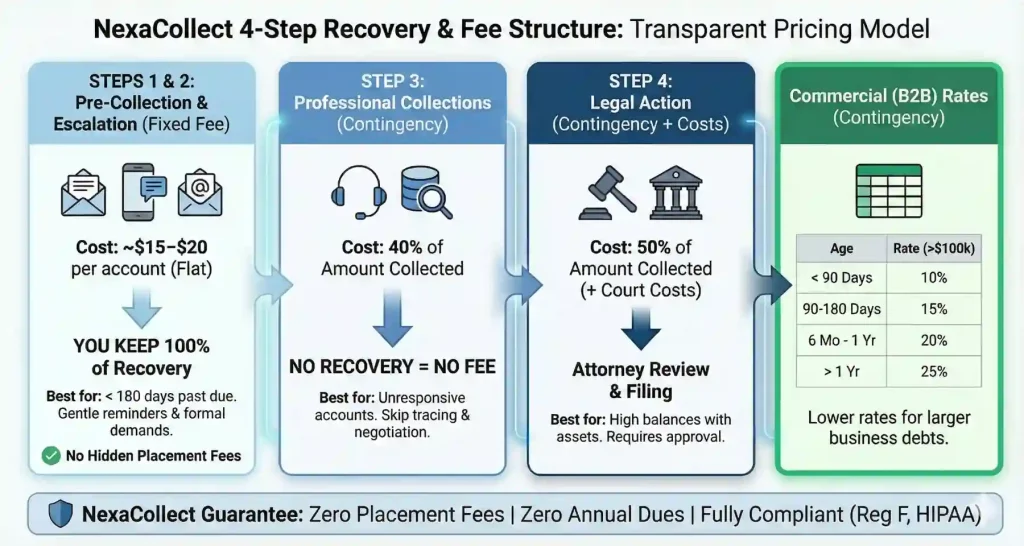
Step 1 & 2: Fixed-Fee Recovery (~$15/account). Professional demand sequences for accounts under roughly 60-90 days. Payments go directly to you. See the full pricing breakdown.
Step 3: Contingency Collection (20%~40%). For older or unresponsive accounts, no recovery, no fee.
Step 4: Legal Referral (client-approved, ~50%). Filing fees reimbursed from the first recovery.
Who We Collect For Across Baltimore
- Medical & Hospital Systems: HIPAA-compliant patient balance recovery for practices and hospital systems across the metro, including the Johns Hopkins Hospital network and independent providers.
- Universities & Higher Education: Tuition and program fee recovery for the metro’s universities, including Johns Hopkins’ academic side specifically, a genuinely distinct account type from its hospital’s patient balances.
- Commercial & Port-Adjacent Logistics: B2B and commercial receivables for the freight, warehousing, and auto-import logistics companies supporting the Port of Baltimore.
- Construction & Infrastructure: Commercial recovery for the contractors, engineering firms, and suppliers engaging with the region’s large-scale infrastructure projects, including the ongoing Key Bridge rebuild.
- Dental: Patient-first dental debt recovery for practices across the metro.
- Schools & Districts: Meal and activity fee recovery for Baltimore-area public school districts.
Recent Recovery Results
1. Port & Intermodal Logistics Supplier (Port of Baltimore Corridor)
-
Balance: $12,600 (Overdue 90-Day Freight, Drayage & Storage Invoices)
-
Outcome: Commercial B2B mediation resolved an accessorial billing dispute with corporate accounts payable, securing full wire payment in two scheduled installments.
2. Outpatient Surgical & Physical Therapy Clinic (Downtown / Mid-Town Baltimore)
-
Balance: $4,150 (Past-Due Patient Co-pays & High Deductibles)
-
Outcome: HIPAA-compliant digital reminders and a simplified payment portal recovered 78% of outstanding balances within 40 days without negative patient feedback.
3. Commercial HVAC & Mechanical Contractor (Baltimore County / Towson)
-
Balance: $9,800 (Delinquent Progress Billing & Equipment Service Charges)
-
Outcome: Direct pre-litigation outreach to the property management group verified completed work orders and secured full settlement before mechanics lien deadlines expired.
Frequently Asked Questions
Does Johns Hopkins generate one type of account, or two genuinely different ones?
Two. Johns Hopkins Hospital generates patient medical balances requiring HIPAA-compliant, sensitivity-aware collection, while Johns Hopkins University, a distinct institution under the same name, generates tuition, program fee, and housing balances that follow standard educational receivable handling instead. Confirming which side of Hopkins an account actually comes from changes which compliance framework and tone applies.
Is the Port of Baltimore still disrupted from the 2024 bridge collapse?
No, the port itself recovered relatively quickly, the shipping channel fully reopened within months, and the port has continued operating as the country’s leading destination for automobile and farm equipment imports, with new business commitments announced as recently as 2026. The Key Bridge rebuild is a separate, ongoing, multi-year infrastructure project, distinct from day-to-day port operations, which have not been disrupted for some time now.
Does the ongoing Key Bridge rebuild create commercial collections opportunities specific to Baltimore right now?
Potentially, yes. As of 2026, Maryland is actively procuring a new construction contractor for a project now estimated at over $4 billion, with completion not expected until 2030. This means engineering, construction, and supply firms are actively engaging with a large, multi-year regional project, a genuine, current source of commercial account activity distinct from the port’s own, already-recovered operations.
Does a partial payment restart Maryland’s statute of limitations on an old debt?
No. Under CJP § 5-101, once the limitations period on a consumer debt expires, a later payment or written acknowledgment does not revive it, the same non-revival rule already confirmed for Maine, Minnesota, and D.C. This makes early placement more valuable in Maryland than in states that do allow revival.
Can medical debt still appear on a Maryland resident’s credit report?
Generally no under Maryland’s HB 1020, though this is worth stating with appropriate precision: the CFPB raised a federal preemption question in October 2025 about whether federal law allows states to ban medical debt reporting at all, an unresolved question affecting Maryland’s law along with similar bans in roughly a dozen other states.
How long does a Baltimore business have to collect on a written contract?
Generally four years for most contracts, extending to 12 years for contracts executed as sealed instruments, a distinction worth confirming on higher-value or older agreements before assuming the shorter period applies.