A Detroit supplier ships an order on net-60 terms. Three weeks later, it learns the customer filed bankruptcy the same week the goods were delivered. Most businesses assume the unpaid invoice is now just another bankruptcy claim. Not necessarily. A seller may have a narrow legal window to demand the goods back — but timing matters.
In short: Michigan gives qualifying sellers powerful tools that ordinary collections advice often overlooks. Under Fisher v. Sweebe, qualifying open-account and account-stated claims can carry a six-year limitations period rather than the UCC’s four-year sales-contract period. And when goods were delivered to an insolvent buyer, Michigan UCC § 2-702 and federal bankruptcy law may provide reclamation rights with very short notice deadlines.
For Detroit manufacturers, distributors, suppliers, commercial service providers — and even healthcare businesses dealing with business accounts — the takeaway is simple: the age of the invoice and what happened immediately before a bankruptcy can materially change the recovery strategy.
Nexa provides 100% reputation-safe, equipped with all 50-state collections license, offering free credit reporting, free litigation/bankruptcy scrubs, and zero onboarding fees. Secure – SOC 2 Type II, FDCPA, UCC & HIPAA compliant.
Need a Collection Agency in Detroit? Contact us
Two Tools Most Detroit Suppliers Don’t Know They Have
Aged trade accounts may not be as time-barred as they look.
Michigan’s Supreme Court held in Fisher Sand & Gravel Co. v. Neal A Sweebe, Inc. that open-account and account-stated claims fall under the state’s 6-year contract limitations period under MCL § 600.5807, not the UCC’s 4-year window, even when the underlying transaction was a sale of goods. A distributor or supplier that’s been writing off 4-to-6-year-old Michigan trade accounts under a generic UCC assumption may be leaving genuinely collectable receivables on the table.
A 10-day clock most businesses never learn about until it’s already run.
If a buyer turns out to have been insolvent when it received goods on credit, UCC § 2-702 gives the seller the right to demand those goods back, but the demand generally has to be made within 10 days of the buyer’s receipt. Standard purchase terms that treat acceptance of goods as an implicit representation of solvency can help preserve this right if that 10-day window is missed for a reason tied to misrepresentation, but absent that, the clock is simply the clock. If the buyer has already filed bankruptcy by the time the seller finds out, Bankruptcy Code § 546(c) provides a parallel right, goods received within 45 days before the filing, with a written demand made within that same 45-day period. Even when reclamation itself doesn’t succeed, § 503(b)(9) can still elevate a seller’s claim to administrative priority status for goods delivered in the 20 days before filing.
Why this matters more here than almost anywhere else.
Detroit’s economy runs on a deep, multi-tier automotive supply chain, Tier 1, 2, and 3 suppliers feeding the Big Three and their broader ecosystem, an industry with a well-documented history of supplier restructurings and OEM-adjacent bankruptcies. A parts supplier that doesn’t know the reclamation window exists has no way to use it, and a business that finds out about it after the ten days have passed has lost a real, legally available remedy for reasons that had nothing to do with the merits of the claim.
The Michigan Legal Landscape
| Statute of Limitations (contracts generally) | 6 years — MCL § 600.5807 |
| Statute of Limitations (open account/goods, per Fisher v. Sweebe) | 6 years, not the UCC’s 4-year default |
| Seller’s Reclamation Right (pre-bankruptcy) | 10-day written demand from buyer’s receipt — UCC § 2-702 |
| Seller’s Reclamation Right (post-filing) | 45-day written demand from buyer’s receipt — Bankruptcy Code § 546(c) |
| Administrative Priority Fallback | Goods delivered within 20 days pre-filing — Bankruptcy Code § 503(b)(9) |
| Governing Consumer Law | Michigan Regulation of Collection Practices Act, reaches original creditors (for consumer-adjacent accounts) |
What This Costs
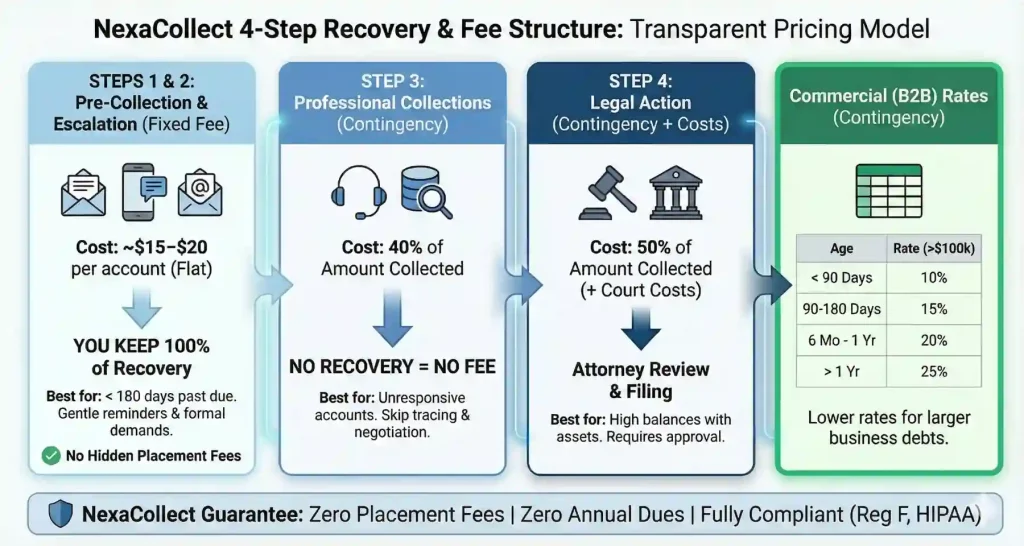
Step 1 & 2: Fixed-Fee Recovery (~$15/account). Professional demand sequences for accounts under roughly 60-90 days. Payments go directly to you. See the full pricing breakdown.
Step 3: Contingency Collection (20%~40%). For older or unresponsive accounts, no recovery, no fee.
Step 4: Legal Referral (client-approved, ~50%). For accounts genuinely warranting litigation, or coordination with counsel on time-sensitive reclamation and bankruptcy-priority claims.
Who We Collect For Across Metro Detroit
- Automotive Suppliers & Manufacturers: B2B and commercial receivables for Tier 1, 2, and 3 parts suppliers, tooling companies, and industrial vendors across the metro, with reclamation-eligibility screening built into intake for accounts tied to a buyer’s insolvency.
- Distributors & Wholesalers: Trade credit recovery for companies extending net terms across the manufacturing and industrial supply base.
- Logistics & Freight: Recovery for the transportation and warehousing companies supporting the region’s manufacturing corridor.
- Professional Services: Commercial receivables for the engineering, staffing, and consulting firms serving the automotive sector.
- Medical & Dental: HIPAA-compliant patient balance recovery for practices across the metro.
- Property Management: Commercial and residential lease-end balance recovery across the region.
Recent Recoveries in Detroit
1. Tier-2 Automotive Tooling Supplier (Metro Detroit / Auburn Hills)
-
Balance: $13,800 (Delinquent 90-Day Custom Fabrication Invoices)
-
Outcome: Commercial B2B mediation resolved an invoice-matching discrepancy with corporate accounts payable, securing full wire settlement in two scheduled payments without disrupting ongoing purchase orders.
2. Industrial Freight & Warehousing Provider (Southwest Detroit)
-
Balance: $8,650 (Overdue Commercial Transport & Storage Fees)
-
Outcome: Direct outreach to the client’s corporate finance team clarified bill-of-lading documentation and secured 100% payment within 30 days.
3. Family & Cosmetic Dental Practice (Midtown Detroit)
-
Balance: $3,400 (Aged Patient Co-pays & Out-of-Pocket Balances)
-
Outcome: HIPAA-compliant digital notifications and structured 3-month payment arrangements recovered over 75% of past-due balances while preserving patient goodwill and clinic reviews.
Frequently Asked Questions
A customer we shipped goods to just declared bankruptcy. Can we get the goods back?
Possibly, but only if you act quickly. Under Bankruptcy Code § 546(c), a seller can generally reclaim goods the debtor received within 45 days before the bankruptcy filing, provided a written demand is made within that same 45-day window. Even where the goods themselves can’t be recovered, § 503(b)(9) can elevate the seller’s claim to administrative priority status for goods delivered in the 20 days before filing, ranking ahead of most unsecured claims even if it doesn’t return the goods directly.
What if we find out a buyer was insolvent before they’ve filed for bankruptcy?
UCC § 2-702 gives sellers a separate right in this situation: if a buyer received goods on credit while insolvent, the seller can demand their return, but generally only within 10 days of the buyer’s receipt of the goods. That deadline doesn’t apply if the buyer made a written misrepresentation of its solvency within the three months before delivery, but absent that, the ten-day window is strict, and missing it generally forfeits the reclamation right even though the underlying debt is still owed.
Is a Michigan trade account really time-barred after four years, or does it depend on the type of claim?
It depends. Michigan’s Supreme Court held in Fisher Sand & Gravel Co. v. Neal A Sweebe, Inc. that open-account and account-stated claims get the state’s 6-year contract limitations period under MCL § 600.5807, not the UCC’s 4-year default, even when the underlying transaction was a sale of goods. An account written off at four years under a generic assumption may still be legally actionable.
How does Nexa determine whether an account is eligible for goods reclamation versus standard collection?
We review the account’s timeline against both windows, the 10-day pre-bankruptcy demand period under UCC § 2-702 and the 45-day post-filing period under Bankruptcy Code § 546(c), as soon as an account is placed, since these deadlines run from the buyer’s receipt of the goods, not from when the seller learns about the situation. Accounts outside both windows move to standard commercial collection or, where appropriate, an administrative priority claim in the bankruptcy proceeding itself.
Does Detroit’s automotive supply chain create different collections risk than a typical manufacturing account elsewhere?
Meaningfully, yes. The multi-tier supplier structure common in automotive manufacturing means a single OEM or Tier 1 disruption can cascade through several layers of smaller suppliers at once, and the industry’s history of supplier restructurings makes insolvency-related risk a more routine consideration here than in a less concentrated manufacturing market. Building reclamation and bankruptcy-priority awareness into standard account handling matters more in this specific market than in most.
What documentation should we have ready if we need to act on a reclamation right quickly?
Proof of the delivery date (to calculate the 10 or 45-day window accurately), the original purchase order or contract terms, any correspondence suggesting the buyer’s financial condition at the time of the order, and, if applicable, standard terms and conditions language addressing acceptance as a representation of solvency. Having this ready before a crisis hits is what actually makes a ten-day deadline achievable.