Dentist burnout is commonly driven by prolonged static posture, precision-heavy clinical work, patient anxiety, administrative workload and schedule pressure. Dentists can reduce daily fatigue through better ergonomics, strategic scheduling, AI-assisted documentation, short postural breaks, clearer patient boundaries and regular peer support.
Key Takeaways
-
Dentist burnout is unique: It stems from a combination of prolonged physical strain, micro-precision demands, and secondhand patient anxiety.
-
Physical health directly impacts mental focus: Chronic musculoskeletal strain in the neck, back, and shoulders accelerates mental exhaustion.
-
Modern practice workflows help: Implementing ergonomic loupes, AI-assisted clinical documentation, and strategic block scheduling significantly reduces daily pressure.
-
Micro-breaks prevent fatigue: A structured 90-second postural reset between patients prevents cumulative physical and mental strain.
Understanding Dentist Burnout: The Chairside Dilemma
Dentist burnout is a state of severe physical, mental, and emotional exhaustion caused by prolonged operational, physical, and interpersonal stress in a clinical setting.
Unlike generic workplace fatigue, burnout in dentistry is uniquely challenging. Clinicians operate within a tiny visual field with zero margin for error, manage fearful patients throughout the day, and maintain taxing physical postures for hours at a time.
The Dental Burnout Cycle
-
Physical Strain: Neck, back, shoulder, and wrist fatigue from static posture and micro-movements.
-
Mental Pressure: Sustained high precision demands with zero-fault tolerance on living tissue.
-
Emotional Toll: Absorbing secondhand anxiety and fear from phobic or resistant patients.
-
Operational Friction: Packed schedules, unexpected delays, and overwhelming administrative charting.
4 Main Drivers of Stress in Modern Dental Practices
1. Chronic Musculoskeletal Strain
Static postural loads—leaning over operatory chairs, twisting to view hard-to-reach surfaces, and performing repetitive micro-movements—cause chronic pain in the neck, upper back, and wrists. When your body hurts all day, your brain burns out faster.
2. Absorbing Secondhand Patient Anxiety
When a patient sits down and immediately says, “I hate being here,” your nervous system reacts. Over a 10-patient day, absorbing this anxiety triggers elevated cortisol levels and emotional depletion (compassion fatigue).
Real-World Example: Dr. Sarah, a general practitioner, noticed her heart rate spiking every time a patient gripped the armrests tightly during a routine crown prep. She wasn’t stressed about the procedure; she was involuntarily reacting to her patient’s fear.
3. Precision Fatigue & Zero Margin for Error
Working under high magnification on living tissue leaves little room for mistakes. Maintaining focused attention for hours at a time creates severe cognitive fatigue.
4. Administrative & Schedule Overload
Running behind schedule due to unexpected difficult extractions or complex root canals creates a domino effect of stress that lasts all day.
6 Practical, Modern Solutions to Control Dentist Burnout
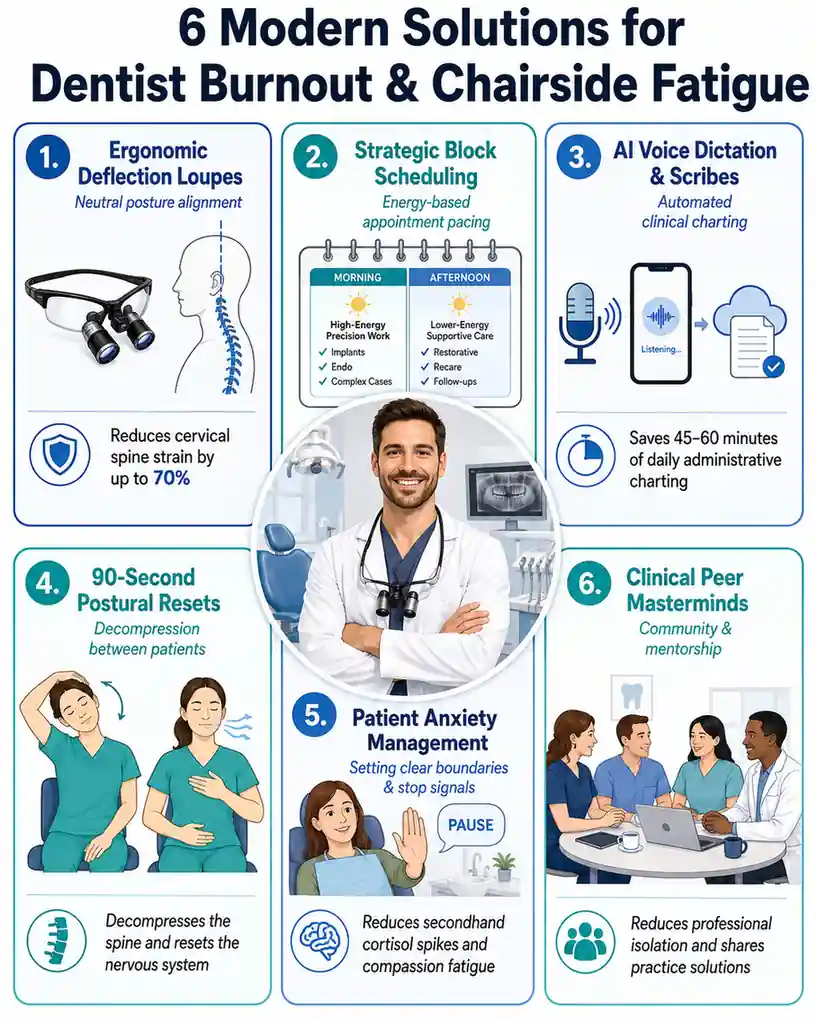
Solution 1: Upgrade to Ergonomic Deflection Loupes
Traditional loupes force you to tilt your neck downward at angles exceeding 30–45 degrees. Modern refractive (ergonomic) deflection loupes project the image straight to your eyes while allowing your neck to remain completely neutral (0–10 degrees).
-
Impact: Reduces cervical spine compression by up to 70%, immediately lowering physical fatigue by mid-day.
Solution 2: Implement “Block Scheduling”
Stop mixing complex, high-stress procedures randomly throughout the afternoon. Use block scheduling to organize your day around natural energy levels:
-
Morning Block (High Energy): Complex procedures (crowns, endo, multi-unit restorations).
-
Mid-Day Buffer (30 Mins): Dedicated time for lab reviews, chart notes, and administrative tasks.
-
Afternoon Block (Lower Energy): Simpler, predictable procedures (fillings, consultations, follow-ups).
Solution 3: Use AI Dictation for Clinical Documentation
Manual chart writing at the end of a long day is a major source of administrative burnout. Modern voice-enabled AI clinical scribes convert natural conversation into formatted ambient SOAP notes in real time.
-
Impact: Saves 45–60 minutes of daily charting time, allowing you to leave the practice on time.
Solution 4: Perform the 90-Second Postural Reset Between Patients
Never jump directly from one operatory chair to another. Before entering the next room, perform this brief sequence:
-
Chin Tucks: Pull your head back straight (creating a double chin) to decompress the upper spine (5 repetitions).
-
Chest Openers: Interlace fingers behind your back and pull shoulders back for 15 seconds.
-
Diaphragmatic Breaths: 3 deep, slow abdominal breaths (4 seconds in, 6 seconds out) to reset your parasympathetic nervous system.
Solution 5: Reset the Narrative with Anxious Patients
Address patient anxiety proactively before starting any treatment to reduce emotional tension:
“I know coming to the dentist isn’t your favorite activity. Our goal today is to keep you completely comfortable. If you need a break at any point, just raise your left hand, and I will stop immediately.”
Giving the patient explicit control reduces their anxiety—which immediately lowers your own stress levels.
Solution 6: Join a Clinical Peer Mastermind or Study Club
Solitary clinical work often leads to isolation. Joining a local or online dental study club allows clinicians to share difficult case experiences, discuss practice friction, and normalize daily challenges with peers who understand the work.
Frequently Asked Questions (FAQ)
What are the earliest signs of burnout in a dentist?
Early warning signs include persistent physical exhaustion despite adequate sleep, physical irritability before the workday starts, feeling detached or cynical toward patients, chronic neck/back stiffness, and feeling overwhelmed by routine charting.
How does bad ergonomics contribute to mental stress?
Chronic physical pain signals the brain’s alarm system, maintaining elevated cortisol levels throughout the day. When you work in physical pain, your mental tolerance for clinical challenges and patient anxiety drops significantly.
How can a solo practitioner reduce admin stress without hiring more staff?
Solo practitioners can reduce administrative strain by adopting ambient AI clinical scribes for chart notes, setting up digital patient intake forms prior to appointments, and designating fixed 20-minute daily blocks for administrative work rather than squeezing it between patients.
How common is burnout among dentists?
Burnout and occupational stress are significant concerns in dentistry. The American Dental Association reports that more than 82% of dentists experience major career stress. Burnout rates vary considerably between studies depending on the population and assessment method, but prolonged workload, physical strain, staffing challenges and administrative pressures are recognized contributors.
Can ergonomic loupes help reduce dentist neck and back pain?
Yes. Modern refractive (deflection) ergonomic loupes allow clinicians to maintain a neutral upright head position (0–10 degree declination angle) rather than bending forward at 30–45 degrees. This neutral posture reduces neck strain and cervical spine compression by up to 70%, preventing chronic back and shoulder pain.
What is the fastest way to reduce stress between dental patients?
The fastest way to reset your nervous system is a 90-second micro-break using diaphragmatic breathing combined with a posture reset. Taking 3 deep abdominal breaths (4-second inhale, 6-second exhale) instantly activates your parasympathetic nervous system, while a quick chin tuck decompresses the upper spine before your next appointment.
Summary: Protect the Asset
The most valuable asset in your practice is not your CBCT scanner or your CAD/CAM mill. It is you. If you break, the practice stops.
Stop accepting high stress as “part of the job.” It is time to delegate the noise—the billing, the collections, the admin headaches—so you can fall in love with dentistry again.
Is unpaid revenue adding to your stress?
Don’t let bad debt burn you out. Let us handle the uncomfortable conversations.