A Texas medical practice cannot pursue collection on a patient balance until it sends a written itemized bill. Since September 1, 2023, Texas law has made this a required step, and the bill must generally be sent within 30 days after final insurer payment. Miss it, and collection can be delayed until the requirement is satisfied.
Corpus Christi also has a uniquely industrial economy, anchored by Port Corpus Christi, energy, petrochemicals, logistics, and healthcare. Nexa helps recover local accounts starting at a $15 fixed fee per account, with contingency options for older balances—combining compliant recovery with reputation-safe, licensed, and easy-to-use service.
Nexa provides a reputation-safe approach, equipped with all 50-state collections license, offering free credit reporting, free litigious debtor check, free bankruptcy scrub, and zero onboarding fees. Secure – SOC 2 Type II & HIPAA compliant. Over 2,000 online reviews rate us 4.85 out of 5. Easy to use and a good client support team.
Need an Corpus Christi Collection Agency? Contact us
What Makes Corpus Christi Genuinely Different
Medical debt collection here has a hard prerequisite most providers don’t know exists.
Under Tex. Health & Safety Code § 185.002, a health care provider requesting payment from a patient must submit a written, itemized bill describing each distinct service or supply provided, and the statute states directly that a provider “may not pursue debt collection against a patient… unless the provider has complied with this section.” The itemized bill must go out no later than 30 days after the provider receives final payment from a third party like an insurer. For Corpus Christi’s major medical hub, home to CHRISTUS Spohn, Corpus Christi Medical Center, and Driscoll Children’s Hospital, confirming this step happened, and happened on time, is worth checking before any account is placed for collection.
Port Corpus Christi anchors a genuinely massive, distinctive commercial economy.
As the largest U.S. crude-oil export gateway and the second-largest U.S. gateway for LNG exports, the port drives a regional petrochemical and industrial-service sector that purchases more than $1.5 billion in local goods and services annually and supports roughly 50,000 direct and indirect jobs. B2B accounts tied to this sector, freight, terminal services, oilfield services, fabrication, and industrial maintenance, are often documentation-heavy, turning on master service agreements, field tickets, and change orders rather than a simple invoice.
Texas’s broad wage garnishment prohibition still applies here, the same as statewide.
Texas generally does not allow wage garnishment for most consumer debts, and the Texas Finance Code Chapter 392 reaches original creditors collecting their own debts, not just third-party agencies, consistent with the framework already established across other Texas cities in this project.
The Texas Legal Landscape
| Statute of Limitations (most consumer debt) | 4 years — Tex. Civ. Prac. & Rem. Code § 16.004 |
| Medical Debt Pre-Collection Requirement | Written itemized bill required before collection — Tex. Health & Safety Code § 185.002 |
| Itemized Bill Deadline | Within 30 days of receiving final third-party payment |
| Wage Garnishment | Not allowed for most consumer debts (exceptions: child support, taxes, certain federal student loans) |
| Governing Consumer Law | Texas Finance Code Chapter 392, reaches original creditors |
| Third-Party Collector Bonding | $10,000 surety bond with the Texas Secretary of State |
| Nonresidential Mechanics Lien | 15th day of the 4th month after completion, termination, or abandonment |
| Residential Mechanics Lien | 15th day of the 3rd month after completion |
| Nueces County Justice Court Limit | $20,000 (excluding statutory interest/costs, including attorney fees) |
What This Costs
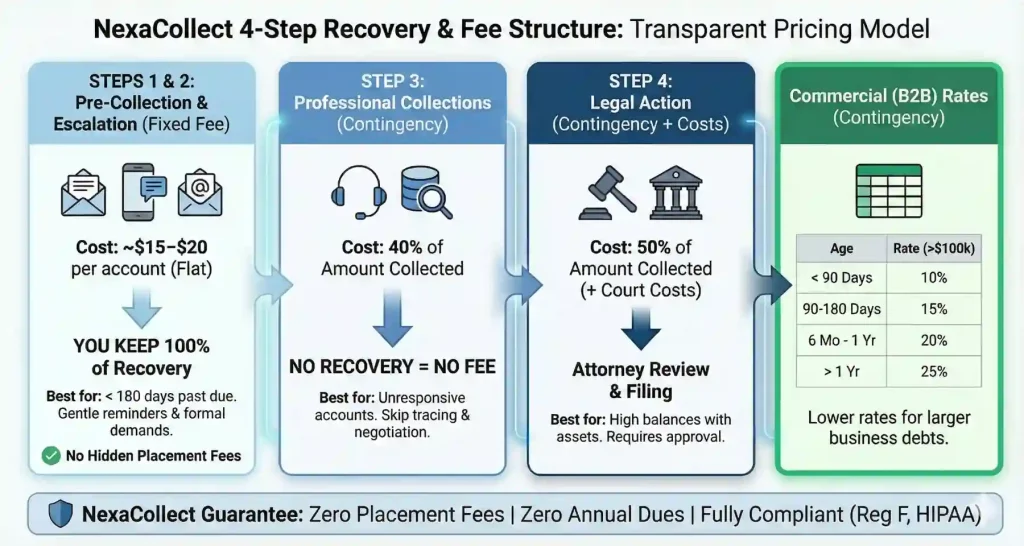
Step 1 & 2: Fixed-Fee Recovery (~$15/account). Professional demand sequences for accounts under roughly 60-90 days, with itemized-bill compliance screening built in for medical accounts. Payments go directly to you. See the full pricing breakdown.
Step 3: Contingency Collection (~40%). For older or unresponsive accounts, no recovery, no fee.
Step 4: Legal Referral (client-approved, ~50%). With mechanics lien deadline coordination for eligible construction accounts, filing fees reimbursed from the first recovery.
Who We Collect For Across Corpus Christi
- Agriculture & Manufacturing: B2B and commercial receivables for the oilfield-service companies, fabricators, and industrial suppliers tied to the Coastal Bend’s refining and petrochemical sector.
- Hospitals, Dental & Medical: HIPAA and Chapter 185-compliant patient balance recovery for the region’s major medical systems and independent practices.
- Colleges & Universities: Tuition and fee recovery for the region’s higher education institutions.
- K-12 Private & Charter Schools: Tuition and activity fee recovery handled diplomatically, alongside meal and fee recovery for public districts.
- Accountants & CPA Firms: Commercial receivables for the professional services firms supporting the energy and port-driven economy.
- Banks & Credit Unions: Recovery for the region’s financial institutions and lending partners.
- Construction & Trades: B2B recovery with Texas’s mechanics lien deadlines flagged at intake for industrial contractors, marine contractors, and trades serving the port and energy sector.
- B2B Commercial, Restoration & Waste Management: Commercial receivables for freight companies, terminal operators, hotels, event venues, restoration contractors, and waste management providers.
Recent recovery Results in Corpus
$38,400 Recovered (66% Recovery Rate) — B2B Industrial Marine & Port Services
An equipment rental and marine repair contractor near the Port of Corpus Christi held $58,200 in past-due invoices from an out-of-region maritime logistics operator disputing fuel surcharges and mobilization fees. Nexa conducted an audit of signed master service agreements (MSAs), daily work tickets, and port gate logs, securing a $38,400 wire settlement in 40 days without formal litigation.
$16,200 Collected (71% Recovery Rate) — Outpatient Medical & Imaging Center
A multi-specialty healthcare and diagnostic imaging clinic near the SPID / Staples commercial corridor accumulated $22,800 across 18 delinquent self-pay and high-deductible patient balances (90–150 days past due). Operating under Texas Finance Code Chapter 392 and HIPAA guidelines, Nexa deployed Step 2 diplomatic demand notices with embedded digital payment links, recovering $16,200 directly to the clinic’s account.
Frequently Asked Questions
Can a Corpus Christi collection agency recover unpaid freight, terminal, and logistics invoices?
Yes. Port Corpus Christi is one of the country’s largest energy and cargo gateways, with connections by deep-water ship channel, rail, interstate highway, terminals, warehouses, and industrial facilities. The Port describes itself as the largest U.S. crude-oil export gateway and the second-largest U.S. gateway for LNG exports. For Corpus Christi freight companies, terminal operators, trucking firms, warehouses, equipment providers, and industrial suppliers, collectible balances may include transportation charges, storage, demurrage-related invoices, equipment rentals, terminal services, project cargo, and other B2B receivables. Keep contracts, rate agreements, bills of lading, delivery records, gate or terminal records, invoices, and emails concerning shortages, delays, storage, or disputed charges. Port-related disputes are often documentation-heavy, so the invoice alone may not tell the full story.
How should Corpus Christi oil, gas, refinery, and petrochemical companies handle unpaid B2B invoices?
Early. The Coastal Bend has one of the country’s largest concentrations of refining, petrochemical, LNG, midstream, fabrication, and industrial-service activity. Corpus Christi reports that the regional petrochemical sector purchases more than $1.5 billion in local goods and services annually and supports roughly 50,000 direct and indirect jobs. That creates significant receivables for oilfield-service companies, industrial contractors, fabricators, maintenance firms, equipment rental companies, engineering businesses, chemical suppliers, transportation companies, and parts vendors. Before collection begins, preserve master service agreements, purchase orders, field tickets, delivery documents, time sheets, change orders, inspection records, invoices, and approval emails. Industrial accounts often involve disputes over scope, downtime, change orders, or who actually authorized the work.
Can Corpus Christi hospitals and medical practices send patient balances to collections under Texas law?
Yes, but Texas healthcare providers need to complete the required billing steps first. Under Texas Health and Safety Code Chapter 185, a covered healthcare provider requesting payment from a patient must provide a written itemized bill showing the services or supplies provided, applicable billing information, and the amount claimed from the patient. Importantly, the law says a provider may not pursue debt collection until it has complied with the itemized-billing requirement. That is particularly relevant in Corpus Christi, which serves as a major South Texas medical hub with systems such as CHRISTUS Spohn, Corpus Christi Medical Center, and Driscoll Children’s Hospital. Medical offices, dentists, hospitals, surgery centers, urgent care providers, imaging centers, and specialists should verify the patient-responsibility balance and required billing documentation before referring an account for professional collection.
How quickly should a Corpus Christi contractor act when a commercial or residential project goes unpaid?
Before the Texas lien deadline starts getting uncomfortable. For an original contractor on a nonresidential project, a lien affidavit generally must be filed by the 15th day of the fourth month after the month the work was completed, terminated, or abandoned. On a residential project, the deadline is generally the 15th day of the third month. Different notice requirements and deadlines can apply to subcontractors, suppliers, and retainage claims. That matters for Corpus Christi industrial contractors, restoration companies, roofers, HVAC firms, electricians, plumbers, marine contractors, subcontractors, and material suppliers. Do not let months of friendly reminders consume potential lien rights. Collection activity can begin while a qualified Texas construction attorney evaluates any statutory notices or lien filings.
Can Corpus Christi hotels and event businesses collect unpaid group bookings or convention invoices?
Yes. Tourism and group business are major parts of the local economy. Visit Corpus Christi reported in 2026 that the city attracts about 5.1 million visitors annually and roughly $1.2 billion in visitor spending, while meetings and events alone generated an estimated $22.2 million in economic impact in 2024. Hotels, resorts, caterers, fishing and charter operators, event venues, AV companies, transportation providers, restaurants, and convention vendors may have unpaid balances involving room blocks, corporate events, catering, cancellation charges, equipment rentals, deposits, or additional services. For stronger collection files, keep the signed event agreement, room-block terms, cancellation or attrition provisions, banquet orders, approved extras, invoices, and correspondence showing who authorized the charges.
Can a Corpus Christi business use Nueces County Justice Court for an unpaid invoice?
Yes, depending on the type and amount of the claim. Nueces County Justice Courts can hear Small Claims cases of up to $20,000, excluding statutory interest and court costs but including attorney fees, if any. Texas also has a separate Debt Claim procedure for certain lawsuits brought by an assignee, debt collector or collection agency, financial institution, or certain lenders. Those cases also generally have a $20,000 Justice Court limit. For a straightforward Corpus Christi invoice with good documentation, Justice Court may be one option after collection efforts fail. However, obtaining a judgment does not automatically mean the money is recovered; enforcement is a separate stage, and larger or more complicated commercial matters may warrant a Texas debt-collection attorney.