Contract-aware. UCC-aware. Relationship-conscious. Litigation Ready, but as the Last Resort.
A $100,000 unpaid invoice should not cost you 40% to collect. Large commercial debts require experienced negotiation and stronger account review, but their size can also justify substantially lower contingency rates. Nexa uses tiered commercial pricing based on both the amount owed and the age of the debt, with qualifying fresh balances of $100,000+ carrying contingency rates as low as 10%. That means B2B negotiation, documentation review, debtor research, structured payment arrangements, dispute resolution, and legal escalation when financially justified, without a flat rate that eats disproportionately into a large recovery.
No Recovery-No Fee.
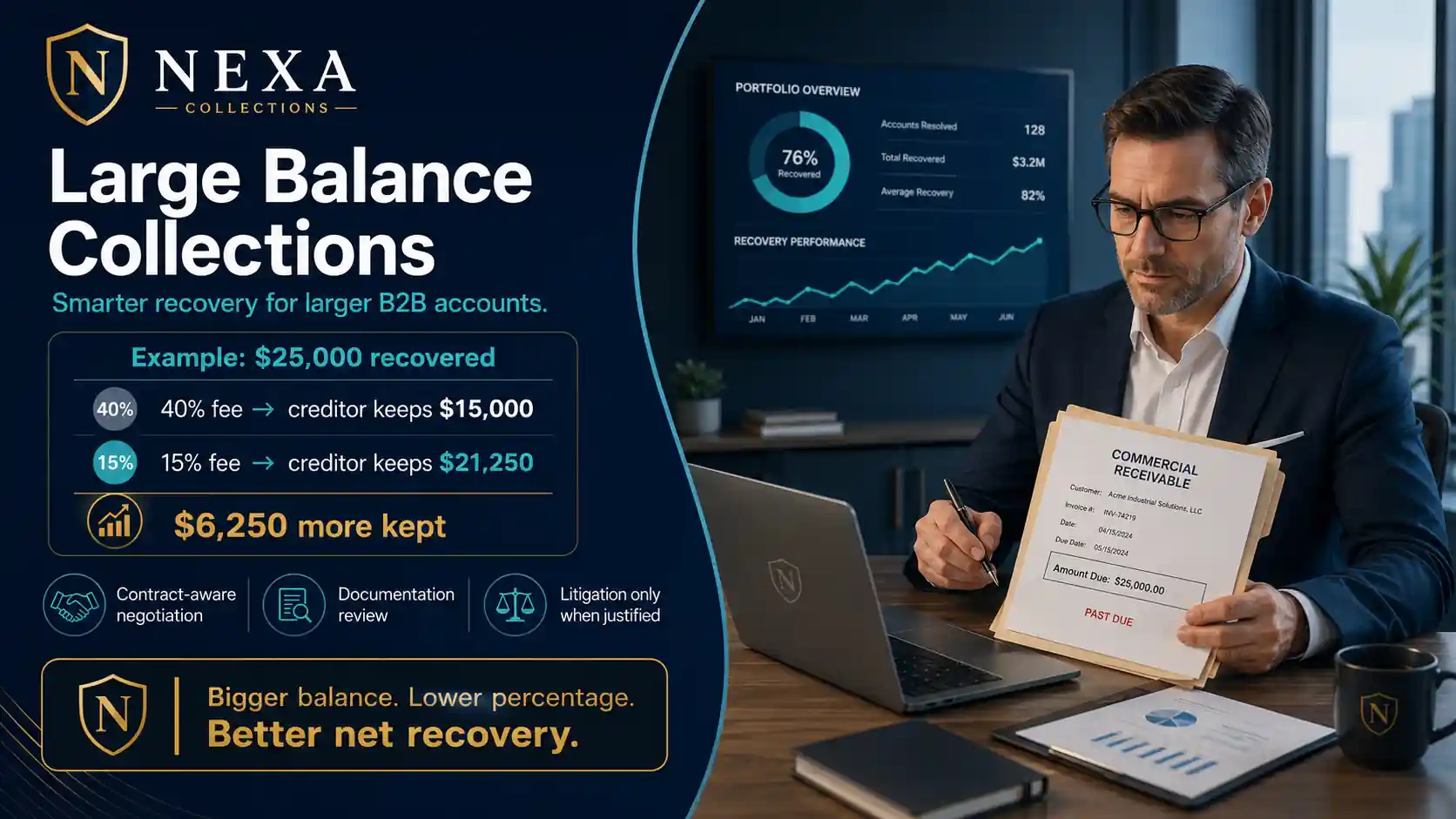
Nexa provides a reputation-safe approach to commercial debt recovery, with nationwide collection capabilities and specialized experience in B2B accounts. Our team handles disputed invoices, contracts, purchase orders, personal guarantees, and UCC-related commercial accounts where applicable. 15+ years experience. Clients receive free bankruptcy screening, litigation checks, business-location research, and appropriate credit reporting, with zero onboarding fees.
Our SOC 2 Type II environment helps protect sensitive business data, while experienced negotiators work to recover payment without unnecessarily damaging valuable commercial relationships. With more than 2,000 online reviews and a 4.85/5 rating, Nexa combines strong recovery capabilities with responsive client support.
Need a Collection Agency for Large Balance Recovery? Contact us
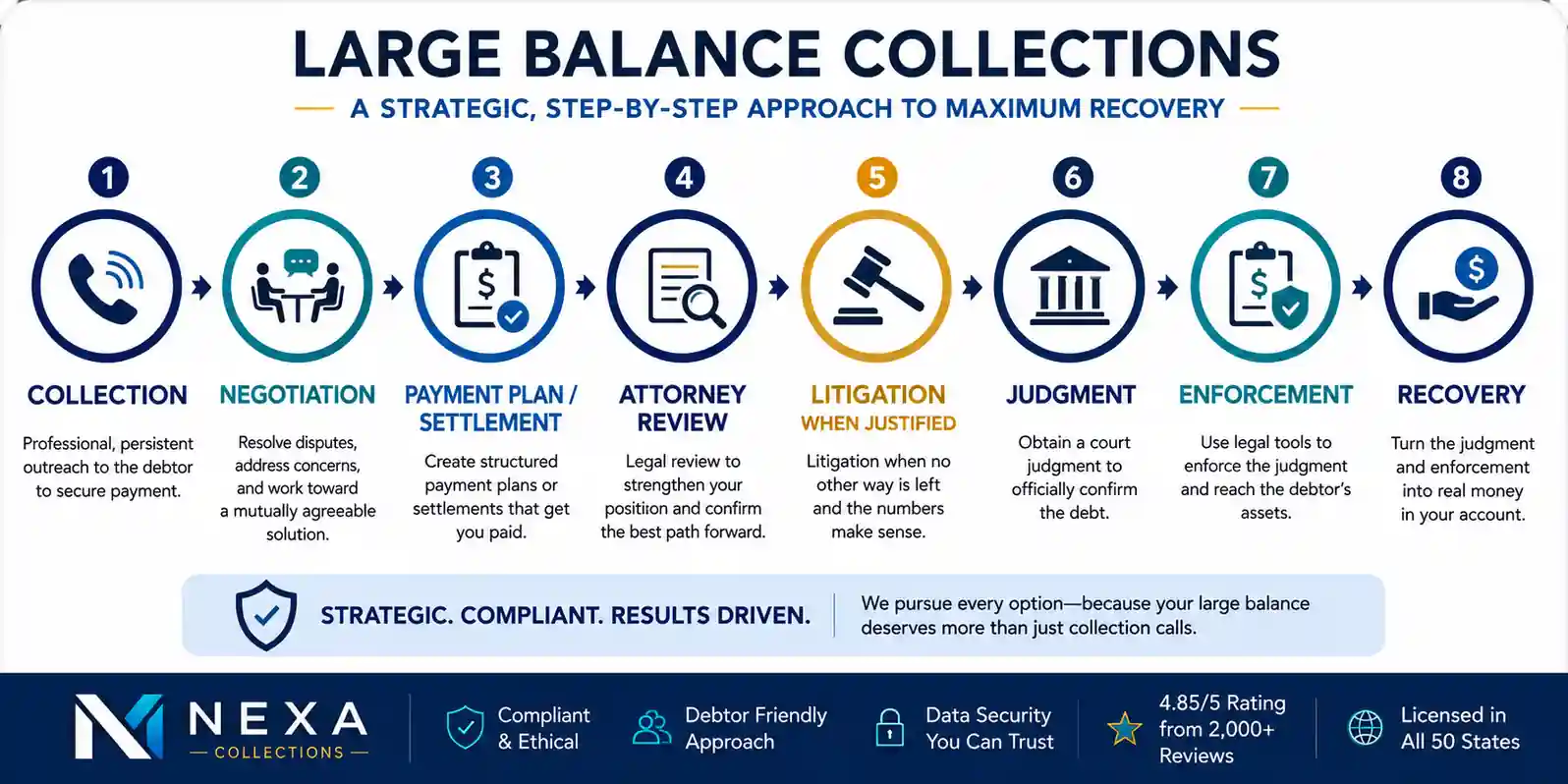
Collection → Negotiation → Payment Plan/Settlement → Attorney Review → Litigation When Justified
Large Debts Need a Different Collection Strategy
A $100,000 unpaid invoice is rarely solved by simply making more calls. Large commercial accounts commonly involve disputed invoices, contract disagreements, purchase-order issues, delayed internal approvals, cash-flow problems on the debtor’s side, partial payments, personal guarantees, and multiple decision-makers who all need to sign off before money actually moves.
High-value commercial collections are often negotiations, not just collection calls. Getting a large balance resolved usually means understanding exactly why payment stopped, not just repeating the amount owed.
Bigger Balance, Lower Contingency Percentage
Nexa can charge lower percentages on larger accounts because the work of collecting a big invoice doesn’t scale one-to-one with its size, and a lower rate on a large recovery still returns more absolute value to both sides than a high rate on a small one.
Here’s what that actually looks like: if $100,000 is recovered at a 10% contingency rate, the creditor keeps $90,000. Compare that to a flat 40% rate on the same recovery:
- $100,000 recovered
- 40% fee = creditor keeps $60,000
- 10% fee = creditor keeps $90,000
- Difference = $30,000
That 10% rate applies specifically to qualifying $100,000+ accounts under 90 days old, not to every large balance regardless of age. The amount recovered matters. The amount you keep matters too.
Nexa’s Commercial Contingency Rates
| Age of Account | $5,000–$19,999.99 | $20,000–$99,999.99 | $100,000+ |
|---|---|---|---|
| Under 90 days | 20% | 15% | 10% |
| 90–180 days | 25% | 20% | 15% |
| 180 days–1 year | 30% | 25% | 20% |
| Over 1 year | 35% | 30% | 25% |
The rate always depends on both the balance and how long it’s been outstanding, not on size alone.
Age of Debt Matters Almost as Much as the Balance
A fresh account generally means better contact information, easier access to supporting documentation, current employees who were actually involved in the transaction still being reachable, fewer ownership or business-status changes, and simply more negotiating leverage while the relationship is still recent.
A $100,000 debt placed at 60 days is not the same collection problem as a $100,000 debt placed after two years. The table above reflects that directly, the same balance can carry a 10% rate or a 25% rate depending entirely on how long it’s been sitting.
Why Large B2B Accounts Need Experienced Negotiation
Large commercial balances often require finding out why payment actually stopped before anything else can happen. That can mean identifying the true underlying dispute, reaching the right controller, CFO, owner, or accounts-payable decision-maker (not just whoever answers the phone), reconciling invoices against purchase orders and delivery records, reviewing the supporting documentation in detail, negotiating realistic payment terms, arranging structured payments, or negotiating an appropriate settlement when the creditor has authorized one.
Professionalism matters here specifically because large B2B relationships are often ongoing ones. Preserving the business relationship, where that’s still valuable to the creditor, is part of doing this well, not a separate consideration from collecting the money.
If Your Transaction Included a Security Interest, You May Have More Options
Large equipment, inventory, or accounts-receivable-financed transactions are more likely than smaller ones to include a properly documented security interest, formalized through a security agreement and typically perfected with a UCC-1 financing statement. If that documentation exists, the creditor generally has real advantages an unsecured creditor doesn’t: the right to repossess collateral without going to court first (provided it can be done without breaching the peace), and, where the collateral is accounts receivable, the right to notify the debtor’s own customers to pay the creditor directly. This can be significantly faster than litigation, and it generally holds a stronger position even if the debtor later files for bankruptcy. Not every large balance has this in place, but for the ones that do, it’s worth confirming before assuming a standard collection or litigation path is the only option.
When Legal Escalation Makes Sense
Large balances can make litigation more economically practical than it would be for a small account, but that doesn’t mean litigation should be treated as automatic. The goal is not to sue because the balance is large. The goal is to escalate when the documentation, collectability, and economics genuinely support it, factoring in bankruptcy screening, the debtor’s current business status, documentation quality, likely collectability of any resulting judgment, expected legal costs, and expected net recovery after those costs.
Collection → Negotiation → Payment Plan/Settlement → Attorney Review → Litigation When Justified
For more on how that legal review process actually works, see our full guide to how debt collection lawyers work.
Types of Large Commercial Debts Nexa Handles
Manufacturing: Large unpaid supply, equipment, component, and purchase-order invoices.
Construction & Trades: Contractor, subcontractor, materials, and project balances.
Staffing Companies: Unpaid invoices where payroll has already been funded.
Transportation & Logistics: Freight, warehousing, shipping, and transportation receivables.
Wholesale & Distribution: Inventory, trade-credit, and distributor balances.
Professional Services: Consulting, engineering, IT, accounting, and other high-value service invoices.
Commercial Property: Commercial lease, vendor, and contractual balances.
See our full commercial collections overview for the broader B2B recovery process this large-balance pricing sits within.
Why Pay 40% on a Fresh $100,000 Account?
A flat contingency percentage may make sense for smaller or genuinely difficult accounts, but applying that same high rate to every balance can dramatically reduce what the creditor actually keeps. Nexa’s tiered pricing recognizes that a $2,000 account and a $200,000 account should not necessarily carry the same collection percentage. See the full fee structure for how this fits alongside standard and legal-referral pricing.
Need a Collection Agency? Contact us
Frequently Asked Questions
Do collection agencies charge lower rates for large debts?
Often, yes, when the agency’s pricing is genuinely tiered rather than flat. Nexa’s contingency rate depends on both the size of the balance and how long it’s been outstanding, with larger, fresher accounts qualifying for meaningfully lower rates than smaller or older ones carry.
What percentage does a collection agency charge on a $100,000 debt?
With Nexa, a qualifying $100,000+ account under 90 days old can carry a contingency rate as low as 10%. That rate rises with age, 15% at 90-180 days, 20% at 180 days to a year, and 25% beyond a year, so the exact rate depends on both size and how long the account has been outstanding.
Can a collection agency recover a $50,000 or $100,000 B2B invoice?
Yes, this is squarely the kind of account experienced commercial collection handles well, provided the underlying debt is documented and the debtor is genuinely collectible. Large B2B balances often benefit from negotiation and documentation review more than repeated calls alone.
Should I use a collection agency or a lawyer for a large commercial debt?
Generally, agency-first, with attorney escalation reserved for accounts where litigation is financially justified. A large balance can make legal costs easier to absorb, but escalation should still depend on documentation strength, debtor collectability, and expected net recovery, not size alone.
When should a large unpaid B2B invoice be sent to collections?
Earlier than most businesses assume. Waiting generally makes recovery harder, contact information ages, documentation gets harder to assemble, and the pricing table above reflects this directly: the same balance carries a meaningfully lower rate when it’s fresh than when it’s aged past a year.
What documents help collect a large disputed commercial debt?
The signed contract or purchase order, invoices, delivery or acceptance records, account statements, relevant email correspondence, any personal guarantee, and the full payment history. A well-documented large account is significantly easier to resolve through negotiation than one relying on the invoice alone.
How does a personal guarantee protect my business if a corporate debtor shuts down?
When an insolvent LLC or corporation closes its doors, standard commercial claims against the company often become uncollectible “paper debts” against an empty shell entity. A signed, enforceable personal guarantee changes the legal landscape. It waives the business principal’s corporate limited-liability shield, creating joint and several liability. This allows you to bypass the lengthy, expensive legal battle of “piercing the corporate veil” and pursue recovery directly against the owner’s personal bank accounts, real estate, and private assets.
How should large debt settlement plans be structured to prevent future defaults?
Large-balance payment plans should never rely on verbal promises or basic promissory notes. If a debtor defaults midway through a plan, an informal agreement forces you to file a lawsuit and spend months proving the original underlying claim. Instead, anchor substantial settlements with an Agreed Judgment, Consent Order, or Confession of Judgment Note (where permitted by state law). Under this structure, the judgment is held in escrow while payments remain current; if the debtor misses a payment, the creditor can immediately enter judgment with the court and proceed directly to post-judgment enforcement—such as bank levies and property liens—without relitigating the case.
Nexa understands that high-value commercial accounts require a different approach than a routine consumer balance. Larger balances may qualify for significantly lower contingency rates, while professional negotiation, documentation review, debtor research, and selective legal escalation help maximize what actually comes back to the creditor. If your business is carrying a large commercial balance, especially $10,000 or above, talk to Nexa about the right recovery strategy and which contingency tier your account qualifies for.