Searching for a “collection agency near me” makes sense, it’s how you’d look for a plumber or a dentist. But debt collection doesn’t work like local services. You’ll never walk into an office to drop off a file, and a collector three states away can pursue your debtor just as effectively as one across town, often more effectively, if they’re actually licensed where it counts.
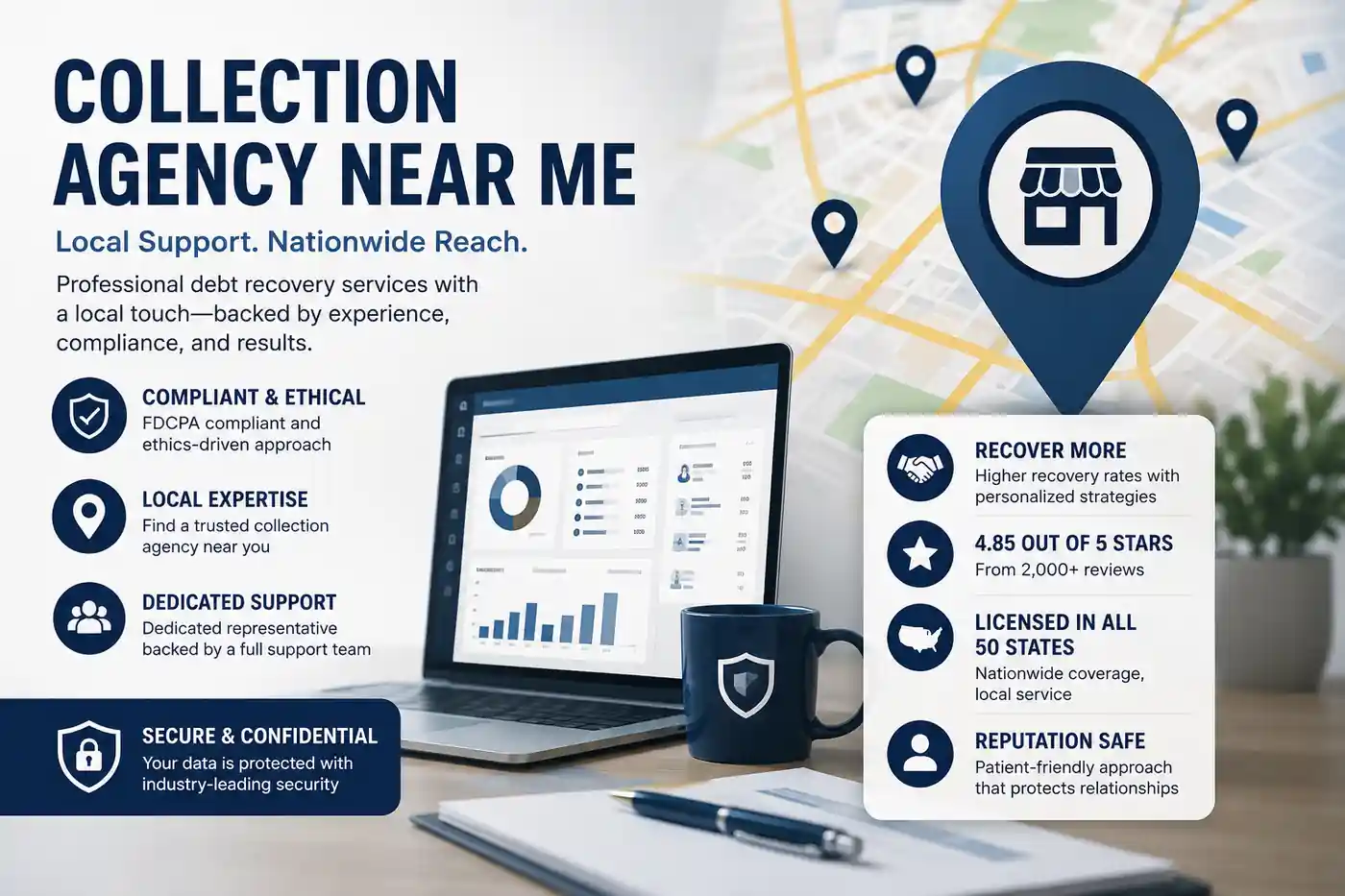
Quick Answer: What “Near Me” Should Actually Mean in Debt Collection
“Near me” in debt collection should mean licensed in your state and your debtor’s state, not physically nearby. A collection agency operates by phone, mail, and secure online portal regardless of location, so 50-state licensing, knowledge of your state’s specific statute of limitations and garnishment rules, and the ability to follow a debtor who moves out of state matter far more than a local street address.
Why Physical Location Doesn’t Matter Here
A local plumber has to show up at your house. A local mover has to physically drive your furniture. A collection agency does neither.
- You’ll never visit their office. Accounts are submitted through a secure online portal from your home or business, not in person.
- They won’t visit your debtor’s house either. Legitimate collection agencies work by letter, phone, and, when necessary, an attorney referral, not door-knocking.
- You don’t check where your other bills come from. Your utility company, your insurance carrier, probably neither is headquartered in your city, and it’s never mattered.
- A local-only agency loses the account the moment your debtor moves. If your debtor relocates out of state, an agency licensed only in your state can no longer legally pursue them. A nationally licensed agency simply keeps working the account.
What Actually Matters: State Law, Not Street Address
Every state has its own statute of limitations, its own wage garnishment rules, its own interest caps, and its own specific consumer protection statutes layered on top of the federal FDCPA. An agency’s real value isn’t its zip code, it’s whether it actually knows which rules apply to your specific debtor’s state, and whether it’s licensed to act on that knowledge. A “local” agency that’s never worked a file in your debtor’s actual state is, functionally, the same as a national one, except it can’t follow the account if the debtor moves.
The one place physical location genuinely matters: if an account escalates to a lawsuit, that suit has to be filed in the debtor’s local court, in their jurisdiction or county. This is exactly why established agencies maintain a nationwide network of local attorneys rather than relying on physical branch offices, the local presence exists exactly where it’s actually needed, at the courthouse, not at a desk you’d never visit anyway.
Local Single-Office Agency vs. Nexa’s 50-State Platform
| Factor | Local Single-Office Agency | Nexa’s 50-State Platform |
|---|---|---|
| Coverage area | Typically one state, sometimes a handful | All 50 states and Puerto Rico |
| What happens if the debtor moves out of state | Account often becomes unenforceable; may need to be referred elsewhere | Continues without interruption |
| Pricing | Varies widely, often less transparent | Flat $15 fixed-fee tier, or contingency with no upfront cost |
| Technology | Ranges from modern to outdated depending on the office | Secure online portal, digital submission, real-time tracking |
| Legal escalation | May lack an established local-attorney relationship outside its home state | Nationwide attorney network, engaged only where the debtor actually is |
Explore Coverage by Location
Nexa operates nationwide, with dedicated content for specific regions, including:
- College Station, TX
- Clovis, CA
- Pearland, TX
- Columbia, MO
- Norman, OK
- Sterling Heights, MI
- Round Rock, TX
- Lewisville, TX
- Illinois state-specific collection laws
How to Actually Shortlist a Collection Agency
Since “near me” isn’t the right filter, use these instead:
- Licensed in your state, and ideally all 50. Confirm this directly, don’t assume.
- A near 5 Star Google Rating, from hundreds of reviews.
- A real recovery-rate figure, not a vague “high success rate” claim.
- Follows FDCPA and applicable state law, protecting you from liability, not just the debtor from harassment.
- Transparent, published pricing, fixed-fee or contingency, stated upfront.
- Data security practices appropriate to what you’re sending them, especially for medical or financial accounts.
Need a Collection Agency With Strong Recovery Rates? Contact Us
Serving Clients Nationwide
- ⭐ 4.85 / 5 · 2,000+ Reviews
- Licensed All 50 States & Puerto Rico
- SOC 2 Type II Certified
- FDCPA, HIPAA & TCPA Compliant
- From $15 / Account — No Upfront Fee
- Free: Skip Tracing · Bankruptcy Scrubs · Onboarding
Nexa’s Pricing — No Surprises, No Upfront Cost

Always free: credit bureau reporting, bankruptcy scrubs, litigation scrubs, skip tracing, and onboarding. Minimum account balance: $50.
Calculator
State Debt Recovery & Statute Estimator
Select your state and debt details to calculate legal timelines and projected net recovery.
4 Years
Within Legal Limits
$4,985
You Retain 100% of Debt
$3,350
Save $1,635 with Nexa
Frequently Asked Questions
Do I need a collection agency with a physical office near me?
No. A collection agency operates by phone, mail, and secure online portal, not in-person visits, so a nearby office provides no practical advantage. What actually matters is licensing in the relevant state and familiarity with that state’s specific collection laws.
Can a local collection agency collect from a debtor who moved out of state?
Usually not, if the agency is only licensed in your original state. Once a debtor relocates, an agency without a license in the new state generally can’t legally continue pursuing the account. A nationally licensed agency simply continues without that interruption.
How do I verify if a debt collection agency is licensed in my state?
Most states maintain a public licensing lookup through their Department of Financial Institutions, Attorney General’s office, or equivalent regulator. A legitimate agency should be able to confirm its license status directly and without hesitation; hesitation or vagueness on this specific question is a real warning sign.
What is the cost of hiring a debt collection agency near me?
Cost depends on the service tier, not the agency’s location. A fixed-fee demand letter service typically runs around $15 per account for fresher balances, while contingency-based collection for older or harder accounts generally runs 20–40% of what’s actually recovered, with nothing owed if nothing is collected.
If my account eventually needs a lawsuit, does going through an agency’s attorney network cost more than hiring a local attorney myself?
Generally not. Reputable agencies work with an established network of local attorneys, and the fee structure is typically comparable to approaching that same attorney directly, since the referral relationship is ongoing rather than a one-off markup. The advantage is that the agency already knows which attorney in that specific jurisdiction actually gets results.
I have debtors spread across several states. Do I need a different agency for each one?
No, and that’s exactly the scenario a nationally licensed agency is built for. Juggling separate local agencies per state means separate onboarding, separate portals, and separate points of contact for what should be one unified accounts-receivable strategy. A single 50-state agency consolidates all of it under one relationship.
If the agency isn’t local, will the outreach still respect my state’s specific rules and feel appropriate to my customers?
Yes, that’s the actual job. A properly licensed national agency tailors its calling hours, required disclosures, and communication approach to whichever state the debtor is actually in, which matters far more to how “appropriate” the outreach feels than whether the letter’s return address happens to be nearby.