A hospital billing office in most states can send an account to collections and, eventually, to court on a fairly standard timeline. Boston’s teaching hospitals operate under a materially different clock. Massachusetts requires roughly six months to pass from the first bill before a lawsuit can even be filed, layers state-specific financial assistance requirements on top of the federal minimum, and runs its own state-funded safety net most states simply don’t have. Getting the sequencing right here isn’t optional, it’s the difference between a collectible account and a compliance problem.
In short: Boston collections run on Massachusetts’ unusually protective hospital billing framework: a 180-day minimum from first bill before a lawsuit can be filed, free care mandated at 200% of the federal poverty level, a state Health Safety Net covering care up to 300% FPL, and a $1 million homestead exemption that matters directly for judgment enforcement. General consumer debt follows Massachusetts’ standard garnishment rules (15% of gross wages or the amount above 50x minimum wage, whichever is less), while the state’s newer 3%-interest, enhanced-garnishment-protection rules apply specifically to medical debt judgments, not debt generally. Nexa is HIPAA compliant and recovers Boston accounts starting at a $15 fixed fee per account, with contingency options for older balances, built around this specific sequencing.

Nexa provides reputation-safe, equipped with all 50-state collections license, offering free credit reporting, free litigation/bankruptcy scrubs, and zero onboarding fees. Secure – SOC 2 Type II & HIPAA compliant. Backed by a very helpful customer support team.
Need a Medical Collection Agency in Boston? Contact us
Why Boston’s Hospital Billing Rules Are Genuinely Different
The 180-day rule changes when an account is actually placeable.
A hospital, or a collector acting for one, generally cannot initiate a lawsuit until at least 180 days have passed from the date of the first post-discharge bill. Placing an account for collection isn’t the same as suing on it, but the sequencing matters: financial assistance screening and payment plan negotiation are supposed to happen within this window, before any legal escalation, not as an afterthought once the clock has already run.
Financial assistance here goes beyond the federal floor.
Every nonprofit hospital must publish a financial assistance policy under federal 501(r) rules, but Massachusetts’ Attorney General layers on additional requirements: free care at or below 200% of the federal poverty level, and hospitals cannot deny assistance for copays, coinsurance, or deductibles even when a patient has insurance. A meaningful share of Boston hospital accounts that look like straightforward non-payment are actually accounts that were never properly screened for a benefit the patient qualified for.
The Health Safety Net is a real, distinctly Massachusetts program.
Beyond hospital-level financial assistance, the state itself funds a Health Safety Net covering care up to 300% of the federal poverty level, a legacy of Massachusetts’ 2006 healthcare reform, the model the ACA was later built on. This is a state-level backstop most other states don’t have, and it’s worth checking before assuming a patient balance is a dead end.
A $1 million homestead exemption changes what judgment enforcement actually looks like.
Massachusetts protects up to $1 million in home equity from most creditor claims, a notably high figure. For a creditor evaluating whether pursuing a residential asset makes sense after judgment, this is a real number to know before spending on that path.
Worth flagging as pending, not current law:
Governor Healey announced in January 2026 an intention to file regulations banning medical debt from credit reporting statewide. As of this writing, that’s an announced intention, not a finalized, currently-effective rule, worth watching rather than assuming is already in force.
The Massachusetts Legal Landscape
| Pre-Suit Waiting Period (hospital debt) | 180 days from first bill |
| Hospital Free Care Threshold | 200% FPL (Attorney General Community Benefits Guidelines) |
| State Health Safety Net Coverage | Up to 300% FPL |
| Homestead Exemption | $1,000,000 |
| General Wage Garnishment | 15% of gross wages or amount above 50x minimum wage, whichever is less |
| Medical Debt Judgment Garnishment | Enhanced protections: 3% interest cap, 65x minimum wage exemption (Debt Collection Fairness Act) |
| Call Frequency (940 CMR 7.00) | 2 calls/7 days to residence, separate 2 calls/30 days to workplace numbers |
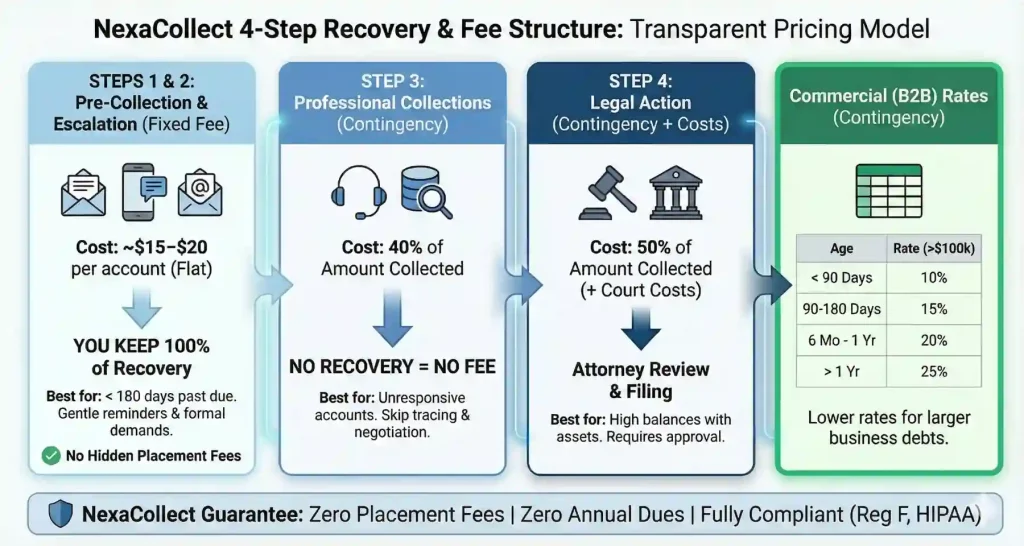
What This Costs
Step 1 & 2: Fixed-Fee Recovery (~$15/account). Professional demand sequences timed appropriately around any applicable waiting periods. Payments go directly to you. See the full pricing breakdown.
Step 3: Contingency Collection (~40%). For older or unresponsive accounts, no recovery, no fee.
Step 4: Legal Referral (client-approved, ~50%). Timed to comply with any applicable pre-suit waiting period, filing fees reimbursed from the first recovery.
Who We Collect For Across Boston
- Academic Medical Centers & Hospitals: HIPAA-compliant patient balance recovery built around Massachusetts’ specific financial assistance sequencing, for the teaching hospitals and specialty practices concentrated in the Longwood Medical Area and beyond.
- Universities & Higher Education: Tuition and program fee recovery for the region’s dense concentration of colleges and universities.
- Biotech & Professional Services: B2B and commercial receivables for the life sciences, consulting, and financial services firms clustered around Kendall Square and the Financial District.
- Property Management: Move-out and lease-end balance recovery for a rental market with unusually high annual turnover given the region’s student population.
- Fitness & Membership Businesses: Recurring billing recovery for studios and gyms across the city.
- Dental: Patient-first dental debt recovery for practices across the metro.
Frequently Asked Questions
How long does a Boston hospital have to wait before suing over an unpaid bill?
At least 180 days from the date of the first post-discharge bill. This waiting period exists specifically to give patients time to apply for financial assistance or negotiate a payment plan before legal escalation becomes an option, so an account placed for collection during this window should focus on resolution and screening, not litigation.
What income level qualifies a patient for free care at a Massachusetts hospital?
Generally 200% of the federal poverty level or below, under the Massachusetts Attorney General’s Community Benefits Guidelines, a higher threshold than federal law alone requires. Hospitals also cannot deny financial assistance for copays, coinsurance, or deductibles, even for patients who have insurance.
What is the Massachusetts Health Safety Net, and how is it different from hospital financial assistance?
It’s a state-funded program, separate from any individual hospital’s own financial assistance policy, that covers care for patients with income up to 300% of the federal poverty level. It’s a legacy of Massachusetts’ 2006 healthcare reform and represents a state-level backstop that most other states don’t have, worth checking on a patient account before assuming a balance is uncollectable from every angle.
How much home equity is protected from creditors in Massachusetts?
Up to $1,000,000 under the state’s homestead exemption, a notably high figure compared to most states. This matters directly for judgment enforcement: pursuing a debtor’s primary residence as an asset is generally not realistic in Massachusetts the way it might be in a state with a smaller or no homestead protection.
Does Massachusetts’ 3% interest cap on medical debt apply to all consumer debt, or just medical judgments?
Just medical debt judgments specifically, under the state’s Debt Collection Fairness Act. General consumer and commercial debt in Massachusetts follows the standard garnishment rule instead, 15% of gross wages or the amount exceeding 50 times minimum wage, whichever is less, a materially different and less protective framework than the medical-specific rules.
Is medical debt currently banned from credit reports in Massachusetts?
Not yet as a finalized rule, though it may be soon. Governor Healey announced in January 2026 that her administration intends to file regulations banning medical debt from credit reporting statewide. As of now, this is an announced intention rather than a currently effective regulation, worth watching rather than treating as settled.