A security and alarm collection agency is a licensed third-party firm that recovers unpaid monitoring fees, equipment financing balances, Recurring Monthly Revenue (RMR), and early-termination charges on behalf of home alarm and commercial security system providers. Unlike general collection agencies, a specialist in security and alarm debt understands the unique structure of multi-year monitoring contracts, the distinction between consumer accounts (governed by the FDCPA) and commercial B2B accounts (governed by contract law), and the brand-sensitivity required when collections involve long-term residential clients who may reactivate service once a balance is resolved.
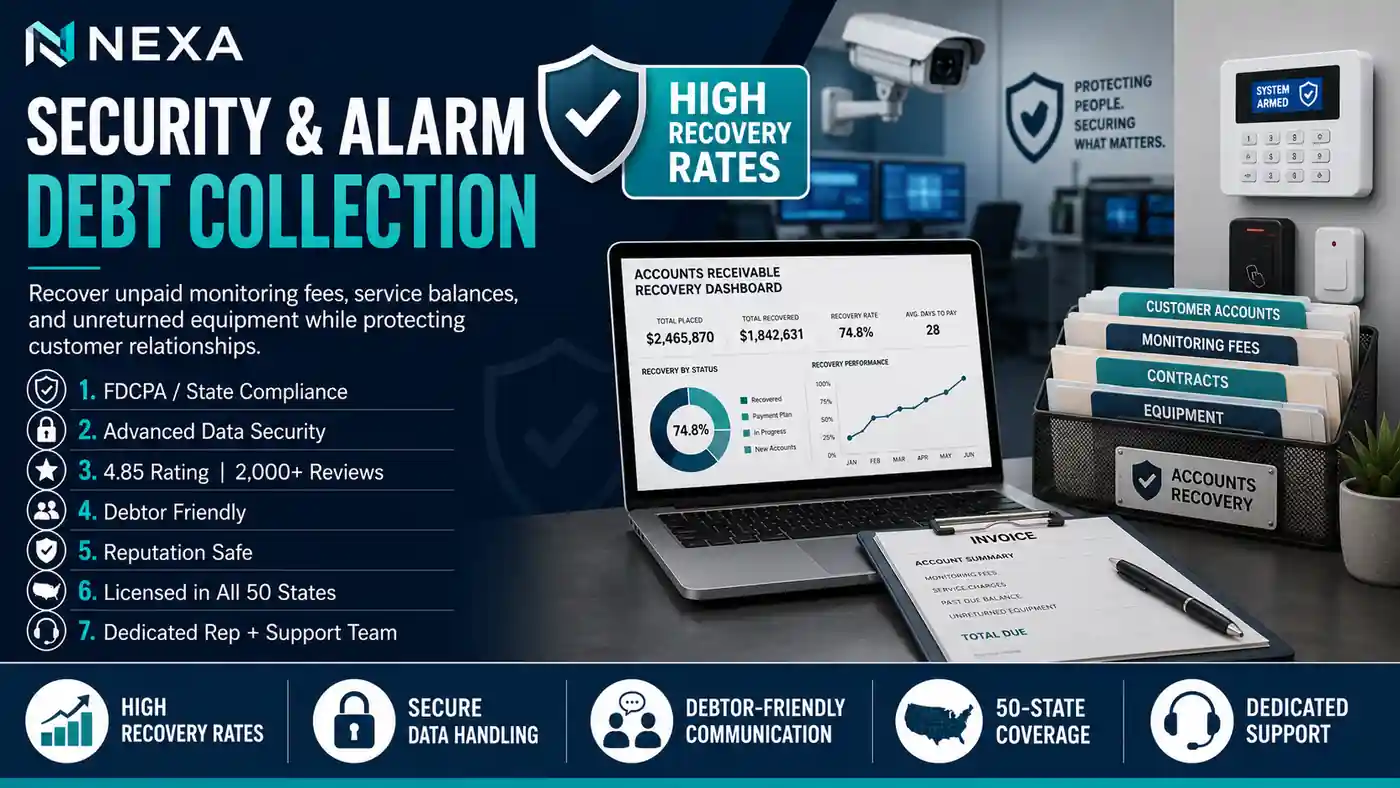
Securing the Perimeter of Your Profits: Revenue Recovery for the Alarm Industry
In an industry where the median subscriber acquisition cost (SAC) has climbed over $1,200 per residential account, every “ghost” cancellation is a direct hit to your bottom line. The security industry isn’t just fighting crime; it’s fighting a silent epidemic of unreturned hardware and monitoring fee defaults.
When an office park or a homeowner “goes dark” without returning your high-end AI cameras or proprietary access hubs, you aren’t just losing a monthly fee—you’re losing thousands in depreciating physical assets. Nexa provides a surgical, legally-fortified recovery strategy that retrieves your funds and hardware while maintaining the professional reputation your brand depends on in a competitive North American market.
Nexa provides 100% reputation-safe, equipped with all 50-state collections license, offering free credit reporting, free litigation, free bankruptcy scrubs, and zero onboarding fees. Secure – SOC 2 Type II & HIPAA compliant. Over 2,000 online reviews rate us 4.85 out of 5.
Need a Collection Agency? Contact us
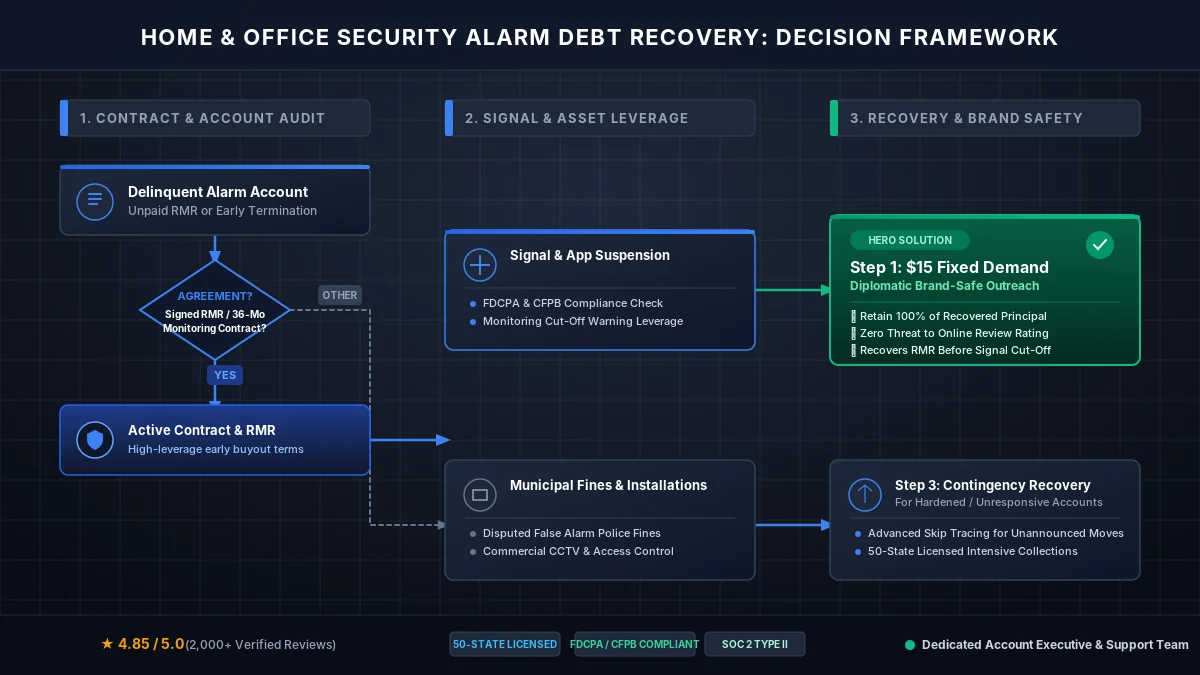
Our 4-Stage Security Alarm Recovery Framework
Nexa’s recovery process is purpose-built for the security and alarm industry — accounting for long-term contract structures, the consumer-vs-commercial split, and the relationship sensitivity that defines recurring monitoring clients.
Stage 1 — Account Intake & Contract Triage
Every security or alarm account transferred to Nexa begins with a structured intake review. Our team imports account data via our secure client portal (no spreadsheet emails required), performs an immediate bankruptcy scrub to flag accounts under federal automatic stay, and conducts a litigation scrub to identify professional plaintiffs who might exploit a technical collection error. We verify the contract type — residential monitoring agreements governed by the FDCPA, or commercial B2B security service contracts handled under contract law — and assign the appropriate compliance track. For home alarm accounts under $200 with balances under 60 days, the fixed-fee $15/account model typically applies. Older or higher-balance accounts proceed to the contingency track. Zero onboarding fees are charged at this stage.
Stage 2 — Diplomatic Multi-Channel Outreach
Security and alarm customers are often long-term clients who fell behind due to a life event rather than intent to defraud. Nexa’s outreach is calibrated accordingly — firm in legal authority, diplomatic in tone. We initiate a sequence of professional demand notices sent under Nexa’s name (shifting the psychological dynamic away from the creditor-client relationship), followed by telephone outreach during permitted hours and, where applicable, compliant email and SMS contact per Regulation F guidelines. All calls are recorded and reviewed by our compliance management team. Our outreach scripts never threaten legal action we do not intend to take, never misrepresent the debt amount, and never contact customers outside the hours permitted under the FDCPA (8 AM–9 PM local time). This stage is designed to resolve the majority of residential accounts within 30–45 days without escalation.
Stage 3 — Resolution, Payment Plans & Escalation Triggers
When initial outreach produces engagement but not full payment, our collectors are authorized to negotiate structured payment plans appropriate to the account balance — typically two to four installments for balances between $200 and $800. For accounts exceeding $1,000 or accounts where the customer has disputed contract termination terms, we escalate to our specialized dispute resolution team, which reviews the original agreement documentation and issues a formal debt validation response within the FDCPA’s required 30-day window. Contingency pricing (20–40% depending on account age and complexity) applies to accounts in this stage. If legal escalation is required — for example, to enforce an early-termination penalty clause on a multi-year commercial monitoring contract — we present the option to the client for authorization before proceeding. Legal escalation is available at up to 50% contingency, client-approved.
Stage 4 — Account Closure & Reconciliation Reporting
Every account closes with full documentation — paid, settled, bankruptcy-discharged, recalled by the client, or referred for legal action. Clients access real-time closure status through the Nexa 24/7 secure portal, including payment receipt confirmation, settlement documentation, and exportable reports for month-end accounts receivable reconciliation. For accounts where payment is received but the customer disputes the original balance, we provide a chain-of-custody record covering every contact attempt and response, protecting the security company from FCRA-related disputes about credit reporting accuracy. Recovered funds are remitted to the client on a net-payment schedule. At the conclusion of each placement cycle, Nexa provides a performance summary showing accounts placed, amounts recovered, recovery rate, and average days to resolution — data that most security companies use to optimize their future 90-day handoff timing.
Security & Alarm Account Types We Collect
The security and alarm industry encompasses several distinct business models, each with its own contract structure, debt profile, and collection strategy. Nexa handles all of the following.
Residential Home Alarm Monitoring Companies
Home alarm companies typically operate on multi-year monitoring contracts with monthly recurring fees of $30–$80. Unpaid residential accounts are governed by the FDCPA and require compliant consumer collection procedures, including a formal debt validation notice within five days of first contact. The most common trigger for non-payment is customer relocation without formal contract termination — skip tracing is frequently required to locate the responsible party at their new address.
Commercial Security System Providers
Commercial security debts — owed by businesses for system installation, maintenance contracts, and monitoring services — fall outside the FDCPA and are governed by the terms of the service agreement and applicable UCC provisions. These accounts typically carry higher balances ($500–$15,000+) and require a business-credit-aware collection strategy, including D&B reporting and, where warranted, formal demand letters that reference the contractual early-termination penalty clause.
CCTV & Surveillance Camera Installers
Camera installation companies frequently carry unpaid balances related to equipment costs, installation labor, and ongoing maintenance agreements. These accounts often involve disputes over system performance — a customer who believes the cameras failed to capture an incident may withhold payment. Nexa’s dispute resolution track documents the original service acceptance records to neutralize this objection and move the account toward resolution.
Access Control & Keypad System Providers
Providers of electronic access control systems — keypad entry, fob systems, and card readers for commercial premises — typically bill on a maintenance and monitoring model. Unpaid balances arise most often when a business changes ownership and the new operator disputes inherited contract obligations. Nexa’s team is experienced in navigating successor-liability collection scenarios under commercial contract law.
Smart Home & Automation Companies
Smart home integrators who bundle security with automation (smart locks, lighting, HVAC control) face unique collection challenges: customers often dispute “security” fees when the automation component is the primary perceived value. Nexa segments bundled-contract accounts to identify and collect the security monitoring portion separately, ensuring the company recovers the regulated service revenue without triggering a broader contract dispute.
Fire & Life Safety Alarm Firms
Fire alarm and life safety companies operate under state-level inspection and certification requirements that create mandatory service relationships — making non-payment particularly disruptive. Unpaid inspection fees and monitoring contracts for fire suppression and sprinkler systems are typically commercial accounts requiring direct contact with the facility manager or property owner. Nexa handles these accounts with the professional authority appropriate to a safety-critical service sector.
The Security Economy: Data & Context
The global security solutions market has surged to $370 billion in 2025, yet industry benchmarks show that involuntary churn remains a persistent leak, often claiming 8.6% of annual revenue. With 4K AI-enabled cameras now retailing between $180 and $650 per unit and commercial access control systems averaging $2,500 per door, a single commercial default can represent a $15,000+ loss in hardware alone. Nexa bridges this gap by moving faster than the 90-day “danger zone,” using high-velocity digital outreach and professional mediation to secure your hardware before it disappears.
Compliance in Security & Alarm Collections
Security and alarm collection spans both consumer and commercial debt — each with its own regulatory framework. Nexa is built to operate compliantly in both tracks.
| Regulation | Who / What It Covers | How Nexa Complies |
|---|---|---|
| FDCPA (Fair Debt Collection Practices Act) | All consumer residential alarm and home security accounts. Does NOT apply to commercial/B2B security contracts. | All consumer-track accounts receive a compliant debt validation notice within 5 days of first contact. Calls limited to 8 AM–9 PM local time per Regulation F. All communications are recorded and reviewed. |
| Regulation F (CFPB, effective Nov. 2021) | Updates to FDCPA governing electronic communications, call frequency caps (max 7 calls/7 days per debt), and model validation notice format. | Nexa’s dialer platform enforces Regulation F call frequency limits automatically. Electronic contact (email, SMS) is initiated only with explicit consent. Model validation notice format is used on all consumer-track accounts. |
| TCPA (Telephone Consumer Protection Act) | All outbound telephone and SMS contact — consumer and commercial. | Nexa maintains consent records for all SMS communications and uses human-initiated calls (not auto-dialers) for accounts where automated calling consent has not been established, reducing TCPA exposure for all clients. |
| FCRA (Fair Credit Reporting Act) | Credit bureau reporting of delinquent consumer accounts. | Nexa provides free credit reporting as part of the contingency service. Reporting is initiated only after the Regulation F required pre-reporting notice period. Disputes are investigated and resolved per FCRA Section 611 timelines. |
| State Automatic Renewal Laws | Many states (CA, NY, IL, FL, and others) require security and alarm companies to provide specific written notice before auto-renewing monitoring contracts. Failure to comply may void the customer’s payment obligation. | Nexa’s intake process flags accounts from high-risk states for a contract compliance review before collection proceeds. Accounts where the underlying contract may be unenforceable are held for client review rather than collected on. |
| FTC Telemarketing Sales Rule (TSR) | Applies to security alarm companies that sell monitoring services via telephone — creates specific disclosure requirements and prohibits certain cancellation practices. | Where a client’s underlying debt involves a TSR-covered sale, Nexa ensures collection proceeds only on balances traceable to a TSR-compliant transaction, protecting the client from collecting on a void contract. |
| SOC 2 Type II / Data Security | Governs the security of consumer data held and processed during collection. | Nexa is SOC 2 Type II certified. All debtor data is encrypted in transit and at rest. Access is role-restricted. No data is stored on local devices. Annual third-party audits verify compliance. |
Local Rules & State Debt Laws: What You Need to Know
Collecting on security contracts is a legal minefield due to “Evergreen” (automatic renewal) clauses. We ensure your business is protected from 2026 compliance audits.
| State | Key Regulation (2026 Standard) |
| California | Alarm contracts must have a separate, signed disclosure for auto-renewals longer than one month; otherwise, the renewal is void. |
| Florida | 3-day “Cooling-Off” period applies to all home solicitation. Contracts for future services can be cancelled if services are no longer available. |
| Texas | “Clear and Conspicuous” rules apply. Evergreen clauses are enforceable only if they are more conspicuous than the surrounding text. |
| Federal (TCPA) | Starting April 2026, opt-out requests for one channel (text) must apply to ALL channels (voice/email) within 10 days. |
Strategic Note: Because security contracts often involve “unreturned equipment” fees, we utilize Bank Levies and Asset Location as primary tools, as these are often more effective than traditional “calls” when hardware is involved.
Real Results: Nexa Security & Alarm Recovery
Case Study 1 — Residential Alarm Company Recovers $38,400 in Monitoring Arrears
Situation: A regional home alarm monitoring company with 3,100 active residential accounts transferred 214 consumer accounts to Nexa after internal collection letters produced a 4% response rate over 90 days. The total placed balance was $41,200, with an average account balance of $193 representing 6–18 months of unpaid monitoring fees. The largest concentration of overdue accounts was concentrated in accounts where the original subscriber had relocated without formally terminating the monitoring contract.
Approach: Nexa processed all 214 accounts through bankruptcy and litigation scrubs at intake, removing 12 accounts from active pursuit. The remaining 202 accounts were placed on the consumer FDCPA track. Skip tracing identified new addresses for 67 relocated subscribers within 14 days. Nexa initiated compliant demand notices followed by telephone outreach using relationship-preserving scripts emphasizing account resolution rather than threat of legal action. Payment plan options were offered to subscribers with balances over $300.
Outcome: 182 of 202 active accounts were resolved within 60 days — a 90.1% resolution rate. Total recovered: $38,400 (93.2% of placed balance). Zero complaints received. The client reactivated 31 subscribers following balance resolution, recovering approximately $1,120 in annual recurring monitoring revenue. (Nexa internal data, 2024)
Case Study 2 — Commercial Security Firm Recovers $94,700 in Contract Balances
Situation: A commercial security system integrator serving retail chains and office complexes transferred 38 B2B accounts to Nexa totaling $97,300 in combined early-termination penalties, unpaid equipment financing, and outstanding maintenance contract balances. Average account size: $2,561. Internal collection attempts had stalled, with several business debtors disputing the enforceability of early-termination clauses under their state’s automatic renewal statutes.
Approach: Because these were commercial accounts, Nexa assigned them to the B2B commercial track (outside FDCPA jurisdiction but subject to contract law and UCC provisions). Our team reviewed the original service agreements for each account and identified five accounts where the client’s automatic renewal notice did not meet the state’s statutory requirements — those five were returned to the client with recommendations for contract amendment. The remaining 33 accounts proceeded to formal commercial demand letters referencing the specific contractual penalty clause, followed by escalating contact with the business’s accounts payable decision-maker and, where necessary, D&B credit bureau reporting.
Outcome: 29 of 33 eligible accounts resolved within 75 days. Total recovered: $94,700 (97.3% of eligible placed balance). Legal referral was authorized for 3 remaining high-value accounts. Zero consumer complaints (commercial track). (Nexa internal data, 2025)
Our Cost-Effective Pricing Models

-
Fixed Fee Service ($15): The industry’s best “pre-collection” tool for accounts 30-60 days past due. The client pays you directly; you keep 100% of the money.
-
Contingency Fee (20% – 40%): Our “No Recovery, No Fee” model for tougher, older defaults. We only get paid when you do.
We seamlessly ingest your subscriber billing portfolios via secure Excel imports directly into our portal to rapidly initiate the recovery of past-due alarm and monitoring accounts meeting our $50 minimum placement threshold.
FAQ — Security & Alarm Debt Collection
Can an alarm company send a customer to collections for unpaid monitoring fees?
Yes. If a customer fails to pay recurring monitoring fees or violates an early-termination clause in a monitoring contract, the alarm company can transfer the account to a licensed collection agency. The collection agency must comply with the FDCPA for consumer (residential) accounts and applicable contract law for commercial accounts. Accounts are most successfully recovered when transferred to a collection agency no later than 90 days after the first missed payment — recovery rates decline significantly after 180 days.
Does the FDCPA apply to security alarm debt collection?
The FDCPA applies to residential home alarm accounts where the monitoring service was used primarily for personal, family, or household purposes. It does not apply to commercial security contracts where the debtor is a business entity. For consumer-track alarm accounts, the collection agency must provide a written debt validation notice within five days of first contact, adhere to calling hour restrictions (8 AM–9 PM local time), and limit telephone contact to seven calls per seven-day period per Regulation F. Nexa complies with all FDCPA and Regulation F requirements on all consumer-track security accounts.
What is the typical fee for a security alarm collection agency?
Security alarm collection agencies typically charge either a fixed per-account fee or a contingency percentage of amounts recovered. Nexa offers a fixed fee starting at $15 per account — you keep 100% of what is recovered. For older, more complex, or disputed accounts, Nexa’s contingency model applies a rate of 20–40% of recovered amounts, with no fee charged on accounts where no recovery is made. Legal escalation, where the client authorizes it, is available at up to 50% contingency. There are no onboarding fees and no charges for credit reporting, bankruptcy scrubs, litigation scrubs, or skip tracing.
What happens if a home security customer moves and leaves an unpaid monitoring contract?
When a residential customer relocates without formally terminating their monitoring contract, the alarm company retains the right to pursue the remaining contract balance and any accrued monitoring fees. Nexa’s skip tracing service locates the customer’s new address and updated contact information at no additional charge, allowing collection to proceed to the correct current address. Most relocated accounts are resolved within 30–45 days of new address confirmation.
Can a security alarm company report unpaid accounts to the credit bureaus?
Yes. Once a security alarm account is placed with a collection agency, the agency can report delinquent accounts to the three major consumer credit bureaus (Equifax, Experian, TransUnion) provided it follows the FCRA’s required pre-reporting notification steps. Nexa provides free credit reporting as part of its standard contingency service. Credit reporting significantly increases collection rates on consumer accounts because it creates a tangible incentive for the debtor to resolve the balance. Commercial accounts may be reported to business credit bureaus including Dun & Bradstreet.
How do collection agencies handle customers who dispute their alarm contract balance?
When a debtor disputes a security alarm balance within 30 days of receiving the debt validation notice, the collection agency must cease collection activity and provide written verification of the debt — typically the original contract, a payment history, and itemization of the disputed balance — before resuming contact. Nexa’s dispute team reviews the original agreement documentation, confirms the amount owed against the client’s records, and issues a formal written debt verification response. If the dispute identifies a legitimate billing error, Nexa notifies the client and adjusts the account accordingly.
What is the minimum balance Nexa accepts for security alarm accounts?
Nexa accepts security and alarm accounts with a minimum balance of $50 per account. There is no minimum number of accounts required to begin a placement. Both individual consumer accounts and bulk commercial portfolios are accepted. Accounts can be placed individually via the client portal or submitted in bulk using Nexa’s standard CSV account upload template. Balances under $50 are generally not cost-effective to pursue through third-party collection and are better handled through a final internal collection letter before the account is written off.
How long does security alarm debt collection typically take?
Most residential home alarm accounts that respond to collection contact are resolved within 30–60 days of placement. Accounts requiring skip tracing for a relocated debtor typically resolve within 45–75 days of address confirmation. Commercial security accounts with disputed contract terms may take 60–90 days due to the documentation review and negotiation process. Accounts that proceed to legal escalation — typically high-value commercial accounts or consumer accounts where the debtor has no intention of paying voluntarily — are referred to the client’s authorization before filing, and timelines vary by jurisdiction.
Does using a collection agency damage the security company’s customer relationships?
When handled by a professional, compliance-first agency, debt collection does not have to damage customer relationships. Nexa’s outreach is specifically designed to be diplomatic and resolution-oriented — many debtors remain customers after resolving a past-due balance. All calls are recorded and reviewed by Nexa’s compliance team to prevent aggressive or off-brand interactions. In Nexa’s residential alarm recovery data, 15–20% of resolved accounts result in service reactivation within six months of debt resolution, generating new recurring monitoring revenue for the client. (Nexa internal data, 2024)
Is Nexa licensed to collect security alarm debts in all 50 states?
Yes. Nexa Collections holds active collection licenses in all 50 states and Puerto Rico, enabling pursuit of security and alarm accounts regardless of where the debtor has relocated. Multi-state coverage is especially important for national home alarm chains and commercial security integrators whose clients may be located across dozens of states. Nexa’s all-state licensing eliminates the need to manage relationships with multiple regional agencies for a single national account portfolio.
Can you recover unreturned equipment costs or early termination fees (ETFs)?
Yes. Our recovery system is optimized to process broken monitoring agreements, early termination penalties, and the depreciated value of unreturned security hardware or smart home panels.
What is the minimum balance required for security account debt placement?
We efficiently manage high-volume subscriber accounts, provided they meet our standard agency minimum of $50.00 per account. This allows your billing team to easily offload micro-debts like final-month monitoring fees and minor hardware balances without wasting internal administrative hours.
RMR & Contract Buyout Recovery Example
See how Nexa’s $15 Step 1 Fixed Demand model outperforms traditional 35% contingency collection.
50 Defaulted Accounts
$45/mo × 18 Mos Remaining
$40,500 Total Balance
Based on resolving 70% of accounts diplomatically. Fixed fee of $15/account ($750 total) while retaining 100% of recovered principal.
35% commission takes $9,923 out of your recovered funds.
+$9,157 Saved
*Example based on historical 70% resolution rate on signed RMR agreements submitted within 90 days of initial breach.
Ready to Reclaim Your Revenue?
Don’t let “zombie debt” and unreturned cameras drain your margins. Partner with a recovery team that understands the alarm industry from the ground up.