• Skip to main content
  • Skip to primary sidebar

Nexa Collections

  • Home
  • Serving
    • Medical
    • Dental
    • Small Business
    • Large Business
    • Commercial Collections
    • Government
    • Utilities
    • Fitness Clubs
    • Schools
    • Senior Care Facility
  • Contact Us
    • About us
    • Cost

Debt Recovery

Winery Debt Collection: Recover Past-Due Invoices

Winery

If you sell through distributors, restaurants, retailers, or trade partners, you already know the painful truth: a great month of shipments can still feel like a cash-flow drought when invoices don’t get paid.

This is why winery debt recovery is different from “generic collections.” Most past-due balances in wine are B2B invoices owed by businesses—and recovery often depends on getting the right person’s attention, fast.


The most common winery receivables that turn into collections

Most wineries place accounts for business-to-business (B2B) invoices, including:

  • Distributor past-due invoices

  • Restaurant and hospitality groups (multiple locations, high invoice volume)

  • Retail chains / independents (deductions, compliance holds, short-pays)

  • Private label / custom production clients

  • Event partners / venues with unpaid contracted balances


Why winery invoices go past due (the real-world reasons)

Wineries don’t have “normal” AR. In the trade channel, overdue balances usually happen for two big reasons:

Top 2 B2B reasons winery invoices go unpaid:

  • They’re using your invoice as working capital. When cash gets tight, some buyers “float” vendors—paying whoever is loudest, whoever can cut off supply, or whoever has executive pressure behind them.

  • Deductions + disputes stall payment. One short pay can turn into months of back-and-forth over promos, pricing, billbacks, breakage, temperature damage, returns, or missing POD/PO details—so your invoice sits “on hold.”

Common winery AR triggers include:

  • Short-pays and deductions (pricing disputes, promos, “allowances,” unauthorized discounts)

  • Billbacks / depletion allowance confusion

  • Breakage, heat damage, or “received short” claims without documentation

  • Invoice holds due to missing PO numbers, delivery paperwork, or compliance steps

  • Chain / group buyers stretching terms (net 30 becomes “net whenever”)

  • Multi-location confusion creating unapplied cash and messy remittances

These aren’t just annoying—they’re profit leaks if you don’t manage them aggressively.


What makes winery B2B collections work: “Decision-maker pressure”

Most past-due wine invoices don’t move because AP “forgot.” They move when the account becomes a priority.

A strong winery-focused B2B recovery process typically includes:

  • Targeting the real decision-makers (Owner/Principal, CFO, Controller, CEO, Managing Partner)—not just a generic AP inbox.

  • Escalation that creates urgency: once leadership is aware, AP is far more likely to cut the check, apply credits correctly, or resolve the “dispute” that’s been dragging out.

  • A clean, documentation-driven push: invoices, statements, and proof of delivery presented in a way that makes it easy for leadership to prioritize your invoice.

In other words: collections succeeds when it reaches authority, not when it sends another reminder email into a black hole.


When should a winery escalate to collections?

Waiting for “about 90 days” is often too simplistic. The smarter approach is to escalate based on behavior, not just age.

Escalate sooner when you see:

  • Repeated broken promises or constant “next week”

  • They stop disputing specifics and start stalling generally

  • Payments become smaller and less frequent

  • Your staff is spending hours chasing one account

  • They keep ordering while leaving older invoices unpaid

A practical escalation timeline:

  • 0–30 days past due: reminders + resend invoice + confirm delivery/PO

  • 31–60 days: firm follow-up, require a plan, stop further credit/shipping

  • 61–90 days: final demand, document disputes, prep placement

  • 90+ days: place with a collector and consider legal escalation if warranted


What you should have ready before placing an account

To recover faster (and reduce disputes), prepare:

  • Invoices + statements

  • Proof of delivery (POD), BOLs, and receiving confirmation

  • Deal sheets / pricing agreements / promo terms (if applicable)

  • Customer contact info (AP + buyer + leadership contacts if you have them)

  • Notes on disputes (what they claimed and when)

  • Your settlement floor (if you’re open to settlement)


FAQ

How long should we wait before placing an account?
If they’re responsive and paying, work it. If they’re stalling or breaking promises, place it sooner—often 45–75 days past due, depending on balance and behavior.

What if they claim deductions or promo disputes?
That’s common in wine. The key is documentation: deal terms, credit memos, and proof of what was delivered.

Will collections ruin the relationship?
Handled professionally, collections often acts as a structured reset (deadlines + documentation) rather than a relationship-ending event.


Call to action

If you have overdue distributor, restaurant, retail, or private-label invoices, the fastest way to move them forward is a clean review: balance, documentation, dispute status, and debtor behavior—followed by decision-maker escalation when needed.

If you need a collections agency to recover money from past due accounts: Contact us
Filed Under: Debt Recovery

Daycare & Preschool Debt Collection: Diplomatic Tuition Recovery That Protects Your Reputation

In the world of early childhood education, your mission is the development of the next generation, but your reality is a business with some of the thinnest margins in the service sector. When a family falls behind on tuition, it places daycare directors and school administrators in an impossible position: balancing the compassion required for childcare with the financial necessity of meeting payroll and licensing standards. Nexa specializes in bridging this gap, offering a sophisticated, diplomatic approach to recovery that secures your past-due balances while fiercely protecting your center’s reputation and parent-teacher rapport.

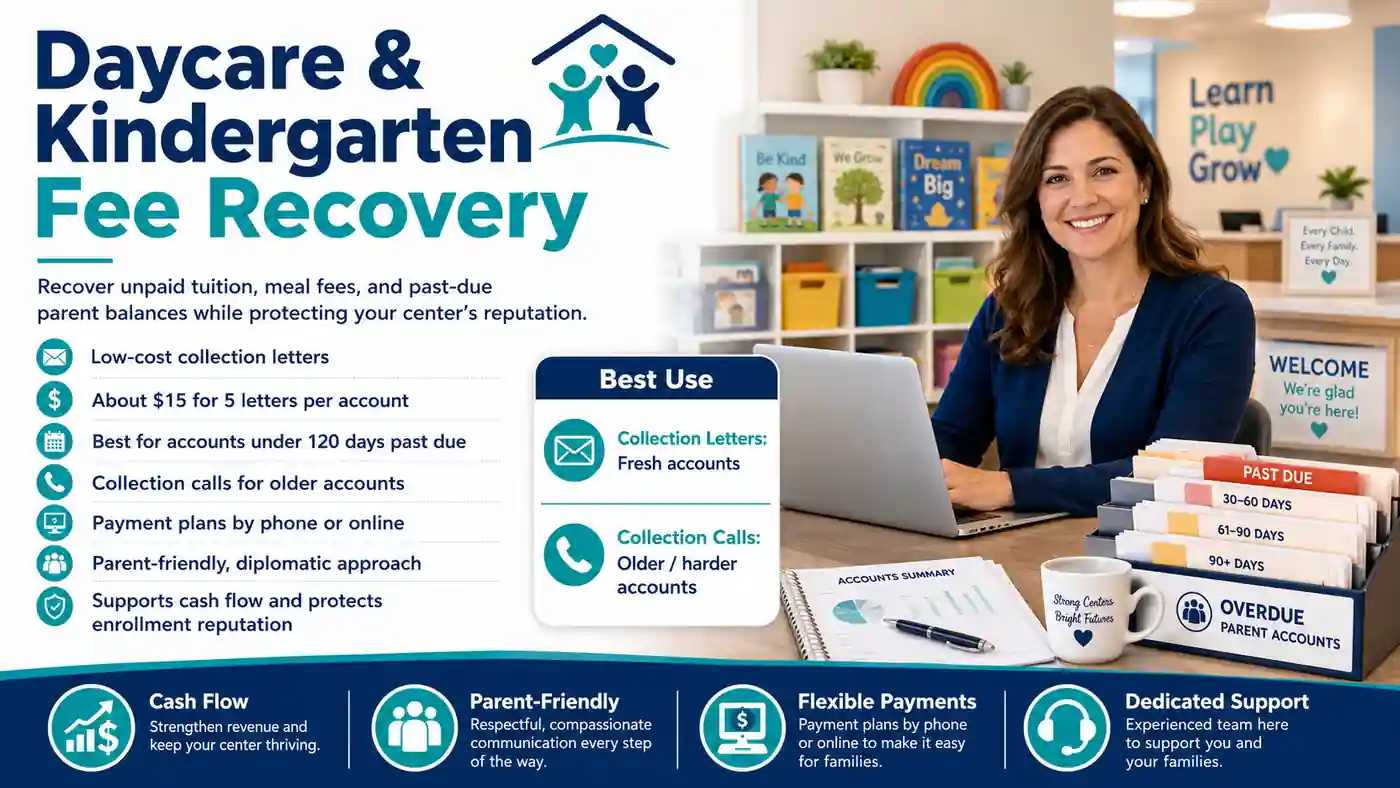
Daycare and kindergarten fee recovery service for unpaid tuition, meal fees, and overdue parent balances using diplomatic collection letters, payment plans, and parent-friendly recovery support.

Quick Answer: Daycare and preschool debt collection requires diplomatic handling to recover unpaid tuition, registration deposits, and state subsidy co-pays (CCDF/CCAP) while protecting your school’s local reputation. Nexa provides 50-state licensed, FDCPA-compliant recovery starting at a $15 fixed fee per account, backed by SOC 2 data security, a dedicated account executive, and a 4.85/5 rating across 2,000+ client reviews.

Nexa provides 100% reputation-safe, equipped with all 50-state collections license, offering free credit reporting, free litigious debtor check, free bankruptcy scrub, and zero onboarding fees. Secure – SOC 2 Type II & HIPAA compliant. Over 2,000 online reviews rate us 4.85 out of 5. Every daycare director is paired with a dedicated account executive, backed by a specialized support team, not a call center queue.

Need a Collection Agency? Contact us


The Childcare Economy: By the Numbers

Recent industry data shows that the average cost of center-based childcare in the U.S. now ranges from $11,500 to over $16,000 per year per child. For a medium-sized center, even a 5% delinquency rate in tuition can result in an annual loss of $30,000 to $50,000, often the difference between profitability and a deficit. With operational costs (labor, insurance, and food) rising by over 12% in recent years, “waiting and hoping” for a parent to pay is no longer a viable business strategy.

Daycare-Specific Billing Friction

Unannounced Withdrawals & Broken Notice Periods

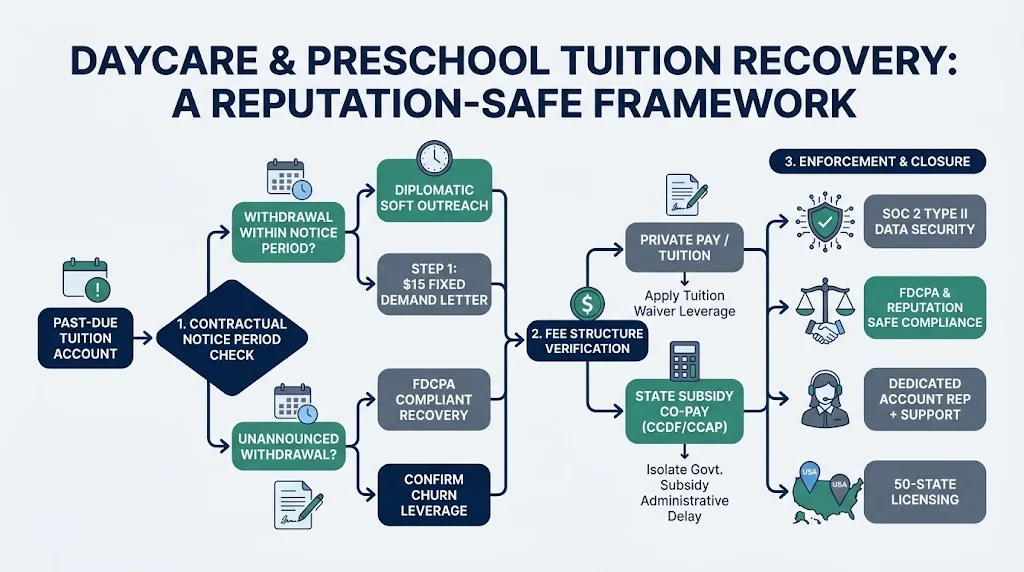
Many enrollment contracts require written notice before a family withdraws, commonly 2 to 4 weeks, sometimes stated as a flat 30-day notice, specifically so the center can plan staffing and fill the vacated slot. A family who disappears without giving that notice generally still owes tuition for the notice period itself, provided the enrollment agreement they originally signed says so clearly. This is one of the most collectable balances in childcare receivables, precisely because it’s backed by a signed contract term, not just a verbal expectation.

State Childcare Subsidies vs. Parent Co-Pays

Families receiving assistance through the Child Care and Development Fund (CCDF) or a state Child Care Assistance Program (CCAP, though the exact name varies by state) typically still owe a required co-pay portion directly to the center. It’s essential to distinguish a genuine subsidy administrative delay, where the state simply hasn’t processed the payment yet, from a parent who has stopped paying their own required co-pay. Pursuing the wrong party, chasing a subsidy payment that’s just slow versus a co-pay a parent is actually avoiding, wastes time and can create confusion with the family.

Registration & Holding Deposits

Deposits collected to hold an upcoming term’s slot are a distinct category from tuition itself. When a family reserves a spot, pays a deposit, and then doesn’t enroll or doesn’t pay the balance due at start of term, the deposit terms in the original agreement determine what’s actually recoverable, some deposits are explicitly non-refundable and simply forfeited, while others credit toward tuition and leave a real balance owed if the family never shows up.

Specialized Education Sectors We Serve

  • Private Kindergartens & Preschools: Managing unpaid enrollment fees and textbook costs with a sensitive, diplomatic approach.
  • Child Daycare Centers: Focused recovery for weekly or monthly tuition balances, including “drop-in” service fees and late-pickup charges.
  • Charter & Private K-12 Schools: Specialized in tuition fee recovery, housing balances, and bursar accounts for older students.
  • Learning Centers & After-School Programs: Recovery for tutoring services, music lessons, and specialized enrichment programs.
  • Montessori & Waldorf Schools: We understand the unique philosophical leanings of these institutions and tailor our communication to match your brand’s voice.

Decision Tree for your Team

Decision tree for daycare centers when to send accounts for collections

The Nexa Advantage: Firm Tactics, Diplomatic Tone

Collecting from parents requires a level of “soft-touch” mediation that traditional collection agencies simply don’t possess. We understand the billing cycle and community dynamics of early childhood education and use mediation to ensure you get paid without damaging the community trust you’ve spent years building.

Legal Developments in Education Accounts Receivable

The legal landscape for educational debt is shifting. Recent updates to Regulation F (the federal implementation of the FDCPA) have placed stricter limits on how and when a school can contact a parent regarding debt. Several states are also moving toward “tuition transparency” laws requiring specific disclosures before a debt can be sent to collections. Nexa’s systems are updated to reflect these standards, protecting your center from liability while we pursue your funds.

Aggressive Collections vs. Nexa’s $15 Diplomatic Step 1

Factor Aggressive/Generic Collections Nexa’s $15 Diplomatic Step 1
Brand & review risk (Yelp/Google) High, aggressive scripts to parents risk public complaints and community backlash Low, framed as a professional billing mediator, not a collector
Upfront cost Often 35%-50% contingency regardless of account age $15 flat fee, you keep 100% of what’s recovered
Compliance & security Varies by agency FDCPA and Regulation F compliant, SOC 2 Type II certified
Account management Often an automated call center Dedicated account executive backed by a specialized support team

Recent Recovery Results

  • Child Daycare Center: A local center had three families leave with outstanding balances totaling $85,200. Using our professional mediation process, we secured $68,200 in full within 24 days, allowing the director to reinvest in new classroom materials.
  • Private Kindergarten: An elite preschool was owed $11,500 in back-tuition from a single family who had moved out of the area. Nexa’s intensive investigation located the family’s new assets and secured a full settlement within 40 days.

Our Cost-Effective Pricing

blank

  • Fixed Fee Service ($15): Perfect for early-stage delinquency. The family pays you directly; you keep 100% of the recovery.
  • Contingency Fee (20%-40%): Our “no recovery, no fee” guarantee. We only get paid when we successfully bring your revenue home.

Frequently Asked Questions

Will sending a parent to collections hurt my center’s reputation?

Not with Nexa. We act as a “third-party billing mediator” rather than a traditional collector. Our tone is professional and solution-oriented, which often results in parents paying their balance just to resolve the matter quietly and professionally, without it ever becoming a public complaint.

At what point should I send a tuition balance to Nexa?

The “Rule of 90” applies here: once a balance is 90 days past due, the probability of recovery drops by roughly 50%. We recommend using our $15 fixed-fee service as soon as a family is 30 days late to prevent the debt from aging.

How do you handle families who claim they are waiting on government subsidies?

We’re experienced in the nuances of subsidy vs. private pay. For families receiving CCDF or state CCAP assistance, we verify whether the subsidy itself is genuinely delayed at the state level or whether the parent has simply failed to pay their own required co-pay portion, ensuring you’re not left holding the bag for a gap that isn’t actually the state’s delay.

Is family personal and medical data secure when transferring accounts to Nexa?

Yes. Every account is handled under SOC 2 Type II certified data security, and sensitive information like emergency contacts or immunization records is treated with the same care your center already applies to it, shared only to the extent actually necessary for collection, never disclosed beyond that.

Do I get a dedicated point of contact, or will I deal with a call center?

A dedicated account executive, backed by a specialized support team, not a rotating call center queue. Your director-level contact understands your specific center’s billing workflow and history, rather than starting from scratch with a different person every time you call.

If a family leaves without giving proper notice, is the notice-period tuition actually collectable?

Generally yes, if your enrollment agreement clearly states a required notice period and the tuition owed during it. This is typically one of the more collectable balances in childcare receivables specifically because it’s backed by a signed contract term the family agreed to at enrollment, not just an informal expectation, which makes it easier to pursue than a dispute with no paper trail behind it.


Reclaim Your Center’s Revenue Today

Don’t let unpaid tuition stall your mission. Partner with a recovery team that understands the delicate balance of childcare and commerce.

Contact Nexa Today

Filed Under: Debt Recovery

Student Loan Collection Agency: Recover Unpaid College Fee

Student Loan

Student Loan & Tuition Collections: What Colleges Are Worried About

Private student loans and in-house tuition plans were once a small part of campus finances. Not anymore.

Today, a growing share of what students owe to your institution is not covered by federal aid.

Nexa provides 100% reputation-safe, equipped with all 50-state collections license, offering free credit reporting, free litigious debtor check, free bankruptcy scrub, and zero onboarding fees. Secure – SOC 2 Type II & HIPAA compliant. Over 2,000 online reviews rate us 4.85 out of 5. 

Need a Collection Agency? Contact us

Colleges are increasingly carrying:

  • Institutional loans and payment plans

  • Unpaid tuition and fees after withdrawals or drop-outs

  • Housing, meal plan, and other campus charges that went past due

Most balances are still collectible — but the pressure on colleges is rising – Buy Why?:

  • Students are rolling off grace periods and into repayment confused and unprepared.

  • Families are juggling multiple debts and prioritizing whatever screams loudest.

  • Regulators and attorneys are paying closer attention to how schools and their partners collect.

If you’re a college, university, trade school, or bootcamp, you need a recovery strategy that is cost-effective, compliant, and reputation-safe — not a generic call center that treats your students like credit-card accounts.

We work nationwide (all 50 states and Puerto Rico) and are highly rated for being firm, professional, and easy to work with — for both schools and students.

Recovering money for colleges nationwide

Need a Student Loan Collection Agency? Contact Us


Real-World AR Problems in Private Student & Campus Balances

1. Cosigner and family surprises
Many private or institutional loans are taken out with help from parents or relatives. Common issues:

  • The student assumes “my parents are handling it.”

  • Parents don’t realize payments were missed until they get a collection call or see a credit impact.

  • Family members feel blindsided and blame the school.

If communication is clumsy, what should have been a straightforward balance becomes a complaint or an escalation.

2. Confusion when the first real bill hits
Students leave the grace period and suddenly see:

  • Interest that has capitalized into the principal

  • Higher-than-expected monthly payments

  • Old fees and charges they don’t remember approving

If nobody explains the numbers clearly, many simply disengage — and a 30-day late quietly becomes a 90+ day problem sitting on your aging report.

3. Withdrawals, drop-outs, and “I didn’t get what I paid for”
Colleges routinely see delinquency spike when a student:

  • Withdraws mid-term or changes programs

  • Fails or stops attending but still owes tuition

  • Feels the education “wasn’t worth it” and uses that as a reason not to pay

These files often include:

  • Complex ledgers with add/drop activity, refunds, and partial term charges

  • Room, board, and fee disputes mixed into the same balance

  • Documentation that may be reviewed by regulators or attorneys

These accounts are collectible — but only if your recovery partner understands how to read a student ledger and talk through school-related concerns.

4. Institutional loan and payment-plan landmines
More schools offer in-house financing, ISA-style programs, or flexible payment plans. Pain points we see repeatedly:

  • Transcript holds and blocked enrollment used too aggressively as a pressure tactic

  • “Special protections” or “no interest until graduation” promises that weren’t clearly documented

  • Contract language that lets students raise school-quality or service issues as a defense

If your collector doesn’t understand these nuances, simple past-due balances can quickly become compliance, PR, and legal headaches for your institution.


How We Approach Private Student Loan & Tuition AR

Our focus is to maximize recovery while keeping you audit-ready and protecting your school’s reputation.

  • We recover for colleges and schools in all 50 states and Puerto Rico.

  • We offer a fixed-fee program (around $15 per account for five contacts) for fresher delinquencies.

  • We pair that with contingency work (about 40%) on older, harder accounts.

  • Most clients use Step 2 (fixed-fee) first, then send non-responders to Step 3 (contingency).

That way, your business office is not paying contingency rates on every late student account — only on those that truly need deeper, one-to-one work.


Step 2 – Fixed-Fee, Low-Cost Collections for Early-Stage Accounts

For 30–120 day past-due tuition, fees, and institutional loans, Step 2 does the heavy lifting:

  • Professional letters plus optional email/SMS outreach

  • Plain-language explanations of what’s owed and how it was calculated

  • Easy ways for students and families to respond, ask questions, or set up payments

Because the fee is low and fixed per account, colleges routinely place large monthly batches and watch early-stage delinquency curve back down — without overwhelming internal staff.


Step 3 – Contingency Collections on Tougher Student Files

Once accounts age past 120 days or show repeated broken promises, we shift to contingency work:

  • We typically keep about 40% of amounts recovered — no recovery, no fee.

  • Our team is trained specifically on education debt and campus AR, so they can quickly tell when a conversation is really about:

    • A school-service complaint

    • A cosigner misunderstanding

    • A genuine financial-hardship story

  • We negotiate realistic payment plans or settlements that protect your net recovery and your college’s name.

You get a partner that understands the politics of higher education, not just the mechanics of collections.


Encouraging Reenrollment and Long-Term Solutions

With colleges and schools, our goal is bigger than “collect and close the file.” Wherever it’s appropriate, we also encourage students to consider reenrollment so they can continue to access government grants and scholarships.

Programs that start with the FAFSA process can help eligible students reduce their reliance on high-cost private debt and structure their education financing more sustainably.

When students return and complete the program they originally enrolled in, colleges often receive more funding tied to completion and retention metrics. That means:

  • Students get a real path to finish their education and improve their earning power.

  • Colleges gain when the student re-enrolls and stays on track, instead of dropping out with debt and no credential.

Handled the right way, collections can actually support better outcomes for both the school and the student — not just short-term cash recovery.


Why Colleges Switch to Us

Most new college clients say similar things about their previous vendor:

  • “They treated these student accounts like generic consumer debt.”

  • “They didn’t understand school policies, appeals, or academic issues.”

  • “They created noise and complaints instead of real solutions.”

We take a different approach:

  • Compliance-first – aligned with FDCPA, Reg F, and current expectations for education-related collections

  • Reputation-safe – professional tone that respects your students and protects your online reviews

  • Cost-effective structure – fixed-fee for early stages, contingency for tougher balances

If your aging report is full of private student loans, institutional balances, or unpaid tuition and fees, and you’re worried about both write-offs and reputational risk, it may be time to switch from your current vendor to a partner that understands colleges and stands behind both performance and brand protection.

Filed Under: Debt Recovery

Gym & Fitness Debt Collection | Protect Your Brand

A gym and fitness collection agency recovers unpaid membership dues, failed EFT and ACH drafts, personal training packages, class pack balances, and initiation fees for health clubs, gyms, boutique studios, and fitness franchises.

Fitness debt collection is distinct from general consumer collections in two important ways: most delinquent accounts involve active members whose payment failed involuntarily (card expiry, bank change, fraud replacement), not intentional non-payment — requiring a card-update “decline recovery” approach rather than traditional collection pressure. For accounts that do involve genuine non-payment or contract abandonment, fitness specialists navigate the state-specific gym membership cancellation laws that govern what is actually collectible.

Gym and fitness collection agency recovering unpaid membership dues and failed EFT payments for health clubs and boutique fitness studios

Stop Chasing Payments. Start Recovering Revenue.

The Gym Owner’s Dilemma: When Unpaid Dues Kill the Vibe

Your club runs on energy and community—not awkward phone calls about money. Yet churn, expired cards, chargebacks, and cancellation disputes can quietly squeeze cash flow. That’s where Nexa Collect comes in: we recover unpaid membership dues, PT packages, class packs, initiation fees, and more—professionally and in a way that protects your brand.

Nexa provides 100% reputation-safe, equipped with all 50-state collections license, offering free credit reporting, free litigious debtor check, free bankruptcy scrubs, and zero onboarding fees. Secure – SOC 2 Type II & HIPAA compliant. Over 2,000 online reviews rate us 4.85 out of 5. 

Need a Collection Agency? Contact us


Decline Recovery vs. Debt Recovery: Two Different Problems

Most gym owners treat all past-due accounts the same way. Specialists don’t — because the two main types of gym delinquency require completely different approaches:

Decline Recovery (Failed EFT/ACH — Active Members)

When a member’s EFT or credit card draft fails, it is almost always involuntary: the card expired, the bank issued a fraud replacement, the account was overdrawn, or the member changed banks and forgot to update their payment info. This is not a collection situation — it is a payment method update situation.

Decline recovery works best when it happens fast (within 7–14 days of the failed draft), uses a soft-touch outreach approach that assumes good faith, and makes it as easy as possible for the member to update their payment information without embarrassment. Done correctly, decline recovery retains the member and recovers the balance — a result that aggressive collection tactics would destroy.

Our Phase 1 brand-safe reminder service is calibrated for exactly this scenario: five professional reminders (letter, email, or SMS where consented) that feel like helpful notices from your gym — not threats from a collection agency. Members pay you directly. You keep 100% of what’s recovered. And the member stays.

Debt Recovery (Contract Abandonment — Former or Non-Responsive Members)

When a member stops responding entirely, disputes the account, claims to have cancelled verbally, or walks away from a contract obligation — that is a genuine debt recovery situation. These accounts require a fundamentally different approach: verification of the contract terms, assessment of state-specific cancellation rights, determination of what balance is legally collectible, and professional third-party outreach that applies appropriate pressure without triggering a complaint or a chargeback dispute.

Our Phase 2 contingency collection service handles these accounts — no upfront cost, no fee if we don’t recover. We assess each account for collectibility before making contact, screening for bankruptcy, military SCRA status, and any state law defences the member might validly invoke.

Why the distinction matters for your gym’s brand

Using a hard-collection approach on a member whose card simply expired destroys a relationship worth hundreds of dollars per year in future dues — and risks a negative Google review that costs you ten new members. Using a soft-reminder approach on a member who has genuinely abandoned their contract wastes time and lets the account age past the point of recovery. Getting the triage right is the most important thing a fitness collection agency can do for your gym’s financial health.


Your Team Isn’t Built for Collections. Ours Is.

Key Strength:
We address core fitness sector pain points directly—such as high member turnover, recurring payment declines, contract cancellation disputes, and member retention/reactivation strategies.

Front-desk or back-office staff aren’t trained in collection laws and can create risk without meaning to. Let your team focus on member experience and sales. Our certified collectors handle the tough conversations with a compliant, diplomatic approach.

A Two-Phase Process Designed for Fitness Businesses

blank

Phase 1: Brand-Safe Reminders (Low, Flat Fee)
Best for: Accounts under 120 days past due.
• Up to 5 professional reminders (letters and/or emails) that feel like formal notices—not attacks.
• About $15 per account; members pay you directly.
• Ideal first step to fix oversights, card failures, or address changes.

Phase 2: Full Contingency Collections (No Recovery, No Fee)
Best for: Older or disputed accounts (over 120 days).
• Expert negotiators use respectful calls and follow-ups to resolve balances.
• No upfront cost. We earn a percentage only if we recover.

We seamlessly ingest your member data via secure Excel imports directly into our portal to automate the recovery of past-due balances meeting our $50 minimum placement threshold.

Serving Fitness Centers Nationwide: Contact us

Gym Membership Contracts & Cancellation Disputes: What’s Actually Collectible

Not every unpaid gym balance is collectible — and pursuing an account that has a valid cancellation defense wastes your time, risks a regulatory complaint, and potentially triggers a Fair Credit Reporting Act (FCRA) issue if you’ve already reported the account. Here is how we determine what’s enforceable before we pursue anything:

What makes a gym account collectible

  • A signed membership agreement with clear payment terms, auto-renewal provisions, and cancellation notice requirements
  • Documentation that the cancellation notice period (typically 30 days written notice) was not satisfied before the member stopped paying
  • Evidence that required state disclosures were provided at the time of signing (required by many state gym statutes)
  • A balance that falls within the applicable statute of limitations for written contracts in your state (typically 4–6 years)

State-specific gym membership laws we navigate

Many states have specific statutes governing health club membership contracts that limit what can be collected and under what circumstances. Key examples:

  • California (Health Studio Services Contract Act): Caps contract length at 3 years, requires specific disclosures, and allows cancellation within 5 business days of signing with a full refund. Accounts from contracts that violated these terms may be uncollectable.
  • New York (General Business Law §624): Requires written cancellation rights disclosure, limits initiation fee amounts, and mandates specific contract terms. Non-compliant contracts are voidable.
  • Texas (Health Spa Act): Requires bond or escrow for health spas, mandates cancellation rights for relocation and medical inability, and has specific contract content requirements.
  • Florida (Statute §501.015): Covers health studios, requires disclosure of cancellation rights, and allows cancellation for medical disability, relocation 25+ miles from any club location, or death.

We screen every gym account against your state’s applicable statute before pursuing it — protecting you from wasted collection effort and regulatory exposure on accounts that have a valid legal defense.

Common cancellation defences and how we evaluate them

  • “I cancelled verbally”: Valid only if your contract permits verbal cancellation. If your agreement requires written notice, a verbal claim is not a valid defense — and we document this position before any outreach.
  • “I moved away”: Valid in many states if the member relocated beyond a specified distance from any of your locations (commonly 25 miles). We verify the relocation claim against change-of-address data before accepting it as a cancellation basis.
  • “I have a medical condition”: Valid in most states for documented, physician-certified conditions that prevent using the facility. We require documentation before accepting this defense.
  • “The gym charged me without authorization”: This is the chargeback path — see the next section. We assess whether the authorization documentation supports representment before any collection action.

Why Gyms and Health Clubs Choose Us

• Brand protection: compliant, member-friendly outreach that preserves your reputation.
• Real-time portal: submit accounts, track progress, and download reports 24/7.
• Credit-bureau option: with your approval, we can report delinquencies to major bureaus—an ethical, effective motivator.
• Easy to pay: online and phone payments reduce friction and speed resolution.
• Security and access: PCI-aware systems; bilingual (English/Spanish) communication to reach more members.

Transparent Pricing. Strong Outcomes.

Choose the phase that fits each account and budget. See transparent pricing and pick the most cost-effective path for your gym.


Fitness Facility Types We Serve

Membership recovery looks different across gym models. Here is how our approach adapts:

Big-box gyms & national franchises

High-volume EFT billing, large member counts, and automated billing mean high volumes of involuntary declines mixed with genuine abandonments. We handle bulk account placements via batch upload and automated intake, with our small-balance automation track resolving high-volume tail accounts efficiently. Franchise operators across multiple locations receive consolidated reporting across all sites.

Boutique fitness studios (yoga, Pilates, barre, cycling)

Boutique studios have smaller member counts but much higher relationship sensitivity — a negative review from a disputed collection can disproportionately damage a studio with 200 members. Our decline recovery approach is calibrated for this environment: maximum empathy, minimum confrontation, and clear escalation only when a member has genuinely abandoned their obligation.

CrossFit affiliates & functional fitness boxes

CrossFit boxes typically use month-to-month agreements or short-term contracts — meaning fewer multi-month balance disputes, but higher sensitivity to community dynamics. Our collectors understand that every member in a CrossFit box knows every other member. We handle these accounts with the discretion and respect that the tight-knit community context demands.

Martial arts & combat sports academies

Martial arts schools often have annual or multi-year contracts, EFT-billed monthly, with families as the contracting party (not the student). Collection involves the parent or guardian, not the minor student. Contracts frequently include rank advancement and belt fee components in addition to monthly tuition — each with different collectability profiles that we assess separately.

YMCAs, JCCs & nonprofit community fitness centers

Nonprofit fitness organizations have additional brand sensitivity: their mission is community service, and aggressive collection optics conflict directly with that brand identity. We handle YMCA and JCC accounts with the same diplomatic approach we use for government collections — recovery-focused but community-conscious, with hardship payment plan options offered proactively to members who indicate financial difficulty.

Country clubs & multi-amenity athletic clubs

Higher average dues, longer-term membership agreements, and members who are often local business leaders or community figures require white-glove mediation. Country club and athletic club collection is handled by our senior mediators — the goal is to recover the balance while preserving the member relationship whenever possible.

Personal training studios & independent trainers

Independent personal trainers and small PT studios often lack formal written contracts — relying on verbal session agreements or informal email confirmations. We work with whatever documentation exists: text chains confirming session bookings, Venmo/cash payment history, or signed training agreements. Even without a formal contract, documented session history and payment records can support collection outreach.


Frequently Asked Questions: Gym & Fitness Debt Collection

Can a gym send you to collections for unpaid membership dues?

Yes. A gym or health club can refer unpaid membership balances to a third-party collection agency after internal collection attempts have been exhausted — typically after 60–90 days of non-payment. The collection agency must comply with the FDCPA in all consumer outreach. The delinquency can also be reported to the major credit bureaus (with the gym’s instruction), where it may remain on the former member’s credit report for up to 7 years. Whether the balance is actually collectible depends on the terms of the membership agreement and your state’s specific health club statutes.

What happens if you don’t pay your gym membership?

Typically: one or two internal reminder attempts from the gym, followed by referral to a collection agency if no payment is made. The collection agency contacts you by letter and phone, offers a payment arrangement, and — if still unresolved — may report the balance to credit bureaus and ultimately refer to a collections attorney. Most gym collection cases resolve through negotiation well before legal action. A gym membership debt rarely justifies the cost of filing suit unless the balance is substantial (typically $1,000+) and you have documented assets.

Can a gym charge you after you cancel?

Only if your cancellation did not meet the contract’s requirements. Most gym contracts require written notice of a specific number of days (commonly 30) before the next billing cycle. If you cancelled without meeting that requirement, the gym may be entitled to collect the balance due through the effective cancellation date. However, many states have specific health club cancellation laws that override contract terms — allowing cancellation for medical disability, relocation, or other qualifying reasons regardless of what the contract says. Whether any remaining balance is collectible depends on your state’s statute and whether the gym’s contract complied with state disclosure requirements.

Does a gym membership affect your credit score?

An unpaid gym membership can affect your credit score if the gym or its collection agency reports the delinquency to the major credit bureaus. Under recent policy changes, medical debt under $500 is no longer reported — but gym membership debt is not medical debt and does not benefit from this exclusion. A reported gym collection account can remain on your credit report for up to 7 years from the date of first delinquency. Paying the balance (or negotiating a “pay for delete” arrangement) resolves the reporting, though the impact timeline varies by bureau.

What is the statute of limitations on gym membership debt?

The statute of limitations for gym membership debt is typically the state’s statute for written contracts, which ranges from 3 to 6 years depending on the state. Once the statute expires, the debt is time-barred from legal collection — though the gym or its agency can still attempt to collect diplomatically. It’s important to note that making a payment or acknowledging the debt in writing can restart the statute clock in some states. If you are being contacted about a very old gym debt, verify the date of last activity before making any payment.

How do you recover from failed EFT or ACH gym membership payments?

Failed EFT payments are most effectively recovered within the first 7–14 days — when the member is still active and most likely to update their payment information without objection. Our Phase 1 decline recovery service deploys branded reminders in your gym’s name within days of a failed draft, directing the member to update their card or banking information via a secure payment link. Recovery rates for voluntary card updates in the first 14 days average 65–75% of contacted accounts — significantly higher than any collection outreach on the same accounts at 60+ days.

Do you integrate with Mindbody, ABC Fitness, or ClubReady?

Yes. We accept account exports from all major club management platforms including Mindbody, ABC Fitness (DataTrak), ClubReady, Daxko, Jonas Club Software, PushPress, Zen Planner, Pike13, and Glofox. Most platforms allow you to export past-due or cancelled member records as a CSV — our intake template maps to standard export fields with no reformatting required. If your platform isn’t listed, we’ll map your custom export format at setup at no charge. Most gyms are fully onboarded and placing their first batch of accounts within one business day.

Can you collect on a month-to-month gym membership with no long-term contract?

Yes — but the collectible amount is limited. Month-to-month memberships without a term commitment can typically only collect the balance accrued up to the effective cancellation date. You cannot collect future dues on a month-to-month agreement the way you can enforce a remaining term on a 12-month contract. However, if the member stopped paying without providing any cancellation notice, you may be entitled to dues through the date that proper notice was given (or should have been given). We assess month-to-month accounts individually for collectible balance before pursuing them.

How do you handle a gym member who claims to have cancelled verbally?

We verify the claim against your cancellation records before accepting it as a valid defense. If your membership agreement requires written notice of cancellation (as most do), a verbal claim is not a valid cancellation — and we document this position clearly in our outreach. If you have no record of a cancellation request of any kind, the member’s verbal claim is their burden to prove. We structure our initial demand letters to invite dispute documentation from the member — shifting the burden of proof appropriately.

What is the difference between Phase 1 (fixed fee) and Phase 2 (contingency) for gyms?

Phase 1 (fixed fee, $15/account) is best for accounts under 120 days past due where the member is likely still reachable and the failure may be involuntary — a card update or payment reminder resolves the account. You pay $15 per account and keep 100% of every dollar recovered. Phase 2 (contingency, 30–40%) is best for older accounts, known cancellation disputes, or members who have stopped responding entirely — where more effort is required. You pay nothing unless we collect. Many gym operators run both phases simultaneously: Phase 1 for their current aging bucket, Phase 2 for their historical write-off pile.

Will using a collection agency cause our members to leave negative reviews?

Not when done correctly. Our Phase 1 outreach is sent in your gym’s name — members have no idea a collection agency is involved. Our Phase 2 outreach is professional and non-threatening — we never use harassment tactics, never call outside of legal hours, and never make false statements. In our experience, the gym members most likely to leave a negative review are the ones who feel they were handled unfairly by your internal staff — not by a trained, compliant third-party collector. We maintain a 4.85/5 rating across 2,000+ online reviews, which reflects our approach to consumer outreach across all industries.

Is there a minimum balance or minimum volume to use Nexa?

No minimum balance and no minimum account volume. Individual studio owners with 5 accounts can place them the same day as a franchise operator with 5,000. Our $15 fixed-fee service is cost-effective even for small balances: recovering a $90 declined yoga membership nets you $75 with no staff time invested. For high-volume fitness operators, we offer bulk pricing and dedicated account management — contact our team for a custom proposal based on your monthly account volume and average balance.


Act Early. Recover More.

Don’t let receivables age out. The sooner you escalate, the higher the recovery—and the less time your staff spends chasing payments.

Get recommendations tailored to your gym. Contact us to start recovering unpaid dues today.


Filed Under: Debt Recovery

Collection Agency for Chiropractic Debt

Chiropractor

Accounts receivable for chiropractors is an ever-growing problem all across America. Insurance coverage is getting more restrictive, and treatments are getting costlier. Depending on which region of the USA you belong to, the unpaid medical bills issue may vary from moderate to severe. Unpaid bills from patients and reduced coverage from insurance companies can severely impact any chiropractic rehab and wellness center.

To give you an idea of how past due accounts quickly eat up into profits – If a chiropractic practice works on a 20% profit margin, say 5% of their patients do not pay, then effectively 25% of their net profit is gone. Collecting money from existing patients is more important than getting new patients.

Serving Chiropractors Nationwide

Need a cost-effective Collection Agency for unpaid bills? Contact Us

Chiropractors generally work in small teams. Their in-house staff are neither trained nor well equipped to recover money from those hard collect unpaid bills. Therefore, the chiropractor’s office must take proactive measures to minimize accounts receivable. This includes communicating the cost to the patient in advance and insisting that he should make the payment in full on the day of treatment. For individuals who have a hard time even shelling out the insurance co-pay fees, you should reschedule their appointment as they have a higher chance of not paying for their out-of-pocket expenses anyway. To maximize cash flow, send notices to your patients more frequently than once a month. Before taking any intensive measures on your patients, ensure that there are no accounting errors otherwise, your mistake can prove costly later.

Despite all your efforts, a sizable number of patients will not clear their medical bills, with reasons as simple as forgetting to pay to more sophisticated excuses. Patients may dispute the cost of services, especially if they did not fully understand the cost at the time of service.

Instead of writing these off as bad debts, involve a good chiropractor collection agency to recover money on your behalf. Chiropractors may be a part of a large practice/hospital or running their clinic, but bad debts hurt all.

Our recommendation: Once you cannot recover a patient’s medical bill within 60 to 90 days, forward this account to a good collection agency. Delaying to act on a past-due account will make it harder to collect.

Summary of Collection Agency’s Services
Collection Letters Service
  • The upfront cost for 5 Collection Letters is about $15 per account.
  • Debtors pay directly to you, no other fees. Low-cost option.
  • Good for accounts less than 120 days past due.
Collection Calls Service
  • Contingency fee only. No upfront or other fees.
  • Agency gets paid a portion of the money they recover.  No recovery-No fees.
  • Best for accounts over 120 days. A debt collector calls a debtor many times.
  • If everything fails, a possible Legal Suit is recommended by the attorney.

Check this: Cost of hiring a collection agency

* Services offered by a collection agency include Collection Demands, Collection Calls and Legal Action. Their representative should be able to explain which service is appropriate for you.

* Make sure that your chiropractic debt collection agency is accredited by ACA (American Collectors Association) and follows all the debt collection laws specified by the government.

* Debt collectors should be adequately trained and follow a diplomatic approach to collecting your money. They should move over to a more intensive approach if required.

* Chiropractor debt collection agency should have a 24/7 online collections portal and follow steps to secure your data. They must be HIPAA certified as well.

* Their services should be easy to use. No hidden costs or surprises. They should have adequate security, data protection measures, and certifications.

* Their collection attempts should be persistent, and to avoid any argument with debtors, the debt collectors must maintain their patience.

Contact us if you want a collection agency to recover money from unpaid chiropractor bills.


Filed Under: Debt Recovery

Rent Collection Agency for Landlords and Apartment Managers

Property management is a well-paying business and a good income source for landlords. But the biggest stress for landlords, property managers, and apartment managers is collecting rent from tenants on time.

Once the rent is past due, the landlord starts evaluating whether or not he should continue his association with the tenant, pressurize him with warnings or late fees. If the rent is further delayed then should he serve an eviction notice?

Even after the tenant leaves, the property may require fixes, a painting job, and finding a new tenant. All this can lead to at least 30-60 days of further loss of rental income. A collection agency for landlords will swiftly act to recover all/maximum money from the defaulting tenant using all amicable and intensive techniques allowed legally.

Serving Landlords and Property Managers Nationwide

Need a Rent Collection Agency? Contact Us

Tenants often do excessive damage to the property. They are supposed to bear the cost of fixing it. Unfortunately, many tenants don’t pay, simply walk out the door and become untraceable too. Property damage costs are tough to recover.

Rent Recovery for Landlords

Debt write-offs are common in the rental and property management business. But it can be minimized if landlords have a proper accounts receivable plan.

Have you already sent a late rent notice, made phone calls, even imposed a late fee, and nothing seems to be working? Or maybe the tenant has been evicted and is untraceable now. Not sure what to do next? 

Involving a Rent Collection Agency at the earliest will improve cash flow and mitigate the risk since they are experts in collecting money. That’s what the debt collectors do all day long, every single working day of their life. Very few collection agencies efficiently work in the rental default recovery segment as it is considered a tough paper to collect money.

Collection Demands Service for Landlords
  • Upfront cost for 5 Collection Demands is about $15 per account.
  • Debtors pay directly to you, no other fees and a low-cost option.
  • Good for accounts less than 120 days past due.
Collection Calls Service (Intensive Collections)
  • Contingency fee only. No upfront or other fees.
  • Agency gets paid a portion of the money they recover.  No recovery-No fees.
  • Best for accounts over 120 days. A debt collector calls debtor many times.
  • If everything fails, a possible Legal Suit if recommended by the attorney.

The involvement of a rent collection agency is a game-changer. Not only can collectors use various tactics and tools, but once your tenant knows that a collection agency is involved, he knows that things have become a lot more severe. He is more likely to settle past-due rent than when the property manager was trying to handle things himself. The financial situation of a defaulting tenant deteriorates quickly. Therefore it is essential to act fast.

Landlords should hire an expert rent recovery collection agency in their best interest of landlords. Landlords will get more time to focus on your property management business while the collection agency works hard to recover your money. Always take proof of income from your tenant. Keeping communications in form of Text messages and Email is beneficial because you have written proof of what the tenant had agreed to. Verbal assurances given by the tenant to his landlord are of no use for debt collectors or the courts.

Collection Letters, Collection Calls, and Legal suits are the three primary services that collection agencies offer.

What filing a legal case against your tenant?

If home or apartment owners go to the small claims court, they may be able to recover rent, additional damages, late fees and legal fees. However, you must understand that it requires considerable time and energy and, most importantly, that you have followed all rental laws issued in your state, and you are sure that there is no chance that your tenant can sue you back ( like unhygienic or dangerous conditions of the rental unit or that he was threatened). Even with a judgment, it can get really hard to recover your money.

Tips for Selecting a good Rent Collection Agency

1. A collection agency should attempt to collect the rent diplomatically without damaging the relationship between the tenant and owner/manager. They should be well aware of debt collection laws and professionally handle all debtor excuses.

2. It should be able to perform collection activities on tenants of single-family homes, retail shops and apartments. Suppose the unfavorable financial situation of the tenant is temporary. In that case, the debt collector can negotiate and place the tenant under a payment plan so that all rental dues are settled amicably.

3. A rent collection agency should be able to provide various payment options, including online payment, PayPal and wire transfer. Collection agents should also be able to accept major credit cards and checks over the phone.

4. For eviction cases, a collection agency will go for intensive collections directly. This includes Collection Calls or a legal suit.

5. A collection agency should have an online client portal using which a property manager should be able to stop the collections activity if you want. Provide backup documentation to the debt collector when the need arises, monitor real-time performance reports and submit additional accounts online.

6. Using advanced Skip Tracing methods, a collection agency should have an effective method for tracking down tenants who have changed their address and are untraceable.

7. There should be a clear accounts receivable strategy with no exceptions. A collection agency should convey to the property managers and owners the importance of assigning the accounts early rather than repeatedly falling back on the inner feeling that the rent may get paid next month in full.

8. Should report accounts to credit reporting agencies: Experian, TransUnion, Equifax whenever needed.

9. Provide a flexible strategy for early- and late-stage (over 120 days past due). There should be no commission or contingency fee with their flat fee process.

10. No hidden costs or minimums and must have a national network of legal advisers.

By assigning the accounts to a rent collection agency on time, landlords will see an increased rate of return on their past due accounts.

These cities and nearby regions face the maximum number of defaults:
1. New York City, Manhattan, Brooklyn and Rochester
2. San Francisco Bay Area, Sacramento, Los Angeles and Glendale, California
3. Miami and Orlando, Florida
4. Province, Rhode Island
5. College Station, Dallas, Houston, and Irving, Texas
6. Boston, Massachusetts
7. Cincinnati, Ohio
8.  Washington, D.C. and
9. Philadelphia

Filed Under: Debt Recovery

  • « Go to Previous Page
  • Page 1
  • Interim pages omitted …
  • Page 49
  • Page 50
  • Page 51
  • Page 52
  • Page 53
  • Interim pages omitted …
  • Page 55
  • Go to Next Page »

Primary Sidebar


accounts receivable

Need a Collection Agency?
Kindly fill this form.
We’ll get in touch with you

    Please prove you are human by selecting the heart.

    Compliance & Security

    • SOC 2 Type II Certified: Third-party audited data security and strict privacy controls.

    • HIPAA Compliant: Secure, legal processing of medical and municipal EMS accounts.

    • PCI-DSS Level 1: Highest tier of data encryption for secure payment processing.

    • FDCPA & FCRA Aligned: Full legal adherence to federal consumer protection laws.

    Recent Posts

    • Why Dental Patients Dispute Bills: The Nexa Collections Dental Account Dispute Index
    • 2027 Commercial Collections Benchmark: U.S. Late Payments, AR Risk and B2B Collection Trends
    • Bulk Account Placement: What a Collection Agency Actually Needs From You
    • Nationwide Debt Collection Agency Serving U.S. Cities
    • Chula Vista Collection Agency for Medical, B2B, Schools & Business Debt
    • Corpus Christi Collection Agency: Itemized Bill Rules for Practices
    • Riverside Collection Agency | For Logistics, Medical, Schools & Business Recovery
    • Collection Agency for Large Balances: High-Value B2B Debt Recovery

    Featured Posts

    • Bankruptcy Debt Recovery Services for Creditors
    • Debt Collection for YMCA
    • Dental Membership Plans Benefits: Traditional Insurance Alternative

    Copyright © 2026 NEXACOLLECT.COM | This content is provided for general informational purposes only and should not be considered legal advice. Collection laws and requirements may vary by state, account type, documentation, debtor status, and specific facts. Please consult qualified legal counsel for guidance regarding your particular situation. Nexa and its authorized collection partners service accounts in accordance with applicable federal and state collection requirements. Visit our home page to know more about us.

    X
    Need a Collection Agency?
    Contact Us