The Nexa Collections Dental Account Dispute Index is a proposed research framework that classifies the reasons patients dispute dental balances, using ten standard dispute codes and a separate outcome code for how each dispute was resolved. Its goal is to turn disputed dental accounts into prevention data a practice’s front desk and billing team can act on.
Quick answer: Dental patients usually dispute bills for reasons other than refusing to pay: they expected insurance to cover more, the final bill came in above the estimate, they don’t recognize a charge, they believe they already paid, they think treatment wasn’t finished or didn’t work, they think someone else owes it, or they say they never got a bill. Each of those points to a different fix upstream. The Index codes every dispute consistently so practices can see which ones are most common and which could have been prevented.
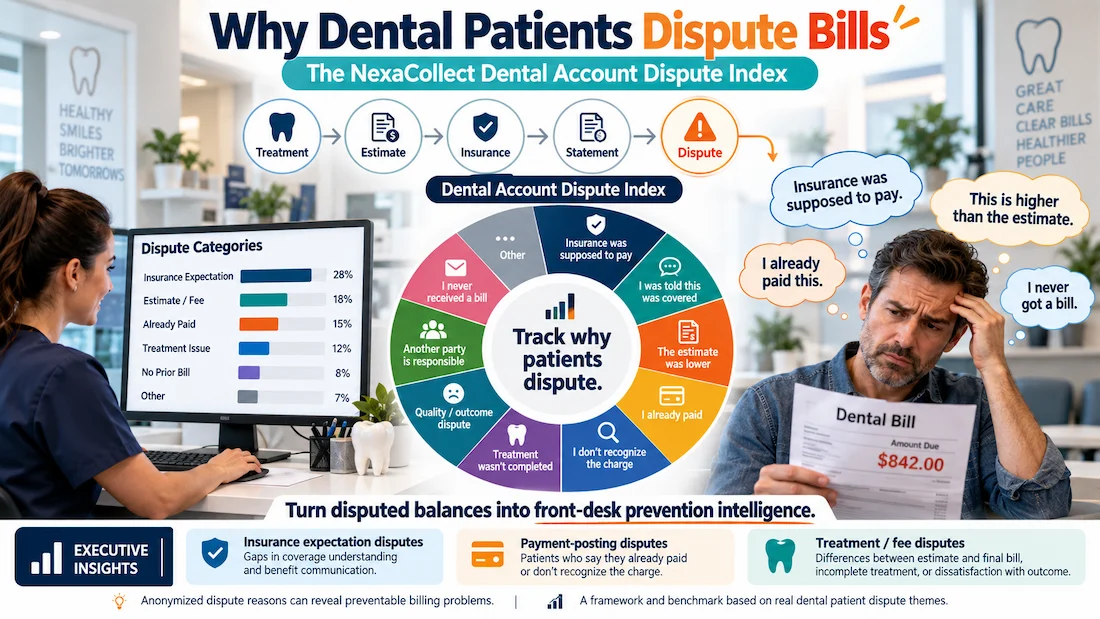
Five patients. Five $1,200 balances. None of them says, “I won’t pay.”
- “Insurance was supposed to cover this.”
- “That’s not what I was quoted.”
- “I already paid this.”
- “I never got a bill.”
- “Why would I pay for a crown that still hurts?”
On your aging report, all five look identical: patient balance outstanding. But they’re five different problems, born in five different parts of the practice, and they need five different responses.
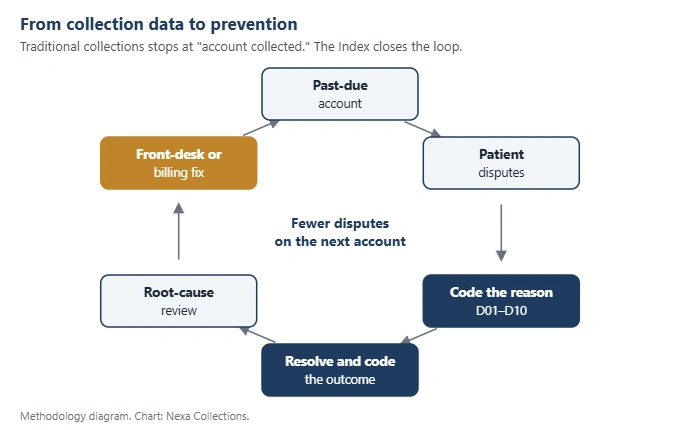
Most collection reporting stops at how much is unpaid. The Dental Account Dispute Index asks why the patient pushed back, because the answer usually points to something that happened months earlier: at benefit verification, at the treatment-plan conversation, at payment posting or at the mailbox.
Dental Dispute Benchmark Matrix
| Dispute Category | Typical Root Cause | Required Documentation | Resolution Protocol |
| Insurance Estimate Mismatch | Downgraded composite to amalgam, or missing pre-auth | Signed Financial Agreement & EOB | Audit claim adjudication; explain plan limitation; offer 2-pay courtesy |
| Dual-Coverage / COB Delay | Birthday rule confusion or non-duplication clause | Primary & Secondary Remittance Advice | Re-bill secondary before pursuing patient balance |
| Incomplete Treatment | Patient stopped mid-bridge or multi-stage root canal | Chart notes with completed CDT codes | Bill only for delivered clinical stages; adjust balance |
| Quality of Care Defense | Dissatisfaction with cosmetic or restorative outcome | Doctor review & clinical narrative | Freeze collection outreach; schedule clinical exam with provider |
“Can’t Pay” and “Don’t Owe” Are Different Accounts
“I owe it, but I can’t pay it today” is a payment problem, usually solved with a payment plan (our guide to common debtor excuses covers that side). “I don’t believe I owe this amount” is a dispute. The balance can be identical; the right response isn’t.
The difference also has real procedural weight once an account reaches a collection agency. Under the federal Fair Debt Collection Practices Act, if a consumer disputes a debt in writing within the validation period, the collector must pause collection of the disputed portion until it sends verification. A clearly coded, well-documented dispute is easier to verify quickly and accurately.
Disputes over accuracy aren’t rare. In its reviews of medical debt collection complaints, the Consumer Financial Protection Bureau found that the most common consumer concerns were that the bill had already been paid, wasn’t theirs, or was for the wrong amount. Some consumers reported learning about a medical bill only when their credit score dropped. Dental balances are a smaller slice of that picture, but the same failure points exist in every dental office.
Why Dental Bills Are Built for Surprises
A dental patient can see half a dozen numbers for one procedure: the dentist’s fee, the plan’s allowed amount, the estimated insurance benefit, the deductible, the coinsurance and the balance that’s left over. Any gap between what the patient expected and what the plan actually paid lands on the patient’s statement.
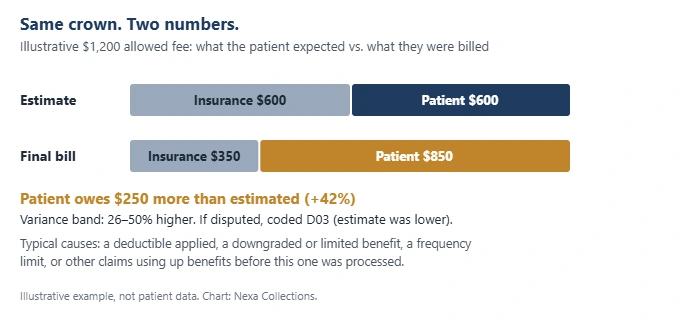
The American Dental Association is explicit on the key point: a preauthorization or predetermination is not a guarantee of payment. It reflects the patient’s eligibility and remaining benefits on the day it was issued. The benefit that actually applies is the one available on the date of service, after limitations, exclusions, coordination of benefits and any claims processed in between.
And patients carry a lot of the bill. Out-of-pocket spending was the largest share of the $189 billion Americans spent on dental care in 2024, ahead of private insurance, according to the ADA Health Policy Institute.
Here’s the counterintuitive part. Annual maximums are often blamed for dental billing surprises, and the ADA notes that many plan maximums haven’t risen in about 50 years. Yet an ADA Health Policy Institute analysis found that only 3.4% of dental patients actually reach the typical annual maximum, and another 3.3% come within $100 of it. So when a patient says “insurance should have paid,” the cause may more often be a deductible, coinsurance, a frequency limit, an exclusion or a downgraded benefit. That’s exactly the kind of assumption the Index is built to test instead of repeat.
The 10 Dental Dispute Codes
Every disputed account gets one primary code (the main reason the patient gives) and, where it applies, a secondary code. “Your office said insurance would cover the crown, and now I owe $800 more than the estimate” is D02 primary, D03 secondary.
| Code | The patient says | What it may point to upstream | First evidence to pull |
|---|---|---|---|
| D01 | “Insurance was supposed to pay.” | Benefit verification, eligibility re-checks | EOB, claim history, eligibility record |
| D02 | “Your office told me it was covered.” | How staff describe benefits | Treatment plan, signed financial policy, notes |
| D03 | “The estimate was lower.” | Estimate accuracy, updates when plans change | Written estimate, final EOB, ledger |
| D04 | “I don’t recognize this charge.” | Statement descriptions, family accounts | Ledger, service dates, clinical record |
| D05 | “I already paid this.” | Payment posting and reconciliation | Receipts, card/ACH records, unapplied credits |
| D06 | “The treatment wasn’t finished.” | Staged-treatment billing, lab fees, refund policy | Treatment plan, appointment history, financial policy |
| D07 | “I disagree with the quality or outcome.” | Clinical communication, informed consent | Route to the practice for review |
| D08 | “Someone else is responsible.” | Guarantor, parent, ex-spouse or policyholder data | Financial responsibility agreement, account setup |
| D09 | “I never received a bill.” | Addresses, returned mail, portal-only notices | Statement history, returned-mail log, contact records |
| D10 | Other | New patterns worth their own code | Reviewed quarterly so “Other” doesn’t become a dumping ground |
Four codes need special handling.
D02: “Covered” vs. “Estimated”
“Insurance covers 50% of crowns” and “Based on the benefit information available today, we estimate your plan may pay about this amount; the carrier makes the final decision when the claim is processed” can describe the same plan. They create very different expectations. A practice with frequent D02 disputes should look at scripts and written estimates, not just insurance verification.
D03: Estimate Variance
For uninsured or self-pay patients, federal Good Faith Estimate rules generally apply, and a patient-provider dispute process can be available when billed charges come in at least $400 above the estimate. Those protections shouldn’t be generalized: the No Surprises Act’s surprise-billing protections generally don’t apply to stand-alone dental plans. For insured patients, the Index tracks estimate-to-final variance (final patient responsibility minus estimated patient responsibility) in bands of within 10%, 11–25%, 26–50% and more than 50% higher, so the data can show whether larger variances actually produce more disputes.
D07: Quality or Outcome Disputes
“The crown still hurts” is not a billing question a collection agency should try to resolve. The code records only that the patient is disputing the balance because of an alleged treatment issue. It makes no judgment about the care. These accounts should generally go back to the practice for review before ordinary collection activity continues, which also helps reduce patient stress and protects the relationship.
D09: “I Never Received a Bill”
To the practice, the account is 120 days past due. To the patient, it’s the first notice. Before placement, it’s worth confirming the patient’s current contact details; our guide to finding a debtor’s latest address and phone number covers the basics.
Dental Accounts – Outcomes by Dispute Category
Based on what we have experienced in recent times.
| Dispute category | % of disputes | % confirmed billing error | % balance upheld |
|---|---|---|---|
| Insurance expectation | 28% | 8% | 74% |
| Estimate variance | 18% | 14% | 61% |
| Already paid | 13% | 26% | 58% |
| Missing bill | 11% | 12% | 69% |
| Treatment issue | 9% | 6% | 76% |
| Other dispute reasons | 21% | — | — |
The Reason Is Only Half the Story
A dispute code records what the patient said. It doesn’t decide who was right. Every dispute also gets an outcome code once it’s resolved:
- Balance confirmed by documentation
- Balance confirmed after explanation
- Insurance issue confirmed or claim reprocessed
- Practice billing error corrected
- Payment-posting error corrected
- Responsible party corrected
- Returned for clinical review
- Balance adjusted
- Unresolved
A patient says insurance should have paid (D01). The review shows the plan correctly applied the annual maximum. The reason stays D01; the outcome is balance confirmed after explanation. Both facts are useful. The first tells the practice what patients misunderstand; the second tells it the billing was right.
Over time, reason and outcome together feed a loop that ordinary collections never closes:
When the Dispute Surfaces Matters
The Index also records the stage at which each dispute first appears:
| Stage | When the patient first disputes |
|---|---|
| 1 | Before the account is past due, directly with the practice |
| 2 | During the practice’s own past-due follow-up |
| 3 | At first contact from the collection agency |
| 4 | Only after repeated collection activity |
If legitimate problems (posting errors, stale addresses, outdated guarantors) keep surfacing at Stage 3, the practice likely needs a stronger pre-placement review. A quick check of the ledger, the latest EOB, any unapplied credits and the patient’s current contact details before an account leaves the office can prevent a dispute from ever reaching a dental collection agency. The same logic shapes how agency outreach should read; see what makes collection letters effective without damaging the patient relationship. And when you choose a collection agency, ask how it records and routes disputes; the answer tells you a lot.
What the Index Will Measure
| Metric | Formula or definition | What it can reveal |
|---|---|---|
| Dental Account Dispute Rate | Accounts with a substantive dispute ÷ eligible dental accounts | How often balances are challenged at all |
| Dispute composition | Share of disputes in each code and management bucket | Which problems are most common |
| Payment-Posting Dispute Rate | D05 disputes ÷ all disputes, split by confirmed patient error vs. confirmed posting error | Whether “already paid” signals a reconciliation problem |
| Prior-Notice Dispute Rate | D09 disputes ÷ all disputes, checked against statement history | Whether bills are actually reaching patients |
| Estimate-to-final variance | Dispute rate by variance band | Whether larger estimate misses drive more disputes |
| Preventable Dispute Share | Potentially preventable disputes ÷ resolved disputes | How much dispute volume the practice could avoid |
| Dispute discovery stage | Share of disputes first raised at Stages 1–4 | Whether problems are caught before placement |
For executive reporting, the ten codes roll up into five buckets: insurance expectation (D01–D02), price and estimate (D03), account accuracy (D04–D05), treatment (D06–D07) and responsibility and communication (D08–D09).
What the Index Won’t Claim
- No invented percentages. Statements such as “most dental disputes are caused by insurance” wait for real data.
- A dispute doesn’t mean the practice made a mistake, and a D07 code isn’t a finding about the quality of care.
- One practice’s accounts won’t be presented as the U.S. dental market.
- Every published figure will disclose sample size, measurement period, eligibility rules, practice mix, coding rules and whether percentages count accounts, dollars or patients.
Dental Patient Account Disputes: Regulatory Safeguards
-
Regulation F – Written disputes during the validation period: If a consumer submits a written dispute within the validation period, the debt collector generally must stop collecting the debt, or the disputed portion of it, until the collector provides verification as required by Regulation F.
-
HIPAA Minimum Necessary Standard: When dental practices or their business associates share protected health information for collection or dispute-resolution purposes, they should limit the information to what is reasonably necessary for the purpose. Full clinical records ordinarily should not be transmitted when narrower billing or treatment documentation is sufficient.
-
Truth in Lending Act / Regulation Z: Certain in-house payment arrangements may constitute consumer credit subject to Regulation Z, particularly when a practice regularly extends credit that carries a finance charge or is payable by written agreement in more than four installments. Practices offering such arrangements should confirm applicable disclosure requirements with qualified counsel.
Frequently Asked Questions
What is the Nexa Collections Dental Account Dispute Index?
It is a proposed research framework that classifies why patients dispute dental balances using ten standard codes, such as insurance expectations, estimate differences, unrecognized charges, prior payment, incomplete treatment, treatment-quality disagreements, responsible-party issues and missing prior bills. Each dispute also receives an outcome code once it is resolved.
What is the most common reason dental patients dispute bills?
There is not yet a validated dataset that answers this, and the Index is designed to measure it rather than assume it. Insurance expectations are a likely candidate because dental plans include deductibles, coinsurance, frequency limits, exclusions and annual maximums, and a predetermination is not a guarantee of payment. Only about 3.4% of dental patients reach a typical annual maximum, so other plan features may explain more of these disputes.
Does a dental predetermination guarantee insurance payment?
No. The American Dental Association notes that a preauthorization or predetermination is not a guarantee of payment. It reflects eligibility and remaining benefits when it was issued, and the claim is still subject to limitations, exclusions, coordination of benefits and eligibility on the date of service.
Why can a final dental bill be higher than the estimate?
Common reasons include deductibles, coinsurance, frequency limits, exclusions, downgraded benefits, a change in eligibility, other claims using up available benefits, or a change in the treatment actually performed. That is why estimates should be described as estimates, and why the Index tracks estimate-to-final variance.
What should a practice do when a patient says a dental bill was already paid?
Review the account before treating it as a refusal to pay. Check the ledger, receipts, card and electronic payment records, unapplied credits, family-account postings, financing payments and any payments received after the account was sent out. The CFPB has reported that “already paid” is among the most common consumer concerns about medical debt collection.
Is a treatment-quality complaint the same as a billing dispute?
It can lead to a billing dispute, but it should be coded and handled separately. Recording that a patient disputes a balance because of the treatment outcome does not decide whether the clinical complaint is valid. It flags that the account likely needs practice or clinical review before ordinary collection activity continues.
The Bottom Line
A disputed dental account isn’t just an unpaid balance. It’s the patient telling the practice exactly where they think something went wrong. Some of those objections will prove mistaken. Others will expose an insurance misunderstanding, a posting error, a stale address or a treatment conversation that needed to go differently.
Record every dispute as “patient refuses to pay,” and all of that disappears. Code the reason. Record the outcome. Send the lesson back to the front desk. The most valuable collection data may not be the data that recovers this balance. It may be the data that keeps the next one from being disputed at all.
About the Dental Account Dispute Index
The Nexa Collections Dental Account Dispute Index is published as a methodology first, before any results, so the codes and definitions stay fixed. Future results will be drawn from anonymized dental accounts and will disclose methodology, sample size, measurement period, practice mix, coding rules and limitations. This article discusses operational approaches to dental accounts receivable and is not legal, clinical or insurance advice.
Want a second look at dental balances before they’re placed? Read how Nexa Collections handles dental accounts, review our collection agency fees, or contact us at support@nexacollect.com or +1-844-639-2123.
Sources
- American Dental Association, Pre-Authorizations
- ADA News, Dear ADA: Annual maximums (ADA Health Policy Institute analysis)
- ADA Health Policy Institute, National Dental Expenditures
- Consumer Financial Protection Bureau, Complaint Bulletin: Medical billing and collection issues described in consumer complaints (April 2022)
- Consumer Financial Protection Bureau, letter on medical bills in credit reports (January 2025)
- 15 U.S.C. §1692g (FDCPA validation and disputes); 45 CFR §149.610 (Good Faith Estimates for uninsured or self-pay individuals)
Published September 2026 | Methodology Edition | Results will follow once enough disputes have been coded and resolved