Submitting 5,000 accounts to collections is not simply the same as submitting five accounts a thousand times.
At scale, data quality, compliance screening, documentation, account validation, and reconciliation become essential parts of the collection process. If these areas are not handled properly, a large placement can quickly lead to duplicate accounts, manual cleanup, unnecessary delays, and increased compliance risk.
A good collection agency should make the entire bulk-placement process smooth and simple for you. Few agencies can also provide API integration directly with your billing or accounting software, allowing accounts and updates to flow automatically between systems.
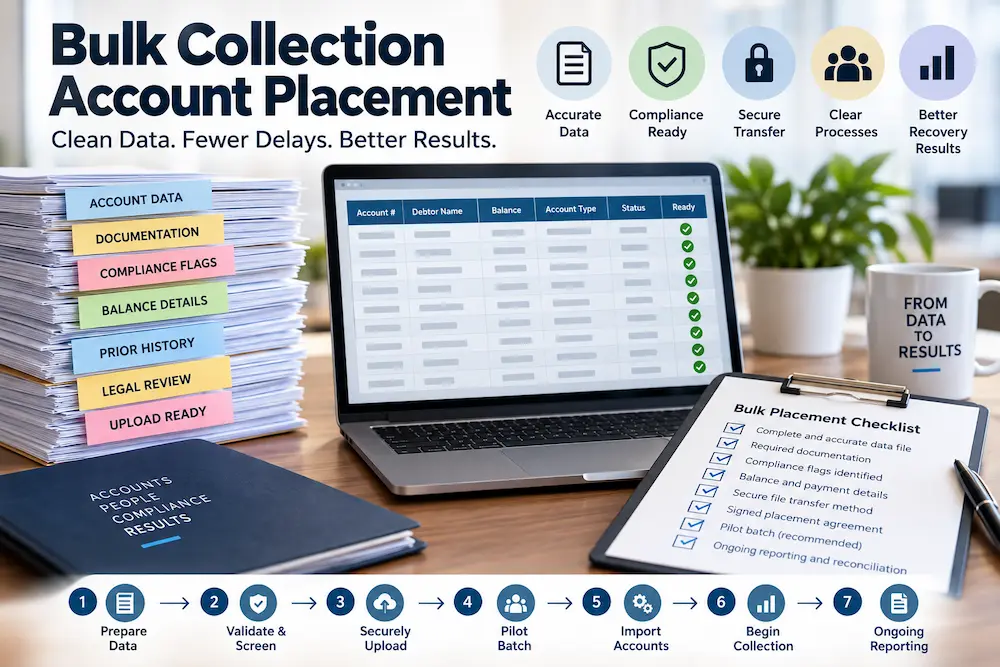
Quick answer: A collection agency handling a large-volume placement needs standardized, machine-readable account data (or a standard excel spreadsheet format), clear consumer-vs-commercial classification, upfront legal and compliance flags (disputes, bankruptcy, attorney representation, statute-of-limitations concerns), available documentation identified in advance, a secure transfer method, a signed placement agreement covering fees and business terms, and a process for reconciling payments the client receives directly. For a new relationship or a new portfolio type, a smaller pilot batch before full-volume placement is the cheapest way to catch problems before they multiply across thousands of accounts.
Ready to place a large portfolio (500, 5000 or 10000 accounts?)
Contact us
Nexa provides a reputation-safe approach, backed by a comprehensive 50-state collections licensing infrastructure, offering free credit reporting, free litigation/bankruptcy scrubs, and zero onboarding fees. A 4.85 of Google rating from 2,000+ reviews. Secure – SOC 2 Type II & HIPAA compliant.
Need a Collection Agency? Contact us
Automated Regulatory Safeguards:
-
Regulation F 7-in-7 Tracking (12 CFR § 1006.14): Automated frequency caps prevent more than 7 telephone calls within 7 rolling days, maintaining lawful tracking even across multiple accounts for the same debtor.
-
Automated Bankruptcy & SCRA Scrubbing: Every batch is screened immediately against federal PACER records and the DoD DMDC database to suppress active bankruptcies and protect active-duty military personnel before contact starts.
-
FCRA Metro 2 Reporting Standards: Standardized batch data furnishing and automated dispute workflows comply fully with federal accuracy mandates and statutory dispute resolution timelines.
Data File Quality and Format
A standardized template or a standard spreadsheet format. Every account needs a unique client or account reference number to prevent duplicate placements and simplify reconciliation later. Core fields should generally include debtor or customer name, business name where applicable, last known address, phone and email, the client’s own reference number, original and current creditor, original and current balance, relevant transaction or invoice dates, date of default, date of last payment, and charge-off date where applicable.
For consumer accounts, provide the itemization behind the current balance, principal, interest, fees, payments, and credits, so the agency isn’t left reconstructing how a number was reached. Sensitive identifiers like date of birth should be included only when legitimately held and actually necessary, not automatically attached to every record. Data should be machine-readable and consistently formatted across every batch; scanned spreadsheets, PDFs used as account lists, and merged cells create exactly the kind of manual cleanup that erases the efficiency bulk placement is supposed to create.
Consumer vs. Commercial Classification
Every account should clearly identify what kind of debt it is: consumer, commercial/B2B, medical, rental or lease, education-related, government or municipal, judgment debt, or another specialized category. This distinction matters more than it might seem, since the applicable notice requirements, communication rules, credit-reporting treatment, and documentation standards can differ substantially between categories. Commercial and consumer accounts in particular follow genuinely different rules, and misclassifying even a portion of a large batch can create compliance exposure across every misclassified account.
Account Documentation and Balance Basis
The agency should know before placement what supporting documentation actually exists, a signed contract, credit application, invoices, purchase orders, delivery confirmation, payment history, a personal guaranty, or a prior settlement agreement, depending on the account type. For large placements, flagging which documents are available directly in the data file is far more efficient than requiring manual inspection of every account.
The client should also identify the principal balance, accrued interest, the contractual interest rate if one applies, late fees or other charges, and the contractual or statutory basis for anything being requested beyond the principal. The agency shouldn’t have to guess how a balance was calculated, and at volume, that guesswork compounds into real errors across the portfolio.
Legal and Compliance Flags
Accounts requiring special handling need to be flagged clearly before placement, not discovered mid-collection. This includes bankruptcy (filed or previously filed), consumer disputes, identity-theft or fraud claims, cease-communication requests, attorney representation, deceased or minor debtors, active litigation, existing judgments, prior settlements, accounts previously placed with another agency, known statute-of-limitations concerns, and any known regulatory complaint. Flagging an account isn’t necessarily a reason to reject it, it’s what allows the agency to route it through the appropriate compliance review before any collection activity begins.
Statute-of-limitations screening shouldn’t rely on the charge-off date alone. Provide the date the obligation arose, the invoice or transaction date, the contract date, the date of default, the date of last payment, the charge-off date, and, where relevant, the governing-law provision in the contract and the state associated with the debtor. Large batches should be systematically screened for potentially time-barred accounts before collection or litigation decisions are made, not assessed account-by-account only when a dispute arises.
Prior Collection Activity and Communication History
The agency should know what’s already happened on an account: a previous collection agency, dates placed and recalled, prior disputes, broken payment arrangements, attorney involvement, previous lawsuits or judgments, and whether the account has previously been furnished to a credit bureau. This prevents duplicated or contradictory collection activity landing on the same debtor from two directions at once.
For consumer portfolios, it also helps to note the source of a phone number or email address, whether the consumer supplied it directly, known preferred language, communication restrictions, and any prior opt-outs from specific electronic channels. This becomes genuinely important once thousands of contact records are transferred at once rather than a handful.
Chain of Title, Industry Requirements, and Data Security
If accounts were sold, purchased, or assigned, chain-of-title documentation should exist before placement, not get reconstructed after a dispute. This includes the purchase and sale agreement, bill of sale, portfolio schedules, and account-level records tying each specific account to the broader portfolio.
Industry-specific pre-collection steps need to be confirmed as already completed, particularly for healthcare, dental, property management, education, utilities, and government accounts. For healthcare accounts specifically, confirm applicable billing and patient-notice requirements were met before placement, and if protected health information is involved, the appropriate Business Associate Agreement and HIPAA safeguards need to already be in place.
Large placements should never move through ordinary email attachments. Use a secure client portal, encrypted SFTP, or an approved API integration instead, with clear access controls, data-retention periods, and breach-notification procedures agreed upon by both sides. Only information actually required for collection should be transferred at all.
Placement Agreement and Business Terms
Before a large batch is submitted, the written agreement should address the fee structure (including different rates by account age or balance, if applicable), minimum balance and maximum account age thresholds, the remittance schedule, how direct payments received by the client are reported and reconciled, account recall procedures, settlement and payment-plan authority, credit-reporting responsibilities, and litigation authorization. See the full fee structure breakdown for how this typically applies across different account types and ages.
Direct-payment reconciliation deserves its own process, not an afterthought. If debtors pay the client directly after placement, that needs to be reported quickly, ideally electronically, matched through the unique account reference number, with periodic reconciliation between agency and client. Without this, an agency can end up continuing to pursue a balance that’s already been paid, a genuinely avoidable and reputation-damaging mistake at volume.
Duplicate Screening, Pilot Batches, and Ongoing Cadence
Automated screening should happen before a large file enters the normal workflow, checking for duplicate accounts, previously placed accounts, zero-balance or already-paid accounts, bankruptcy accounts, deceased consumers, and accounts already in litigation or outside the agency’s acceptance criteria.
For a new client or a new portfolio type, a pilot batch beats loading the full portfolio immediately. Testing file formatting, documentation quality, duplicate detection, compliance flagging, and reporting on a smaller representative sample identifies problems while they’re still cheap to fix, before they’re multiplied across an entire portfolio. Once that pilot runs cleanly, the same process scales to the full batch.
If placements will happen regularly, establishing a predictable cadence, weekly, twice monthly, or monthly, is generally easier to manage than irregular large file dumps, along with a clear cutoff rule for when an account moves from internal accounts receivable into collections.
Reporting and Designated Contacts
Agree in advance on what reporting the client actually wants: accounts and dollars placed, amounts collected, recovery rate, payment arrangements, disputes, recalls, and legal recommendations. For large portfolios, this is best delivered through a dashboard, scheduled report, or API rather than manually prepared each time.
Both sides should also appoint specific contacts for day-to-day placement questions, data issues, disputes, compliance questions, payment reconciliation, and management escalation. Without designated contacts, small questions become real bottlenecks once thousands of accounts are involved.
The Bulk Placement Process, Start to Finish
→ Execute agreement and compliance documents
→ Agree on standardized file format
→ Securely transfer a pilot batch
→ Validate data and documentation
→ Run duplicate, bankruptcy, and compliance screening
→ Resolve exceptions
→ Approve full portfolio
→ Import accounts
→ Begin collection activity
→ Reconcile payments and account changes regularly
→ Provide scheduled performance reporting
At volume, data quality, automated screening, documentation, secure transfer, and reconciliation aren’t separate from the collection process, they are the collection process. A clean pilot batch before full implementation remains the simplest, least expensive way to catch problems before they’re multiplied across an entire portfolio.
Frequently Asked Questions
What’s the biggest mistake businesses make when placing a large volume of accounts?
Treating thousands of accounts as though they were simply one account repeated thousands of times. Without standardized data, upfront compliance flags, and automated duplicate and eligibility screening, an agency ends up doing manual cleanup that erases most of the efficiency bulk placement is supposed to create.
Do we need to flag every account with a potential compliance issue, or only the ones we’re sure about?
Flag anything with a genuine question mark, disputes, bankruptcy, attorney representation, cease-communication requests, or statute-of-limitations concerns. Flagging isn’t the same as rejecting the account, it’s what allows the agency to route it through the right compliance review before any collection activity starts, rather than discovering the issue mid-collection.
Why does a pilot batch matter if we’re confident in our data?
Because a pilot batch tests the entire process, file formatting, documentation quality, duplicate detection, and reporting, on a small, manageable sample before the same process runs across an entire portfolio. Problems that are cheap to fix in a pilot of a few hundred accounts can be expensive and disruptive once they’re already multiplied across ten thousand.
What happens if a debtor pays us directly after we’ve placed the account for collection?
That payment needs to be reported to the agency quickly and matched to the account through its unique reference number, ideally electronically rather than through ad hoc updates. Without a reliable reconciliation process, the agency can continue pursuing a balance that’s already been paid or reduced, which is avoidable and can damage the debtor relationship unnecessarily.
Does the statute of limitations review depend only on the charge-off date?
No, and relying on charge-off date alone is a common mistake. A proper review also considers the date the obligation arose, the original transaction or contract date, the date of default, the date of last payment, and the governing-law provision or debtor’s state, since these can point to a different limitations period than the charge-off date alone would suggest.
How is a commercial (B2B) portfolio different from a consumer portfolio for placement purposes?
The applicable notice requirements, communication rules, and documentation standards can differ substantially between consumer and commercial debt, so every account should be clearly classified by type before placement. Misclassifying accounts, even a small portion of a large batch, can create compliance exposure across every account affected.