The 2027 Commercial Collections Benchmark is Nexa Collections’ annual reference report tracking U.S. B2B payment behavior, overdue receivables, payment terms, accounts-receivable risk and commercial collection trends using the latest available industry datasets.
Quick answer: U.S. businesses head into 2027 with a quieter problem than “customers pay late.” Customers are increasingly paying on longer terms, often terms nobody formally agreed to. Fifty-nine percent of small businesses now carry invoices 30+ days overdue (up from 47% a year earlier), small businesses wait an average of 29.3 days to get paid, and credit managers report net-30 customers drifting to 45 days. The businesses best positioned for 2027 will watch payment behavior, not just invoice age, and set written rules for when follow-up becomes escalation.

Here is the oddest pair of numbers in this year’s payment data.
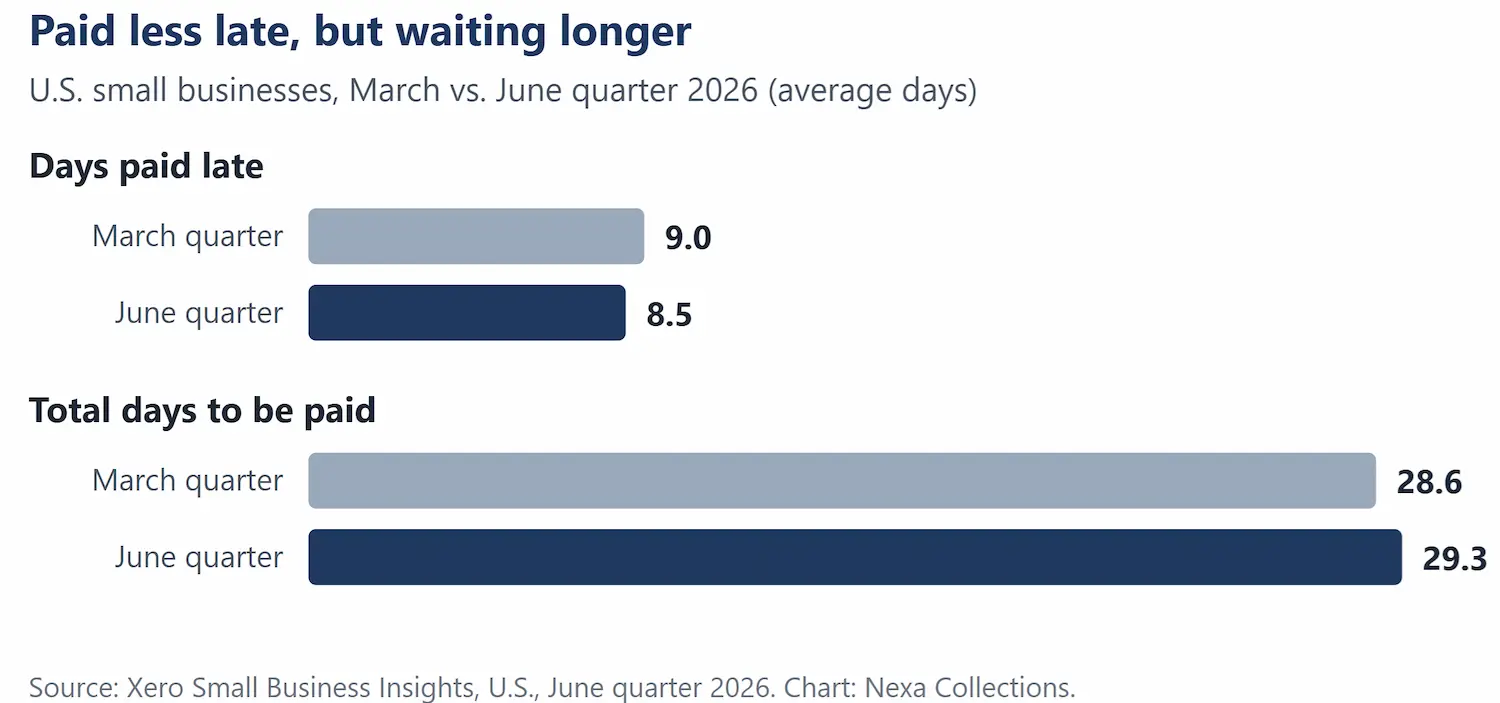
In the June quarter of 2026, U.S. small businesses got paid less late: an average of 8.5 days past due, down half a day. Yet they waited longer for their money: 29.3 days from invoice to payment, up from 28.6.
Both can be true because the due dates moved. Xero, whose transaction data produced those figures, reads the gap as businesses extending their invoice terms. Credit managers describe the same thing from the other side of the desk: customers who used to pay in 30 days now taking 45, sometimes without asking.
That is the story of this benchmark. Late payment in 2026 isn’t only showing up as delinquency. It’s showing up as drift, and drift doesn’t set off alarms on a standard aging report.
| Delinquency Window | Average National Collectability Rate | Asset Depreciation Velocity | Recommended Resolution Track |
| Current to 30 Days Past Due | 93% – 95% | Baseline (Normal credit cycle) | In-house accounts receivable / polite automated reminders |
| 60 to 90 Days Past Due | 70% – 73% | ~10% loss in value per 30 days | Step 1 Diplomatic Resolution ($15 Fixed Fee per account) |
| 90 to 180 Days Past Due | 50% – 55% | Rapid decline; debtor solvency risks surge | Step 2 Final Fixed Notice ($15) >> Contingency (30%–40%) |
| 180 to 365 Days Past Due | 25% – 30% | Severe risk; corporate asset dissipation likely | Contingency Placement (40%–50%) with asset investigation |
| 365+ Days (1+ Year Past Due) | Under 10% | Critical write-off threshold | Legal review / judgment enforcement / bad debt write-off |
This edition brings four independent datasets (Intuit QuickBooks, Xero, Atradius and the National Association of Credit Management) into one practical view of the receivables risk U.S. businesses are carrying into 2027. Because 2027 hasn’t started yet, it uses the newest 2026 data as the baseline. Nexa Collections will update it as 2027 data arrives.
The 2027 Benchmark at a Glance
| Indicator | Latest figure | Population | Source |
|---|---|---|---|
| Small businesses with invoices 30+ days overdue | 59% (47% a year earlier) | U.S. small businesses | QuickBooks, 2026 |
| Average owed to businesses waiting on unpaid invoices | $17,700 (about $17,500 a year earlier) | U.S. small businesses | QuickBooks, 2026 |
| Businesses with 20%+ of invoices 30+ days overdue | 22% | U.S. small businesses | QuickBooks, 2026 |
| Overdue invoices: net-30 vs. immediate-payment businesses | 55% vs. 26% | U.S. small businesses | QuickBooks, 2026 |
| Owners who say one late payment made payroll or bills harder to cover | 39% | U.S. small businesses | QuickBooks, 2026 |
| Average time to be paid, June quarter 2026 | 29.3 days (28.6 prior quarter) | U.S. small businesses (transaction data) | Xero, 2026 |
| Average days paid late, June quarter 2026 | 8.5 days (down 0.5) | U.S. small businesses (transaction data) | Xero, 2026 |
| Share of B2B sales made on credit | 45% | U.S. businesses | Atradius, 2026 |
| Firms experiencing late B2B payments | About 7 in 10 | North America (U.S., Canada, Mexico) | Atradius, 2026 |
| Share of B2B receivables overdue | 23% | North America | Atradius, 2026 |
| Overdue B2B invoices paid within 30 days of due date | 71% | North America | Atradius, 2026 |
| NACM Credit Managers’ Index, August 2026 | 54.6 (down 1.8) | U.S. credit professionals | NACM, 2026 |
These studies measure different populations with different methods. Read them side by side, not added together. There is no single “national late-payment rate,” and this table doesn’t try to create one.
Finding 1: “Late” Is Quietly Being Rewritten as “Terms”
Three independent sources point in the same direction.
Transaction data (Xero). Days paid late improved every month of the June quarter (8.7 in April, 8.5 in May, 8.3 in June), while total time to be paid rose to 29.3 days, above the dataset’s historical average of 28.9. Xero’s own reading: small businesses, on average, extended their invoice payment terms.
Survey data (Atradius). Most North American suppliers kept payment terms unchanged in recent months. Where terms did change, they got longer more often than shorter, particularly among trade companies and businesses in the United States and Mexico.
Credit-desk reports (NACM). NACM’s September 2026 reporting describes customers asking for extended terms to hold on to cash, and some simply moving themselves from 30-day to 45-day payment without asking. NACM economist Amy Crews Cutts described these customers as “deciding to unilaterally rewrite the contract.”
Why this matters for collections: most aging reports measure lateness against the due date. If the effective due date slides from day 30 to day 45, an account can look “current” while your cash conversion cycle gets two weeks longer. That’s why this benchmark adds a metric many AR teams don’t track: terms drift, the average days from invoice to payment compared with the terms in the contract. (See the metrics table below.)
Finding 2: More Businesses Are Waiting, Not for Bigger Balances
QuickBooks’ 2026 Small Business Late Payments Report found that 59% of small businesses have at least some invoices 30 or more days overdue, up from 47% a year earlier. That’s a 12-point jump in twelve months.
The average amount owed barely moved: $17,700, versus about $17,500 the year before.
Read together, those numbers say the problem got wider, not deeper. Far more businesses are waiting on money than a year ago, even though the typical balance is about the same.
For a meaningful minority it got deeper too. 22% of businesses say at least one in five of their invoices is 30+ days overdue. At that level you’re not dealing with a few stragglers anymore. You’re dealing with a credit policy, a customer mix or a follow-up process that isn’t working.
One clarification worth making: 59% doesn’t mean 59% of invoices are late. It means 59% of businesses have at least one invoice that has crossed the 30-day overdue mark.
Finding 3: It Doesn’t Take a Big Miss to Break a Month
- 39% of owners say a single late payment made it harder to cover payroll or bills in the past year.
- 27% say a missed payment under $5,000 was enough to cause that strain.
- 12% say a payment under $1,000 was enough.
Then the problem travels. 42% of businesses say outside pressures delayed payments they owed to their own contractors, suppliers or vendors over the last quarter. That rises to 53% among businesses with overdue invoices, versus 26% among those without. And among businesses with invoices 30+ days overdue, nearly one in four (24%) point specifically to delayed revenue as the reason they couldn’t pay their own vendors on time.
Businesses with overdue invoices are also leaning harder on credit cards: 38% say they’ve become more reliant on them over the past year, compared with 21% of businesses without overdue invoices.
That’s the payment chain in plain terms. A late customer becomes a late vendor payment, which becomes someone else’s late customer, often financed at credit-card rates along the way. A $2,000 invoice may be immaterial to your customer and critical to you, so collection priority should reflect your exposure, not just the invoice size.
Finding 4: Payment Terms Are the Biggest Lever You Already Control
QuickBooks’ data draws a clear line between terms and trouble.
| Businesses on net-30 terms | Businesses requiring immediate payment | |
|---|---|---|
| Report overdue invoices | 55% | 26% |
Looked at from the other direction, 64% of businesses with no overdue invoices require immediate payment, compared with 34% of businesses that do have overdue invoices. QuickBooks itself cautions that terms don’t explain every late invoice, and some industries and client relationships genuinely require credit.
This isn’t an argument for putting every customer on prepay. Trade credit wins deals, supports larger orders and builds long relationships. It’s an argument for treating credit as a decision rather than a default:
- New customers: start with shorter terms or a lower limit, and extend as payment history earns it.
- Large or unusual orders: consider a deposit, partial prepayment or progress billing.
- Existing customers who start slipping: review limits before shipping more. Credit managers quoted by NACM describe approving new terms only with conditions attached, such as partial prepayment, cash in advance or a standby letter of credit.
- Contract terms: state due dates plainly and, where your agreements and applicable law allow, spell out late fees up front rather than improvising them later.
Collection risk starts the day credit is extended, not the day an invoice turns 90.
Finding 5: B2B Late Payment Is Common. The Real Risk Is the Tail.
Atradius’ 2026 Payment Practices Barometer for North America, a survey of 662 businesses in the U.S., Canada and Mexico, shows how routine late payment has become in B2B trade:
- U.S. businesses conduct about 45% of their B2B sales on credit.
- Across the region, about seven in ten firms experience late B2B payments.
- Overdue invoices make up an average of 23% of B2B receivables.
But look at when those overdue invoices actually get paid.
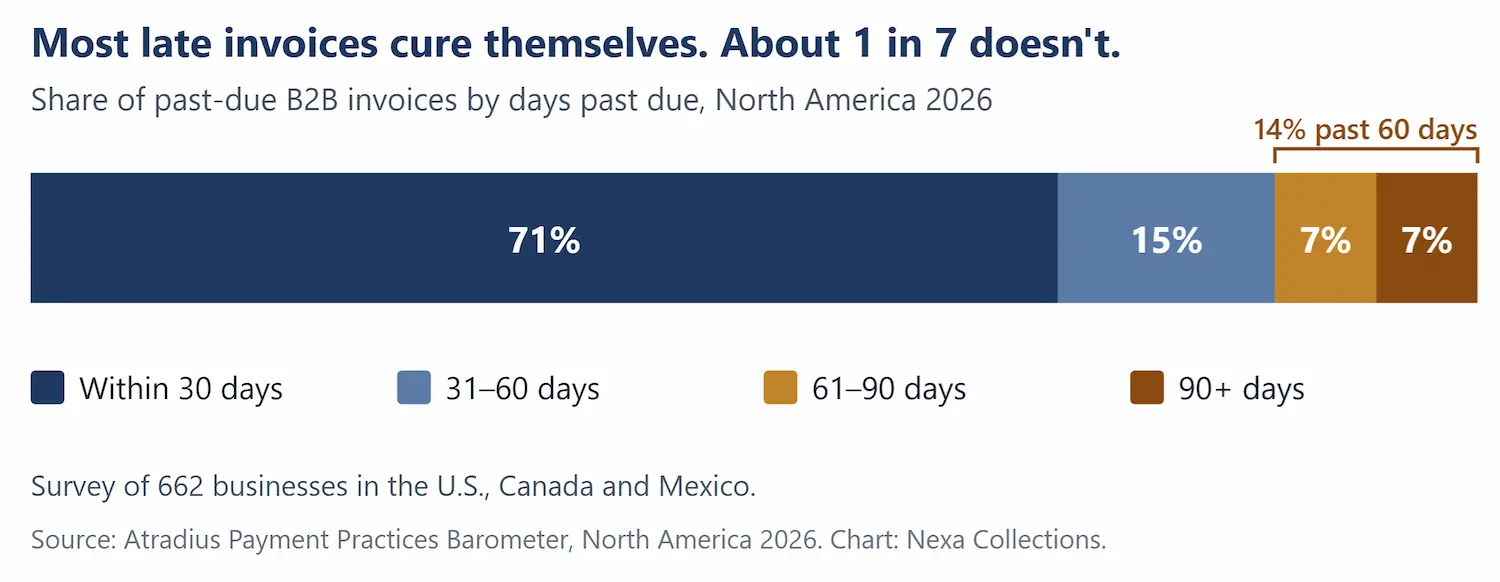
71% of past-due invoices are settled within 30 days of the due date. Another 15% land at 31 to 60 days. The remaining 14% stretch past 60 days, and half of those go beyond 90.
That’s the core insight for collection strategy: most late invoices cure themselves. The job isn’t to escalate every slow payer. It’s to spot the roughly one in seven that won’t cure, early, while contact details are current and the customer is still operating.
Why do customers pay late? Customer cash flow leads by a wide margin (49% of respondents), followed by banking delays (36%), complex payment processes (17%) and internal approval delays (16%). Atradius attributes delays mainly to liquidity rather than disputes or administrative errors.
Bad debt remains broadly contained. Nearly half of North American suppliers report bad debt below 1% of receivables, and fewer than one in four report levels above 2%. Notably, Atradius links bad debt more often to customers becoming inactive or unreachable than to long-running nonpayment of large invoices, which is a strong argument for acting while a customer still picks up the phone.
What 1% can cost (illustrative): on $10 million in annual credit sales, 1% bad debt is $100,000. At a 10% net margin, replacing that profit takes roughly $1 million in new revenue.
Finding 6: Stable Headlines, Fragile Underneath
On the surface, the outlook looks calm. Most North American businesses in the Atradius survey expect customer payment behavior to hold steady, two in five expect faster payments, and nearly half expect margins to improve.
Underneath the surface:
- 62% expect insolvency risk to stay elevated, and 27% expect it to rise further.
- Around one-third of suppliers already report reduced cash availability.
- Economic slowdown tops the list of expected risks to payment behavior, followed by inflation and cost pressures, then interest rates.
Atradius’ own analyst framed it this way: payment performance and financial confidence are moving in different directions, and many companies are managing through pressure rather than coming out of it.
NACM’s Credit Managers’ Index tells a similar two-sided story. The combined index fell 1.8 points to 54.6 in August 2026. That’s still above the 50 line that separates expansion from contraction, but the drop was driven by a sharp swing in dollar sales that NACM ties to customer cash-flow strain.
Meanwhile, Xero recorded 4.0% year-over-year sales growth for U.S. small businesses in the June quarter. Sales are up. Cash is slower. Revenue growth and cash-flow improvement are not the same thing.
Why the Aging Report Doesn’t Tell the Whole Story
Two invoices. Both 75 days past due.
Invoice A: The customer responded right away. A missing PO number held up approval, the paperwork was corrected, and accounts payable confirmed a payment date.
Invoice B: The customer has promised payment four times. Every date has passed. Calls now go to voicemail. There’s no dispute.
Your aging report shows them identically. Their risk is nothing alike.
A credit manager quoted by NACM draws the key distinction: first work out whether you’re looking at a cash problem or a cash-management problem. A cash-management problem (an invoice routed to the wrong inbox, turnover in accounts payable, a missing PO) is usually fixed with better paperwork. A genuine cash problem calls for faster, more protective action.
| What you see | Likely cause | Right first move |
|---|---|---|
| No acknowledgment, no response to billing | Wrong contact, lost invoice, AP turnover | Re-verify the contact; resend with PO and supporting documents |
| Customer raises a specific objection | Genuine dispute | Investigate, document, and resolve or credit quickly |
| Customer acknowledges the balance and asks for time | Temporary cash pressure | Written payment arrangement; hold on new credit until it’s current |
| Broken promises, fading contact, no dispute | Serious financial distress | Escalate now, using a documented plan for a client who won’t pay, rather than waiting for the next aging bucket |
8 Early-Warning Signals to Watch in 2027
- Promise dates keep moving. “Friday” becomes “next week” becomes “end of the month.” (Here’s how to handle the most common debtor excuses.)
- A reliable payer starts stretching. A customer who always paid in 20 days and now pays in 45 deserves more attention than one who has always paid at 45.
- Requests for longer terms, or longer terms simply taken without asking.
- Unplanned partial payments from a customer who used to pay in full.
- Several invoices aging at once from the same account.
- New orders keep arriving while old balances sit unpaid, quietly growing your exposure.
- Accounts-payable contacts go quiet: unanswered emails, staff turnover, disconnected numbers.
- “We’ll pay when we get paid.” Credit managers report hearing this more often, even when the contract says net-30. It can signal that your customer’s receivables problem is becoming yours.
The 30-60-90-120 Commercial Escalation Framework
There’s no single day when every commercial account should go to collections. Contracts, balances, industries and relationships differ. What every business does need is written escalation points, so accounts move on purpose instead of aging by default.
| Days past due | Objective | What to do | Decision at the end of this stage |
|---|---|---|---|
| 1–30 | Remove friction | Confirm the invoice was received, the PO and billing details are correct, documentation is complete and the right AP contact has it; get a committed payment date | Is this administrative or financial? |
| 31–60 | Diagnose behavior | Log every contact, promise date, partial payment, extension request and dispute | Is the customer engaging or drifting? |
| 61–90 | Formal risk review | Review contract terms, payment history, other open invoices, business status and, where appropriate, bankruptcy filings; decide whether to hold new credit | Is internal effort still producing progress? |
| 91–120 | Decide and escalate | Options include intensified internal follow-up, a written payment arrangement, settlement discussions, third-party commercial collections placement, or attorney review of suitable accounts through the legal collection process | Which path fits the facts of this account? |
| 120+ | No drifting | Give every account a documented status: payment plan, disputed, third-party collection, legal review, bankruptcy or write-off | Does every old balance have an owner and a status? |
“Still in AR” is not a status. If you’re weighing whether to keep chasing internally or hand accounts off, our comparison of in-house collections vs. an agency walks through the trade-offs.
Why the clock matters: widely cited Commercial Law League of America figures put the collectability of commercial debt at roughly 73% at 90 days, about 50% at 180 days and about 25% at one year. Treat those as a rule of thumb rather than a promise, since documentation, debtor solvency and whether the business is still operating all matter, but the direction is consistent: time rarely helps. Legal time limits can also eventually apply; see our guide to statutes of limitations on debt.
7 Accounts Receivable Metrics Worth Tracking in 2027
| Metric | What it tells you | Warning sign |
|---|---|---|
| Past-due % by aging bucket | Where risk is accumulating | A growing share in the 60+ and 90+ buckets |
| Days Sales Outstanding (DSO) | How quickly sales turn into cash | Rising DSO not explained by seasonality or a change in customer mix |
| Terms drift | Average days from invoice to payment vs. contract terms | Customers paying “on time” to a due date that keeps moving |
| Promise-to-pay kept rate | Share of payment promises actually honored | A falling rate, often visible before write-offs rise |
| Broken promises before escalation | How many “next week”s your team accepts before acting | Nobody knows the answer, so measure it |
| Time to escalation | Days from due date to a real escalation decision | Old accounts with no decision attached |
| Bad debt % of credit sales, plus recovery by age at placement | What ultimately becomes uncollectible, and when referral works best for your accounts | Bad debt creeping up, or recoveries falling on late placements |
Why There’s No Honest “Average Commercial Recovery Rate”
“What percentage will you recover?” is the question businesses ask collection agencies most often. There’s no credible universal answer. Results depend on account age, balance, documentation quality, whether the debtor is solvent and still operating, contactability, dispute status, prior collection attempts, bankruptcy, industry and jurisdiction.
A portfolio of 45-day-old invoices from active companies can’t fairly be compared with two-year-old accounts from businesses that may have closed. Whenever you see a recovery rate quoted, ask what kinds of accounts produced it. For how pricing typically works, see our breakdown of collection agency fees.
Nexa’s 2027 Watchlist
The trends we think credit and AR teams should watch most closely next year, and the ones we plan to revisit in future editions:
- Terms drift. Are customers taking longer before invoices are even “due”?
- “Pay when paid.” Is your payment being tied to your customer’s own collections?
- Good customers going slow. Are historically reliable accounts starting to stretch?
- The tail. Is the share of overdue receivables past 60 and 90 days growing?
- Unreachable customers. Are once-active accounts going silent, the pattern most linked to bad debt?
- Time to escalation. Are you deciding sooner, or letting old balances pile up?
Methodology and Limitations
The 2027 Nexa Collections Commercial Collections Benchmark is published ahead of calendar year 2027 and uses the latest available 2026 data as its baseline.
- Intuit QuickBooks, 2026 Small Business Late Payments Report. Draws on QuickBooks Small Business Insights, an ongoing quarterly survey of roughly 5,000 small-business owners and decision-makers, and an online survey of 1,305 U.S. business owners (0 to 250 employees) conducted in December 2025.
- Xero Small Business Insights, U.S., June quarter 2026. Aggregated, anonymized transaction data from Xero small-business subscribers. Time to be paid runs from invoice to payment; late payment compares the payment date with the invoice due date.
- Atradius Payment Practices Barometer, North America 2026. Online survey of 662 businesses across the U.S., Canada and Mexico, conducted between late Q2 and mid-Q3 2026. Most figures are regional (North America), not U.S.-only; the 45% credit-sales share is U.S.-specific. Atradius updated its survey panel for this edition and notes that direct comparisons with prior years aren’t possible.
- NACM Credit Managers’ Index, August 2026. Monthly survey of U.S. credit and collection professionals rating favorable and unfavorable business factors; readings above 50 indicate expansion.
Because these sources use different populations, definitions and methods, their percentages shouldn’t be added together or treated as one sample. This benchmark is an industry reference and risk-management resource. It isn’t a prediction about any individual customer or portfolio, and it isn’t legal advice.
Commercial Credit & Collection: Plain-English Legal Reference Rules
-
CLLA Depreciation Principle (Commercial Law League of America): Commercial accounts receivable depreciate exponentially after the 90-day mark. Delaying third-party intervention past 120 days cuts recovery likelihood in half, as corporate debtors prioritize vendors applying active collection pressure over silent creditors.
-
Uniform Commercial Code § 2-725 (Sale of Goods): A 4-year statute of limitations generally governs commercial contracts for goods. Waiting for informal promises to pay can cause claims to approach expiration under state-specific commercial code deadlines.
-
Account Stated Doctrine: Sending regular monthly statements with clear dispute deadlines creates an enforceable “account stated” under common law. If the business debtor retains invoices without written objection, courts presume the accuracy of the debt, defeating late-stage balance disputes.
-
Preference Claim Safeguards (11 U.S.C. § 547): When collecting from financially distressed businesses, third-party recovery strategies must structure settlements to fit within standard business terms or contemporaneous exchanges, protecting funds from bankruptcy trustee 90-day clawbacks.
Frequently Asked Questions
What percentage of U.S. small businesses have overdue invoices?
According to Intuit QuickBooks’ 2026 Small Business Late Payments Report, 59% of small businesses have at least some invoices 30 or more days overdue, up from 47% a year earlier. Businesses waiting on unpaid invoices are owed about $17,700 on average, similar to roughly $17,500 the year before.
How long do U.S. small businesses wait to get paid?
Xero Small Business Insights data shows U.S. small businesses waited an average of 29.3 days to be paid in the June quarter of 2026, up from 28.6 days in the March quarter. Late payments actually improved to an average of 8.5 days past due, which Xero interprets as businesses extending their invoice payment terms.
How common are late B2B payments in North America?
Atradius’ 2026 Payment Practices Barometer for North America found that about seven in ten firms across the U.S., Canada and Mexico experience late B2B payments, and overdue invoices make up an average of 23% of B2B receivables. U.S. businesses conduct about 45% of their B2B sales on credit. Most overdue invoices, 71%, are paid within 30 days of the due date.
Why are B2B customers paying invoices late in 2026?
Customer cash flow is the leading reason, cited by 49% of North American suppliers in Atradius’ 2026 survey, followed by banking delays and complex payment or approval processes. Credit managers surveyed by NACM also report more customers requesting extended terms or saying they will pay only after they themselves are paid.
When should an unpaid B2B invoice be sent to collections?
There’s no single age that fits every commercial account. Consider the balance, payment terms, customer history, dispute status, documentation, responsiveness and whether internal follow-up is still producing progress. Many businesses set a formal review point between 60 and 90 days past due. What matters most is having a written escalation policy so accounts don’t age without a decision.
Does commercial debt become harder to collect as it gets older?
Generally, yes. Businesses close, contacts leave, records get harder to find and legal time limits can eventually apply. Widely cited Commercial Law League of America figures put collectability at roughly 73% at 90 days, 50% at 180 days and 25% at one year, though documentation, debtor solvency, disputes and contactability can matter as much as age.
The Bottom Line: Treat Your Aging Report as a Risk Report
No single statistic defines commercial collections going into 2027. What stands out is how consistently the evidence points the same way: more businesses waiting, customers stretching terms, small misses hitting payroll, and calm headlines sitting on top of real liquidity strain.
The strongest credit teams in 2027 won’t necessarily be the ones making the most calls. They’ll be the ones who notice behavior changes first, fix legitimate invoice problems fastest, document every promise, limit new exposure to slipping accounts, and know exactly when routine follow-up becomes formal escalation.
When an invoice goes seriously past due, “How much do they owe us?” stops being the most useful question. The better one is: Why haven’t they paid, what has changed, how much risk are we carrying, and what are we doing next?
About the Nexa Collections Commercial Collections Benchmark
The Nexa Collections Commercial Collections Benchmark is an ongoing research series on U.S. B2B payment behavior, accounts receivable management and commercial debt recovery. This baseline edition uses the latest public 2026 research. Future editions will add new industry data and, where enough anonymized data is available, Nexa portfolio statistics such as recovery by account age, balance size, industry and time to first payment.
Carrying B2B accounts that have stopped moving? Talk to the Nexa Collections commercial team at support@nexacollect.com or +1-844-639-2123.
Sources
- Intuit QuickBooks, 2026 Small Business Late Payments Report (July 2026)
- Xero, United States Small Business Insights, June quarter 2026 (July 2026)
- Atradius, B2B Payment Practices Trends in North America 2026 (September 2026)
- NACM, Payment delays rise as customers hold tight to cash (September 2026)
- NACM, Growth cools as customers continue to hold onto cash (September 2026)
Published September 2026 | Baseline edition for 2027 | Built on the latest available 2026 data