Is your business accidentally financing your clients?
When you let an invoice slide 30, 60, or 90 days past due without consequence, you’re essentially giving your customer an interest-free loan. Meanwhile, you’re the one paying interest on your line of credit or credit cards to keep operations running. It’s time to stop being the “nice guy” creditor and start getting paid.

Quick Answer: Legally Charging Late Fees on Invoices
Late fees are enforceable only if they were disclosed in writing before the debt was incurred, in the contract, quote, or invoice terms, never added retroactively after the fact. Most B2B agreements use 1.5% per month (18% APR), which stays under the usury caps most states apply, though several states cap unwritten or undisclosed rates as low as 8-10% annually. Collecting the fee still requires the same leverage as collecting the principal once a client actually refuses to pay.
Implementing a late fee policy isn’t just about collecting a few extra dollars, it’s about training your clients to respect your payment terms. Here’s how to do it effectively, legally, and professionally.
The Psychology: Why Late Fees Work
The purpose of a late fee is not to generate revenue. If you’re budgeting based on collecting late fees, your business model is broken. The purpose is deterrence.
Most businesses pay bills based on “pain points.”
- If they don’t pay the electric bill, the lights go out. (High pain)
- If they don’t pay the credit card, they get hit with 29% interest. (High pain)
- If they don’t pay you, and nothing happens, you go to the bottom of the pile. (Zero pain)
A late fee moves your invoice from the “ignore” pile to the “must pay” pile.
The Math: How Much Can You Charge?
The standard industry rate for B2B late fees is 1.5% per month (which equals 18% APR).
- Why 1.5%? It’s generally high enough to be annoying, but low enough to stay under the “usury” (predatory lending) limits in most states.
- The flat fee alternative: For smaller consumer invoices, a flat fee (e.g., “$25 per month”) can be more effective than a percentage. 1.5% of a $100 bill is only $1.50, nobody notices. A $25 penalty gets attention.
⚠️ Legal warning: Usury laws vary by state. In some states, you cannot charge more than 8-10% annually without a specific written contract. Always check your local state regulations before setting a rate.
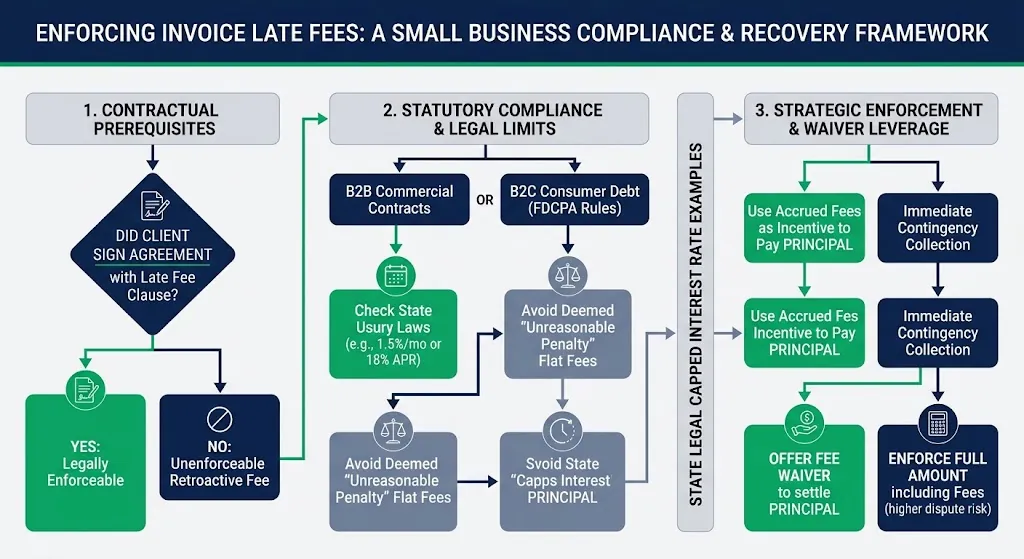
B2B Invoices vs. Consumer Debt: Different Rulebooks
This distinction matters more than most small business owners realize. The federal Fair Debt Collection Practices Act (FDCPA) governs how consumer debt can be collected, communication frequency, required disclosures, prohibited language, but it doesn’t directly regulate what a business can charge another business in late fees under a signed commercial agreement. B2B late fees are primarily a contract law question: what did the agreement actually say, and does the rate fall within your state’s usury limits. A late fee charged to an individual consumer, by contrast, may also need to comply with state consumer protection statutes layered on top of ordinary contract law, not just usury caps. Know which category your invoice falls into before assuming the same rules apply.
Fee Types vs. Legal Constraints vs. Nexa’s Strategy
| Fee Type | Legal Constraint | How It Holds Up | Nexa’s Approach |
|---|---|---|---|
| Monthly interest (e.g., 1.5%/mo) | Capped by state usury law, commonly 8-10% to 18%+ depending on state and whether the agreement is in writing | Strong, if disclosed in writing before the debt was incurred | Verified against your original contract before being included in any demand |
| Flat administrative fee (e.g., $25) | Generally more flexible than percentage-based interest, but must still be disclosed upfront | Strong for smaller balances where a percentage is negligible | Applied only when the original terms explicitly listed a flat fee |
| Retroactive fees (added after the fact) | Not legally enforceable in most cases | Weak to none, courts generally require prior written agreement | Never pursued; retroactive fees are dropped from any formal demand |
| Collection cost pass-through clauses | Enforceable if the original contract specifically allows recovering collection costs or attorney’s fees | Strong, and increasingly common in modern service agreements | Pursued as part of the demand when the underlying contract supports it |
The Execution: It Must Be in Writing
You cannot simply add a late fee to an invoice after the fact if the customer never agreed to it. To make it enforceable, it must be part of the initial agreement.
Where to put it:
- The contract: “Accounts not paid within 30 days of the invoice date are subject to a 1.5% monthly finance charge.”
- The quote/estimate: Have them sign off on the terms before work begins.
- The invoice footer: Reiterate the policy on every bill.
Sample wording for invoices:
“Payment is due within 30 days. Please note that a late fee of 1.5% per month (18% annually) will be automatically applied to all past-due balances. To avoid these charges, please remit payment by [Date].”
The “Grace Period” Myth
Should you give a grace period? No.
If your terms are Net-30, the money is due on day 30. If you allow them to pay on day 45 without penalty, you don’t have Net-30 terms, you have Net-45 terms. Be consistent. If you waive the fee every time, your policy is toothless.
What If They Refuse to Pay the Fee?
A common scenario: the client finally sends a check for the original principal amount but refuses to pay the accrued interest.
- The “good client” exception: If this is a loyal client who slipped up once, waive the fee. Use it as a negotiation tool: “I’ll waive the $40 late charge this one time, but please note our system adds it automatically next time.”
- The “problem client”: If they’re habitually late, apply the payment to the interest first, leaving a balance remaining on the principal. This keeps the invoice open and past due, and gives you continued leverage rather than closing the account prematurely.
When Late Fees Aren’t Enough
Sometimes, a late fee is just ignored. If an invoice hits 60 or 90 days past due, adding another 1.5% won’t magically make them write a check. At this stage, you need leverage, not just math.
This is where Nexa Collections steps in. Instead of giving up 30-50% of your invoice immediately to a traditional agency, start with our fixed-fee demand service.
- Step 1: We send official, third-party demand letters.
- The cost: A flat fee, starting around $15/account, see the full pricing breakdown.
- The result: You keep 100% of the money recovered.
For older, unresponsive, or larger commercial balances where the numbers justify more effort, our commercial collections service applies deeper leverage, still without the 30-50% cut of a traditional agency. Third-party intervention is often the shock a debtor needs to realize you’re serious, far more effective than another “past due” email from your bookkeeper.
Need a Collection Agency for Pre-Collections and Full Collections – Contact Us
Frequently Asked Questions
Can I charge a late fee if it wasn’t in my original contract?
Generally, no. Late fees are only enforceable if the customer agreed to them before the debt was incurred, in the signed contract, the quote, or clearly stated invoice terms. A fee added retroactively, after a client is already late, with no prior written agreement, is very difficult to enforce and can itself become a point of dispute that distracts from collecting the actual principal owed.
What is the maximum late fee a small business can charge legally?
There’s no single national maximum, it depends entirely on your state’s usury law. Many states allow rates up to 18% annually (1.5% monthly) for written commercial agreements, but some cap undisclosed or informal rates as low as 8-10% annually. Confirming your specific state’s limit before setting a rate is worth the ten minutes it takes, since exceeding it can make the entire fee unenforceable.
How do I word a late payment fee policy on an invoice?
Clearly and specifically, stating both the rate and the trigger. A workable template: “Payment is due within 30 days. A late fee of 1.5% per month (18% annually) will be automatically applied to all past-due balances.” The key elements are the exact rate, how often it applies, and what triggers it, vague language like “late fees may apply” is far weaker than a specific, disclosed number.
Should I waive late fees to collect the primary unpaid balance?
Often, yes, strategically. If a generally reliable client is disputing only the fee and not the principal, waiving it (once, and saying so explicitly) usually gets the larger balance paid faster and preserves the relationship. For a habitually late client, the better move is often the opposite: apply their payment to the accrued interest first, keeping the account technically open and past due, which preserves your leverage rather than closing the matter early.
Can late fees compound, charging interest on top of previously accrued interest?
This depends entirely on what the original agreement actually says, and most standard invoice language does not authorize it. Unless the contract specifically states that unpaid interest itself accrues additional interest, the safer and more defensible approach is calculating the monthly fee against the original principal balance only, not against principal plus previously accumulated fees, since compounding without explicit authorization is a common way an otherwise-enforceable fee becomes vulnerable to challenge.
Is a percentage-based late fee treated differently under the law than a flat administrative fee?
Often, yes. Percentage-based interest charges are what most state usury caps are specifically written to limit, while a genuine flat administrative or processing fee, covering the actual cost of handling a late payment, is sometimes treated more flexibly. That distinction isn’t a loophole to inflate a fee under a different label; it needs to reflect what the fee actually is,