• Skip to main content
  • Skip to primary sidebar

Nexa Collections

  • Home
  • Serving
    • Medical
    • Dental
    • Small Business
    • Large Business
    • Commercial Collections
    • Government
    • Utilities
    • Fitness Clubs
    • Schools
    • Senior Care Facility
  • Contact Us
    • About us
    • Cost

Debt Recovery

CPA & Accounting Firm Debt Collection: Protect Relationships & Recover Past-Due Fees

You finished the return. You finished the audit. The client isn’t paying, and the fee sitting in accounts receivable outweighs almost any client relationship, but the way you go after it matters more in this profession than in almost any other, because a badly handled fee dispute doesn’t just cost you money, it can cost you a malpractice complaint you didn’t actually do anything to deserve.
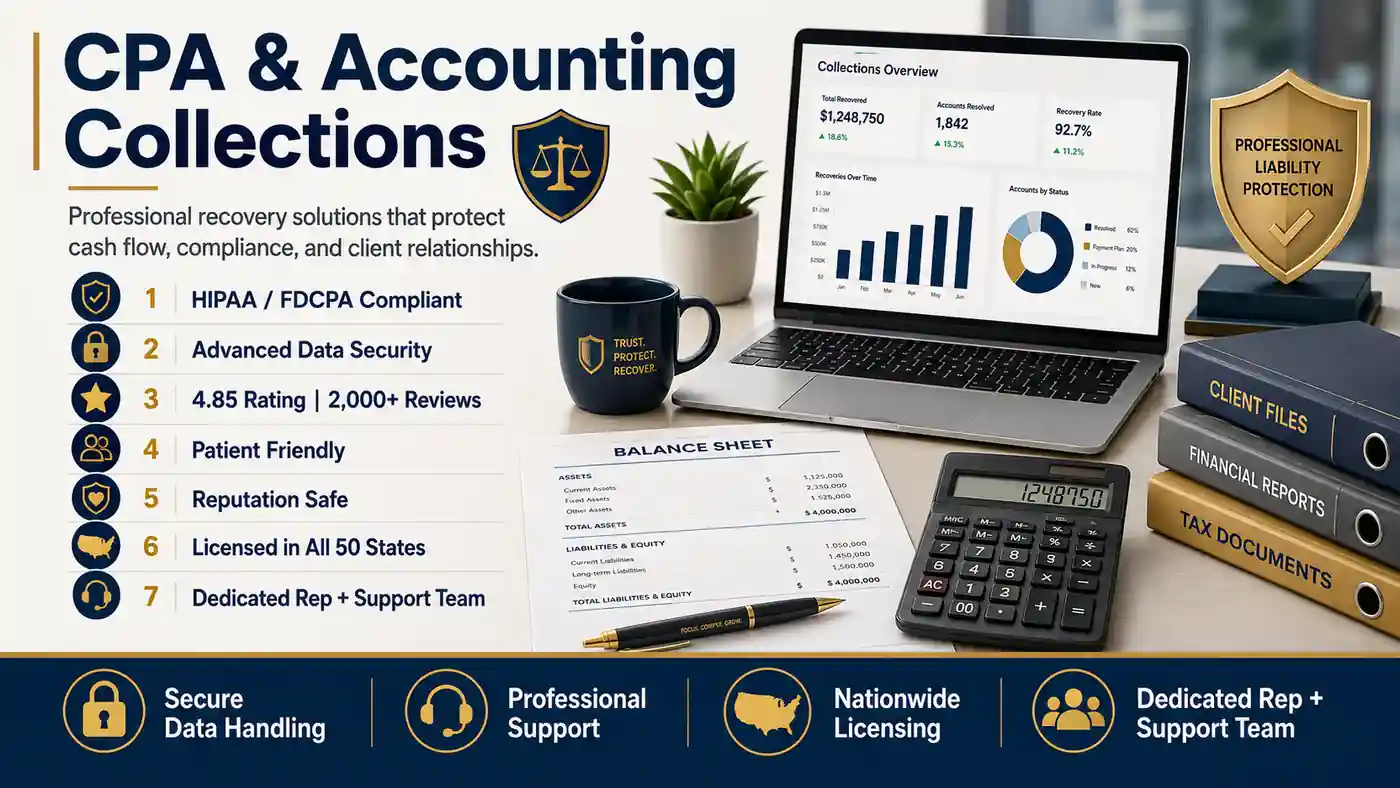
CPA and accounting collections dashboard showing secure financial recovery, balance-sheet management, data protection, nationwide licensing, dedicated support, and a 4.85 rating from 2,000+ reviews.

Quick Answer: Recovering Past-Due Accounting & Tax Fees
CPA firms should recover unpaid fees through diplomatic, AICPA-conscious outreach rather than aggressive demands or a lawsuit filed directly by the firm, since suing a client for fees is one of the most common triggers for a retaliatory malpractice counterclaim. A neutral third party sending a low-cost, professional demand letter, starting around $15 per account, resolves most balances without ever creating that opening.

Need a collection agency? Contact us


The Real Reason CPAs Hesitate to Collect: The Malpractice Counter-Claim

Every accounting firm has felt this hesitation, and it’s not paranoia. Suing a client directly for unpaid fees is one of the most reliable ways to provoke a retaliatory malpractice allegation, whether or not the underlying work had any real problem. Once a firm becomes the plaintiff in a fee dispute, the client has every incentive to reframe the relationship as a grievance instead of an unpaid bill, and even a meritless counterclaim can trigger a malpractice insurance notification, discovery costs, and months of distraction.

A neutral third party changes that dynamic entirely. When a collection agency, not the firm itself, sends the first formal demand, there’s no direct legal confrontation between accountant and client to escalate into a counterclaim. Nexa’s $15 fixed-fee demand letter functions as exactly that firewall: professional enough to get results, distant enough that it doesn’t read as the CPA personally coming after the client.

Where Accounting Fees Actually Go Unpaid

Four situations account for most delinquent accounting receivables, and each needs a slightly different approach:

Tax return delivered, fee unpaid. 
The most common scenario. The return is finished and the client wants it, but hasn’t paid. This is also the one governed by the most specific ethics rules (see below), get it wrong and you risk more than the fee.

Scope creep on audit or advisory work. 
What started as a defined engagement grows, more questions, more meetings, more analysis, without a formal amendment to the engagement letter. When the final invoice reflects that growth, clients often push back precisely because nothing was signed acknowledging the expanded scope.

Retainer depletion. 
A client burns through a retainer faster than expected, work continues because stopping mid-engagement feels worse than the risk of nonpayment, and the gap between retainer and actual hours becomes a receivable no one formally agreed to.

Monthly bookkeeping defaults. 
Recurring engagements are especially vulnerable to quiet nonpayment: a client stops paying the monthly invoice but still expects the books kept current, and by the time a firm notices, several months have accumulated.

Serving Accounting Firms Nationwide

Need an Accounting Collection Agency, or for your clients? Contact Us

What AICPA Rules Actually Say About Withholding Records

This is worth getting exactly right, because the wrong move here can turn a simple fee dispute into an ethics complaint.

Under AICPA Interpretation 501-1, client records fall into categories with different rules:

  • Records the client originally provided to you cannot be withheld under any circumstance, including an active fee dispute. This isn’t optional.
  • Your own completed work product, a finished tax return, financial statement, or similar deliverable, can generally be withheld if the client hasn’t paid the specific fee tied to preparing it. This is a real, recognized “practitioner’s lien.”

For tax engagements specifically, there’s an additional federal layer: IRS Circular 230, Section 10.28(a) generally requires practitioners to promptly return any records the client needs to meet their own federal tax filing obligations, even during an active fee dispute, unless the applicable state specifically permits a retaining lien, in which case only what must be physically attached to the return needs to go back.

The practical takeaway: you can often hold the finished return itself as leverage, but you can’t hold hostage whatever the client’s own filing deadline actually requires. Getting this distinction wrong is exactly the kind of misstep that turns a billing dispute into a state board complaint.

Litigation vs. Traditional Agency vs. Nexa’s $15 Demand

Factor Firm Files Suit Directly Traditional Collection Agency Nexa’s Step 1 ($15 Fixed-Fee Demand)
Malpractice counterclaim risk High, direct legal confrontation invites a retaliatory response Lower, but generic scripts can still feel adversarial Best, positioned as a professional, neutral nudge
Upfront cost Filing fees + attorney time Often none (contingency) $15 per account, flat
Client retention Very low, the relationship is effectively over Low to moderate Higher, many clients pay and quietly return
Speed Months Weeks Days to a few weeks
Confidentiality handling Court filings are public record Varies by agency SOC 2 Type II secure, no client data exposure beyond what’s necessary

Transparent, CPA-Friendly Pricing

Accounting receivables don’t all look the same, so the fee model shouldn’t either.

Fixed-Fee Recovery ($15/account)

Best suited to early-stage receivables — invoices where the debtor relationship is still fresh and a firm, professional nudge is likely enough. Debtors pay 100% directly to you. There are no commissions taken from what’s recovered. Can be claimed as a business expense so this service can essentially be 100% free for you.

Contingency Service (20%–40%)

Built for older, disputed, or “ghosted” accounts that need sustained investigation, skip tracing, and negotiation. No Recovery, No Fee — Nexa is paid only when the account is successfully collected.

Nexa Collections fixed-fee and contingency pricing structure for restoration company debt recovery

Recent Recovery Results

1. Mid-Sized Tax & Advisory Firm (Texas)

  • The Challenge: The firm faced $48,500 in aged past-due balances across 22 client accounts following tax season. The primary drivers were clients who received completed returns/filings but ghosted final invoice reminders, alongside scope-creep billing for unbudgeted IRS audit defense work. The managing partner was hesitant to pursue legal action due to malpractice countersuit risks. Accounts were about 60 days past due.

  • The Strategy: Deployed Nexa’s Fixed-Fee Service ($15/account). Diplomatic, soft-demand letters framed the balances as unapplied administrative oversights and offered structured monthly payment plan engineering.

  • The Result:

    • 72% ($34,920) recovered within 30 days.

    • $0 paid in contingency fees (firm retained 100% of recovered funds).

    • 14 out of 22 client relationships were successfully preserved for the following tax year without a single state board or malpractice complaint filed.

2. Regional CPA & Bookkeeping Practice (Florida)

  • The Challenge: A multi-partner CPA firm held $92,000 in severe delinquency (120+ days past due) from 8 corporate clients who defaulted on monthly retainer agreements and year-end audit fees. Internal AR staff had spent over 60 hours chasing payment with zero response.

  • The Strategy: Escalated accounts to Nexa’s Step 3 Contingency Recovery, utilizing batch skip tracing, corporate asset searches, and direct officer-level mediation while maintaining strict adherence to AICPA Rule 1.700 confidentiality guidelines.

  • The Result:

    • 61% total recovery across 6 of the 8 accounts.

    • Negotiated 3 full-balance lump-sum payouts and 3 structured 90-day settlement arrangements.

    • Total time-to-recovery averaged 82 days from placement, eliminating internal staff administrative overhead.


Frequently Asked Questions

Can a CPA send a client to collections without violating client confidentiality?

Yes, as long as only the information necessary to collect the debt is shared, name, amount owed, and basic contact details, not the underlying financial or tax information from the engagement itself. This is consistent with AICPA confidentiality standards, which govern disclosure of client information but don’t prevent a firm from pursuing payment for services already rendered.

How do I collect unpaid tax preparation fees without getting sued for malpractice?

The single biggest risk factor is the firm itself filing suit or sending aggressive demands directly, since that’s what most often provokes a retaliatory counterclaim. Routing the demand through a neutral third party, rather than the CPA personally, removes that direct confrontation and resolves most balances without ever creating the opening for a countersuit.

Is a $15 fixed-fee collection letter effective for accounting firms?

Often, yes, particularly for fresher balances. A professional, third-party demand letter frequently resolves the account without escalation, and because it’s flat-fee rather than contingency, the firm keeps 100% of whatever is recovered. It’s typically the right first move before considering contingency collection or legal escalation.

Should a CPA firm withhold tax returns for unpaid billing fees?

It depends on which records are involved. A firm can generally withhold its own completed work product, like a finished return, if the client hasn’t paid the fee tied to preparing it, but cannot withhold records the client originally provided, under any circumstance. For tax engagements specifically, IRS Circular 230 requires promptly returning whatever the client needs to meet their own federal filing deadline, even mid-dispute, unless state law specifically allows a retaining lien, in which case only what must be attached to the return has to go back.


If you are looking for a good collection agency for accountants or CPA’s,  or for their clients, we can help you.

Filed Under: Debt Recovery

Contractor Debt Recovery: Stop Funding Your Customers’ Projects

Plumber

Your Customers Aren’t “Late”—They’re Using You as a Zero-Interest Bank!

In the trades—whether you’re clearing drains, installing HVAC systems, or framing additions—every unpaid invoice is a direct hit to your personal pocket. You already paid for the copper. You already paid your crew’s Friday payroll. You already paid for the gas in the truck.

When a customer ghosts your calls or “forgets” to send the check, you are literally funding their lifestyle with your hard-earned cash. Chasing money isn’t just annoying; it’s a second, unpaid job that keeps you away from your next billable project. It’s time to stop being the neighborhood’s free credit line and start getting paid like a professional.

Nexa is the recovery partner for plumbers, electricians, and general contractors. We offer a $15 fixed-fee demand service that gets you paid without ruining the referral-heavy reputation you’ve built.

Stop Funding Your Clients. Start Collecting Today


The Tradesman’s “Aha!” Strategy: 3 Moves to Secure Your Cash

1. The “Final Walkthrough” is Your Insurance Policy

The #1 reason residential customers withhold payment is “minor dissatisfaction”—often a $50 fix used to hold up a $5,000 invoice.

  • The Move: Never leave a site without a signed Certificate of Completion.

  • The “Aha!” Factor: When a debtor tries to claim the work was “substandard” to a collector later, that signed document is your “Get Out of Jail Free” card. It turns a subjective argument into an objective debt.

2. Watch the 90-Day “Lien Cliff”

Most contractors wait far too long to get serious. In many states, your legal right to file a Mechanic’s Lien expires exactly 90 days after your last day on the job.

  • The Move: If the check isn’t in your hand by day 45, the account is officially at risk.

  • The “Aha!” Factor: Nexa’s $15 Fixed-Fee Service triggers a formal agency demand on day 46. It sends a signal that you aren’t just “some guy in a truck”—you’re a business with a legal team.

3. Conditional Lien Waivers: The Safe Middle Ground

Customers often refuse to pay because they fear you’ll file a lien after they pay.

  • The Move: Offer a Conditional Lien Waiver.

  • The “Aha!” Factor: This document says: “My right to file a lien is gone as soon as this check clears.” It removes the customer’s last excuse for withholding the funds.


Cost-Effective Recovery (No Onboarding Fees)

blank

  • Fixed-Fee Recovery ($15/account): We send professional, firm demands under our agency name. The customer pays 100% directly to you. You keep every dollar recovered.

  • Contingency Fee (20%–40%): For the accounts that require “diplomatic” phone calls and deeper skip-tracing. No Recovery = No Fee.


Industries We Serve

  • Plumbing & Rooter: Rapid recovery for high-volume residential calls.

  • HVAC & Mechanical: Managing high-value equipment invoices and maintenance contracts.

  • Electrical & Solar: Navigating complex commercial progress payments.

  • Restoration & Remediation: Expertise in handling “Insurance-Check” withholding disputes.

  • General Contracting & Sub-Trades: Securing the payment chain between the GC and the homeowner.


Recent Trade Success Stories

  • The “Punch List” Blockade:
    A kitchen remodeler was owed $12,000. The customer refused to pay because of a loose cabinet handle. Nexa used Amicable Mediation to secure the $11,800 undisputed portion in 10 days, allowing the contractor to fix the handle and move on.

  • The Ghosting Homeowner:
    An electrician completed a full panel upgrade ($4,500) and was blocked on the customer’s phone. Nexa’s Fixed-Fee Demand reached the customer’s spouse; the full payment was mailed within 48 hours.


Frequently Asked Questions (FAQ)

1. “I don’t have a written contract. Can I still collect?”
Yes. While a written contract is best, a series of text messages, emails, or even a signed work order can serve as evidence of an “agreement to pay.” We specialize in building cases out of unconventional documentation.

2. “What if the customer claims my work was bad?”
This is the most common “defensive” tactic. We act as a third-party mediator. By asking the customer for specific documentation of the “bad work,” we often expose the claim as a stall tactic, allowing us to pivot back to the payment demand.

3. “I’m afraid of a bad Google/Yelp review if I send them to collections.
“
Our “Amicable First” strategy is designed to preserve your reputation. We don’t use “strong-arm” tactics; we use professional business mediation. Most customers respect a firm business approach and will settle the debt once a third party is involved.

4. “How do I know when it’s time to stop calling them myself?”
If you have called three times and been promised a check that never arrived, you are being “managed.” Stop wasting your billable hours. Hand the account to Nexa so you can get back to the job site.

Serving Plumbers Nationwide

Need a Collection Agency for Plumbers? Contact Us


Filed Under: Debt Recovery

Re-Energizing Your Debt Recovery: Why Low Collection Rates Mean It’s Time to Act

blank

Watching only pennies trickle back from thousands in overdue invoices? Low recovery rates aren’t a mystery—they’re a warning sign that something in your collection pipeline is broken and needs a quick fix.


Industry Quick-Take

  • Typical success rate: U.S. agencies recover 20 – 30 % of the dollars placed with them—$20–$30 on every $100.

  • Time kills accounts: Place a balance within 90 days and recovery can double; wait a full year and odds drop below 10 %.

If your current partner lags behind even these modest benchmarks, run through the checklist below before you replace them—or confirm that you definitely should.

# What to Ask the Agency Why It Matters
1 Do you publish live metrics on an online collections portal? A last-minute scramble for data means they were never tracking performance.
2 Are you running all scrubs—Change of Address, bankruptcy, litigious-debtor? Skipping them saves pennies but can lift recovery 5–8 %.
3 Did you sell me the right tier—collection letters vs. live collection calls? Letters shine in the first 120 days; older files need live calls and skip tracing.
4 Can I see sample letters? Color printing and line-item charges make debtors 17 % more likely to pay.
5 Show me two call logs from high-balance files. You should see 5–7 contact attempts in the first month.
6 What payment channels do you offer—ACH, credit-card, Western Union? More options = 10 % higher completion.
7 Is a “Settle-in-Full” policy in place? Accepting 80–90 % today beats 0 % next year.
8 Do you handle credit-bureau reporting in line with U.S. debt-collection laws? Collectors can’t threaten to report, but must tell the truth when asked.

Could You Be Behind the Low Numbers?

  • Late placements. After twelve months, the probability of recovery sinks below 15 %.

  • Missing documents. Contracts, invoices or service receipts are the collector’s legal ammunition—deliver them within 48 hours of request.

  • Portfolio mix. A cluster of bankruptcies or skip-traced accounts drags any metric down; compare your file to industry averages before placing blame.


Real-World Example

ABC Pediatric Clinic sent $50,000 in 120-day-old co-pays to one of NexaCollect’s vetted partners and recovered $24,500 (49 %) within six months—more than double the 22 % rate they saw with their previous agency.


Ready for Better Results?

NexaCollect has already vetted agencies that post 40–55 % recovery on fresh medical and small-business debt—nearly twice the industry mean. Want an introduction? Contact us for a free, no-obligation referral.

Filed Under: Debt Recovery

Collection Agency Fees: What You Really Pay (and Why It Varies)

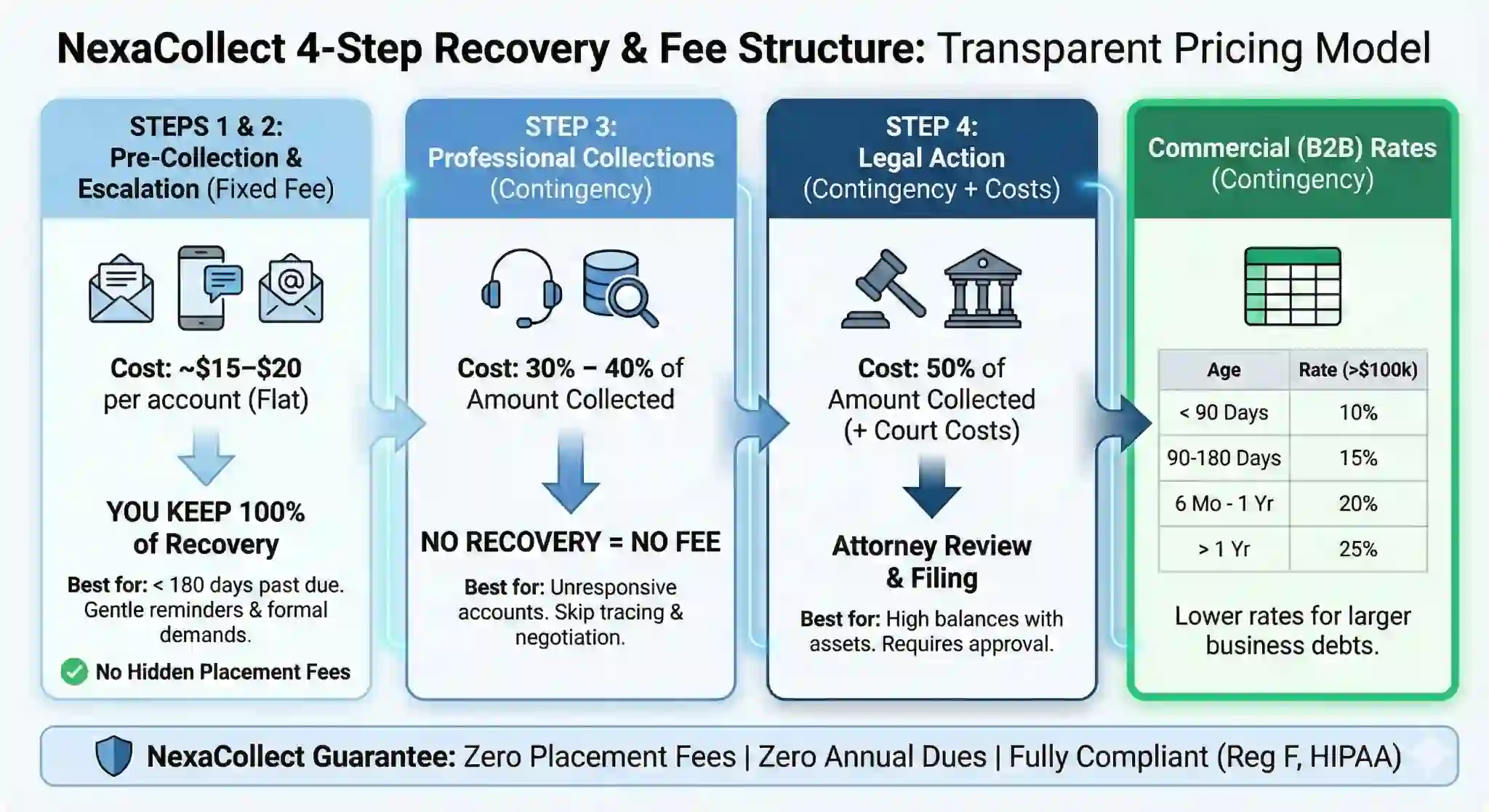
Collection agency fees typically fall into two models: a low fixed fee for newer accounts or a contingency percentage for older or harder-to-collect debts.
 
Early-stage fixed fee recovery can cost about $15–$20 per account, allowing you to keep 100% of recovered principal, while contingency collections generally range from 40% for consumer debts (B2C) and about 10%–35% for commercial (B2B) accounts, depending on the age and size of the debt.
 
blank
 

At a Glance: The 2026 Fee Structure (Consumer Collections- B2C)

Stop guessing. Here is how modern collection costs break down.

Service Type Cost to You Best For Risk Level
Step 1: Pre-Collection ~$15 / account (Flat Fee) < 90 days past due. Gentle reminders. Low: You keep 100% of recovery.
Step 2: Escalation ~$15 / account (Flat Fee) 90-150 days past due. Formal demands. Low: You keep 100% of recovery.
Step 3: Contingency 20% – 40% of amount collected Unresponsive accounts / > 180 days. Zero: No recovery = No fee.
Step 4: Legal Action 40% – 50% of amount collected High-balance debtors with assets. Med: Requires court costs + approval.

(Keep your existing detailed “Key Things to Check” section here, but add this “Trust Trigger” box right after it)

⚠️ Warning: The “Hidden Fee” Trap

Be wary of agencies offering rates below 15%. Often, they make up the difference with:

  • Placement Fees: Charging you just to upload a file.

  • Membership Dues: Annual costs regardless of performance.

  • Cancellation Penalties: Fines for withdrawing an account.

NexaCollect Guarantee: We have Zero placement fees, Zero annual dues, and Zero hidden onboarding costs.


The 4-Step Recovery Model (B2C & B2B)

We use a “waterfall” approach. You pay only for the level of intensity you need.

Step 1 & 2: The “100% Back to You” Phase

  • Cost: ~$15–$20 per account.

  • The ROI: If you recover just one $500 account out of 20 placements, the service pays for itself.

  • What happens: A structured campaign of letters, emails, and texts (where compliant) sent first in your name, then ours.

  • Perfect for: Medical Practices and Dental Offices wishing to preserve patient relationships.

Step 3: The “No Recovery, No Fee” Phase

When letters don’t work, professional collectors step in.

  • Rate: ~40% (Consumer) or 10-35% (Commercial).

  • Activity: Skip tracing, credit monitoring, and compliant phone negotiation.

  • Why it works: A third-party demand carries weight that an internal billing call does not.


Commercial (B2B) Contingency Rates

Business debts are often larger and settled by finance professionals, allowing for lower rates.

Commercial Contingency fee (Based on Account Age and Amount Assigned)
Age:
If > 1 year
40% 35% 30% 25%
180 days – 1 year 35% 30% 25% 20%
90-180 days 30% 25% 20% 15%
< 90 days 25% 20% 15% 10%
Amount Assigned -> $500-
$5k
$5k-
$20k
$20k-
$100k
     $100K +

Need a good Collection Agency? Contact us

Serving Nationwide


Why the “Cheapest” Collection Agency Often Costs You More

A lot of businesses still shop for a collection agency the way they shop for office supplies – by looking for the lowest price. That can be an expensive mistake.

Imagine you place $40,000 in unpaid accounts with two different agencies:

  • Agency A

    • Charges a contingency fee of 20%.

    • Obviously gives less time to each account. Recovers $6,000 (15% of your placements).

    • Your net after fees: $4,800.

  • Agency B

    • Charges a contingency fee of 30%.

    • Charges more, but also works a lot harder on each account. Recovers $16,000 (40% of your placements).

    • Your net after fees: $11,200.

Even though Agency B charges a higher fee percentage, you end up with more than double the money in your bank account.

This gap gets even larger when you add:

  • Fewer write-offs

  • Better documentation and compliance

  • Less time your staff spend chasing the same accounts

In today’s environment—where average agency recovery rates are often in the 20–30% range and top performers can do significantly better—the real question isn’t “Who is cheapest?” but “Who can recover the most, safely?”


Recent Results

Below are fresh, sample scenarios that reflect what a modern fee structure can look like in practice. These are illustrative only, not guaranteed outcomes.

  • Dental practice in Ohio – Fixed fee COMPLETE service

    • $18,600 in early-stage patient balances placed under 150 days past due.

    • Used Step 1 + Step 2 (~$20 per account for 220 accounts).

    • Within 45 days, $10,900 was recovered directly by the practice (no contingency fee; only the flat fees paid).

  • HVAC contractor in Texas – B2C contingency (Step 3)

    • $62,000 in residential invoices, most between 6–12 months old.

    • Placed directly into Step 3 at ~40% contingency.

    • Over 6 months, $34,500 collected; the contractor received roughly $20,700 after agency fees.

  • Wholesale distributor in California – B2B contingency

    • $210,000 in past-due invoices, mostly 90–180 days with a few just over a year old.

    • Fee grid ranged from 15%–30% depending on balance and age.

    • Within 4 months, $88,000 recovered; net back to client after fees: approximately $69,000.

  • Multi-location medical group in Florida – mix of fixed fee and contingency

    • $75,000 in balances under 120 days placed on COMPLETE (Steps 1+2) plus $40,000 older than 180 days on Step 3.

    • Fixed-fee side: about $31,000 recovered directly to the practice.

    • Contingency side: $14,400 recovered, with roughly $8,600 net to the group after Step 3 fees.

  • Technology services firm in New York – B2B legal placements

    • Ten disputed invoices totaling $180,000, all over 1 year old.

    • After non-legal efforts, select cases moved to Step 4 (legal) at ~40–50% contingency, plus court costs advanced by the client.

    • Three cases produced judgments and settlements totaling $72,000, with approximately $36,000–$40,000 net back to the client after legal fees and costs.

These examples show how different fee structures (fixed vs. contingency vs. legal) can be combined to match your risk, account age, and business goals.

Filed Under: Debt Recovery

Offering Debt Collections Service to Clients: Lets be 100% Honest

Honesty and patience reap betters results than being pushy when trying to sell your collections service to a prospective client. Let your prospective clients ask questions about your service before you explain your collection services to them.

1. Understand all services and believe in them:

The sales process requires a deep understanding of the product/service to a level where a Sales Agent believes in the product and is 100% confident that it will benefit his clients. He should understand which service is beneficial for which type of client, make recommendations, and then let clients select the service of their choice. 

Observation: Working as a Sales Representative in a Collection Agency is a very challenging career. Most agencies offer only commission-based payout and no fixed salary component. Although most Sales Reps would love to have fewer very large clients which generate hefty commissions, this never happens for most Reps. The client portfolio of most Sales Reps consists of several small clients, a handful of medium-sized clients, and no large clients. Many Reps will change their career within a couple of months because they cannot make any meaningful money. Due to this sales pressure, a small portion of Reps indulges in presenting partial-truth information about the collection agency they represent.

Being a Sales Rep for a collection agency can be rewarding, but only over a period of time, and cracking that six-figure salary/commissions barrier will take years of hard work. Here are practical and honest tips for individuals looking to make a career in this field.

2. Be honest to your prospective client:

Let me give a few examples where a Sales Rep may not be very truthful for these questions are raised by a prospective client:

Q1) What are your collection rates?
A1) Our collection rates are the highest in the industry.
( Instead, reply with some real collection percentage numbers across various phases of service. Explain to him what results in higher collection rates.)

Q2) Are all your operations located in the USA?
A2) Yes
( Even if your corporate office is located in USA, but maybe your back office IT is located in India, or your call center or support staff is located in the Philippines then you just hid the facts.)

Q3) What guarantee do you offer?
A3) If we do not recover your investment, we will refund your money.
( That’s usually not 100% true, most agencies will return only a partial amount back and withhold any commissions that have been paid out to employees/staff, or there will be additional riders. Instead, tell them that the detailed guarantee terms are mentioned in the agreement.)

Q4) In which collection phase do you recommend I should submit my accounts?
A4) Collection calls – We don’t charge you till we collect.
(Suggest what is best for the clients and not what is good for your own commissions. If the age of debt is less, then suggest a lower fee, fixed fees collection letter service, and not the collection calls which are contingency based and result in a higher cost for the client.)

Check your company’s policy to answer such questions or consult your supervisor for all such questions.

3. Be patient – don’t be pushy:

Pushing hard to seal the deal in the very first call can be a huge mistake. It may work in a few cases, but in most cases, this approach fails. Give adequate opportunity to your client to let them ask as many questions as they like, explain your services clearly, then ask for a follow-up meeting to finally close the sales. Even though many Sales Managers will disagree with this approach, based on my experience, more deals are closed if you are more patient with a client versus when you are pressurizing.

Filed Under: Debt Recovery

Collection Letters, Calls, or Lawsuits: Choosing the Right Move at the Right Moment

blank

1. The clock starts ticking the day an invoice turns 30-days past due

  • Why speed matters: Industry analysts estimate recovery chances slip roughly one percentage point every week after the due date. By six months, even A-rated agencies collect only a third of what they could have captured in month one.
  • Example: A Colorado dental practice placed 40 past-due patient invoices at just 35 days late. Within six weeks, they had pocketed 31 payments—an 77 % liquidation rate. A sister clinic waited until day 120 and recovered just 24 % on a nearly identical batch.

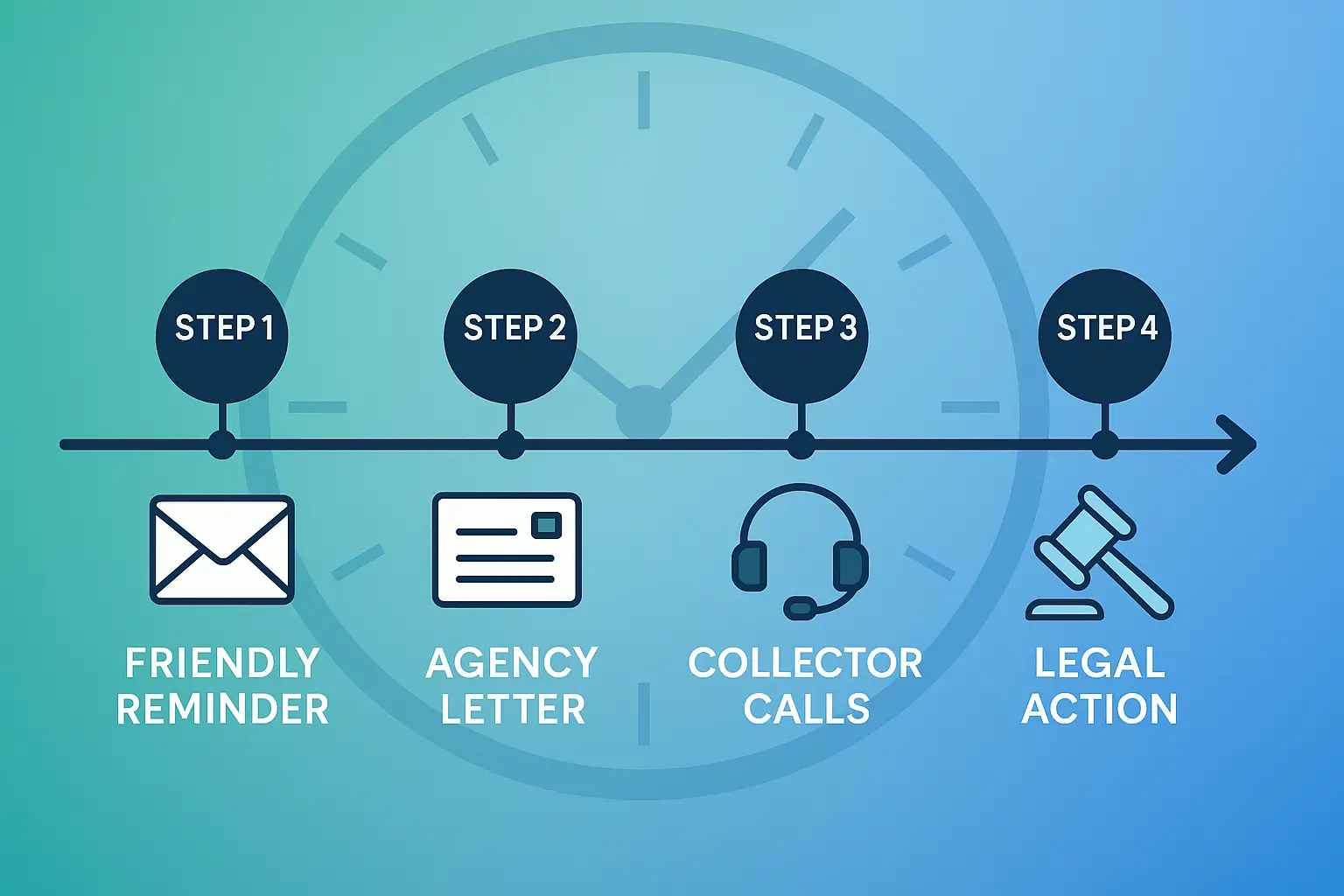
2. The Four-Step Collection Continuum

Step Ideal Age of Debt Who Contacts Debtor Typical Cost Expected Liquidation* Best For
Step 1 – Friendly Reminders (“Pre-Collections”) 30-45 days Your name & branding Flat fee ≈ $15 Up to 70 % First-cycle delinquencies, small balances
Step 2 – Agency Letters 60-120 days Agency letterhead Same flat fee 50-70 % Accounts that ignored Step 1
Step 3 – Professional Collector Calls 120 + days Live collectors Contingency 35-50 % 20-40 % Higher balances, chronic non-responders
Step 4 – Legal Action Post-Step 3 or very high balance Attorneys Filing costs + higher contingency Rare—but highest dollar yield Debts with assets to levy or liens to file

*Results vary by industry, documentation, and credit profile.


3. Step-by-Step Deep Dive with Mini-Case Studies

Step 1: Five-Touch Gentle Nudge

  • What happens: Five escalating letters or emails mailed under your logo. You keep every dime collected.
  • Mini-case: A boutique gym sent 220 members to a pre-collection letter service at 38 days late. Total flat-fee spend: $3,300. Fast-forward three weeks—$27,000 in membership dues hit their bank.

Step 2: Certified Agency Letters

  • Adds third-party gravitas—return address now reads “Professional Debt Collection Agency.”
  • Mini-case: A wholesale HVAC supplier skipped Step 1 and placed 19 invoices (avg. $1,800) at 75 days late. After two agency letters, 12 customers paid in full, 4 started payment plans, and only 3 progressed to phone collections.

Step 3: Human Calls & Negotiation

  • Live collectors work within the “7 calls in 7 days” rule, so persuasion—not robo-dial volume—wins.
  • Mini-case: An e-commerce brand escalated 600 aged orders (avg. $420) at 150 days past due. The agency’s skip-trace located 85 new cell numbers, and skilled negotiators closed $102,000 within sixty days—on a pure contingency fee.

Step 4: Litigation

  • Only about 2 % of files merit a lawsuit once an asset search is done.
  • Mini-case: A commercial landlord had a tenant default on $68,000 in rent. The agency’s attorney filed, won judgment, and garnished the tenant’s merchant-card deposits—recovering 92 % after costs.

4. Compliance & Good-Will Checkpoints

  1. FDCPA & Reg F: Ensure dialer logic respects the “7-in-7” call cap and the model validation notice.
  2. Data Security: Use agencies that can show SOC-2 reports or HIPAA Business Associate Agreements for medical files.
  3. Tone Matters: In post-collection surveys, 54 % of debtors said they paid sooner because letters sounded respectful rather than threatening.

5. Quick Decision Matrix

  • Balance under $500 & < 45 days late? → Step 1.
  • Multiple reminders ignored & 60-120 days late? → Step 2.
  • Over 120 days OR balance > $1,000? → Step 3.
  • Assets located & claim > $5,000? → Ask if Step 4 pencils out.

Bottom Line

Every month you delay moves an invoice closer to the industry’s 20 % recovery gutter. Place accounts early, escalate methodically, and lean on agencies that blend fixed-fee economy with contingency muscle. Still unsure? Drop us a note—NexaCollect will match you with a vetted, fully compliant partner by tomorrow morning.

Filed Under: Debt Recovery

  • « Go to Previous Page
  • Page 1
  • Interim pages omitted …
  • Page 51
  • Page 52
  • Page 53
  • Page 54
  • Page 55
  • Go to Next Page »

Primary Sidebar


accounts receivable

Need a Collection Agency?
Kindly fill this form.
We’ll get in touch with you

    Please prove you are human by selecting the tree.

    Compliance & Security

    • SOC 2 Type II Certified: Third-party audited data security and strict privacy controls.

    • HIPAA Compliant: Secure, legal processing of medical and municipal EMS accounts.

    • PCI-DSS Level 1: Highest tier of data encryption for secure payment processing.

    • FDCPA & FCRA Aligned: Full legal adherence to federal consumer protection laws.

    Recent Posts

    • Why Dental Patients Dispute Bills: The Nexa Collections Dental Account Dispute Index
    • 2027 Commercial Collections Benchmark: U.S. Late Payments, AR Risk and B2B Collection Trends
    • Bulk Account Placement: What a Collection Agency Actually Needs From You
    • Nationwide Debt Collection Agency Serving U.S. Cities
    • Chula Vista Collection Agency for Medical, B2B, Schools & Business Debt
    • Corpus Christi Collection Agency: Itemized Bill Rules for Practices
    • Riverside Collection Agency | For Logistics, Medical, Schools & Business Recovery
    • Collection Agency for Large Balances: High-Value B2B Debt Recovery

    Featured Posts

    • Collection Agency in Cedar Rapids, IA | Compliant & Effective
    • Difference Between Training, Education and Learning
    • When Should you Not Hire a Collection Agency

    Copyright © 2026 NEXACOLLECT.COM | This content is provided for general informational purposes only and should not be considered legal advice. Collection laws and requirements may vary by state, account type, documentation, debtor status, and specific facts. Please consult qualified legal counsel for guidance regarding your particular situation. Nexa and its authorized collection partners service accounts in accordance with applicable federal and state collection requirements. Visit our home page to know more about us.

    X
    Need a Collection Agency?
    Contact Us