• Skip to main content
  • Skip to primary sidebar

Nexa Collections

  • Home
  • Serving
    • Medical
    • Dental
    • Small Business
    • Large Business
    • Commercial Collections
    • Government
    • Utilities
    • Fitness Clubs
    • Schools
    • Senior Care Facility
  • Contact Us
    • About us
    • Cost

Debt Recovery

Top Excuses Debtors give during Collection Calls

Debtor excuses are the biggest hurdle in debt collection. Sometimes their claims may be genuine, but more often they are simply delay tactics to postpone or avoid making payment altogether.

An aggressive approach will force the debtor to hide things from you, lowering your chances of getting paid. Try to work with the debtor, rather than working against them.

Financial Problems How to negotiate
• Job Loss.
• Divorce.
• I am waiting for my customers to pay me first.
• Cash flow problem.
• Spent money on a medical emergency.
• Lost money in gambling.
• No money to pay, no special reason.
• Medical emergency expenses.
When does he/she expect to be employed again? Is the debtor receiving unemployment benefits? How are their other expenses being met? Understand the debtor’s situation and ask when he expects the situation to improve. Contact the debtor at a later date again. Maybe the debtor is more comfortable paying in installments or settling for a lesser amount.
Delay Tactic How to negotiate
• Need a copy of the invoice or statement.
• Prove me that I actually owe this amount.
• Never received an invoice asking me to pay.
• Check is in the mail. You will get it soon.
• No time for this right now. I have other priorities.
• Our accounting department works only 1 hour a day or once a month, please call during that time.  Our accounting department sits elsewhere.
• No time to go to the bank due to my work schedule.- Changing banks or checkbooks not received yet.
• Signatory is not available.
• Lost the bill. Can you send the invoice again?
• Really, I haven’t paid it yet? Give me time to check my bank statement.
• I know nothing about this.
• Debtor returns the bill to the sender and tries to become untraceable.
• I did not expect my bill to be that high.
• Someone else handles my billing ( ok .. ask if they can add that person to this call now?)
Provide information/ documentation if the debtor had requested verification of the debt. This could be resending the invoice or documentation to prove that the debt is actually owed. Even better – fax or email it to them immediately while you have them on the phone.

However, most of the time, debt collectors have to actually call the debtor on a later date/time that is convenient for the debtor, and then communicate that he has already been given enough time.  An experienced debt collector knows how to work around these delay tactics. Ex: He may ask the debtor to give the check number and date when the check was written. The debtor will usually fumble badly if they are lying.

Dispute or Denial to pay How to negotiate
• I do not owe anything
• I will send you legal notice for harassing me.
• Let’s go to the court.
• Invoice is disputed.
• Never received the goods or service.
• Goods were defective, or service provided was bad.
• I am being overcharged, or I did not expect my bill to be that high
• My insurance company did not cover my entire bill as I thought.
• Over my dead body.
• Threats: Dude, I have connections; will have someone visit you !!
 If the debtor continues to resist and there is adequate proof that the debtor owes the debt, it may be time to check with the attorneys if a legal suit is advisable.

However, it is quite possible that the debtor really owns nothing. The data in your systems could be incorrect or outdated.

Other Reasons How to negotiate
 • Statute of limitations
• Person you need to talk to is not here right now.
• Bankruptcy
• Debtor has expired
• I have already paid.
• Wrong number.
 A debt collector needs to get the facts straight and get further information on the case. Take a call if further collection activity is even possible or not.
Possible Genuine Reasons What to do?
• I am disabled and have no money.


•  I am an armed service member ( Military, Navy, Air-force, etc.) and am currently posted overseas.

Check with your supervisor if an asset check/search is advisable or not. Most companies will not do this unless the balance is very high.

Service Members Civil Relief Act and Fair Debt Collection Practices for Servicemembers Act (HR 5003) give some extra rights to military personnel deployed overseas, ensuring their rights are not violated.

A debt collector should insist on proof or an explanation about what the debtor is saying. The debt collector may even give an option to the debtor to pay the outstanding amount in installments or renegotiate to settle the debt for a slightly lower amount ( provided they have authorization from their client to settle debts for that lower amount).

A Debt Collector should deal with great patience yet sound confident and assertive. Using abusive or unprofessional language is not only illegal; it can also take the debtor to a point where he becomes completely non-cooperative.

It is very important to hire a good Collection Agency which employs top-of-the-line debt collectors, even if they charge slightly more than other agencies. Not every debt collector can make a perfect collections call. They get better and groomed over time.


Filed Under: Debt Recovery Tagged With: Collection Agency, debtor excuses

Consumer vs Commercial Collection Agency : Differences

Commercial collections recover debts owed by businesses (B2B), such as unpaid invoices, contracts and trade accounts, while consumer collections involve personal debts owed by individuals (B2C). Consumer recovery is subject to stronger protections under laws such as the FDCPA, FCRA and TCPA, whereas B2B collections generally rely on contracts, applicable state law and, where relevant, the Uniform Commercial Code. Choosing an agency experienced in the correct debt type helps improve recovery while protecting customer or business relationships.

Side-by-side comparison of individual consumer collections and business commercial collections, showing personal debt compliance and payment plans versus B2B invoice, contract, trade account and UCC-based recovery.

Aspect Commercial Collection Agency Consumer Collection Agency
Type of Debt Business-to-Business (B2B) Business-to-Consumer (B2C)
Debtor Profile Businesses, Companies, Corporations Individual consumers
Average Debt Amount Higher amounts (often thousands to millions) Lower amounts (usually hundreds to thousands)
Collection Approach Professional, negotiation-based, relationship-focused Often more regulated, consumer protection-focused
Governing Regulations Primarily UCC (Uniform Commercial Code) FDCPA, FCRA, TCPA, CFPB
Reporting to Credit Bureaus Less common, typically commercial bureaus (D&B, Experian Business) Common, personal credit bureaus (Experian, Equifax, TransUnion)
Legal Action Frequency Higher likelihood due to higher amounts Lower likelihood, reserved for significant cases
Collection Methods Negotiations, structured payments, relationship maintenance Calls, letters, credit bureau reporting, sometimes legal threats
Emotional Aspect Lower, usually professional relationship Higher, personal and sensitive situations
Account Complexity Typically more complex (contracts, invoices, disputes) Usually simpler (credit cards, medical bills, loans)
Settlement Flexibility Higher, frequent negotiation and settlements Moderate, subject to stricter legal constraints
Impact of Nonpayment Business disruptions, cash flow issues Credit score impact, personal financial distress
Cost Structure Often contingency-based (15%-50%) Typically contingency-based (20%-50%), occasionally fixed fee for smaller debts
  • Bankruptcy laws are different for individuals and companies.
  • The way Credit Check is run on individuals vs companies is vastly different.
  • A good commercial collection agency would likely be registered with the International Association of Commercial Collectors (IACC). Collection agencies dealing with consumer debt are affiliated with the Association of Credit Collection Professionals (ACA)

Need a collection agency with 20 years of experience? Contact Us


One may wonder, when a “debt is a debt, ” why do we classify it as a Commercial or a Consumer debt? When it comes to debt collections, they are treated quite differently, primarily due to the difference in debt recovery laws instituted by the US Government.

 A commercial debt collection agency treats every case differently.

Scenarios change depending on the type of business. For example, the approach involved in collecting money from a hospital will differ from that of a car dealership. Collection Agencies maintain a delicate balance between recovering the debt and maintaining good business terms between the parties. The average balance of commercial accounts is generally much higher when compared to consumer debts. Commercial collection agencies are highly specialized in their field.

A 30-day dispute period does not apply to Commercial Collections

When the debtor is a consumer, a collection agency has to provide a 30-day dispute period regarding the debt.  During the dispute period, a consumer can also ask the Collection Agency to prove that he indeed owns the debt (also called as the “verification of debt”). However, a commercial collection agency can start the recovery process right away.

The commission fee is lower for Commercial Collections

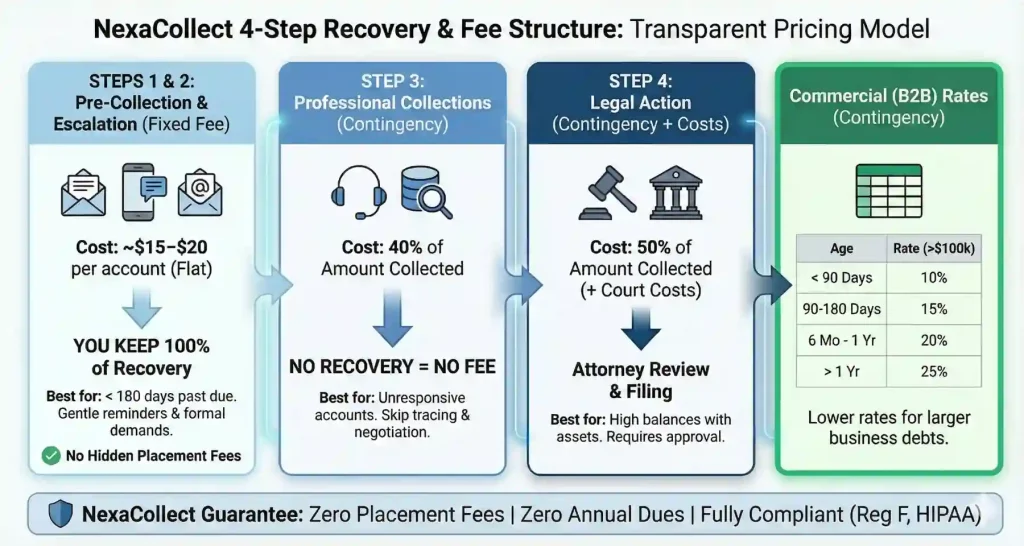
The contingency fees of a commercial collection agency vary from 10% to 50%. For accounts over $500K you can negotiate a collection fee of about 10%. For accounts about $50K, the fee is around 20%; for accounts lower than $1K, it’s around 50%.  It is always around 35% to 50% for Consumer Collections and averages around 40%. Even with lower contingency fees, a Commercial Agency can make more money per case due to higher balances. If a commercial debt is over one year, 5% extra fees may be charged.

Filed Under: Debt Recovery Tagged With: business debt, commercial debt

Why Hire a Collection Agency? When to Escalate, What It Costs, & How to Protect Your Brand

Every unpaid invoice starts the same way: a client who was good for it, a due date that quietly passed, and a business owner deciding whether it’s worth the fight. Most people wait too long, not because the money doesn’t matter, but because escalating feels like more trouble than it’s worth. It usually isn’t. A collection agency exists specifically to be the professional third party that changes a debtor’s math, without you having to become someone you’re not.

Accounts receivable recovery dashboard showing improved cash flow, secure invoice management, brand protection, nationwide licensing, dedicated support, and a 4.85 rating from 2,000+ reviews.

Quick Answer: Why & When to Hire a Collection Agency?
Hire a collection agency once an account is 60–90 days past due, the debtor has broken a promise to pay or gone silent, and your own follow-up calls have stopped moving the needle. Third-party involvement works because it signals the debt is now being taken seriously, which changes debtor behavior on its own, and it stops your staff from quietly absorbing the cost of chasing it yourself.


What Actually Happens When You Wait

An unpaid debt doesn’t sit still, it decays. Based on Commercial Law League of America data on invoice aging:

Time Past Due Estimated Recovery Probability
90 days ~73%
180 days ~50%
1 year ~25%

The curve bends hardest in the first six months, which is exactly the window most businesses spend hoping the client “just needs a little more time.” Every month of delay is a month of value quietly leaving the account.

The Silent Cost of Chasing It Yourself

Sure, if your staff has time to make a few polite reminder calls, send follow-up bills, and track the responses, try it. But be extremely careful, respectful, polite, and patient with the debtor throughout. Most businesses that try this seriously underestimate the actual cost: a staffer spending even 3 hours a month chasing one account, at a fully loaded cost of $30–$50/hour, can already exceed what a $15 fixed-fee letter from a collection agency would have cost, without the debtor taking it any more seriously than the calls they’ve already ignored.

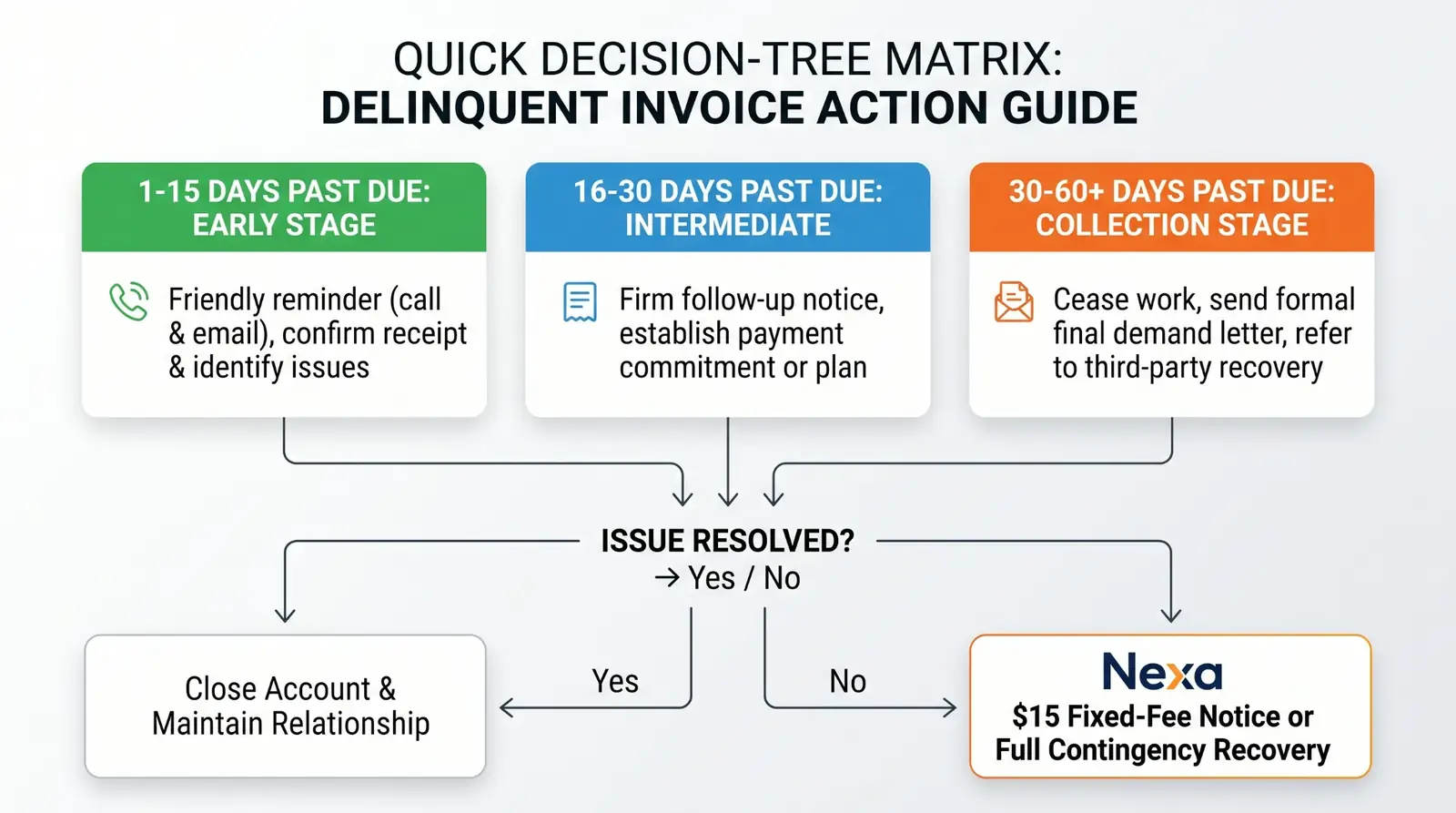
That’s the trap: internal reminders work fine for the first 30–45 days, then stop working almost entirely, while continuing to cost you staff time regardless. The moment your debtor learns a professional collection agency is now involved, they’re often far more inclined to pay off the outstanding debt at the earliest opportunity, simply because a third party changes what the debt now represents to them.

What Kind of Debt Can Go to Collections?

Almost any past-due account you’re legally entitled to be paid for, and can back up with proof, can be assigned to a collection agency. Common examples:

  1. Unpaid medical bills owed to a doctor or hospital.
  2. Services or products that were delivered but never fully paid for.
  3. Mortgage debt, credit card bills, or other bank delinquencies.
  4. Unpaid phone bills, gym memberships, or other recurring fees.
  5. Unpaid car loan or student loan installments.
  6. Accrued interest and penalties tied to any of the above.

Example: Imagine you’re a dentist, and your patient agreed to pay for treatment in 5 installments. After the 2nd payment, they stop. Your gentle reminders go nowhere. Do you write off the balance, or escalate to harsher measures yourself? Neither is the right move, aggressive self-collection can backfire into a complaint against you. This is exactly the gap a collection agency is built to close.

Collection Agency vs. Small Claims Court vs. an Attorney vs. Nexa

Metric Internal AR (You) Small Claims Court Retaining an Attorney Nexa Collections
Upfront cost Staff time, no cash outlay Filing fees (usually $30–$100) Retainer + hourly ($250–$500/hr) $15 fixed-fee, or 0% upfront on contingency
Staff time required High, ongoing Moderate (you still argue the case) Low, but you still gather evidence Minimal, handed off entirely
Reach / jurisdiction Wherever you can personally call Limited to the local court’s jurisdiction and dollar cap Wherever the attorney is licensed Nationwide, 50-state licensed
Skip tracing None None Rarely included Included
Relationship preservation Depends entirely on your own tone Low, a lawsuit ends most relationships Low Higher, diplomatic “Velvet Hammer” approach designed to avoid burning bridges
Best for Very fresh, small accounts Debts within the court’s dollar limit and your own time budget Large debts where litigation is already likely Most accounts, from first escalation through legal referral if needed

5 Signs It’s Time to Place the Account

  1. Communication breakdown. The debtor has stopped responding to calls, emails, or texts entirely.
  2. Broken payment plans. Two or more promised payment dates have come and gone.
  3. Stall-tactic disputes. A “quality” or “billing error” complaint surfaces only after 60 days of silence, with no documentation behind it.
  4. The balance matters to your margin. The size of the debt is large enough that continuing to carry it affects your own cash flow.
  5. The debtor has moved or gone quiet. You need skip tracing to even locate them, something internal staff generally can’t do.

If two or more of these are true, the account has crossed from “needs a reminder” to “needs a professional.”

Should I Try to Collect the Debt Myself First?

Do you really have the time, patience and knowledge of all legalities required to collect your own money?

For very recent balances, sure, a couple of polite reminders can resolve a simple oversight. But there’s a natural point where internal reminders stop working: once a debtor has ignored two or three attempts, a fourth attempt from the same friendly, familiar source rarely changes anything. Third-party involvement breaks that pattern because it’s no longer the same conversation; it’s a different kind of pressure entirely, applied diplomatically rather than aggressively.

What You’ll Need to Get Started

Most agencies won’t ask for full documentation upfront, only if the debtor later disputes the charge. At intake, expect to provide the basics: debtor name, address, phone, amount due, invoice or reference number, and the date the debt was incurred. Keep your full proof of the debt on hand regardless, in case it’s needed later. For a fuller breakdown of what a collection agency actually does step by step, see services that collection agencies offer.

The Legal Side

Collection agencies operate under the Fair Debt Collection Practices Act (FDCPA) and applicable state law, governing how demand notices, collection letters, and calls can be conducted. Before an agency accepts your accounts, they’ll have you sign an agreement authorizing them to act on your behalf, this is standard, not a red flag. For a broader look at the legal landscape collection agencies operate under, see debt collection laws in the U.S.

Credit Reporting: Less Reliable Than It Used to Be

Credit reporting used to be the default threat, but that landscape has shifted. The major credit bureaus have voluntarily scaled back reporting on smaller and paid-off balances in recent years, and separate court rulings have added further uncertainty to how aggressively medical and other debt categories can be reported. The practical result: leaning on “we’ll report this to your credit” as your main leverage is less reliable than it used to be. Diplomatic outreach and structured, realistic payment plans now do more of the actual work. See the benefits and limits of credit bureau reporting for the fuller picture.

Nexa provides reputation-safe, equipped with all 50-state collections license, offering free credit reporting, free litigious debtor check, free bankruptcy scrub, easy to use, and zero onboarding fees. Secure – SOC 2 Type II & HIPAA compliant. Over 2,000 online reviews rate us 4.85 out of 5. 

Need a Collection Agency? Contact us

Key Strength: We successfully bridge top-of-funnel decision-making with direct commercial conversion—shifting the conversation from “should we hire an agency?” to “which account step ($15 fixed demand vs. contingency) should we deploy today?”


Frequently Asked Questions

Will hiring a collection agency ruin my business reputation?

Not if it’s the right kind of agency. A diplomatic, “Velvet Hammer” approach is designed to resolve the balance without burning the relationship, in many cases preserving it better than months of increasingly awkward calls made personally by the business owner. The agencies that damage reputations are the aggressive, script-driven ones; that’s a choice of agency, not an inherent feature of using one at all.

Is a collection agency better than taking a client to small claims court?

For most accounts, yes, at least as the first move. Small claims court requires your own time to file and argue the case, is capped by dollar amount and local jurisdiction, and doesn’t include skip tracing if the debtor has moved. A collection agency can be a faster, lower-effort first step, with legal escalation, including small claims or a full lawsuit, still available afterward if needed.

What is the difference between a $15 fixed-fee service and contingency collections?

Fixed-fee is a flat, predictable cost, generally the better fit for fresher accounts, where you keep 100% of whatever is recovered. Contingency has no upfront cost but takes a percentage of what’s actually collected, and fits better for older or harder-to-reach accounts where more effort (skip tracing, negotiation) is likely needed. Most businesses start with fixed-fee and move unresolved accounts to contingency.

How old can an unpaid invoice be before it’s too late to collect?

There’s no universal cutoff, every state has its own statute of limitations for debt, but recovery odds decline steadily well before any legal deadline arrives. Practically speaking, an account is never “too old to try,” but the earlier it’s placed, generally within 60–90 days, the higher the odds of a full recovery.

Do I need a signed contract to send someone to collections?

A signed contract is the strongest form of proof, but it’s not always required to start. Invoices, purchase orders, email confirmations, and delivery records can all support a claim. What matters most is being able to show the debtor legitimately owes the amount if the charge is ever disputed.

Filed Under: Debt Recovery Tagged With: Bad Debt, Collection Agency

How do Debt Collection Agencies Work?

A collection agency helps businesses recover overdue accounts through professional demand letters, collection calls, payment arrangements and legal escalation when appropriate. It may also report eligible unpaid accounts to the credit bureaus when requested and legally permitted. Choose an agency with consistently high Google ratings, strong compliance controls and a patient- or customer-friendly approach, because its communication style can directly affect your organization’s reputation.

Collection agency to recover debts.

Collection agencies are specialists in debt recovery. Their highly trained and well-equipped teams can successfully collect even from accounts that are typically difficult to recover. When in-house staff struggles to collect overdue accounts, businesses often turn to professional collection agencies for assistance.

Collection agencies play a vital role in the financial ecosystem. Without their involvement, many outstanding debts would remain unpaid, resulting in significant losses for businesses and medical practices. While no collection agency can guarantee the recovery of 100% of the assigned debt, they employ proven strategies and work diligently to collect as much as possible. In fact, a single call from a professional debt collector can have a greater impact on a debtor than repeated attempts from in-house staff.

Types of Debt Collectors:

1. “Collection Agencies” – Agencies that act as a middleman between the creditor and debtor using standard recovery techniques. They attempt to collect the debt in full. Some agencies operate in one state only while others have a nationwide license.

2. “Debt Buyers” -Debt buyers buy debt that is deemed unrecoverable. Debt buyers buy unpaid accounts by paying pennies on the dollar and readily agree to settle the debt even if a way-lower payment is offered.

3. “Collection Lawyers“: Unlike Collection Agencies, they do not have a single collections approach for all accounts. They study each case, give a customized solution and quote a fee accordingly.

Here is a detailed explanation for each of them.

1. Collection Agencies

When a creditor approaches a collection agency, he is offered three types of collection services:  Collection Demands (Letters), Collection Calls and Filing a Legal Suit.

a) Collection Letters (Fixed Fees Service- Accounts purchased in advance) – A collection agency sends up to 5 collection letters to a debtor and charges between $10 to $25 upfront per account for this service. Collection letters are sent every ten days or so. They run a “USPS-Address-Change” scrub on these accounts to ensure the letters are mailed to the latest address of the debtor. This is also called skip tracing.

They also check if the agency/creditors are legally prohibited from collecting a debt. For example, when a debtor has been granted bankruptcy protection or if he has deceased.

During the Collection Letters service, all amounts go directly to the creditor, the collection agency keeps nothing other than the small flat fees they had charged earlier (roughly $12-$16 per account). You can also add the late fees to the amount due if your contract permits.

The creditor must report all payments made by the debtor directly to them so that the Collection Agency can print the correct (lower) outstanding amount on the remaining letters. They will stop sending letters if the amount has been Paid in Full or deemed uncollectible through written demands and may require stronger action.

Collection Letters service is usually recommended for debts that are within 30-120 days past-due date. They give far superior results than your own in-house collections.  You may check our sample debt collection letters to get an idea of what the debtor receives from a Collection Agency.

b) Collection Calls (Contingency-based,  No Collection – No Fees) – This is where an actual human being (debt collector) picks up the phone and starts making phone calls to the debtor. This is a contingency-based collections service and is usually recommended for debts older than 120 days, or if the Collection Letters service did not recover the debt.

A Collection Agency would usually not accept an account for collections if the debt is older than 3 years. They also specify the minimum amount of debt that can be assigned for this service, usually, there is a $100 is the cutoff limit.

With their extensive experience, debt collectors are able to make a perfect collections call. They are able to handle debtor excuses way more professionally, patiently, and smartly than your own employees. Most agencies hire multilingual staff to handle Spanish collections if required.

The collection agency keeps 33% to 50% of the amount collected per your agreement and passes the remaining money to you (the creditor). Do not always fall for those ultra-low-cost collection agencies,  because their recovery rates may be a lot lower. If a collection agency is near you do not hire them just because of that reason, in debt collections, the location does not matter.

Hiring a good collection agency is really important to get superior collection results.

c) Filing a Legal Suit (Contingency based) – This is the third type of collection service where a Debt Collection Agency’s attorney (or a partner attorney) sends legal notices to the debtor. The attorney may even try to collect the outstanding amount against the assets of a debtor or garnish his wages. Assets could be the debtor’s bank account, brokerage account, and even against certain types of real estate that the debtor may own.

Collection agency usually takes a cut of around 25%-40% for these kinds of cases. These accounts should carry high-value debts to justify the cost of hiring an attorney.

Collection fee can be negotiated with the collection agency in case the outstanding amount is in thousands of dollars or if it is a B2B debt (commercial/business debt).

In the case of B2C debt (individual/consumer debt), there is usually no room for negotiation. Individual debts are harder to collect, and unlike B2B accounts the B2C debts are subjected to far more stringent collection laws.

2. Debt Buyers:

Debt Buyers purchase bad debt in bulk and pay a little money to the creditor for it.  The collection activity starts after the purchase. For example, if the outstanding debt on an account is $1000, a Debt Buyer may buy it for  $50 only. Accounts are usually settled at a lower price point. For example using the above scenario: A debt buyer will happily settle the account even if the debtor offers to pay $200, for a nice $150 profit. The Debt Buyer keeps 100% of the money recovered, and does not need to share anything with original creditors.

3. Collection Lawyers:

A collection agency does not always do collection activity, many lawyers are in this industry as well. They study each case, give a customized solution, and quote a fee accordingly. In this case, a debtor will receive a legal notice or a phone call from the lawyer’s office. If there is a co-signer on the debt, the collection activity can also be made on the co-signer.

Fair debt collection laws:

There are several “Consumer protection laws” and the “Fair Debt Collection Practice Laws” that all debt collectors are supposed to follow during consumer collections. Here is the list of all debt collection laws.

A debt collection agency should be respectful, law-abiding and truthful. They should not discriminate against people based upon gender, race, age etc. They should not contact you in odd hours, like late evenings or very early mornings. They cannot try to threaten you bypassing statements like “If you do not pay, the police will arrest you“.

If the collection agency determines that the debtor cannot pay the debt in full, they can settle an account for a slightly less payment if the creditor allows doing so. A debt collection agency may also allow the debt to be paid in monthly installments. Debts do have an expiry date, there are some statute of limitations beyond which a collection agency is not allowed to sue a debtor. For example, many states in the USA, have a rule that a debt older than 4 years cannot be collected upon.  Other states have a 3 or a 10-year cut-off period.

Credit Bureau Reporting

Non-payment of debt can be reported to credit bureaus ( Transunion, Experian and Equifax) by the collection agency if the original creditor wishes to do so. This negative entry on the debtor’s credit history report can be quite damaging because the chances of getting a new loan goes down significantly for many years. He may also face problems in changing jobs as many employers run credit checks on their prospective employees.


Watch this Video:

Importance of collection agencies

Due to the nature of their business, debt collection companies have a bad reputation. FTC gets the highest number of complaints from this industry. But see the flip side, there are thousands of collection agencies in the USA, giving employment to hundreds of thousands of individuals. They also help many businesses to avoid going out of business due to unpaid bills, saving their jobs as well.

Do read our article about how to improve the cash flow for your business and minimizing accounts receivables. While you outsource all those problems in debt collection to a 3rd party collection agency, you can focus on more important things like expanding your business or serving your existing clients.

Get a Free Quote from good Collection Agencies

Filed Under: Debt Recovery Tagged With: Bad Debt, Collection Agency, Debt Recovery

  • « Go to Previous Page
  • Page 1
  • Interim pages omitted …
  • Page 52
  • Page 53
  • Page 54

Primary Sidebar


accounts receivable

Need a Collection Agency?
Kindly fill this form.
We’ll get in touch with you

    Please prove you are human by selecting the flag.

    Compliance & Security

    • SOC 2 Type II Certified: Third-party audited data security and strict privacy controls.

    • HIPAA Compliant: Secure, legal processing of medical and municipal EMS accounts.

    • PCI-DSS Level 1: Highest tier of data encryption for secure payment processing.

    • FDCPA & FCRA Aligned: Full legal adherence to federal consumer protection laws.

    Recent Posts

    • Baltimore Collection Agency | Medical, Commercial, Schools & More
    • Commercial and B2B Collection Agency in Detroit
    • Boston Medical Collection Agency | Serving Hospitals, Physicians & Dentists
    • Collection Agency in El Paso, TX | Compliant, Cost Effective & Reputation Safe
    • Collection Agency in Washington DC | Medical, Schools, Businesses & Contractors
    • The Collection Agency School Districts Trust With Their Reputation
    • How Dental Insurance Denials Turn Into Patient Debt (And How to Stop It)
    • College Station Collection Agency: Recovering What Aggieland Is Owed

    Featured Posts

    • Indications: Its Time to Seek a Debt Collector’s Help
    • How to Reduce Chargebacks for Your Business
    • How to Shortlist Live-In Caregiver: Questions to Ask

    Copyright © 2026 NEXACOLLECT.COM | This content is provided for general informational purposes only and should not be considered legal advice. Collection laws and requirements may vary by state, account type, documentation, debtor status, and specific facts. Please consult qualified legal counsel for guidance regarding your particular situation. Nexa and its authorized collection partners service accounts in accordance with applicable federal and state collection requirements. Visit our home page to know more about us.

    X
    Need a Collection Agency?
    Contact Us