• Skip to main content
  • Skip to primary sidebar

Nexa Collections

  • Home
  • Serving
    • Medical
    • Dental
    • Small Business
    • Large Business
    • Commercial Collections
    • Government
    • Utilities
    • Fitness Clubs
    • Schools
    • Senior Care Facility
  • Contact Us
    • About us
    • Cost

Search Results for: the bureaus

Utility Collection Agency for Electric, Gas, Water & Sewer Providers

A utility collection agency recovers unpaid bills for electric, gas, water, sewer, and waste service providers — with a specialization in final-bill and move-out recovery that standard collection agencies are not equipped to handle.

Utility debt collection operates under a unique compliance environment: in addition to FDCPA and TCPA, collectors must navigate state Public Utility Commission (PUC) rules, seasonal disconnection moratoriums, landlord/tenant liability disputes, and GLBA data-security requirements.

The most effective utility collection agencies combine forensic skip-tracing for moved-out customers, regulatory-compliant multi-channel outreach, and automated moratorium controls that protect your utility brand from regulatory complaints.

Utility collection agency recovering unpaid electric and gas bills for power providers — FDCPA and PUC compliant with forensic skip-tracing for final-bill accounts

Electric, gas, water, sewer, and waste providers keep communities running. But high account volumes, tight margins, seasonality, and strict public-utility rules make past-due recovery uniquely challenging—especially final bills after a move-out. You need a specialist who protects your brand while improving net recoveries.

Why In-House Efforts Plateau

  • Hidden cost of collections: staff time, training, QA, and turnover dilute results.

  • Compliance exposure: FDCPA, TCPA consent/dialer rules, FCRA (if reporting), GLBA data safeguards, plus state PUC shut-off/moratorium rules. A single misstep risks fines and reputational damage.

  • Operational gaps: large “long tail” of small balances, skip-trace needs on move-outs, landlord/tenant responsibility disputes, and seasonal spikes.

What Makes Us Different

  • Utility-specific approach: respectful, “customer-first” collections that align with community expectations and board/council oversight.

  • Compliance by design: FDCPA, TCPA (express consent management, DNC scrubs), FCRA/Metro-2 (optional, by client policy), GLBA; PCI-compliant payments and SOC 2–aligned processes.

  • Omnichannel with consent: letter, phone, email, SMS, self-serve portal/IVR, and multilingual (incl. Spanish).

  • Data-driven results: segmentation, propensity-to-pay modeling, right-time outreach, and real-time dashboards.


Serving Utility Companies Nationwide !

Need a collection agency: Contact us

Solutions Mapped to Your AR Stages

Our 4-Stage Utility Recovery Framework

Utility debt recovery is not a single process — it is a sequenced framework calibrated to the account’s age, balance, debtor status, and regulatory environment. Here is how we approach every utility portfolio:

Stage 1 — Immediate Data Scrubbing & Account Triage

The moment accounts are placed, we cross-reference every disconnected account against national change-of-address (NCOA) databases, utility industry databases, and credit header data to locate the debtor’s current address before a single letter is sent. Accounts are simultaneously screened for bankruptcy, military (SCRA) status, deceased indicators, and active PUC moratorium holds — removing ineligible accounts from the collection queue before any outreach begins. This eliminates wasted spend and compliance exposure from day one.

Stage 2 — Soft-Touch, PUC-Compliant Multi-Channel Outreach

For accounts cleared by Stage 1 screening, we initiate regulatory-compliant, multi-channel communications — letters, SMS (with verified TCPA consent), email, and self-serve IVR — calibrated to your Public Utility Commission’s standards and your brand voice. Outreach is sequenced by propensity-to-pay score: higher-probability accounts receive earlier phone escalation; lower-probability accounts are resolved through cost-efficient digital channels first. All messaging is available in English and Spanish as standard, with additional languages on request for service territories with diverse customer populations.

Stage 3 — Advanced Forensic Skip-Tracing

For high-balance gas and electric final-bill accounts where the customer left no forwarding information — or where Stage 2 outreach confirmed the provided address is stale — we deploy deep-tier forensic skip-tracing. This goes beyond NCOA: we cross-reference employer records, phone carrier data, property transfer records, utility connection records at new addresses, social profile signals, and court filings to build a current contact profile. Forensic skip-tracing is the single highest-ROI activity for utility final-bill portfolios, where the moved-out customer is often traceable but simply unreachable through standard channels.

Stage 4 — Credit Reporting & Final Resolution

For accounts that remain unresolved after Stages 1–3, we report eligible inactive accounts to the major consumer credit bureaus — Equifax, Experian, and TransUnion — using Metro-2 compliant formatting (client-controlled; you decide which accounts are reported and when). Credit reporting is one of the most effective final-resolution tools for utility debt because the impact on a customer’s credit profile creates urgency to resolve — particularly for former customers who are now applying for new utility service, a mortgage, or a car loan. Legal escalation via affiliated attorneys is available for high-balance accounts with verified assets, with your explicit written approval.

Where We Excel for Utilities

  • Final Bills & Move-Outs: advanced skip-trace, new-address linking, employer/phone/email enrichment.

  • Landlord/Tenant Responsibility: documented occupancy windows, lease linkage, and property-manager workflows.

  • Dispute Resolution: meter read/date disputes, estimated bill corrections, and payment-plan conversion.

  • Energy Theft/Tampering Fees: specialized scripts and evidence handling.

  • Deposits, Fees & Returned Checks: deposit application/recovery, NSF, reconnection/field fees.

  • Deceased & Probate Handling: compassionate outreach, estate claims, and timeline tracking.

  • Bankruptcy & Military (SCRA) Protocols: automatic scrubs and compliant treatment paths.

  • Medical/Critical-Care Flags & Moratoria: respectful handling; no shut-off pressure messaging, weather/winter rules honored.

  • Small-Balance at Scale: automated micro-AR cleanups without burdening your team.

Utility Types We Serve

Our recovery process is calibrated to the regulatory, billing, and customer-relationship differences across utility commodity types:

Electric utilities — investor-owned, municipal, and rural co-ops

Electric utility collections involve the highest average final-bill balances and the strictest state PUC oversight. Investor-owned utilities (IOUs) face public rate-case scrutiny that makes complaint rates especially sensitive. Municipal electric utilities operate under city council oversight with additional political accountability. Rural electric cooperatives (RECs) serve member-owners — meaning every collection interaction affects a co-op membership relationship, not just a customer account. We tailor scripts, escalation thresholds, and reporting formats to your governance structure.

Natural gas providers

Gas accounts carry the highest seasonal volatility: winter heating bills spike final-bill balances significantly, and winter moratorium rules in most states restrict disconnection and collection activity between November and April. Our compliance engine automatically applies state-specific heating moratorium rules, suppresses collection activity during protected periods, and queues accounts for immediate outreach when the moratorium window closes — capturing the recovery opportunity before the next heating season begins.

Water & sewer authorities

Water account collections often involve municipal or special-district governance with formal public meeting reporting requirements. Balance sizes tend to be lower than electric or gas, making fixed-fee letter campaigns the most cost-effective recovery path. Landlord/tenant disputes are especially common in water collections because water service is frequently maintained in the landlord’s name even during tenancy — creating complex liability questions that our documented occupancy-window process resolves before outreach begins.

Telecom, cable & internet providers

Telecom final bills involve equipment return disputes, early termination fee collections, and a high volume of disputed balances. Our dispute-handling workflow verifies equipment return status and ETF calculation before pursuing any contested balance — preventing the frivolous-dispute volume that inflates collection costs for telecom AR teams. We also handle returned-equipment charge recovery separately from service-balance recovery, since these have different documentation requirements.

Waste, refuse & recycling services

Waste collection accounts typically have the lowest individual balances but the highest account volumes — making automated, low-cost fixed-fee resolution the right approach. Our small-balance automation handles bulk refuse portfolios efficiently without manual collector involvement, recovering aggregate revenue that would otherwise be written off as too small to pursue individually.

Multi-commodity & energy retailers

Energy retailers operating in deregulated markets often manage both electric and gas accounts under a single customer relationship — with different state PUC regulations governing each commodity. Our collectors are trained on the specific regulatory frameworks of all deregulated energy markets (Texas ERCOT, Illinois, Ohio, New York, Pennsylvania, etc.) and apply the correct rules per commodity, per account, per state.

Seasonal Moratoriums & State PUC Collection Rules

Every state has its own Public Utility Commission (PUC) rules governing when and how utilities can pursue debt collection. Getting this wrong — even with the right intent — can result in regulatory fines, consumer complaints filed with the PUC, and reputational damage that outweighs the recovered revenue. Here is how we manage the most common regulatory constraints:

Winter heating shutoff moratoriums

Most states with significant cold-weather seasons have winter heating moratorium rules that restrict or prohibit disconnection of natural gas and electric heating accounts between specific dates (commonly November 1 through April 15, though exact dates vary by state). Many states also restrict collection agency contact on these accounts during the moratorium period. Our compliance engine is state-mapped: accounts in moratorium states are automatically flagged, collection activity is suspended for the protected period, and accounts are queued for immediate outreach when the moratorium window closes — capturing the spring recovery window before accounts age further.

Medical necessity and critical-care holds

Customers with documented medical conditions requiring continuous electric or gas service can apply for medical necessity holds that restrict disconnection and, in some states, third-party collection activity. We process medical hold flags at account intake and apply compliant treatment paths — never using shutoff-pressure messaging on medically protected accounts, and routing these to payment-plan outreach only.

Low-income customer protections

Many states require utilities to offer low-income customers arrearage management programs (AMPs), budget billing, or LIHEAP referrals before pursuing collection. Our collectors identify LIHEAP, LIHWAP, and state-specific assistance program eligibility markers at intake and refer qualifying customers to assistance programs — reducing write-offs while avoiding the regulatory liability of pursuing someone who qualifies for protected status.

State-specific PUC interest rate caps and fee limitations

Some state PUC tariffs cap the interest rates and late fees that utilities can charge on overdue accounts — and by extension, limit what can be included in a collection demand. Our compliance engine is updated dynamically to mirror individual state tariff limitations, ensuring that demand letters never include uncollectable fee amounts that could trigger a dispute or a PUC complaint.

Landlord & Tenant Utility Debt: Determining Responsibility

One of the most common complications in utility final-bill recovery is the landlord/tenant liability dispute — where the property owner and former tenant both claim the other is responsible for the unpaid balance. Here is how we navigate this:

How we document the service period

Before any outreach, we establish the billing window — the dates during which service was provided and consumed. We cross-reference your billing system’s service dates against lease commencement and termination records (where available), property transfer records, and NCOA data. This creates a documented occupancy timeline that establishes who was in residence during the period the charges accrued.

Tenant liability vs. landlord liability

In most states, the person who applied for and received service is the primarily liable party — regardless of who actually consumed it. If a tenant applied for service in their name, they are the primary debtor. If the account was in the landlord’s name throughout the tenancy, the landlord retains liability for any balance, with a separate right of action against the tenant under the lease agreement. We pursue the documented account holder first, not the property address.

Property manager workflows

For utility companies servicing large rental portfolios managed by property management companies, we offer a dedicated property manager contact protocol — reaching out to the management company’s AR contact rather than the individual property owner for multi-unit residential landlord accounts. This consolidates communication, reduces duplicate contacts, and respects the professional relationship between your utility and large property management clients.

When both parties dispute

When both the landlord and tenant deny responsibility, we conduct a documented dispute resolution process: requesting lease agreements, move-in/move-out inspection records, and utility transfer confirmation, then assigning liability based on the weight of documentation. Unresolved disputes are escalated to our legal team for assessment of which party has a viable collection path — rather than pursuing both simultaneously and creating regulatory exposure.

Integration, Reporting, and Our Security

  • Fast, secure onboarding: SFTP/API or portal upload; account-level consent flags, service status, and move-out dates captured.

  • 24/7 portal: placements, notes, disputes, recoveries, and dashboard KPIs (recovery %, liquidation by DPD, right-party contact rate, average days-to-pay, complaint rate).

  • Controls: call recording, QA scorecards, model governance, and monthly performance reviews.

  • Key Strength: We address critical utility industry pain points directly—such as final-bill aging, high move-out delinquency rates, budget-billing reconciliation, and preserving customer goodwill in regulated markets.

Utility Collection Results

Case Study: Regional Electric Co-op — $890,000 in Final-Bill Recovery

The situation: A rural electric cooperative with 41,000 member-accounts had accumulated $890,000 across 3,200 final-bill accounts from moved-out members. Average balance: $278. The co-op’s internal billing team had sent one statement per account but had no skip-tracing capability — approximately 40% of accounts had no valid forwarding address in the system.

Our approach: We ran the full portfolio through Stage 1 NCOA and utility-database scrubbing within 48 hours of placement, locating new addresses for 1,840 of the 3,200 accounts (57.5%). We deployed Stage 2 branded letter campaigns for located accounts and Stage 3 forensic skip-tracing for the remaining 1,360. All outreach was calibrated to the co-op’s member-relationship tone — emphasising account resolution over pressure tactics.

The outcome: 68% of located accounts resolved within 90 days. Total recovered: $604,000. An additional $87,000 recovered via credit reporting trigger payments in months 4–6. Zero PUC complaints filed. The co-op’s board reported the program at the annual member meeting as a model for responsible revenue recovery. (Nexa internal data, 2025)

Case Study: Municipal Water Authority — High-Volume Small-Balance Cleanup

The situation: A city water authority had 8,400 final accounts under $200 — totalling $1.1M — that had been written off internally due to the perceived cost of pursuing small balances individually. Staff estimated that manual outreach on these accounts would require 1.5 FTE for six months.

Our approach: We processed the full portfolio through our small-balance automation track: Stage 1 scrubbing, then a five-letter fixed-fee demand series at $15 per account. Total placement cost to the authority: $126,000. No phone outreach was required — the letter series alone resolved 52% of accounts.

The outcome: $571,200 recovered. Net return after placement cost: $445,200 — with zero additional staff hours from the authority’s team. Accounts over $200 were escalated to Stage 3 contingency phone outreach, recovering a further $143,000. Total net recovery: $588,200 on a $126,000 investment. (Nexa internal data, 2024)

Results You Can Expect

  • 10–25% lift in final-bill recoveries vs. in-house only

  • 20–40% reduction in cost-to-collect on early-stage AR

  • Measurably lower complaint rates with community-sensitive scripting

Stop letting past-due accounts leak revenue. Choose a partner engineered for utility AR—and built to protect public trust.

Frequently Asked Questions: Utility Debt Collection

Can you collect on active utility accounts, or only inactive/closed ones?

We primarily specialise in final-bill and inactive utility accounts — past tenants, moved property owners, and closed service accounts. This protects your ongoing customer relationships while aggressively recovering lost revenue from dormant accounts. Active-account early-stage reminders (Step 1 first-party program) can be deployed for newly past-due balances as a brand-safe pre-collection service, but our core utility expertise is in final-bill and move-out recovery where skip-tracing and forensic location work is required.

How do you ensure compliance with state Public Utility Commission (PUC) rules?

Our compliance engine is dynamically updated to mirror individual state laws, maximum interest rate caps, and seasonal disconnection/collection moratoriums — ensuring zero regulatory risk to your utility brand. When a state implements a new moratorium rule or updates its tariff-based fee limitations, our system flags affected accounts and adjusts outreach protocols automatically. We provide monthly compliance attestation reports you can submit to your regulatory affairs team or use in PUC proceedings.

How long before a utility bill goes to collections?

Most utility providers place final-bill accounts with a collection agency between 60 and 90 days after the final bill is issued, following at least one internal statement attempt. For active accounts, the threshold is typically 90–120 days past due after internal escalation has been exhausted. Waiting beyond 120 days on final bills significantly reduces recovery rates — a moved-out customer’s contact information degrades rapidly, and forensic skip-tracing becomes more expensive and less successful the longer the account ages.

Does an unpaid utility bill affect credit scores?

It can — but the landscape has changed. Unpaid utility balances under $500 are no longer included on consumer credit reports under major bureau policy changes effective 2023–2024. For balances over $500 placed with a collection agency, the agency can report to Equifax, Experian, and TransUnion using Metro-2 formatting — which typically remains on the consumer’s credit report for up to 7 years from the date of first delinquency. Credit reporting is a client-controlled option at Nexa: you decide which accounts are reported and when, based on your utility’s customer relationship policy.

How do you handle SCRA military account protections?

The Servicemembers Civil Relief Act (SCRA) provides significant protections for active-duty military members — including interest rate caps, restrictions on certain legal actions, and in some cases protections against utility disconnection. We run SCRA scrubs on all accounts at intake using the Department of Defense’s Manpower Data Center (DMDC) database. Active SCRA accounts are flagged and removed from standard collection workflows; they receive a compliant treatment path that respects military protections and maintains your relationship with active-duty customers and their families.

What is forensic skip-tracing and how is it different from standard skip-tracing?

Standard skip-tracing uses NCOA (National Change of Address) and credit header data to find a new address — it resolves the majority of “soft skip” accounts where the customer simply moved and forgot to update their address. Forensic skip-tracing goes deeper: we cross-reference employer records, property transfer databases, utility connection records at new addresses (showing where they turned on service next), phone carrier data, and social profile signals. For high-balance electric and gas final-bill accounts where the customer deliberately left no forwarding trail, forensic skip-tracing often recovers accounts that standard methods cannot.

Who is responsible for an unpaid utility bill — the tenant or the landlord?

In most cases, the person who applied for and received service is the primarily liable party — regardless of who consumed it. If a tenant applied for service in their name, they are the primary debtor. If the account was in the landlord’s name, the landlord retains liability. When both parties dispute responsibility, we conduct a documented occupancy-window analysis using lease dates, NCOA data, and property transfer records to establish who was in residence during the billing period — then pursue the party with documented liability.

Can you collect from a former tenant who has moved to another state?

Yes. Nexa is licensed to collect in all 50 states. When a former tenant moves out of your service territory, the debt moves with them — subject to the originating state’s statute of limitations on utility debt (typically 3–6 years depending on the state and the nature of the obligation). We apply the debtor’s current state’s contact rules while pursuing a debt originated in your state. Interstate utility final-bill recovery is a core competency — it’s where forensic skip-tracing most frequently proves its value.

How does the fixed-fee letter service work for small utility balances?

For accounts under approximately $300–$500 where the contingency economics don’t justify phone outreach, our fixed-fee letter series (Step 2, $15 per account) sends five escalating written demands with dispute-handling workflows built in. You pay $15 per account regardless of outcome on accounts that resolve — and keep 100% of every dollar recovered. The letter series resolves 40–60% of cleanly documented final-bill accounts without requiring any phone outreach, making it the most cost-effective utility collection tool for high-volume small-balance portfolios.

Do you integrate with utility billing and CIS platforms?

Yes. We accept account placements via SFTP file transfer or REST API integration, with account-level consent flags, service status, move-out dates, and last-known address captured at intake. Tested platforms include Oracle CC&B (Customer Care & Billing), SAP ISU, Cayenta, Datastream, and major AMI/MDM systems. Payment confirmations and account status updates are pushed back to your system on a scheduled basis. Our 24/7 secure portal provides real-time account-level visibility for your billing and AR teams without requiring system integration.

What happens to accounts during a PUC-mandated winter moratorium?

Accounts in states with active winter heating moratoriums are automatically suppressed in our outreach queue for the protected period — no letters, no calls, no collection activity. The account remains in our system and is queued for immediate outreach when the moratorium window closes. This ensures you capture the spring recovery window — typically March through May — when customer incomes stabilise after winter and before the next heating season begins. We provide a moratorium status report showing all suppressed accounts and their scheduled reactivation dates.

How do you handle deceased utility account holders?

Deceased accounts require compassionate outreach directed to the estate executor or next of kin — never to the deceased individual. We run deceased-indicator scrubs at intake, flag identified accounts for estate-claim processing, and direct outreach to the estate with a notice of claim that is legally appropriate in the relevant state. For small-balance deceased accounts where estate proceedings are unlikely, we apply a documented write-off workflow that satisfies your audit requirements without incurring collection costs on unrecoverable balances.

What is your complaint rate for utility collections?

We maintain utility-specific complaint rate tracking separate from our overall portfolio — because the political sensitivity of government-regulated utility collections demands a higher standard. Our utility complaint rate targets are: zero PUC-filed complaints and fewer than 0.5 FDCPA complaints per 1,000 accounts contacted. We report complaint rates monthly in your performance dashboard and treat any PUC-filed complaint as a critical incident requiring same-day review and response. We maintain a 4.85/5 aggregate rating across 2,000+ online reviews — a reflection of our community-sensitive outreach standards.


 

Filed Under: Debt Recovery

Collection Agency: Body Shop and Auto Repair Garage

Car Workshop

Automotive repair and body shop garages regularly face issues related to accounts receivable. Whether it is because a customer did not fulfill his obligation to pay or a delay/rejection of the claim by an insurance company. Past-due accounts can quickly erode the profits of an automotive workshop and even interrupt the smooth running of the facility.

If an Automotive workshop on a 20% profit margin, say 5% of their customers do not pay, then effectively 25% of their net profit is gone. Collecting money from existing customers is more important than getting new customers. Sounds unreal, but it’s correct.

Need a collections agency: Contact us

Besides the time required to generate new business, an automotive workshop faces many challenges. These include increased competition, certification requirements, integrated vehicle technologies, a limited number of skilled workers, paperwork, and higher expectations for speedy repairs despite a slower reimbursement process by insurance companies.

If a repair is being paid through an insurance claim, the garage must often navigate a complex process to get paid. This can lead to delays and increased administrative burden.

Relying on in-house staff, which are not adequately trained to collect the debt can be ineffective, time-consuming and costly. Transferring an account to a professional collection agency will reduce the staff burden and even result in higher recovery rates. Debt collectors are experts in collecting debt; after all that is what they do every workday. They ensure that the debt collection rules and regulations specified by the Federal and State governments are followed, minimizing the chances of a counter-lawsuit.

A collection agency will also do advance Skip Tracing, which helps to locate a debtor in case he has shifted from this residence. Services offered by collection agencies are usually diplomatic but can be slightly intensive if required. The two-step collection process offered by collection agencies is perfect for starting the diplomatic process initially and then using debt collectors or filing a legal suit to put more pressure to settle the account. Collection agencies can also report the debt to Credit Bureaus if you request them to do so. They drastically reduce the stress of debt collection for the owner and the staff.

Collection Letters Service
  • Upfront cost for 5 Collection Letters is about $15 per account.
  • Debtors pay directly to you, no other fees. Low cost option.
  • Good for accounts less than 120 days past due.
Collection Calls Service
  • Contingency fee only. No upfront or other fees.
  • Agency gets paid a portion of money they recover.  No recovery-No fees.
  • Best for accounts over 120 days. A debt collector calls debtor many times.
  • If everything fails, a possible Legal Suit if recommended by the attorney.


Filed Under: Debt Recovery

Gym & Fitness Debt Collection | Protect Your Brand

A gym and fitness collection agency recovers unpaid membership dues, failed EFT and ACH drafts, personal training packages, class pack balances, and initiation fees for health clubs, gyms, boutique studios, and fitness franchises.

Fitness debt collection is distinct from general consumer collections in two important ways: most delinquent accounts involve active members whose payment failed involuntarily (card expiry, bank change, fraud replacement), not intentional non-payment — requiring a card-update “decline recovery” approach rather than traditional collection pressure. For accounts that do involve genuine non-payment or contract abandonment, fitness specialists navigate the state-specific gym membership cancellation laws that govern what is actually collectible.

Gym and fitness collection agency recovering unpaid membership dues and failed EFT payments for health clubs and boutique fitness studios

Stop Chasing Payments. Start Recovering Revenue.

The Gym Owner’s Dilemma: When Unpaid Dues Kill the Vibe

Your club runs on energy and community—not awkward phone calls about money. Yet churn, expired cards, chargebacks, and cancellation disputes can quietly squeeze cash flow. That’s where Nexa Collect comes in: we recover unpaid membership dues, PT packages, class packs, initiation fees, and more—professionally and in a way that protects your brand.

Nexa provides 100% reputation-safe, equipped with all 50-state collections license, offering free credit reporting, free litigious debtor check, free bankruptcy scrubs, and zero onboarding fees. Secure – SOC 2 Type II & HIPAA compliant. Over 2,000 online reviews rate us 4.85 out of 5. 

Need a Collection Agency? Contact us


Decline Recovery vs. Debt Recovery: Two Different Problems

Most gym owners treat all past-due accounts the same way. Specialists don’t — because the two main types of gym delinquency require completely different approaches:

Decline Recovery (Failed EFT/ACH — Active Members)

When a member’s EFT or credit card draft fails, it is almost always involuntary: the card expired, the bank issued a fraud replacement, the account was overdrawn, or the member changed banks and forgot to update their payment info. This is not a collection situation — it is a payment method update situation.

Decline recovery works best when it happens fast (within 7–14 days of the failed draft), uses a soft-touch outreach approach that assumes good faith, and makes it as easy as possible for the member to update their payment information without embarrassment. Done correctly, decline recovery retains the member and recovers the balance — a result that aggressive collection tactics would destroy.

Our Phase 1 brand-safe reminder service is calibrated for exactly this scenario: five professional reminders (letter, email, or SMS where consented) that feel like helpful notices from your gym — not threats from a collection agency. Members pay you directly. You keep 100% of what’s recovered. And the member stays.

Debt Recovery (Contract Abandonment — Former or Non-Responsive Members)

When a member stops responding entirely, disputes the account, claims to have cancelled verbally, or walks away from a contract obligation — that is a genuine debt recovery situation. These accounts require a fundamentally different approach: verification of the contract terms, assessment of state-specific cancellation rights, determination of what balance is legally collectible, and professional third-party outreach that applies appropriate pressure without triggering a complaint or a chargeback dispute.

Our Phase 2 contingency collection service handles these accounts — no upfront cost, no fee if we don’t recover. We assess each account for collectibility before making contact, screening for bankruptcy, military SCRA status, and any state law defences the member might validly invoke.

Why the distinction matters for your gym’s brand

Using a hard-collection approach on a member whose card simply expired destroys a relationship worth hundreds of dollars per year in future dues — and risks a negative Google review that costs you ten new members. Using a soft-reminder approach on a member who has genuinely abandoned their contract wastes time and lets the account age past the point of recovery. Getting the triage right is the most important thing a fitness collection agency can do for your gym’s financial health.


Your Team Isn’t Built for Collections. Ours Is.

Key Strength:
We address core fitness sector pain points directly—such as high member turnover, recurring payment declines, contract cancellation disputes, and member retention/reactivation strategies.

Front-desk or back-office staff aren’t trained in collection laws and can create risk without meaning to. Let your team focus on member experience and sales. Our certified collectors handle the tough conversations with a compliant, diplomatic approach.

A Two-Phase Process Designed for Fitness Businesses

Phase 1: Brand-Safe Reminders (Low, Flat Fee)
Best for: Accounts under 120 days past due.
• Up to 5 professional reminders (letters and/or emails) that feel like formal notices—not attacks.
• About $15 per account; members pay you directly.
• Ideal first step to fix oversights, card failures, or address changes.

Phase 2: Full Contingency Collections (No Recovery, No Fee)
Best for: Older or disputed accounts (over 120 days).
• Expert negotiators use respectful calls and follow-ups to resolve balances.
• No upfront cost. We earn a percentage only if we recover.

We seamlessly ingest your member data via secure Excel imports directly into our portal to automate the recovery of past-due balances meeting our $50 minimum placement threshold.

Serving Fitness Centers Nationwide: Contact us

Gym Membership Contracts & Cancellation Disputes: What’s Actually Collectible

Not every unpaid gym balance is collectible — and pursuing an account that has a valid cancellation defense wastes your time, risks a regulatory complaint, and potentially triggers a Fair Credit Reporting Act (FCRA) issue if you’ve already reported the account. Here is how we determine what’s enforceable before we pursue anything:

What makes a gym account collectible

  • A signed membership agreement with clear payment terms, auto-renewal provisions, and cancellation notice requirements
  • Documentation that the cancellation notice period (typically 30 days written notice) was not satisfied before the member stopped paying
  • Evidence that required state disclosures were provided at the time of signing (required by many state gym statutes)
  • A balance that falls within the applicable statute of limitations for written contracts in your state (typically 4–6 years)

State-specific gym membership laws we navigate

Many states have specific statutes governing health club membership contracts that limit what can be collected and under what circumstances. Key examples:

  • California (Health Studio Services Contract Act): Caps contract length at 3 years, requires specific disclosures, and allows cancellation within 5 business days of signing with a full refund. Accounts from contracts that violated these terms may be uncollectable.
  • New York (General Business Law §624): Requires written cancellation rights disclosure, limits initiation fee amounts, and mandates specific contract terms. Non-compliant contracts are voidable.
  • Texas (Health Spa Act): Requires bond or escrow for health spas, mandates cancellation rights for relocation and medical inability, and has specific contract content requirements.
  • Florida (Statute §501.015): Covers health studios, requires disclosure of cancellation rights, and allows cancellation for medical disability, relocation 25+ miles from any club location, or death.

We screen every gym account against your state’s applicable statute before pursuing it — protecting you from wasted collection effort and regulatory exposure on accounts that have a valid legal defense.

Common cancellation defences and how we evaluate them

  • “I cancelled verbally”: Valid only if your contract permits verbal cancellation. If your agreement requires written notice, a verbal claim is not a valid defense — and we document this position before any outreach.
  • “I moved away”: Valid in many states if the member relocated beyond a specified distance from any of your locations (commonly 25 miles). We verify the relocation claim against change-of-address data before accepting it as a cancellation basis.
  • “I have a medical condition”: Valid in most states for documented, physician-certified conditions that prevent using the facility. We require documentation before accepting this defense.
  • “The gym charged me without authorization”: This is the chargeback path — see the next section. We assess whether the authorization documentation supports representment before any collection action.

Why Gyms and Health Clubs Choose Us

• Brand protection: compliant, member-friendly outreach that preserves your reputation.
• Real-time portal: submit accounts, track progress, and download reports 24/7.
• Credit-bureau option: with your approval, we can report delinquencies to major bureaus—an ethical, effective motivator.
• Easy to pay: online and phone payments reduce friction and speed resolution.
• Security and access: PCI-aware systems; bilingual (English/Spanish) communication to reach more members.

Transparent Pricing. Strong Outcomes.

Choose the phase that fits each account and budget. See transparent pricing and pick the most cost-effective path for your gym.


Fitness Facility Types We Serve

Membership recovery looks different across gym models. Here is how our approach adapts:

Big-box gyms & national franchises

High-volume EFT billing, large member counts, and automated billing mean high volumes of involuntary declines mixed with genuine abandonments. We handle bulk account placements via batch upload and automated intake, with our small-balance automation track resolving high-volume tail accounts efficiently. Franchise operators across multiple locations receive consolidated reporting across all sites.

Boutique fitness studios (yoga, Pilates, barre, cycling)

Boutique studios have smaller member counts but much higher relationship sensitivity — a negative review from a disputed collection can disproportionately damage a studio with 200 members. Our decline recovery approach is calibrated for this environment: maximum empathy, minimum confrontation, and clear escalation only when a member has genuinely abandoned their obligation.

CrossFit affiliates & functional fitness boxes

CrossFit boxes typically use month-to-month agreements or short-term contracts — meaning fewer multi-month balance disputes, but higher sensitivity to community dynamics. Our collectors understand that every member in a CrossFit box knows every other member. We handle these accounts with the discretion and respect that the tight-knit community context demands.

Martial arts & combat sports academies

Martial arts schools often have annual or multi-year contracts, EFT-billed monthly, with families as the contracting party (not the student). Collection involves the parent or guardian, not the minor student. Contracts frequently include rank advancement and belt fee components in addition to monthly tuition — each with different collectability profiles that we assess separately.

YMCAs, JCCs & nonprofit community fitness centers

Nonprofit fitness organizations have additional brand sensitivity: their mission is community service, and aggressive collection optics conflict directly with that brand identity. We handle YMCA and JCC accounts with the same diplomatic approach we use for government collections — recovery-focused but community-conscious, with hardship payment plan options offered proactively to members who indicate financial difficulty.

Country clubs & multi-amenity athletic clubs

Higher average dues, longer-term membership agreements, and members who are often local business leaders or community figures require white-glove mediation. Country club and athletic club collection is handled by our senior mediators — the goal is to recover the balance while preserving the member relationship whenever possible.

Personal training studios & independent trainers

Independent personal trainers and small PT studios often lack formal written contracts — relying on verbal session agreements or informal email confirmations. We work with whatever documentation exists: text chains confirming session bookings, Venmo/cash payment history, or signed training agreements. Even without a formal contract, documented session history and payment records can support collection outreach.


Frequently Asked Questions: Gym & Fitness Debt Collection

Can a gym send you to collections for unpaid membership dues?

Yes. A gym or health club can refer unpaid membership balances to a third-party collection agency after internal collection attempts have been exhausted — typically after 60–90 days of non-payment. The collection agency must comply with the FDCPA in all consumer outreach. The delinquency can also be reported to the major credit bureaus (with the gym’s instruction), where it may remain on the former member’s credit report for up to 7 years. Whether the balance is actually collectible depends on the terms of the membership agreement and your state’s specific health club statutes.

What happens if you don’t pay your gym membership?

Typically: one or two internal reminder attempts from the gym, followed by referral to a collection agency if no payment is made. The collection agency contacts you by letter and phone, offers a payment arrangement, and — if still unresolved — may report the balance to credit bureaus and ultimately refer to a collections attorney. Most gym collection cases resolve through negotiation well before legal action. A gym membership debt rarely justifies the cost of filing suit unless the balance is substantial (typically $1,000+) and you have documented assets.

Can a gym charge you after you cancel?

Only if your cancellation did not meet the contract’s requirements. Most gym contracts require written notice of a specific number of days (commonly 30) before the next billing cycle. If you cancelled without meeting that requirement, the gym may be entitled to collect the balance due through the effective cancellation date. However, many states have specific health club cancellation laws that override contract terms — allowing cancellation for medical disability, relocation, or other qualifying reasons regardless of what the contract says. Whether any remaining balance is collectible depends on your state’s statute and whether the gym’s contract complied with state disclosure requirements.

Does a gym membership affect your credit score?

An unpaid gym membership can affect your credit score if the gym or its collection agency reports the delinquency to the major credit bureaus. Under recent policy changes, medical debt under $500 is no longer reported — but gym membership debt is not medical debt and does not benefit from this exclusion. A reported gym collection account can remain on your credit report for up to 7 years from the date of first delinquency. Paying the balance (or negotiating a “pay for delete” arrangement) resolves the reporting, though the impact timeline varies by bureau.

What is the statute of limitations on gym membership debt?

The statute of limitations for gym membership debt is typically the state’s statute for written contracts, which ranges from 3 to 6 years depending on the state. Once the statute expires, the debt is time-barred from legal collection — though the gym or its agency can still attempt to collect diplomatically. It’s important to note that making a payment or acknowledging the debt in writing can restart the statute clock in some states. If you are being contacted about a very old gym debt, verify the date of last activity before making any payment.

How do you recover from failed EFT or ACH gym membership payments?

Failed EFT payments are most effectively recovered within the first 7–14 days — when the member is still active and most likely to update their payment information without objection. Our Phase 1 decline recovery service deploys branded reminders in your gym’s name within days of a failed draft, directing the member to update their card or banking information via a secure payment link. Recovery rates for voluntary card updates in the first 14 days average 65–75% of contacted accounts — significantly higher than any collection outreach on the same accounts at 60+ days.

Do you integrate with Mindbody, ABC Fitness, or ClubReady?

Yes. We accept account exports from all major club management platforms including Mindbody, ABC Fitness (DataTrak), ClubReady, Daxko, Jonas Club Software, PushPress, Zen Planner, Pike13, and Glofox. Most platforms allow you to export past-due or cancelled member records as a CSV — our intake template maps to standard export fields with no reformatting required. If your platform isn’t listed, we’ll map your custom export format at setup at no charge. Most gyms are fully onboarded and placing their first batch of accounts within one business day.

Can you collect on a month-to-month gym membership with no long-term contract?

Yes — but the collectible amount is limited. Month-to-month memberships without a term commitment can typically only collect the balance accrued up to the effective cancellation date. You cannot collect future dues on a month-to-month agreement the way you can enforce a remaining term on a 12-month contract. However, if the member stopped paying without providing any cancellation notice, you may be entitled to dues through the date that proper notice was given (or should have been given). We assess month-to-month accounts individually for collectible balance before pursuing them.

How do you handle a gym member who claims to have cancelled verbally?

We verify the claim against your cancellation records before accepting it as a valid defense. If your membership agreement requires written notice of cancellation (as most do), a verbal claim is not a valid cancellation — and we document this position clearly in our outreach. If you have no record of a cancellation request of any kind, the member’s verbal claim is their burden to prove. We structure our initial demand letters to invite dispute documentation from the member — shifting the burden of proof appropriately.

What is the difference between Phase 1 (fixed fee) and Phase 2 (contingency) for gyms?

Phase 1 (fixed fee, $15/account) is best for accounts under 120 days past due where the member is likely still reachable and the failure may be involuntary — a card update or payment reminder resolves the account. You pay $15 per account and keep 100% of every dollar recovered. Phase 2 (contingency, 30–40%) is best for older accounts, known cancellation disputes, or members who have stopped responding entirely — where more effort is required. You pay nothing unless we collect. Many gym operators run both phases simultaneously: Phase 1 for their current aging bucket, Phase 2 for their historical write-off pile.

Will using a collection agency cause our members to leave negative reviews?

Not when done correctly. Our Phase 1 outreach is sent in your gym’s name — members have no idea a collection agency is involved. Our Phase 2 outreach is professional and non-threatening — we never use harassment tactics, never call outside of legal hours, and never make false statements. In our experience, the gym members most likely to leave a negative review are the ones who feel they were handled unfairly by your internal staff — not by a trained, compliant third-party collector. We maintain a 4.85/5 rating across 2,000+ online reviews, which reflects our approach to consumer outreach across all industries.

Is there a minimum balance or minimum volume to use Nexa?

No minimum balance and no minimum account volume. Individual studio owners with 5 accounts can place them the same day as a franchise operator with 5,000. Our $15 fixed-fee service is cost-effective even for small balances: recovering a $90 declined yoga membership nets you $75 with no staff time invested. For high-volume fitness operators, we offer bulk pricing and dedicated account management — contact our team for a custom proposal based on your monthly account volume and average balance.


Act Early. Recover More.

Don’t let receivables age out. The sooner you escalate, the higher the recovery—and the less time your staff spends chasing payments.

Get recommendations tailored to your gym. Contact us to start recovering unpaid dues today.


Filed Under: Debt Recovery

Dental Collection Agency | HIPAA-Compliant Recovery for Dentists & DSOs

You spent years building their trust; don’t let a $200 co-pay burn that bridge. We aren’t just collectors, we are the ‘Relationship Guard‘ that secures your revenue while keeping the door open for their next cleaning. Our high Google ratings are a testament to our patient-friendly approach. We offer a reputation-safe, HIPAA-compliant recovery process designed for modern dental practices.

A Modern Approach to Dental Patient Collections

Quick answer: Dental debt collection recovers past-due copays, deductibles, and defaulted treatment-plan balances through HIPAA-compliant, patient-friendly outreach that coordinates with your practice management software. The credit bureaus voluntarily exclude paid debt and balances under $500 as their own policy, not a binding federal rule, so effective recovery leans on diplomatic communication and flexible payment plans rather than the threat of credit damage.


The New Rules of Dental Billing: Compliance First

Before any account can be collected, your practice must be compliant. Recent laws have changed how patient billing works, and using a partner who understands this landscape is critical.

  • HIPAA & Business Associate Agreements (BAA): As your partner, we are a “Business Associate” under HIPAA. We can sign a BAA with your practice, binding us to protect your patients’ Protected Health Information (PHI). We only use the “minimum necessary” information (like name, balance, and dates of service) to perform our job.
  • The “No Surprises Act” (NSA): This federal law is crucial. It requires you to provide “Good Faith Estimates” (GFEs) to your uninsured or self-pay patients before a service. An attempt to collect a bill that is significantly higher than your GFE can lead to disputes and legal challenges. We help you navigate collections for accounts that are fully compliant.

The ‘Velvet Hammer’ Approach
We treat your patients like patients, not criminals. Our fixed fee Step 1 service looks exactly like a gentle reminder from your front desk, preserving the relationship so they return for their next cleaning.

Ready to start collections? Contact Us

Services & Pricing

Your hygienists went to school to save smiles, not to perform financial interrogations. When you turn your front desk into a collection department, you don’t just lose revenue, you lose morale. Let them keep the drills; we’ll handle the bills. See our full pricing breakdown for how these fees compare across account types.

Collection agency cost

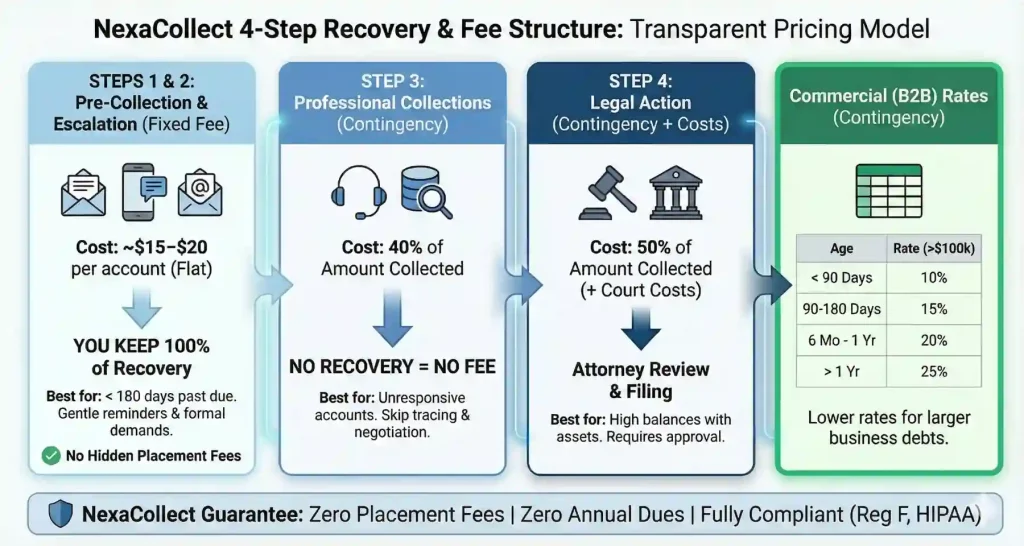
  1. Step 1 — First-Party Courtesy Reminders (Fixed-Fee)
    We act as your extension with five soft reminders for fresher balances (0–60 days), sent as if these reminders are coming from you.

    • Typical Fee: $15 per account.
  2. Step 2 — Third-Party Written Demands (Fixed-Fee)
    Five professional letters on our letterhead that prompt action while preserving goodwill.

    • Typical Fee: $15 per account.
  3. Step 3 — Full Third-Party Collections (Contingency)
    Persistent, polite phone and digital outreach from our HIPAA-trained specialists. We negotiate payment plans and settlements to get you paid.

    • Typical Fee: 40% of amounts recovered. No Recovery, No Fee.
  4. Step 4 — Legal Collections (Contingency, Client-Approved)
    For large, unresponsive accounts, we escalate to an attorney after an in-depth review, and only with your explicit approval.

    • Typical Fee: Up to 50% of amounts recovered. No Recovery, No Fee.

Recent Successes in Dental Debt Recovery

Case 1: Multi-Location DSO (12 Practices)

  • Initial Challenge: $142,000 in aged (>120 days) patient balances and unpaid PPO copays stuck across multiple Dentrix ledgers. High administrative burden and fear of negative Google reviews across locations.

  • Nexa Strategy: Automated ledger batching, guarantor account consolidation, and soft-touch digital outreach with flexible, interest-free payment portal options.

  • Result: 84% total recovery ($119,280) within 60 days with zero negative reviews or patient complaints across all 12 practice locations.

Case 2: Cosmetic & Implant Dental Practice (Solo Office)

  • Initial Challenge: $38,500 in defaulted high-ticket dental implant treatment plans where patients abandoned care mid-treatment or defaulted on internal financing.

  • Nexa Strategy: Audit of completed clinical steps against unearned fee adjustments, followed by diplomatic financial counseling and budget-matched installment structuring.

  • Result: $31,200 recovered (81% recovery rate) while preserving ongoing patient relationships for routine hygiene and preventative care.

⚠️ Dental Billing Compliance Watch

  • Good Faith Estimates: The “No Surprises Act” requires strict estimates for self-pay patients. We ensure your collections match these rules to avoid fines.
  • Credit Reporting Is a Patchwork, Not a Rule: The credit bureaus voluntarily stopped reporting paid debt and balances under $500 as their own 2022–2023 policy. A federal rule that would have gone further and banned medical/dental debt reporting nationally was vacated by a court in July 2025, and that ruling also cast legal doubt on the roughly 15 state laws restricting this reporting too. Old-school credit “threats” were never reliable and are even less so now. You need diplomatic, persistent outreach strategies instead.

Key Benefits of Our Service:

  • For Steps 1-2, payments go directly to you.
  • We can collect in all 50 states and Puerto Rico.
  • Free Services: We provide free bankruptcy screening, litigious debtor checks, and free address verification on all accounts.
  • Practice Software Integration: We support streamlined ledger exports compatible with major dental PMS platforms, including Dentrix, Eaglesoft, Open Dental, Curve Dental, and PracticeWorks, so your front desk isn’t stuck manually re-entering account data. At most, you will download data in an excel sheet from your PMS platform and directly upload in our portal.

The Dental Practice Ledger Dispute Matrix

Not every unpaid balance has the same root cause, and the right recovery approach depends on knowing which one you’re dealing with.

Dental Account Type Root Cause of Delay Recovery Strategy
PPO Patient Copays Patient assumed insurance covered 100% of treatment EOB verification, patient financial education, soft digital payment plans
Family Ledger Accounts Combined household balances or divorce/custody disputes over who’s responsible Guarantor-level consolidation, diplomatic outreach, clear itemized family statements
Mid-Treatment Defaults Patient discontinues multi-stage care (implants, ortho) partway through Audit unearned-fee adjustments, bill only completed procedure steps, offer flexible financing
In-House Membership Plans Failed card on file for a recurring membership payment Soft automated retries, courteous update notices, balance reconciliation

Best Practices for Your In-Office Team

The best collection is one that never has to be sent. We find that practices with the highest success rates follow these steps:

  1. Have a Clear Financial Policy: Patients should sign a clear, simple policy stating they are responsible for all charges not covered by insurance.
  2. Verify Insurance Before Treatment: Always check eligibility and benefits before the appointment to give the most accurate co-pay estimate.
  3. Collect Co-pays at Time of Service: This is the easiest way to reduce post-treatment billing.
  4. Send Statements Immediately: Send the final patient-responsible bill as soon as the EOB (Explanation of Benefits) is received.

When Is It Time to Send an Account to Us?

It’s time to let your staff focus on patient care when you see these red flags:

  • The patient has ignored two or more statements.
  • The patient has made a broken promise to pay.
  • The patient is no longer communicating (“ghosting”).
  • Your staff is spending more time chasing payments than serving patients.
  • An invoice is 90-120 days past due. The older an account gets, the harder it is to collect.

Why Dental Practices Switch to Us

  • We Protect Your Reputation: We will not harass your patients. Our goal is to find a solution, not create a conflict. We save you from negative Google and Yelp reviews.
  • We Are HIPAA Experts: We are not just “HIPAA compliant”; we are experts who understand the law and can sign a BAA with your practice, the same expertise we apply on our medical debt recovery side of the business.
  • Better ROI: Our blend of low-cost fixed-fee options (Steps 1-2) and a professional contingency service (Step 3) means you recover more, more efficiently.
  • Get Your Front Desk Back to Scheduling, Not Chasing: Your front desk team are healthcare professionals, not collectors. Let them focus on patient care and growing your practice.

Frequently Asked Questions for Dental Practices

What if the patient is disputing an insurance claim?

We are not an insurance billing company. We only pursue the patient-responsible balance after insurance has paid or denied the claim. We will direct patients with insurance questions back to your office.

Will you sue my patients?

We are not a law firm and will never sue a patient without your explicit, written permission. Our process (Steps 1-3) is designed to resolve accounts before legal action is ever considered.

What about credit reporting?

It’s more limited and less predictable than most practices assume. The credit bureaus voluntarily stopped reporting paid debt and balances under $500 as their own policy, not a binding federal law, and a broader federal rule that would have banned medical/dental debt reporting entirely was struck down by a court in 2025. We believe protecting your patient relationship is far more valuable than chasing credit-report leverage anyway, and we focus on professional, diplomatic communication to get results.

How do we get started?

It’s simple. You Contact us, we sign a Business Associate Agreement (BAA), and you can securely place accounts through our online portal.

How do you handle a family account when the guarantor and the patient who received treatment aren’t the same person?

Dependent balances get consolidated under the primary guarantor, the person who signed the financial responsibility agreement, rather than pursued piecemeal across multiple family members. If a divorce or custody dispute is part of the picture, we work from what your intake paperwork actually says about who’s financially responsible, not a private agreement between the parents that your practice was never a party to.

Can we refuse to schedule a patient’s future appointments if they have an unpaid balance? Is that patient abandonment?

Declining new, elective appointments for a patient with a significant unpaid balance is generally permissible, the same way any business can decline future service to a customer who hasn’t paid. Where it gets legally and ethically risky is discontinuing care mid-treatment, an active infection, a procedure left incomplete, since that can cross into patient abandonment regardless of the balance owed. The distinction is whether the patient relationship is being ended cleanly between treatment plans, or cut off in the middle of one.

A patient stopped a multi-stage treatment plan (implants, ortho) partway through. Can we bill for the full plan, or only the work actually completed?

Only the completed and documented clinical steps, not the full plan as originally quoted. Billing for unearned future stages of a treatment plan the patient never received is difficult to defend if challenged, and doing so is one of the faster ways to turn a routine balance dispute into a state dental board complaint. We audit the account against what was clinically completed before pursuing it, and adjust the balance to match.

Ready to Improve Your Practice’s Cash Flow?

Stop letting aged receivables hurt your bottom line. Contact us for a no-obligation, fully compliant quote.

Need a Dental Collection Agency? Contact Us

Serving hundreds of dentists nationwide – HIPAA compliant.

Best recovery rates in the industry


Information about Dental Malpractice Insurance: Types, Cost and Lawsuit Reasons
Additional Information:  Suggested Dental Collection Strategy


Filed Under: Debt Recovery

Medical Debt Collection Agency: Patient-Friendly, HIPAA-Compliant Recovery

A patient who ignored three billing statements often responds to the fourth one, if it comes from someone whose entire job is getting it resolved without burning the relationship. That’s the gap Nexa fills: revenue recovered, HIPAA compliance maintained, and the patient still comfortable walking back through your door next year. With over 50% of our clients coming from the medical and dental fields, we are true specialists in the healthcare industry.

Quick answer: Nexa Collections recovers unpaid patient balances through HIPAA-compliant, patient-friendly outreach, starting at a $15 fixed fee per account, with 40% contingency for older debts. Recovery is built around 501(r) charity-care screening for hospitals and No Surprises Act compliance for emergency billing, not around threatening credit damage, since medical debt’s presence on credit reports is shifting and increasingly state-dependent.

Medical billing specialist consulting empathetically with a patient about flexible payment plan options.

Why Choose Nexa?

  • Transparent Pricing: Fixed fees starting at $15/account.
  • No Recovery, No Fee: 40% contingency for older debts.
  • Compliance First: 501(r) & No Surprises Act ready.

Respectful Treatment: It’s Our Policy, Not Just a Promise

Your patients deserve respect, even in collections. We understand that avoiding harsh tactics is your top priority. That’s why we record and randomly review our calls, to ensure our collectors always maintain our minimal patient stress policy and protect your practice’s reputation.


Services and Fee Structure

Let your team keep the stethoscopes; we’ll handle your AR spreadsheets.

Nexa Collections medical collection agency fee structure — $15 fixed fee per account for demand letters, 40% contingency for phone collections

Step Service Type What We Do Fee Structure
Step 1 First-Party Demands Five polite payment reminders sent to the debtor in your name. Fixed-Fee: $15 per account
Step 2 Third-Party Written Demands Five collection letters sent by our agency. Fixed-Fee: $15 per account
Step 3 Third-Party Collections Persistent, professional phone outreach and resolution. Contingency: 40% of amount collected
Step 4 Legal Collections (client-approved) Attorney-led action where appropriate. Contingency: 50% of amount collected

See the full pricing breakdown for how these tiers compare across account types.


Healthcare Providers We Serve

We recover patient balances across every healthcare specialty and setting, with compliant workflows tailored to each provider type:

  • Hospitals & Health Systems: 501(r)-compliant intake, FAP screening, ECA documentation, and high-volume account processing.
  • Physician Groups & Multi-Specialty Clinics: Clean claim verification, EOB reconciliation, and payment plan enrollment before escalation.
  • Urgent Care Centers: High-volume, lower-balance accounts processed efficiently with fixed-fee letter campaigns.
  • Dental Practices: HIPAA-compliant dental debt recovery with patient-first communication that preserves recall rates and referral relationships.
  • Behavioral Health & Addiction Treatment: Sensitivity-trained collectors who understand the unique stigma, privacy concerns, and the stricter federal consent rules that govern this billing category specifically (see the FAQ below).
  • Ambulatory Surgery Centers (ASCs): Higher-balance accounts with complex insurance coordination, resolved via structured payment plans and portal enrollment.
  • Home Health & Hospice: Balance billing recovery from families and patients in sensitive circumstances, handled with appropriate care and compliance.
  • Physical Therapy & Chiropractic: High-frequency, moderate-balance accounts suited to our fixed-fee first-party demand service.
  • Federally Qualified Health Centers (FQHCs): Sliding-scale and self-pay recovery with financial assistance awareness built into every outreach.

Medical office staff are frustrated with being forced into part-time debt collectors, as it distracts them from their primary responsibilities.

Quick start: Send 10–20 test accounts or a CSV export. We’ll review in 1 business day and recommend the lowest-friction path.

Need a Medical Collection Agency? Contact Us

Serving Thousands of Medical Professionals Nationwide

Easy to use • Fully Compliant with HIPAA, Federal and State Laws • USA Citizens-Only Team • 24×7 Secure Portal • High Recovery Rates • Expert Medical Collectors • Free Credit Bureau reporting • Low fee 


Recent Results

• Multi-Specialty Clinic – $380–$1,400 balances – 72–118 days
Up-front estimate + two-way texting + 4-month plans → 82% resolved without ECAs in 30 days.

• Nonprofit Hospital Outpatient – $650 average – 95 days
FAP screening + plain-language bills + text-to-pay → 68% pay/plan within 21 days; remainder documented for charity review.

• Ambulatory Surgery Center – $1,200 average – 132 days
Portal enrollment + hardship tiers + autopay → 74% enrolled in plans, with <3% cancellations over 90 days.


Why Medical Debt Collection Requires Dual Compliance: FDCPA + HIPAA

Most general collection agencies are only trained on the Fair Debt Collection Practices Act (FDCPA), the federal law governing how debts can be collected from consumers. Medical debt collection adds a second, equally strict layer: HIPAA (the Health Insurance Portability and Accountability Act). See our general overview of collection laws for how these federal and state rules interact more broadly.

Requirement FDCPA (all collection agencies) HIPAA (medical only)
What it governs How, when, and how often collectors can contact patients How patient health information (PHI) is accessed, stored, and shared
Key obligation No harassment, false statements, or unfair practices Minimum necessary PHI only; signed BAA required with all vendors
Violation risk Lawsuit by patient; FTC enforcement; $1,000/violation OCR investigation; $100–$50,000/violation; potential criminal charges
Who is liable The collection agency The healthcare provider AND the agency (shared liability)

The key risk for providers: If your collection agency mishandles PHI, even accidentally, your practice shares liability under HIPAA. A signed Business Associate Agreement (BAA) is not enough on its own; the agency must also have documented HIPAA training, secure data transfer protocols, and audit trails. Nexa Collections is fully SOC 2 Type II certified and HIPAA-compliant, with BAAs in place before any account is processed.


What Changed Recently (Why This Matters to Your Revenue)

  • Credit reporting is now a patchwork, not a lever. The major credit bureaus voluntarily stopped reporting paid medical debt and balances under $500 (with roughly a one-year grace period) as their own 2022–2023 policy. Separately, a federal rule that would have banned medical debt reporting nationwide was vacated by a court in July 2025, and that same ruling cast real legal doubt on the roughly 15 state laws that restrict it too. The practical upshot: credit-report pressure is no longer a reliable lever anywhere, and it’s a shifting, state-by-state question where it applies at all. That’s exactly why our outreach leans on communication and payment structure, not the threat of a credit ding.
  • No Surprises Act: Out-of-network emergency and post-stabilization charges have strong federal protections; our outreach aligns with those rules.
  • Hospitals (501(r)): Nonprofit hospitals must screen for financial assistance before any extraordinary collection actions (ECAs). We document those “reasonable efforts” so you stay audit-ready.
  • Policy watch: Regulations continue to evolve, especially around credit reporting. We keep scripts, notices, and workflows current so your team stays compliant.

HIPAA, Privacy & Dignity

  • We share only the minimum necessary PHI for payment/operations.
  • Business Associate Agreements with all third-party vendors we engage.
  • Scripts avoid clinical specifics; focus stays on balance, options, and empathy.

What We Need to Start

Invoices/statement • EOB (if available) • Patient contact info • Registration notes • Prior outreach logs • Financial-assistance status (if hospital)


Medical Collections FAQs

Can unpaid medical bills still appear on credit reports?

It depends more on the state than on any single federal rule right now. The three major credit bureaus voluntarily stopped reporting paid medical debt and balances under $500, with a roughly one-year grace period, as their own 2022–2023 policy, not a legal mandate. Separately, a federal rule that would have banned medical debt reporting nationwide was vacated by a court in July 2025, and that ruling also found federal law may preempt the roughly 15 state laws that restrict this reporting too, so even those state protections are on uncertain footing. We build outreach around getting paid regardless of what credit reporting can or can’t do, since that landscape keeps shifting.

When should we place accounts?

After two unsuccessful internal attempts and by 60–120 days past due. Earlier placement means better patient recall and faster resolution.

What counts as an “extraordinary collection action” (ECA) for hospitals?

Examples include liens, wage garnishment, adverse credit reporting, and non-emergent care denial due to past bills, and they’re considered only after documented FAP screening.

Is sending a medical account to outside collections a HIPAA violation?

No, if you share the minimum necessary information for payment/operations and have a BAA in place.

Do you handle surprise-bill disputes?

Yes, we explain protections under the No Surprises Act and help resolve misunderstandings about out-of-network emergency and post-stabilization charges.

Behavioral health and addiction treatment are listed as specialties. Does substance use disorder billing require anything beyond standard HIPAA compliance?

Yes, and it’s a meaningfully higher bar. Substance use disorder treatment records are protected by 42 CFR Part 2, a federal regulation stricter than HIPAA that generally requires specific, SUD-tailored patient consent before that information, including billing details tied to the treatment, can be disclosed to a collection agency at all. A standard HIPAA Business Associate Agreement isn’t automatically sufficient on its own; the consent language needs to specifically cover SUD records. We handle these accounts under that stricter standard rather than treating them like an ordinary medical balance.


Ready to Lower Bad Debt (Without Damaging Trust)?

Start with 10–20 test accounts or a payer-mix subset. We’ll map the shortest path: TOS optimization, payment plans, charity screening, or—only when necessary—post-screen escalation.

Need a Collection Agency? Contact us

Filed Under: Debt Recovery

Collection Agency in Fond du Lac, WI | Compliant & Effective

Collection Help in Fond du Lac, WI — Firm, Calm, and Reputation-Safe

Fond du Lac runs on momentum: trucks moving up I-41, boats cutting across Lake Winnebago, and small teams keeping big promises.

When invoices go quiet, it doesn’t just hurt cashflow — it drags down your whole week. Our Account Reconciliation Team helps you get paid without turning your customer list into a complaint list.

Nexa provides a reputation-safe approach, equipped with all 50-state collections license, offering free credit reporting, free litigious debtor check, free bankruptcy scrub, and zero onboarding fees. Secure – SOC 2 Type II & HIPAA compliant. Over 2,000 online reviews rate us 4.85 out of 5. 

Need a Collection Agency? Contact us


Simple Pricing That Makes Sense Upfront

Option 1: $15 Fixed-Fee (you keep 100%)
Perfect for early-stage accounts where a respectful nudge and clean follow-up is usually enough.

Option 2: 40% Contingency (no recovery, no fee)
Best when the account is older, the debtor is dodging, or you want us to drive the process end-to-end.

When appropriate and permitted, we can also use email and text to speed up responses. And yes — earlier placement typically means higher recovery, because people are still reachable and the story is still fresh.

Money-saver tip: Many clients are able to offset the fixed-fee service by treating it as a business expense (after checking with their CPA).

The “Velvet Hammer” Approach: You Don’t Win by Getting Loud

Arguing feels productive. It almost never is.

Most people who owe money already feel defensive. If you corner them, they stall, avoid, or retaliate (especially online). If you work the problem with them, you create a path where paying you becomes the easiest way out.

That’s the Velvet Hammer:
firm enough to secure payment, calm enough to protect your reputation.

Here’s what it looks like in real life:

  • We lead with a clear, professional summary of the balance and the timeline.

  • We give the debtor a dignified off-ramp: payment options, split-pay, or a short plan.

  • We keep pressure steady — not emotional. No threats. No drama. Just progress.

Before we push harder, we also run a litigation scrub and risk checks, so you don’t waste energy chasing accounts that are legally risky or likely to implode into a bigger headache.

A Fond du Lac Reality: People Move, Phones Change, Memory Fades

Between seasonal work, relocations around the Lake Winnebago area, and the steady shuffle between Fond du Lac, Oshkosh, and Appleton — a “simple past-due” can turn into “we can’t find them.”

That’s why we combine diplomacy with verification:

  • USPS address checks

  • Skip tracing

  • Bankruptcy checks

  • Optional credit reporting (only if you choose and it’s permitted)

Recent Recovery Results

1) Medical Balance — Fond du Lac

A specialty office had a patient balance just under $1,900 that kept bouncing between “I’ll handle it next Friday” and silence.
Step 1: We verified the best contact route (address + phone) and sent a polite but firm reconciliation notice with simple payment options.
Step 2: Patient responded with a job-change situation; we structured a short split-pay plan that didn’t feel like a punishment.
Step 3: Payments cleared on schedule, and the account closed without complaints or escalation.

2) Business-to-Business — Near Oshkosh

A local supplier had an overdue commercial invoice around $9,400 tied to a project that finished months ago. The customer wasn’t disputing the work — just delaying.
Step 1: We requested a written confirmation of the delivered scope and reset the conversation around documentation, not opinions.
Step 2: We secured a partial payment within days, then a firm follow-up calendar for the remainder.
Step 3: Balance resolved through two payments, with the relationship still intact for future orders.

⚠️ Red Flags We See Around Fond du Lac (Avoid These)

1) Letting it “wait until after the busy season.”
Busy season ends, the balance doesn’t. Early action wins.

2) Mixing service conversations with collection conversations.
Your staff shouldn’t have to chase money right after they fixed a problem.

3) One-size-fits-all pressure.
Some debtors need a plan; others need deadlines. Treating everyone the same slows you down.

A Note From the Account Reconciliation Team

We’re not here to “pick fights.” We’re here to collect cleanly — the kind of recovery that keeps your name strong in a town where word travels fast. Whether you serve customers near Downtown Fond du Lac, along the I-41 corridor, or out toward the county airport, the goal is the same: get paid, stay respected, move on.

What We Can Recover (Without the Headaches)

  • Patient balances for hospitals and specialty clinics (privacy-first, respectful communication)

  • Tuition, housing balances, and bursar accounts for colleges and universities

  • Past-due treatment plans for dental offices, orthodontists, and specialty practices

  • Restoration invoices, pool service accounts, and contractor balances after job completion

  • Unpaid enrollment fees and school-related balances for private and charter schools

  • Professional fee recovery for accountants and CPA firms on net-30 / net-60 billing

  • Delinquent consumer loan obligations and account deficiencies for banks and credit unions

  • Trade balances for HVAC, electrical, plumbing, and general contractors

  • Commercial B2B recovery for vendors, restoration providers, and waste management routes

And yes — Spanish-speaking collectors are available, which helps in diverse customer bases and multi-location portfolios.

Guardrails That Protect Your Brand

Collections can go sideways when someone gets emotional or improvises.

That’s why our calls are recorded and randomly reviewed. It’s a built-in safety net that helps prevent rogue behavior, sloppy language, and review-bomb risk.

Collections Rules That Matter (Practical, Not Legal Advice)

Every account has to be handled with boundaries — and with proof.

In general, we follow:

  • Federal consumer debt rules that restrict harassment, misrepresentation, and unfair pressure

  • Communication rules for calls, voicemails, and written notices

  • Credit reporting standards (only when permitted and authorized)

  • Wisconsin-specific consumer protections that reinforce fair dealing in collection activity

We also support documentation-first recovery, which matters when a debtor suddenly “forgets” what they agreed to.

FAQs

Can you work accounts outside Fond du Lac too?
Yes. Many clients operate across the Lake Winnebago region — including nearby areas like Oshkosh, Appleton, and up the Green Bay direction via I-41.

Will this hurt my online reputation?
It doesn’t have to. Our Velvet Hammer approach is built to stay firm without provoking backlash — and calls are recorded and reviewed for quality control.

Do you report to credit bureaus automatically?
No. Credit reporting is optional, and it’s only used when it’s permitted and appropriate for the account type.

Contact Nexa Today

  • « Go to Previous Page
  • Page 1
  • Interim pages omitted …
  • Page 14
  • Page 15
  • Page 16
  • Page 17
  • Page 18
  • Interim pages omitted …
  • Page 27
  • Go to Next Page »

Primary Sidebar


accounts receivable

Need a Collection Agency?
Kindly fill this form.
We’ll get in touch with you

    Please prove you are human by selecting the house.

    Compliance & Security

    • SOC 2 Type II Certified: Third-party audited data security and strict privacy controls.

    • HIPAA Compliant: Secure, legal processing of medical and municipal EMS accounts.

    • PCI-DSS Level 1: Highest tier of data encryption for secure payment processing.

    • FDCPA & FCRA Aligned: Full legal adherence to federal consumer protection laws.

    Recent Posts

    • Nationwide Debt Collection Agency Serving U.S. Cities
    • Chula Vista Collection Agency for Medical, B2B, Schools & Business Debt
    • Corpus Christi Collection Agency: Itemized Bill Rules for Practices
    • Riverside Collection Agency | For Logistics, Medical, Schools & Business Recovery
    • Collection Agency for Large Balances: High-Value B2B Debt Recovery
    • Baltimore Collection Agency | Medical, Commercial, Schools & More
    • Commercial and B2B Collection Agency in Detroit
    • Boston Medical Collection Agency | Serving Hospitals, Physicians & Dentists

    Featured Posts

    • Timeshare Debt Recovery | Maintenance Fee Collections
    • Pros and Cons of Senior Living Communities
    • Telecom & ISP Debt Recovery | Equipment & Revenue Solutions

    Copyright © 2026 NEXACOLLECT.COM | This content is provided for general informational purposes only and should not be considered legal advice. Collection laws and requirements may vary by state, account type, documentation, debtor status, and specific facts. Please consult qualified legal counsel for guidance regarding your particular situation. Nexa and its authorized collection partners service accounts in accordance with applicable federal and state collection requirements. Visit our home page to know more about us.

    X
    Need a Collection Agency?
    Contact Us