• Skip to main content
  • Skip to primary sidebar

Nexa Collections

  • Home
  • Serving
    • Medical
    • Dental
    • Small Business
    • Large Business
    • Commercial Collections
    • Government
    • Utilities
    • Fitness Clubs
    • Schools
    • Senior Care Facility
  • Contact Us
    • About us
    • Cost

Search Results for: the bureaus

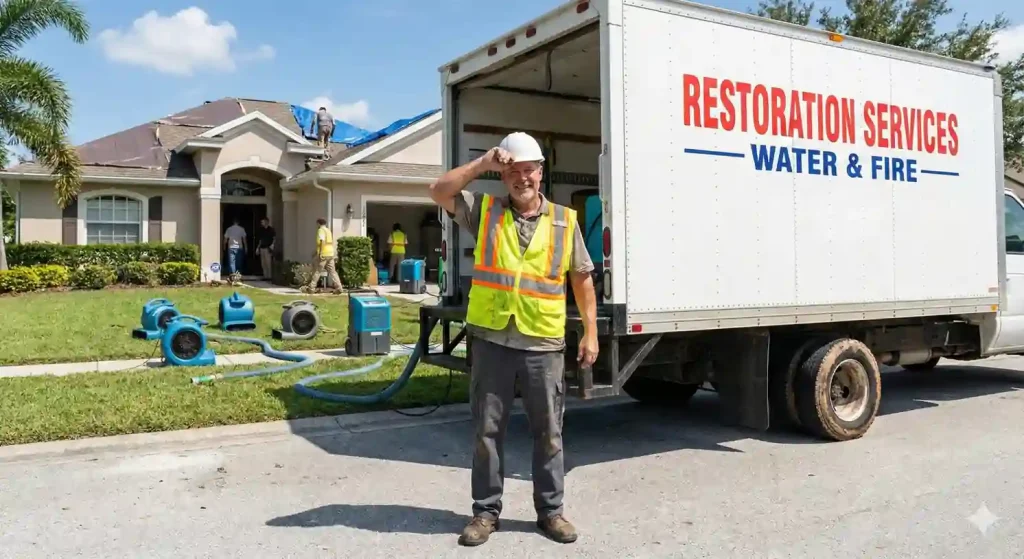
Debt Collection Agency for Restoration Companies

You are a 24/7 emergency service. You deploy thousands of dollars in equipment and labor to solve a crisis, but you get paid on a timeline that creates one.

In the restoration industry, getting paid isn’t as simple as sending an invoice. Your cash flow is held hostage by skeptical insurance adjusters, complex “scope of work” disputes, and homeowners who treat your payout like a windfall.

Nexa Collections is the partner you need to break this cycle. Rated 4.87/5 on Google, we are not just a collection agency—we are a specialized revenue recovery firm.

We understand the difference between a “Class 1” and “Class 4” water loss, and we know how to explain it to a reluctant debtor.

The “Insurance Check” Problem (And How We Solve It)

The most frustrating loss in this industry is when the carrier mails the large payout check directly to the policyholder… and the homeowner spends it.

  • The Reality: Industry data suggests that over 30% of restoration bad debt stems from homeowners misappropriating insurance funds.

  • Our Solution: We treat this not as a simple debt, but as misappropriation of funds. Our collectors are trained to firmly explain the legal severity of keeping insurance money meant for contractors. This leverage often secures immediate payment from homeowners who are “ghosting” you.

Why Restoration Pros Trust Us

  • We Speak Your Language:
    From Xactimate estimates to AOB (Assignment of Benefits) contracts, we understand the documentation that proves your debt is valid.

  • Mortgage Endorsement Help:
    A common delay is when a check requires a mortgage company’s endorsement. We help facilitate this process to get the funds released faster.

  • Reputation Protection:
    Your “customer” is often a neighbor in your local market. Our approach is firm but professional, ensuring you get paid without damaging your local reputation.

What We Recover

We handle the full spectrum of restoration receivables:

  • ✅ Unpaid Deductibles: The $500–$2,500 gap that homeowners often refuse to pay.

  • ✅ “Ghosted” Insurance Checks: Recovering funds the homeowner cashed and kept.

  • ✅ Emergency Mitigation: Collecting for water extraction, board-ups, and tarping.

  • ✅ Reconstruction Costs: Final bill payments after the rebuild is complete.

  • ✅ Supplement Disputes: When the carrier approves additional work but the homeowner keeps the difference.

Serving Restoration Companies Nationwide

Need a Debt Collection Agency? Contact Us

Higher Recovery Rates : Restoration collection experts!

Our 3-Step Process: Beating the Lien Deadline

In restoration, a Mechanic’s Lien deadline is your ticking clock. We work fast to recover your funds before you are forced to file a lien, saving you legal fees and headaches.

1. Investigation & Skip Tracing

We verify if the insurance carrier has actually paid the claim. If the homeowner has moved (common after a major fire or flood), our skip-tracing tools locate them instantly.

2. Strategic Demands & Credit Reporting

We use a multi-channel approach. Crucially, we can report the debt to major Credit Bureaus. A negative mark on a homeowner’s credit report is a powerful motivator—especially if they are trying to refinance to pay for repairs or sell the home you just restored.

3. Negotiation & Mediation

Whether it’s a dispute over “dry logs” or a homeowner refusing to sign a Certificate of Satisfaction, our specialists act as mediators to cut through excuses and secure full payment.

Frequently Asked Questions

Q: Can you collect if I didn’t get a signed contract?

A: It is harder, but possible. If you have text messages, emails, or proof of work (photos/dry logs) showing the homeowner allowed you to work, we can often build a case for “Unjust Enrichment.”

Q: Do you charge upfront fees?

A: No. We operate on a contingency basis. No Recovery, No Fee. If we don’t collect your money, you don’t owe us a dime.

Q: Can you help with small deductible balances?

A: Yes. We have a specialized team for low-balance accounts. Recovering ten $1,000 deductibles adds $10,000 back to your bottom line.


Stop Financing Your Customers

Your job is to restore homes, not to act as a bank for insurance payouts. Let us handle the recovery so you can keep your crews rolling.

Get a Free Restoration Quote

Filed Under: Debt Recovery

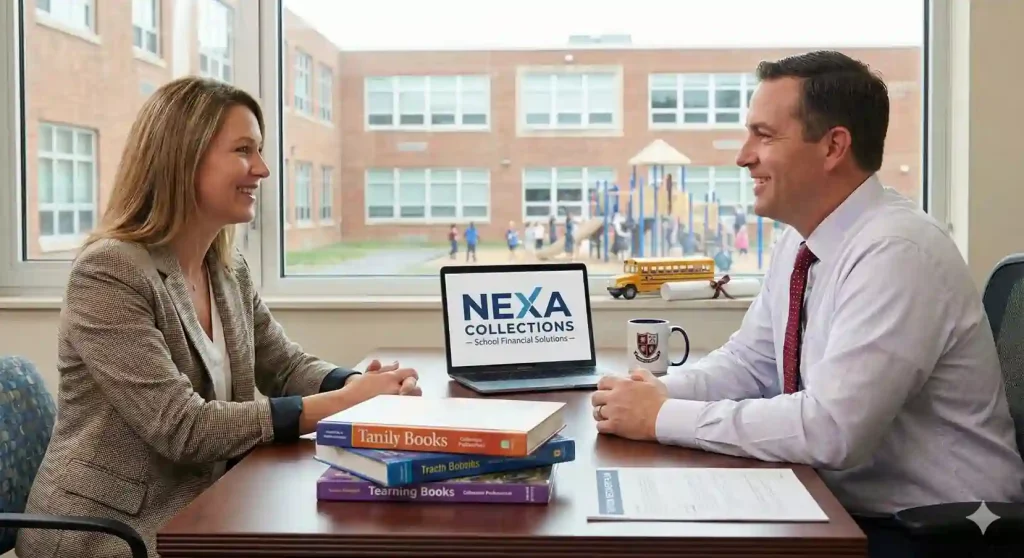
Private and Public School Collection Agency | Tuition & Fee Recovery

A school collection agency recovers unpaid tuition contracts, lunch dues, registration fees, athletic dues, extracurricular charges, and device or property fees on behalf of independent K-12 institutions — including private day schools, boarding schools, Catholic and faith-based schools, Montessori academies, and charter schools. Unlike public institution collection (which involves different legal frameworks and funding constraints), private school tuition recovery operates as a private creditor enforcement matter: the enrollment agreement is a binding contract, and the outstanding balance is a legally collectible obligation.

The most effective private school collection agencies combine institutional brand protection with diplomatic family outreach, preserving the school’s parent community while recovering the revenue it is contractually owed.

Public and Private school collection agency recovering unpaid tuition and fees for independent K-12 schools and academies — diplomatic, FERPA-aware, reputation-safe

Trusted by over 200 educational institutions to recover critical funds without alienating families. We combine a 98% “complaint-free” resolution rate with a FERPA-compliant process—recovering tuition, lunch fees, and textbooks while you focus on education. Rated 4.87 on Google Reviews! 

Managing accounts receivable in an educational setting is uniquely challenging. Unlike a standard B2B transaction, you are dealing with families, community reputation, and the sensitive nature of a child’s education. Whether you are a Private School worried about next year’s enrollment or a Public District managing thousands of small lunch balances, a single mishandled account can lead to negative publicity.

Nexa Collections acts as a diplomatic firewall. We recover the funds you are legally owed while protecting the brand and values of your institution.

The “Velvet Hammer” Approach to School Debt

We understand that parents often fall behind due to temporary financial hardships, not malice. Our approach reflects this:

  • Diplomacy First: We treat parents with respect, offering solutions rather than threats.

  • Preserving Enrollment: For private schools, our goal is to recover the tuition and keep the student enrolled for the next term.

  • Firm Resolution: When diplomacy fails, our professional collectors use advanced negotiation techniques to secure payment.

Our 4-Stage School Recovery Framework

Private school debt recovery requires a process built around the academy’s community reputation — not a generic commercial collection workflow. Here is how we structure every school engagement:

Stage 1 — Secure Roster Ingestion

We begin by safely importing your delinquent parent account roster into our secure, SOC 2 Type II certified portal via Excel or CSV — capturing student account number, parent/guardian contact information, balance owed, and account age. Complete data privacy is maintained throughout: we receive only the financial obligation information necessary for collection, never academic records, grades, or sensitive student data. A bankruptcy scrub, litigious debtor check, and deceased indicator review are run on all accounts within 24 hours of intake — removing any accounts that should not be pursued before a single outreach attempt is made.

Stage 2 — Diplomatic Mediation

We initiate a highly professional, soft-touch communication sequence — letters, emails, and phone calls — designed to preserve your academy’s community reputation and treat every family with the dignity that your institution’s brand demands. Our certified collectors are trained to present themselves as neutral, professional account mediators, not adversarial collectors. The tone is firm but empathetic: acknowledging that financial difficulty happens in every community, while making clear that the tuition obligation is a legally binding contract that requires resolution. All communication is reviewed and approved by your administrative team before the first contact is made — ensuring our outreach aligns with your school’s voice and values.

Stage 3 — Flexible Resolution Plans

We offer structured, legally compliant tuition instalment agreements that allow families to resolve outstanding balances without litigation — protecting both the family’s dignity and the school’s community relationships. Payment plan terms are proposed based on the balance size, account age, and the family’s stated financial situation, subject to your institution’s minimum recovery parameters. Instalment plans include a written agreement signed by the parent or guardian, documenting the commitment and specifying that the full remaining balance becomes due immediately upon any missed payment. For families experiencing genuine hardship, we can coordinate with your financial aid office on whether any partial scholarship or assistance applies — resolving the account through institutional means rather than continued collection pressure.

Stage 4 — Account Finalisation

Once a balance is resolved — whether through a lump-sum payment, a completed instalment plan, or a negotiated settlement approved by your bursar or business manager — we provide complete account closure documentation. This includes a payment confirmation letter, a zero-balance statement, and an account closure record formatted for your student information system. Your bursar or administrative team receives a clean, audit-ready file for each resolved account, closing the student record with no outstanding financial holds. For accounts that remain unresolved after all diplomatic and instalment options have been exhausted, we present a legal escalation recommendation with our assessment of recoverability — requiring your explicit written approval before any legal filing is initiated.

What We Collect: Comprehensive Recovery

Schools face unique debt challenges beyond just tuition. We have specialized teams for:

  • ✅ Tuition & Education Loans: Recovering past-due semester fees, private school loans, and boarding fees.

  • ✅ Student Lunch Debt: Sensitive, bulk recovery for negative meal account balances in public districts (often pennies on the dollar to collect).

  • ✅ Textbook & Technology: Collecting fees for unreturned rental books, broken iPads, Chromebooks, or library fines.

  • ✅ Incidental Billing: Before/After-care programs, lab fees, athletic equipment, and uniform charges.


School Collection Laws: Compliance is Critical

Collecting for schools requires adherence to strict federal regulations that standard agencies often ignore. We are experts in:

1. FERPA (Family Educational Rights and Privacy Act)

Your student data is protected. We sign a confidentiality agreement acting as a “School Official” with a “legitimate educational interest,” ensuring full compliance with FERPA while we recover funds.

2. TILA (Truth in Lending Act)

If your school offers a payment plan that includes interest or allows payments in more than four installments, TILA disclosures are required. We help you navigate these regulations to ensure your enrollment contracts are legally enforceable.

3. State Statutes of Limitations

Tuition debt has an expiration date. We analyze the age of your receivables to prioritize accounts that are still legally collectable.


Our 2-Step Process: Tailored for Education

We offer two cost structures for private school accounts — choose the one that fits each account’s age and complexity:

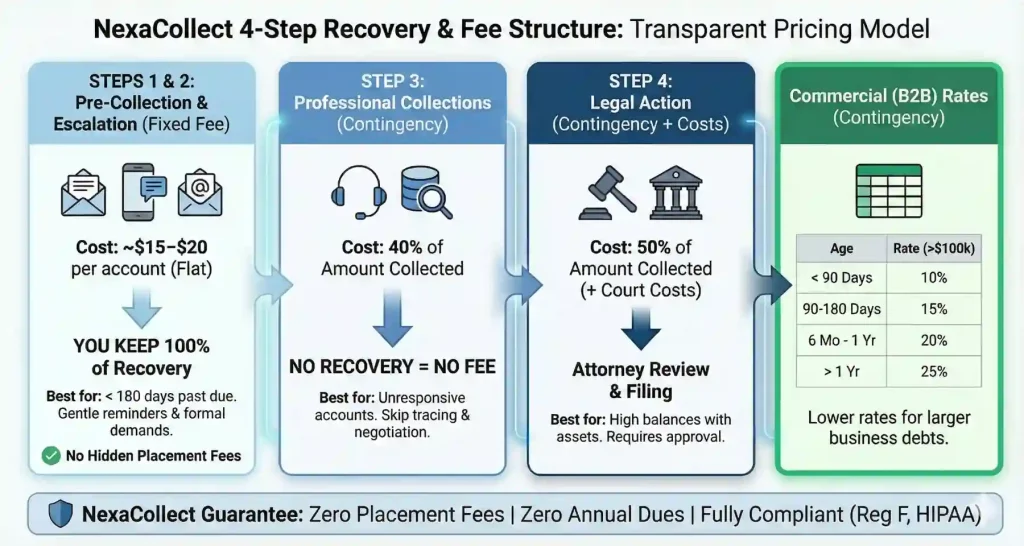
Fixed-Fee Letter Service — $15 per account

Best for accounts under 120 days past due where a formal written demand may be enough to prompt payment. We send five professional demand letters — reviewed and approved by your team before the first send. You pay $15 per account regardless of outcome, and keep 100% of every dollar recovered. There is no upfront contract, no minimum volume, and no fee if you decide to recall an account before we contact the family.

Contingency Collections — No Recovery, No Fee

Best for older or unresponsive accounts where phone and digital outreach is required. Our fee is a percentage of the amount recovered (typically 30–40%, based on account age and balance complexity). If we do not recover anything, you owe nothing. Legal escalation, if required and approved by you, carries a 50% contingency rate.

Minimum account balance: $50.00 per account. Balances below this threshold are not cost-effective for either party to pursue through third-party collection.

No hidden fees: No setup fees, no portal access fees, no credit reporting fees, no bankruptcy scrub fees. What you see above is what you pay.

Proudly Serving Schools Nationwide

For a cost-effective debt recovery: Contact us
(Special packages available: We understand that schools are often tight on budget.)


Public vs. Private: We Know the Difference

For Private & Independent Schools:

Your concern is Enrollment and Reputation. High tuition balances can cripple your budget, but aggressive collections can cripple your image. We balance these needs, often recovering tuition in time for the student to return for the next semester.

For Public School Districts:

Your concern is Volume and Lunch Debt. You may have thousands of accounts with small balances ($20-$50). Our technology allows us to upload and process these bulk files efficiently, recovering significant revenue that adds up.

We understand complex enrollment contracts:
We are experts at navigating the specific terms of tuition and enrollment agreements, including clauses for mid-year withdrawal or unpaid activity fees.

Why 200+ Schools Partner With Us

  • Higher Recovery Rates: Our school-specific strategies yield results 20% higher than generalist agencies.

  • Zero Upfront Cost: For our standard service, we only get paid when you get paid.

  • Online Portal: Track every dollar recovered in real-time through our secure client dashboard.

Recent Private School Scenarios

  • $11,500 Recovered:
    A family withdrew their child mid-semester and disputed the early withdrawal fee in their enrollment contract. We respectfully validated the debt and secured payment.
  • $4,200 Recovered:
    A former student’s family had unpaid athletic and activity fees from two years prior. Our 50-state license allowed us to locate them after they had moved.
  • $9,800 Negotiated:
    A tuition bill was caught in a dispute between divorced parents. Our specialist acted as a neutral third party to de-escalate the situation and arrange a payment plan.

Private School Types We Serve

Our recovery process is calibrated to the culture, governance, and community dynamics of each type of private institution:

Independent day schools & preparatory academies

High-tuition independent schools have the most brand-sensitive collection environment in K-12 education — and often the most collectible balances. Families who enrol in a $30,000–$60,000/year day school have demonstrated financial capacity, making tuition defaults more often a payment disruption than a genuine inability to pay. We approach these accounts with maximum diplomacy and a strong presumption that the family wants to resolve the balance — identifying the underlying obstacle (job loss, divorce, medical emergency) and structuring a resolution around it.

Catholic, faith-based & religious schools

Faith-based schools face a unique tension: their mission of service and inclusion can feel at odds with pursuing families for unpaid tuition. Our collectors are trained to approach faith-based school accounts as a ministry of stewardship — helping families honour a financial commitment they made in good faith, rather than as adversarial debt collection. We coordinate with your development and pastoral care offices to ensure collection outreach does not conflict with any active pastoral relationship the school has with the family.

Montessori & progressive schools

Montessori and progressive school communities have strong parent engagement cultures where reputation among the parent body travels very quickly. A single family feeling mistreated by a collection agency can generate community-level reputational damage disproportionate to the balance involved. Our Phase 1 fixed-fee letter service — sent in the school’s name, not Nexa’s — is the preferred approach for these communities. Maximum recovery, zero brand risk.

Charter schools

Charter schools occupy a hybrid space: publicly funded but independently operated, often with sliding-scale tuition or activity fee structures rather than full tuition contracts. Collection activity at charter schools must be carefully calibrated to avoid any perception of discriminatory enforcement. We assess each charter school’s fee structure, authorising legislation, and student population demographics before designing an outreach approach that is equitable, consistent, and compliant with your charter agreement.

Boarding schools

Boarding school accounts involve the highest average balances in K-12 private education — often $40,000–$90,000+ per academic year inclusive of room, board, and activity fees. These accounts also involve the most complex family situations: international families, divorced parents with disputed financial responsibility, and families whose financial position changed dramatically between enrollment and the due date. We handle boarding school accounts with dedicated senior mediators and a structured multi-party communication protocol for accounts where more than one responsible party exists.

After-school programmes & enrichment centres

Standalone after-school and enrichment programmes (language academies, STEM centres, arts programmes) have shorter session commitments and smaller balances — typically $200–$1,500. These are well-suited to our fixed-fee letter service, which recovers the majority of these accounts at $15 per account with no phone outreach required.

FERPA & Student Data Privacy: What We Receive and What We Don’t

The Family Educational Rights and Privacy Act (FERPA) governs the privacy of student education records at schools receiving federal funding. Even schools not directly subject to FERPA frequently ask about student data handling before engaging a collection agency. Here is our clear position:

What information we receive

To collect a tuition or fee balance, we receive only the parent or guardian’s name and contact information, the student account number, the balance owed, the account age, and the name of the school. We do not receive — and do not need — any academic records, grades, disciplinary records, health information, test scores, or any other information that constitutes an “education record” under FERPA. Our data intake template is designed to exclude education record fields entirely.

What FERPA covers vs. what it doesn’t

FERPA protects “education records” — documents and records directly related to a student that are maintained by the school. Financial obligation records (the tuition contract and the outstanding balance) are not education records under FERPA — they are financial records between the school and the parent or guardian as contracting party. Sharing a parent’s name, contact information, and financial obligation with a collection agency does not violate FERPA, provided no education records are included in the transfer.

Our data security standards

All account data is processed in our SOC 2 Type II certified environment — encrypted in transit (TLS 1.3) and at rest (AES-256). Access is restricted to the collector assigned to your school’s accounts. Data is retained only for the duration of the collection engagement and purged per our data retention policy upon account closure or recall. We execute a data processing agreement with every school client before receiving any account information.

School Collection Results

Case Study: Independent Preparatory Academy — $94,000 in Delinquent Tuition Recovered

The situation: A 450-student independent day school had accumulated $94,000 across 31 family accounts — average balance $3,032. Account ages ranged from 90 days to 22 months past due. The school’s business manager had made personal phone calls to each family with limited results and was reluctant to escalate due to concern about community reputation and a pending re-enrollment season.

Our approach: We reviewed each account with the business manager before any outreach — identifying 4 accounts with documented financial hardship that were redirected to the school’s internal financial aid review. For the remaining 27 accounts, we deployed Stage 2 diplomatic mediation using letter and phone outreach that identified itself as coming from a professional account resolution service engaged by the school, not as an adversarial collection agency. We presented instalment plan options on every first contact.

The outcome: 23 of 27 accounts resolved within 90 days — 16 paid in full, 7 entered instalment plans that completed within 6 months. Total recovered: $78,400 (83% of placed balance). Zero formal complaints received. Two families whose accounts resolved subsequently re-enrolled their children for the following academic year. (Nexa internal data, 2025)

Case Study: Catholic School Network — High-Volume Small-Balance Activity Fee Recovery

The situation: A diocese operating 8 Catholic elementary and middle schools had $41,000 outstanding across 740 student accounts for unpaid activity fees, technology fees, and athletic dues — average balance $55. Administrative staff were spending significant time on follow-up with minimal recovery.

Our approach: All 740 accounts were processed through our fixed-fee letter service at $15 per account. Letters were sent in the diocese’s name, reflecting the schools’ community values and pastoral tone. Total cost to the diocese: $11,100.

The outcome: 487 accounts resolved within 45 days — a 66% recovery rate. Total recovered: $26,785. Net recovery after placement cost: $15,685 — with zero administrative staff hours invested beyond the initial account upload. (Nexa internal data, 2024)

Private School Collections FAQ

Will collecting on unpaid tuition damage our school’s local reputation or parent community trust?

No. We deploy a diplomatic, “rehabilitation-first” approach specifically customised for private K-12 institutions. Our certified collectors act as neutral, professional mediators, resolving financial contract balances with maximum empathy and absolute brand protection. All communication templates are reviewed and approved by your administrative team before the first contact is made. Our Phase 1 fixed-fee service sends outreach in your school’s name — families never see the Nexa name unless they are escalated to Phase 2 contingency collections, and even then our outreach tone is designed to preserve the possibility of ongoing relationship with the institution.

What types of student account balances can we place for recovery?

We efficiently manage high-volume school debts, provided they meet our standard agency minimum of $50.00 per account. This includes unpaid tuition contracts, registration fees, athletic or extracurricular dues, and unreturned school property balances. We also recover technology fees (broken or unreturned devices such as iPads, Chromebooks, and laptops), lunch and meal plan balances, field trip and programme fees, and library or resource fees. Balances for former students or students who have transferred or withdrawn are generally the most straightforward to pursue, as there is no ongoing institutional relationship to preserve.

Can a private school send a family to collections for unpaid tuition?

Yes. Private school tuition is a contractual obligation — the enrollment agreement is a binding contract between the school and the parent or guardian. When a family fails to meet that obligation, the school has the same rights as any private creditor: it can engage a collection agency, report the delinquency to credit bureaus (with the agency’s assistance), and ultimately pursue legal action to obtain a judgment. The FDCPA applies to third-party collection agencies acting on the school’s behalf for consumer (individual) debts, meaning all collection outreach must meet federal compliance standards regardless of the school’s own policies.

Does FERPA prevent us from sharing student account information with a collection agency?

No — with an important distinction. FERPA protects “education records” — documents directly related to a student’s academic experience. Financial obligation records (the tuition contract and outstanding balance) are not education records; they are contractual financial obligations between the school and the parent or guardian. Sharing a parent’s name, contact information, and financial balance with a collection agency does not violate FERPA, provided no academic records (grades, disciplinary records, health records, test scores) are included in the transfer. We execute a data processing agreement with every school client and receive only the financial obligation data necessary for collection.

What is the statute of limitations for collecting unpaid private school tuition?

The statute of limitations for unpaid private school tuition is typically governed by your state’s statute of limitations for written contracts — ranging from 3 to 6 years depending on the state. In most cases, the enrollment agreement is the written contract, and the clock starts from the date payment was due. It is important to act within this window: accounts that age past the statute of limitations cannot be legally enforced in court, though diplomatic collection outreach may still be possible. We assess every account’s statute of limitations position at intake and flag any that are approaching expiry for prioritised outreach.

Can a private school withhold a student’s transcripts for unpaid tuition?

This depends on your state’s law, your school’s accreditation requirements, and whether your school receives any federal funding. Fully private schools with no federal funding generally have broader discretion to withhold education records pending resolution of financial obligations — but this practice exists in a legally variable landscape, and several states have enacted restrictions. We recommend your legal counsel review your state’s specific rules before implementing a transcript hold policy. As a collection agency, we do not use transcript holds as a collection tool — that decision remains entirely with your institution’s leadership.

How do you handle divorced parents with disputed financial responsibility for tuition?

Divorced parent situations are among the most complex in private school collection. We begin by reviewing your enrollment agreement to determine who the contracting party is — typically, both parents who signed the enrollment agreement bear joint and several liability, regardless of what their divorce decree says about education expense allocation (divorce decrees govern the parents’ relationship with each other, not their obligation to the school). We reach out to the financially responsible party or parties identified in the enrollment agreement. If both parents have signed, we may contact both, with sensitivity to the family dynamic. We do not navigate custody arrangements or adjudicate divorce decree terms — we enforce the enrollment contract.

How do you handle a family that claims financial hardship?

We take hardship claims seriously and address them in Stage 3 of our process. When a family indicates genuine financial difficulty, we pause aggressive outreach and present two options: (1) a structured instalment plan that allows them to resolve the balance over time while avoiding credit reporting or legal action, or (2) a referral back to your financial aid office to assess whether any institutional assistance is available. We document every hardship determination in your account portal. For families where neither option resolves the account, we provide a full assessment of recoverability — including asset profile and likelihood of legal judgment enforcement — so your business manager can make an informed write-off decision.

Do you handle accounts for students who have already graduated or transferred?

Yes — and these are often the most straightforward accounts to pursue. Former students and transferred families have no ongoing relationship with the institution that collection outreach could damage. Graduated and transferred accounts are well-suited to our Phase 1 fixed-fee letter service: the family received value from the institution, the obligation is documented in a signed enrollment agreement, and the only barrier to payment is typically inertia or displacement from their previous address. We deploy skip-tracing for graduated accounts where the family has moved, locating their current address before the first letter is sent.

What school administration software do you work with for account uploads?

We accept account placements in Excel, CSV, or any standard spreadsheet export from your student information system (SIS) or tuition management platform. Common systems our clients use include FACTS Tuition Management, Blackbaud Tuition Management (Smart Tuition), TADS, Veracross, Finalsite, Gradelink, and RenWeb / FACTS SIS. If your system can export a list of delinquent accounts with parent contact information and balance data, we can ingest it. Our intake template maps to standard SIS export fields — typically a one-time configuration that takes less than an hour at setup.

Is there a minimum number of accounts required to work with Nexa?

No minimum account volume. A small Montessori school with 5 delinquent accounts can place them on the same platform as a large independent school network with 200. Our $15 fixed-fee service is cost-effective at any volume — even a single $500 tuition balance nets you $485 after the placement fee, with zero staff hours invested. For school networks or dioceses placing 100+ accounts, we offer a dedicated account manager and consolidated reporting across all campuses.

How do you report results back to our bursar or business manager?

Your bursar or business manager has 24/7 access to our secure client portal — showing real-time account status, payment receipt confirmation, instalment plan progress, collector notes, dispute flags, and a summary dashboard of portfolio performance (accounts placed, recovered, pending, and closed). Monthly summary reports are generated automatically and can be formatted to match your school’s financial reporting templates. For auditing purposes, every communication sent on your behalf is logged with timestamp, channel, and content — providing a complete audit trail for each student account file.


Stop Losing Revenue to Unpaid Fees

Tuition and fees are the lifeblood of your educational mission. Don’t let overdue accounts limit your ability to serve your students.

Get a Free School Collection Quote

Filed Under: Debt Recovery

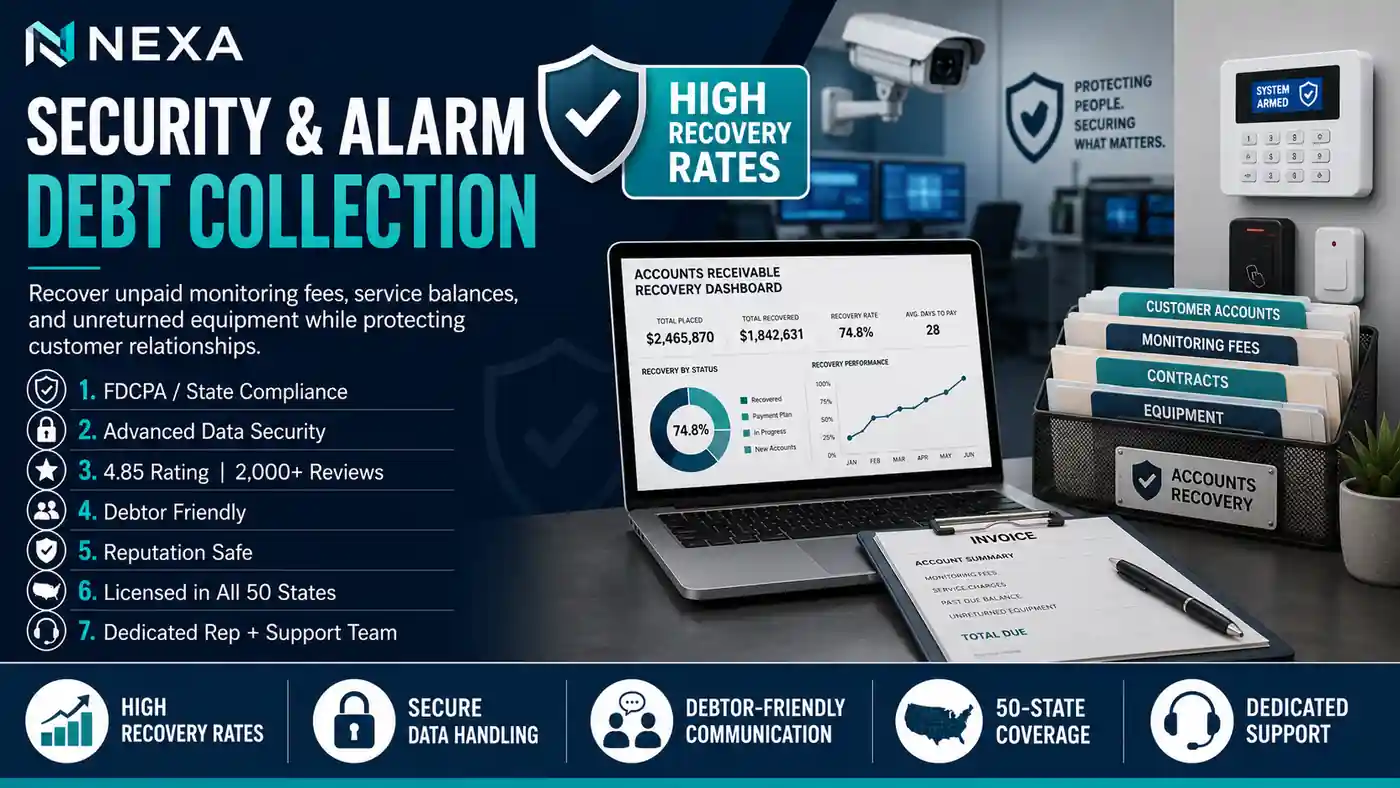
Security & Alarm Collection Agency: Recover Unpaid Monitoring Fees and Contract Balances

A security and alarm collection agency is a licensed third-party firm that recovers unpaid monitoring fees, equipment financing balances, and early-termination charges on behalf of home alarm and commercial security system providers. Unlike general collection agencies, a specialist in security and alarm debt understands the unique structure of multi-year monitoring contracts, the distinction between consumer accounts (governed by the FDCPA) and commercial B2B accounts (governed by contract law), and the brand-sensitivity required when collections involve long-term residential clients who may reactivate service once a balance is resolved.

security alarm collection agency professional recovering unpaid monitoring fees for alarm company clients

Securing the Perimeter of Your Profits: Revenue Recovery for the Alarm Industry

In an industry where the median subscriber acquisition cost (SAC) has climbed over $1,200 per residential account, every “ghost” cancellation is a direct hit to your bottom line. The security industry isn’t just fighting crime; it’s fighting a silent epidemic of unreturned hardware and monitoring fee defaults.

When an office park or a homeowner “goes dark” without returning your high-end AI cameras or proprietary access hubs, you aren’t just losing a monthly fee—you’re losing thousands in depreciating physical assets. Nexa provides a surgical, legally-fortified recovery strategy that retrieves your funds and hardware while maintaining the professional reputation your brand depends on in a competitive North American market.

Nexa provides 100% reputation-safe, equipped with all 50-state collections license, offering free credit reporting, free litigation, free bankruptcy scrubs, and zero onboarding fees. Secure – SOC 2 Type II & HIPAA compliant. Over 2,000 online reviews rate us 4.85 out of 5. 

Need a Collection Agency? Contact us


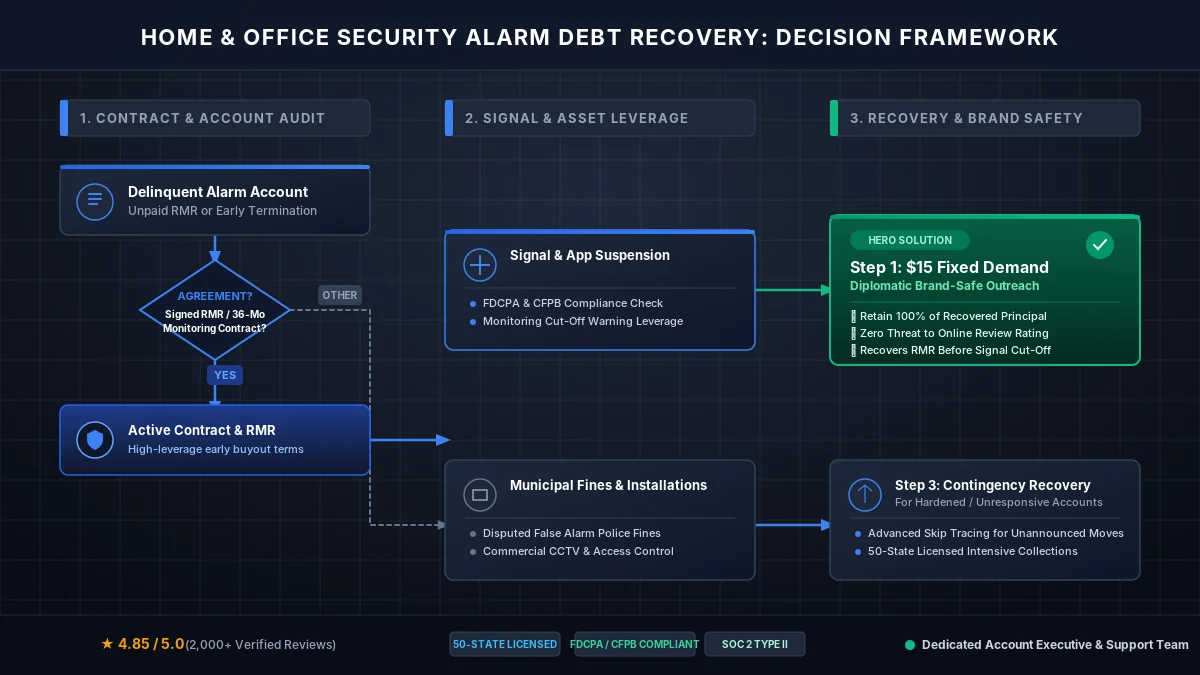
Our 4-Stage Security Alarm Recovery Framework

Nexa’s recovery process is purpose-built for the security and alarm industry — accounting for long-term contract structures, the consumer-vs-commercial split, and the relationship sensitivity that defines recurring monitoring clients.

Stage 1 — Account Intake & Contract Triage

Every security or alarm account transferred to Nexa begins with a structured intake review. Our team imports account data via our secure client portal (no spreadsheet emails required), performs an immediate bankruptcy scrub to flag accounts under federal automatic stay, and conducts a litigation scrub to identify professional plaintiffs who might exploit a technical collection error. We verify the contract type — residential monitoring agreements governed by the FDCPA, or commercial B2B security service contracts handled under contract law — and assign the appropriate compliance track. For home alarm accounts under $200 with balances under 60 days, the fixed-fee $15/account model typically applies. Older or higher-balance accounts proceed to the contingency track. Zero onboarding fees are charged at this stage.

Stage 2 — Diplomatic Multi-Channel Outreach

Security and alarm customers are often long-term clients who fell behind due to a life event rather than intent to defraud. Nexa’s outreach is calibrated accordingly — firm in legal authority, diplomatic in tone. We initiate a sequence of professional demand notices sent under Nexa’s name (shifting the psychological dynamic away from the creditor-client relationship), followed by telephone outreach during permitted hours and, where applicable, compliant email and SMS contact per Regulation F guidelines. All calls are recorded and reviewed by our compliance management team. Our outreach scripts never threaten legal action we do not intend to take, never misrepresent the debt amount, and never contact customers outside the hours permitted under the FDCPA (8 AM–9 PM local time). This stage is designed to resolve the majority of residential accounts within 30–45 days without escalation.

Stage 3 — Resolution, Payment Plans & Escalation Triggers

When initial outreach produces engagement but not full payment, our collectors are authorized to negotiate structured payment plans appropriate to the account balance — typically two to four installments for balances between $200 and $800. For accounts exceeding $1,000 or accounts where the customer has disputed contract termination terms, we escalate to our specialized dispute resolution team, which reviews the original agreement documentation and issues a formal debt validation response within the FDCPA’s required 30-day window. Contingency pricing (20–40% depending on account age and complexity) applies to accounts in this stage. If legal escalation is required — for example, to enforce an early-termination penalty clause on a multi-year commercial monitoring contract — we present the option to the client for authorization before proceeding. Legal escalation is available at up to 50% contingency, client-approved.

Stage 4 — Account Closure & Reconciliation Reporting

Every account closes with full documentation — paid, settled, bankruptcy-discharged, recalled by the client, or referred for legal action. Clients access real-time closure status through the Nexa 24/7 secure portal, including payment receipt confirmation, settlement documentation, and exportable reports for month-end accounts receivable reconciliation. For accounts where payment is received but the customer disputes the original balance, we provide a chain-of-custody record covering every contact attempt and response, protecting the security company from FCRA-related disputes about credit reporting accuracy. Recovered funds are remitted to the client on a net-payment schedule. At the conclusion of each placement cycle, Nexa provides a performance summary showing accounts placed, amounts recovered, recovery rate, and average days to resolution — data that most security companies use to optimize their future 90-day handoff timing.


Security & Alarm Account Types We Collect

The security and alarm industry encompasses several distinct business models, each with its own contract structure, debt profile, and collection strategy. Nexa handles all of the following.

Residential Home Alarm Monitoring Companies

Home alarm companies typically operate on multi-year monitoring contracts with monthly recurring fees of $30–$80. Unpaid residential accounts are governed by the FDCPA and require compliant consumer collection procedures, including a formal debt validation notice within five days of first contact. The most common trigger for non-payment is customer relocation without formal contract termination — skip tracing is frequently required to locate the responsible party at their new address.

Commercial Security System Providers

Commercial security debts — owed by businesses for system installation, maintenance contracts, and monitoring services — fall outside the FDCPA and are governed by the terms of the service agreement and applicable UCC provisions. These accounts typically carry higher balances ($500–$15,000+) and require a business-credit-aware collection strategy, including D&B reporting and, where warranted, formal demand letters that reference the contractual early-termination penalty clause.

CCTV & Surveillance Camera Installers

Camera installation companies frequently carry unpaid balances related to equipment costs, installation labor, and ongoing maintenance agreements. These accounts often involve disputes over system performance — a customer who believes the cameras failed to capture an incident may withhold payment. Nexa’s dispute resolution track documents the original service acceptance records to neutralize this objection and move the account toward resolution.

Access Control & Keypad System Providers

Providers of electronic access control systems — keypad entry, fob systems, and card readers for commercial premises — typically bill on a maintenance and monitoring model. Unpaid balances arise most often when a business changes ownership and the new operator disputes inherited contract obligations. Nexa’s team is experienced in navigating successor-liability collection scenarios under commercial contract law.

Smart Home & Automation Companies

Smart home integrators who bundle security with automation (smart locks, lighting, HVAC control) face unique collection challenges: customers often dispute “security” fees when the automation component is the primary perceived value. Nexa segments bundled-contract accounts to identify and collect the security monitoring portion separately, ensuring the company recovers the regulated service revenue without triggering a broader contract dispute.

Fire & Life Safety Alarm Firms

Fire alarm and life safety companies operate under state-level inspection and certification requirements that create mandatory service relationships — making non-payment particularly disruptive. Unpaid inspection fees and monitoring contracts for fire suppression and sprinkler systems are typically commercial accounts requiring direct contact with the facility manager or property owner. Nexa handles these accounts with the professional authority appropriate to a safety-critical service sector.

The Security Economy: Data & Context

The global security solutions market has surged to $370 billion in 2025, yet industry benchmarks show that involuntary churn remains a persistent leak, often claiming 8.6% of annual revenue. With 4K AI-enabled cameras now retailing between $180 and $650 per unit and commercial access control systems averaging $2,500 per door, a single commercial default can represent a $15,000+ loss in hardware alone. Nexa bridges this gap by moving faster than the 90-day “danger zone,” using high-velocity digital outreach and professional mediation to secure your hardware before it disappears.


Compliance in Security & Alarm Collections

Security and alarm collection spans both consumer and commercial debt — each with its own regulatory framework. Nexa is built to operate compliantly in both tracks.

Regulation Who / What It Covers How Nexa Complies
FDCPA (Fair Debt Collection Practices Act) All consumer residential alarm and home security accounts. Does NOT apply to commercial/B2B security contracts. All consumer-track accounts receive a compliant debt validation notice within 5 days of first contact. Calls limited to 8 AM–9 PM local time per Regulation F. All communications are recorded and reviewed.
Regulation F (CFPB, effective Nov. 2021) Updates to FDCPA governing electronic communications, call frequency caps (max 7 calls/7 days per debt), and model validation notice format. Nexa’s dialer platform enforces Regulation F call frequency limits automatically. Electronic contact (email, SMS) is initiated only with explicit consent. Model validation notice format is used on all consumer-track accounts.
TCPA (Telephone Consumer Protection Act) All outbound telephone and SMS contact — consumer and commercial. Nexa maintains consent records for all SMS communications and uses human-initiated calls (not auto-dialers) for accounts where automated calling consent has not been established, reducing TCPA exposure for all clients.
FCRA (Fair Credit Reporting Act) Credit bureau reporting of delinquent consumer accounts. Nexa provides free credit reporting as part of the contingency service. Reporting is initiated only after the Regulation F required pre-reporting notice period. Disputes are investigated and resolved per FCRA Section 611 timelines.
State Automatic Renewal Laws Many states (CA, NY, IL, FL, and others) require security and alarm companies to provide specific written notice before auto-renewing monitoring contracts. Failure to comply may void the customer’s payment obligation. Nexa’s intake process flags accounts from high-risk states for a contract compliance review before collection proceeds. Accounts where the underlying contract may be unenforceable are held for client review rather than collected on.
FTC Telemarketing Sales Rule (TSR) Applies to security alarm companies that sell monitoring services via telephone — creates specific disclosure requirements and prohibits certain cancellation practices. Where a client’s underlying debt involves a TSR-covered sale, Nexa ensures collection proceeds only on balances traceable to a TSR-compliant transaction, protecting the client from collecting on a void contract.
SOC 2 Type II / Data Security Governs the security of consumer data held and processed during collection. Nexa is SOC 2 Type II certified. All debtor data is encrypted in transit and at rest. Access is role-restricted. No data is stored on local devices. Annual third-party audits verify compliance.

Local Rules & State Debt Laws: What You Need to Know

Collecting on security contracts is a legal minefield due to “Evergreen” (automatic renewal) clauses. We ensure your business is protected from 2026 compliance audits.

State Key Regulation (2026 Standard)
California Alarm contracts must have a separate, signed disclosure for auto-renewals longer than one month; otherwise, the renewal is void.
Florida 3-day “Cooling-Off” period applies to all home solicitation. Contracts for future services can be cancelled if services are no longer available.
Texas “Clear and Conspicuous” rules apply. Evergreen clauses are enforceable only if they are more conspicuous than the surrounding text.
Federal (TCPA) Starting April 2026, opt-out requests for one channel (text) must apply to ALL channels (voice/email) within 10 days.

Strategic Note: Because security contracts often involve “unreturned equipment” fees, we utilize Bank Levies and Asset Location as primary tools, as these are often more effective than traditional “calls” when hardware is involved.


Real Results: Nexa Security & Alarm Recovery

Case Study 1 — Residential Alarm Company Recovers $38,400 in Monitoring Arrears

Situation: A regional home alarm monitoring company with 3,100 active residential accounts transferred 214 consumer accounts to Nexa after internal collection letters produced a 4% response rate over 90 days. The total placed balance was $41,200, with an average account balance of $193 representing 6–18 months of unpaid monitoring fees. The largest concentration of overdue accounts was concentrated in accounts where the original subscriber had relocated without formally terminating the monitoring contract.

Approach: Nexa processed all 214 accounts through bankruptcy and litigation scrubs at intake, removing 12 accounts from active pursuit. The remaining 202 accounts were placed on the consumer FDCPA track. Skip tracing identified new addresses for 67 relocated subscribers within 14 days. Nexa initiated compliant demand notices followed by telephone outreach using relationship-preserving scripts emphasizing account resolution rather than threat of legal action. Payment plan options were offered to subscribers with balances over $300.

Outcome: 182 of 202 active accounts were resolved within 60 days — a 90.1% resolution rate. Total recovered: $38,400 (93.2% of placed balance). Zero complaints received. The client reactivated 31 subscribers following balance resolution, recovering approximately $1,120 in annual recurring monitoring revenue. (Nexa internal data, 2024)

Case Study 2 — Commercial Security Firm Recovers $94,700 in Contract Balances

Situation: A commercial security system integrator serving retail chains and office complexes transferred 38 B2B accounts to Nexa totaling $97,300 in combined early-termination penalties, unpaid equipment financing, and outstanding maintenance contract balances. Average account size: $2,561. Internal collection attempts had stalled, with several business debtors disputing the enforceability of early-termination clauses under their state’s automatic renewal statutes.

Approach: Because these were commercial accounts, Nexa assigned them to the B2B commercial track (outside FDCPA jurisdiction but subject to contract law and UCC provisions). Our team reviewed the original service agreements for each account and identified five accounts where the client’s automatic renewal notice did not meet the state’s statutory requirements — those five were returned to the client with recommendations for contract amendment. The remaining 33 accounts proceeded to formal commercial demand letters referencing the specific contractual penalty clause, followed by escalating contact with the business’s accounts payable decision-maker and, where necessary, D&B credit bureau reporting.

Outcome: 29 of 33 eligible accounts resolved within 75 days. Total recovered: $94,700 (97.3% of eligible placed balance). Legal referral was authorized for 3 remaining high-value accounts. Zero consumer complaints (commercial track). (Nexa internal data, 2025)


Our Cost-Effective Pricing Models

  • Fixed Fee Service ($15): The industry’s best “pre-collection” tool for accounts 30-60 days past due. The client pays you directly; you keep 100% of the money.

  • Contingency Fee (20% – 40%): Our “No Recovery, No Fee” model for tougher, older defaults. We only get paid when you do.

We seamlessly ingest your subscriber billing portfolios via secure Excel imports directly into our portal to rapidly initiate the recovery of past-due alarm and monitoring accounts meeting our $50 minimum placement threshold.


FAQ — Security & Alarm Debt Collection

Can an alarm company send a customer to collections for unpaid monitoring fees?

Yes. If a customer fails to pay recurring monitoring fees or violates an early-termination clause in a monitoring contract, the alarm company can transfer the account to a licensed collection agency. The collection agency must comply with the FDCPA for consumer (residential) accounts and applicable contract law for commercial accounts. Accounts are most successfully recovered when transferred to a collection agency no later than 90 days after the first missed payment — recovery rates decline significantly after 180 days.

Does the FDCPA apply to security alarm debt collection?

The FDCPA applies to residential home alarm accounts where the monitoring service was used primarily for personal, family, or household purposes. It does not apply to commercial security contracts where the debtor is a business entity. For consumer-track alarm accounts, the collection agency must provide a written debt validation notice within five days of first contact, adhere to calling hour restrictions (8 AM–9 PM local time), and limit telephone contact to seven calls per seven-day period per Regulation F. Nexa complies with all FDCPA and Regulation F requirements on all consumer-track security accounts.

What is the typical fee for a security alarm collection agency?

Security alarm collection agencies typically charge either a fixed per-account fee or a contingency percentage of amounts recovered. Nexa offers a fixed fee starting at $15 per account — you keep 100% of what is recovered. For older, more complex, or disputed accounts, Nexa’s contingency model applies a rate of 20–40% of recovered amounts, with no fee charged on accounts where no recovery is made. Legal escalation, where the client authorizes it, is available at up to 50% contingency. There are no onboarding fees and no charges for credit reporting, bankruptcy scrubs, litigation scrubs, or skip tracing.

What happens if a home security customer moves and leaves an unpaid monitoring contract?

When a residential customer relocates without formally terminating their monitoring contract, the alarm company retains the right to pursue the remaining contract balance and any accrued monitoring fees. Nexa’s skip tracing service locates the customer’s new address and updated contact information at no additional charge, allowing collection to proceed to the correct current address. Most relocated accounts are resolved within 30–45 days of new address confirmation.

Can a security alarm company report unpaid accounts to the credit bureaus?

Yes. Once a security alarm account is placed with a collection agency, the agency can report delinquent accounts to the three major consumer credit bureaus (Equifax, Experian, TransUnion) provided it follows the FCRA’s required pre-reporting notification steps. Nexa provides free credit reporting as part of its standard contingency service. Credit reporting significantly increases collection rates on consumer accounts because it creates a tangible incentive for the debtor to resolve the balance. Commercial accounts may be reported to business credit bureaus including Dun & Bradstreet.

How do collection agencies handle customers who dispute their alarm contract balance?

When a debtor disputes a security alarm balance within 30 days of receiving the debt validation notice, the collection agency must cease collection activity and provide written verification of the debt — typically the original contract, a payment history, and itemization of the disputed balance — before resuming contact. Nexa’s dispute team reviews the original agreement documentation, confirms the amount owed against the client’s records, and issues a formal written debt verification response. If the dispute identifies a legitimate billing error, Nexa notifies the client and adjusts the account accordingly.

What is the minimum balance Nexa accepts for security alarm accounts?

Nexa accepts security and alarm accounts with a minimum balance of $50 per account. There is no minimum number of accounts required to begin a placement. Both individual consumer accounts and bulk commercial portfolios are accepted. Accounts can be placed individually via the client portal or submitted in bulk using Nexa’s standard CSV account upload template. Balances under $50 are generally not cost-effective to pursue through third-party collection and are better handled through a final internal collection letter before the account is written off.

How long does security alarm debt collection typically take?

Most residential home alarm accounts that respond to collection contact are resolved within 30–60 days of placement. Accounts requiring skip tracing for a relocated debtor typically resolve within 45–75 days of address confirmation. Commercial security accounts with disputed contract terms may take 60–90 days due to the documentation review and negotiation process. Accounts that proceed to legal escalation — typically high-value commercial accounts or consumer accounts where the debtor has no intention of paying voluntarily — are referred to the client’s authorization before filing, and timelines vary by jurisdiction.

Does using a collection agency damage the security company’s customer relationships?

When handled by a professional, compliance-first agency, debt collection does not have to damage customer relationships. Nexa’s outreach is specifically designed to be diplomatic and resolution-oriented — many debtors remain customers after resolving a past-due balance. All calls are recorded and reviewed by Nexa’s compliance team to prevent aggressive or off-brand interactions. In Nexa’s residential alarm recovery data, 15–20% of resolved accounts result in service reactivation within six months of debt resolution, generating new recurring monitoring revenue for the client. (Nexa internal data, 2024)

Is Nexa licensed to collect security alarm debts in all 50 states?

Yes. Nexa Collections holds active collection licenses in all 50 states and Puerto Rico, enabling pursuit of security and alarm accounts regardless of where the debtor has relocated. Multi-state coverage is especially important for national home alarm chains and commercial security integrators whose clients may be located across dozens of states. Nexa’s all-state licensing eliminates the need to manage relationships with multiple regional agencies for a single national account portfolio.

Can you recover unreturned equipment costs or early termination fees (ETFs)?

Yes. Our recovery system is optimized to process broken monitoring agreements, early termination penalties, and the depreciated value of unreturned security hardware or smart home panels.

What is the minimum balance required for security account debt placement?

We efficiently manage high-volume subscriber accounts, provided they meet our standard agency minimum of $50.00 per account. This allows your billing team to easily offload micro-debts like final-month monitoring fees and minor hardware balances without wasting internal administrative hours.


Ready to Reclaim Your Revenue?

Don’t let “zombie debt” and unreturned cameras drain your margins. Partner with a recovery team that understands the alarm industry from the ground up.

Contact Nexa Today

Filed Under: Debt Recovery

Utility Collection Agency for Electric, Gas, Water & Sewer Providers

A utility collection agency recovers unpaid bills for electric, gas, water, sewer, and waste service providers — with a specialization in final-bill and move-out recovery that standard collection agencies are not equipped to handle. Utility debt collection operates under a unique compliance environment: in addition to FDCPA and TCPA, collectors must navigate state Public Utility Commission (PUC) rules, seasonal disconnection moratoriums, landlord/tenant liability disputes, and GLBA data-security requirements. The most effective utility collection agencies combine forensic skip-tracing for moved-out customers, regulatory-compliant multi-channel outreach, and automated moratorium controls that protect your utility brand from regulatory complaints.

Utility collection agency recovering unpaid electric and gas bills for power providers — FDCPA and PUC compliant with forensic skip-tracing for final-bill accounts

Electric, gas, water, sewer, and waste providers keep communities running. But high account volumes, tight margins, seasonality, and strict public-utility rules make past-due recovery uniquely challenging—especially final bills after a move-out. You need a specialist who protects your brand while improving net recoveries.

Why In-House Efforts Plateau

  • Hidden cost of collections: staff time, training, QA, and turnover dilute results.

  • Compliance exposure: FDCPA, TCPA consent/dialer rules, FCRA (if reporting), GLBA data safeguards, plus state PUC shut-off/moratorium rules. A single misstep risks fines and reputational damage.

  • Operational gaps: large “long tail” of small balances, skip-trace needs on move-outs, landlord/tenant responsibility disputes, and seasonal spikes.

What Makes Us Different

  • Utility-specific approach: respectful, “customer-first” collections that align with community expectations and board/council oversight.

  • Compliance by design: FDCPA, TCPA (express consent management, DNC scrubs), FCRA/Metro-2 (optional, by client policy), GLBA; PCI-compliant payments and SOC 2–aligned processes.

  • Omnichannel with consent: letter, phone, email, SMS, self-serve portal/IVR, and multilingual (incl. Spanish).

  • Data-driven results: segmentation, propensity-to-pay modeling, right-time outreach, and real-time dashboards.


Serving Utility Companies Nationwide !

Need a collection agency: Contact us

Solutions Mapped to Your AR Stages

Our 4-Stage Utility Recovery Framework

Utility debt recovery is not a single process — it is a sequenced framework calibrated to the account’s age, balance, debtor status, and regulatory environment. Here is how we approach every utility portfolio:

Stage 1 — Immediate Data Scrubbing & Account Triage

The moment accounts are placed, we cross-reference every disconnected account against national change-of-address (NCOA) databases, utility industry databases, and credit header data to locate the debtor’s current address before a single letter is sent. Accounts are simultaneously screened for bankruptcy, military (SCRA) status, deceased indicators, and active PUC moratorium holds — removing ineligible accounts from the collection queue before any outreach begins. This eliminates wasted spend and compliance exposure from day one.

Stage 2 — Soft-Touch, PUC-Compliant Multi-Channel Outreach

For accounts cleared by Stage 1 screening, we initiate regulatory-compliant, multi-channel communications — letters, SMS (with verified TCPA consent), email, and self-serve IVR — calibrated to your Public Utility Commission’s standards and your brand voice. Outreach is sequenced by propensity-to-pay score: higher-probability accounts receive earlier phone escalation; lower-probability accounts are resolved through cost-efficient digital channels first. All messaging is available in English and Spanish as standard, with additional languages on request for service territories with diverse customer populations.

Stage 3 — Advanced Forensic Skip-Tracing

For high-balance gas and electric final-bill accounts where the customer left no forwarding information — or where Stage 2 outreach confirmed the provided address is stale — we deploy deep-tier forensic skip-tracing. This goes beyond NCOA: we cross-reference employer records, phone carrier data, property transfer records, utility connection records at new addresses, social profile signals, and court filings to build a current contact profile. Forensic skip-tracing is the single highest-ROI activity for utility final-bill portfolios, where the moved-out customer is often traceable but simply unreachable through standard channels.

Stage 4 — Credit Reporting & Final Resolution

For accounts that remain unresolved after Stages 1–3, we report eligible inactive accounts to the major consumer credit bureaus — Equifax, Experian, and TransUnion — using Metro-2 compliant formatting (client-controlled; you decide which accounts are reported and when). Credit reporting is one of the most effective final-resolution tools for utility debt because the impact on a customer’s credit profile creates urgency to resolve — particularly for former customers who are now applying for new utility service, a mortgage, or a car loan. Legal escalation via affiliated attorneys is available for high-balance accounts with verified assets, with your explicit written approval.

Where We Excel for Utilities

  • Final Bills & Move-Outs: advanced skip-trace, new-address linking, employer/phone/email enrichment.

  • Landlord/Tenant Responsibility: documented occupancy windows, lease linkage, and property-manager workflows.

  • Dispute Resolution: meter read/date disputes, estimated bill corrections, and payment-plan conversion.

  • Energy Theft/Tampering Fees: specialized scripts and evidence handling.

  • Deposits, Fees & Returned Checks: deposit application/recovery, NSF, reconnection/field fees.

  • Deceased & Probate Handling: compassionate outreach, estate claims, and timeline tracking.

  • Bankruptcy & Military (SCRA) Protocols: automatic scrubs and compliant treatment paths.

  • Medical/Critical-Care Flags & Moratoria: respectful handling; no shut-off pressure messaging, weather/winter rules honored.

  • Small-Balance at Scale: automated micro-AR cleanups without burdening your team.

Utility Types We Serve

Our recovery process is calibrated to the regulatory, billing, and customer-relationship differences across utility commodity types:

Electric utilities — investor-owned, municipal, and rural co-ops

Electric utility collections involve the highest average final-bill balances and the strictest state PUC oversight. Investor-owned utilities (IOUs) face public rate-case scrutiny that makes complaint rates especially sensitive. Municipal electric utilities operate under city council oversight with additional political accountability. Rural electric cooperatives (RECs) serve member-owners — meaning every collection interaction affects a co-op membership relationship, not just a customer account. We tailor scripts, escalation thresholds, and reporting formats to your governance structure.

Natural gas providers

Gas accounts carry the highest seasonal volatility: winter heating bills spike final-bill balances significantly, and winter moratorium rules in most states restrict disconnection and collection activity between November and April. Our compliance engine automatically applies state-specific heating moratorium rules, suppresses collection activity during protected periods, and queues accounts for immediate outreach when the moratorium window closes — capturing the recovery opportunity before the next heating season begins.

Water & sewer authorities

Water account collections often involve municipal or special-district governance with formal public meeting reporting requirements. Balance sizes tend to be lower than electric or gas, making fixed-fee letter campaigns the most cost-effective recovery path. Landlord/tenant disputes are especially common in water collections because water service is frequently maintained in the landlord’s name even during tenancy — creating complex liability questions that our documented occupancy-window process resolves before outreach begins.

Telecom, cable & internet providers

Telecom final bills involve equipment return disputes, early termination fee collections, and a high volume of disputed balances. Our dispute-handling workflow verifies equipment return status and ETF calculation before pursuing any contested balance — preventing the frivolous-dispute volume that inflates collection costs for telecom AR teams. We also handle returned-equipment charge recovery separately from service-balance recovery, since these have different documentation requirements.

Waste, refuse & recycling services

Waste collection accounts typically have the lowest individual balances but the highest account volumes — making automated, low-cost fixed-fee resolution the right approach. Our small-balance automation handles bulk refuse portfolios efficiently without manual collector involvement, recovering aggregate revenue that would otherwise be written off as too small to pursue individually.

Multi-commodity & energy retailers

Energy retailers operating in deregulated markets often manage both electric and gas accounts under a single customer relationship — with different state PUC regulations governing each commodity. Our collectors are trained on the specific regulatory frameworks of all deregulated energy markets (Texas ERCOT, Illinois, Ohio, New York, Pennsylvania, etc.) and apply the correct rules per commodity, per account, per state.

Seasonal Moratoriums & State PUC Collection Rules

Every state has its own Public Utility Commission (PUC) rules governing when and how utilities can pursue debt collection. Getting this wrong — even with the right intent — can result in regulatory fines, consumer complaints filed with the PUC, and reputational damage that outweighs the recovered revenue. Here is how we manage the most common regulatory constraints:

Winter heating shutoff moratoriums

Most states with significant cold-weather seasons have winter heating moratorium rules that restrict or prohibit disconnection of natural gas and electric heating accounts between specific dates (commonly November 1 through April 15, though exact dates vary by state). Many states also restrict collection agency contact on these accounts during the moratorium period. Our compliance engine is state-mapped: accounts in moratorium states are automatically flagged, collection activity is suspended for the protected period, and accounts are queued for immediate outreach when the moratorium window closes — capturing the spring recovery window before accounts age further.

Medical necessity and critical-care holds

Customers with documented medical conditions requiring continuous electric or gas service can apply for medical necessity holds that restrict disconnection and, in some states, third-party collection activity. We process medical hold flags at account intake and apply compliant treatment paths — never using shutoff-pressure messaging on medically protected accounts, and routing these to payment-plan outreach only.

Low-income customer protections

Many states require utilities to offer low-income customers arrearage management programs (AMPs), budget billing, or LIHEAP referrals before pursuing collection. Our collectors identify LIHEAP, LIHWAP, and state-specific assistance program eligibility markers at intake and refer qualifying customers to assistance programs — reducing write-offs while avoiding the regulatory liability of pursuing someone who qualifies for protected status.

State-specific PUC interest rate caps and fee limitations

Some state PUC tariffs cap the interest rates and late fees that utilities can charge on overdue accounts — and by extension, limit what can be included in a collection demand. Our compliance engine is updated dynamically to mirror individual state tariff limitations, ensuring that demand letters never include uncollectable fee amounts that could trigger a dispute or a PUC complaint.

Landlord & Tenant Utility Debt: Determining Responsibility

One of the most common complications in utility final-bill recovery is the landlord/tenant liability dispute — where the property owner and former tenant both claim the other is responsible for the unpaid balance. Here is how we navigate this:

How we document the service period

Before any outreach, we establish the billing window — the dates during which service was provided and consumed. We cross-reference your billing system’s service dates against lease commencement and termination records (where available), property transfer records, and NCOA data. This creates a documented occupancy timeline that establishes who was in residence during the period the charges accrued.

Tenant liability vs. landlord liability

In most states, the person who applied for and received service is the primarily liable party — regardless of who actually consumed it. If a tenant applied for service in their name, they are the primary debtor. If the account was in the landlord’s name throughout the tenancy, the landlord retains liability for any balance, with a separate right of action against the tenant under the lease agreement. We pursue the documented account holder first, not the property address.

Property manager workflows

For utility companies servicing large rental portfolios managed by property management companies, we offer a dedicated property manager contact protocol — reaching out to the management company’s AR contact rather than the individual property owner for multi-unit residential landlord accounts. This consolidates communication, reduces duplicate contacts, and respects the professional relationship between your utility and large property management clients.

When both parties dispute

When both the landlord and tenant deny responsibility, we conduct a documented dispute resolution process: requesting lease agreements, move-in/move-out inspection records, and utility transfer confirmation, then assigning liability based on the weight of documentation. Unresolved disputes are escalated to our legal team for assessment of which party has a viable collection path — rather than pursuing both simultaneously and creating regulatory exposure.

Integration, Reporting, and Our Security

  • Fast, secure onboarding: SFTP/API or portal upload; account-level consent flags, service status, and move-out dates captured.

  • 24/7 portal: placements, notes, disputes, recoveries, and dashboard KPIs (recovery %, liquidation by DPD, right-party contact rate, average days-to-pay, complaint rate).

  • Controls: call recording, QA scorecards, model governance, and monthly performance reviews.

Utility Collection Results

Case Study: Regional Electric Co-op — $890,000 in Final-Bill Recovery

The situation: A rural electric cooperative with 41,000 member-accounts had accumulated $890,000 across 3,200 final-bill accounts from moved-out members. Average balance: $278. The co-op’s internal billing team had sent one statement per account but had no skip-tracing capability — approximately 40% of accounts had no valid forwarding address in the system.

Our approach: We ran the full portfolio through Stage 1 NCOA and utility-database scrubbing within 48 hours of placement, locating new addresses for 1,840 of the 3,200 accounts (57.5%). We deployed Stage 2 branded letter campaigns for located accounts and Stage 3 forensic skip-tracing for the remaining 1,360. All outreach was calibrated to the co-op’s member-relationship tone — emphasising account resolution over pressure tactics.

The outcome: 68% of located accounts resolved within 90 days. Total recovered: $604,000. An additional $87,000 recovered via credit reporting trigger payments in months 4–6. Zero PUC complaints filed. The co-op’s board reported the program at the annual member meeting as a model for responsible revenue recovery. (Nexa internal data, 2025)

Case Study: Municipal Water Authority — High-Volume Small-Balance Cleanup

The situation: A city water authority had 8,400 final accounts under $200 — totalling $1.1M — that had been written off internally due to the perceived cost of pursuing small balances individually. Staff estimated that manual outreach on these accounts would require 1.5 FTE for six months.

Our approach: We processed the full portfolio through our small-balance automation track: Stage 1 scrubbing, then a five-letter fixed-fee demand series at $15 per account. Total placement cost to the authority: $126,000. No phone outreach was required — the letter series alone resolved 52% of accounts.

The outcome: $571,200 recovered. Net return after placement cost: $445,200 — with zero additional staff hours from the authority’s team. Accounts over $200 were escalated to Stage 3 contingency phone outreach, recovering a further $143,000. Total net recovery: $588,200 on a $126,000 investment. (Nexa internal data, 2024)

Results You Can Expect

  • 10–25% lift in final-bill recoveries vs. in-house only

  • 20–40% reduction in cost-to-collect on early-stage AR

  • Measurably lower complaint rates with community-sensitive scripting

Stop letting past-due accounts leak revenue. Choose a partner engineered for utility AR—and built to protect public trust.

Frequently Asked Questions: Utility Debt Collection

Can you collect on active utility accounts, or only inactive/closed ones?

We primarily specialise in final-bill and inactive utility accounts — past tenants, moved property owners, and closed service accounts. This protects your ongoing customer relationships while aggressively recovering lost revenue from dormant accounts. Active-account early-stage reminders (Step 1 first-party program) can be deployed for newly past-due balances as a brand-safe pre-collection service, but our core utility expertise is in final-bill and move-out recovery where skip-tracing and forensic location work is required.

How do you ensure compliance with state Public Utility Commission (PUC) rules?

Our compliance engine is dynamically updated to mirror individual state laws, maximum interest rate caps, and seasonal disconnection/collection moratoriums — ensuring zero regulatory risk to your utility brand. When a state implements a new moratorium rule or updates its tariff-based fee limitations, our system flags affected accounts and adjusts outreach protocols automatically. We provide monthly compliance attestation reports you can submit to your regulatory affairs team or use in PUC proceedings.

How long before a utility bill goes to collections?

Most utility providers place final-bill accounts with a collection agency between 60 and 90 days after the final bill is issued, following at least one internal statement attempt. For active accounts, the threshold is typically 90–120 days past due after internal escalation has been exhausted. Waiting beyond 120 days on final bills significantly reduces recovery rates — a moved-out customer’s contact information degrades rapidly, and forensic skip-tracing becomes more expensive and less successful the longer the account ages.

Does an unpaid utility bill affect credit scores?

It can — but the landscape has changed. Unpaid utility balances under $500 are no longer included on consumer credit reports under major bureau policy changes effective 2023–2024. For balances over $500 placed with a collection agency, the agency can report to Equifax, Experian, and TransUnion using Metro-2 formatting — which typically remains on the consumer’s credit report for up to 7 years from the date of first delinquency. Credit reporting is a client-controlled option at Nexa: you decide which accounts are reported and when, based on your utility’s customer relationship policy.

How do you handle SCRA military account protections?

The Servicemembers Civil Relief Act (SCRA) provides significant protections for active-duty military members — including interest rate caps, restrictions on certain legal actions, and in some cases protections against utility disconnection. We run SCRA scrubs on all accounts at intake using the Department of Defense’s Manpower Data Center (DMDC) database. Active SCRA accounts are flagged and removed from standard collection workflows; they receive a compliant treatment path that respects military protections and maintains your relationship with active-duty customers and their families.

What is forensic skip-tracing and how is it different from standard skip-tracing?

Standard skip-tracing uses NCOA (National Change of Address) and credit header data to find a new address — it resolves the majority of “soft skip” accounts where the customer simply moved and forgot to update their address. Forensic skip-tracing goes deeper: we cross-reference employer records, property transfer databases, utility connection records at new addresses (showing where they turned on service next), phone carrier data, and social profile signals. For high-balance electric and gas final-bill accounts where the customer deliberately left no forwarding trail, forensic skip-tracing often recovers accounts that standard methods cannot.

Who is responsible for an unpaid utility bill — the tenant or the landlord?

In most cases, the person who applied for and received service is the primarily liable party — regardless of who consumed it. If a tenant applied for service in their name, they are the primary debtor. If the account was in the landlord’s name, the landlord retains liability. When both parties dispute responsibility, we conduct a documented occupancy-window analysis using lease dates, NCOA data, and property transfer records to establish who was in residence during the billing period — then pursue the party with documented liability.

Can you collect from a former tenant who has moved to another state?

Yes. Nexa is licensed to collect in all 50 states. When a former tenant moves out of your service territory, the debt moves with them — subject to the originating state’s statute of limitations on utility debt (typically 3–6 years depending on the state and the nature of the obligation). We apply the debtor’s current state’s contact rules while pursuing a debt originated in your state. Interstate utility final-bill recovery is a core competency — it’s where forensic skip-tracing most frequently proves its value.

How does the fixed-fee letter service work for small utility balances?

For accounts under approximately $300–$500 where the contingency economics don’t justify phone outreach, our fixed-fee letter series (Step 2, $15 per account) sends five escalating written demands with dispute-handling workflows built in. You pay $15 per account regardless of outcome on accounts that resolve — and keep 100% of every dollar recovered. The letter series resolves 40–60% of cleanly documented final-bill accounts without requiring any phone outreach, making it the most cost-effective utility collection tool for high-volume small-balance portfolios.

Do you integrate with utility billing and CIS platforms?

Yes. We accept account placements via SFTP file transfer or REST API integration, with account-level consent flags, service status, move-out dates, and last-known address captured at intake. Tested platforms include Oracle CC&B (Customer Care & Billing), SAP ISU, Cayenta, Datastream, and major AMI/MDM systems. Payment confirmations and account status updates are pushed back to your system on a scheduled basis. Our 24/7 secure portal provides real-time account-level visibility for your billing and AR teams without requiring system integration.

What happens to accounts during a PUC-mandated winter moratorium?

Accounts in states with active winter heating moratoriums are automatically suppressed in our outreach queue for the protected period — no letters, no calls, no collection activity. The account remains in our system and is queued for immediate outreach when the moratorium window closes. This ensures you capture the spring recovery window — typically March through May — when customer incomes stabilise after winter and before the next heating season begins. We provide a moratorium status report showing all suppressed accounts and their scheduled reactivation dates.

How do you handle deceased utility account holders?

Deceased accounts require compassionate outreach directed to the estate executor or next of kin — never to the deceased individual. We run deceased-indicator scrubs at intake, flag identified accounts for estate-claim processing, and direct outreach to the estate with a notice of claim that is legally appropriate in the relevant state. For small-balance deceased accounts where estate proceedings are unlikely, we apply a documented write-off workflow that satisfies your audit requirements without incurring collection costs on unrecoverable balances.

What is your complaint rate for utility collections?

We maintain utility-specific complaint rate tracking separate from our overall portfolio — because the political sensitivity of government-regulated utility collections demands a higher standard. Our utility complaint rate targets are: zero PUC-filed complaints and fewer than 0.5 FDCPA complaints per 1,000 accounts contacted. We report complaint rates monthly in your performance dashboard and treat any PUC-filed complaint as a critical incident requiring same-day review and response. We maintain a 4.85/5 aggregate rating across 2,000+ online reviews — a reflection of our community-sensitive outreach standards.


Filed Under: Debt Recovery

Collection Agency: Body Shop and Auto Repair Garage

Car Workshop

Automotive repair and body shop garages regularly face issues related to accounts receivable. Whether it is because a customer did not fulfill his obligation to pay or a delay/rejection of the claim by an insurance company. Past-due accounts can quickly erode the profits of an automotive workshop and even interrupt the smooth running of the facility.

If an Automotive workshop on a 20% profit margin, say 5% of their customers do not pay, then effectively 25% of their net profit is gone. Collecting money from existing customers is more important than getting new customers. Sounds unreal, but it’s correct.

Need a collections agency: Contact us

Besides the time required to generate new business, an automotive workshop faces many challenges. These include increased competition, certification requirements, integrated vehicle technologies, a limited number of skilled workers, paperwork, and higher expectations for speedy repairs despite a slower reimbursement process by insurance companies.

If a repair is being paid through an insurance claim, the garage must often navigate a complex process to get paid. This can lead to delays and increased administrative burden.

Relying on in-house staff, which are not adequately trained to collect the debt can be ineffective, time-consuming and costly. Transferring an account to a professional collection agency will reduce the staff burden and even result in higher recovery rates. Debt collectors are experts in collecting debt; after all that is what they do every workday. They ensure that the debt collection rules and regulations specified by the Federal and State governments are followed, minimizing the chances of a counter-lawsuit.

A collection agency will also do advance Skip Tracing, which helps to locate a debtor in case he has shifted from this residence. Services offered by collection agencies are usually diplomatic but can be slightly intensive if required. The two-step collection process offered by collection agencies is perfect for starting the diplomatic process initially and then using debt collectors or filing a legal suit to put more pressure to settle the account. Collection agencies can also report the debt to Credit Bureaus if you request them to do so. They drastically reduce the stress of debt collection for the owner and the staff.

Collection Letters Service
  • Upfront cost for 5 Collection Letters is about $15 per account.
  • Debtors pay directly to you, no other fees. Low cost option.
  • Good for accounts less than 120 days past due.
Collection Calls Service
  • Contingency fee only. No upfront or other fees.
  • Agency gets paid a portion of money they recover.  No recovery-No fees.
  • Best for accounts over 120 days. A debt collector calls debtor many times.
  • If everything fails, a possible Legal Suit if recommended by the attorney.


Filed Under: Debt Recovery

Gym & Fitness Debt Collection | Protect Your Brand

A gym and fitness collection agency recovers unpaid membership dues, failed EFT and ACH drafts, personal training packages, class pack balances, and initiation fees for health clubs, gyms, boutique studios, and fitness franchises. Fitness debt collection is distinct from general consumer collections in two important ways: most delinquent accounts involve active members whose payment failed involuntarily (card expiry, bank change, fraud replacement), not intentional non-payment — requiring a card-update “decline recovery” approach rather than traditional collection pressure. For accounts that do involve genuine non-payment or contract abandonment, fitness specialists navigate the state-specific gym membership cancellation laws that govern what is actually collectible.

Gym and fitness collection agency recovering unpaid membership dues and failed EFT payments for health clubs and boutique fitness studios

Stop Chasing Payments. Start Recovering Revenue.

The Gym Owner’s Dilemma: When Unpaid Dues Kill the Vibe

Your club runs on energy and community—not awkward phone calls about money. Yet churn, expired cards, chargebacks, and cancellation disputes can quietly squeeze cash flow. That’s where Nexa Collect comes in: we recover unpaid membership dues, PT packages, class packs, initiation fees, and more—professionally and in a way that protects your brand.

Nexa provides 100% reputation-safe, equipped with all 50-state collections license, offering free credit reporting, free litigation, free bankruptcy scrubs, and zero onboarding fees. Secure – SOC 2 Type II & HIPAA compliant. Over 2,000 online reviews rate us 4.85 out of 5. 

Need a Collection Agency? Contact us


Decline Recovery vs. Debt Recovery: Two Different Problems

Most gym owners treat all past-due accounts the same way. Specialists don’t — because the two main types of gym delinquency require completely different approaches:

Decline Recovery (Failed EFT/ACH — Active Members)

When a member’s EFT or credit card draft fails, it is almost always involuntary: the card expired, the bank issued a fraud replacement, the account was overdrawn, or the member changed banks and forgot to update their payment info. This is not a collection situation — it is a payment method update situation.

Decline recovery works best when it happens fast (within 7–14 days of the failed draft), uses a soft-touch outreach approach that assumes good faith, and makes it as easy as possible for the member to update their payment information without embarrassment. Done correctly, decline recovery retains the member and recovers the balance — a result that aggressive collection tactics would destroy.

Our Phase 1 brand-safe reminder service is calibrated for exactly this scenario: five professional reminders (letter, email, or SMS where consented) that feel like helpful notices from your gym — not threats from a collection agency. Members pay you directly. You keep 100% of what’s recovered. And the member stays.

Debt Recovery (Contract Abandonment — Former or Non-Responsive Members)

When a member stops responding entirely, disputes the account, claims to have cancelled verbally, or walks away from a contract obligation — that is a genuine debt recovery situation. These accounts require a fundamentally different approach: verification of the contract terms, assessment of state-specific cancellation rights, determination of what balance is legally collectible, and professional third-party outreach that applies appropriate pressure without triggering a complaint or a chargeback dispute.

Our Phase 2 contingency collection service handles these accounts — no upfront cost, no fee if we don’t recover. We assess each account for collectibility before making contact, screening for bankruptcy, military SCRA status, and any state law defences the member might validly invoke.

Why the distinction matters for your gym’s brand

Using a hard-collection approach on a member whose card simply expired destroys a relationship worth hundreds of dollars per year in future dues — and risks a negative Google review that costs you ten new members. Using a soft-reminder approach on a member who has genuinely abandoned their contract wastes time and lets the account age past the point of recovery. Getting the triage right is the most important thing a fitness collection agency can do for your gym’s financial health.


Your Team Isn’t Built for Collections. Ours Is.

Front-desk or back-office staff aren’t trained in collection laws and can create risk without meaning to. Let your team focus on member experience and sales. Our certified collectors handle the tough conversations with a compliant, diplomatic approach.

A Two-Phase Process Designed for Fitness Businesses

Phase 1: Brand-Safe Reminders (Low, Flat Fee)
Best for: Accounts under 120 days past due.
• Up to 5 professional reminders (letters and/or emails) that feel like formal notices—not attacks.
• About $15 per account; members pay you directly.
• Ideal first step to fix oversights, card failures, or address changes.

Phase 2: Full Contingency Collections (No Recovery, No Fee)
Best for: Older or disputed accounts (over 120 days).
• Expert negotiators use respectful calls and follow-ups to resolve balances.
• No upfront cost. We earn a percentage only if we recover.

We seamlessly ingest your member data via secure Excel imports directly into our portal to automate the recovery of past-due balances meeting our $50 minimum placement threshold.

Serving Fitness Centers Nationwide

Gym Membership Contracts & Cancellation Disputes: What’s Actually Collectible

Not every unpaid gym balance is collectible — and pursuing an account that has a valid cancellation defence wastes your time, risks a regulatory complaint, and potentially triggers a Fair Credit Reporting Act (FCRA) issue if you’ve already reported the account. Here is how we determine what’s enforceable before we pursue anything:

What makes a gym account collectible

  • A signed membership agreement with clear payment terms, auto-renewal provisions, and cancellation notice requirements
  • Documentation that the cancellation notice period (typically 30 days written notice) was not satisfied before the member stopped paying
  • Evidence that required state disclosures were provided at the time of signing (required by many state gym statutes)
  • A balance that falls within the applicable statute of limitations for written contracts in your state (typically 4–6 years)

State-specific gym membership laws we navigate

Many states have specific statutes governing health club membership contracts that limit what can be collected and under what circumstances. Key examples:

  • California (Health Studio Services Contract Act): Caps contract length at 3 years, requires specific disclosures, and allows cancellation within 5 business days of signing with a full refund. Accounts from contracts that violated these terms may be uncollectable.
  • New York (General Business Law §624): Requires written cancellation rights disclosure, limits initiation fee amounts, and mandates specific contract terms. Non-compliant contracts are voidable.
  • Texas (Health Spa Act): Requires bond or escrow for health spas, mandates cancellation rights for relocation and medical inability, and has specific contract content requirements.
  • Florida (Statute §501.015): Covers health studios, requires disclosure of cancellation rights, and allows cancellation for medical disability, relocation 25+ miles from any club location, or death.

We screen every gym account against your state’s applicable statute before pursuing it — protecting you from wasted collection effort and regulatory exposure on accounts that have a valid legal defence.

Common cancellation defences and how we evaluate them

  • “I cancelled verbally”: Valid only if your contract permits verbal cancellation. If your agreement requires written notice, a verbal claim is not a valid defence — and we document this position before any outreach.
  • “I moved away”: Valid in many states if the member relocated beyond a specified distance from any of your locations (commonly 25 miles). We verify the relocation claim against change-of-address data before accepting it as a cancellation basis.
  • “I have a medical condition”: Valid in most states for documented, physician-certified conditions that prevent using the facility. We require documentation before accepting this defence.
  • “The gym charged me without authorisation”: This is the chargeback path — see the next section. We assess whether the authorisation documentation supports representment before any collection action.

Why Gyms and Health Clubs Choose Us

• Brand protection: compliant, member-friendly outreach that preserves your reputation.
• Real-time portal: submit accounts, track progress, and download reports 24/7.
• Credit-bureau option: with your approval, we can report delinquencies to major bureaus—an ethical, effective motivator.
• Easy to pay: online and phone payments reduce friction and speed resolution.
• Security and access: PCI-aware systems; bilingual (English/Spanish) communication to reach more members.

Transparent Pricing. Strong Outcomes.

Choose the phase that fits each account and budget. See transparent pricing and pick the most cost-effective path for your gym.


Fitness Facility Types We Serve

Membership recovery looks different across gym models. Here is how our approach adapts:

Big-box gyms & national franchises

High-volume EFT billing, large member counts, and automated billing mean high volumes of involuntary declines mixed with genuine abandonments. We handle bulk account placements via batch upload and automated intake, with our small-balance automation track resolving high-volume tail accounts efficiently. Franchise operators across multiple locations receive consolidated reporting across all sites.

Boutique fitness studios (yoga, Pilates, barre, cycling)

Boutique studios have smaller member counts but much higher relationship sensitivity — a negative review from a disputed collection can disproportionately damage a studio with 200 members. Our decline recovery approach is calibrated for this environment: maximum empathy, minimum confrontation, and clear escalation only when a member has genuinely abandoned their obligation.

CrossFit affiliates & functional fitness boxes

CrossFit boxes typically use month-to-month agreements or short-term contracts — meaning fewer multi-month balance disputes, but higher sensitivity to community dynamics. Our collectors understand that every member in a CrossFit box knows every other member. We handle these accounts with the discretion and respect that the tight-knit community context demands.

Martial arts & combat sports academies

Martial arts schools often have annual or multi-year contracts, EFT-billed monthly, with families as the contracting party (not the student). Collection involves the parent or guardian, not the minor student. Contracts frequently include rank advancement and belt fee components in addition to monthly tuition — each with different collectibility profiles that we assess separately.

YMCAs, JCCs & nonprofit community fitness centres

Nonprofit fitness organisations have additional brand sensitivity: their mission is community service, and aggressive collection optics conflict directly with that brand identity. We handle YMCA and JCC accounts with the same diplomatic approach we use for government collections — recovery-focused but community-conscious, with hardship payment plan options offered proactively to members who indicate financial difficulty.

Country clubs & multi-amenity athletic clubs

Higher average dues, longer-term membership agreements, and members who are often local business leaders or community figures require white-glove mediation. Country club and athletic club collection is handled by our senior mediators — the goal is to recover the balance while preserving the member relationship whenever possible.

Personal training studios & independent trainers

Independent personal trainers and small PT studios often lack formal written contracts — relying on verbal session agreements or informal email confirmations. We work with whatever documentation exists: text chains confirming session bookings, Venmo/cash payment history, or signed training agreements. Even without a formal contract, documented session history and payment records can support collection outreach.


Frequently Asked Questions: Gym & Fitness Debt Collection

Can a gym send you to collections for unpaid membership dues?

Yes. A gym or health club can refer unpaid membership balances to a third-party collection agency after internal collection attempts have been exhausted — typically after 60–90 days of non-payment. The collection agency must comply with the FDCPA in all consumer outreach. The delinquency can also be reported to the major credit bureaus (with the gym’s instruction), where it may remain on the former member’s credit report for up to 7 years. Whether the balance is actually collectible depends on the terms of the membership agreement and your state’s specific health club statutes.

What happens if you don’t pay your gym membership?

Typically: one or two internal reminder attempts from the gym, followed by referral to a collection agency if no payment is made. The collection agency contacts you by letter and phone, offers a payment arrangement, and — if still unresolved — may report the balance to credit bureaus and ultimately refer to a collections attorney. Most gym collection cases resolve through negotiation well before legal action. A gym membership debt rarely justifies the cost of filing suit unless the balance is substantial (typically $1,000+) and you have documented assets.

Can a gym charge you after you cancel?

Only if your cancellation did not meet the contract’s requirements. Most gym contracts require written notice of a specific number of days (commonly 30) before the next billing cycle. If you cancelled without meeting that requirement, the gym may be entitled to collect the balance due through the effective cancellation date. However, many states have specific health club cancellation laws that override contract terms — allowing cancellation for medical disability, relocation, or other qualifying reasons regardless of what the contract says. Whether any remaining balance is collectible depends on your state’s statute and whether the gym’s contract complied with state disclosure requirements.

Does a gym membership affect your credit score?

An unpaid gym membership can affect your credit score if the gym or its collection agency reports the delinquency to the major credit bureaus. Under recent policy changes, medical debt under $500 is no longer reported — but gym membership debt is not medical debt and does not benefit from this exclusion. A reported gym collection account can remain on your credit report for up to 7 years from the date of first delinquency. Paying the balance (or negotiating a “pay for delete” arrangement) resolves the reporting, though the impact timeline varies by bureau.

What is the statute of limitations on gym membership debt?

The statute of limitations for gym membership debt is typically the state’s statute for written contracts, which ranges from 3 to 6 years depending on the state. Once the statute expires, the debt is time-barred from legal collection — though the gym or its agency can still attempt to collect diplomatically. It’s important to note that making a payment or acknowledging the debt in writing can restart the statute clock in some states. If you are being contacted about a very old gym debt, verify the date of last activity before making any payment.

How do you recover from failed EFT or ACH gym membership payments?

Failed EFT payments are most effectively recovered within the first 7–14 days — when the member is still active and most likely to update their payment information without objection. Our Phase 1 decline recovery service deploys branded reminders in your gym’s name within days of a failed draft, directing the member to update their card or banking information via a secure payment link. Recovery rates for voluntary card updates in the first 14 days average 65–75% of contacted accounts — significantly higher than any collection outreach on the same accounts at 60+ days.

Do you integrate with Mindbody, ABC Fitness, or ClubReady?

Yes. We accept account exports from all major club management platforms including Mindbody, ABC Fitness (DataTrak), ClubReady, Daxko, Jonas Club Software, PushPress, Zen Planner, Pike13, and Glofox. Most platforms allow you to export past-due or cancelled member records as a CSV — our intake template maps to standard export fields with no reformatting required. If your platform isn’t listed, we’ll map your custom export format at setup at no charge. Most gyms are fully onboarded and placing their first batch of accounts within one business day.

Can you collect on a month-to-month gym membership with no long-term contract?

Yes — but the collectible amount is limited. Month-to-month memberships without a term commitment can typically only collect the balance accrued up to the effective cancellation date. You cannot collect future dues on a month-to-month agreement the way you can enforce a remaining term on a 12-month contract. However, if the member stopped paying without providing any cancellation notice, you may be entitled to dues through the date that proper notice was given (or should have been given). We assess month-to-month accounts individually for collectible balance before pursuing them.

How do you handle a gym member who claims to have cancelled verbally?

We verify the claim against your cancellation records before accepting it as a valid defence. If your membership agreement requires written notice of cancellation (as most do), a verbal claim is not a valid cancellation — and we document this position clearly in our outreach. If you have no record of a cancellation request of any kind, the member’s verbal claim is their burden to prove. We structure our initial demand letters to invite dispute documentation from the member — shifting the burden of proof appropriately.

What is the difference between Phase 1 (fixed fee) and Phase 2 (contingency) for gyms?

Phase 1 (fixed fee, $15/account) is best for accounts under 120 days past due where the member is likely still reachable and the failure may be involuntary — a card update or payment reminder resolves the account. You pay $15 per account and keep 100% of every dollar recovered. Phase 2 (contingency, 30–40%) is best for older accounts, known cancellation disputes, or members who have stopped responding entirely — where more effort is required. You pay nothing unless we collect. Many gym operators run both phases simultaneously: Phase 1 for their current aging bucket, Phase 2 for their historical write-off pile.

Will using a collection agency cause our members to leave negative reviews?

Not when done correctly. Our Phase 1 outreach is sent in your gym’s name — members have no idea a collection agency is involved. Our Phase 2 outreach is professional and non-threatening — we never use harassment tactics, never call outside of legal hours, and never make false statements. In our experience, the gym members most likely to leave a negative review are the ones who feel they were handled unfairly by your internal staff — not by a trained, compliant third-party collector. We maintain a 4.85/5 rating across 2,000+ online reviews, which reflects our approach to consumer outreach across all industries.

Is there a minimum balance or minimum volume to use Nexa?

No minimum balance and no minimum account volume. Individual studio owners with 5 accounts can place them the same day as a franchise operator with 5,000. Our $15 fixed-fee service is cost-effective even for small balances: recovering a $90 declined yoga membership nets you $75 with no staff time invested. For high-volume fitness operators, we offer bulk pricing and dedicated account management — contact our team for a custom proposal based on your monthly account volume and average balance.


Act Early. Recover More.

Don’t let receivables age out. The sooner you escalate, the higher the recovery—and the less time your staff spends chasing payments.

Get recommendations tailored to your gym. Contact us to start recovering unpaid dues today.


Filed Under: Debt Recovery

  • « Go to Previous Page
  • Page 1
  • Interim pages omitted …
  • Page 13
  • Page 14
  • Page 15
  • Page 16
  • Page 17
  • Interim pages omitted …
  • Page 27
  • Go to Next Page »

Primary Sidebar


accounts receivable

Need a Collection Agency?
Kindly fill this form.
We’ll get in touch with you

    Please prove you are human by selecting the cup.

    Compliance & Security

    • SOC 2 Type II Certified: Third-party audited data security and strict privacy controls.

    • HIPAA Compliant: Secure, legal processing of medical and municipal EMS accounts.

    • PCI-DSS Level 1: Highest tier of data encryption for secure payment processing.

    • FDCPA & FCRA Aligned: Full legal adherence to federal consumer protection laws.

    Recent Posts

    • Recovering Cash in Clovis Without Losing Your Community Respect
    • When Pearland Businesses Stop Getting Paid, the Clock Starts Ticking
    • In Columbia, Unpaid Invoices Don’t Age Gracefully – Neither Should Your Recovery Strategy
    • Norman Debt Collection Services | Professional Revenue Recovery OK
    • Collection Agency in Sterling Heights | Compliant & Effective
    • Round Rock Revenue Recovery: The Diplomacy of Dollars
    • Debt Collection Lewisville TX | $15 Fixed-Fee Revenue Recovery
    • Collection Agency in Fargo, ND | Compliant & Effective

    Featured Posts

    • Maryland Medical Debt Collection Agency
    • Contractor Debt Recovery: Stop Funding Your Customers’ Projects
    • Achieving Maximum Benefit from a Sales Presentation

    Copyright © 2026 NEXACOLLECT.COM | This content is provided for general informational purposes only and should not be considered legal advice. Collection laws and requirements may vary by state, account type, documentation, debtor status, and specific facts. Please consult qualified legal counsel for guidance regarding your particular situation. Nexa and its authorized collection partners service accounts in accordance with applicable federal and state collection requirements. Visit our home page to know more about us.

    X
    Need a Collection Agency?
    Contact Us