• Skip to main content
  • Skip to primary sidebar

Nexa Collections

  • Home
  • Serving
    • Medical
    • Dental
    • Small Business
    • Large Business
    • Commercial Collections
    • Government
    • Utilities
    • Fitness Clubs
    • Schools
    • Senior Care Facility
  • Contact Us
    • About us
    • Cost

Debt Recovery

Turning Past Due Accounts into Gold: Debt Collection for Jewelers

jewelry collection agency
Jewelers, just like any other business, can improve sales by offering financing options to customers. Costly items, such as engagement rings, luxury watches, and precious stones can be out of reach for many cash buyers. With branded in-house store credit, jewelers can turn more shoppers into buyers. While increased sales are a good thing for jewelers, unpaid accounts receivable can destroy the bottom line. Understanding collection options is essential for the successful use of store credit.

Need a Collection Agency for your Jewelry Store?
Serving Nationwide. Contact us 

Good debt collection practices begin at application

When extending credit, there is always a risk of nonpayment. Because of this risk, the best debt collection practice begins at the time credit is extended. Take the time at the beginning of the process to properly qualify buyers. Requiring a small deposit, such as $100 down, can help weed out less creditworthy buyers. It’s also important to check the buyer’s credit. When doing so, look for records of positive payments. If the applicant has delinquencies, ask for a detailed explanation. Have the applicant complete a simple cash flow showing income and expenses. If there is ample room to pay for the installments, the buyer probably is a good bet.

If properly qualified, you’ll also have crucial information to help with your collection efforts. Collect as much contact information as you can. Ask for credit references and personal references. You can contact the credit references at application to ensure their accounts were timely paid, and personal references give you a contact in the event that the customer fails to pay. One of the strongest collection tools is contact, so prepare now and be able to connect with your customer in good times and in bad.

Tools for jewelry stores

Also, consider automatic drafting for payments, so you don’t have to rely on a buyer sending payment each month. Other tips include offering incentives for early payment, such as a 5% discount or waiving the last installment. Store credit is a sales tool, but it also is part of building a solid customer relationship. Your buyer might have a temporary setback that impacts the ability to pay. Be mindful of this as part of a bigger relationship. Flexibility in payments can help ensure full payment in the future.

But, if a debtor cannot pay and refuses to engage in conversations about payment arrangements or incentives for full performance under the credit agreement, be prepared to exercise some of the collections options available to jewelers. For the most part, a jewelry store is just like any other creditor. You can formally demand payment, contact the debtor, and move to legal steps if the customer does not respond to demands

Most of your legal rights will be the same as any other creditor, with one key difference. Most consumer debt is considered unsecured, because a lien – such as a mortgage or a car title lien – is not involved in the transaction. However, in some circumstances, store credit accounts can retain a security interest (similar to a lien) in the item that is purchased with credit. This can become a powerful tool in the event of a bankruptcy proceeding. Instead of your debt is wiped away, the debtor may be required to return the jewelry to you in the event of nonpayment. It is important to ensure that you use the right language in your credit agreement to retain this protection.

Using a third-party collection agency

In most cases, collections can be more successful if handled by a third party. You have a jewelry business to run, and by handing the case to a professional collection agency, you can focus on growing your business while an experienced professional firm can engage in the type of investigation and contact necessary for successful collection.

Collection Agency Services Include
Collection Letters Service
  • The upfront cost for 5 Collection Letters is about $15 per account.
  • Debtors pay directly to you, no other fees and a low-cost option.
  • Good for accounts less than 120 days past due.
Collection Calls Service
  • Contingency fee only. No upfront or other fees.
  • Agency gets paid a portion of the money they recover.  No recovery-No fees.
  • Best for accounts over 120 days. A debt collector calls the debtor many times.
  • If everything fails, a possible Legal Suit if recommended by the attorney.

For more information on the benefits of hiring a third-party collection contact us.
Filed Under: Debt Recovery

Collection Agency for Rent-to-Own Industry

Rent-to-Own Debt Collection

The rent-to-own industry is one of the most unique business models in the country. The business is a part service industry, part retail, and part leasing company. On a given day, a Rent-to-Own business has to deal with all sorts of issues and challenges in order to keep the business up and running smoothly. Customers primarily lease furniture and appliances. One of the biggest problems in the industry is unpaid bills. 

Every Rent-to-Own company faces clients with unpaid bills all the time. There are multiple ways of dealing with this, and the Rent-to-Own industry even has special collections laws that apply only to this industry.

Need a Collection Agency for unpaid bills? Contact Us

Serving Rent-to-Own Stores Nationwide

Most common AR issues are:

  1. Delayed Payments: Some customers may not pay their monthly installments on time, either due to financial hardship, forgetfulness, or other reasons. This can lead to cash flow problems for the rent-to-own company.
  2. Customer Default: In some cases, customers may cease payments altogether because they can no longer afford the payments or because they have decided not to continue with the rent-to-own agreement.
  3. Disputes Over Product Quality or Service: If a customer is dissatisfied with the quality of the product or service received, they may withhold payment or seek to terminate the agreement.
  4. Inadequate Customer Screening: Failing to properly assess a customer’s creditworthiness or ability to make payments over the long term can result in a higher likelihood of default.
  5. Regulatory and Legal Challenges: Rent-to-own companies operate in a heavily regulated environment, and changes in laws or regulations can impact AR by affecting what can be charged, how collections can be pursued, etc.

No matter how you do it now, every Rent-to-Own company should consider working with a specialized debt collection agency that knows the ins and outs of the rent-to-own business. Here is why.

Dealing with Unpaid Bills 

Like any business, Rent-to-Own companies provide a service and goods to consumers, expecting them to pay as specified by the contract they enter into. When customers don’t pay, this can hurt the business’ bottom line and lead to problems. Companies with too much outstanding debt may lack the cash flow needed for day-to-day operating costs or long-term growth. This is the biggest problem facing the Rent-to-Own industry.

The industry does have some unique advantages that other businesses do not. The biggest advantage is that they own the goods until the end of the lease agreement. While this offers some protection, taking back goods is not ideal for multiple reasons, including the time it takes to resell and the possibility of being unable to sell it again. Collecting the debt owed is the best outcome, so working with a debt collection agency with experience in the Rent-to-Own industry is such a good idea.

Rent-to-Own stores offer Furniture, Appliances, Electronics and Computers on a lease. The timeframe of the rent-to-own agreement is usually 2-3 years. This may include TVs, couches, washers, smartphones, computers, dryers, engagement rings and motor vehicles. These stores are located nationwide.  Their prices are often higher because they include delivery, setup and other services many retailers don’t offer. Laws in many states allow rent-to-own companies to pursue criminal charges against customers who miss payments and do not return the rentals upon the company’s request. Unpaid bills or lease installments are a huge problem for the industry.

Knowing the Collection Laws 

One of the biggest reasons that working with a specialized Rent-to-Own industry debt collection agency makes so much sense is that they know the debt collection laws that are specific to the Rent-to-Own industry. And, not only do they know them, they know how to leverage them effectively and efficiently to get the best result.

Since the property involved in Rent-to-Own deals is still the property of the selling/ leasing company, debt collectors can be more aggressive in their pursuit of settling the debt in these situations. While it is against the Fair Debt Collection Practices Act to threaten criminal action in most debt collection cases, there are many states where Rent-to-Own debt collectors can use this tool as not returning Rent-to-Own merchandise can be pursued as theft.

Protecting Your Business Reputation

Because unpaid bills are such a big problem in the Rent-to-Own industry and collectors can use more aggressive tactics, many companies in the industry can get a reputation for being vicious debt collators. This reputation can go beyond just your collection department and seep into your core business. This can cause bigger problems down the line than just delinquent bills.

Separating your business from the act of collecting the debt is a good move for the health of your business. The debt collection company you choose can still pursue debts vigorously but will be acting independently from your core business. This will help insulate your business from negative reviews and other complaints while still allowing you to pursue debts with all the tools available to a Rent-to-Own business.

Conclusion 

 Debt collection and the Rent-to-Own industry go hand in hand. While many businesses handle it themselves, it makes more sense in many cases to use an experienced debt collection agency that knows the intricacies of the Rent-to-Own business. It will benefit the business and cost less in the long run, both in PR and real dollars.

Filed Under: Debt Recovery

Collection Agency for Raintree EMR: Recover your Unpaid Bills

debt collection agency
Medical professionals widely use Raintree systems EMR, especially those practicing in Physical Therapy (PT, OT, ST), Rheumatology, Bariatrics, Pain Medicine and Pulmonology.

Already using Raintree Systems EMR? Have unpaid medical bills? 
Need to transfer your overdue accounts receivable to a debt collection agency? Contact us

  • You decide what should be the minimum outstanding balance eligible for collections.
  • Only send accounts if a payment hasn’t been made in _(60/120/180) days.
  • Send 5 collection demands to your patient or transfer directly for debt collection calls.
  • You are in total control of the process. Dedicated small business debt collectors.
  • Contact us for a demo of our free Raintree debt collection utility. 

    Collection Agency
    Debt Collection Utility

Raintree Software Benefits and Features

To run a successful medical practice in 2020, most practices need some software to help. Practice management software offers many features and benefits that allow practices to spend less time on this business end of the practice and more time focusing on what matters, caring for patients.

The problem is, every practice is different, and what is good for a cardiologist might not be suitable for a pediatrician. That is why specialists benefit most from software solutions tailored to their specialties. For physical therapists, Therapy Rehab Plus by Raintree Systems has provided specialized software for these types of practices since 1985. Here are some of this software’s biggest and best features and benefits.

“Tailored”, Not Just Customized

Like most practice management software solutions, Raintree uses words like “flexible” and “customized” to describe their offerings, but they take it a step further. Raintree integrates with your practice by offering “tailored” solutions, not vice versa. Their software is meant to manage your existing business and allow you to continue work the way you want. With this software, your practice can keep existing workflows, processes, and best practices. The software will make it all easier to manage.

The Raintree Implementation Experience

One of the biggest concerns that practices have about implementing practice management software is the time and money it will take to get it up and running. Integrating these dense systems into your practice can lead to downtime, things getting lost or missed, and more money than initially anticipated.

The Raintree Implementation Experience is an answer to these concerns. The company has a tried and tested system to get practices going with the software with minimal headaches. They will assign you a dedicated Implementation Team to help deal with any issues that arise and offer guidance and assistance until the system is up and running smoothly.

Tools Specifically Designed for Physical Therapists 

Practice management software is only as good as the tools it offers your practice. A one-size-fits-all software may have great tools, but if they aren’t designed with your specialty in mind, you may have to flex to use them effectively. With Raintree, you get an easy-to-navigate, single-screen dashboard with specially designed tools that physical therapy practices need. These tools include physical therapy-specific functions such as:

  • Tracking multiple episodes of care in one patient record
  • Provides workflows and templates specifically for physical, occupational, and speech therapy
  • Can email or fax documents to referring and participating providers
  • Uses an automated electronic insurance eligibility verification

These are just a few of the specialized capabilities this system offers. The system can also seamlessly connect all your departments so everyone in the practice is on the same page. They also offer specialized revenue cycle management (RCM) software to help your therapy practice stay on track financially while using these tools.

Conclusion 

There are a lot of great practice management systems out there, but there are very few that are specifically customized to be used by a certain specialty. That is what makes Raintree’s Therapy Rehab Plus system truly stand out. Having a software that is already tailored to your practice, coupled with the fact that Raintree is dedicated to getting your practice up and running on the system with as little hassle as possible, makes for a great practice management software solution experience.


Filed Under: Debt Recovery

University & College Collection Agency for Tuition, Housing, and Bursar Accounts

A university and college collection agency recovers unpaid tuition, housing, meal plan, library, laboratory, and administrative fee balances for institutions of higher education — from research universities and liberal arts colleges to community colleges, trade schools, and online institutions. Higher education collections is fundamentally different from standard consumer debt recovery: the student who owes a balance may still be enrolled, eligible for federal aid that could cover the debt entirely, or considering re-enrollment that would generate new revenue for the institution. The most effective college collection agencies treat student accounts as retention opportunities first and recovery situations second — recovering revenue through FAFSA guidance, diplomatic mediation, and flexible instalment structures rather than punitive demand.

University and college collection agency recovering unpaid tuition, housing, and bursar balances for higher education institutions — FERPA-compliant, reputation-safe, 50 states

For university bursars and CFOs, an unpaid tuition bill is more than a financial shortfall—it is a student retention crisis. Recent data indicates that nearly 43% of higher education providers are forecasting deficits in 2025 academic year. In an era where institutional sustainability is under fire, every dollar of uncollected revenue directly impacts the quality of student services and academic programs.

However, the traditional “hard-nosed” approach to debt collection often backfires in the education sector. With the Department of Education’s July 2024 ban on transcript withholding for aid-covered terms, colleges have lost a primary lever for recovery. To survive, institutions must shift from punitive measures to a diplomatic, compliance-first recovery model that protects the university’s reputation while securing its bottom line.

The University CFO/Bursar plays a crucial role in maintaining the financial health of the institution, they can rely on collection agencies to perform appropriate recovery services for active and inactive students.

The 4-Step Waterfall Strategy: Diplomacy Meets Results

At NexaCollect, we don’t treat students like debtors; we treat them as part of your community. Our 4-step process is designed to recover funds while maintaining the “Guest-Host” relationship essential to higher education.
blank

Step 1: The “Soft Audit” Phase (Fixed Fee ~$15)

The most effective recovery happens early. Within the first 60–90 days, we send professional reminders in your institution’s name.

  • The Goal: To nudge students who may have simply missed a deadline or hit a temporary FAFSA snag.

  • The Benefit: You keep 100% of the recovery. It functions as a seamless extension of your billing department. Payments go directly to you.

Step 2: Formal Escalation (Fixed Fee ~$15)

If the “soft touch” is ignored, the account moves to formal demands under the NexaCollect name. This shift signals that the account is no longer an internal billing matter, often prompting immediate action from students looking to protect their credit before it escalates to contingency phases. You keep all money collected.

Step 3: Professional Recovery (40% Contingency)

For accounts over 120 days old, our recovery specialists engage in intensive, call-based negotiation. We operate on a “No Recovery, No Fee“ basis. Our team is trained to navigate “Service Dissatisfaction” disputes—a common excuse for tuition non-payment—by mediating between your records and the student’s concerns.

Step 4: Legal Escalation (Contingency + Costs)

For high-value balances or corporate-sponsored accounts that remain unresponsive, we provide attorney review and litigation support to obtain a judgment.

Need a Debt Collection Agency? Contact Us

Serving universities and regional colleges nationwide

Turning Debt Recovery into a Retention Tool

A student who drops out due to financial stress is a lost revenue source for the next three years. At NexaCollect, we use debt recovery as a reenrollment engine. Our collectors are trained to instruct students on completing their Federal Student Aid documentation.

The “FAFSA-Remittance” Strategy

The FAFSA is the entry ramp to federal grants and loans that many students depend on to afford college. We explain to students that by re-enrolling, they may qualify for Pell Grants covering up to 90% of their tuition, whereas dropping out leaves them 100% liable for the balance.

Below is a template you/we use during Step 1 to bridge the gap between “billing” and “financial aid support.”

Subject: Important: Your Enrollment Status & Financial Aid Options

Dear [Student Name],

Our records at [University Name] indicate an outstanding tuition balance of $[Amount] for the [Term] semester. We understand that navigating college costs can be complex, and our goal is to help you stay on track toward your degree.

Have you completed your FAFSA for this year? Many students find they are eligible for federal grants or low-interest loans that can cover the majority of their balance. If you haven’t yet filed, please visit StudentAid.gov to ensure you aren’t leaving available funding on the table.

If you are facing a change in financial circumstances (loss of income, medical expenses, etc.), you may be eligible for a Financial Aid Appeal. Please contact the Financial Aid Office immediately at [Phone/Email] to discuss your options.

Please remit payment or contact us by [Date] to avoid registration holds for the upcoming term. > Sincerely, [University Billing/NexaCollect on behalf of University Name]

Our 4-Stage Higher Education Recovery Framework

Higher education debt recovery is not a single workflow — it is a sequenced framework that respects the student’s academic status, your institution’s mission, and the federal compliance environment at every stage:

Stage 1 — Secure Registrar Ingestion

We begin by safely batch-uploading your delinquent student ledger files via Excel or CSV into our SOC 2 Type II certified secure portal, maintaining rigorous data privacy throughout. Every account undergoes an immediate triage: we verify student status (active, withdrawn, graduated, transferred), screen for bankruptcy filings, flag Title IV aid eligibility, and identify any accounts that should be handled differently based on student circumstance before a single outreach attempt is made. This triage — not the first letter — is where effective higher education collections begins.

Stage 2 — Student-Centric Mediation

We initiate a highly professional, diplomatic outreach campaign tailored to preserve your university’s institutional reputation. For active and recently withdrawn students, outreach is framed as a student services communication — not a collection demand. Our collectors are trained to assess whether the student’s financial difficulty is resolvable through re-enrollment and federal aid activation: students who re-enroll and complete their coursework may access Pell Grants covering up to 90% of their tuition obligation, converting a bad debt into a recovered account and a recovered student simultaneously. For graduated and permanently inactive students, outreach is more direct but still respectful — focusing on resolution options, not pressure.

Stage 3 — Flexible Payment Structure

We establish legally compliant instalment agreements to resolve outstanding tuition balances before the next enrollment cycle — structured in alignment with your institution’s student accounts policy and any applicable state regulations. Instalment plans are documented in writing, signed by the student or guarantor, and include a clause making the full remaining balance due immediately upon a missed payment. For students returning to enrol under FAFSA or institutional aid, we coordinate with your financial aid office to structure the resolution so that aid disbursement covers the maximum portion of the outstanding balance, minimising the student’s out-of-pocket obligation and maximising institutional recovery.

Stage 4 — Bursar Reconciliation

We secure the full recovery of past-due fees and provide your bursar or student accounts office with complete account closure documentation — payment confirmations, instalment completion records, and zero-balance statements formatted for your student information system. Your administrative team can cleanly clear financial holds, release transcripts (where permissible under the post-2024 regulatory framework), and finalise student account files with a complete audit trail. For accounts that remain unresolved after all mediation options are exhausted, we provide a legal escalation assessment — evaluating recoverability based on the student’s known assets and the applicable statute of limitations — and proceed only with your explicit written approval.

Soft Receivables vs. Hard Bad Debt: Knowing What to Place and When

Not all delinquent student accounts should be treated the same way — and treating them identically is the most common mistake universities make in their collection strategy.

Soft receivables — current or recently active students

Soft receivables are accounts where the student is still enrolled, recently enrolled, or potentially re-enrollable. These include: overdue tuition instalment payments, housing and meal plan balances, library fines, parking citations, health centre co-pays, and technology or lab fees. The correct approach for soft receivables is our fixed-fee Step 2 service ($15/account) — professional letters that identify the balance and present clear resolution options without aggressive pressure that could trigger a withdrawal or a complaint.

Soft receivables also include the category the Nexa university accountants team calls “Small Balance Fatigue” — hundreds of accounts under $100 (library fines, lost ID replacements, health centre visits) that your staff doesn’t have time to chase but that cumulatively represent significant write-off volume. Our $15 flat-fee service makes micro-debt pursuit economically viable for the first time: a $60 library fine is worth placing if the net recovery ($45 after the flat fee) is better than writing it off.

Hard bad debt — withdrawn, transferred, or non-responsive students

Hard bad debt is accounts where the student has withdrawn without completing formal procedures, transferred to another institution, graduated without satisfying a balance, or has stopped responding entirely to institutional communications for 90+ days. These accounts require our Step 3 contingency service (40%) — dedicated collectors, skip-tracing for students who have relocated, credit bureau reporting as a resolution motivator, and full dispute-handling workflows for students who claim the balance is incorrect.

The most critical hard bad debt category is the R2T4 (Return to Title IV) balance — an urgent, time-sensitive account that requires specialist handling (see below).

When to escalate

  • 30–90 days past due: Fixed-fee letter service. Low cost, zero staff burden, resolves the majority of soft receivables.
  • 90–180 days past due: Contingency phone outreach. For accounts where letters alone haven’t resolved the balance.
  • 180+ days past due: Skip-tracing, credit bureau reporting, legal assessment. For accounts where the student has gone silent.
  • R2T4 balances: Immediate placement regardless of age — these have federal processing deadlines that override standard aging thresholds.


Bulletproof Compliance and Trust

Higher Ed is a highly regulated sector. A single compliance error can lead to a PR nightmare or a federal audit. We safeguard your institution with rigorous adherence to:

  • FERPA & HIPAA: Ensuring all educational and medical records are handled with total confidentiality.

  • FDCPA & TCPA: Protecting you from lawsuits and fines associated with improper contact methods.

  • All 50 States Licensed: We can reach your students wherever they transfer or relocate.

  • 4.85-Star Google Rating: We are one of the few agencies whose reputation is verified by the people we collect from.

State-Specific Rules for University Debt Collection

University debt collection is governed not only by federal law (FDCPA, FERPA, Title IV regulations) but also by state-specific statutes that vary significantly across jurisdictions. Here are key examples your institution should be aware of:

  • Virginia: Public university debt under $3,000 that is 60+ days past due may be referred to a private collection agency. Debt over $3,000 must be referred to the state Attorney General’s office for collection — a longer, more bureaucratic process with lower recovery rates. Private collection can process smaller accounts more efficiently.
  • California: The California Consumer Financial Protection Law (CCFPL) and the Rosenthal Fair Debt Collection Practices Act impose stricter contact rules than the federal FDCPA, applying to original creditors as well as third-party agencies. California institutions must ensure their collection partner complies with both sets of rules — many national agencies fail this test.
  • New York: New York’s strict debt collection regulations include additional disclosure requirements and shorter statute of limitations periods for some debt types. The CFPB’s Regulation F has additional force in New York due to state-level enforcement history.
  • Texas: Public universities in Texas operate under the Texas Education Code, which provides specific guidance on student debt collection procedures, including notification requirements before referral to collection.
  • Florida: Florida’s Consumer Collection Practices Act (FCCPA) holds original creditors (including universities collecting directly) to the same standards as third-party agencies — meaning institutions collecting internally face the same compliance obligations as the agency they hire. This creates a strong incentive to use a specialist agency rather than internal staff.
  • Michigan/Ohio/Pennsylvania: These states have significant public university systems with state-specific procurement requirements for collection agency contracts, including performance bond requirements, MBE/WBE participation requirements, and formal RFP processes for public institution vendor selection.

We are licensed and active in all 50 states and Puerto Rico. Our compliance team monitors state-specific rule changes and updates our collection protocols accordingly — ensuring your institution is never exposed to regulatory liability from a compliance gap at the vendor level.

Higher Education Institution Types We Serve

Collection strategy varies significantly by institution type — here is how our approach adapts:

Research universities & flagship state institutions

Large research universities generate the highest volume and diversity of student debt: tuition, on-campus housing, graduate program fees, international student surcharges, and complex financial aid packages that create net balance calculations. These institutions also have the most politically sensitive AR environments — a single media story about aggressive student debt collection can generate legislative attention. Our approach is volume-capable and compliance-first, with dedicated reporting for large-account bursar offices.

Liberal arts & private four-year colleges

Private colleges have smaller student bodies and higher average tuition, creating fewer but larger individual accounts. Many have significant endowment-funded aid programs, which means the net student balance after aid is often smaller than the sticker tuition — but the student’s financial obligation is clear and documented in the enrollment agreement. These institutions are especially reputation-sensitive; our fixed-fee first-contact service operates with institutional branding to protect the college-student relationship.

Community colleges

Community colleges serve a disproportionately high share of first-generation, low-income, and working adult students — making collection strategy the most politically and ethically charged in higher education. Community college debt portfolios are typically high-volume and low-average-balance, making our fixed-fee $15/account service the most cost-effective track. We apply the most empathetic outreach tone in our portfolio and actively connect students with FAFSA and financial aid resources before any credit bureau reporting is considered.

Trade schools & vocational institutions

Vocational and trade school debt operates under a different federal regulatory framework — many trade programmes are not Title IV eligible, meaning FERPA protections may be more limited and transcript withholding rules may not apply in the same way. Students in trade programmes often have higher immediate earning potential upon completion, making recently graduated students strong collection candidates. We handle trade school accounts as a distinct category with programme-completion-status as a key triage criterion.

Online universities & continuing education

Online institutions and continuing education programmes generate unique collection challenges: students are geographically dispersed across all 50 states (meaning all 50 state compliance frameworks apply simultaneously), often stop attending without any formal withdrawal, and may have their accounts managed across multiple systems that don’t communicate with each other. Our nationwide licensing and multi-state compliance engine addresses these challenges systematically.

Graduate & professional schools (law, medicine, business)

Graduate and professional programme debt is typically the highest per-account balance in higher education — law school tuition debt, MBA programme fees, and medical school institutional loan balances can reach five and six figures per student. These students have the highest future earning capacity in the higher education portfolio, making them excellent long-term collection candidates even at significant account ages. We handle graduate programme accounts with senior mediators and a formal legal escalation pathway for large balances where the student has documented employment.

Types of Debts for Colleges and Universities

Universities are complex institutions that have many financial aspects involved. Unlike most businesses where accounts receivables are for a single or small group of products or services, the types of debt college students may owe to a university are diverse and wide-ranging. These debts that sometimes go unpaid can include but are not limited to things such as:

  • Tuition Fees
  • Student housing charges
  • Meal plans
  • Library charges
  • On-campus violations
  • Administration fees
  • And more

When these debts to universities go unpaid, it is vital to collect as much of the owed money as possible and in as timely a manner as possible. The university must collect to operate and students must fulfill their financial obligations.

Higher Education Collection Results

Case Study: Mid-Size Public University — R2T4 & Aged Tuition Portfolio Recovery

The situation: A regional state university with 18,000 students had $2.3M outstanding across 1,840 student accounts — $680,000 in R2T4 balances from the prior two academic years, and $1.62M in aged tuition and housing balances from students who had withdrawn or transferred. Internal staff had made one phone and one email attempt per account, with a 9% response rate. The institution had lost access to transcript withholding as a recovery tool for most accounts following the 2024 ED rule change.

Our approach: R2T4 accounts were placed immediately and processed as a dedicated sub-portfolio. For all accounts, we ran FAFSA eligibility checks — identifying 247 students who had withdrawn but remained aid-eligible and could resolve their balance by re-enrolling. We contacted these students with a dual message: explain the financial consequence of not re-enrolling and the tuition coverage available if they do. For permanently inactive students, we deployed skip-tracing (34% had moved since their last known address), contingency phone outreach, and credit bureau reporting on accounts over 120 days.

The outcome: $1.54M recovered within 12 months — 67% of the placed portfolio. 31 students re-enrolled under FAFSA guidance, resolving $284,000 in balances through aid disbursement at zero contingency cost to the institution. Zero federal compliance complaints. DSO for new placements reduced by 18 days within the first semester of partnership. (Nexa internal data, 2025)

Case Study: Urban Community College — High-Volume Micro-Debt Cleanup

The situation: A 12,000-student urban community college had 6,400 student accounts with balances between $18 and $280 — totalling $490,000 — that had been uncollected for 1–3 years because the cost of internal outreach exceeded the average balance. The accounts included library fines, parking citations, health centre co-pays, and unreturned equipment fees. The institution had never used a collection agency and was concerned about community reputation and student trust.

Our approach: All 6,400 accounts were processed through our fixed-fee letter service at $15/account. Letters were sent in the college’s name and framing — no mention of Nexa — and directed students to a branded payment portal. We applied our most empathetic tone, acknowledging that community college students often face real financial hardship, and included information about financial assistance resources in every communication.

The outcome: 3,712 accounts resolved within 60 days — a 58% recovery rate. Total recovered: $284,000. Net recovery after placement cost ($96,000): $188,000 — with zero internal staff hours invested beyond the initial data upload. Zero formal complaints to the institution. The college subsequently placed a second batch of 2,100 accounts using the same model. (Nexa internal data, 2024)

University & College Collections FAQ

How does your agency ensure compliance with federal higher education laws like FERPA?

Our recovery process is built from the ground up to respect student data privacy. We ensure full adherence to FERPA guidelines, protecting sensitive student academic and financial records throughout the entire mediation cycle. Specifically: we receive only the financial obligation data necessary for collection (student name, contact information, account balance, account age) — never academic records, grades, disciplinary records, or health information. We operate as a “school official” contractor under FERPA’s legitimate educational interest exception, which permits sharing of financial obligation data for collection purposes while prohibiting disclosure of education records to any unauthorised third party. We execute a FERPA-compliant data processing agreement with every institution before receiving any student account data.

What is the minimum ledger balance required for higher education debt placement?

We efficiently manage high-volume university debts, provided they meet our standard agency minimum of $50.00 per account. This allows your bursar office to easily offload micro-debts like unpaid library fines, housing fees, lab balances, and partial tuition arrears without wasting internal resources. Our $15 fixed-fee service makes micro-debt pursuit economically viable — a $60 library fine placed at $15 flat fee nets your institution $45 with zero internal staff time. There is no minimum account volume: you can place one account or ten thousand in the same batch upload.

Can a college or university send a student to collections?

Yes. Universities and colleges have the same rights as any private creditor to refer unpaid balances to a third-party collection agency. For public institutions, state-specific rules govern the process — some states (like Virginia) require certain account sizes or ages before referral to private agencies. For private institutions, the enrollment agreement and institutional debt policy govern when accounts can be placed. The collection agency must comply with the FDCPA for all consumer outreach, and FERPA compliance governs what student information can be shared.

Can universities still withhold transcripts for unpaid tuition after the 2024 rule?

Partially. Under the July 2024 Department of Education regulations, institutions participating in Title IV federal aid cannot withhold official transcripts for balances from terms in which the student received Title IV aid. This is a significant restriction that affects the majority of student accounts at most institutions. However, the prohibition does not apply to: balances from non-Title-IV terms, non-aid-related charges (parking, library, housing damage) at non-aid-covered institutions, or institutions that do not participate in Title IV programs. We help institutions understand which accounts are still subject to transcript holds and which require alternative collection strategies.

What is an R2T4 balance and how do you collect it?

Return to Title IV (R2T4) is the federal requirement that when a Title IV aid recipient withdraws, the institution must return a calculated portion of that aid to the Department of Education within 45 days. This creates an immediate student obligation — the amount the institution returned on the student’s behalf. R2T4 balances are urgent, time-sensitive, and should be placed for collection within the R2T4 calculation window. We handle R2T4 accounts as a dedicated sub-portfolio with specific workflows aligned to the 45-day federal return deadline and the post-withdrawal communication rules.

Does sending a student to collections violate FERPA?

No — provided it is done correctly. FERPA includes exceptions for “school officials” (which includes contractors like collection agencies) acting in the context of a legitimate educational interest. Financial obligation collection falls within this exception. We operate strictly within FERPA bounds: we receive only financial obligation data, never education records; we never disclose any information about the student’s academic status, grades, or programme to any unauthorised party; and we execute a FERPA-compliant data processing agreement before any data transfer. A properly structured collection engagement does not violate FERPA.

Can unpaid college tuition affect a student’s credit score?

Yes — if the balance is placed with a collection agency and the agency reports to the major credit bureaus. Credit bureau reporting is a client-controlled option at Nexa: your institution decides which accounts are reported and when, based on your student accounts policy. For recent graduates, credit bureau reporting is often the most effective single motivator — a former student applying for an apartment, a car loan, or a mortgage is strongly incentivised to resolve an outstanding university balance before the credit check. We recommend credit reporting as a Stage 3 tool, after direct outreach has been exhausted, not as a first response.

How do you handle a student who claims their balance is incorrect?

When a student disputes a balance, we pause collection activity immediately and flag the account for review. We request the specific nature of the dispute and, working with your bursar or student accounts office, verify the claim against the institutional ledger. If the balance is confirmed correct, we resume collection with the documentation needed to counter the student’s objection. If an error is confirmed, we update the balance and issue a corrected demand. We never pursue a balance we cannot document — disputed accounts that cannot be verified within a reasonable timeframe are returned to the institution rather than escalated.

How do you encourage withdrawn students to re-enroll?

We assess FAFSA re-enrollment eligibility on every withdrawn student account before any outreach begins. For students who withdrew while maintaining federal aid eligibility, our initial outreach includes a specific explanation of the re-enrollment financial calculus: if you re-enroll and complete the course, Pell Grants and federal loans can cover up to 90% of your tuition obligation — whereas if you remain withdrawn, you are 100% liable for the full balance with no federal coverage. This framing converts a collection call into a student services conversation, and in our experience generates significantly higher response rates than a standard demand letter. We coordinate with your financial aid office on re-enrollment offers and eligibility verification.

What happens to accounts for students who have moved abroad or become unreachable?

We deploy skip-tracing for accounts where the student’s last known address is stale, including domestic and international address searches. For students who have moved abroad, collection options are more limited — the FDCPA applies to contacts within the United States, and cross-border legal escalation is complex and rarely cost-effective for student debt. However, credit bureau reporting remains available for students with US Social Security Numbers, and the debt remains valid and pursuable if and when the student returns to the US for employment, mortgage, or other credit activity.

Do you handle Perkins Loan and institutional loan collections?

Yes — with important distinctions. Perkins Loans are federal loans administered by institutions and are subject to specific federal servicing requirements, including mandatory due diligence steps before assignment to collection and specific collection cost calculation rules under 34 CFR §674. Institutional loans (in-house financing, deferred payment plans, income share agreements) are private obligations governed by the loan agreement’s terms and the applicable state contract law. We handle both categories, applying the appropriate federal or state framework for each account type.

What SIS and ERP systems do you integrate with for account placement?

We accept account exports from all major higher education student information systems including Ellucian Banner, Ellucian Colleague, Oracle PeopleSoft Campus Solutions, Workday Student, Jenzabar EX/CX, Salesforce Education Cloud, and Slate. For institutions on legacy or custom systems, we accept any standard Excel or CSV export — our intake team configures the field mapping at setup, one-time, no charge. Most institutions complete onboarding and place their first batch within one business day.

How do you report results back to our bursar and CFO?

Your bursar office and CFO have 24/7 access to our secure client portal — showing real-time account status by student, payment receipt confirmation, instalment plan progress, dispute flags, and a portfolio dashboard (accounts placed, recovered, pending, closed). Reports can be exported in formats compatible with your institution’s financial reporting templates and ERP. Monthly and semester-end performance summaries are generated automatically. For institutions with Banner or PeopleSoft integration, payment confirmations can be pushed directly to your ledger to eliminate manual reconciliation.

The Bottom Line

Old university debt is often considered high-value because graduates’ ability to pay improves as they settle into careers. By moving to a professional, diplomatic third party at the 90-day mark, you maximize recovery while upholding your institution’s mission.

Stop letting “one more month” of promises drain your campus resources.

Contact NexaCollect Today for a Higher Ed AR Strategy Session

Filed Under: Debt Recovery

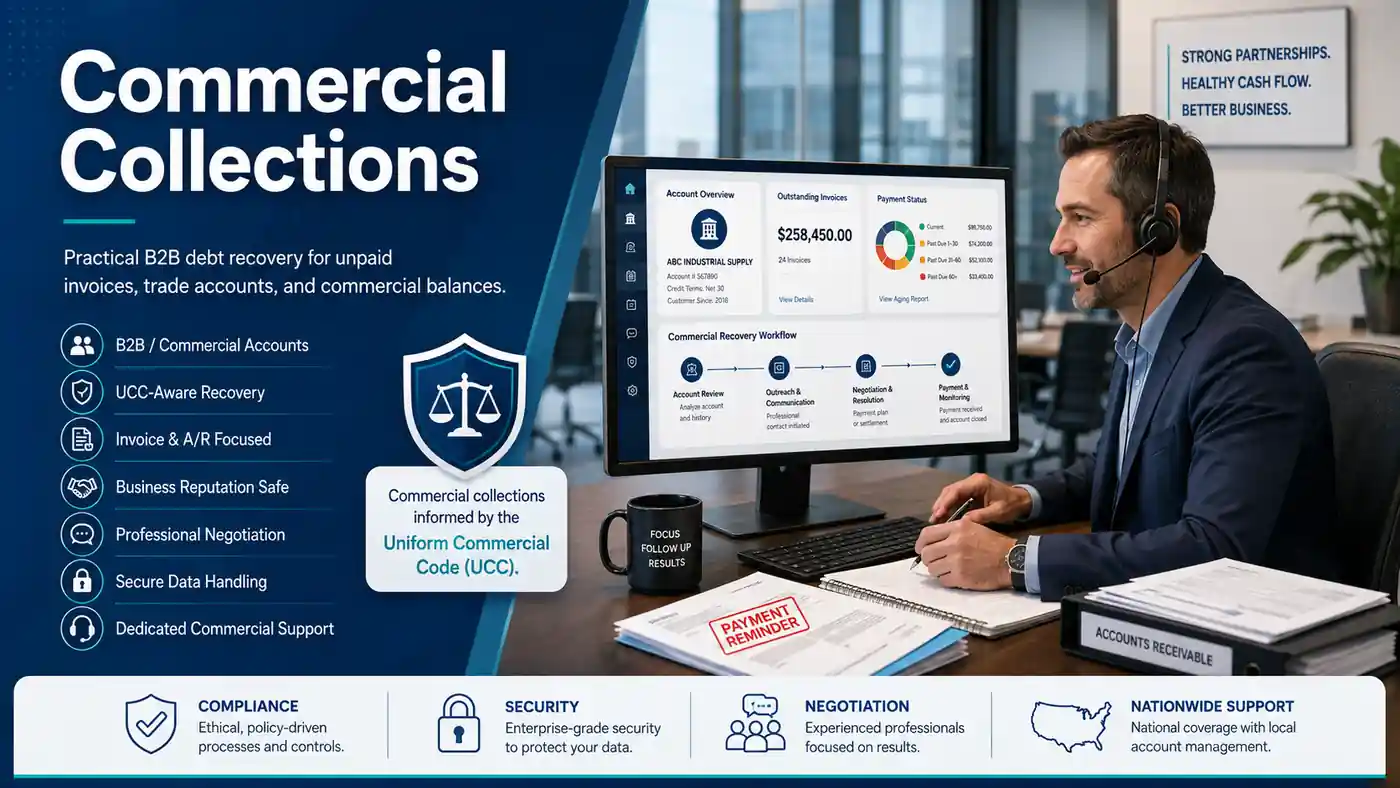
Commercial Debt Collection Agency: B2B Debt Recovery for Businesses

A commercial collection agency specializes in recovering unpaid invoices and past-due debts owed by one business to another (B2B). Unlike consumer debt collection, which is heavily regulated by the FDCPA, commercial collections are driven primarily by contracts, applicable state law and, where relevant, the Uniform Commercial Code (UCC).

Businesses typically turn to a commercial collection agency after internal accounts-receivable efforts have stalled and invoices are 60–120+ days past due. Commercial recovery is rarely one-size-fits-all. Each account is evaluated individually based on the contract, invoice history, documentation, dispute status, debtor’s financial condition, personal guarantees, available assets and likelihood of recovery.

Depending on the type of transaction and industry, recovery may involve credit reporting, negotiated settlements, payment plans, UCC-related remedies, mechanics liens, bond claims or legal escalation. The objective is to apply the right amount of pressure to each account while protecting valuable business relationships and maximizing recovery.

Infographic displaying the B2B commercial debt dispute matrix showing strategies for Net 30 trade credit, supply contract breach, and personal guarantees

Commercial debt collection, disputes often involve complex contracts, purchase orders, freight bills, and multiple decision-makers across departments. At Nexa Collections, we serve CFOs, accounts receivable teams, small businesses, and enterprise companies nationwide, combining diplomatic professionalism with proven legal leverage to recover what you’re owed, without destroying the relationships that matter.

Unpaid invoices are not just an inconvenience; they are a direct threat to cash flow. Research from the Commercial Law League of America shows that a debt only 90 days old has a 73% chance of recovery, but that number falls by roughly 10% for every additional month it goes unpaid. Acting fast is the single biggest factor in successful commercial debt recovery.

Note: To establish enforceable Uniform Commercial Code (UCC) claims and expedite commercial recovery, ensure each placed account includes a signed credit application with personal guarantee, Master Service Agreements or purchase orders, signed bills of lading or proof-of-delivery receipts, and an itemized statement of account.


Trusted by businesses nationwide to recover millions in lost revenue annually. We combine a 80% success rate on viable claims with a diplomatic “Velvet Hammer” approach—ensuring you get paid without damaging valuable B2B relationships.

Over 20 Years of Experience in B2B Debt Recovery.

Need a Commercial Agency? Contact us


When Should You Hire a Commercial Collection Agency?

Most businesses should consider engaging a commercial collection agency when:

  • An invoice is 60 or more days past due with no payment or payment plan in place
  • A debtor has stopped responding to your calls, emails, or mailed notices
  • A client disputes the invoice but has not provided a legitimate counter-claim or documentation
  • Internal AR staff are spending more than 2 hours per week chasing a single account
  • You suspect a business has changed names, moved, or is preparing to close
  • The outstanding balance is large enough to affect your operating cash flow

The 60-day mark is the industry benchmark because recovery rates remain highest before the 90-day threshold. Every month of delay costs you roughly 10% of the recoverable value (Commercial Law League of America).

Quick Facts: Why Choose Us?

  • High Success Rate: While industry averages sit between 15% to 40%, we achieve a nearly 80% success rate on viable debts (accounts under 300 days old backed by solid documentation). Fee communicated in advance after reviewing your case. Results may vary as viability depends on documentation, debtor solvency and dispute status.
  • Business Credit Reporting: We report unpaid accounts to major Business Credit Bureaus. This affects the debtor’s ability to get future financing, creating a powerful incentive to pay you.
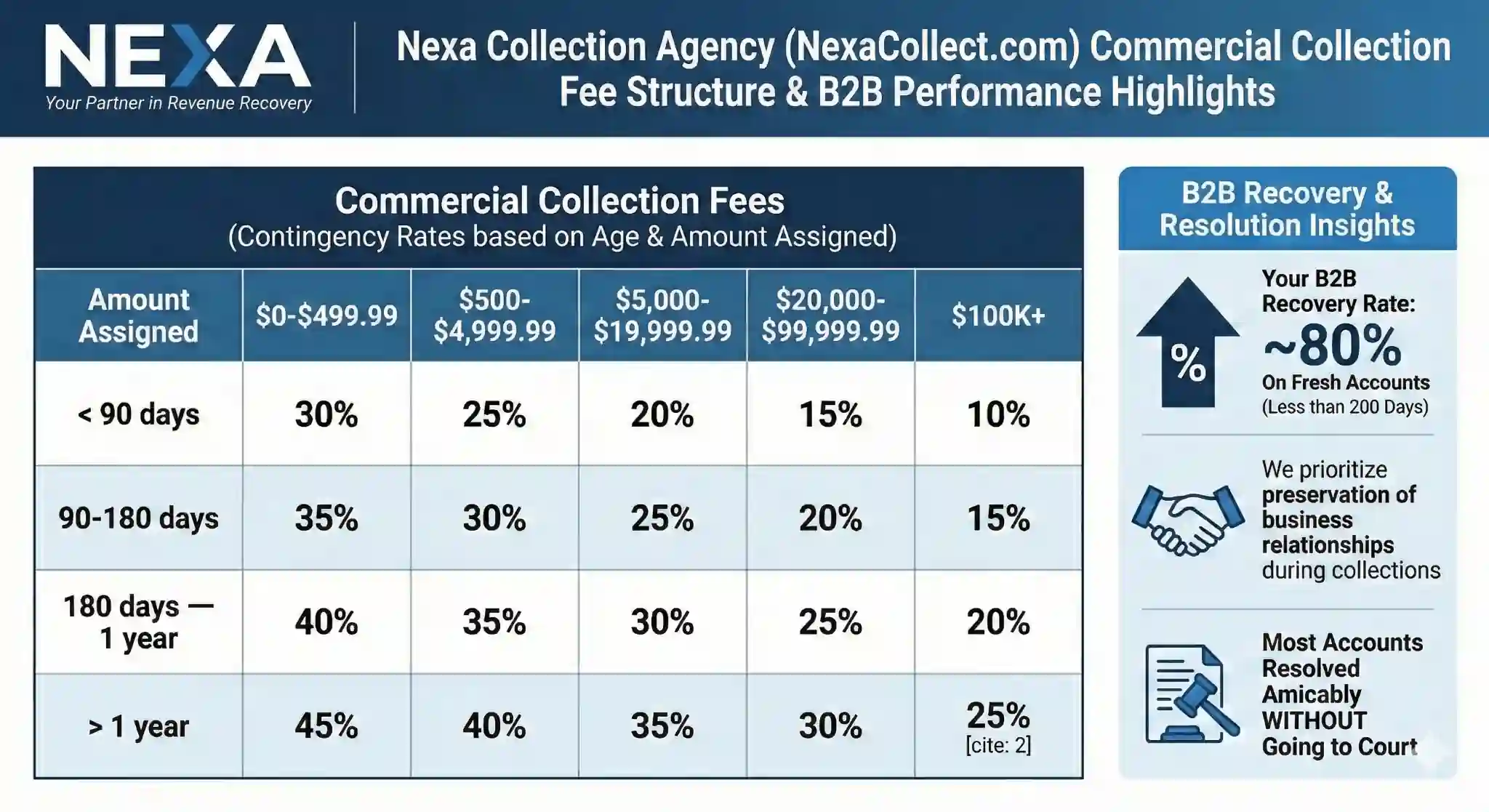
  • No Risk Pricing: We operate on a contingency basis, No Recovery, No Fee, with rates tiered by debt age and balance size rather than one flat percentage.
  • Highly Rated: 4.85 stars across 2,000+ verified client reviews, backed by a dedicated account representative and a specialized B2B support team, not a rotating call queue.
  • Nationwide Compliance: Backed by over 20 years experience, we are licensed in all 50 states and strictly follow the Uniform Commercial Code (UCC) and TCPA regulations.
  • Credentials: Collections performed by ACA-compliant collectors fully licensed to collect in all 50 states. SOC 2 Type II and PCI-DSS compliant, with FDCPA/FCRA-aligned practices for any consumer-adjacent accounts.

Nexa Collections commercial collection agency fee structure — contingency pricing tiers from 15% to 40% based on debt age and balance


The “Velvet Hammer” Approach for B2B

A business debtor is often also a potential future client. We understand that preserving the business relationship is critical. Our collectors use a “Velvet Hammer” strategy: we are persistent and firm regarding the financial obligation, but professional and respectful in our communication. This approach recovers your money while leaving the door open for future business.


Our 4-Step Commercial Recovery Process

Our commercial debt collectors utilize persistent contact, credit leverage, and skilled negotiation to resolve the vast majority of cases amicably, reserving legal action strictly as a last resort.

1. Investigation & Skip Tracing
Before making the first call, we investigate. We verify business status, identify key decision-makers (owners, CFOs), and check for bankruptcy filings. If a debtor has “ghosted,” our skip tracing tools locate them.

2. Strategic Demands & Credit Reporting
We use a multi-channel approach (calls, emails, and mailed notices). Crucially, we utilize credit leverage: a negative mark on a business credit report (such as D&B, Experian, or Equifax) can block a company from getting loans or vendor credit. This pressure often forces immediate payment.

3. Negotiation & Mediation
Commercial debts often involve disputes over service quality or contract terms. Our specialists act as mediators to cut through excuses and secure full payment or enforce a structured settlement plan.

4. Legal Escalation (With Your Approval)
If a debtor has assets but refuses to pay, we can forward the case to our affiliated network of commercial litigation attorneys. We handle the paperwork and manage the process, so you don’t have to.

Need a Commercial Collection Agency?

Contact Us

Serving Nationwide – Low Fee

Built for How You Already Track Receivables

Manual re-entry is friction your finance team doesn’t need. We support streamlined ledger exports and reporting workflows compatible with major accounting and ERP platforms, including QuickBooks, NetSuite, Xero, and Sage, so placing an account doesn’t mean re-keying data your system already has.

Tailored to Your Scale

Small & Mid-Sized Businesses: protects cash flow against larger non-paying customers, enforces personal guarantees and contractually allowed interest, and runs entirely on contingency, zero upfront legal or collection expense.

Enterprise Corporations & Distributors: bulk accounts receivable batching, DSO-reduction reporting, and multi-entity support for companies managing hundreds of accounts across divisions.

Industries We Specialize In

Commercial debt requires industry-specific knowledge. We have dedicated teams for:

  • Construction & Contractors: Handling liens, material disputes, and general contractor issues.
  • Manufacturing & Logistics: Collecting on unpaid freight bills, warehousing fees, and supply orders.
  • Staffing & SaaS: Recovering service fees and contract buyouts.
  • Wholesalers & Distributors: Managing high-volume, low-balance delinquent accounts.
  • Commercial / Office Leases

Commercial Collection Agency vs. Attorney vs. In-House AR Team

Not sure which path is right for your unpaid B2B invoice? Here’s how the three most common options compare:

Factor Collection Agency Commercial Attorney In-House AR Team
Cost Contingency only (15–40%). No upfront fee. Hourly ($250–$500/hr) + court costs. High upfront risk. Salaried staff cost. Consumes internal resources.
Speed 30–90 days for most cases 6–18 months if litigation required Varies; often slow due to competing priorities
Relationship Impact Low — professional, diplomatic approach preserves the relationship High — legal action typically ends the business relationship Moderate — awkward for staff managing existing accounts
Legal Authority None directly; escalates to attorneys when needed Full legal authority — can sue, lien, garnish wages None
Best For Debts of any size; first recovery attempt; relationship-sensitive accounts Large debts ($50K+) where debtor has assets and refuses all negotiation Very recent invoices (under 30 days); ongoing client relationships
Credit Reporting Yes — reports to D&B, Experian, Equifax Business Only via court judgment No

Most businesses use a collection agency first, and only escalate to legal counsel if the agency recommends it based on debtor assets and dispute complexity.

Recent B2B Recovery Results:

  • Midwest Logistics & Freight ($140,000): Resolved a complex cross-border brokerage dispute in 22 days via targeted mediation, bypassing months of litigation.
  • Industrial Manufacturing ($210,000): Recovered 100% of principal plus interest in under 45 days using “Corporate Diplomacy” to reconnect with new decision-makers after a client’s restructuring.
  • Commercial HVAC Construction ($68,000): Secured a full retention payment in 24 days. By filing a “Notice of Intent to Lien,” we forced a developer to release funds to protect their property title.

Our Technical Edge: B2B Security

Secured Creditor Leverage: We specialize in UCC-1 filings and Mechanic’s Liens to “perfect” your security interests. This is a genuine priority advantage over unsecured creditors in a liquidation or insolvency scenario, though priority among competing secured parties still depends on filing timing and specifics, our team handles that analysis rather than assuming a UCC-1 alone guarantees first position.

Checklist: What We Need to Start

To help achieve that 80% success rate, providing the right documentation is key. When you place an account, we recommend uploading:

  • Copies of the original Invoices.
  • The signed Contract, Purchase Order (PO), or Service Agreement.
  • Statement of Account (showing payment history).
  • Any relevant email correspondence regarding the debt.

Frequently Asked Questions: Commercial Debt Collection

What is the difference between consumer and commercial collections?

Consumer collections (B2C) are strictly regulated by the Fair Debt Collection Practices Act (FDCPA) to protect individuals. Commercial collections (B2B) are governed by the Uniform Commercial Code (UCC) and contract law, allowing for different strategies, including business credit bureau reporting, UCC-1 filings, and mechanic’s liens, and often shorter timelines for resolution.

How much does a commercial collection agency charge?

We operate on a contingency fee model, no upfront cost, ever. Our rates are tiered, typically ranging from 15% to 40% of the amount recovered, depending on the age of the debt, the balance size, and the complexity of the case. If we don’t collect, you pay nothing.

How long does commercial debt collection take?

Most commercial debts are resolved within 30–90 days. Simple cases with strong documentation (signed contracts, invoices, proof of delivery) can settle in 2–4 weeks. Complex disputes involving litigation or mediation can take 3–6 months. The sooner a past-due account is placed, the faster, and more likely, the recovery.

Can you collect business debts from companies in another state?

Yes. Nexa Collections is licensed in all 50 states and works with an affiliated network of commercial litigation attorneys nationwide. Interstate B2B collections are routine, and we are well-versed in the UCC provisions and contract law governing cross-border commercial disputes.

When is it too late to collect a commercial debt?

Every state has a statute of limitations for commercial contracts, typically 3 to 6 years. However, collection success drops significantly after 90 days, approximately 10% per additional month (Commercial Law League of America). Acting within 60–120 days of a missed invoice gives you the best chance of full recovery without litigation.

What is a UCC-1 filing and how does it help?

A UCC-1 (Uniform Commercial Code financing statement) is a legal notice filed with the state that establishes your interest in a debtor’s assets. Filing a UCC-1 generally strengthens your position relative to unsecured creditors if the debtor faces insolvency or asset liquidation, though where you land among other secured creditors still depends on filing order and specifics.

Do I need a lawyer to collect a commercial debt?

Not initially. A commercial collection agency resolves the majority of B2B debts through negotiation, credit leverage, and mediation, no litigation required. Legal escalation is reserved as a last resort for debtors who have assets but refuse to pay. In those cases, Nexa manages the entire legal escalation process through our attorney network.

Can you collect from a business that has closed down?

Difficult, but often possible. If the owner signed a personal guarantee, operates as a sole proprietor, or is part of a general partnership, they are personally liable. We also investigate for successor liability (reopened under a new name) and fraudulent transfers (hidden assets). Personal asset pursuit typically requires a court judgment via an affiliated attorney.

What is the average recovery rate for commercial collection agencies?

The industry average ranges from 15% to 40%. Nexa Collections achieves a nearly 80% success rate on viable claims, accounts under 300 days old backed by solid documentation. Results vary based on debtor solvency, dispute status, and documentation quality.

Is it worth hiring a collection agency for a small balance?

Yes, because reputable agencies work on contingency, you pay nothing unless money is recovered. Even balances under $5,000 are worth placing. The recovered funds go directly to your bottom line at zero upfront cost to you.

How do you handle a debtor who claims the goods or services were defective or never delivered as agreed?

Documentation settles this quickly rather than taking either side’s word for it. We review the contract, purchase order, and any proof-of-delivery records before treating a dispute as anything other than genuine, since a debtor manufacturing a quality complaint only after a payment reminder arrives looks very different from one raising a documented issue at the time of delivery. Collecting on a fabricated dispute usually costs more in relationship damage than the balance is worth, so we separate the two before escalating.

Does Nexa integrate with our accounting or ERP software?

Yes, streamlined ledger exports and reporting workflows are compatible with major accounting and ERP platforms, including QuickBooks, NetSuite, Xero, and Sage, so your team isn’t stuck manually re-entering account data every time you place a batch of accounts.

We just learned the invoice we’re trying to collect was already sold to a factoring company. Who actually has the right to pursue it?

It can shift the account out of your hands entirely. Once a receivable is genuinely sold to a factor, the factor typically owns the right to collect it, not the original business, and the factoring agreement usually dictates who pursues a nonpaying account and under what terms. Before placing that invoice with us, it’s worth confirming whether the sale was a true sale or a recourse arrangement where the obligation could come back to you.

Our delinquent customer is a franchisee. Can we pursue the franchisor for the unpaid balance?

Usually not. Franchise law generally treats a franchisee as an independent business responsible for its own trade debts, and a franchisor typically isn’t liable simply because its name is on the location. The exceptions are narrow, such as a franchisor that personally guaranteed the account. Knowing which entity actually signed the credit application matters more here than which brand is on the sign.


Ready to Boost Your Cash Flow?

Don’t let unpaid invoices sit on your books. Statistics show that after 90 days, the chance of collecting a debt drops by 10% every month.

Get a Free Commercial Quote

Filed Under: Debt Recovery

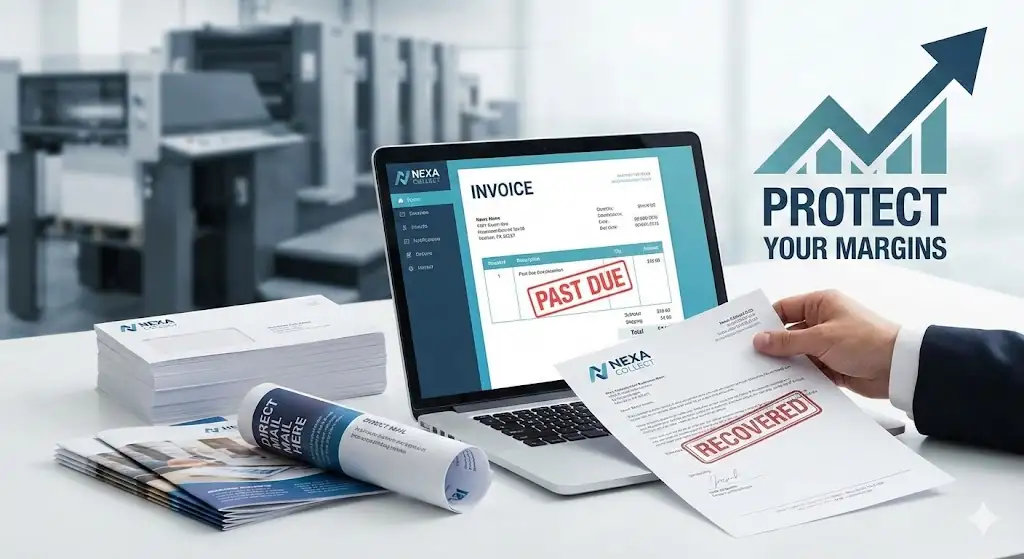
Printing & Mailing Collections: Protecting Your Margins Without Burning Bridges

blank

In the printing and mailing industry, cash flow moves on a timeline of ink and postage. When clients delay payment on a large run or a quarterly campaign, your business isn’t just out of profit—you’re out of the physical costs of paper and labor.

You don’t need an aggressive “debt collector.” You need a structured resolution that keeps your B2B reputation intact while securing your revenue.

Nexa provides a reputation-safe approach, equipped with all 50-state collections license, offering free credit reporting, free litigious debtor check, free bankruptcy scrub, and zero onboarding fees. Secure – SOC 2 Type II & HIPAA compliant. Over 2,000 online reviews rate us 4.85 out of 5. 

Need a Collection Agency? Contact us

Two Ways to Recover Your Revenue

  • Fixed-fee $15: You keep 100% of what is collected. Best for early-stage B2B invoices.

  • Contingency 20%–40%: No recovery, no fee. We take the risk on older or harder-to-reach accounts.

blank

Why the “Velvet Hammer” Fits the Printing Industry

Most printing debts are B2B. While B2B collections offer more legal leeway than consumer debt, aggressive tactics can still trigger “review-bombing” or loss of future contracts.

  • Firm Structure: We move accounts from vague promises to documented payment dates.

  • Bilingual Outreach: Our Spanish-speaking collectors ensure clear communication across all client demographics.

  • Data-Driven: We use bankruptcy scrubs and litigation checks so you don’t waste time chasing the impossible.

Red Flag Box: 3 Signs a Print Client is Stalling

  • The “Quality Dispute” Delay: They only mention a print error after the invoice is 60 days past due.

  • The “Waiting on My Client” Excuse: They try to make their cash flow your problem.

  • Silent AP Departments: When your primary contact goes quiet and accounting won’t return calls.

Recent Recovery Result

$12,500 Direct Mail Campaign (B2B)

  1. The Issue: A marketing agency skipped payment, claiming their own client hadn’t paid them yet.

  2. The Nexa Approach: We bypassed the “waiting game” by reaching the decision-maker and establishing a three-part payment schedule.

  3. The Result: 100% recovery within 22 days. The printer maintained the relationship for the next campaign.

Behind the Curtain: Our Compliance Tools

  • USPS Address Checks: Essential for mailing houses to ensure billing accuracy.

  • Skip Tracing: To find owners of “ghost” agencies or dissolved businesses.

  • Recorded Calls: Every interaction is logged to protect your brand from rogue collection tactics.

Frequently Asked Questions

Does Nexa handle disputes over “print quality”?
Yes. We act as a neutral third party to move past subjective excuses. We request documentation and set a firm timeline to resolve the balance before the dispute “ages” the debt into a loss.

Can I collect if my client says they are “waiting to be paid” by their customer?
Absolutely. In B2B printing, this is a common stall tactic. We shift the focus back to the original contract between you and your client, ensuring your cash flow isn’t tied to their internal mismanagement.

Is there a minimum balance required for the $15 fixed-fee service?
No. Our fixed-fee service is designed to be cost-effective for even small invoices, allowing you to clear your books of “nuisance” balances without losing 40% of the revenue.

Will using a collection agency ruin my reputation in the industry?
Not with our “Velvet Hammer” approach. We prioritize mediation and professional reminders. Our goal is to secure your payment while leaving the door open for future business once the client’s cash flow stabilizes.

Need a Collection Agency: Contact Us

Filed Under: Debt Recovery

  • « Go to Previous Page
  • Page 1
  • Interim pages omitted …
  • Page 27
  • Page 28
  • Page 29
  • Page 30
  • Page 31
  • Interim pages omitted …
  • Page 54
  • Go to Next Page »

Primary Sidebar


accounts receivable

Need a Collection Agency?
Kindly fill this form.
We’ll get in touch with you

    Please prove you are human by selecting the key.

    Compliance & Security

    • SOC 2 Type II Certified: Third-party audited data security and strict privacy controls.

    • HIPAA Compliant: Secure, legal processing of medical and municipal EMS accounts.

    • PCI-DSS Level 1: Highest tier of data encryption for secure payment processing.

    • FDCPA & FCRA Aligned: Full legal adherence to federal consumer protection laws.

    Recent Posts

    • Commercial and B2B Collection Agency in Detroit
    • Boston Medical Collection Agency | Serving Hospitals, Physicians & Dentists
    • Collection Agency in El Paso, TX | Compliant, Cost Effective & Reputation Safe
    • Collection Agency in Washington DC | Medical, Schools, Businesses & Contractors
    • The Collection Agency School Districts Trust With Their Reputation
    • How Dental Insurance Denials Turn Into Patient Debt (And How to Stop It)
    • College Station Collection Agency: Recovering What Aggieland Is Owed
    • Recovering Cash in Clovis Without Losing Your Community Respect

    Featured Posts

    • Improve Financial Literacy: Tips for Better Money Management
    • Debt Collection Laws and Agencies in Germany
    • Collection Agency for Garage Door, Glazing & Window Companies

    Copyright © 2026 NEXACOLLECT.COM | This content is provided for general informational purposes only and should not be considered legal advice. Collection laws and requirements may vary by state, account type, documentation, debtor status, and specific facts. Please consult qualified legal counsel for guidance regarding your particular situation. Nexa and its authorized collection partners service accounts in accordance with applicable federal and state collection requirements. Visit our home page to know more about us.

    X
    Need a Collection Agency?
    Contact Us