Washington, D.C. is not a place for one-size-fits-all debt collection. Consumer accounts face unusually detailed procedural requirements—including strict documentation and service-of-process rules—while medical, commercial B2B, professional-service and other debts each require a different recovery strategy. Nexa combines D.C.-aware compliance, reputation-safe communication, secure handling and account-specific recovery to help organizations collect what they are owed without creating unnecessary legal or reputational risk.
In short: Washington, D.C. runs one of the strictest, most procedurally detailed debt collection codes reviewed anywhere in this project (D.C. Code § 28-3814): a permanent ban on visiting a debtor’s home or workplace, a call cap of 4 per account per week, a 3-year statute of limitations that explicitly cannot be revived by a later payment, and a GPS-and-timestamp photo requirement for proof of service in any lawsuit. Nexa recovers D.C. accounts starting at a $15 fixed fee per account, with contingency options for older balances, run against this specific procedural framework from the first contact.
Need a Collection Agency in Washington, D.C.? Contact us
The Procedural Rules That Make D.C. Different
Proof of service has to be photographic and GPS-verified.
Under § 28-3814(p), before filing suit a collector must reasonably investigate the debtor’s current address, and when proof of service is filed with the court, it must include a photograph with a readable timestamp and readable GPS coordinates showing where service occurred. This exists specifically to prevent “sewer service”, falsely claiming service happened to obtain a default judgment, and it means any lawsuit filed here needs genuinely rigorous documentation from the process server, not just a signed affidavit.
Home and workplace visits are permanently off the table.
Separate from D.C.’s (currently inactive) pandemic-era provisions, § 28-3814(d) permanently bars a collector from visiting a consumer’s household or place of employment at any time for collection purposes, the only exception is serving legal process. Contact has to happen by phone, mail, or approved electronic channels.
Contact frequency is capped tighter than the federal norm.
D.C. limits calls to 4 per account in any 7-day period (versus the more commonly cited federal benchmark of 7), and after a completed call, no callback for 7 days unless the consumer asks for one. Text messages, emails, and social media messages are capped at 5 per account per week, and none of those channels can be used at all before the required written validation notice has been mailed.
The statute of limitations doesn’t bend for a later payment.
Under § 28-3814(o), consumer debt actions must generally be filed within 3 years of accrual, “notwithstanding the provisions of any other statute of limitations.” Section (l) goes further than most states’ case law by saying so directly: once that period expires, a later payment or written or oral acknowledgment does not revive it. D.C. joins Maine, Maryland, and Minnesota as a non-revival jurisdiction, stated with more statutory clarity than most.
The Washington, D.C. Legal Landscape
| Statute of Limitations (consumer debt) | 3 years, non-revivable — D.C. Code § 28-3814(o), (l) |
| Home/Workplace Visits | Permanently prohibited for collection purposes — § 28-3814(d)(5)-(6) |
| Call Frequency | Max 4 per account per 7-day period — § 28-3814(d)(4)(A) |
| Text/Email Frequency | Max 5 per account per 7-day period, after written notice — § 28-3814(d)(4)(B) |
| Proof of Service | GPS-tagged, timestamped photograph required — § 28-3814(p) |
| Attorney’s Fees | Generally capped at 15% of the debt absent detailed justification — § 28-3814(v) |
| Imprisonment for Debt | Prohibited outright — § 28-3814(y) |
| Statutory Damages | $500–$4,000 per violation, plus actual and punitive damages — § 28-3814(u) |
What This Costs
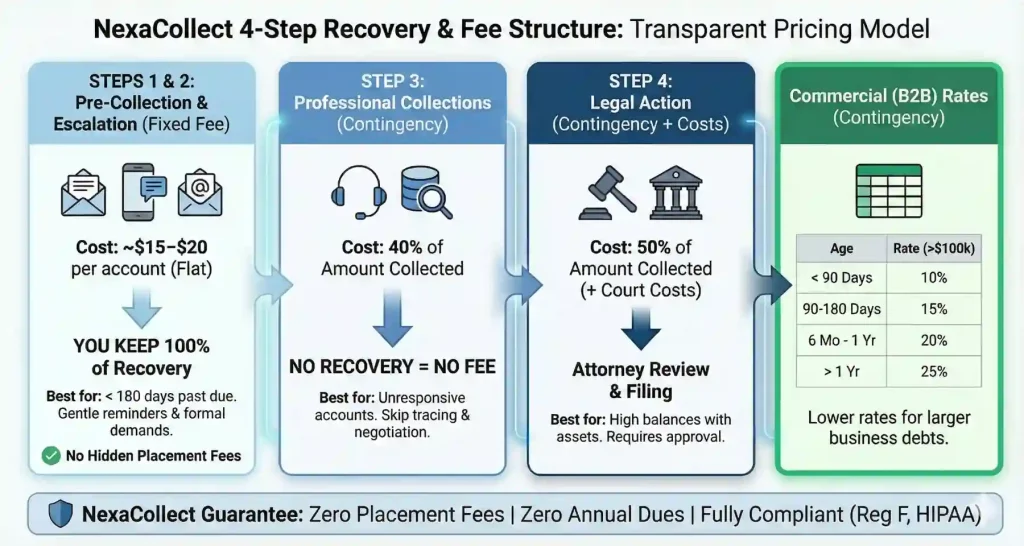
Step 1 & 2: Fixed-Fee Recovery (~$15/account). Five professional demand touches for accounts under roughly 60 days. Payments go directly to you. See the full pricing breakdown.
Step 3: Contingency Collection (20%~40%). For older or unresponsive accounts, no recovery, no fee.
Step 4: Legal Referral (client-approved, ~50%). Handled with the documentation rigor D.C.’s courts specifically require, filing fees reimbursed from the first recovery.
Who We Collect For Across the District
- Medical & Dental: HIPAA-compliant patient balance recovery for practices across the district’s hospital and outpatient network.
- Government Contractors, Law Firms & Associations: B2B and commercial receivables for the professional services, consulting, and trade-association sector that defines much of D.C.’s private-sector economy.
- Nonprofits & Membership Organizations: Recurring dues and program-fee recovery for the district’s dense concentration of associations and advocacy organizations.
- Schools & Education: Tuition and program fee recovery for the district’s private schools and universities.
- Property Management: Move-out and lease-end balance recovery for the district’s rental market.
- Fitness & Membership Businesses: Recurring billing recovery for studios and gyms across the city.
Recent Recovery Results
1. Private Day School (NW Washington, DC)
-
Balance: $6,400 (Past-Due Tuition & Program Fees)
-
Outcome: Resolved via a diplomatic 3-month payment plan after skip tracing located the relocated parent, recovering the balance without damaging school-community relations.
2. Outpatient Medical Clinic (Downtown DC)
-
Balance: $3,850 (Aging Patient Co-pays & Deductibles)
-
Outcome: HIPAA-compliant outreach and online payment portal setup resulted in over 70% direct payment settlement within 45 days.
3. Commercial IT & Professional Services (K Street Corridor)
-
Balance: $11,500 (Delinquent 90-Day Vendor Invoices)
-
Outcome: Professional B2B mediation with corporate accounts payable resolved a billing dispute and secured full wire settlement in two installments.
Frequently Asked Questions
Why does a debt collection lawsuit in D.C. require a photo with GPS coordinates?
Because D.C. Code § 28-3814(p) requires it specifically to prevent “sewer service,” a process server falsely claiming a defendant was served in order to obtain a default judgment. When proof of service is filed with the court, it must include a photograph with a readable timestamp and readable GPS coordinates showing the location of service, a documentation standard well beyond what most jurisdictions require.
Can a collection agency visit a debtor’s home or workplace in D.C.?
No, not for the purpose of collecting a debt. § 28-3814(d) permanently prohibits visiting a consumer’s household or place of employment at any time for collection purposes, with the only exception being to serve legal process. This is a standing rule, separate from D.C.’s pandemic-era provisions, which suspended other collection activity but are not currently in effect.
How many times can a collector call a D.C. resident in a week?
Generally no more than 4 times per account in any 7-day period, stricter than the 7-per-week benchmark commonly cited under federal rules. After a completed call, the collector generally cannot call back for 7 days unless the consumer requests it.
If a debtor makes a payment on an old D.C. debt, does that restart the clock?
No. Under § 28-3814(l), once the 3-year statute of limitations on a consumer debt has expired, a later payment or a written or oral acknowledgment does not revive it. D.C. states this directly in statute, more explicitly than most states leave to case law.
Are attorney’s fees capped if a collection lawsuit goes to judgment in D.C.?
Generally yes. Under § 28-3814(v), a contractual attorney’s fee provision is enforceable up to 15% of the debt, excluding fees and collection costs, unless the prevailing party applies to the court with a detailed, itemized justification for a higher amount and the court finds the additional fees were reasonably necessary.
Does D.C.’s law treat debt buyers differently from original creditors pursuing their own accounts?
Yes, significantly. Before a debt buyer can obtain a default or summary judgment, § 28-3814(s) requires account-specific affidavits establishing the debt from the original creditor and from every subsequent party in the chain of ownership, a real evidentiary burden that doesn’t apply to original creditors collecting their own debt.