A collection agency’s worst outcome for a school district isn’t a low recovery rate. It’s a parent posting a screenshot of an aggressive collection call on the district Facebook group the week before a bond referendum.
Every dollar recovered the wrong way costs more in trust than it returns in cash. That’s the entire premise behind how Nexa works with school districts, and it’s why districts nationwide, several of whom are current clients seeing genuinely strong recovery results, have moved their unpaid balances to a partner built specifically for public education rather than a generic commercial collector wearing a school-friendly logo.
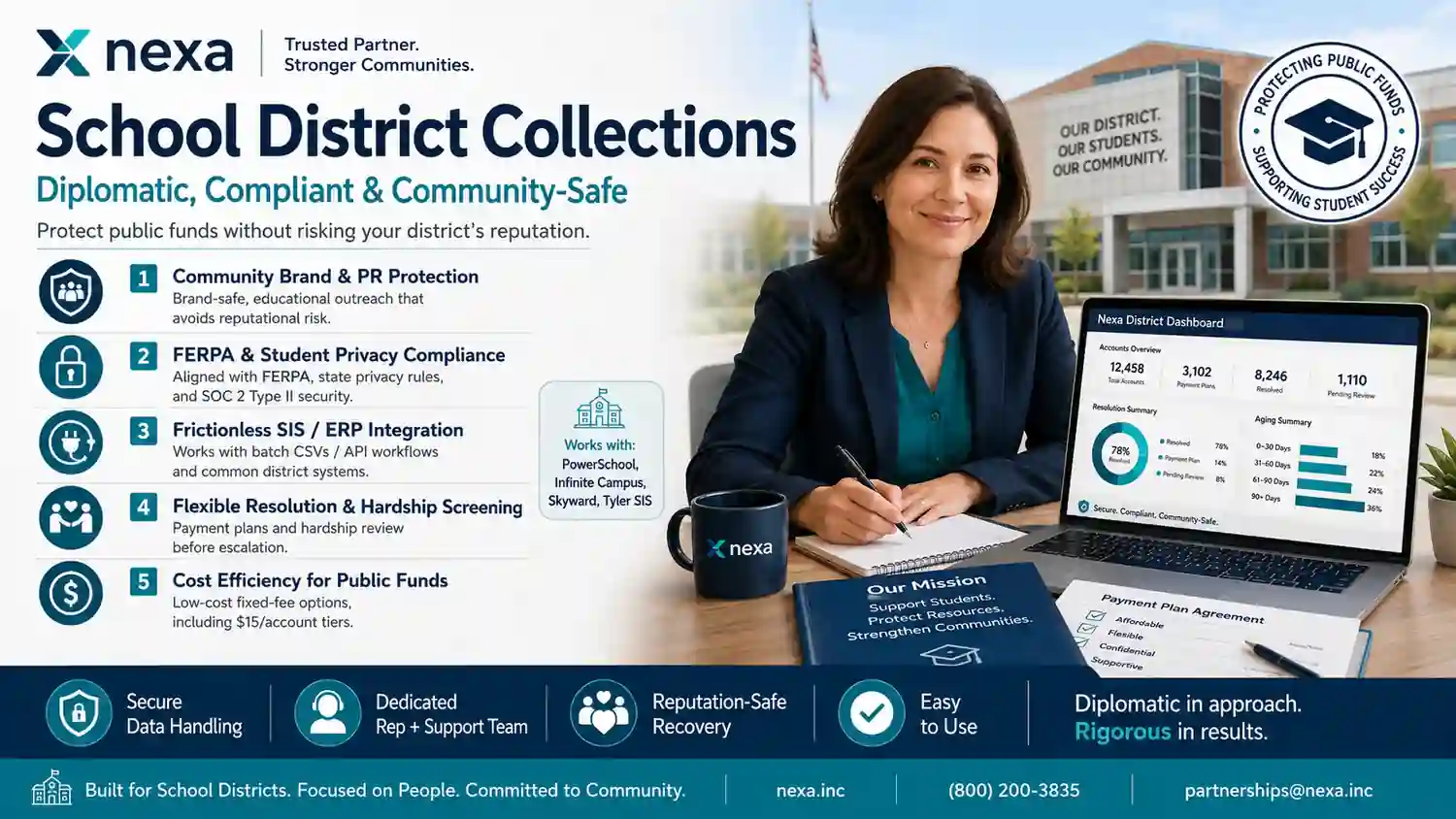
Quick answer: School districts recover unpaid meal, device, and activity balances most effectively through diplomatic third-party mediation, not aggressive collection tactics. Because a child’s school standing is involved, families respond quickly to an official, credible notice once they realize a balance is genuinely overdue, often faster than to another portal reminder buried in daily school communications. Nexa works with public districts, charter networks, and private schools under FERPA’s school-official exception, offering a $15 fixed-fee option (districts keep 100% of recovered funds) alongside contingency recovery for aged accounts, with SIS-compatible batch uploads and strict anti-lunch-shaming-aware communication standards.
Nexa provides reputation-safe, parent friendly, 50-state collections license with free skip tracing, litigious debtor check and bankruptcy scrubs, and zero hidden or onboarding fees on both fixed-fee and contingency models. Secure – SOC 2 Type II & FEPRA compliant. Easy to use, and references available upon request.
Need a Collection Partner for Your District? Contact us
Why Recovery Rates Run Higher Than Districts Expect
A parent portal notice competes with dozens of other messages in a given week. An official third-party notice doesn’t. It signals, correctly, that a balance has moved past the point of routine reminders, and because it involves a child’s account standing, families tend to act on it promptly rather than letting it sit in an inbox. This isn’t aggressive pressure, it’s simply cutting through genuine notification fatigue with something that reads as serious without reading as hostile.
Third-party mediation also does something a district’s own staff structurally can’t: it creates distance. A front-office employee who has to see a family at pickup every day is in a difficult position pursuing a balance directly. A neutral third party absorbs that friction, letting the district maintain the same warm, welcoming relationship with the family it had before the balance became a problem.
What Districts Actually Look For in a Collection Partner
Public reputation and PR safety come first, not last.
Zero heavy-handed tactics, full brand protection, and a tone that could be read aloud at a school board meeting without anyone flinching. This isn’t a nice-to-have for a public institution, it’s the primary selection criterion.
Real FERPA compliance, not a badge.
Student financial data is shared under FERPA’s school-official exception, which requires a formal written agreement, use limited strictly to the collection purpose, and the district retaining control over how that data is used. SOC 2 Type II certified security and encryption back this up operationally.
Administration that doesn’t create work for already-stretched staff.
A dedicated account manager, simple batch Excel uploads, and direct compatibility with the SIS platforms districts already run, PowerSchool, Infinite Campus, Skyward, and similar systems, so placing accounts doesn’t mean building a new workflow from scratch.
Transparent, genuinely taxpayer-friendly pricing.
A $15 flat fixed fee for earlier-stage accounts, with the district keeping 100% of what’s recovered, and contingency pricing reserved for older, harder-to-recover balances. Public funds deserve a pricing model a board member can explain in one sentence.
Licensing that doesn’t create a gap.
Active licensing across all 50 states means a family that relocates mid-collection doesn’t cause the account to simply stall.
The Balances Districts Actually Place
- Unpaid meal and cafeteria balances, handled in a way that’s aware of, and consistent with, state anti-lunch-shaming requirements from the first contact.
- 1:1 device and technology fees, damaged, lost, or unreturned Chromebooks, tablets, laptops, and mobile hotspots, an increasingly large category as 1:1 programs have become standard.
- Extracurricular, athletic, and activity fees, sports participation, instrument rental, club dues, and field trip balances.
- Textbook, library, and course material replacement costs.
- Early childhood, Pre-K, and extended-day/after-school program balances.
- Dual-enrollment, AP, and exam or lab fee balances, an account type that’s often overlooked until it accumulates across a graduating class.
Why Gentle, Respectful Outreach Actually Works Better Here
Heavy-handed tactics don’t just risk one family’s goodwill in a school district context, they risk becoming a story. A Pennsylvania district drew national attention after sending letters implying unpaid lunch debt could lead to a child’s removal from the home. Minnesota districts drew similar attention after considering barring students with meal debt from their own graduation ceremony, a plan state officials stepped in to stop. Neither of these recovered more money than a calm, well-documented process would have; both cost the districts involved real public trust.
The alternative that actually works: clear, empathetic communication explaining the balance, flexible installment plans, an accessible online parent payment portal, and a genuine, fast path to dispute resolution when a family believes a charge is wrong. Families experiencing documented financial hardship are routed toward the district’s own assistance programs rather than pursued as a standard account, since collecting from a family that genuinely cannot pay isn’t a collections problem, it’s a policy question the district should be handling directly.
Worth Knowing: Pending Federal Legislation on Meal Debt Specifically
A federal bill, the No Shame at School Act, has been reintroduced in Congress and would specifically prohibit districts from hiring debt collectors to pursue school meal balances. It has not passed. This doesn’t change what’s legally available to districts today, but it’s a genuine signal of where policy attention on meal debt specifically is heading, and it’s part of why Nexa’s approach to meal balances in particular leans toward the gentlest end of the outreach spectrum: clear communication and payment plans first, with collection escalation used sparingly and only after every softer option has been offered.
What This Costs

Early-Stage Fixed Fee ($15/account). A structured sequence of respectful, official-sounding notices for accounts still fresh. The district keeps 100% of what’s recovered. See the full pricing breakdown.
Contingency Recovery. For older, harder-to-reach accounts, no recovery, no fee, with free bankruptcy scrubs and skip-tracing/address verification included before any account is actively worked.
Why Districts Choose Nexa Specifically
- 100% reputation-safe communication, reviewed against the same standard a school board would apply.
- Two flexible recovery tiers, so a district isn’t paying contingency rates on accounts that would resolve with a simple, low-cost notice.
- SIS-compatible batch processing, no manual re-entry for PowerSchool, Infinite Campus, Skyward, or similar platforms.
- SOC 2 Type II data security, FERPA-aware handling, FDCPA and CFPB Regulation F compliance, and a dedicated account manager who understands public education specifically, not commercial collections dressed up for schools.
Frequently Asked Questions
Is it legal and FERPA-compliant for a school district to use a collection agency?
Yes, when it’s structured correctly. FERPA’s “school official” exception allows a district to share necessary financial data with a collection agency without separate parental consent, provided the agency performs a service the district would otherwise handle itself, is formally designated under the district’s FERPA notice, and remains under the district’s control over how the data is used. This requires a written agreement between the district and the agency, it isn’t automatic simply because the agency claims compliance.
How does Nexa handle unpaid school meal balances without violating state anti-lunch-shaming statutes?
By treating meal debt as the most sensitive account category by default, not an edge case. At least 15 states have specific anti-lunch-shaming laws, and common requirements, meals aren’t withheld regardless of balance, and communication goes confidentially to parents rather than identifying a student publicly, are built into how meal accounts are handled from the first contact, not added after a complaint.
What happens if a family experiences documented financial hardship?
Hardship accounts are routed toward resolution and the district’s own assistance programs rather than pursued as a standard collection. The goal is matching the response to the actual situation, a family that genuinely cannot pay needs a different conversation than one that’s simply overlooked a bill, and treating both identically is where reputational damage tends to start.
How do parents typically respond when an outside collection agency contacts them about school fees?
Generally faster and more directly than they respond to internal reminders, since an official third-party notice reads as a clear signal that a balance needs real attention, cutting through the volume of routine school communications most parents receive weekly. This isn’t about pressure, it’s about a message that’s distinguishable from the noise.
Does COPPA apply to school debt collection?
No, and this is worth being precise about rather than repeating a common assumption. COPPA governs commercial websites and online services that collect personal data directly from children under 13, and it explicitly does not apply to schools or districts as “operators.” School debt collection involves contacting parents about a financial balance, not collecting data from a child through an online service, so COPPA simply isn’t the relevant framework here; FERPA is.
How does Nexa’s $15 fixed-fee model actually save money for taxpayer-funded districts?
By pricing per account rather than as a percentage of the balance recovered, so the district keeps the full amount collected instead of losing a third or more to a traditional contingency fee on every account. For the large volume of smaller-balance accounts, meal debt, activity fees, minor device charges, that a district typically carries, this difference compounds significantly across a full aging report compared to a contingency-only model.