Quick answer: A dental insurance denial becomes patient debt when the shifted balance reaches the patient without a clear explanation, and the practice has no structured process for appeal, communication, and follow-up before the account ages past the point of easy recovery. Most claims can still be appealed within 30 to 180 days of denial, most patient statements go unpaid simply because they’re confusing, and most practices should refer an account to collections between 90 and 180 days of unsuccessful internal follow-up, since collectability drops sharply after that window.
Need help with unpaid dental balances? Contact us
Why a Denial Turns Into a Debt Problem, Not Just a Billing Problem
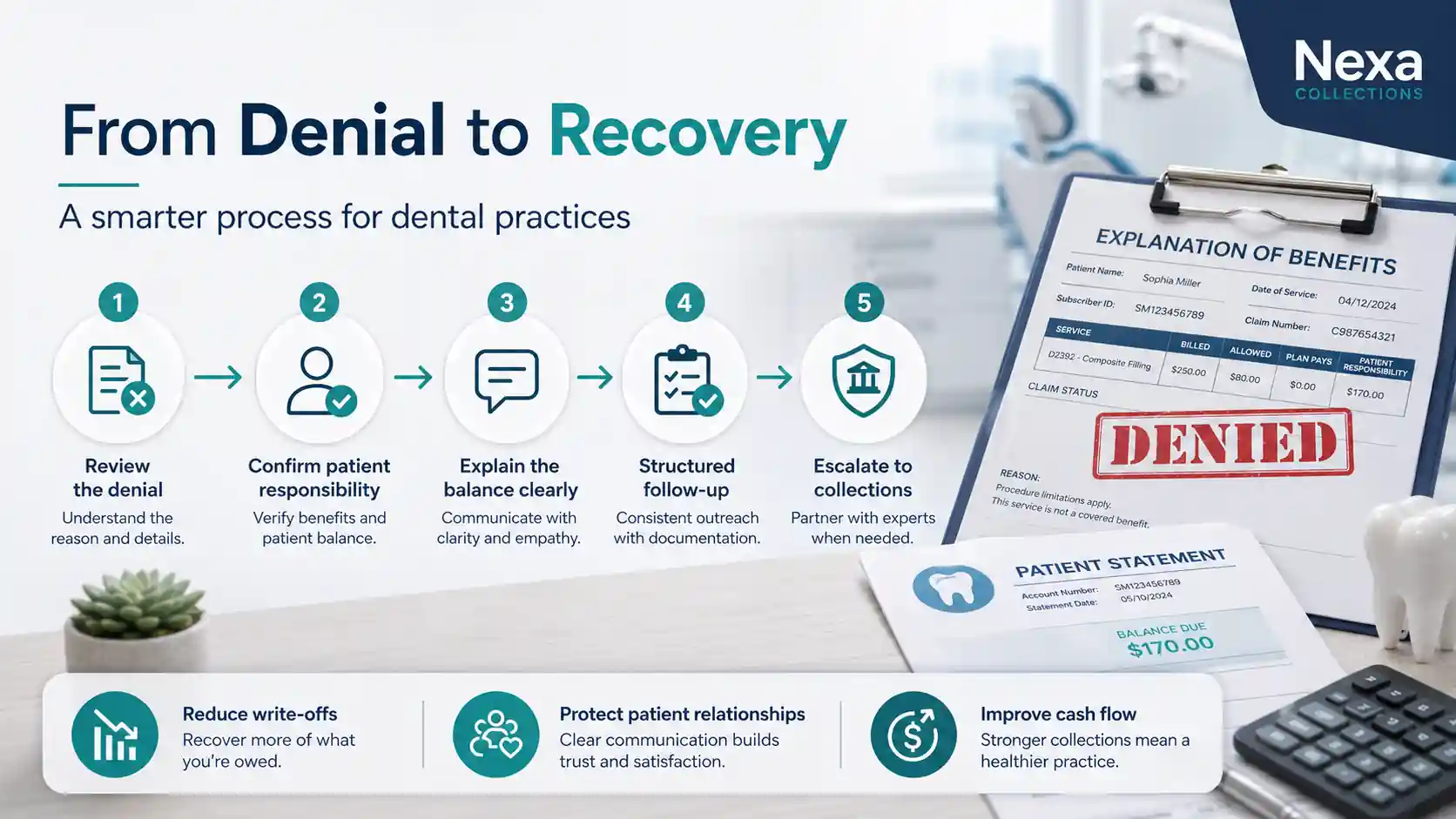
The claim gets denied. Weeks pass. The practice, trying to keep the ledger current, sends a statement. The patient, who assumed insurance was handling it, has no idea why they suddenly owe $340. That gap, between the denial and an explanation the patient can actually understand, is where a solvable billing issue turns into an unpaid balance.
This isn’t a small or occasional problem. More than half of dentists cite denied or delayed insurance reimbursement as a top practice challenge, and initial denial rates typically run 5–15% of submitted claims depending on payer mix and documentation quality. Across a full patient panel, that’s a meaningful share of production sitting in limbo at any given time, and most of it is genuinely recoverable if the process behind it is right.
What Actually Causes Dental Claims to Get Denied
Treating every denial as a single category leads to the same generic response every time, appeal and hope. The reality is more specific, and knowing the category changes both the appeal strategy and the odds of success.
- Missing or incomplete documentation. Narratives, radiographs, or periodontal charting that didn’t accompany the original submission. Often the fastest and highest-odds appeal, since the fix is simply attaching what should have been there.
- Frequency limitations exceeded. The plan covers the procedure, but not this often, this year. Appeals here rarely succeed unless there’s a documented medical necessity for the exception.
- Non-covered service. The plan simply doesn’t include the procedure. These are usually not appealable in the traditional sense; the conversation shifts to patient financial responsibility from the start, which is exactly why clear, upfront communication before treatment matters.
- Bundling or down-coding. The payer reclassified the procedure as part of a broader code, or paid at a lower-complexity rate than billed. These require a specific, documented rebuttal tied to the actual clinical findings, not a generic appeal letter.
Knowing which category a denial falls into before drafting an appeal is the difference between a productive fifteen minutes and a wasted one.
Before You Bill the Patient: Confirm You’re Actually Allowed To
Appeal first. Billing a patient before the insurance process is exhausted, before the final EOB actually confirms patient responsibility, is one of the more damaging mistakes in dental billing, and it isn’t only a relationship problem.
In-network providers have signed an agreement with the payer, and that agreement can restrict balance-billing for certain denial categories, particularly when the denial traces back to a practice-side error like a missed timely-filing deadline or a documentation gap. Billing the patient for a balance the practice isn’t contractually entitled to collect isn’t just bad optics; it can be a breach of the provider agreement itself. Out-of-network providers generally have more flexibility, but “more flexibility” isn’t “no rules,” and a denial tied to exhausted benefits behaves differently than one tied to a coding dispute.
The practical rule: don’t bill until the final EOB has actually established what the patient owes. Most carriers allow 30 to 180 days for an appeal from the denial date.
Does the No Surprises Act Protect Patients From These Bills?
Almost certainly not, and this is worth stating clearly because the assumption runs the other way. The No Surprises Act’s balance-billing protections, the part most people mean when they invoke it, apply to emergency care and certain out-of-network care at in-network facilities. Dental insurance is virtually always classified as an “excepted benefit” plan under federal regulation, which places routine dental care outside those protections entirely.
What the NSA does require, and this genuinely applies to dental practices: a Good Faith Estimate must be given to uninsured or self-pay patients before treatment, generally within three business days of scheduling or request, under 45 CFR 149.610. If the actual bill comes in $400 or more above that estimate, the patient can formally dispute it through the federal Patient-Provider Dispute Resolution process. A denied-claim patient who was insured at the time of treatment generally falls outside this specific protection, but a practice that failed to provide a required estimate to an uninsured patient has real exposure regardless of how the claim itself was handled.
How to Communicate a Denial So the Patient Actually Pays
The single highest-leverage sentence in dental billing may be this one, placed directly on the statement: “Your insurance claim was denied. That is why you are receiving this bill.” Patients who understand why they owe money pay faster, respond to follow-up more readily, and, when they’re frustrated, direct that frustration at the insurer rather than the practice that treated them. A statement with a dollar amount and no context gets set aside, not paid.
We leverage state prompt-pay statutes (e.g., Texas Insurance Code § 843.338, California Insurance Code § 10123.13) to enforce 30-day interest penalties on clean EDI 837D claims.
The Internal Follow-Up Window Before Escalation
A structured sequence, generally running 90 days, gives a practice its best shot at resolving the balance without outside help:
- Day 30: Initial statement with the denial explanation attached, plus a first follow-up contact.
- Day 60: Second notice, ideally offering a payment plan, since a debtor who understands the balance but is under financial strain will often commit to a schedule they can actually keep.
- Day 90: Final notice with clear next steps, including that continued non-payment moves the account toward professional collection.
Document every contact: date, method, outcome. That record protects the practice twice over, it keeps the billing team aligned on where each account stands, and it demonstrates the practice made a genuine effort if the account does eventually move to a collection agency.
When to Hand the Account to a Collection Agency
Most dental practices refer accounts to collections after 90 to 180 days of unsuccessful internal follow-up, and earlier tends to outperform later. Collectability drops to roughly the mid-70s percent range once an account passes 90 days past due, and falls below half by around nine months. Waiting longer doesn’t protect the patient relationship; it just lowers the odds of ever collecting the balance at all.
The clearer signals that an account is ready: no response across multiple documented contacts, a dispute the practice genuinely cannot resolve internally, or a patient who can no longer be located. Any one of those, following a real internal effort, is a reasonable trigger.
Nexa’s dental debt collection services are built specifically for this handoff, HIPAA-compliant, dental-specific, and diplomatic by design, since most of these balances trace back to insurance confusion rather than an unwillingness to pay. See the full pricing structure for how fixed-fee and contingency options compare for accounts at this stage.
Frequently Asked Questions
Who is actually responsible for a dental bill after an insurance denial?
Generally the patient, once the final Explanation of Benefits confirms the balance as patient responsibility, but whether the practice is allowed to bill for it depends on the provider’s network status and the denial reason. In-network providers can be contractually restricted from balance-billing patients for certain denial categories, particularly ones caused by a practice-side error like a missed filing deadline, so the final EOB should be treated as the trigger for billing, not the initial denial notice itself.
Does the No Surprises Act protect patients from a denied dental claim balance?
Generally no. The NSA’s balance-billing protections apply mainly to emergency care and certain out-of-network hospital-facility scenarios, and dental insurance is almost always classified as an excepted benefit plan that falls outside those specific protections. The part of the NSA that does apply to dental practices is the Good Faith Estimate requirement for uninsured or self-pay patients, which carries its own separate dispute right if the final bill exceeds the estimate by $400 or more.
What’s the fastest way to know if a denial is worth appealing?
Identify which category it falls into before drafting anything. A denial for missing documentation is usually a fast, high-odds fix, attach what should have been submitted originally. A denial for a non-covered service or an exceeded frequency limit is rarely worth a generic appeal and is better handled as a direct, upfront conversation with the patient about financial responsibility.
What should a patient statement actually say after a denial?
It needs one clear sentence explaining why the balance exists, something as simple as noting the claim was denied and that’s the reason for the bill. Statements that show only a dollar amount with no context are the single biggest reason denied-claim balances go unpaid, since patients who don’t understand a bill tend to set it aside rather than call to ask about it.
How long should a dental practice wait before sending a denied-claim balance to collections?
Most practices refer accounts after 90 to 180 days of documented, unsuccessful internal follow-up, and earlier referral generally produces a better outcome than waiting. Collectability declines significantly once an account passes 90 days past due, so the trigger is worth setting as a firm policy rather than a case-by-case judgment call that tends to drift later than it should.
What should a practice look for in a collection agency for denied dental claims?
HIPAA compliance is non-negotiable given the health information involved, and dental-specific experience matters because most of these accounts stem from insurance confusion or financial hardship rather than deliberate non-payment, which calls for a different tone than standard commercial collections. A contingency-based fee structure, or a low fixed fee for earlier-stage accounts, also means the practice isn’t paying anything upfront on a balance that may not be fully recoverable.
Need help with denied-claim dental balances? Contact us