• Skip to main content
  • Skip to primary sidebar

Nexa Collections

  • Home
  • Serving
    • Medical
    • Dental
    • Small Business
    • Large Business
    • Commercial Collections
    • Government
    • Utilities
    • Fitness Clubs
    • Schools
    • Senior Care Facility
  • Contact Us
    • About us
    • Cost

Debt Recovery

Reducing Patient Stress in Collections | Diplomatic Medical Recovery

Bad Bedside Manner in Billing: Why Diplomacy is Your Best Collection Tool

In the medical world, a patient’s “financial hangover” often kicks in just as their physical recovery begins. When a person is staring at a stack of bills on their kitchen table, they aren’t just looking at numbers; they are looking at stress.

If your collection approach feels like a cold extraction, the patient will instinctively hide. But if your approach feels like a continuation of their care, your bill moves from the bottom of the “ignore” pile to the top of the “resolve” list.

Protect Your Practice’s Reputation & Cash Flow

Your Reputation, Our Priority

We understand that for medical professionals too, the number one concern when sending accounts to collections is ensuring that their patients are treated respectfully and not harshly. To guarantee this, all our calls are recorded and randomly reviewed, ensuring our team strictly adheres to our ‘minimal-stress’ collection policy.“


The “Respect” Factor: Why Nice Guys Collect First

It’s simple human psychology: People pay the people they like (or at least the people who treat them with dignity). * The Bully Method: High-pressure tactics trigger a “fight or flight” response. The patient either disputes the bill out of spite or vanishes entirely to avoid the stress.

  • The Nexa Diplomatic Method: We replace the “demand” with a “dialogue.” By reducing the cortisol levels in the conversation, we lower the patient’s defenses. When a patient feels heard and respected, they aren’t “settling a debt”—they are “closing a chapter” of their care with a provider they trust.


Insights from the Front Lines: Lessons in Diplomacy

To truly reduce patient stress and prioritize your bill, we integrate three key principles from the field:

  1. The “Typo” Trap: As noted in industry studies, a significant amount of patient “refusal” is actually confusion. A minor error in a name, insurance code, or contact detail can lead to a denial. Diplomacy means we double-check the bill before we demand payment. Solving a coding error for a patient earns a level of trust that no “demand letter” ever could.

  2. The 5-Day “Clarity” Rule: Stress compounds over time. Sending out clear, accurate billing information within five days of service prevents the “bill shock” that leads to avoidance.

  3. The Continuity of Care: A medical relationship shouldn’t end at the exit door. Diplomatic collections ensure that a financial hurdle doesn’t become a permanent barrier to future care. We help patients see that resolving their debt is the first step toward their next healthy visit.


How Diplomacy Becomes Your Competitive Advantage

In a world of rising interest rates and inflation, your patient is playing “financial musical chairs.” Here is how diplomatic collections ensures your practice gets the last seat:

  • Trust Trumps Threats: A patient who trusts you will be honest about their financial situation. This honesty allows us to create structured payment plans that actually stick, rather than empty promises made just to get a collector off the phone.

  • Reputation as ROI: One “viral” negative review about a “predatory” collection agency can cost your practice tens of thousands in lost future patients. Diplomacy is the ultimate insurance policy for your brand.

  • The “Hometown Hero” Shield: For local clinics, your patients are your neighbors. We act as a professional buffer, ensuring the financial friction never tarnishes the clinical relationship.

Nexa provides 100% reputation-safe, equipped with all 50-state collections license, offering free credit reporting, free litigious debtor check, free bankruptcy scrub, and zero onboarding fees. Secure – SOC 2 Type II & HIPAA compliant. Over 2,000 online reviews rate us 4.85 out of 5. 

Need a Collection Agency? Contact us


Frequently Asked Questions (FAQ)

1. Does being “nice” mean we collect less?

Actually, it’s the opposite. Our data shows that diplomatic mediation leads to higher long-term recovery rates because patients stay engaged instead of disappearing.

2. How do you handle “professional” avoiders?

Diplomacy doesn’t mean weakness. We are firm on the obligation but professional in the delivery. We use legal leverage as a last resort, always attempting to resolve the debt through mediation first.

3. Will the patient return to my practice after collections?

If the process is handled diplomatically, yes. We’ve seen many cases where a resolved debt actually restarts the patient relationship because the “shame” of the unpaid bill has been removed.

Filed Under: Debt Recovery

Compulink Medical Software Debt Collection and A/R Recovery Services.

Compulink keeps your clinic busy. But is it keeping your A/R clean?

Compulink Advantage is pitched as an all-in-one platform – EHR, practice management, and revenue cycle management for specialties like ophthalmology, optometry, dermatology, podiatry, behavioral health, and more.

On top of the software, their AdvantageRCM service promises to “handle everything associated with billing your claims,” including claim scrubbing, payer follow-up, posting, and patient billing – with an average collection rate around 98% for the claims they manage.

That’s impressive.

But if you log into Compulink and see:

  • Days in A/R creeping past 40–50 days

  • A big chunk of balances sitting in 90+ day aging

  • Patient A/R growing faster than your staff can chase it

…then you’ve hit the limit of what software + RCM can do on their own. That’s where a true collections strategy has to kick in.


Quick reality check: what “healthy” A/R should look like

Most financial benchmarks for medical practices cluster around a few key numbers:

  • Days in A/R (DAR / DSO)

    • Many sources put 30–40 days as a solid target.

    • Keeping DAR under 45 days is generally seen as acceptable; beyond that, cash flow starts to feel tight.

  • A/R over 90 days

    • Best practice: keep less than 10% of total A/R in the 90+ bucket.

    • Once a balance passes 90 days, the odds of full recovery drop sharply.

If your Compulink reports show:

  • Days in A/R >45, and/or

  • More than 10% of receivables over 90 days

…you’re not just “a bit behind.” You’re sitting in the danger zone where many practices quietly write off money they’ve already earned.


What Compulink actually handles well in the revenue cycle

To be fair, Compulink does a lot of heavy lifting already:

  • EHR + practice management to streamline encounters, documentation, and scheduling.

  • Integrated RCM (AdvantageRCM) for professional billing services:

    • Claim scrubbing and submission

    • Payer follow-up and denial work

    • Payment posting

    • Patient billing and statements

  • Specialty-focused workflows (smart templates, niche documentation, etc.) that keep charge capture aligned with clinical reality.

Used properly, that stack should:

  • Boost your clean-claim rate

  • Reduce avoidable denials

  • Keep most payments in the 30–40 day window

What it does not do is chase down seriously delinquent patient balances for months or years, or decide which accounts are worth sending to a collection agency.


Where money still leaks out (even with AdvantageRCM)

Even with a strong system and an outsourced RCM team, there are predictable “leak points”:

  • High-deductible and self-pay balances

    • Insurance might pay on time, but the patient portion lingers.

  • Denials that are technically fixable, but practically ignored

    • The billing team is overloaded; some claims age out instead of being appealed.

  • Patients who go dark

    • Email and portal messages bounce or are ignored; phone numbers change; addresses are stale.

  • No hard “stop line”

    • Statements keep going out, but there’s no clear rule for when an account leaves Compulink/RCM and goes to third-party collections.

By the time a balance sits in 90–120+ day A/R, your odds of full recovery are far lower.

That’s exactly the range where a collection agency is built to operate.


Turning Compulink reports into a collections pipeline

Instead of debating every old account in staff meetings, use Compulink’s data to make automatic, boring, consistent decisions.

Think in three steps:

1. Use Compulink to segment your A/R

From your Compulink Advantage or reporting module, regularly pull:

  • A/R by aging bucket (0–30, 31–60, 61–90, 91–120, 120+)

  • Separate insurance A/R vs patient A/R

  • Optional: by location, provider, or specialty line (e.g., retina vs routine eye exams, med vs surg, etc.)

This isn’t just for a pretty dashboard. These buckets become rules.

2. Decide when a Compulink account stops being “ours”

Write simple, hard triggers like:

  • Time rule

    • Any patient balance with no payment in 90+ days

    • Plus 3–4 documented contacts (statements, reminders, calls)
      → Eligible for external collections.

  • Dollar rule

    • Very small balances (<$50–$100): either batch them for infrequent placement or write them off.

    • Mid-range balances (say $150–$750): placed at 90–120 days if unresponsive.

    • Larger cases ($750+ or $1,000+): get closer attention early and don’t sit beyond 60–90 days without a plan.

  • Exception rule

    • Disputed cases, formal charity-care, or certain program patients can follow a different internal path.

Once this is on paper, your staff is no longer arguing case by case — they’re following policy driven by Compulink data.

3. Make the handoff simple

Whether you export via:

  • A scheduled A/R aging export from Compulink

  • A custom report filtered by your placement criteria

  • A small in-house utility that formats files for your agency

…the key is that once a month (or once a week for large groups), your “collections file” is pulled and securely transferred to your chosen collection partner. No manual cherry-picking.

Recovered payments come back and are posted in Compulink like any other payment, keeping your books and your dashboards accurate.


Sample policy you can adapt for Compulink users

Here’s a compact, “steal-this” version you can tweak:

  • Send to collections when ALL of these are true:

    1. Patient balance ≥ $200

    2. No payment in 90+ days

    3. At least 3 touches (statement, portal message, or phone attempt)

    4. No active payment plan, no open dispute

  • High-balance exception:

    • If balance is ≥ $1,000, escalate review at 60 days; if still no payment or arrangement by 90 days, move to collections.

  • Low-balance sweep:

    • Once or twice a year, run a Compulink report for balances $50–$200 with 120+ days aging and either:

      • Place them in one batch with your agency, or

      • Write them off and clean the ledger

Tie this to the benchmarks: if your A/R over 90 days drops under ~10% and your days in A/R move toward the 30–40 day range, you’ll see the difference in your bank balance long before the next Compulink feature release.


Why a Compulink-savvy collection partner matters

Compulink is heavily used in specialty practices (ophthalmology, optometry, dermatology, podiatry, behavioral health, pain, PT, etc.).

A good collection agency for Compulink users should:

  • Understand specialty billing patterns (global periods, bundles, high-ticket procedures, recurring visits).

  • Work from your Compulink exports without constant hand-holding.

  • Respect your need for good patient relationships – especially in long-term specialty care.

  • Stay fully compliant with HIPAA, FDCPA, and state collection rules.

You’re not looking to replace Compulink. You’re looking to finish the job Compulink starts by adding a focused recovery layer for the oldest accounts.


Where Nexa fits into the Compulink picture

When a Compulink-based practice sends us an aging A/R export, we take it from there.

What we do:

  • Work your Compulink or AdvantageRCM aging export directly, using the placement rules you set — no re-keying, no manual cherry-picking.
  • Contact patients directly across mail, phone, and email, inside FDCPA and HIPAA guidelines, using a tone built for long-term specialty care relationships.
  • Handle payment plans, disputes, and settlement conversations so your front-desk staff isn’t stuck making collections calls between patient visits.
  • Return recovered payments and account status updates so they post back into Compulink cleanly, keeping your books accurate.

You’re not looking to replace Compulink or AdvantageRCM. You’re adding a dedicated recovery layer for the accounts that have already aged past what a billing team can chase — the accounts your Compulink data says are 90-plus days out and going nowhere on their own.

Are you already using Compulink Medical Software? Have unpaid patient balances aging past 90 days?

Need to transfer your overdue accounts receivable to a collection agency? Contact us

  • You decide what should be the minimum outstanding balance eligible for collections.
  • Only send accounts if a payment hasn’t been made in _(60/120/180) days.
  • Send 5 collection demands to your patient or transfer directly for debt collection calls.
  • You are in total control of the process. Dedicated small business debt collectors.
  • Contact us for a demo of our free Compulink debt collection utility. 

    Collection Agency
    Debt Collection Utility

FAQ

Does AdvantageRCM handle collections on old patient balances?

No. AdvantageRCM handles claim submission, denial follow-up, payment posting, and patient billing, with a strong average collection rate on the claims it manages. It isn’t built to chase seriously delinquent patient balances sitting in 90-plus day aging — that’s a separate function a collection agency is built for.

What’s a healthy days-in-A/R number for a Compulink practice?

Most benchmarks put 30-40 days as a solid target, with anything under 45 days generally acceptable. Once days-in-A/R climbs past that and more than 10% of receivables sit in the 90-plus day bucket, cash flow typically starts to feel the strain.

Can Nexa work directly from a Compulink aging export?

Yes. Nexa takes a Compulink or AdvantageRCM A/R aging export, filtered by whatever placement rules a practice sets — a balance threshold, a days-past-due cutoff, or both — and works the file without requiring manual account-by-account handoff.

Does sending an account to Nexa mean I’m replacing Compulink or AdvantageRCM?

No. Compulink and AdvantageRCM continue handling claims, current billing, and patient records as usual. Nexa only takes over the specific accounts a practice has already decided are past the point of in-house recovery, typically 90-plus days with no payment.

Is Nexa’s process HIPAA compliant for Compulink-based practices?

Yes. All account handling, communication, and data transfer follow HIPAA requirements alongside FDCPA and applicable state collection rules, which matters given the volume of protected health information tied to a Compulink export.

Filed Under: Debt Recovery

NextGen Ambulatory Software & Collections: Turning Reports into Cash

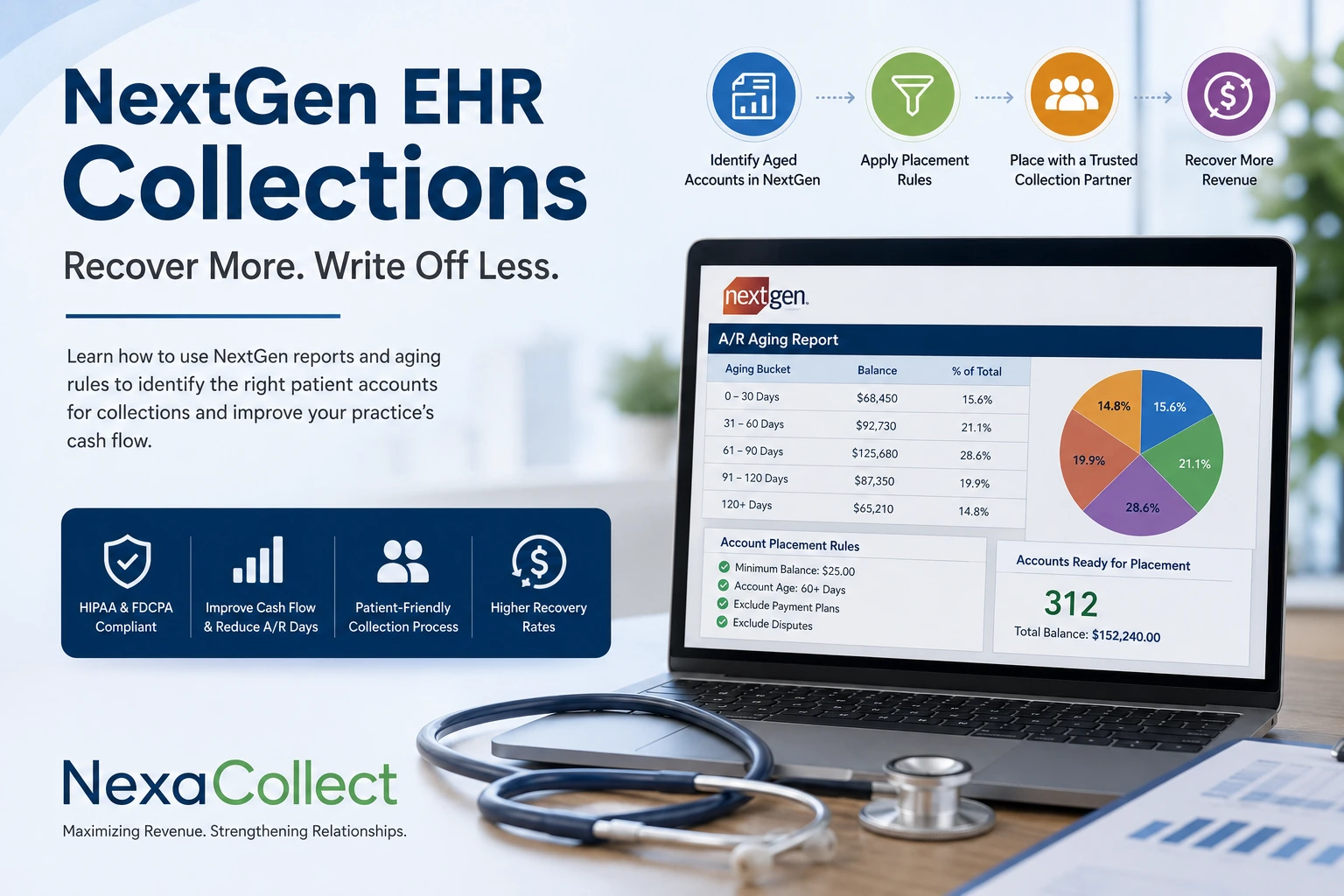
NextGen helps medical practices manage billing, claims and accounts receivable, but persistent patient balances may eventually require an outside collection agency. Practices can use NextGen aging reports to identify eligible accounts based on balance amount, age, contact attempts, payment-plan status and dispute status.

nextgen ehr collection agency

NextGen is modern. Your A/R might not be.

NextGen has grown into a major player in ambulatory EHR and practice management, with cloud-based tools for scheduling, documentation, billing, and revenue cycle management for both small practices and larger enterprise groups.

On paper, it can:

  • Streamline claims

  • Reduce days in A/R

  • Accelerate collections

NextGen even offers A/R recovery support, where a specialist team works aged accounts and some clients see several-fold returns on that investment.

Yet many practices still see:

  • Days in A/R drifting well past 40–50 days

  • A growing stack of 60–120+ day patient balances

  • No clear policy on when an account stops being “just late” and becomes bad debt

The problem usually isn’t the software. It’s the last mile of collections.


What NextGen actually does well for the money side

Before talking about collections, it helps to be clear about what NextGen already brings to the table.

For billing & RCM, NextGen can:

  • Capture charges and push cleaner claims through its integrated PM and clearinghouse

  • Use rules engines and edits to reduce denials and rework

  • Provide A/R dashboards and reports so you can see aging, payer mix, and payment lag

  • Offer RCM services teams who focus on insurance A/R, underpayments, and denials

Done well, a practice-management system like NextGen should help you keep most payments inside 30–40 days, with overall A/R days ideally under 40–50.

What it doesn’t do is chase stubborn patient balances indefinitely.


Where NextGen stops and true collections begin

NextGen is built to manage the revenue cycle:

  • Registration

  • Eligibility

  • Coding and charges

  • Claims and remits

  • Insurance follow-up

But once a self-pay or residual balance has:

  • Ignored statements, texts, and portals

  • Sat in 60–120+ day aging buckets

  • Stopped responding to your staff

…you’re no longer dealing with a billing issue. You’re in debt recovery territory.

At this stage, you need:

  • Persistent, structured follow-up over weeks and months

  • Skip-tracing when contact data is wrong

  • Negotiation skills with patients juggling multiple debts

  • A clear path to escalation or closure

That’s work for a collection agency, not an EHR.


A simple NextGen → collection agency workflow

Instead of exporting random spreadsheets whenever someone has time, you can turn your overdue A/R into a repeatable pipeline.

Your existing page already hints at a NextGen debt collection utility. Let’s frame what that looks like in a way that’s clear for readers.

You keep control over four levers:

  1. Minimum balance

    • Example: only send accounts above $100, $250, or $500, depending on your patient base and risk tolerance.

  2. Account age / last payment date

    • Only send accounts where no payment has been made in, say, 60 / 90 / 120 / 180 days.

    • This uses the “last payment” or “last activity” data already living in NextGen.

  3. What “step” they go into

    • Soft, fixed-fee letter campaigns (polite but firm, branded notices).

    • Or straight into phone-driven, contingency collections for chronically late payers.

    • Or a combination: letters first; calls later if there’s still no response.

  4. Who not to send

    • Disputed cases

    • Active payment plans

    • Certain payer classes or assistance programs

    • Any accounts you want to treat with extra care

Once those rules are locked in, the workflow is simple:

  • Run your NextGen aging / A/R reports

  • The utility picks up accounts that meet your rules

  • Approved accounts are transferred cleanly to your chosen collection partner

  • As money is recovered, payments are posted back in your system like any other payment

No re-keying. No “we’ll do this someday.”


When does a NextGen account become a collections account?

Every practice needs its own policy, but your NextGen data should drive that decision, not gut feeling.

A practical approach:

1. Watch your aging buckets

From your NextGen PM or RCM reports, track:

  • 0–30 days (normal cycle)

  • 31–60 days (reminders + phone calls)

  • 61–90 days (warning zone)

  • 91–120+ days (high risk / probable bad debt)

If a noticeable chunk of your patient A/R lives in 91+ days, those dollars are in danger.

2. Set a time rule

For example:

  • Any patient balance with:

    • No payment in 90+ days, and

    • At least 3–4 contacts (statements / reminders / calls), and

    • No active arrangement

    → Eligible for collections placement.

3. Set a dollar rule

  • Very small balances (say, under $50–$100):

    • Bundle them for periodic batch placement or write-off.

  • Mid-size balances (e.g., $150–$750):

    • Full reminder sequence, then collections at 90–120 days.

  • Big balances (e.g., $750+ or $1,000+):

    • Extra attention early; don’t let them quietly age past 60–90 days.

Once you’ve written these rules down, your NextGen reports become a placement engine, not just an FYI.


Why a NextGen-savvy collection agency matters

NextGen already gives you:

  • Detailed A/R and encounter data

  • Insurance vs patient split

  • Notes about earlier contact and billing history

A good collection agency knows how to work with that data instead of starting from scratch. That means:

  • Using your exports to prioritize high-yield accounts

  • Respecting your patient-experience expectations while still being firm

  • Staying compliant with HIPAA, FDCPA, and state collection laws

  • Reporting back with enough detail that you can reconcile easily inside NextGen

You’re not looking for “sharks.” You’re looking for a specialized extension of your revenue cycle that understands how NextGen practices operate.


Where Nexa fits in

Nexa operates as a full-service debt collection agency built to plug directly into your NextGen aging reports. We handle everything from soft-letter reminders to intensive third-party recovery—so your billing team can stay focused on active patient care.

What we do:

  • Work your NextGen aging or A/R export directly, using the balance, age, and exception rules your practice sets.
  • Contact patients directly across mail, phone, and email, inside FDCPA and HIPAA guidelines, with a tone built for specialty and long-term care relationships.
  • Handle payment plans, disputes, and negotiation so your billing staff isn’t stuck chasing chronically late accounts between patient visits.
  • Return recovered payments and account status updates so they post back into NextGen cleanly, keeping your aging reports accurate.

You’re not replacing NextGen’s billing or RCM tools. You’re adding a dedicated recovery layer for the accounts that have already aged past what in-house follow-up or NextGen’s own A/R recovery service can close — typically the 90-plus day balances still sitting on your books with no payment plan in place.

Already using NextGen Medical/EMS Software? Have unpaid medical bills? 


Need to transfer your overdue accounts receivable to a collection agency? Contact us

  • You decide what should be the minimum outstanding balance eligible for collections.
  • Only send accounts if a payment hasn’t been made in _(60/120/180) days.
  • Send 5 collection demands to your patient or transfer directly for debt collection calls.
  • You are in total control of the process. Dedicated small business debt collectors.
  • Contact us for a demo of our free NextGen debt collection utility. 

    Collection Agency
    Debt Collection Utility

FAQ

Does NextGen’s own A/R recovery service replace a collection agency?

Not entirely. NextGen’s A/R recovery support works aged accounts within the practice’s existing billing relationship, and practices using it have seen 3x-10x ROI. For balances that have gone fully unresponsive, typically 90-plus days with no contact, a dedicated collection agency picks up where that service stops.

What’s a healthy days-in-A/R number for a NextGen practice?

Most practices target 30-40 days, with overall A/R days ideally kept under 40-50. Once a noticeable share of patient balances sits in the 91-plus day bucket, those dollars become increasingly unlikely to recover through normal billing follow-up alone.

Can Nexa work directly from a NextGen aging report?

Yes. Nexa takes a NextGen aging or A/R export, filtered by whatever balance and age rules a practice sets, and works the file without requiring manual account-by-account handoff.

Does NextGen offer software for dental practices too?

Yes. NextGen Healthcare markets a dedicated Dental EHR and practice management solution alongside its ambulatory products, so dental practices on NextGen can use the same collections workflow described here.

Is Nexa’s process HIPAA compliant for NextGen-based practices?

Yes. Account handling, communication, and data transfer all follow HIPAA requirements alongside FDCPA and applicable state collection rules.

Filed Under: Debt Recovery

Eaglesoft Integration: Turn Stale Dental A/R into Collected Cash

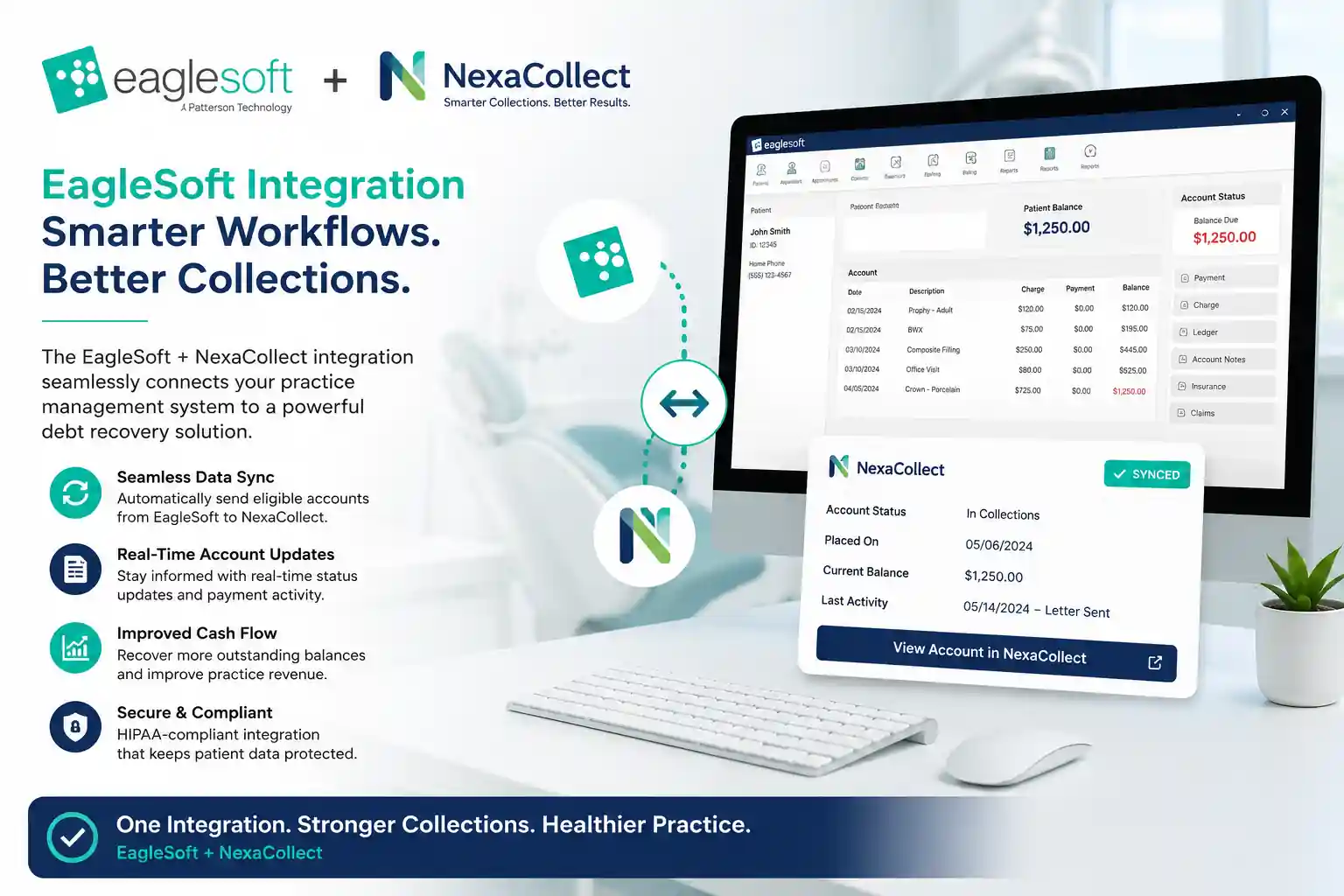
Eaglesoft integration, in the context of dental accounts receivable, means connecting the aging and A/R data your practice already tracks in Patterson Dental’s Eaglesoft system to a dedicated collections process for the patient balances that have stopped responding to statements and reminders. It isn’t a plug-in inside Eaglesoft itself streaming into another app; it’s a workflow, where an aging export feeds placement rules, like balance size, days since last payment, and existing payment plans, that decide which accounts move to a collection agency and which stay in-house. For a user base of nearly 30,000 practices, that handoff is often the missing piece between a well-run front office and a shrinking 90-day column.

Eaglesoft Dental Accounts Receivable Aging Report

Eaglesoft is popular. Old A/R is, unfortunately, even more popular.

Eaglesoft has been around for 25+ years and serves nearly 30,000 active users across the U.S. and Canada. It’s a serious platform, not a hobby product.

Yet typical dental A/R tells a different story:

  • Benchmarks often show the average dental practice with tens of thousands of dollars sitting in 90+ day A/R, and once balances cross 90 days, practices usually recover only a small fraction of that money.

  • Many offices see A/R days around 45, even though insurers often pay in roughly 30 days.

In other words: Eaglesoft can be rock-solid and you can still be leaking cash.

This page is about that gap — and how to use both Eaglesoft and a collection agency (via a small, free utility) to close it.


What “healthy” A/R actually looks like for a dental office

Before talking integrations, it helps to know what you’re aiming for.

Dental advisors commonly recommend:

  • A/R days: roughly 30–45 days. Anything consistently above that suggests slow collections or broken workflows.

  • A/R over 90 days: under 10% of total A/R (excluding long ortho contracts).

  • Net collections: around 98–100% of adjusted production.

  • A/R ratio (A/R ÷ average monthly production): ideally close to 1.0–1.5 months of production on the books, not 2–3 months.

Reality check for Eaglesoft users:

If your Eaglesoft A/R report shows A/R days >45, more than 10% of A/R in 90+ days, or an A/R ratio well above 1.5, you’re outside the comfort zone. Those aren’t “slow payers” — that’s bad debt in slow motion.


Eaglesoft does the early work. Late A/R is a different game.

Eaglesoft is built to manage your everyday operations:

  • Scheduling, charting, imaging

  • Insurance claims and e-attachments

  • Statements and online payments (via integrated partners like Vyne Trellis, DentalXChange, CarePay+, card-on-file tools, etc.)

  • A/R and production reports by provider, location, and date

That’s a powerful early-stage revenue engine.

But Eaglesoft will never:

  • Chase a non-responsive patient every week for six months

  • Dig up a new address or phone number

  • Negotiate a multi-step payment plan with someone already behind on other bills

  • Decide which accounts are worth escalating and which should be written off

That’s the line where “practice management” ends and “debt collection” begins.


Step one: find your “collection zone” inside Eaglesoft

Instead of going by gut feeling (“she’s nice, give her more time”), let your Eaglesoft reports tell you when an account has crossed the line.

Start with the A/R Aging report:

  • Look at the breakdown: 0–30, 31–60, 61–90, 91–120, 120+ days.

  • Focus on patient balances, not just insurance A/R.

Ask:

  • What percentage of my A/R is in 90+ days?

  • How much of that is patient responsibility?

  • How long has it been since any payment or meaningful contact?

Remember: once a balance hits 90+ days, your recovery odds drop sharply. Waiting another three months rarely helps.


The free Eaglesoft collection utility: a small tool with sharp teeth

To turn “we should send these to collections” into something automatic, you can use a small, free Eaglesoft debt collection utility.

You stay in control; the utility just enforces your rules.

You can typically set:

  • Minimum balance to send

    • Example: only send accounts over $100, $250, or $500.

  • Age of the account

    • Based on days since last payment or last activity — for example, 60, 90, 120 or 180 days.

  • Which recovery step to use

    • Gentle, fixed-fee letter campaigns first,

    • or direct to full contingency collections for serious delinquents.

  • Which patients to exclude

    • Ortho on long payment plans

    • Genuine hardship or charity-care cases

    • VIPs you want to handle personally

Once the criteria are saved, the utility:

  1. Reads the Eaglesoft database.

  2. Finds accounts matching your rules.

  3. Prepares a clean export for your collection partner (no retyping from screens).

You go from “someday we’ll clean this up” to “once a month, our 90+ day list is automatically prepped for collections.”


Practical placement rules (feel free to modify)

Here are sample rules a typical Eaglesoft practice might adopt:

1. Standard rule for everyday accounts

  • Balance ≥ $200

  • No payment in 90+ days

  • At least 3 statements / reminders already sent
    → Send to fixed-fee letter service or step-2 style demand program.

2. High-balance rule

  • Balance ≥ $750 or $1,000

  • No payment in 60+ days

  • Not in ortho or active payment plan
    → Move faster: short internal follow-up, then straight to contingency collections.

3. Low-balance batch rule

  • Balance $50–$200

  • No payment in 120+ days
    → Either batch these to collections once or twice a year or write off; don’t let tiny balances chew up staff time.

If you can shrink 90+ A/R from something like $100,000 down to $25–30k over time by tightening collections, that’s tens of thousands of dollars back in the bank, not abandoned on old ledgers.


How this plays with the Eaglesoft ecosystem you already use

You don’t have to choose between Eaglesoft integrations and collections. They’re different layers.

  • Claims and e-attachment partners

    • Help you send cleaner claims, get ERAs faster, and reduce payer delays.

  • Payment and text-to-pay tools

    • Make it easier for patients to pay via text, mobile, online, and card-on-file.

Those tools are about preventing A/R from aging in the first place.

The Eaglesoft collection utility + a third-party collection agency are about what to do when, despite all that, money still isn’t coming in.

Think of it as:

Eaglesoft + payment integrations = early-stage collections.
Eaglesoft + our utility + a collection agency = late-stage collections.

You need both layers for a truly healthy A/R.


Where Nexa Fits into Your Eaglesoft Workflow

Nexa operates directly as a full-service debt collection agency designed to integrate with Eaglesoft’s accounts receivable reports. We eliminate the friction of chasing delinquent patient balances while maintaining your practice’s reputation in the community.

What we do for Eaglesoft practices:

  • Direct Report Ingestion: Work directly from your Eaglesoft Account Aging Report or custom exports—no manual cherry-picking or data re-entry required.
  • Automated Collection Sequences: Contact patients via compliant mail, phone, and digital channels inside HIPAA and FDCPA guidelines, tailored specifically for dental patient relationships.
  • Full Account Resolution: Handle payment plans, settlement discussions, and balance disputes so your front desk isn’t stuck making awkward collection calls between patient check-ins.
  • Clean Ledger Reconciliation: Recovered payments and status updates flow back to your team, allowing clean posting directly into your Eaglesoft ledger.


Already using Eaglesoft Dental Software? Have unpaid medical bills? 


Need to transfer your overdue accounts receivable to a debt collection agency? Contact us

  • You decide what should be the minimum outstanding balance eligible for collections.
  • Only send accounts if a payment hasn’t been made in _(60/120/180) days.
  • Send 5 collection demands to your patient or transfer directly for debt collection calls.
  • You are in total control of the process. Dedicated small business debt collectors.
  • Contact us for a demo of our free Eaglesoft debt collection utility. 

    Collection Agency
    Debt Collection Utility

FAQ

Does Eaglesoft handle collections on old patient balances itself?

No. Eaglesoft manages scheduling, charting, claims, statements, and online payments, but it isn’t built to chase a non-responsive patient for months or negotiate payment plans with someone already behind on other bills. That’s where a dedicated collection agency takes over.

What’s a healthy A/R days number for an Eaglesoft dental practice?

Dental advisors commonly target 30-45 A/R days, with under 10% of total A/R sitting past 90 days and net collections around 98-100% of adjusted production. Once those numbers slip, cash flow typically tightens fast.

Can Nexa work directly from an Eaglesoft aging export?

Yes. Nexa takes an Eaglesoft A/R aging export, filtered by whatever balance and age rules a practice sets, and works the file without requiring manual account-by-account handoff.

Does using Eaglesoft’s payment integrations replace the need for collections?

No. Tools like Vyne Trellis, DentalXChange, and CarePay+ help prevent A/R from aging in the first place by making it easier for patients to pay early. Once a balance is already 90-plus days past due, that’s a separate, later-stage recovery problem.

Is Nexa’s process HIPAA compliant for Eaglesoft-based practices?

Yes. Account handling, communication, and data transfer all follow HIPAA requirements alongside FDCPA and applicable state collection rules.

Can Nexa collect debt directly from an Eaglesoft Aging Report export?

Yes. Nexa processes Eaglesoft Account Aging Reports directly based on your customized placement rules. You define the account age (e.g., 90+ days without payment) and minimum balance thresholds, allowing your office to transfer delinquent accounts seamlessly without manual data re-entry.

Is the Eaglesoft debt collection utility HIPAA compliant?

Yes. All account transfers, digital records, patient notices, and debt resolution communications strictly adhere to HIPAA security standards, FDCPA guidelines, and federal consumer protection regulations.

Does using Nexa replace Eaglesoft or integrated clearinghouse tools?

No. Eaglesoft and clearinghouses like Vyne Trellis or DentalXChange continue handling active insurance billing and daily practice management. Nexa steps in exclusively for delinquent patient balances that have exceeded in-house follow-up limits.


Filed Under: Debt Recovery

Using Nextech Software? Need Debt Collection Agency?

If you are a doctor or practice administrator you know that the software you use is of vital importance to the success of your practice, both in terms of patient care and its financial success.

A great practice management software will help your practice run more smoothly, get through your appointments faster, and help your medical professionals see the information they need at-a-glance.

You need to find a package that fits your changing needs, is suitable for both the medical providers and the front and back-office staff. If you are a specialist practice your software solution is even more vital. For over two decades Nextech have produced an advanced and integrated EMR and PM solution, but is it the right one for your business?

Already using Nextech Software? Have unpaid medical bills? 
Need to transfer your overdue accounts receivable to a debt collection agency? Contact us

  • You decide what should be the minimum outstanding balance eligible for collections.
  • Only send accounts if a payment hasn’t been made in _(60/120/180) days.
  • Send 5 collection demands to your patient or transfer directly for debt collection calls.
  • You are in total control of the process. Dedicated small business debt collectors.
  • Contact us for a demo of our free Nextech debt collection utility. 

    Collection Agency
    Debt Collection Utility

Who is Nextech EMR for?

Nextech’s Practice Management software is designed specifically for practices that specialize in areas like ophthalmology, plastic surgery, dermatology, orthopedics and medical spas.

What are the Benefits of Using Nextech EMR?

The key benefit of using Nextech EMR for your specialist practice is that it is highly customizable, so you can customize templates and more to fit the needs of your practice and desired workflow. Some of the other key benefits are:

  • Speedy Charting – charting is often a time-consuming process, but Nextech can be tailored instantaneously to a physician’s needs without the need to talk to a developer. These custom templates allow you to take accurate, relevant notes and do diagnosis coding via dropdown menus and filtered lists.
  • Streamlined Laboratory Communication – the time it takes to order tests and wait for results is stressful for clients and frustrating for physicians, but the software tracks the progress, reduces paperwork, and reduces the amount of time before a doctor can give a diagnosis.
  • Streamlined Scheduling – The scheduling module allows maximum efficiency whilst dealing with numerous medical providers at different locations, easy drag and drop appointment changes, and a first available appointment finder.
  • Appointment Reminder and Automatic Schedule Updates – Within the scheduler, there is an integrated secure reminder system that automatically messages patients’ cell phones and, when they text back either confirming or canceling, the scheduler automatically updates to reflect their answer.
  • Real-Time Practice Management – The room manager allows both providers and administrators to see in real-time how patients are progressing during their visits. This allows identification of problem areas so the correct choices can be made to ease the patient’s path and thus helps to improve patient care.
  • Optimized Billing – Your billing will be simplified and profitability increased by Nextech’s intuitive ICD-10 coding assisted solution which decreases denials and maximizes reimbursements. Your payment turn-around will be accelerated and the workflow of your back office optimized. There is a comprehensive claims management system that simplifies this often complex and troublesome area.
  • Cloud-Based – It is a web-based, multi-platform system where providers can study patient profiles, check appointments and view all data on their cell phones and tablets. The interface is very simple to use allowing physicians to flip through documents as if they were paper. It also enables individual charting and maximizes charting efficiency keeping all data accessible and complete.
  • Patient Portal – There is an option within the software to provide a patient portal so that patients can update their information, look at three test results and check on appointments.
  • Strong Support – One of the most important aspects of any software is its support. Nextech provides both on the phone and in-person support are ready to address your problems and find solutions. They want happy, successful customers who will be happy with their system and recommend it to other practices in their field.

What are Nextech EMR’s Features?

  • Custom Templates and Fields
  • Drag and Drop Scheduling
  • High-Powered Analytics Tools
  • Patient Portal
  • Multi-Platform
  • Cloud-Based
  • Nextech Network Easy Referrals
  • Shared Clinical Knowledge Library
  • Dictation Tools
  • E-Prescribing
  • HIPAA Compliant

Is Nextech Right For You?

The software is constantly being updated and refined to keep your practice performing at its best, and while no practice management software is faultless, Nextech is constantly fine-tuning their product to remove any bugs, improve performance and take on board customers’ feedback.

At the moment Nextech is used worldwide by 7,000 medical providers and over 50,000 support office staff. You don’t get that kind of success without providing a Practice Management system that works well, runs smoothly and allows medical providers to concentrate on helping their patients, so it’s highly likely it will be the right software for your practice.

Nextech doesn’t offer a free trial and the only way to get a quote is to contact them, so if you think Nextech is right for your practice, contact them for a demo.

Filed Under: Debt Recovery

eClinicalWorks & Medical Collections: Turning Your A/R Dashboard Into Real Cash

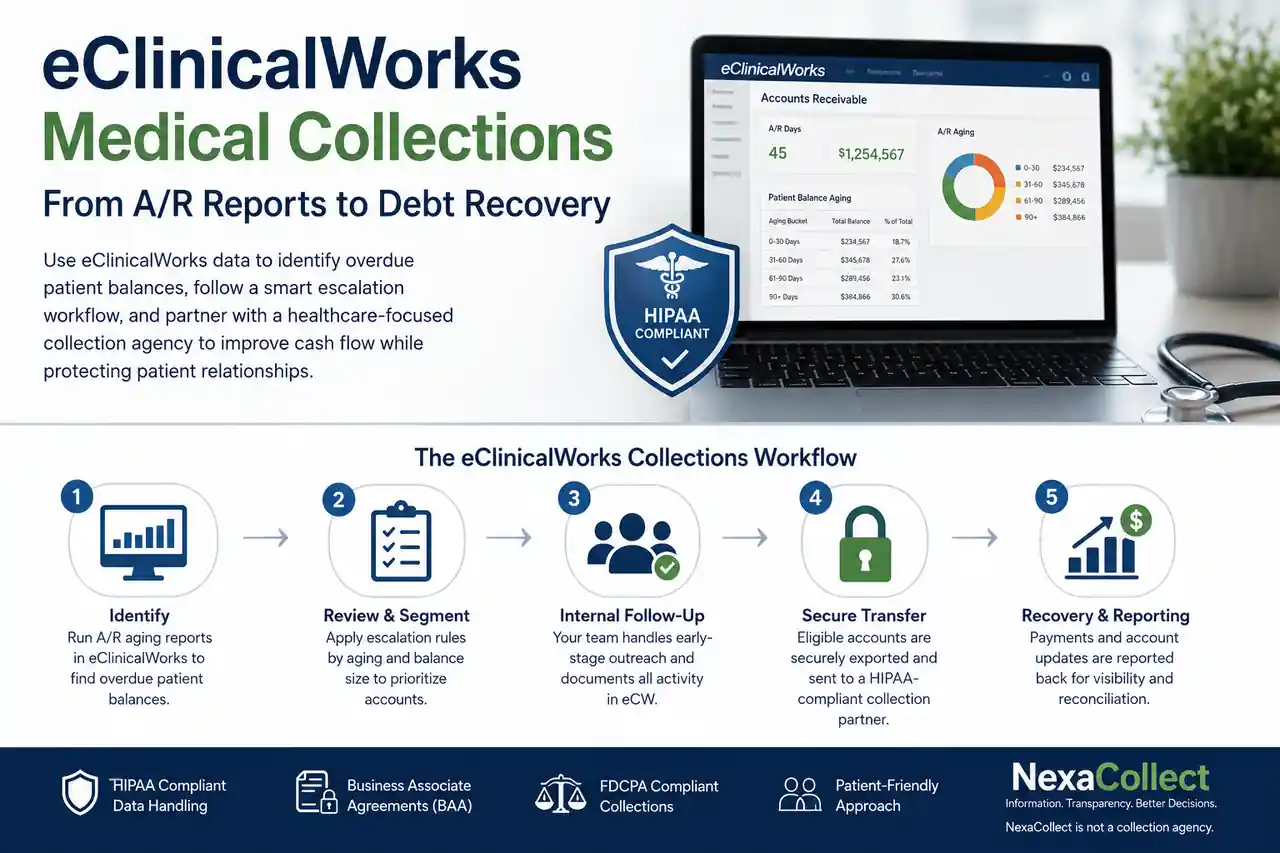
Using eClinicalWorks alongside a collection agency means keeping your EHR and RCM tools exactly as they are for claims, billing, and reporting, while routing a specific slice of your aging report — the patient balances that have stopped responding to statements and reminders, typically 90-plus days out — to a dedicated collections process. This isn’t a live software plug-in inside eClinicalWorks; it’s a secure export workflow, where your aging report data feeds placement rules that decide which accounts move to collections and which stay in-house. If you’re watching A/R creep past 45-60 days on eCW, the fix usually isn’t the software. It’s the missing handoff between what eClinicalWorks shows you and what happens next.

eClinicalWorks & Medical Collections: Turning Your A/R Dashboard Into Real Cash

eClinicalWorks is strong EHR software. It’s not a collections department.

eClinicalWorks has grown into one of the largest ambulatory EHR and PM platforms in the U.S. Tens of thousands of providers rely on it every day for scheduling and clinical documentation, e-prescribing, labs, and imaging, charge capture and coding, and claims, posting, and reporting.

Many practices also use eCW RCM tools and services for eligibility and deductible checks, claim scrubbing and automated edits, ERA posting and denial queues, and dashboards and KPIs.

More recently, eCW has leaned heavily into AI-powered, “agentic” RCM to reduce manual work and speed up claim cycles.

All of that is valuable. But even with great software, most practices still face A/R days drifting into the 40s and 50s, 10-20% of A/R sitting in 90+ day aging, and denial rates in double digits, especially as payer rules change.

At some point, technology alone cannot force patients or payers to pay. You need clear policies, people, and a medical collections process built for patient balances around the system.

Need a Collection Agency? Contact us


What eClinicalWorks does well for revenue — and what it doesn’t do

It helps to draw a clean line.

eCW is great at:

  • Capturing charges quickly and consistently
  • Reducing obvious coding and format errors
  • Submitting and tracking claims electronically
  • Highlighting denials and underpayments
  • Producing A/R and aging reports by payer, provider, and location

eCW does not:

  • Call overdue patients and arrange payment plans for you
  • Negotiate with stubborn self-pay accounts that are 120+ days old
  • Skip-trace bad addresses or wrong phone numbers
  • Litigate or pursue hard-to-collect balances
  • Replace a licensed, compliant, third-party collection agency for bad-debt A/R

If you treat eClinicalWorks like a “set it and forget it” collections machine, you end up with a beautiful dashboard and a growing pile of unpaid balances.

Are your eClinicalWorks numbers actually healthy?

The first step is to stop guessing and look at your eCW reports like a CFO, not just a clinician. Key metrics to pull from eCW:

  • Days in A/R (overall): Strong practices aim for roughly 30-40 days. When you’re consistently over 45-50 days, something is off.
  • A/R aging buckets: Break out patient and insurance A/R into 0-30, 31-60, 61-90, 91-120, and 120+ days. A/R over 90 days should be a small slice, not a large chunk — when more than 10-15% of total A/R lives there, it’s a red flag.
  • Insurance vs. patient responsibility: Look at how much A/R is payer balances, pure self-pay, or patient-due after insurance. With high deductibles and co-insurance, patient balances are rising, and these require a very different follow-up approach than payer A/R.
  • Denial rate and top denial reasons: eCW already shows the percentage of claims denied on first pass and common denial codes. If denials are creeping up year over year, staff spend more time firefighting, and more balances drift into aged A/R.

Once you know your numbers, the question becomes: what happens to those 60-, 90-, and 120-day balances next?

Where balances slip through in eClinicalWorks workflows

Even well-run practices see money slipping through at a few critical points:

  1. Front-office gaps: Demographics, insurance information, or eligibility checks are incomplete, and patients are not clearly told how much they will owe or when.
  2. Back-office overload: Denial queues in eCW grow faster than staff can work them, and simple, low-dollar claims get ignored in favor of complex ones.
  3. Weak patient follow-up: Statements go out, but no structured reminder schedule exists, and staff make calls “when they have time,” which is never enough.
  4. No clear escalation rule: Some practices keep accounts forever in “patient A/R” because nobody wants to “send patients to collections,” resulting in high A/R, low cash, and a lot of quiet write-offs.

eClinicalWorks shows you the problem clearly on screen. But unless you turn those insights into rules and actions, nothing changes.

Using eClinicalWorks data to decide what goes to collections

A practical approach is to define simple, written placement rules based on your eCW reports. For example:

By aging:

  • Patient balances 0-30 days: statements and soft reminders only.
  • 31-60 days: reminder letter plus text/email and a phone attempt.
  • 61-90 days: stronger reminder, offer a payment plan, final internal notice.
  • 90+ days: if no progress or arrangement, eligible for third-party collections.

By balance size:

  • Small balances (under $50-$100): one or two reminders, then internal write-off or batch placement depending on your policy.
  • Mid-range balances ($100-$500): full internal workflow, then move to collections at 90+ days.
  • Large balances ($500+ or $1,000+): earlier calls, more effort at 30-60 days — don’t let them quietly age into 6-12 months.

By payer / visit type:

  • Chronic non-paying payers or plans: tighten pre-authorization and eligibility rules, and watch balances from those plans closely.
  • Certain visit types (procedures, high-dollar imaging, elective care): stricter front-end collections such as deposits and signed estimates, with a faster escalation path if the patient balance is ignored.

You can set up most of these segments directly inside eCW using existing reports and filters. The missing piece is the policy and follow-through.

AI + humans: pairing eCW RCM with real-world collections

eClinicalWorks’ newer AI and automation features are ideal for scrubbing claims and catching coding issues, checking status with payers, pushing clean claims out faster, and flagging risky accounts before they age out.

What AI cannot do on its own: talk a scared patient through a bill they don’t understand, negotiate a realistic payment plan with someone juggling multiple debts, track down a moved patient with no forwarding address, or decide when it’s time to escalate to legal action.

That’s where professional medical collection agencies come in. The best ones understand HIPAA, FDCPA, and modern medical-debt rules, are comfortable working from eClinicalWorks exports and reports, use patient-friendly scripts and payment options, and provide feedback that helps you tweak your eCW workflows upstream.

Think of it as a layered system: eClinicalWorks and your staff prevent as much A/R and denial waste as possible, while a collection partner recovers what inevitably slips through, without abusing patients or damaging your reputation.

What a healthcare-focused collection agency should know about eClinicalWorks

If you’re on eCW, look for agencies that can speak your language. They should be ready to accept secure exports of aging reports, patient contact data, and balance details from eCW, work with your payer codes, rendering providers, and locations, respect your do-not-contact lists, charity-care policies, and state-specific rules, and report back recovery data in a format you can easily map to your eCW metrics.

Red flags: agencies that treat medical debt exactly like credit-card collections, show no understanding of the No Surprises Act, medical-debt credit reporting changes, or balance-billing limits, and have no process for protecting PHI or signing Business Associate Agreements.

You want a partner that understands both medical compliance and the reality of patient-pay balances in a high-deductible world, not just a generic call center.

How account data is handled

Every eClinicalWorks export Nexa receives is transferred through a secure, encrypted channel, never email attachments or unsecured file sharing. A signed Business Associate Agreement is in place before any protected health information is shared, consistent with HIPAA requirements. All patient contact and collection activity follows FDCPA guidelines alongside applicable state debt collection laws. This is a data-handling relationship, not a public data feed: your export stays within your account and is used only for the accounts you’ve placed.

Where Nexa fits in

To be direct about what this actually is: Nexa does not have a live, embedded software integration inside eClinicalWorks. What we offer is a secure export workflow — your practice pulls an aging or A/R report from eClinicalWorks using your own placement rules, and sends it to us through a secure, HIPAA-compliant channel. Nexa Collections is a full-service collection agency, not a referral service or an information hub. Once we receive that export, we take it from there.

What we do:

  • Work your eClinicalWorks aging or A/R export directly, using the age, balance, and exception rules your practice sets.
  • Contact patients directly across mail, phone, and email, inside FDCPA and HIPAA guidelines, using scripts built for patients already juggling multiple bills.
  • Sign a Business Associate Agreement (BAA) before any PHI changes hands, and handle every account under that agreement.
  • Handle payment plans, disputes, and negotiation so your billing staff isn’t stuck chasing 90-plus day balances between denial queues and new claims.
  • Return recovered payments and account status updates so they map back into your eClinicalWorks metrics cleanly.

You’re not replacing eClinicalWorks or its RCM and AI-powered claim tools. You’re adding a dedicated recovery layer, connected by a secure export rather than a technical integration, for the accounts that have already aged past what statements, reminders, and internal follow-up can close. This same secure-export approach applies whether your practice runs on Compulink instead, on NextGen for ambulatory or dental practices, or on Eaglesoft for dental practices — the workflow and compliance standards stay the same. For exact rates, see the full breakdown of Nexa’s fixed-fee and contingency pricing.

FAQ

Does eClinicalWorks include a built-in collection agency?

No. eClinicalWorks offers powerful billing and RCM tools, and in some cases full-service RCM, but it is still software and services, not a contingency collection agency. It will not pursue old patient debts the way a licensed collection firm does.

What A/R days should a practice on eClinicalWorks aim for?

Many practices using eCW aim for 30-40 days in A/R with a relatively small slice of A/R over 90 days. If dashboards show 45-50+ days consistently, or a large chunk of A/R sitting 90+ days, the follow-up and collections process needs work.

How do I know which eCW accounts to send to collections?

Use eClinicalWorks aging reports to define clear rules by age, balance size, and visit type. A common pattern is: once a patient balance is 90+ days old with no response, it is a strong candidate for third-party collections.

Can I still use eClinicalWorks if I outsource collections?

Yes. Most practices continue to use eCW for charge capture, billing, and reporting, while sending specific sets of aged accounts to an external agency. The data starts and ends in the EHR/PM system; the collection agency works that data in between.

Will using a collection agency upset my patients?

Handled poorly, it can. Handled well, it doesn’t have to. A good medical-focused agency uses respectful language, offers payment plans, and knows when to back off. Often patients have already ignored multiple statements and calls before an account is placed.

Is this a live, technical integration with eClinicalWorks?

No. Nexa doesn’t have an embedded plug-in or API connection inside eClinicalWorks. The workflow is a secure export: your practice pulls an aging or A/R report using your own placement rules and sends it to Nexa through an encrypted channel.

Will Nexa sign a Business Associate Agreement (BAA)?

Yes. A BAA is signed before any protected health information is shared, and every account is handled under that agreement, consistent with HIPAA requirements.

Filed Under: Debt Recovery

  • « Go to Previous Page
  • Page 1
  • Interim pages omitted …
  • Page 28
  • Page 29
  • Page 30
  • Page 31
  • Page 32
  • Interim pages omitted …
  • Page 54
  • Go to Next Page »

Primary Sidebar


accounts receivable

Need a Collection Agency?
Kindly fill this form.
We’ll get in touch with you

    Please prove you are human by selecting the flag.

    Compliance & Security

    • SOC 2 Type II Certified: Third-party audited data security and strict privacy controls.

    • HIPAA Compliant: Secure, legal processing of medical and municipal EMS accounts.

    • PCI-DSS Level 1: Highest tier of data encryption for secure payment processing.

    • FDCPA & FCRA Aligned: Full legal adherence to federal consumer protection laws.

    Recent Posts

    • Commercial and B2B Collection Agency in Detroit
    • Boston Medical Collection Agency | Serving Hospitals, Physicians & Dentists
    • Collection Agency in El Paso, TX | Compliant, Cost Effective & Reputation Safe
    • Collection Agency in Washington DC | Medical, Schools, Businesses & Contractors
    • The Collection Agency School Districts Trust With Their Reputation
    • How Dental Insurance Denials Turn Into Patient Debt (And How to Stop It)
    • College Station Collection Agency: Recovering What Aggieland Is Owed
    • Recovering Cash in Clovis Without Losing Your Community Respect

    Featured Posts

    • Easiest Way to Accept Payments Online for Small Business
    • How to Write an Effective Credit Policy for Your Company?
    • Setup Fee for Collection Agency: Waived Off !!

    Copyright © 2026 NEXACOLLECT.COM | This content is provided for general informational purposes only and should not be considered legal advice. Collection laws and requirements may vary by state, account type, documentation, debtor status, and specific facts. Please consult qualified legal counsel for guidance regarding your particular situation. Nexa and its authorized collection partners service accounts in accordance with applicable federal and state collection requirements. Visit our home page to know more about us.

    X
    Need a Collection Agency?
    Contact Us