
• Skip to main content
  • Skip to primary sidebar

Nexa Collections

  • Home
  • Serving
    • Medical
    • Dental
    • Small Business
    • Large Business
    • Commercial Collections
    • Government
    • Utilities
    • Fitness Clubs
    • Schools
    • Senior Care Facility
  • Contact Us
    • About us
    • Cost

Debt Recovery

Calculating and Improving Accounts Receivable Turnover Ratio

account turnover ratio
The quicker your business is able to collect on outstanding invoices, the healthier it will be financially. It’s better for cash flow purposes and saves money and headaches associated with trying to collect delinquent debts.

The AR turnover ratio is a standard metric used to determine the pace with which businesses are able to collect their debts. It isn’t difficult to compute and knowing your company’s ratio will give you a benchmark against which you can judge attempts to collect invoices more rapidly.

How To Compute Your Business’s Accounts Receivable Turnover Ratio

To compute this ratio you’ll need to know your company’s net credit sales and your average accounts receivable. These numbers are available on your company’s balance sheet.

To compute this ratio you’ll divide your net credit sales by your average AR. Here’s a bit more information on these two measures.

Net Credit Sales

This is the portion of your annual sales that are tied up in invoices. To compute your net credit sales you’ll take your total annual sales and subtract any cash sales, sales returns, and other allowances, such as price changes and discounts.

Average Accounts Receivable

This represents the average amount of money owed to your business as invoices at any given time. You’ll compute this by adding your accounts receivable amount from the beginning of the year to the amount from the end of the year. Then you’ll divide by two.

Let’s say you had $20,000 in AR at the start of the year and $35,000 at the end.

$20,000 + $35,000 = $55,000

$55,000 ÷ 2 = $27,500

This shows that your average AR is $27,500 for the year.

Computing Your Accounts Receivable Turnover Ratio
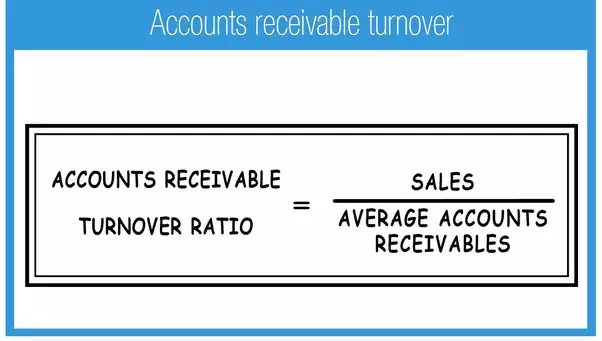
AR turnover ratio
Let’s say that you had $150,000 in net credit sales for the year. And we now know your average AR was $27,500. To compute your AR turnover ratio we’ll use formula detailed at the top of this section.

$150,000 ÷ $27,500 = 5.45

Your accounts receivable turnover ratio is 5.45. This means that your AR turned over 5.45 times in the last year. To put that in terms that are easier to understand, divide the total number of days in the year by your ratio.

365 ÷ 5.45 = 66.9

This tells you that it took an average of about 67 days for you to collect on an invoice. To collect invoices faster, you need a higher ratio. As an example, had you found your ratio was double what it is, or 10.9, you would know that you’re collecting invoices in half the time, or in 34 days.

Now that you know your AR turnover ratio, what can you do to improve it?

Improving Your Accounts Receivable Turnover Ratio

A low AR turnover ratio can indicate poor collections policies and/or a larger than ideal percentage of financially irresponsible customers. For the health of your business, you should try to increase low ratios. Here are a few things to try.

Invoice Immediately

In order to collect payments quickly, it’s best to invoice while your work is still fresh in your customer’s mind. Send out invoices as soon as the work is completed. This shows you’re serious about your credit collection policies.

Include Early Payment Discounts and Late Payment Penalties

You can offer a small discount to entice customers to pay their invoices earlier than required. You might also charge a penalty for late payments beyond a certain point. If your terms are normally net 30, you might offer a 3% discount for payments made within 15 days.

Penalties shouldn’t be onerous. You don’t want to punish your customers. You only want to motivate them to pay. 1.5% interest per month that the invoice is late might be appropriate.

Give Your Customers a Range of Payment Options

Let your customers pay you however they see fit. This helps their payment processes and can get you paid faster. Offer links to online payment options directly within your invoice and also allow for credit card payments, checks, bank drafts, and more.

Take Deposits Upfront

An upfront deposit ensures that you’ll receive at least some portion of your total invoice. A deposit also gets your customer to put skin in the game, which increases the likelihood that the remainder will be paid on time.

Send Out Regular Reminders

Use an automated invoicing system to send automatic emails when your customers become delinquent. Oftentimes a friendly reminder is all it takes to get paid.

Stop Working With Problematic Customers

Customers that pay egregiously late on a regular basis will drag down your AR turnover ratio and cause constant problems for your business. Consider whether you might be better off not working with them.

The longer invoices remain unpaid, the longer your business can’t use that money to pay its own bills. Try these suggestions to get your AR turnover ratio higher. Your business will thank you.

Important Conclusion:

The turnover ratio is a measure of current liabilities and an indicator of a low collections model.

If the ratio is too high, means a business has very aggressive collections practices, which may drive new customers or even loyal customers to the competition.

Finally, it’s good to keep records of different ratios over different periods (months, quarters, etc) so the business can adjust its collections practices accordingly.


Filed Under: Debt Recovery

Why Diplomacy is the Best Approach in Debt Collection

Diplomatic debt collections

Businesses that are faced with collecting on delinquent invoices often don’t know where to begin. They tend to react with anger, the assumption being that the customer is intentionally trying to rip off their business. While this may feel warranted, it isn’t an ideal approach. A better assumption to start your collections process with is this:

Very few people don’t pay their debts simply because they don’t want to.

Most people aren’t criminals trying to steal from you. They have reasons why they haven’t paid. It could be that someone in the household lost a job or some other source of revenue dried up. They may have gotten themselves into debt and are now having a difficult time digging out.

Instead of pursuing them out of anger, it’s better to use a diplomatic approach that treats them like human beings, not deadbeats. When you consider their circumstances and attempt to open up a friendly dialogue you’ll enjoy collections success far more often. There a number of other reasons why a diplomatic approach is better as well.

Diplomacy Preserves Your Relationship

If you demonize delinquent customers and pursue them in a combative manner you’ll almost certainly sour the relationship. You might be able to collect what you’re owed, but you’ll lose any future business. This can be a penny-wise, pound-foolish decision.

Your customer’s circumstances will likely change. If they lost their job, they’ll find a new one. They may be having difficulty paying bills now, but that won’t last. If you approach them in a friendly, understanding manner, and work with them to find a payment plan that works for them, they’ll actually appreciate you more. Not only will you get what you’re owed by you could have a customer for life, promising significant future revenues.

Diplomacy Gets Your Customer to Call You Back

Customers don’t respond to anger and threats. If you leave a menacing message in someone’s voicemail you may cause them to retreat in fear and ignore future messages. They know they owe you money and in many cases, they don’t know what to do. Adding threats only compounds their problems.

On the other hand, leaving a calm, understanding message that stresses your desire to work with them to find a solution that they can afford gives them hope. It helps them to see that there is a light at the end of the tunnel. Their fear of repercussions is replaced with an optimism that they’ll find a way out of debt.

When someone feels you’re on their side they’re much more likely to call you back.

Diplomacy Is Easier on Your Collections Staff

The way we treat other people has an effect on how we see ourselves. Imagine if you had to spend each workday stalking and yelling at people that you knew were already down on their luck. It would take a toll on your psyche.

Taking a diplomatic approach to debt collection allows your staff to have conversations with people instead of threatening them. It lets them get to know your customers better instead of treating them like delinquents.

Instead of feeling like they’re chasing people down, your staff will feel like they’re helping people. And that’s because they are. Diplomatic debt collection is about helping your late-paying customers find a solution to their situation. It’s a positive process that benefits you and them. When your staff approaches the situation in this way they’ll report higher job satisfaction and you’ll experience less churn.

In the end, a diplomatic approach to debt collection is better for your business, your staff, and your customers. You’ll collect more debts, faster, and you’ll retain those relationships into the future.

Filed Under: Debt Recovery

Best Practices for Medical Accounts Receivable Management

Medical Accounts Receivable Management

In one of our previous blogs, Using a Revenue Recovery Service to Recover debt, we discussed the risk undertaken by a business extending credit to another business, or consumer, by providing services in exchange for a promise of “due and proper consideration”. In layman’s terms, this means that a company extends credit to a customer by issuing an invoice for a product or service already provided and then expecting payment of such product or service in the near future. In accounting terms, this process bears the name of ‘accounts receivable’.

In order to help medical practices and businesses monitor and control that credit risk, we have compiled this list of best practices for the management of accounts receivables:

1. Always state the terms and conditions of payment clearly in the contract, even when dealing with friendly patients or reputable companies. 

A payment provision ensures that the customer is aware of what happens should they default on the contract, and lists any fees, interest or penalties associated with non-compliance. In addition, it helps your business automate the accounts receivable process, especially when you tend to use the same payment terms for all your customers. In the case of a medical practice, checking a patient’s insurance and making sure they understand their co-pay and deductible during that first introductory meeting is paramount. Not only will they be more likely to have the payment readily available when they walk through the door for future appointments, but it will give them a sense of control and safety over their ability to pursue medical care and pay for it.

2. Do not assume that a future receivable is money in your company’s coffers now. 

One of the most important risks to a company’s growth and profitability is expecting money you don’t have yet and then using that as credit to take further risks. Even though a receivable is recorded on your balance sheet as a current or long-term asset, depending on whether the balance is due in less than a year or more, it carries a high risk of long-term debt to you or even an uncollectable account. Make sure your patients understand your billing policy by stating it on initial bills and later payment reminders, including details such as the billing cycle, any deadlines they must meet, the options to pay online or over the phone, any fees for the options, and the option to arrange a payment plan for special cases, if you can offer them. Offer incentives for patients to pay their high deductible in a lump sum.

3. Carrying the lowest possible level of bad debt involves having a sound credit policy and shortened collection periods. 

As a business owner, you have to extend credit only as far as your business can afford the risk. There is always an allowance for doubtful accounts, but don’t become negligent about how much you allow. One way of monitoring this is tracking a patient’s pattern of paying their bills to you. If you realize that a patient has a hard time paying some bills but not others, give them the benefit of the doubt. Do they tend to pay their bills more consistently when they receive their paycheck? When their kids’ school year starts so they don’t have to pay for childcare while they’re on vacation? Getting to know repeat customers with a periodic phone call can give you more insights into their situation, which in turn can help your business decisions about their account.  A human touch pays off.

4. Always verify the patient’s current address and contact information, as well as the best time to contact them. 

Otherwise, it will take you more time later to track them down, delaying a payment they might have made promptly if you were able to reach them quickly.

5. Never threaten to send your patient’s account to a collection agency except for cases when it is legally allowed and you actually intend to do so.

Medical collections fall under the purview of the FDCPA, which means, among others, that you can’t use an abusive, deceptive or unfair practice to threaten an action that you don’t intend to take, make a collection call before 8 a.m. or after 9 p.m. in the patient’s time zone, or call their place of employment if the patient has not given you permission to do so. There are many other legal prohibitions, for instance disclosure to a third party without their permission, such as to a daughter, neighbor, or baby-sitter that the customer has a debt, stamping ‘outstanding balance’ or ‘past due’ on envelopes addressed to your patient, or contacting the patient by postcard for the purpose of collecting.

6. Make sure you use the right codes. 

One of the biggest problems for health care providers is having a claim denied and then having to reprocess it. Codes are changed, deleted or introduced every year, and you can use “cms.gov” or “findacode.com” to quickly verify if you’re using the correct codes.

7. Understand when a decreasing total for accounts receivable is indicative of your practice’s good financial health and when you should worry.

You should see decreasing accounts receivable as good when your cash inflow increases. That means that the amount of debt owed to your company has decreased. The other side of the coin is when you decrease accounts receivables by writing debt off as forgiven or uncollectable. You should be able to deduct that on your tax returns, but having too many such deductions or listing them year after year should be a sign that you need to change the way you manage your accounts receivable.

8. Don’t ignore the importance of human error and staffing. 

Given the increasing trend of insurance companies to deny claims for the smallest of errors, you need to offer sufficient training and documented best practices and monitor how well staff applies them so you can rely on them to keep accurate records, track and correct errors, communicate efficiently, report issues and come up with solutions, use overtime only as strictly needed, and make other important day-to-day decisions.

9. Use the marketing methods that are at everyone’s fingertips these days.

This means not only word-of-mouth but also online tools such as Facebook, Instagram, Google Ads. Your practice can increase significantly by acquiring new patients. That being said, beware of public negative reviews and your response to them. Leaving a bad review unanswered will insert doubts into potential patients’ minds or confirm some borderline experiences they’ve had in your office. Your reputation as a sole practitioner is what can help your business grow or stay afloat.

10. Maintain clear records of your practice’s attempts to collect an outstanding balance. 

That will not only inform your decision to seek help from a debt collection agency or write off the debt, but it will also prove to the IRS that you made a reasonable effort to collect on a debt you intend to deduct on your taxes. You have to keep in mind that the debt is only deductible in the year the debt becomes worthless.

Finally, always remember that accounts receivable is different from a cash transaction in that the payment takes place at a later time.

For that reason, an unreceived payment carries a higher risk for the business awaiting the funds. The balance due from the debtor may take from a few weeks to more than a year to be received by the crediting business (i.e. the creditor), which may leave the creditor exposed. For medical practices, the risk is often even higher because of the hoops they have to jump through with patients and third parties, such as insurance companies.

These are all reasons why your business needs to invest in ways to manage accounts receivable to minimize the financial risk associated with them and convert them into solid cash sooner rather than later.

Filed Under: Debt Recovery

6 Ways to Enhance your Customer Invoicing Experience

customer invoice experience

Invoicing is a critical part of the business cycle, but it’s oftentimes the most difficult. Customers expect to be billed for services rendered, of course, but that doesn’t mean they’re excited to receive them. Paying bills is almost universally considered a negative experience, and this is an association that’s hard to escape.

As a result, there’s considerable value in working to make your invoices as painless as possible for your customers. Not only will you find that this improves your customer’s experience of doing business with you, but it will also likely get your invoices paid more rapidly. Try altering your invoicing process to include these suggestions.

Switch to Digital Invoices

Most businesses utilize digital systems for their accounting needs. When you send a paper invoice, you add an extra layer of unnecessary complexity. Your customer has to manually input the details of your invoice into their system. And if they don’t do this immediately, they run the risk of misplacing your invoice and missing a payment.

In many cases, customers can automate the integration of digital invoices, which saves them time. Plus digital invoices can include direct links to online bill payment services, making it quick and easy for your customers to settle their debts.

Accommodate Your Customer’s Preferences

Most of your customers will appreciate digital invoices, but some may still prefer old-fashioned paper bills. While printing paper invoices and mailing them is more difficult for you, it may still be worth doing it if it makes things easier for your customer.

In general, it’s a good idea to try and accommodate your customers if they have specific requirements for their invoices. Sometimes this means including specific information or changing the order of things. The goal is to make it as easy as possible for your customers to pay you, so it’s worth doing a bit of extra work.

Offer Many Different Payment Options

Not only do customers have different payment preferences, but those preferences can change. As an example, a customer that normally prefers to pay using a credit card might opt to pay with a check if their credit card balance is unusually high.

Part of making it easy for your customer to pay you involves making as many different payment options as possible available to them. The more you offer, the more likely it is that each customer will have their preference available, as well as their standard fallback option.

Digital invoices make this extremely easy. As mentioned earlier, you can place direct links for digital payments directly in the invoice. Information for more traditional payment methods can be included in written form in the invoice as well.

Design Your Invoices for Clarity and Brevity

Customers prefer not to have to hunt for information on your invoices. You should work to ensure everything listed is necessary and clearly labeled. If you don’t already, you should include a brief description of the services or products supplied to make it easier for your client to link your invoice with specific purchases.

On that point, be sure to include your customer’s purchase order numbers on your invoices if they supply then to you. This is another way to help your customers match invoices to actions.

Make Sure Your Customer is Aware of Their Payment Terms

You likely have regular terms that you use with most of your customers. These can change, depending on your customer’s preferences and payment histories. Because one customer’s terms may be different from others, it’s important to list them on each invoice.

Not only does this make it easier for you to follow up on outstanding invoices, but it also makes certain that your customer knows when their invoice is due and any discounts or fees that may apply, assuming they pay earlier or later than their due date.

Don’t Sacrifice Customers Because of One Late Payment

As a business owner, you know that there are peaks and valleys. Sometimes you’re flush with cash and other times you’re struggling to pay bills. If you have a customer that is suddenly paying invoices late, talk with them. Don’t assume they’re suddenly irresponsible. There’s likely a good reason why they’re having trouble getting invoices settled. Try and work with them before resorting to more drastic measures.

If you immediately become combative you’ll likely lose someone that would remain a good customer once they get back on their feet. It’s better to reserve more severe measures for customers that consistently abuse their payment terms.

Try these suggestions and you’re likely to find happier customers and better cash flow as a result.

Filed Under: Debt Recovery

Medical Lab Collection Agency for Unpaid Patient Bills: Secure & HIPAA Compliant

Medical lab collections have a problem most healthcare providers don’t: patients often don’t recognize who is billing them. A blood test, pathology review, toxicology screen, or genetic panel may have been ordered by a physician, but the invoice arrives later from a laboratory the patient barely remembers—or never interacted with directly. That confusion is exactly where otherwise collectible balances start to age.

Nexa helps clinical laboratories, pathology labs, toxicology labs, molecular and genetic testing companies, and other diagnostic providers recover unpaid patient balances through HIPAA-compliant, patient-friendly outreach. We help explain legitimate patient responsibility, locate hard-to-reach patients, resolve billing confusion, arrange payments, and escalate difficult accounts when appropriate. The goal is simple: turn overlooked lab bills into recovered revenue without damaging patient trust, reputation or the referral relationships your laboratory depends on.

Collection agency for lab unpaid bills. HIPAA compliant, secure and lcensed in all 50 states.

Nexa is equipped with all 50-state collections license, offering free credit reporting, free litigious debtor check, free bankruptcy scrub, and zero onboarding fees. Secure – SOC 2 Type II & HIPAA compliant. Over 2,000 online reviews rate us 4.85 out of 5. Excellent client support and easy to use process.

Exorcise Your Lab’s Bad Debt – Contact Nexa Today


Respectful Treatment: It’s Our Policy, Not Just a Promise

Your patients deserve respect, even in collections. We understand that avoiding harsh tactics is your top priority. That’s why we record and randomly review our calls—to ensure our collectors always maintain our minimal-stress policy and protect your practice’s reputation. We hold ourselves to this standard by recording and auditing our calls, ensuring every collector follows our signature minimal-stress approach to debt resolution.


The Lab Financial Reality (Industry Stats)

  • $3,500+ Per Panel: For toxicology and molecular labs, a single unpaid genetic screen can wipe out the profit from 100 routine blood draws.

  • 65% Recognition Gap: Nearly two-thirds of patients ignore lab invoices because they don’t associate the “Lab Name” with the “Doctor’s Office” they actually visited.

  • The 90-Day “Cliff”: Lab debt ages twice as fast as other medical debt. Without an ongoing clinical relationship to maintain, patients deprioritize lab bills almost immediately after the 3-month mark.

  • 30% Data Decay: Approximately 30% of lab requisitions arrive from referring clinics with missing or outdated contact information, making internal collections nearly impossible.


Why Lab Bills Go “Cold” (And How We Heat Them Up)

1. The Identity Crisis (Education vs. Collection)

We don’t just “demand” payment; we educate. Our mediators are trained to bridge the gap, explaining to the patient exactly which test was performed and how it assisted their referring physician’s diagnosis. Once the patient understands the value of the service, the willingness to pay skyrockets.

2. HIPAA-Compliant Recovery & Reputation Protection

In the diagnostic world, your reputation with referring physicians is your most valuable asset. We recover your funds in a 100% HIPAA-compliant manner, ensuring patient data is handled with bank-grade security. Our Reputation Protection strategy means we never use harsh tactics that could lead to a patient complaining back to their doctor—protecting your referral pipeline at all costs.

3. The “Bad Data” Detective Work

If a referring clinic sent you a sample with a missing SSN or an old address, your internal staff is stuck. Nexa uses Advanced Skip Tracing to hunt down the missing pieces of the puzzle, turning “Return to Sender” envelopes into deposited checks.


Specialized Recovery for Modern Labs

We provide expert-level recovery across all diagnostic sectors:

  • Toxicology & Pain Management: Handling the complexities of recurring testing cycles.

  • Molecular & Genetic Testing: Recovering high-dollar patient responsibilities for advanced panels.

  • Clinical & Pathology: High-volume, “small-balance” recovery that adds up to massive annual revenue.

  • DNA & Paternity: Navigating the sensitive nature of relationship testing with total diplomacy.


The Nexa 2-Step Lab Recovery System

  1. Fixed-Fee Outreach ($15): Best for accounts 60-90 days past due. A third-party “nudge” that preserves the relationship while securing the payment directly to you.

  2. Contingency Mediation: No Recovery, No Fee. For the “hard-to-find” patients and aged debt that requires intensive skip-tracing and professional negotiation.

blank


Frequently Asked Questions (FAQ)

1. Why did the patient receive a laboratory bill after already paying their doctor?

A laboratory may bill the patient separately because the physician ordered the test but an independent laboratory performed the testing. Patients may never have visited or even recognize the laboratory, which is why these balances are frequently questioned or ignored. A lab-focused collection agency should first explain who performed the test and why the laboratory charge is separate before requesting payment. Large diagnostic labs identify this as a common patient billing question.

2. Can a medical laboratory use a collection agency and remain HIPAA compliant?

Yes. HHS specifically states that debt collection is a permitted healthcare payment activity and that a covered healthcare entity may engage a collection agency through an appropriate business associate arrangement. The collection agency must follow applicable HIPAA requirements, including safeguards for protected health information and the minimum-necessary standard.

3. What should a medical lab verify before sending a patient balance to collections?

Before placement, the laboratory should confirm that the balance is actually the patient’s responsibility, verify current insurance and contact information, and determine whether the insurer denied the claim or applied the amount to a deductible, copay, or coinsurance. Labs should also make sure the bill does not conflict with applicable federal or state surprise-billing protections before collection begins. Quest identifies incorrect insurance information, claim denials, deductibles and insurer non-response as common reasons patients unexpectedly receive laboratory bills.

4. Can a collection agency find a patient whose address or phone number is outdated?

Yes. Skip tracing and location-information services can be used to locate patients when bills are returned or contact information has become outdated. HHS specifically recognizes obtaining location information as a payment-related activity under HIPAA, although the collection agency must also comply with applicable FDCPA restrictions when performing these searches.

5. Can an unpaid medical laboratory bill be reported to the credit bureaus?

Potentially, but medical-debt credit reporting is now significantly restricted. Current CFPB guidance says an unpaid medical debt that is more than 365 days delinquent from the date of service and over $500 may appear on a consumer credit report. Laboratories and collection agencies should also check applicable state laws and current bureau policies before reporting any medical account.

6. How much does a medical lab collection agency cost, and when should a lab use fixed-fee versus contingency collections?

For newer accounts, Nexa currently describes a $15 fixed-fee outreach option, particularly for balances around 60–90 days past due; the laboratory keeps the money recovered. Older, difficult, or hard-to-locate accounts can move to contingency recovery, where the agency is paid only when it successfully collects. Using an early fixed-fee stage followed by contingency collection allows laboratories to reserve the more expensive recovery process for accounts that actually need it.

Need a Collection Agency for your Lab: Contact us


Filed Under: Debt Recovery

Modern AR Collection Process: Recover More, Spend Less, Protect Relationships

Debt Collection Process

Is Your Current AR Strategy Costing You 50% More Than It Should?

If you are reading this, your Accounts Receivable (AR) process is likely stuck in one of two dangerous places: either you are burning valuable internal hours chasing invoices that are 90+ days past due, or you are handing them over to a traditional collection agency that immediately takes half of your money.

Both options are draining your bottom line.

In today’s economic climate, where interest rates are high and cash flow is king, holding onto bad debt is expensive. But the old way of fixing it—hiring aggressive “break-their-knees” agencies—is obsolete. Modern businesses need a recovery partner that uses data, technology, and Regulation F compliance to get paid without torching customer relationships.

It is time to switch to a model that prioritizes your equity, protects your name on Google, and scales with your growth.

The Problem: Why Traditional “Contingency-Only” Agencies Fail You

Most agencies operate on a “churn and burn” model. They don’t make a dime unless they collect, which sounds good in theory. However, this motivates them to use aggressive tactics immediately, often ignoring the nuances of your customer relationships. Furthermore, they usually charge 33% to 50% on the first dollar collected—even if that debtor would have paid with a simple, firm, third-party letter.

Why switch to us?

  • Keep your legal risk low while recovering more: We strictly adhere to the latest CFPB Regulation F updates, ensuring you aren’t liable for harassment suits.

  • Stretch your internal team further without hiring extra staff: Let your accounting team focus on current billing while we handle the backlog.

  • Protect your brand equity while boosting cash flow: We treat your customers with dignity, preserving the possibility of future business.

The Solution: A 4-Step Intelligent Recovery System

We don’t force you into a high-fee tier immediately. Our system is designed to recover funds at the lowest possible cost to you.

Step 1: First-Party Gentle Reminders (The Extension of Your Team)

  • Cost: Flat fee of $15 per account.

  • Action: We act as your internal AR department. Communications go out in your name. This is perfect for early-stage delinquency (30-60 days) where you want to maintain a “customer service” tone.

  • Result: You keep 100% of the money collected.

Step 2: Third-Party Demands (The Authority Shift)

  • Cost: Flat fee of $15 per account.

  • Action: If the debtor ignores you, the tone shifts. We send formal demand letters in our name (NexaCollect). This signals to the debtor that the account has been escalated to a professional agency.

  • Result: This psychological shift is often all it takes. You still keep 100% of the money collected in this phase. Most of our clients resolve their AR issues here.

Step 3: Intensive Contingency Collections (The Pressure Phase)

  • Cost: 40% of the amount collected (No fee if we don’t collect).

  • Action: If demands are ignored, our professional collectors begin intensive phone negotiations, skip-tracing (locating debtors who moved), and credit bureau reporting.

  • Compliance Note: We utilize modern “7-in-7” call frequency rules to ensure maximum pressure without violating federal harassment laws.

Step 4: Legal Litigation (The Final Hammer)

  • Cost: 50% of the amount collected.

  • Action: For debtors with assets who refuse to pay, our nationwide network of attorneys files suit.

  • Note: We never sue without your explicit permission.

Recent Results: Real Recovery Scenarios

We don’t just talk about results; we deliver them. Here is how we are helping businesses right now:

The SaaS Scenario (Austin, TX)

  • The Client: A B2B software provider with $48,000 in unpaid subscription renewals from 15 different clients.

  • The Challenge: They feared using an agency would look “desperate” to their investor base and alienate clients.

  • The Fix: We used Step 2 (Third-Party Demands).

  • The Outcome: We recovered $39,500 within 35 days. The total cost to the client was under $300 in flat fees. A traditional agency would have taken nearly $13,000 in commissions for the same work.

The Logistics Scenario (Savannah, GA)

  • The Client: A mid-sized trucking brokerage owed $22,000 by a single manufacturer who was ghosting them.

  • The Challenge: The debtor was active but hiding behind gatekeepers.

  • The Fix: We ran a litigious check (free) to confirm solvency, then moved to Step 3 immediately due to the debt age (120+ days).

  • The Outcome: Our skip-tracing team located the CFO’s direct line. We negotiated a settlement of $20,000 paid in two installments. The client recovered the majority of the funds rather than writing it off as a total loss.

Need a Collection Agency for your Business?
Serving Nationwide. Contact us 

A cost-effective revenue recovery service with extensive experience in recovering money for companies while preserving your business terms with clients.

Q&A: Mastering the Modern AR Process

Q: What new laws should I be worried about regarding AR collections?

A: The biggest recent shift is Regulation F (Reg F), implemented by the Consumer Financial Protection Bureau (CFPB). It modernized the Fair Debt Collection Practices Act (FDCPA).

  • Call Limits: Debt collectors are now strictly limited to calling a debtor 7 times in 7 days.

  • Digital Contact: It clarified rules for using email and text messages for collections, requiring clear “opt-out” mechanisms.

  • Validation: It standardized the “Notice of Debt” validation letter.

  • Why it matters: If your current agency (or internal team) isn’t strictly following Reg F, your business could be sued for statutory damages. We handle this compliance for you.

Q: My internal team sends emails. Why aren’t they getting paid?

A: “Vendor fatigue.” When a debtor sees an email from your accounting department, they view it as a request they can deprioritize. When they receive a formal demand from a third-party agency, the dynamic changes. It signals consequences—specifically credit damage or legal action. Our data shows a third-party letterhead is up to 5x more effective than an internal email at prompting payment.

Q: How do I know if a debt is “uncollectible”?

A: Don’t guess; let us check. We provide Free Bankruptcy and Litigious Checks.

  • Bankruptcy: If they filed Chapter 7, you cannot legally pursue them. We identify this instantly so you don’t waste money.

  • Litigious Defaulters: Some debtors are “professional plaintiffs” who sue agencies for technical violations. We flag these high-risk individuals before we make the first call.

Q: When should I move an account to your service?

A: The “Golden Window” is between 60 and 90 days past due. At this stage, the debt is still fresh enough to recover easily using our low-cost Step 2 letters. Once a debt passes 120 days, the likelihood of full recovery drops significantly, often requiring the more expensive Step 3 contingency service.

Stop Letting Your Invoices Depreciate

Every day an invoice sits unpaid, inflation eats away at its value. Take control of your accounts receivable with a process that is smarter, safer, and significantly more profitable.

Click here to Contact Us and start your recovery campaign.

Filed Under: Debt Recovery

  • « Go to Previous Page
  • Page 1
  • Interim pages omitted …
  • Page 25
  • Page 26
  • Page 27
  • Page 28
  • Page 29
  • Interim pages omitted …
  • Page 54
  • Go to Next Page »

Primary Sidebar


accounts receivable

Need a Collection Agency?
Kindly fill this form.
We’ll get in touch with you

    Please prove you are human by selecting the truck.

    Compliance & Security

    • SOC 2 Type II Certified: Third-party audited data security and strict privacy controls.

    • HIPAA Compliant: Secure, legal processing of medical and municipal EMS accounts.

    • PCI-DSS Level 1: Highest tier of data encryption for secure payment processing.

    • FDCPA & FCRA Aligned: Full legal adherence to federal consumer protection laws.

    Recent Posts

    • Baltimore Collection Agency | Medical, Commercial, Schools & More
    • Commercial and B2B Collection Agency in Detroit
    • Boston Medical Collection Agency | Serving Hospitals, Physicians & Dentists
    • Collection Agency in El Paso, TX | Compliant, Cost Effective & Reputation Safe
    • Collection Agency in Washington DC | Medical, Schools, Businesses & Contractors
    • The Collection Agency School Districts Trust With Their Reputation
    • How Dental Insurance Denials Turn Into Patient Debt (And How to Stop It)
    • College Station Collection Agency: Recovering What Aggieland Is Owed

    Featured Posts

    • Electrician & HVAC Collection Agency: How Contractors Actually Get Paid
    • The Collection Agency School Districts Trust With Their Reputation
    • Pros and Cons of Hiring a Debt Collection Agency

    Copyright © 2026 NEXACOLLECT.COM | This content is provided for general informational purposes only and should not be considered legal advice. Collection laws and requirements may vary by state, account type, documentation, debtor status, and specific facts. Please consult qualified legal counsel for guidance regarding your particular situation. Nexa and its authorized collection partners service accounts in accordance with applicable federal and state collection requirements. Visit our home page to know more about us.

    X
    Need a Collection Agency?
    Contact Us