• Skip to main content
  • Skip to primary sidebar

Nexa Collections

  • Home
  • Serving
    • Medical
    • Dental
    • Small Business
    • Large Business
    • Commercial Collections
    • Government
    • Utilities
    • Fitness Clubs
    • Schools
    • Senior Care Facility
  • Contact Us
    • About us
    • Cost

Search Results for: the bureaus

Collection Agency for Buy Now, Pay Later (BNPL) & E-Commerce

The “Phantom Debt” Crisis is Here. Is Your Reputation-Safe Recovery Strategy Ready?

The landscape of consumer credit has shifted. By 2025-26, the global BNPL market has surged to $600 billion, yet nearly 41% of users report missing a payment in the last 12 months. This isn’t just standard bad debt; economists call it “Phantom Debt”—liabilities that often don’t show up on traditional credit reports, making risk assessment nearly impossible for merchants.

If you are a BNPL provider or a retailer running an internal installment program, you face a unique mathematical problem: High Volume + Low Balances.

Sending a $65.00 defaulted installment to a traditional agency charging 40% contingency destroys your margin. You need a smarter, data-driven approach.


Why NexaCollect? The “Micro-Balance” Economics

Most collection agencies are built to chase $5,000 credit card balances. They fail with BNPL because their cost-to-collect is too high. NexaCollect is different. We have engineered a Fixed-Fee Digital Waterfall specifically for the BNPL ecosystem.

1. Balance Grading & Propensity Scoring (The “Brain”)

Before we make a single contact, we analyze your portfolio. Since many BNPL users have “thin” credit files, FICO scores alone are useless. We use Alternative Data Modeling to grade accounts:

  • Grade A (High Propensity): The “Forgetful” Payer. Good history, likely just missed an email. Strategy: Low-cost digital nudges.

  • Grade B (Medium Risk): The “Overextended” Payer. Juggling multiple BNPL loans (stacking). Strategy: Structured payment plans.

  • Grade C (High Risk): The “Intentional” defaulter. Strategy: Aggressive contingency collections.

The Result: We don’t waste expensive human labor on Grade A accounts. We automate them, saving you thousands in fees.

2. Seamless API & SFTP Integration

We act as an invisible extension of your ERP. Whether you use Shopify, Magento, or a custom lending platform, we accept:

  • REST API : real-time placement (for instant escalation after Day 90).

  • SFTP Batching:  (CSV/XML) for weekly portfolio sweeps.

  • Two-Way Sync: When a user pays us, your system updates instantly to unlock their purchasing power again.


Pricing & Services: The BNPL “Waterfall”

We flipped the model. Instead of taking a huge cut of your small orders, we offer a flat rate for early-stage recovery.

Step 1: The “Digital Nudge” (White-Label)

  • Cost: ~$15 per account (Fixed Fee).

  • Best For: Balances < $200; 30-90 days past due.

  • The Strategy: Omnichannel reminders (SMS, Email, Letter) sent in your brand’s voice.

  • Why it works: It feels like customer service, not collections. It preserves the customer’s dignity—and their lifetime value (LTV).

  • You Keep: 100% of the recovered funds.

Step 2: The “Compliance Firewall” (Agency Name)

  • Cost: ~$15 per account (Fixed Fee).

  • Best For: 90-120 days past due.

  • The Strategy: The tone shifts. The demand comes from “NexaCollect,” signaling serious consequences to the consumer’s future borrowing ability.

  • Why it works: It breaks the “subscription fatigue” cycle.

Step 3: Contingency Collections (Deep Tracing)

  • Cost: 30% – 40% of amount collected (No Recovery = No Fee).

  • Best For: “Ghost” accounts, potential fraud, or balances > $500.

  • The Strategy: Our team manually skip-traces users who have changed addresses or phone numbers—a common issue with Gen Z renters.


Q&A: Addressing Your BNPL Challenges

Q: Our average order value (AOV) is only $85. Is it worth collecting?
A: Yes, but only with Step 1. If you use a standard 40% contingency agency, you recover ~$51. With our Step 1 (~$15 fee), you net $70. Multiplied across 1,000 defaults, that is a $19,000 difference to your bottom line.

Q: Do you report to Credit Bureaus?
A: Yes, but strategically. Reporting a $50 debt immediately can seem punitive and trigger “revenge reviews” online. We use credit reporting leverage in Step 3, giving the consumer ample time to cure the debt before we damage their score.

Q: Can you handle “Friendly Fraud” (Item Not Received claims)?
A: Absolutely. This is the plague of e-commerce. Our portal allows you to upload Proof of Delivery (POD) instantly. We attach this proof to our demand notices, effectively shutting down invalid disputes before they become chargebacks.


Recent Results: BNPL & E-Commerce Recovery

  • Fast Fashion Retailer (Gen Z Focus):

    • Challenge: 12,000 micro-balances (avg $45) from a “Split in 4” program. Traditional agencies refused the file due to low balances.

    • Nexa Solution: Automated Step 1 campaign via SMS/Email only.

    • Result: Recovered 41% of the portfolio (approx $221,000) for a total cost of just $1.50 per dollar collected.

  • Electronics “Lease-to-Own” Platform:

    • Challenge: High-value defaults ($1,200+) on gaming laptops. Customers were “ghosting” after the first payment.

    • Nexa Solution: Balance Grading identified that 60% of these debtors had high utilization on other cards. We moved them straight to Step 3 (Intensive).

    • Result: Recovered $185,000 in assets and cash. The skip-tracing team located 300+ devices for repossession/payment.

  • Luxury Skincare Brand (Subscription Model):

    • Challenge: High “passive churn” from expired cards on $150 auto-ships.

    • Nexa Solution: A “White-Label” Step 1 campaign focused on account updating rather than debt collection.

    • Result: $62,000 collected, plus 450 customers updated their billing info, restoring $67,000/month in recurring revenue.

Need a Collection Agency? Contact us

Filed Under: Debt Recovery

University & College Collection Agency for Tuition, Housing, and Bursar Accounts

A university and college collection agency recovers unpaid tuition, housing, meal plan, library, laboratory, and administrative fee balances for institutions of higher education — from research universities and liberal arts colleges to community colleges, trade schools, and online institutions. Higher education collections is fundamentally different from standard consumer debt recovery: the student who owes a balance may still be enrolled, eligible for federal aid that could cover the debt entirely, or considering re-enrollment that would generate new revenue for the institution. The most effective college collection agencies treat student accounts as retention opportunities first and recovery situations second — recovering revenue through FAFSA guidance, diplomatic mediation, and flexible instalment structures rather than punitive demand.

University and college collection agency recovering unpaid tuition, housing, and bursar balances for higher education institutions — FERPA-compliant, reputation-safe, 50 states

For university bursars and CFOs, an unpaid tuition bill is more than a financial shortfall—it is a student retention crisis. Recent data indicates that nearly 43% of higher education providers are forecasting deficits in 2025 academic year. In an era where institutional sustainability is under fire, every dollar of uncollected revenue directly impacts the quality of student services and academic programs.

However, the traditional “hard-nosed” approach to debt collection often backfires in the education sector. With the Department of Education’s July 2024 ban on transcript withholding for aid-covered terms, colleges have lost a primary lever for recovery. To survive, institutions must shift from punitive measures to a diplomatic, compliance-first recovery model that protects the university’s reputation while securing its bottom line.

The University CFO/Bursar plays a crucial role in maintaining the financial health of the institution, they can rely on collection agencies to perform appropriate recovery services for active and inactive students.

The 4-Step Waterfall Strategy: Diplomacy Meets Results

At NexaCollect, we don’t treat students like debtors; we treat them as part of your community. Our 4-step process is designed to recover funds while maintaining the “Guest-Host” relationship essential to higher education.

Step 1: The “Soft Audit” Phase (Fixed Fee ~$15)

The most effective recovery happens early. Within the first 60–90 days, we send professional reminders in your institution’s name.

  • The Goal: To nudge students who may have simply missed a deadline or hit a temporary FAFSA snag.

  • The Benefit: You keep 100% of the recovery. It functions as a seamless extension of your billing department. Payments go directly to you.

Step 2: Formal Escalation (Fixed Fee ~$15)

If the “soft touch” is ignored, the account moves to formal demands under the NexaCollect name. This shift signals that the account is no longer an internal billing matter, often prompting immediate action from students looking to protect their credit before it escalates to contingency phases. You keep all money collected.

Step 3: Professional Recovery (40% Contingency)

For accounts over 120 days old, our recovery specialists engage in intensive, call-based negotiation. We operate on a “No Recovery, No Fee“ basis. Our team is trained to navigate “Service Dissatisfaction” disputes—a common excuse for tuition non-payment—by mediating between your records and the student’s concerns.

Step 4: Legal Escalation (Contingency + Costs)

For high-value balances or corporate-sponsored accounts that remain unresponsive, we provide attorney review and litigation support to obtain a judgment.

Need a Debt Collection Agency? Contact Us

Serving universities and regional colleges nationwide

Turning Debt Recovery into a Retention Tool

A student who drops out due to financial stress is a lost revenue source for the next three years. At NexaCollect, we use debt recovery as a reenrollment engine. Our collectors are trained to instruct students on completing their Federal Student Aid documentation.

The “FAFSA-Remittance” Strategy

The FAFSA is the entry ramp to federal grants and loans that many students depend on to afford college. We explain to students that by re-enrolling, they may qualify for Pell Grants covering up to 90% of their tuition, whereas dropping out leaves them 100% liable for the balance.

Below is a template you/we use during Step 1 to bridge the gap between “billing” and “financial aid support.”

Subject: Important: Your Enrollment Status & Financial Aid Options

Dear [Student Name],

Our records at [University Name] indicate an outstanding tuition balance of $[Amount] for the [Term] semester. We understand that navigating college costs can be complex, and our goal is to help you stay on track toward your degree.

Have you completed your FAFSA for this year? Many students find they are eligible for federal grants or low-interest loans that can cover the majority of their balance. If you haven’t yet filed, please visit StudentAid.gov to ensure you aren’t leaving available funding on the table.

If you are facing a change in financial circumstances (loss of income, medical expenses, etc.), you may be eligible for a Financial Aid Appeal. Please contact the Financial Aid Office immediately at [Phone/Email] to discuss your options.

Please remit payment or contact us by [Date] to avoid registration holds for the upcoming term. > Sincerely, [University Billing/NexaCollect on behalf of University Name]

Our 4-Stage Higher Education Recovery Framework

Higher education debt recovery is not a single workflow — it is a sequenced framework that respects the student’s academic status, your institution’s mission, and the federal compliance environment at every stage:

Stage 1 — Secure Registrar Ingestion

We begin by safely batch-uploading your delinquent student ledger files via Excel or CSV into our SOC 2 Type II certified secure portal, maintaining rigorous data privacy throughout. Every account undergoes an immediate triage: we verify student status (active, withdrawn, graduated, transferred), screen for bankruptcy filings, flag Title IV aid eligibility, and identify any accounts that should be handled differently based on student circumstance before a single outreach attempt is made. This triage — not the first letter — is where effective higher education collections begins.

Stage 2 — Student-Centric Mediation

We initiate a highly professional, diplomatic outreach campaign tailored to preserve your university’s institutional reputation. For active and recently withdrawn students, outreach is framed as a student services communication — not a collection demand. Our collectors are trained to assess whether the student’s financial difficulty is resolvable through re-enrollment and federal aid activation: students who re-enroll and complete their coursework may access Pell Grants covering up to 90% of their tuition obligation, converting a bad debt into a recovered account and a recovered student simultaneously. For graduated and permanently inactive students, outreach is more direct but still respectful — focusing on resolution options, not pressure.

Stage 3 — Flexible Payment Structure

We establish legally compliant instalment agreements to resolve outstanding tuition balances before the next enrollment cycle — structured in alignment with your institution’s student accounts policy and any applicable state regulations. Instalment plans are documented in writing, signed by the student or guarantor, and include a clause making the full remaining balance due immediately upon a missed payment. For students returning to enrol under FAFSA or institutional aid, we coordinate with your financial aid office to structure the resolution so that aid disbursement covers the maximum portion of the outstanding balance, minimising the student’s out-of-pocket obligation and maximising institutional recovery.

Stage 4 — Bursar Reconciliation

We secure the full recovery of past-due fees and provide your bursar or student accounts office with complete account closure documentation — payment confirmations, instalment completion records, and zero-balance statements formatted for your student information system. Your administrative team can cleanly clear financial holds, release transcripts (where permissible under the post-2024 regulatory framework), and finalise student account files with a complete audit trail. For accounts that remain unresolved after all mediation options are exhausted, we provide a legal escalation assessment — evaluating recoverability based on the student’s known assets and the applicable statute of limitations — and proceed only with your explicit written approval.

Soft Receivables vs. Hard Bad Debt: Knowing What to Place and When

Not all delinquent student accounts should be treated the same way — and treating them identically is the most common mistake universities make in their collection strategy.

Soft receivables — current or recently active students

Soft receivables are accounts where the student is still enrolled, recently enrolled, or potentially re-enrollable. These include: overdue tuition instalment payments, housing and meal plan balances, library fines, parking citations, health centre co-pays, and technology or lab fees. The correct approach for soft receivables is our fixed-fee Step 2 service ($15/account) — professional letters that identify the balance and present clear resolution options without aggressive pressure that could trigger a withdrawal or a complaint.

Soft receivables also include the category the Nexa university accountants team calls “Small Balance Fatigue” — hundreds of accounts under $100 (library fines, lost ID replacements, health centre visits) that your staff doesn’t have time to chase but that cumulatively represent significant write-off volume. Our $15 flat-fee service makes micro-debt pursuit economically viable for the first time: a $60 library fine is worth placing if the net recovery ($45 after the flat fee) is better than writing it off.

Hard bad debt — withdrawn, transferred, or non-responsive students

Hard bad debt is accounts where the student has withdrawn without completing formal procedures, transferred to another institution, graduated without satisfying a balance, or has stopped responding entirely to institutional communications for 90+ days. These accounts require our Step 3 contingency service (40%) — dedicated collectors, skip-tracing for students who have relocated, credit bureau reporting as a resolution motivator, and full dispute-handling workflows for students who claim the balance is incorrect.

The most critical hard bad debt category is the R2T4 (Return to Title IV) balance — an urgent, time-sensitive account that requires specialist handling (see below).

When to escalate

  • 30–90 days past due: Fixed-fee letter service. Low cost, zero staff burden, resolves the majority of soft receivables.
  • 90–180 days past due: Contingency phone outreach. For accounts where letters alone haven’t resolved the balance.
  • 180+ days past due: Skip-tracing, credit bureau reporting, legal assessment. For accounts where the student has gone silent.
  • R2T4 balances: Immediate placement regardless of age — these have federal processing deadlines that override standard aging thresholds.

&nbsp;

Bulletproof Compliance and Trust

Higher Ed is a highly regulated sector. A single compliance error can lead to a PR nightmare or a federal audit. We safeguard your institution with rigorous adherence to:

  • FERPA & HIPAA: Ensuring all educational and medical records are handled with total confidentiality.

  • FDCPA & TCPA: Protecting you from lawsuits and fines associated with improper contact methods.

  • All 50 States Licensed: We can reach your students wherever they transfer or relocate.

  • 4.85-Star Google Rating: We are one of the few agencies whose reputation is verified by the people we collect from.

State-Specific Rules for University Debt Collection

University debt collection is governed not only by federal law (FDCPA, FERPA, Title IV regulations) but also by state-specific statutes that vary significantly across jurisdictions. Here are key examples your institution should be aware of:

  • Virginia: Public university debt under $3,000 that is 60+ days past due may be referred to a private collection agency. Debt over $3,000 must be referred to the state Attorney General’s office for collection — a longer, more bureaucratic process with lower recovery rates. Private collection can process smaller accounts more efficiently.
  • California: The California Consumer Financial Protection Law (CCFPL) and the Rosenthal Fair Debt Collection Practices Act impose stricter contact rules than the federal FDCPA, applying to original creditors as well as third-party agencies. California institutions must ensure their collection partner complies with both sets of rules — many national agencies fail this test.
  • New York: New York’s strict debt collection regulations include additional disclosure requirements and shorter statute of limitations periods for some debt types. The CFPB’s Regulation F has additional force in New York due to state-level enforcement history.
  • Texas: Public universities in Texas operate under the Texas Education Code, which provides specific guidance on student debt collection procedures, including notification requirements before referral to collection.
  • Florida: Florida’s Consumer Collection Practices Act (FCCPA) holds original creditors (including universities collecting directly) to the same standards as third-party agencies — meaning institutions collecting internally face the same compliance obligations as the agency they hire. This creates a strong incentive to use a specialist agency rather than internal staff.
  • Michigan/Ohio/Pennsylvania: These states have significant public university systems with state-specific procurement requirements for collection agency contracts, including performance bond requirements, MBE/WBE participation requirements, and formal RFP processes for public institution vendor selection.

We are licensed and active in all 50 states and Puerto Rico. Our compliance team monitors state-specific rule changes and updates our collection protocols accordingly — ensuring your institution is never exposed to regulatory liability from a compliance gap at the vendor level.

Higher Education Institution Types We Serve

Collection strategy varies significantly by institution type — here is how our approach adapts:

Research universities & flagship state institutions

Large research universities generate the highest volume and diversity of student debt: tuition, on-campus housing, graduate program fees, international student surcharges, and complex financial aid packages that create net balance calculations. These institutions also have the most politically sensitive AR environments — a single media story about aggressive student debt collection can generate legislative attention. Our approach is volume-capable and compliance-first, with dedicated reporting for large-account bursar offices.

Liberal arts & private four-year colleges

Private colleges have smaller student bodies and higher average tuition, creating fewer but larger individual accounts. Many have significant endowment-funded aid programs, which means the net student balance after aid is often smaller than the sticker tuition — but the student’s financial obligation is clear and documented in the enrollment agreement. These institutions are especially reputation-sensitive; our fixed-fee first-contact service operates with institutional branding to protect the college-student relationship.

Community colleges

Community colleges serve a disproportionately high share of first-generation, low-income, and working adult students — making collection strategy the most politically and ethically charged in higher education. Community college debt portfolios are typically high-volume and low-average-balance, making our fixed-fee $15/account service the most cost-effective track. We apply the most empathetic outreach tone in our portfolio and actively connect students with FAFSA and financial aid resources before any credit bureau reporting is considered.

Trade schools & vocational institutions

Vocational and trade school debt operates under a different federal regulatory framework — many trade programmes are not Title IV eligible, meaning FERPA protections may be more limited and transcript withholding rules may not apply in the same way. Students in trade programmes often have higher immediate earning potential upon completion, making recently graduated students strong collection candidates. We handle trade school accounts as a distinct category with programme-completion-status as a key triage criterion.

Online universities & continuing education

Online institutions and continuing education programmes generate unique collection challenges: students are geographically dispersed across all 50 states (meaning all 50 state compliance frameworks apply simultaneously), often stop attending without any formal withdrawal, and may have their accounts managed across multiple systems that don’t communicate with each other. Our nationwide licensing and multi-state compliance engine addresses these challenges systematically.

Graduate & professional schools (law, medicine, business)

Graduate and professional programme debt is typically the highest per-account balance in higher education — law school tuition debt, MBA programme fees, and medical school institutional loan balances can reach five and six figures per student. These students have the highest future earning capacity in the higher education portfolio, making them excellent long-term collection candidates even at significant account ages. We handle graduate programme accounts with senior mediators and a formal legal escalation pathway for large balances where the student has documented employment.

Types of Debts for Colleges and Universities

Universities are complex institutions that have many financial aspects involved. Unlike most businesses where accounts receivables are for a single or small group of products or services, the types of debt college students may owe to a university are diverse and wide-ranging. These debts that sometimes go unpaid can include but are not limited to things such as:

  • Tuition Fees
  • Student housing charges
  • Meal plans
  • Library charges
  • On-campus violations
  • Administration fees
  • And more

When these debts to universities go unpaid, it is vital to collect as much of the owed money as possible and in as timely a manner as possible. The university must collect to operate and students must fulfill their financial obligations.

Higher Education Collection Results

Case Study: Mid-Size Public University — R2T4 & Aged Tuition Portfolio Recovery

The situation: A regional state university with 18,000 students had $2.3M outstanding across 1,840 student accounts — $680,000 in R2T4 balances from the prior two academic years, and $1.62M in aged tuition and housing balances from students who had withdrawn or transferred. Internal staff had made one phone and one email attempt per account, with a 9% response rate. The institution had lost access to transcript withholding as a recovery tool for most accounts following the 2024 ED rule change.

Our approach: R2T4 accounts were placed immediately and processed as a dedicated sub-portfolio. For all accounts, we ran FAFSA eligibility checks — identifying 247 students who had withdrawn but remained aid-eligible and could resolve their balance by re-enrolling. We contacted these students with a dual message: explain the financial consequence of not re-enrolling and the tuition coverage available if they do. For permanently inactive students, we deployed skip-tracing (34% had moved since their last known address), contingency phone outreach, and credit bureau reporting on accounts over 120 days.

The outcome: $1.54M recovered within 12 months — 67% of the placed portfolio. 31 students re-enrolled under FAFSA guidance, resolving $284,000 in balances through aid disbursement at zero contingency cost to the institution. Zero federal compliance complaints. DSO for new placements reduced by 18 days within the first semester of partnership. (Nexa internal data, 2025)

Case Study: Urban Community College — High-Volume Micro-Debt Cleanup

The situation: A 12,000-student urban community college had 6,400 student accounts with balances between $18 and $280 — totalling $490,000 — that had been uncollected for 1–3 years because the cost of internal outreach exceeded the average balance. The accounts included library fines, parking citations, health centre co-pays, and unreturned equipment fees. The institution had never used a collection agency and was concerned about community reputation and student trust.

Our approach: All 6,400 accounts were processed through our fixed-fee letter service at $15/account. Letters were sent in the college’s name and framing — no mention of Nexa — and directed students to a branded payment portal. We applied our most empathetic tone, acknowledging that community college students often face real financial hardship, and included information about financial assistance resources in every communication.

The outcome: 3,712 accounts resolved within 60 days — a 58% recovery rate. Total recovered: $284,000. Net recovery after placement cost ($96,000): $188,000 — with zero internal staff hours invested beyond the initial data upload. Zero formal complaints to the institution. The college subsequently placed a second batch of 2,100 accounts using the same model. (Nexa internal data, 2024)

University & College Collections FAQ

How does your agency ensure compliance with federal higher education laws like FERPA?

Our recovery process is built from the ground up to respect student data privacy. We ensure full adherence to FERPA guidelines, protecting sensitive student academic and financial records throughout the entire mediation cycle. Specifically: we receive only the financial obligation data necessary for collection (student name, contact information, account balance, account age) — never academic records, grades, disciplinary records, or health information. We operate as a “school official” contractor under FERPA’s legitimate educational interest exception, which permits sharing of financial obligation data for collection purposes while prohibiting disclosure of education records to any unauthorised third party. We execute a FERPA-compliant data processing agreement with every institution before receiving any student account data.

What is the minimum ledger balance required for higher education debt placement?

We efficiently manage high-volume university debts, provided they meet our standard agency minimum of $50.00 per account. This allows your bursar office to easily offload micro-debts like unpaid library fines, housing fees, lab balances, and partial tuition arrears without wasting internal resources. Our $15 fixed-fee service makes micro-debt pursuit economically viable — a $60 library fine placed at $15 flat fee nets your institution $45 with zero internal staff time. There is no minimum account volume: you can place one account or ten thousand in the same batch upload.

Can a college or university send a student to collections?

Yes. Universities and colleges have the same rights as any private creditor to refer unpaid balances to a third-party collection agency. For public institutions, state-specific rules govern the process — some states (like Virginia) require certain account sizes or ages before referral to private agencies. For private institutions, the enrollment agreement and institutional debt policy govern when accounts can be placed. The collection agency must comply with the FDCPA for all consumer outreach, and FERPA compliance governs what student information can be shared.

Can universities still withhold transcripts for unpaid tuition after the 2024 rule?

Partially. Under the July 2024 Department of Education regulations, institutions participating in Title IV federal aid cannot withhold official transcripts for balances from terms in which the student received Title IV aid. This is a significant restriction that affects the majority of student accounts at most institutions. However, the prohibition does not apply to: balances from non-Title-IV terms, non-aid-related charges (parking, library, housing damage) at non-aid-covered institutions, or institutions that do not participate in Title IV programs. We help institutions understand which accounts are still subject to transcript holds and which require alternative collection strategies.

What is an R2T4 balance and how do you collect it?

Return to Title IV (R2T4) is the federal requirement that when a Title IV aid recipient withdraws, the institution must return a calculated portion of that aid to the Department of Education within 45 days. This creates an immediate student obligation — the amount the institution returned on the student’s behalf. R2T4 balances are urgent, time-sensitive, and should be placed for collection within the R2T4 calculation window. We handle R2T4 accounts as a dedicated sub-portfolio with specific workflows aligned to the 45-day federal return deadline and the post-withdrawal communication rules.

Does sending a student to collections violate FERPA?

No — provided it is done correctly. FERPA includes exceptions for “school officials” (which includes contractors like collection agencies) acting in the context of a legitimate educational interest. Financial obligation collection falls within this exception. We operate strictly within FERPA bounds: we receive only financial obligation data, never education records; we never disclose any information about the student’s academic status, grades, or programme to any unauthorised party; and we execute a FERPA-compliant data processing agreement before any data transfer. A properly structured collection engagement does not violate FERPA.

Can unpaid college tuition affect a student’s credit score?

Yes — if the balance is placed with a collection agency and the agency reports to the major credit bureaus. Credit bureau reporting is a client-controlled option at Nexa: your institution decides which accounts are reported and when, based on your student accounts policy. For recent graduates, credit bureau reporting is often the most effective single motivator — a former student applying for an apartment, a car loan, or a mortgage is strongly incentivised to resolve an outstanding university balance before the credit check. We recommend credit reporting as a Stage 3 tool, after direct outreach has been exhausted, not as a first response.

How do you handle a student who claims their balance is incorrect?

When a student disputes a balance, we pause collection activity immediately and flag the account for review. We request the specific nature of the dispute and, working with your bursar or student accounts office, verify the claim against the institutional ledger. If the balance is confirmed correct, we resume collection with the documentation needed to counter the student’s objection. If an error is confirmed, we update the balance and issue a corrected demand. We never pursue a balance we cannot document — disputed accounts that cannot be verified within a reasonable timeframe are returned to the institution rather than escalated.

How do you encourage withdrawn students to re-enroll?

We assess FAFSA re-enrollment eligibility on every withdrawn student account before any outreach begins. For students who withdrew while maintaining federal aid eligibility, our initial outreach includes a specific explanation of the re-enrollment financial calculus: if you re-enroll and complete the course, Pell Grants and federal loans can cover up to 90% of your tuition obligation — whereas if you remain withdrawn, you are 100% liable for the full balance with no federal coverage. This framing converts a collection call into a student services conversation, and in our experience generates significantly higher response rates than a standard demand letter. We coordinate with your financial aid office on re-enrollment offers and eligibility verification.

What happens to accounts for students who have moved abroad or become unreachable?

We deploy skip-tracing for accounts where the student’s last known address is stale, including domestic and international address searches. For students who have moved abroad, collection options are more limited — the FDCPA applies to contacts within the United States, and cross-border legal escalation is complex and rarely cost-effective for student debt. However, credit bureau reporting remains available for students with US Social Security Numbers, and the debt remains valid and pursuable if and when the student returns to the US for employment, mortgage, or other credit activity.

Do you handle Perkins Loan and institutional loan collections?

Yes — with important distinctions. Perkins Loans are federal loans administered by institutions and are subject to specific federal servicing requirements, including mandatory due diligence steps before assignment to collection and specific collection cost calculation rules under 34 CFR §674. Institutional loans (in-house financing, deferred payment plans, income share agreements) are private obligations governed by the loan agreement’s terms and the applicable state contract law. We handle both categories, applying the appropriate federal or state framework for each account type.

What SIS and ERP systems do you integrate with for account placement?

We accept account exports from all major higher education student information systems including Ellucian Banner, Ellucian Colleague, Oracle PeopleSoft Campus Solutions, Workday Student, Jenzabar EX/CX, Salesforce Education Cloud, and Slate. For institutions on legacy or custom systems, we accept any standard Excel or CSV export — our intake team configures the field mapping at setup, one-time, no charge. Most institutions complete onboarding and place their first batch within one business day.

How do you report results back to our bursar and CFO?

Your bursar office and CFO have 24/7 access to our secure client portal — showing real-time account status by student, payment receipt confirmation, instalment plan progress, dispute flags, and a portfolio dashboard (accounts placed, recovered, pending, closed). Reports can be exported in formats compatible with your institution’s financial reporting templates and ERP. Monthly and semester-end performance summaries are generated automatically. For institutions with Banner or PeopleSoft integration, payment confirmations can be pushed directly to your ledger to eliminate manual reconciliation.

The Bottom Line

Old university debt is often considered high-value because graduates’ ability to pay improves as they settle into careers. By moving to a professional, diplomatic third party at the 90-day mark, you maximize recovery while upholding your institution’s mission.

Stop letting “one more month” of promises drain your campus resources.

Contact NexaCollect Today for a Higher Ed AR Strategy Session

Filed Under: Debt Recovery

Commercial Collection Agency: Recover B2B Debts Fast

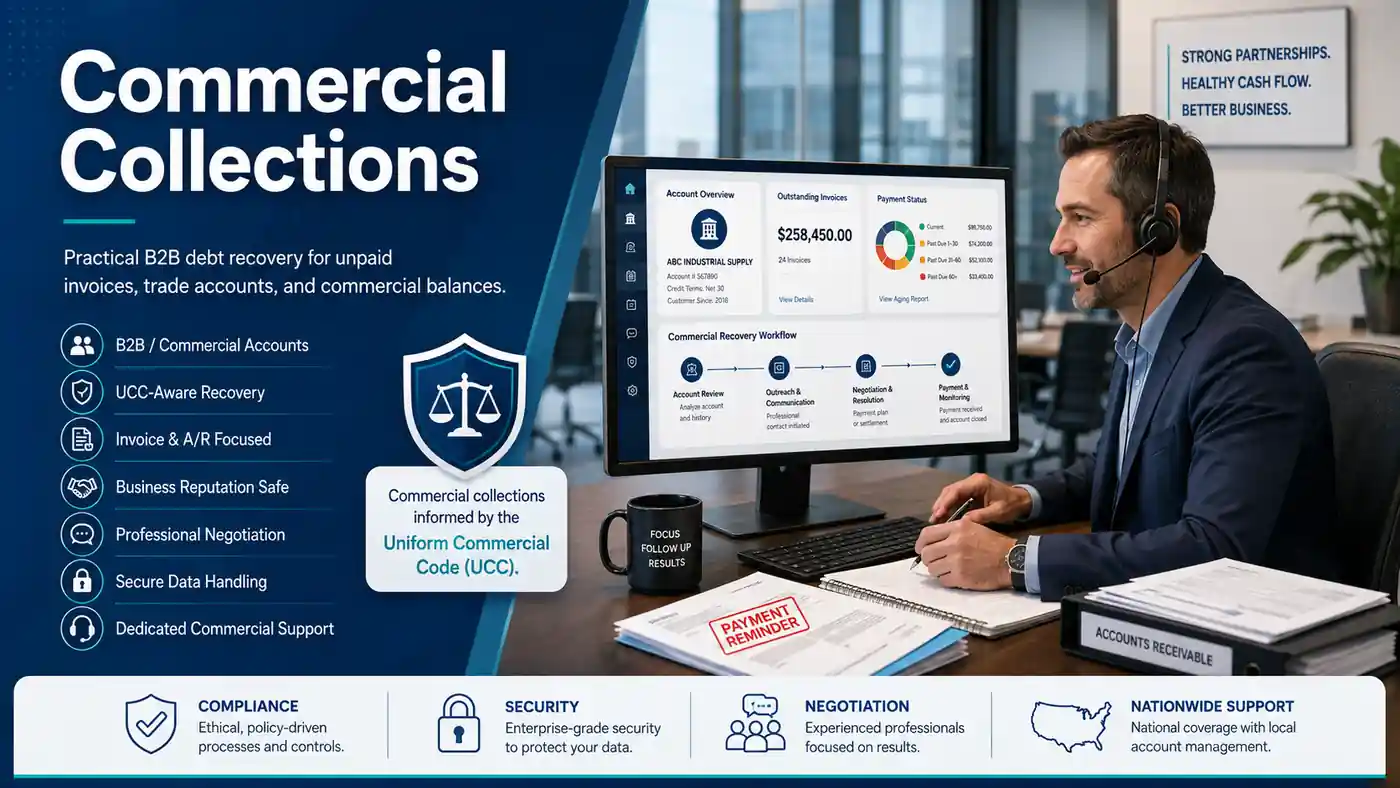
A commercial collection agency specializes in recovering unpaid invoices and past-due debts between businesses (B2B). Unlike consumer debt collection — which is tightly regulated by the FDCPA — commercial recovery operates under the Uniform Commercial Code (UCC) and contract law, enabling faster timelines, credit bureau leverage, and tools like UCC-1 filings and mechanic’s liens. Businesses typically engage a commercial collection agency when internal accounts receivable efforts have failed and outstanding invoices are 60–120+ days past due.

Nexa Collections 4-step commercial debt recovery process — investigation, credit reporting, negotiation, legal escalation

Commercial debt collection — also called B2B collections — is the process of recovering money owed by one business to another. These disputes often involve complex contracts, purchase orders, freight bills, and multiple decision-makers across departments. At Nexa Collections, we serve CFOs, accounts receivable teams, small businesses, and enterprise companies nationwide, combining diplomatic professionalism with proven legal leverage to recover what you’re owed — without destroying the relationships that matter.

Unpaid invoices are not just an inconvenience; they are a direct threat to cash flow. Research from the Commercial Law League of America shows that a debt only 90 days old has a 73% chance of recovery — but that number falls by roughly 10% for every additional month it goes unpaid. Acting fast is the single biggest factor in successful commercial debt recovery.

Trusted by businesses nationwide to recover millions in lost revenue annually. We combine a 80% success rate on viable claims with a diplomatic “Velvet Hammer” approach—ensuring you get paid without damaging valuable B2B relationships.

When Should You Hire a Commercial Collection Agency?

Most businesses should consider engaging a commercial collection agency when:

  • An invoice is 60 or more days past due with no payment or payment plan in place
  • A debtor has stopped responding to your calls, emails, or mailed notices
  • A client disputes the invoice but has not provided a legitimate counter-claim or documentation
  • Internal AR staff are spending more than 2 hours per week chasing a single account
  • You suspect a business has changed names, moved, or is preparing to close
  • The outstanding balance is large enough to affect your operating cash flow

The 60-day mark is the industry benchmark because recovery rates remain highest before the 90-day threshold. Every month of delay costs you roughly 10% of the recoverable value (Commercial Law League of America).

Quick Facts: Why Choose Us?

  • High Success Rate: While industry averages sit between 15% to 40%, we achieve a nearly 80% success rate on viable debts (accounts under 300 days old backed by solid documentation). Fee communicated in advance after reviewing your case. Results may vary as viability depends on documentation, debtor solvency and dispute status.

  • Business Credit Reporting: We report unpaid accounts to major Business Credit Bureaus. This affects the debtor’s ability to get future financing, creating a powerful incentive to pay you.

  • No Risk Pricing: We operate on a contingency basis—No Recovery, No Fee.

  • Nationwide Compliance: Backed by over 20 years experience, we are licensed in all 50 states and strictly follow the Uniform Commercial Code (UCC) and TCPA regulations.

  • Credentials: Collections performed by ACA compliant collectors who are fully licensed to collect in all 50 states. HIPAA, NFIB, PCI and SOC type 2 compliant collection agency.

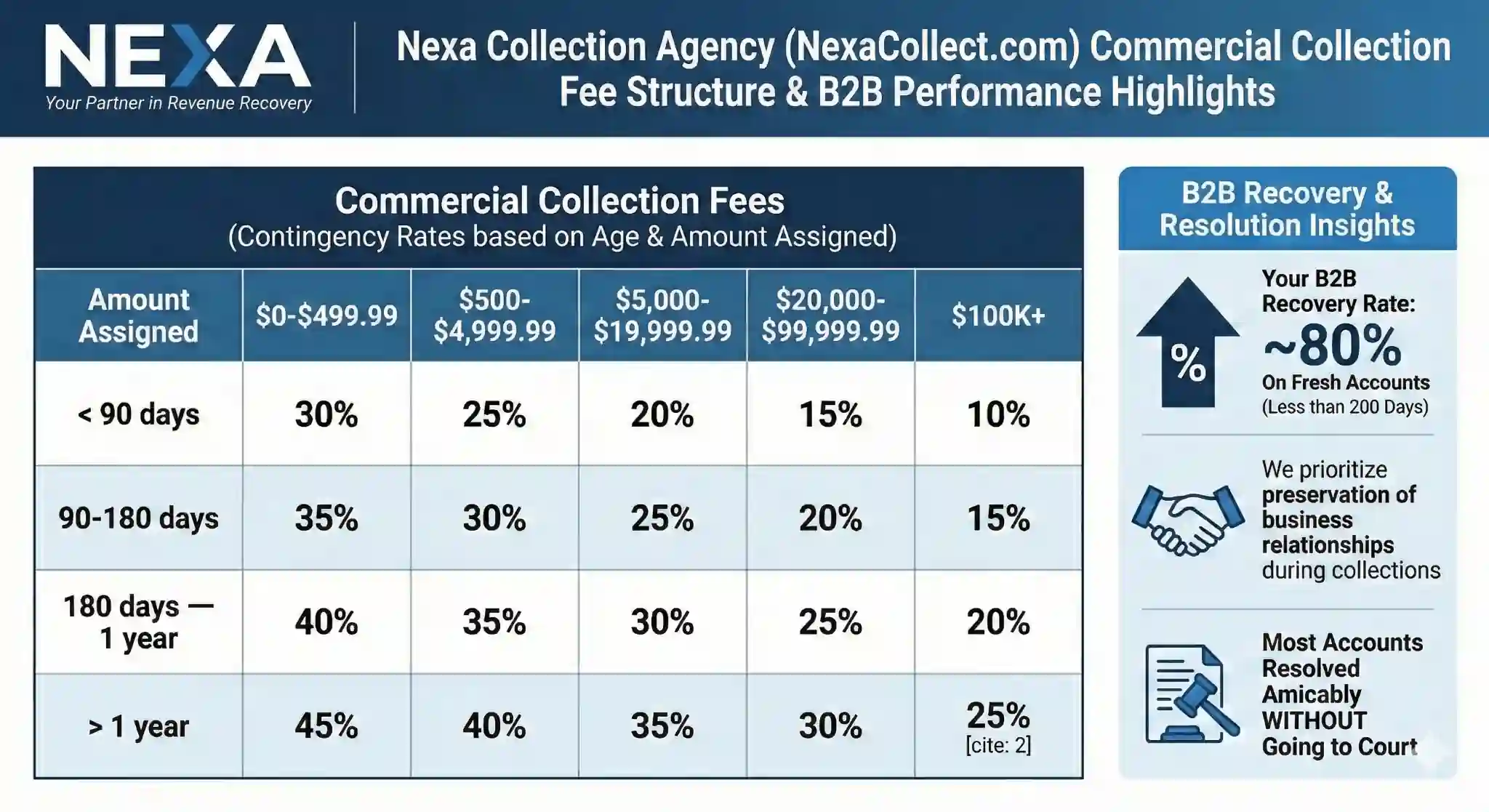
Nexa Collections commercial collection agency fee structure — contingency pricing tiers from 15% to 40% based on debt age and balance


The “Velvet Hammer” Approach for B2B

A business debtor is often also a potential future client. We understand that preserving the business relationship is critical. Our collectors use a “Velvet Hammer” strategy: we are persistent and firm regarding the financial obligation, but professional and respectful in our communication. This approach recovers your money while leaving the door open for future business.


Our 4-Step Commercial Recovery Process

Our commercial debt collectors utilize persistent contact, credit leverage, and skilled negotiation to resolve the vast majority of cases amicably, reserving legal action strictly as a last resort.

1. Investigation & Skip Tracing

Before making the first call, we investigate. We verify business status, identify key decision-makers (owners, CFOs), and check for bankruptcy filings. If a debtor has “ghosted,” our skip tracing tools locate them.

2. Strategic Demands & Credit Reporting

We use a multi-channel approach (calls, emails, and mailed notices). Crucially, we utilize credit leverage:

Impact: A negative mark on a business credit report (such as D&B, Experian, or Equifax) can block a company from getting loans or vendor credit. This pressure often forces immediate payment.

3. Negotiation & Mediation

Commercial debts often involve disputes over service quality or contract terms. Our specialists act as mediators to cut through excuses and secure full payment or enforce a structured settlement plan.

4. Legal Escalation (With Your Approval)

If a debtor has assets but refuses to pay, we can forward the case to our affiliated network of commercial litigation attorneys. We handle the paperwork and manage the process, so you don’t have to.

Need a Commercial Collection Agency?

Contact Us

Serving Nationwide – Low Fee

Industries We Specialize In

Commercial debt requires industry-specific knowledge. We have dedicated teams for:

  • Construction & Contractors: Handling liens, material disputes, and general contractor issues.

  • Manufacturing & Logistics: Collecting on unpaid freight bills, warehousing fees, and supply orders.

  • Staffing & SaaS: Recovering service fees and contract buyouts.

  • Wholesalers & Distributors: Managing high-volume, low-balance delinquent accounts.

  • Commercial / Office leases 

Commercial Collection Agency vs. Attorney vs. In-House AR Team

Not sure which path is right for your unpaid B2B invoice? Here’s how the three most common options compare:

Factor Collection Agency Commercial Attorney In-House AR Team
Cost Contingency only (15–40%). No upfront fee. Hourly ($250–$500/hr) + court costs. High upfront risk. Salaried staff cost. Consumes internal resources.
Speed 30–90 days for most cases 6–18 months if litigation required Varies; often slow due to competing priorities
Relationship Impact Low — professional, diplomatic approach preserves the relationship High — legal action typically ends the business relationship Moderate — awkward for staff managing existing accounts
Legal Authority None directly; escalates to attorneys when needed Full legal authority — can sue, lien, garnish wages None
Best For Debts of any size; first recovery attempt; relationship-sensitive accounts Large debts ($50K+) where debtor has assets and refuses all negotiation Very recent invoices (under 30 days); ongoing client relationships
Credit Reporting Yes — reports to D&B, Experian, Equifax Business Only via court judgment No

Most businesses use a collection agency first — and only escalate to legal counsel if the agency recommends it based on debtor assets and dispute complexity.


Proven Results & Legal Authority

  • Midwest Logistics & Freight ($140,000): Resolved a complex cross-border brokerage dispute in 22 days via targeted mediation, bypassing months of litigation.

  • Industrial Manufacturing ($210,000): Recovered 100% of principal plus interest in under 45 days using “Corporate Diplomacy” to reconnect with new decision-makers after a client’s restructuring.

  • Commercial HVAC Construction ($68,000): Secured a full retention payment in 24 days. By filing a “Notice of Intent to Lien,” we forced a developer to release funds to protect their property title.

Our Technical Edge: B2B Security

Secured Creditor Leverage: We specialize in UCC-1 filings and Mechanic’s Liens to “perfect” your security interests. This expertise ensures your business is moved to the front of the line during payment disputes or insolvency proceedings, providing the highest level of legal protection available.

Checklist: What We Need to Start

To achieve that 75% success rate, providing the right documentation is key. When you place an account, we recommend uploading:

  • Copies of the original Invoices.

  • The signed Contract, Purchase Order (PO), or Service Agreement.

  • Statement of Account (showing payment history).

  • Any relevant email correspondence regarding the debt.


Frequently Asked Questions: Commercial Debt Collection

What is the difference between consumer and commercial collections?

Consumer collections (B2C) are strictly regulated by the Fair Debt Collection Practices Act (FDCPA) to protect individuals. Commercial collections (B2B) are governed by the Uniform Commercial Code (UCC) and contract law, allowing for different strategies — including business credit bureau reporting, UCC-1 filings, and mechanic’s liens — and often shorter timelines for resolution.

How much does a commercial collection agency charge?

We operate on a contingency fee model — no upfront cost, ever. Our rates typically range from 15% to 40% of the amount recovered, depending on the age of the debt, the balance size, and the complexity of the case. If we don’t collect, you pay nothing.

How long does commercial debt collection take?

Most commercial debts are resolved within 30–90 days. Simple cases with strong documentation (signed contracts, invoices, proof of delivery) can settle in 2–4 weeks. Complex disputes involving litigation or mediation can take 3–6 months. The sooner a past-due account is placed, the faster — and more likely — the recovery.

Can you collect business debts from companies in another state?

Yes. Nexa Collections is licensed in all 50 states and works with an affiliated network of commercial litigation attorneys nationwide. Interstate B2B collections are routine, and we are well-versed in the UCC provisions and contract law governing cross-border commercial disputes.

When is it too late to collect a commercial debt?

Every state has a statute of limitations for commercial contracts, typically 3 to 6 years. However, collection success drops significantly after 90 days — approximately 10% per additional month (Commercial Law League of America). Acting within 60–120 days of a missed invoice gives you the best chance of full recovery without litigation.

What is a UCC-1 filing and how does it help?

A UCC-1 (Uniform Commercial Code financing statement) is a legal notice filed with the state that establishes your interest in a debtor’s assets. Filing a UCC-1 effectively moves your business to the front of the repayment line if the debtor faces insolvency or asset liquidation — one of the most powerful tools in commercial debt recovery.

Do I need a lawyer to collect a commercial debt?

Not initially. A commercial collection agency resolves the majority of B2B debts through negotiation, credit leverage, and mediation — no litigation required. Legal escalation is reserved as a last resort for debtors who have assets but refuse to pay. In those cases, Nexa manages the entire legal escalation process through our attorney network.

Can you collect from a business that has closed down?

Difficult, but often possible. If the owner signed a personal guarantee, operates as a sole proprietor, or is part of a general partnership, they are personally liable. We also investigate for successor liability (reopened under a new name) and fraudulent transfers (hidden assets). Personal asset pursuit typically requires a court judgment via an affiliated attorney.

What is the average recovery rate for commercial collection agencies?

The industry average ranges from 15% to 40%. Nexa Collections achieves a nearly 80% success rate on viable claims — accounts under 300 days old backed by solid documentation. Results vary based on debtor solvency, dispute status, and documentation quality.

Is it worth hiring a collection agency for a small balance?

Yes — because reputable agencies work on contingency, you pay nothing unless money is recovered. Even balances under $5,000 are worth placing. The recovered funds go directly to your bottom line at zero upfront cost to you.


Ready to Boost Your Cash Flow?

Don’t let unpaid invoices sit on your books. Statistics show that after 90 days, the chance of collecting a debt drops by 10% every month.

Get a Free Commercial Quote

Filed Under: Debt Recovery

Using CareCloud Software? Need a Collections Agency to Recover Bills?

Tired of a beautiful CareCloud dashboard and an ugly aging report?
You’re not alone. Many practices get the front end right—claims go out, payments come in—yet a stubborn pile of old patient balances never really moves.

Why CareCloud users still struggle with A/R

CareCloud checks a lot of boxes:

  • Cloud-based EHR and practice management

  • Integrated RCM tools or full billing services

  • Dashboards that show denials, collections, A/R trends

On paper, everything looks under control.

But in real life you still see:

  • Accounts that sit 60, 90, 120+ days past due

  • A growing chunk of A/R tied to patient responsibility

  • Staff who “will follow up later” but never quite get to it

That’s not a software bug. That’s the gap between billing and debt recovery.


Where CareCloud helps you – and where it stops

CareCloud is very good at what it is supposed to do:

  • Capture charges and create claims

  • Scrub and submit those claims accurately

  • Post payments and adjustments

  • Generate aging and KPI reports

  • Send standard statements and reminders

What it does not do:

  • Call a patient every week for two months

  • Track down a guarantor who moved and changed numbers

  • Negotiate a realistic payment plan when a family is already behind on other bills

  • Decide which accounts should move from “late” to “collections”

If your strategy is “we’ll keep sending statements and hope something happens,” your old A/R will keep growing—no matter how polished the software is.


The “red zone”: when an invoice stops being a bill and becomes bad debt

Every practice has a point where, if you’re honest, you know:

“If this hasn’t been paid by now, it probably won’t be… unless someone treats it like a collections problem.”

A few simple signals:

  • Age: The balance has been sitting for three to four months with no meaningful payment.

  • Silence: Statements went out, maybe a couple of calls… and then nothing.

  • Behavior: The patient stopped responding, keeps cancelling, or ignores every message.

CareCloud will happily show you these accounts in your A/R Aging report. It will not make the hard decision for you.

You need a line in the sand that says:

“After this point, this stops living in our billing workflow and moves to our collection workflow.”


Turn your CareCloud A/R into a simple rulebook

Instead of debating every account, build a small rulebook that lives on top of your CareCloud data.

Here’s one way to structure it:

Rule 1: Time

  • If a patient balance has no payment in 90+ days, and

  • You’ve already made at least 3 contact attempts (statement, portal reminder, or phone call),

→ it is eligible for collections.

Rule 2: Amount

  • Very small balances (for example under $50–$100):

    • Either batch them once or twice a year, or make a decision to write them off.

  • Mid-sized balances (for example $150–$750):

    • Follow your normal reminder workflow; if still unpaid at 90–120 days, move them to collections.

  • Larger balances (for example $1,000+):

    • Review earlier and escalate faster if there is no payment or plan by 60–90 days.

Rule 3: Exceptions

  • Keep out:

    • Formal payment plans that are being honored

    • Active disputes

    • Approved charity-care or special-case patients

Once this is written down, CareCloud becomes a trigger engine, not just a reporting tool.


How a CareCloud-friendly collections workflow fits in

Now you need a way to turn those rules into an actual, repeatable process.

That’s where a CareCloud-friendly debt-collection utility comes in. The goal is to make the handoff from CareCloud → collection agency:

  • Easy to configure

  • Boring to run

  • Hard to forget

Typical knobs you control:

  • Minimum balance:
    “Only send accounts with balances over $200 or $300.”

  • Account age:
    “Only send accounts where there’s been no payment for 90 days (or 60 / 120 / 180—your choice).”

  • Recovery path:

    • Start with a fixed-fee letter series (firm but courteous demand letters), or

    • Go straight to contingency collections for the worst accounts.

  • Exclusions:

    • Remove accounts in payment plans, flagged disputes, or any category you mark as “do not place.”

Once configured, the utility:

  1. Reads the A/R data from CareCloud.

  2. Finds accounts that match your rules.

  3. Prepares a clean, secure file for your collection partner.

You’re no longer “remembering to send accounts to collections”. It just happens on schedule.


Three simple playbooks (you can adjust the numbers)

You don’t have to reinvent anything. Start with patterns like these and tweak them to your comfort level.

Playbook 1 – Standard patient A/R

  • Balance ≥ $200

  • No payment in 90+ days

  • At least 3 contacts recorded

→ Send to a fixed-fee letter program first. If no response after that series, escalate to contingency collections.


Playbook 2 – High-balance safeguard

  • Balance ≥ $1,000

  • No payment or arrangement at 60 days

→ Manager review + one last internal call.
If still no plan by 90 days, move to a full collections placement.


Playbook 3 – Old A/R cleanup
Once a month, run a report of all patient A/R over 120 days that isn’t in a payment plan or dispute.

  • Decide whether to:

    • Place them in bulk with your collection agency, or

    • Close / write off accounts that truly have no recovery path

Either way, you stop letting “forever balances” clutter your CareCloud reports.


“Won’t using a collection agency upset our patients?”

It depends on who you choose and what you ask them to do.

A good healthcare-focused collection agency will:

  • Work under HIPAA and other privacy rules, sharing only the minimum needed information

  • Follow debt-collection regulations and your own communication preferences

  • Approach patients with a firm but respectful tone

  • Offer realistic payment options instead of “pay in full or else” ultimatums

Your team stays focused on care and early financial conversations.
The agency focuses on late-stage accounts that have already been given reasonable chances.


Where Nexa fits in (and what we don’t do)

Quick clarification:

  • Nexa is an information portal.

  • We are not a collection agency.

  • We do not call your patients or report to credit bureaus.

What we do:

  • Talk with practices that use platforms like CareCloud and dig into their A/R challenges, typical balances and patient mix.

  • Help you think through placement rules that sit on top of your existing CareCloud reports.

  • Share your collection requirements with a shortlist of medical collection agencies we believe are a good match for your type of receivables.

  • Leave it completely up to you whether to work with any of them.

CareCloud already gives you cleaner claims, better reporting, and a clearer view of your revenue.

Layer a simple, rule-based collections process on top, and those stubborn 60–120+ day balances stop being long-term residents in your aging report—and start becoming cash you can actually use.

Already using CareCloud Software? Have unpaid medical bills? 

Need to transfer your overdue accounts receivable to a collection agency? Contact us

  • You decide what should be the minimum outstanding balance eligible for collections.
  • Only send accounts if a payment hasn’t been made in _(60/120/180) days.
  • Send 5 collection demands to your patient or transfer directly for debt collection calls.
  • You are in total control of the process. Dedicated small business debt collectors.
  • Contact us for a demo of our free CareCloud debt collection utility. 

    Collection Agency
    Debt Collection Utility


Filed Under: Debt Recovery

Enterprise Collection Agency for Large Business: B2B & B2C Recovery

An enterprise collection agency provides outsourced accounts receivable recovery for mid-size and large corporations managing high-volume or high-value debt portfolios across both business clients (B2B) and individual consumers (B2C).

Unlike small business collection, enterprise recovery requires ERP system integration, portfolio segmentation by risk tier, multi-jurisdiction compliance architecture (FDCPA, TCPA, HIPAA, CCPA), and dedicated account management for relationship-critical debtors. The right enterprise collection partner functions as a seamless extension of your internal AR team — reducing DSO, cutting staff overhead, and protecting your corporate brand simultaneously.

Enterprise collection agency managing large-scale B2B and B2C debt recovery portfolios for corporations and mid-size businesses

Nexa acts as a surgical extension of your A/R department. We understand that while a B2B client requires a “white-glove mediation” to save a million-dollar contract, a B2C portfolio requires an automated, high-velocity system that resolves thousands of small balances without triggering a single regulatory red flag.

Nexa provides 100% reputation-safe, equipped with all 50-state collections license, offering free credit reporting, free litigation, free bankruptcy scrubs, and zero onboarding fees. Secure – SOC 2 Type II & HIPAA compliant. Over 2,000 online reviews rate us 4.85 out of 5. 

Need a Collection Agency? Contact us


Enterprise AR Benchmarks: B2B vs B2C at Scale

Understanding how commercial and consumer debt performs at enterprise volume is the first step in building an effective outsourced recovery strategy:

Metric B2B (Commercial) B2C (Consumer)
Average invoice / balance value $6,420 (global average) $132 (consumer average)
Typical overdue rate 10.5% of total AR 15–22% depending on sector
Industry average DSO 45–65 days (varies by sector) 30–45 days (varies by sector)
DSO improvement with outsourced collections 8–15 day reduction typical Up to 40% reduction in 90-day bucket
Bad debt write-off rate (benchmark) <1% of revenue (healthy) <2% of revenue (healthy)
Recovery lift with AI-assisted outreach 15–25% improvement Up to 40% reduction in OPEX
Primary regulatory framework UCC, contract law (fewer debtor protections) FDCPA, TCPA, HIPAA, Regulation F, state laws
Relationship preservation priority Critical — a recovered B2B client may represent 7-figure future revenue Moderate — brand reputation and online review risk

How Enterprise Collections Reduces Your DSO

Days Sales Outstanding (DSO) is the primary KPI every CFO uses to measure AR health. It measures the average number of days it takes to collect revenue after a sale is made. The formula is simple:

DSO = (Total Accounts Receivable ÷ Total Credit Sales) × Number of Days

A DSO of 45 days in a Net-30 environment means your customers are paying 15 days late on average — a 50% payment delay that compounds across every invoice in your portfolio.

DSO benchmarks by industry (for context)

  • Manufacturing: 45–60 days average DSO
  • Wholesale & Distribution: 35–50 days
  • Technology & SaaS: 40–55 days
  • Healthcare (B2C): 50–75 days
  • Construction & Trades: 60–80 days
  • Retail & E-commerce (B2B wholesale): 30–45 days

If your DSO is more than 15 days above your payment terms, your AR process has a measurable revenue drag — and outsourced collections is typically the fastest lever to pull.

How Nexa reduces DSO in practice

  • Earlier intervention: Our Step 1 fixed-fee service ($15/account) deploys at the 30–60 day mark — before most internal AR teams escalate. Earlier contact means faster resolution and a shorter average collection cycle.
  • Omnichannel automation for B2C portfolios: AI-driven SMS, email, and IVR outreach resolves small consumer balances at scale without manual staff time — cutting the 90-day delinquency bucket without adding headcount.
  • White-glove mediation for B2B: Relationship-tier accounts are handled by dedicated mediators who find the underlying paperwork issue (missing PO, disputed delivery, AP routing error) and resolve it in days, not weeks.
  • Real-time ERP sync: Payment updates flow directly back into your SAP, Oracle, or NetSuite ledger — eliminating the 3–5 day reporting lag that inflates your reported DSO artificially.

The Nexa Dual-Track Ladder

1. B2B Strategy: Professional Mediation

Commercial debt is rarely about “no money.” It’s usually about a missing PO, a “punch list” dispute, or a slow-moving AP department.

  • The Step 1 Approach: We use Fixed-Fee ($15) white-label notices that act as a neutral third-party “reconciliation request.” This preserves the relationship while signaling that the grace period is over.

  • The Mediation Phase: For aged B2B debt, our mediators act as resolution specialists. We find the person with the “check-cutting authority” and solve the underlying paperwork issue.

2. B2C Strategy: High-Velocity Automation

When dealing with thousands of individual consumers, every manual “touch” by your staff costs you profit.

  • Digital-First Recovery: We use AI-driven omnichannel triggers (SMS, Email, and IVR) to resolve small balances before they hit the 90-day mark.

  • Compliance by Design: Our systems are hard-coded with the latest 2026 consumer protection rules, ensuring that your corporate brand is never associated with “strong-arm” tactics or legal non-compliance.

Enterprise collection agency pricing — $15 fixed fee for first-party recovery, 20–40% contingency for third-party collections, 50% for legal escalation


Enterprise AR Portfolio Segmentation: How Nexa Triages Your Accounts

Enterprise AR is not a uniform portfolio — and treating every delinquent account with the same approach is both expensive and relationship-damaging. Nexa segments every enterprise portfolio into three tiers before a single outreach attempt is made:

Tier 1 — Relationship-critical accounts (white-glove mediation)

These are B2B accounts where the debtor is an active, ongoing customer relationship — a supplier, a key distributor, a multi-year service contract client. Standard collection pressure would risk a relationship worth far more than the outstanding balance.

Our approach: Dedicated account mediators who understand your industry context. Outreach is framed as an “account reconciliation” — identifying the underlying cause (missing PO approval, disputed delivery, AP routing error, budget freeze) and resolving the paperwork friction rather than applying payment pressure. Escalation never happens without your explicit sign-off.

Tier 2 — Standard commercial accounts (structured automation + human escalation)

B2B accounts with no ongoing relationship risk, or B2C accounts with balances above $1,000. These receive structured outreach: Step 1 fixed-fee demand letters, followed by phone and digital escalation if unresolved within 30 days.

Our approach: Semi-automated outreach with human review at each escalation decision point. Skip tracing and bankruptcy scrubs run at placement. Credit bureau reporting (D&B, Experian Business for B2B; Equifax, Experian, TransUnion for B2C) deployed at the appropriate stage.

Tier 3 — High-volume tail accounts (AI-driven high-velocity resolution)

Large consumer portfolios of small balances ($50–$500) where manual outreach costs more than the balance recovered. These require automation at scale — not human collectors.

Our approach: AI-driven omnichannel triggers across SMS, email, and IVR. Self-service payment portal available 24/7. FDCPA/TCPA compliance hard-coded into every outreach sequence, with automatic adjustment for state-specific rules (California Rosenthal Act, New York frequency limits, Texas TDCA). Resolution target: 90% of resolvable accounts closed within 60 days without a single human touch.


Compliance Architecture: What Enterprise Legal Teams Need to See

Enterprise procurement and legal teams evaluate collection partners against a compliance checklist before vendor approval. Here is how Nexa addresses each requirement:

Regulation Who It Covers How Nexa Complies
FDCPA All B2C consumer debt collection 50-state licensed. All collectors trained and tested annually. Call recording and audit trail on every account.
TCPA + Regulation F (CFPB 2021) Phone, SMS, and digital outreach to consumers Consent-verified contact lists. 7-call-in-7-days limit enforced systemically. Email channel added per Reg F. Opt-out honored within 24 hours.
HIPAA B2C healthcare, dental, and insurance portfolios BAA executed before any PHI is shared. Minimum necessary information only. SOC 2 Type II certified data environment.
CCPA / State Privacy Laws California consumers (and expanding state equivalents) Consumer data requests processed within 45-day statutory window. Data minimization applied at account intake. No data sold or shared with third parties.
UCC (B2B) Commercial accounts, secured creditor claims UCC-1 lien eligibility screened on high-value B2B accounts. Affiliated commercial attorneys in all 50 states for legal escalation.
SOC 2 Type II Data security (all clients) Annual third-party audit. Covers security, availability, processing integrity, confidentiality, and privacy trust service criteria.

Full compliance documentation — including our SOC 2 Type II report summary, HIPAA BAA template, and state licensing certificates — is available upon request during the enterprise evaluation process.


Enterprise Brand Protection: The “Zero-Complaint” Goal

For a big business, the PR damage from a single mishandled collection can exceed the value of the entire portfolio.

  • The Reputation Shield: We maintain a 4.85 Google rating because we treat people as your customers, not just debtors.

  • Legal Liability Transfer: By moving your recovery to Nexa, you transfer the immense regulatory risk of consumer contact to our fully licensed and insured team.


Recent Enterprise Results

  • National Logistics (B2B Focus): A global carrier had $1.4M in commercial “micro-balances” (under $500) deemed too expensive to chase. Nexa’s Step 1 service recovered $640,000 in 90 days for a total cost of $12,000.

  • Utility/Telecom (B2C Focus): A national service provider reduced their 90-day delinquency bucket by 32% in one quarter using our automated digital triggers, saving an estimated $400k in staff labor costs.


Enterprise Collection FAQ

What is the difference between enterprise collections and standard debt collection?

Enterprise collections involves recovering debt at scale — typically thousands of accounts per month — across complex portfolio types (B2B and B2C), multiple jurisdictions, and diverse regulatory frameworks. It requires ERP integration, tiered account segmentation, multi-channel automated outreach, dedicated compliance architecture, and often dedicated account management for high-value relationships. Standard collection is account-by-account manual recovery. Enterprise collection is a managed AR function.

How does outsourcing collections affect our Days Sales Outstanding (DSO)?

When implemented correctly, outsourced collections typically reduces DSO by 8–20 days within the first two quarters. The mechanism is earlier intervention — accounts placed at 30–60 days resolve significantly faster than those placed at 90+ days. Real-time ERP payment sync also eliminates the reporting lag that artificially inflates DSO figures in systems that update on batch cycles.

What happens to accounts that involve ongoing customer contracts?

These are handled as Tier 1 relationship accounts under our white-glove mediation protocol. Outreach is framed as an “account reconciliation” — we identify the underlying cause (missing PO, billing dispute, AP routing error, temporary budget freeze) and resolve the friction without confrontational collection language. No escalation to third-party status without your explicit written approval. The goal is to recover the balance while keeping the contract intact.

How do you handle multi-state consumer portfolios with different state laws?

Our outreach system is hard-coded with state-specific compliance rules that automatically adjust based on the debtor’s state of residence. This covers: contact frequency limits (New York’s stricter rules, California’s Rosenthal Act protections), required disclosures, time-of-contact restrictions, and Regulation F email channel requirements. All of this is handled systemically — your team does not need to manage state-level compliance manually.

Can you handle both B2B and B2C portfolios simultaneously for the same client?

Yes — this is a core enterprise capability. We run completely separate compliance protocols, outreach strategies, and reporting tracks for B2B and B2C portfolios. Your AR director sees consolidated reporting across both tracks in our real-time portal, but the collection logic, regulatory framework, and account handling are entirely distinct. This prevents consumer protection rules from being accidentally applied to commercial accounts (and vice versa), which is a common compliance failure at agencies that don’t specialise in mixed portfolios.

What security certifications does Nexa hold for enterprise data handling?

Nexa is SOC 2 Type II certified — audited annually by an independent third party against the AICPA Trust Service Criteria for security, availability, processing integrity, confidentiality, and privacy. We are also HIPAA-compliant for healthcare portfolio clients, with BAA execution as a standard contract requirement. All data is encrypted in transit (TLS 1.3) and at rest (AES-256). Full security documentation is available on request during the enterprise evaluation process.

What is your process for high-value B2B accounts over $100,000?

High-value B2B accounts receive dedicated mediator assignment from day one — not a queue-based system. Before any outreach, we conduct a debtor asset profile (business credit pull, litigation history, UCC lien search, bankruptcy check) to understand the recovery landscape. The outreach strategy is customised to the specific debtor relationship and dispute type. Legal escalation via our affiliated commercial attorney network is available for accounts with verified assets and no engagement after diplomatic channels are exhausted.

How does the reporting and portal work for enterprise clients?

Enterprise clients access a real-time, 24/7 secure portal with: account-level status tracking, payment receipt confirmation, dispute flag visibility, collector notes, and portfolio-level analytics (recovery rate, DSO impact, accounts by stage). Reports can be exported in formats compatible with SAP, Oracle, and NetSuite. For clients with API integration, reporting data can be pushed directly to your data warehouse or BI tool on a scheduled basis.

Do you report to business credit bureaus for B2B accounts?

Yes — Nexa reports to Dun & Bradstreet (D&B) and Experian Business for commercial B2B accounts where reporting is appropriate and legally permissible. Business credit reporting is a powerful leverage tool for commercial accounts — a delinquency report on a company’s D&B file affects their vendor credit terms across their entire supply chain, which creates strong motivation to resolve the balance. We discuss reporting strategy with you before deploying it, as the decision can affect the debtor relationship.

What is your minimum volume requirement for enterprise accounts?

There is no minimum volume requirement to start — even enterprise clients with a single high-value account can place it through our portal. For clients with ongoing high-volume portfolios (500+ accounts per month), we offer dedicated account management, custom integration setup, and volume-tiered pricing. Contact our enterprise team for a custom quote based on your portfolio profile, average balance, and account mix.

Stop Risking Your Brand. Start Recovering Your Revenue.

Let us show you a more intelligent, effective, and professional approach to your accounts receivable.

Schedule Your Enterprise Consultation Today

Filed Under: Debt Recovery

Swimming Pool Debt Recovery: Why “Do-It-Yourself” Collections Sink Profits

Swimming Pool Cleaning

In the swimming pool industry, you sell two things: your labor and your chemicals. When a client doesn’t pay, you aren’t just losing profit; you are physically paying out of pocket to keep their water blue.

Many pool business owners fall into the trap of trying to be their own debt collectors. They send awkward texts, leave polite voicemails, and hope for the best.

Here is the hard truth: If you are scrubbing tiles, you shouldn’t be scrubbing your aging report. Here is why handing accounts over to a professional agency is the smartest move for your bottom line.

  Serving Pool Companies Nationwide

Need a Collection Agency? Contact Us

The “Neighborhood Reputation” Trap

Pool service is a hyper-local business. You rely on referrals from neighbors.

  • The Problem: Aggressively chasing a client for $300 can lead to them bad-mouthing you on Nextdoor or local Facebook groups.

  • The Agency Solution: A third-party agency acts as a professional buffer. They play the “bad cop,” allowing you to remain the “good cop” who just wants to provide great service. You can truthfully say, “I’m sorry, our accounting system automatically forwards accounts at 90 days, it’s out of my hands.” This preserves your reputation while still applying pressure.

Service Routes vs. Construction: Where Agencies Shine

1. The Maintenance Route (Unsecured Debt)

For weekly cleaning, chemical stops, and minor repairs ($200 – $1,000), you generally cannot file a Mechanic’s Lien. The legal costs to sue in small claims court often exceed the debt itself.

  • Why DIY fails: A homeowner knows you won’t sue them for $250. They prioritize their mortgage and car payment over you.

  • Why Agencies win: A collection agency can report the debt to the Credit Bureaus. Suddenly, that “ignorable” $250 bill threatens their credit score. This is often the only leverage that works for service debts.

2. The “Missed Window” Construction Debt

For builders and plasterers, the Mechanic’s Lien is powerful, but the window to file is tight (often 60-90 days).

  • The Reality: Many builders wait too long because the client keeps promising “the check is in the mail.” Once that lien deadline passes, you have zero leverage.

  • The Fix: When the lien window closes, a collection agency is your safety net. They have the tools to trace assets and demand payment even after your lien rights are gone.

The Hidden Power: Skip Tracing

A common scenario in the pool industry: The “Sold Home” Vanishing Act. A client runs up a bill getting the pool ready to sell, sells the house, and moves out of state without paying you.

  • You: Send invoices to an empty house.

  • The Agency: Uses “Skip Tracing” technology to locate the debtor’s new address, new phone number, and sometimes even their new place of employment. They find the people who are trying to hide.

The 90-Day “Hand-Off” Rule

When should you stop asking and start assigning? The industry standard is 90 days.

  • Days 1-60: This is your job. Send the invoice, send the reminder, pause service.

  • Day 90: If they haven’t paid after three months, they aren’t “forgetting.” They are ignoring.

  • The Cost of Waiting: Research shows that once a debt is 6 months old, the chance of collecting it drops to 50%. Hand it off while the debt is still “fresh” to maximize your recovery rate.

Focus on Blue Water, Not Red Tape

Your expertise is hydraulics, chemistry, and construction. A collection agency’s expertise is the FDCPA (Fair Debt Collection Practices Act).

  • If you call a debtor at the wrong time or threaten the wrong thing, you can be sued.

  • Agencies are licensed to apply maximum legal pressure without crossing the line.

Stop funding your clients’ swimming pools. Get a Collection Agency Specialized in the Pool Industry.

Contact Us


Filed Under: Debt Recovery

  • « Go to Previous Page
  • Page 1
  • Interim pages omitted …
  • Page 9
  • Page 10
  • Page 11
  • Page 12
  • Page 13
  • Interim pages omitted …
  • Page 27
  • Go to Next Page »

Primary Sidebar


accounts receivable

Need a Collection Agency?
Kindly fill this form.
We’ll get in touch with you

    Please prove you are human by selecting the tree.

    Compliance & Security

    • SOC 2 Type II Certified: Third-party audited data security and strict privacy controls.

    • HIPAA Compliant: Secure, legal processing of medical and municipal EMS accounts.

    • PCI-DSS Level 1: Highest tier of data encryption for secure payment processing.

    • FDCPA & FCRA Aligned: Full legal adherence to federal consumer protection laws.

    Recent Posts

    • Recovering Cash in Clovis Without Losing Your Community Respect
    • When Pearland Businesses Stop Getting Paid, the Clock Starts Ticking
    • In Columbia, Unpaid Invoices Don’t Age Gracefully – Neither Should Your Recovery Strategy
    • Norman Debt Collection Services | Professional Revenue Recovery OK
    • Collection Agency in Sterling Heights | Compliant & Effective
    • Round Rock Revenue Recovery: The Diplomacy of Dollars
    • Debt Collection Lewisville TX | $15 Fixed-Fee Revenue Recovery
    • Collection Agency in Fargo, ND | Compliant & Effective

    Featured Posts

    • Why My Emails Go to Spam: Fix Deliverability & Inbox Rates
    • Why New York Medical Practices Are Rethinking Their Collection Partner
    • Scale Faster: The Non-Tech Guide to AI-Augmented VAs

    Copyright © 2026 NEXACOLLECT.COM | This content is provided for general informational purposes only and should not be considered legal advice. Collection laws and requirements may vary by state, account type, documentation, debtor status, and specific facts. Please consult qualified legal counsel for guidance regarding your particular situation. Nexa and its authorized collection partners service accounts in accordance with applicable federal and state collection requirements. Visit our home page to know more about us.

    X
    Need a Collection Agency?
    Contact Us