• Skip to main content
  • Skip to primary sidebar

Nexa Collections

  • Home
  • Serving
    • Medical
    • Dental
    • Small Business
    • Large Business
    • Commercial Collections
    • Government
    • Utilities
    • Fitness Clubs
    • Schools
    • Senior Care Facility
  • Contact Us
    • About us
    • Cost

Search Results for: the bureaus

Short-Staffed and Drowning in AR? Here’s the Real Problem

When you’re short-staffed, unpaid invoices are the first thing to slip.

No one is hired just to chase money. The people you already have are busy keeping customers happy, answering phones, scheduling jobs, and putting out fires.

Meanwhile:

  • Most businesses are regularly paid after the due date

  • A big chunk of revenue often sits in the 60–90–120+ day bucket

  • Teams spend hours every week “circling back” on overdue invoices

If you’re short on people, you simply don’t have those hours. So AR becomes a someday project, and “someday” rarely comes.


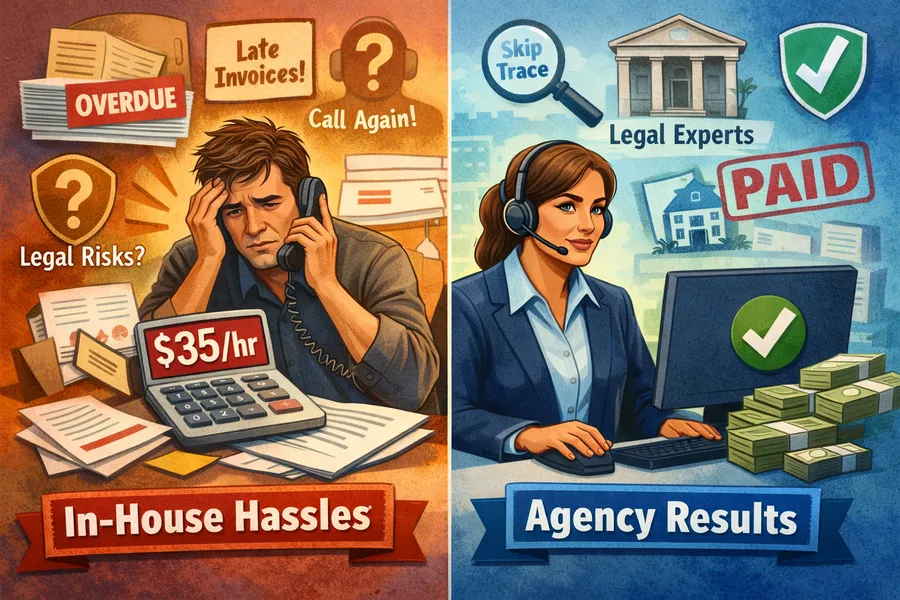
When you factor in salary, benefits, taxes and overhead, those “just 30 minutes a day” quickly add up to $30–$40+ per hour of fully loaded cost—hundreds of dollars a month—for an employee who lacks skip-tracing tools, bankruptcy screening, or knowledge of collection laws, and who usually has zero interest in acting as a part-time debt collector. In the end you’re paying a premium rate for slow, risky, and uncomfortable collections work that a specialized agency can do faster, safer, and purely on results.


The core issue: nobody truly “owns” collections

In a short-staffed operation, AR is treated like background noise:

  • “We’ll call them after this busy week.”

  • “Let’s get caught up on service first.”

  • “We’ll tackle aging invoices next month.”

That next month never arrives.

The real problem isn’t bad customers; it’s lack of ownership and consistency:

  • No one’s job is to be methodical about follow-up

  • Nobody has proper training in handling excuses and pushback

  • There’s no clear point where “late” becomes “collections”

So debts quietly age until they’re no longer worth the fight.


The hidden cost of “we’ll just hire someone”

On paper, hiring an in-house AR/collections person feels like the natural solution.

In reality, it’s expensive:

  • Salary (often tens of thousands a year)

  • Benefits, payroll taxes, software, workspace, training

  • Manager time to supervise, review, and replace if they leave

And collections work isn’t steady:

  • Some months they’re slammed

  • Other months there’s not enough work to justify the cost

  • If they’re mediocre, you pay a full salary for half the results

For a short-staffed business, that’s a heavy, permanent cost for a problem that’s irregular and spiky.


Why DIY collections rarely work well

Most businesses try to “share the load” internally:

  • The receptionist makes a few calls

  • The office manager sends some reminder emails

  • Someone in accounting tries to chase old invoices on Fridays

Common outcomes:

  • Awkward conversations – staff are afraid to be firm with customers they know

  • Inconsistent follow-up – two calls… then nothing for 6 weeks

  • No structure – every debtor is handled differently, depending on who picked up the file

  • Legal risk – nobody is trained on collection laws, call-time limits, or what you can and can’t say

On paper, DIY collections look cheap.
In practice, they’re slow, stressful, and lead to a lot of quiet write-offs.


Why outsourcing is often cheaper than “doing it ourselves”

A professional collection agency is usually contingency-based:

  • If they don’t recover, you don’t pay a fee

  • If they do recover, you share a percentage of the money collected

Compare that to a full-time salary, benefits, and overhead—paid every month, whether or not your AR actually improves.

For a short-staffed team, outsourcing means:

  • No fixed payroll cost for collections

  • No training, turnover, or management headaches

  • Staff stay focused on work that actually generates new revenue

You’re effectively trading “unpredictable write-offs and staff time” for “a predictable share of money you probably weren’t going to collect anyway.”


A four-step collection process that fits into your existing workflow

The fear with agencies is that they’ll be too harsh and damage relationships. A good one works in measured steps, not with a sledgehammer.

Think of it as a four-step ladder.

Step 1 – Gentle, branded reminders

This is the “soft touch” phase:

  • Professional letters or emails mentioning your company

  • Clear summaries of what’s owed and how to pay

  • A friendly, “we need to get this squared away” tone

This alone cleans up a surprising number of accounts—people who simply forgot or misplaced the invoice.

Step 2 – Polite, persistent live contact

For those who ignore written reminders, the agency begins live outreach:

  • Calls and, where allowed, text or email

  • Trained collectors who spend all day handling excuses and delays

  • Calm but persistent follow-up at different times of day

The tone is still respectful. The goal is to confirm the debt and get a realistic plan in place, not to threaten.

Step 3 – Deeper recovery tools

For tougher cases:

  • Skip tracing to find new addresses or phone numbers

  • Checking whether the debtor can realistically pay

  • Offering structured payment plans or, when appropriate, settlements

Here, experience matters. Collectors know when to push, when to listen, and when a partial recovery is better than adding another year to your aging report.

Step 4 – Legal and credit escalation (for the few that need it)

A small percentage of accounts are simply refusing to pay. For those:

  • Formal attorney letters or legal action may be considered (usually for larger balances)

  • Where allowed and appropriate, accounts may be reported to credit bureaus

By the time an account reaches this stage, every softer option has been tried. This step is for won’t-pay, not can’t-pay, situations.


How this helps a short-staffed team in real life

The real win isn’t just more recovered money—it’s clarity and relief.

You set simple rules, such as:

  • “Send accounts to Step 1 at 45 or 60 days past due.”

  • “Move to live contact at 90 days if there’s still no payment.”

  • “Only place accounts over $X, except for periodic cleanups of small, very old balances.”

After that:

  • Your team continues to serve customers and run the business

  • The agency handles the persistence, structure, and legal nuance

  • Money that used to quietly die in the 90–120+ day column starts coming back in


The bottom line

Being short-staffed isn’t just a staffing problem—it’s a cash problem when overdue invoices are allowed to pile up.

You can:

  • Ignore them and write off more every year

  • Keep trying to squeeze collections into already overloaded roles

  • Or plug in a four-step outsourced process that’s persistent, reputation-conscious, and paid for out of money you weren’t collecting anyway

If “we’re too short-staffed to chase AR” sounds familiar, that’s exactly why a structured, outsourced collections process isn’t an extra expense—it’s the missing piece in your revenue strategy.


Filed Under: Debt Recovery

What to Do When Your Collection Agency Closes: How to Transfer Accounts?

You had submitted accounts to a collection agency, but they have ceased their operations now.

This is a fairly serious situation.

What happens to the accounts they were working on, and what about those debtors in the middle of a payment plan?

Are there any legal aspects involved?

Concerned business owner reviewing account records after a collection agency shuts down, with steps to protect payments and transfer accounts.

What about the charges that were credit reported? If there is a need to undo the credit reporting for a debtor (say due to some error), how will that be handled?

  • Try to retrieve any files, account data, or documentation they have regarding your accounts. Keep records of all communications with the collection agency. If your debtors have made payments to the agency or have arranged a payment plan.
  • Explore any potential claims you may have against the agency.
  • Are they notifying your debtors about the shutdown and any instructions on how their debt will be handled in the future?
  • If the agency was responsible for reporting to credit bureaus, ensure this information is accurately reflected as needed. Make sure that any payments your debtors have made are reported. After evaluation, it may just be better to withdraw all credit reporting submitted by that collection agency for your debtors.
  • Double-check that the agency has shut down and that this isn’t a mistake or a scam.

There is a possibility that your old collection agency is not cooperating or is simply unreachable. Their phones don’t work and they have abandoned the office.


Next, Hire a new Collection Agency. Your priority this time is to look out for a mid-to-large-sized collection agency, regardless of their location. Smaller agencies always carry the risk of shutting down.

Your new collection agency should be able to guide you through the transition process, minimizing the risk. Share all updates that have been received from your old collection agency.

There is a systematic procedure to hand over accounts from one collection agency to another that is legally compliant and convenient. Not all collection agencies are experts in handling this transition.

Need a new collection agency: Contact us today
Please mention that your existing agency has closed, and we’ll make the transition easy.

Why Collection Agency Closures Are Happening More Often?

Many collection agencies have shut down recently, and the pressure hasn’t let up. The reasons compound on each other:

  • Regulation F: The CFPB’s Regulation F took effect November 30, 2021 and remains the most significant update to debt collection law since the FDCPA itself. It set a hard “7-in-7” call frequency limit, more than seven calls in seven consecutive days about a particular debt, or calling again within seven days of a prior conversation about it, creates a presumption of harassment. It also formalized rules for email, text, and social media contact, each requiring a working opt-out mechanism, and introduced a model validation notice format. Many smaller agencies found it cheaper to close than to rebuild call scripts, dialer logic, and notice templates around these requirements. And the tightening hasn’t stopped: New York City’s own local rule, taking effect in September 2026, cuts the limit to just three contact attempts in seven days and extends it to original creditors, not just third-party collectors, a preview of where local and state rules may be headed elsewhere.
  • Debtors aren’t picking up the phone the way they used to. Carrier-level spam filtering and caller ID apps now flag collection-agency numbers as “Spam Likely” or “Scam Likely” at scale. Branded, authenticated calls answer around 62% of the time; unbranded numbers sit closer to 20%, and a number tagged “Spam Likely” is mostly ignored outright. One bad labeling event can drop a number’s answer rate 20-50% overnight, and industry surveys show a majority of businesses have lost real revenue to incorrect spam flagging, some losing well over $100,000. An agency still relying on a pure cold-call playbook is fighting a connection problem that didn’t exist a decade ago.
  • Credit Bureau Reporting changes, and they’ve only gotten more restrictive. Starting July 2022, the top three credit bureaus made it harder to report medical debt. Since then, several states, including California, Colorado, North Carolina, and Maryland, have gone further and banned medical debt credit reporting outright. The CFPB’s own broader federal rule on this was vacated in July 2025, an unresolved legal question that leaves some of these state bans in a genuinely uncertain position, but the direction of travel is clear. Medical debt makes up nearly half of consumer debt collections, and “credit damage” as a collection lever has been steadily losing its force for several years now.
  • Compliance infrastructure costs keep stacking up. The Gramm-Leach-Bliley Act, effective for collection agencies since June 2023, requires securing consumer data nearly the same way a bank does. That’s on top of state-by-state licensing, many states require a surety bond, some license third-party agencies but exempt original creditors, and the specific requirements rarely match from state to state, plus SOC 2 audits and HIPAA obligations for any agency touching medical accounts. For a small agency, this isn’t one cost, it’s a compounding stack of them, and it’s a genuine reason the math on staying in business stops working.

What to Look in your new collection agency

  • Most collection agencies that shut down were small collection agencies. Hiring medium-sized collection agencies with the license to collect consumer and commercial debt across the USA is always advisable.
  • They should have a staff of more than 25 people and in business for more than 10 years.
  • Immediately hire a collection agency (without delay) because there may have been quite a few of your debtors who were about to pay or were paying their debt in installments.
  • Hire a collection agency that offers both fixed fee and contingency fee collections. Accounts less than 90 days past due should ideally be submitted for fixed fee collections.
  • You should also be able to download a collection performance report for all your accounts online.
  • They should have the license to collect money in all 50 states, which takes care of issues in case your debtor crosses state lines.
  • Ask whether bankruptcy and litigious-debtor screening happens on every account before contact, not just when something goes wrong. A smaller, under-resourced agency may skip this step entirely, and that exposure ultimately lands on the creditor whose name is on the account, not just the agency.

How Nexa Handles Your Portfolio Transition

Moving accounts from a shut-down or struggling agency to a new one is not a flip of a switch, and any agency that promises it will be shouldn’t be trusted on that promise. The prior agency often doesn’t cooperate. Phones may go unanswered, records may be incomplete or missing entirely, and the timeline depends as much on what the old agency will or won’t provide as it does on how fast the new one moves. This is a careful, deliberate process, not a fast one.

What Nexa actually does with an incoming portfolio:

  • Verify chain of title on each account, confirming what documentation exists and what’s missing before anything else happens.
  • Run a fresh address and bankruptcy scrub on the full portfolio, since accounts sitting idle during a shutdown or transition often have outdated contact information or new bankruptcy filings that need to be caught before any further contact is made.
  • For transferred accounts with existing disputes, active legal representation, or prior cease-and-desist notices, files must be reviewed on a case-by-case basis. Seamless transition requires basic cooperation from your prior agency to provide account histories, dispute notes, and attorney contact details to maintain full FDCPA compliance
  • Validate remaining statute of limitations on every account individually, since accounts that sat idle during a shutdown may be closer to their legal deadline than the paperwork suggests.
  • Re-engage aged balances cleanly, with a compliant first-contact sequence rather than picking up wherever the prior agency left off, since the debtor’s own history with that agency (including its shutdown) is now part of the account’s context.

This takes real time to do properly, and Nexa would rather tell a prospective client that upfront than promise a seamless handoff that doesn’t reflect how this actually works.


Frequently Asked Questions

What should I do if my collection agency suddenly shuts down?

This requires your immediate attention. Start by securing your account files, debtor contact information, payment histories, dispute records, payment-plan details, and credit-reporting status. Confirm which accounts are still active and whether the agency is holding any debtor payments. Make this process quick as your accounts data may become unavailable after they completely shut operations. Then identify a replacement collection agency that can review the portfolio and manage the transition without unnecessary interruption. The longer accounts sit untouched, the harder they may become to recover.

Can I transfer uncollected accounts from my old collection agency to Nexa?

Yes. Accounts can generally be reassigned after they have been properly closed or withdrawn from the previous agency and the account status has been documented. Nexa should be informed of any existing disputes, attorney representation, cease-communication requests, bankruptcies, settlements, or payment arrangements before collection activity begins. Federal rules place specific restrictions on communications involving disputed accounts, cease requests, and consumers represented by attorneys.

What happens to debtors who were already making payments when the collection agency closed?

These accounts need special attention. Obtain a complete payment ledger showing amounts already paid, remaining balances, payment-plan terms, and any funds still held by the former agency. Debtors should receive clear instructions about where future payments should be made so they are not confused or contacted for amounts they have already paid. Accounts should be reconciled before a new agency resumes collection activity.

What happens to credit reporting if my old collection agency goes out of business?

First determine which accounts the previous agency reported and whether balances, payments, settlements, or disputes are accurately reflected. A replacement agency should not simply assume that the former agency’s credit-reporting information can be transferred unchanged. Credit-reported accounts should be reviewed individually so reporting remains accurate and any necessary updates or corrections can be addressed.

Should transferred accounts use fixed-fee or contingency collections?

It depends largely on the age and condition of the account. Newer accounts that have not undergone extensive collection activity may be suitable for Nexa’s fixed-fee service, starting around $15 per account, where you keep 100% of payments received. Older, difficult, disputed, or heavily worked accounts may be better suited to contingency collections, where the collection agency is paid only when it successfully recovers money.

How do I avoid hiring another collection agency that could shut down?

Look beyond the contingency rate. Evaluate the agency’s years in business, nationwide licensing capabilities, data security, compliance program, staffing, client portal, online reputation, industry experience, and ability to handle both consumer and commercial accounts. Data security is particularly important: the FTC specifically includes collection agencies among the financial institutions covered by its Safeguards Rule, which requires covered businesses to maintain appropriate protections for customer information.

Filed Under: Debt Recovery

Making Medical Credit Reporting Harder is a Disaster in the Making

We all agree that healthcare costs in the USA are incredibly high.

Most doctors (and dentists) who do private practice struggle to cope with never-ending government regulations and mandates, a constant fear of frivolous lawsuits, dealing with insurance companies, and loss due to unpaid patient bills. The medical profession is among the most stressful careers out there.

Back to our core topic of medical debts and credit reporting of medical bills, here are our thoughts on this matter.

Regardless of the balance, reporting all unpaid bills to credit bureaus as the final step does two main things.

1. Inform future creditors about bills on which a person has defaulted so they can assess their own risk to lend money to that person.
2. It gives a chance to the borrowers to pay off their bills so that the concerned credit report entry can be marked as “Paid in full.” Paying off reported bills helps borrowers to improve their credit scores instead of leaving them unpaid.

But all this is changing, “only” for medical debts.

Credit bureaus have implemented these new rules:

a) Stop reporting medical debts lower than $500
b) Remove medical line items that have been fully paid
c) Collection agencies must wait one year before medical debts can be reported.

In the last few years, there has been a pushback on how medical bills are reported. These include government rules, credit scoring models, and even credit bureaus have made their own rules.

All these create roadblocks for medical credit reporting, encouraging patients to avoid paying their bills.

Debt is a debt … Shouldn’t all unpaid defaults ( medical or otherwise) be reported to credit reports in the same way?

Then let the lenders decide which one they want to consider or ignore.

Forcefully suppressing unpaid medical debts from credit bureau reporting will undoubtedly result in many unintended consequences.

  •  Fewer patients would be willing to pay their medical bills. Even those who can pay may decide not to pay in the future.
  •  The cost of unpaid bills will be passed to patients who can pay.
  • Won’t hospitals be encouraged to push patients for procedures with a higher chance of getting paid?
  •  This also means that the cost of medical treatments will increase gradually.
  •  Some medical practices may try to intentionally inflate the cost of specific treatments so that accounts receivable from patients is over $500 so that they can be reported to the credit bureaus.
  • On the other side, even patients may very well pay a portion of their medical bills, so the outstanding amount is less than $500. Now default on the remaining amount since there is no risk of credit reporting for amounts lower than $500.
  • How is medical debt different from any other bill? Why does defaulting on one type of bill differ less from other kinds of bills? Isn’t this increasing the risk for future creditors who will lend money to the patient without knowing that the patient had past unpaid (medical) bills?

For example: What if a patient who owes $10,000 in medical bills wants to take a $500,000 home loan? Now he purposefully pays his old $10,000 medical bill to remove it from his credit report. Then he can qualify for a $500,000 loan. Wouldn’t this increase the risk of the bank/credit union with whom he takes that mortgage?

Suppressing how medical reports are reported to the credit bureaus will surely increase the cost of healthcare, more defaults, more legal mess, and higher risk for future creditors.

Filed Under: Debt Recovery

Ignoring Debt Collection Calls: Consequences & Solutions

The Myth of the “Ignored” Account: Professional Recovery in the Digital Age

In the modern healthcare and B2B economy, there is a persistent myth that if a balance is simply ignored, it will eventually vanish. For the professional practice or business owner, an unresponsive account is a drain on cash flow and a primary driver of staff burnout.

At Nexa Collections, we believe unresponsiveness is not a dead end—it is a signal to activate a more sophisticated, data-driven reconciliation process.

The Nexa Security Suite: Bridging the “Unresponsive” Gap

When internal reminders fail, our Account Reconciliation Team deploys a multi-layered strategy that moves beyond simple phone calls. We use “Respectful Friction” to ensure your practice remains protected while we resolve the outstanding balance.

1. Advanced Skip Tracing & Verification

“Hiding” is increasingly difficult in a connected economy. We utilize deep-dive skip tracing and USPS address verification to identify current contact information for patients or vendors who have moved or changed their details. We don’t just “chase” leads; we verify them to ensure every outreach is accurate and compliant.

2. Strategic Credit Reporting (The Non-Legal Lever)

For many, a credit report is the primary gateway to major life milestones—home loans, car financing, and employment screenings. We utilize Credit Reporting to major bureaus (Experian, TransUnion, Equifax for consumers; Dun & Bradstreet for B2B) as a powerful, non-legal lever. An unresponsive account that hits a credit report remains a barrier for seven years, often motivating a resolution when all other efforts have failed.

3. Pre-Legal Review & Judgment Enforcement

If professional mediation and credit reporting do not yield results, we activate our pre-legal layer.

  • The Litigation Scrub: We screen every account for high-risk or litigious profiles before escalating, protecting your practice from counter-suits.

  • Structured Enforcement: When litigation is recommended and approved, we pursue formal judgments. This can lead to wage garnishments or bank levies, ensuring that unresponsiveness has real, enforceable consequences.


The “Peace of Office” Advantage

Once an account becomes unresponsive, it should no longer take up space on your front desk’s task list. By transitioning these accounts to our team, you achieve:

  • Reduced Staff Burnout: Your team stops playing “private investigator” and returns to patient care and core operations.

  • Reputation Safety: Every outreach is recorded and reviewed. We maintain a respectful, clinical tone that prevents the “review-bombing” often associated with aggressive agencies.

  • Net-Zero Investment: With our $15 fixed-fee and contingency options, the cost of professional recovery is often neutralized by the revenue reclaimed—and is typically tax-deductible as a business expense.


Frequently Asked Questions

Q: What is the risk of waiting too long to send an unresponsive account to collections?
A: Time is the enemy of recovery. As an account ages, the “paper trail” fades and the debtor’s sense of obligation diminishes. We recommend a “90-day rule”: if internal efforts haven’t worked by month three, it’s time for professional reconciliation.

Q: Can unresponsiveness be caused by a language barrier?
A: Frequently. Many accounts are “ignored” simply because the patient doesn’t fully understand the billing cycle. Our Bilingual (Spanish) Team removes this friction, resolving many “unresponsive” accounts through clear, inclusive communication.

Filed Under: Debt Recovery

The Auction-Trap: Why Selling Their Stuff is Costing You Thousands

Storage warehouse units

If your delinquency strategy relies on cutting locks and hosting auctions, you are playing a losing game.

For decades, self-storage owners have been taught a simple workflow: Tenant doesn’t pay -> Lock the unit -> Auction the contents. But let’s look at the real math. When you auction a unit, you are usually selling used mattresses, old clothes, and broken furniture. You might get $40 for the contents, but the tenant owes you $800.

You just accepted 5 cents on the dollar and called it a “resolution.”

That isn’t a recovery; that’s a donation.

Smart operators know that auctions clear space, but collections clear debt. At NexaCollect, we help you pivot from relying on low-yield auctions to securing full cash payments. We use the leverage of credit reporting and professional demands to get your money before the lock has to be cut.

Why the Auction Process is a Revenue Killer

Relying solely on your state’s lien laws to recover revenue is financially dangerous for three reasons:

  • The “Junk” Factor: Industry stats show that over 80% of auctioned units sell for less than the outstanding debt. You are spending money on newspaper ads and certified mail to sell items that nobody wants.

  • The Leverage Gap: Many tenants actually want you to auction their unit. They left trash behind and are using you as a free dumpster service. They don’t care about the stuff—but they do care about their credit score.

  • The Opportunity Cost: Every day you wait for the legally mandated auction timeline (often 60-90 days), that debt gets older and harder to collect.

The Better Way: Don’t wait for the auction. Deploy a third-party collection agency early (Day 45-60). When a tenant realizes that non-payment will block them from renting an apartment or buying a car in the future, they find the money to pay you—often before the auction even happens.

Recover Dollars, Not Pennies: A Strategy That Works

We offer a recovery system that runs parallel to your lien process, maximizing your chance of getting paid in full.

1. The “Pre-Auction” Pressure (The Sweet Spot)

  • Timing: Days 30–60 (Before you cut the lock).

  • The Move: Use our Step 1 & 2 Flat-Fee Service ($15/account).

  • The Logic: We send official demands warning the tenant that this is now a “Collection Account.” This is far scarier than a lien notice.

  • The Result: The tenant rushes to pay the full balance to avoid credit damage. You get 100% of the cash and don’t have to waste time hosting an auction.

2. The “Deficiency” Cleanup (If You Must Auction)

  • Timing: Post-Auction.

  • The Move: Use our Step 3 Contingency Service (40% fee).

  • The Logic: If you do have to sell the unit to clear the space, don’t write off the remaining balance. We pursue the tenant for the difference.

  • The Result: You clear the unit for a new renter and we chase the old tenant for the cash they still owe.

Serving Some of the largest Self-Storage Companies!

Need a collection agency? Contact us

Real Scenarios: Auction vs. Collection

See the difference in how these scenarios play out for your bottom line:

Scenario A: The “Traditional” Auction Route

  • Debt: $1,200 (3 months rent + late fees).

  • Action: You wait 90 days. You follow lien laws. You auction the unit.

  • Sale Price: The unit sells for $110.

  • Net Result: You recover $110. You lose $1,090.

Scenario B: The NexaCollect Route (Columbus, OH Client)

  • Debt: $1,200.

  • Action: On Day 45, the facility manager submitted the account to our Step 2 service.

  • The Leverage: We sent a formal demand letter noting the intent to report the debt to credit bureaus. The tenant was applying for a mortgage and couldn’t risk a collection record.

  • Net Result: The tenant paid the full $1,200 immediately. The facility paid us a $15 flat fee. Net recovery: $1,185.

FAQ: Rethinking Storage Collections

Q: Can I send a tenant to collections before I auction their unit?

A: Yes! In fact, you should. Your lease agreement is a financial contract. Once they are in default (usually Day 5-30 depending on your lease), you have the right to demand payment through a third party. You do not have to wait for the lien process to finish.

Q: Won’t the auction satisfy the debt?

A: Rarely. Unless they are storing gold bars, the auction proceeds almost never cover the rent, late fees, and legal costs. Relying on the auction to make you whole is a gamble with terrible odds.

Q: If they pay the collection agency, what happens to the unit?

A: If they pay in full, the default is cured! You unlock the unit, and they are an active tenant again (or they can move out properly). You saved the customer relationship and avoided the hassle of a sale.

Q: Do you report to tenant screening databases?

A: We report to the major credit bureaus (Equifax, Experian, TransUnion). This feeds into the tenant screening reports that other landlords use. A tenant who stiffed you will find it very hard to rent an apartment next month.

Recent Results: Real Numbers from the Industry

The RV & Boat Storage Case (Texas)

  • The Situation: A specialized facility had 3 high-value parking spots abandoned. The vehicles were towed/auctioned, but the remaining balance for back rent was $18,500.

  • The Challenge: The owners had moved out of state and thought they were untouchable.

  • The Result: Our skip-tracing team located all three debtors. We negotiated settlements totaling $14,200 within 60 days. The facility owner recovered nearly 77% of “lost” revenue without lifting a finger.

The Multi-Unit “Hoarder” Cleanup (Ohio)

  • The Situation: A facility manager dealt with a tenant who rented 4 large units, filled them with trash, and stopped paying. The cleanup cost alone was $3,500 on top of $6,000 in back rent.

  • The Challenge: The auctions netted a combined total of only $200.

  • The Result: We pursued the tenant for the full deficiency plus lease-specified cleaning fees. Fa

Stop Trading Valuable Rent for Cheap Junk

Your units are real estate, not flea market booths. Enforce your lease and get paid what you are owed.

Click here to Contact Us and upgrade your recovery strategy.

Filed Under: Debt Recovery

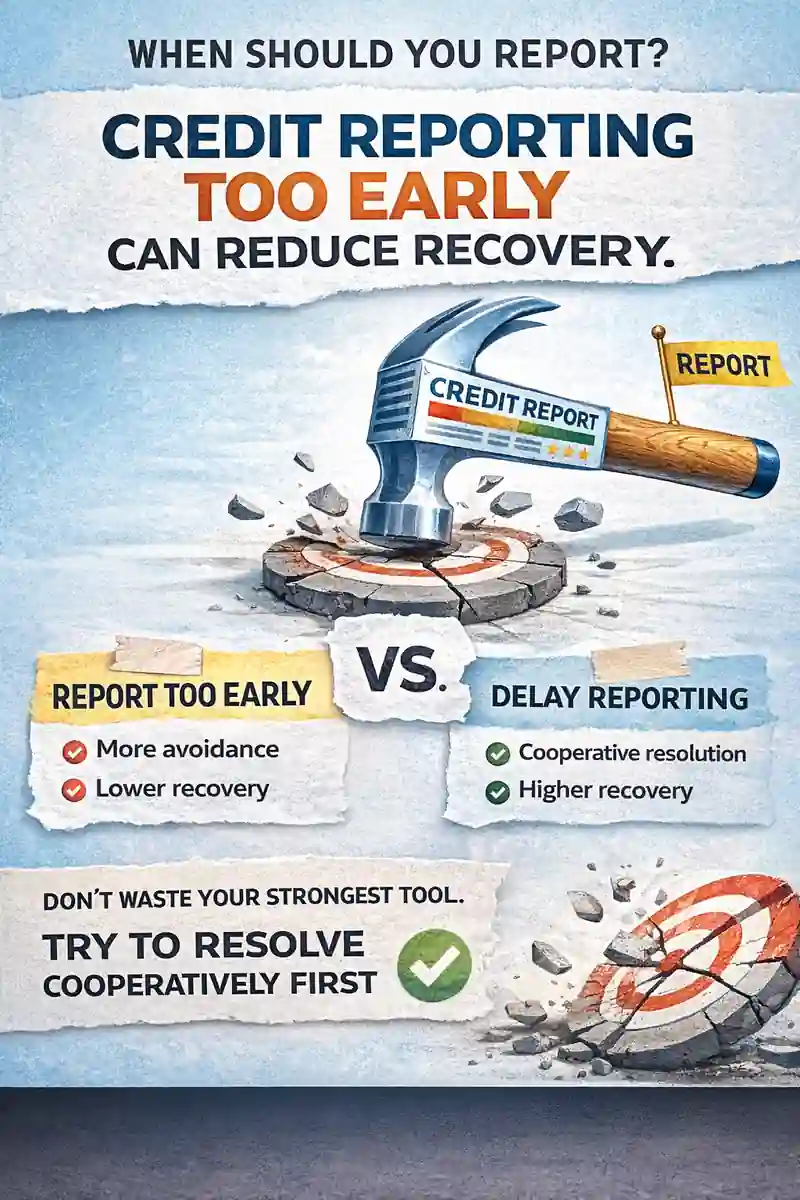
Credit Reporting Too Early Can Reduce Recovery

Credit reporting is powerful. That’s exactly why you shouldn’t waste it too soon.
If you report an unpaid balance immediately, you may accidentally kill the best reason the account holder had to resolve it quickly.

The Simple Truth

When an unpaid account hits a credit report, the situation “feels final” to the person on the other side.
And once something feels final, urgency drops.

Most people don’t think: “I should fix this right now.”
They think: “It already happened… so what’s the point?”

That’s why timing matters more than anger.


Why “Delayed Reporting” Often Collects More

Credit reporting is not just a punishment mechanism.
It’s a late-stage lever.

If you use it first, you have fewer tools left later.

Delayed reporting keeps pressure in reserve—while you attempt higher-yield recovery methods first:

  • professional outreach

  • structured negotiation

  • email + text follow-ups

  • settlement options

  • payment plans where appropriate

This approach protects your recovery rate and your reputation.


The Better Order of Operations (What Works in the Real World)

Here’s the sequence that typically produces the most money:

Step 1: Resolve with calm pressure
Reach out professionally. Create urgency without hostility.
Make it easy to say “yes” before people get defensive.

Step 2: Escalate structure, not emotion
More documentation. More firmness. Clear deadlines.
Still respectful. Still controlled.

Step 3: Credit reporting (only if needed)
When the account holder refuses to cooperate, reporting becomes the final non-legal lever.

That’s the win: you don’t spend your strongest tool on the weakest moment.


“But Isn’t Credit Reporting the Fastest Way?”

It’s fast.
But speed isn’t the same as recovery.

If your goal is to collect, reporting too early can backfire.

It turns a negotiation into a locked room.

And once the other side mentally checks out, you’re left with fewer options:

  • legal escalation (often not practical for smaller balances)

  • months of no response

  • “pay only if you delete it” behavior

You want the opposite:
A clear path to resolution that feels fair, doable, and final.


The One Thing You Should Never Do

Never use credit reporting like revenge.
It makes your process look emotional, not professional.

Credit reporting works best when it’s positioned as:
✅ a documented business step
✅ used after attempts to resolve
✅ based on verified account accuracy

That’s how you keep credibility—and keep recoveries high.


“Pay for Delete” Sounds Tempting (But It’s a Trap)

Some agencies push a “pay and we’ll remove it” style deal.
That strategy causes problems because it trains the account holder to think:

“I’ll pay only if I get something special.”

And it can create disputes, complaints, and reputation risk.

In many industries, credit bureaus expect accurate reporting to remain accurate—not used as a bargaining chip.

Better approach:
Delay reporting until reconciliation fails.

Then use reporting as the last lever—not the first threat.


The Exception: Medical Debt Rules Are Different

Medical debt is treated differently by the major credit reporting agencies in multiple ways, including timing and removal rules once paid.
That’s exactly why medical accounts require a more careful strategy from day one.

(If you’re collecting medical balances, you should be using a patient-friendly approach first anyway.)


What You Should Do Instead (If You Want Higher Recovery)

If the account is unpaid and you want maximum recovery:

✅ Start with structured outreach
Short messages. Clear amounts. Clear options.

✅ Use professional negotiation
Payment plan options can outperform pressure when the person is cooperative.

✅ Document everything
Bad documentation kills leverage. Clean documentation closes accounts.

✅ Hold credit reporting as the final lever
That’s where it does the most damage to avoidance—not to your recovery rate.


Quick Takeaway

Credit reporting works best when it’s delayed—not rushed.
Use professional reconciliation first.
Save reporting for the moment when the account holder is choosing avoidance over resolution.

Reconcile → Negotiate → Final Notice → Credit Reporting → Legal Review


FAQs

Should I report every unpaid balance to credit bureaus?
Not always. Many accounts resolve faster through structured outreach before reporting is used.

When does reporting make sense?
When the account holder stops cooperating, ignores notice, or repeatedly breaks resolution commitments.

Does reporting guarantee payment?
No. It increases leverage, but recovery is highest when you use it at the correct stage—not on day one.

Filed Under: Debt Recovery

  • « Go to Previous Page
  • Page 1
  • Interim pages omitted …
  • Page 8
  • Page 9
  • Page 10
  • Page 11
  • Page 12
  • Interim pages omitted …
  • Page 27
  • Go to Next Page »

Primary Sidebar


accounts receivable

Need a Collection Agency?
Kindly fill this form.
We’ll get in touch with you

    Please prove you are human by selecting the key.

    Compliance & Security

    • SOC 2 Type II Certified: Third-party audited data security and strict privacy controls.

    • HIPAA Compliant: Secure, legal processing of medical and municipal EMS accounts.

    • PCI-DSS Level 1: Highest tier of data encryption for secure payment processing.

    • FDCPA & FCRA Aligned: Full legal adherence to federal consumer protection laws.

    Recent Posts

    • Nationwide Debt Collection Agency Serving U.S. Cities
    • Chula Vista Collection Agency for Medical, B2B, Schools & Business Debt
    • Corpus Christi Collection Agency: Itemized Bill Rules for Practices
    • Riverside Collection Agency | For Logistics, Medical, Schools & Business Recovery
    • Collection Agency for Large Balances: High-Value B2B Debt Recovery
    • Baltimore Collection Agency | Medical, Commercial, Schools & More
    • Commercial and B2B Collection Agency in Detroit
    • Boston Medical Collection Agency | Serving Hospitals, Physicians & Dentists

    Featured Posts

    • Consequences of Ignoring Debt Collection
    • Risks and Benefits of AI on Accounting Jobs
    • Difference Between Accounts Receivable and Collections

    Copyright © 2026 NEXACOLLECT.COM | This content is provided for general informational purposes only and should not be considered legal advice. Collection laws and requirements may vary by state, account type, documentation, debtor status, and specific facts. Please consult qualified legal counsel for guidance regarding your particular situation. Nexa and its authorized collection partners service accounts in accordance with applicable federal and state collection requirements. Visit our home page to know more about us.

    X
    Need a Collection Agency?
    Contact Us