Ex-employee debt recovery is the process of recovering money or company property that a former employee owes an employer, including unreturned equipment, overpaid wages, unearned advances, unreconciled expenses and other documented balances, through itemized written demands, skip tracing, negotiation and, where warranted, legal escalation.
Quick answer: Yes, a collection agency can pursue most of what a former employee owes you, as long as it’s documented and not genuinely disputed: unreturned laptops and phones (or their value), overpaid wages, unearned advances, company-card balances and agreed repayments. The catch is payroll. Many states sharply limit what an employer can take from a final paycheck, so recovery often has to happen outside payroll, through a return-first, itemized demand. Polite, documented and fast beats aggressive every time.
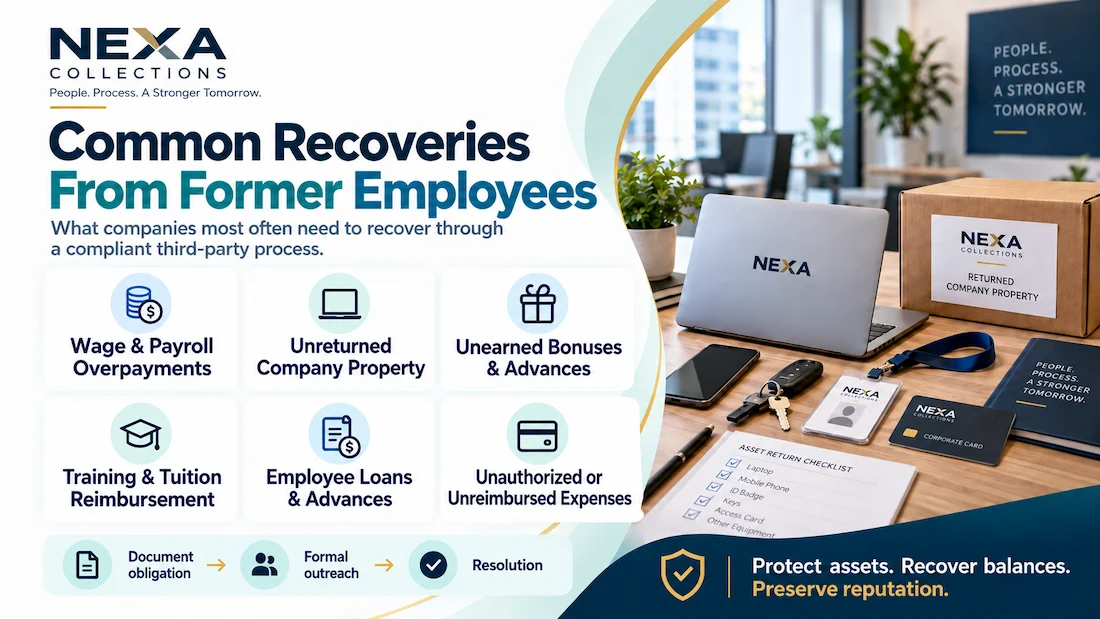
The laptop is in a closet in Tucson. The overpayment is sitting in a checking account in Ohio. And the person who has both stopped answering email. Now what?
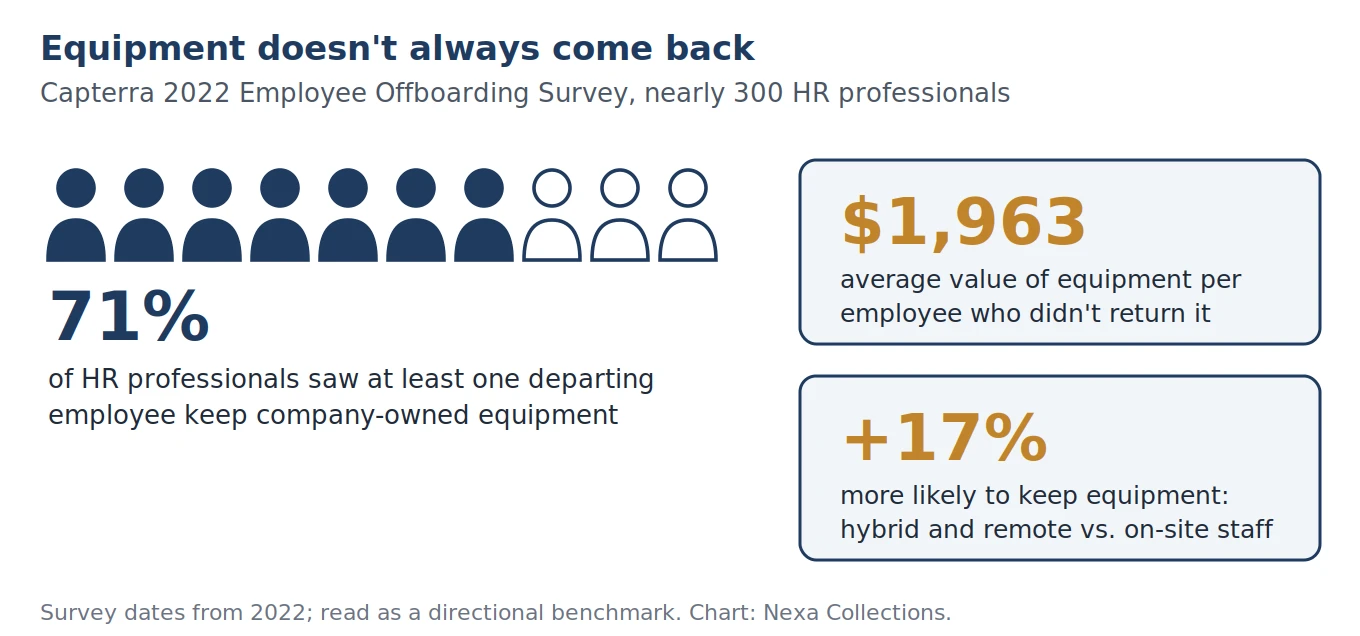
If you run payroll, IT or a growing team, you know this account. It’s too small to justify a lawsuit and too big to write off quietly. And it isn’t rare. U.S. employers recorded about 5.1 million separations in July 2026 alone, roughly 3.1 million of them quits (BLS). Capterra’s offboarding survey of nearly 300 HR professionals found that 71% had seen at least one departing employee fail to return company equipment, that hybrid and remote workers were 17% more likely to keep it, and that the average haul was worth $1,963. (The survey dates from 2022, so treat it as a directional benchmark, not a 2026 measurement.)
Most departures end cleanly. The ones that don’t share a pattern: nobody asked in writing, nobody itemized the balance, and by the time someone noticed, the trail was cold. This guide fixes that.
Need a Collection Agency? Contact us
What a Collection Agency Can Recover From a Former Employee
If the obligation is documented and the employee hasn’t raised a genuine dispute, most of the following can be pursued:
| What’s owed | Typical examples | Have this in hand | Watch out for |
|---|---|---|---|
| Company equipment | Laptops, phones, tablets, monitors, tools, badges, keys, fuel cards | Asset log with serial numbers, signed receipt, written return requests | Ask for the item back first. If you bill for it, use a defensible value, such as depreciated ledger value, not a new-for-old price tag |
| Overpaid wages and payroll errors | Duplicate pay, wrong rate, pay after separation, miscalculated PTO payout | Pay records, a plain-language correction notice, the math | Deduction rules for final pay vary by state. Overpayments that cross a tax year add payroll-tax steps, so loop in payroll first |
| Unearned advances and draws | Pay advances, commission draws, negative commission balances | A signed advance or draw agreement and the ledger | Commission clawback rules are state-specific |
| Bonus, relocation, training or tuition repayment | Sign-on bonus, relocation package, certification costs | A signed repayment agreement with clear terms | Newer “stay-or-pay” laws restrict many of these. See below |
| Company-card and expense balances | Personal charges, unreconciled advances, missing receipts | Card statements, the expense policy, signed acknowledgment | Give a reasonable chance to reconcile before treating it as a debt |
| Perks and stipends paid but not earned | Fitness or wellness stipends, phone, internet and home-office allowances, certification fees | A written policy that clearly ties the perk to continued employment | A vague perk isn’t a debt. The policy has to say so |
| Employee loans and purchase balances | Payroll loans, employee purchase plans, installment arrangements | A signed note or installment agreement | Written terms matter, and the balance should match them exactly |
| Benefit premiums advanced during leave | The employee’s share of premiums the employer fronted | Leave records and a written agreement | Only where the law and the agreement allow recovery |
What Isn’t a Collection Matter
An agency recovers money and property. It doesn’t replace employment counsel when the problem is something else:
- Trade secrets, confidential files or customer lists. Time-sensitive and legal. Call counsel the same day.
- Non-compete, non-solicit or confidentiality breaches. Contract enforcement, not debt.
- Damage claims that depend on proving fault or misconduct. A court or counsel decides those.
- Theft or criminal reports. That’s a decision for you and counsel, not an agency.
- Anything you owe them. Earned wages, required PTO payouts and expense reimbursements get paid. Netting them against a debt is the shortcut that costs the most.
The Final Paycheck Trap
Here’s what catches most employers: the instinct is to recover the money from the last paycheck. In many states, that’s exactly what you can’t do.
Federal law doesn’t require final pay to be handed over immediately (the Department of Labor says so plainly), but states can, and many set tighter deadlines. Federal rules also generally let employers deduct for lost or unreturned items from non-exempt employees only if the deduction doesn’t push pay below minimum wage or eat into overtime. State rules then layer on top:
| Jurisdiction | General position on deducting debts or equipment from final pay |
|---|---|
| Federal (FLSA) | No immediate-payment requirement. For non-exempt employees, deductions can’t cut pay below minimum wage or into overtime |
| California | Among the strictest. The Labor Commissioner’s long-standing position is that debts can’t be offset against final wages, and equipment-loss deductions are tightly limited. Withheld or late final pay can trigger waiting-time penalties |
| New York | Deductions are limited to specific categories, with notice, timing and cap rules for recovering overpayments. Unreturned equipment isn’t a typical permitted category |
| Illinois | Generally requires the employee’s express written consent given freely at the time of the deduction. Hiring paperwork alone typically isn’t enough |
| Other states | Anywhere from an outright prohibition to a written-authorization requirement to little beyond the federal baseline |
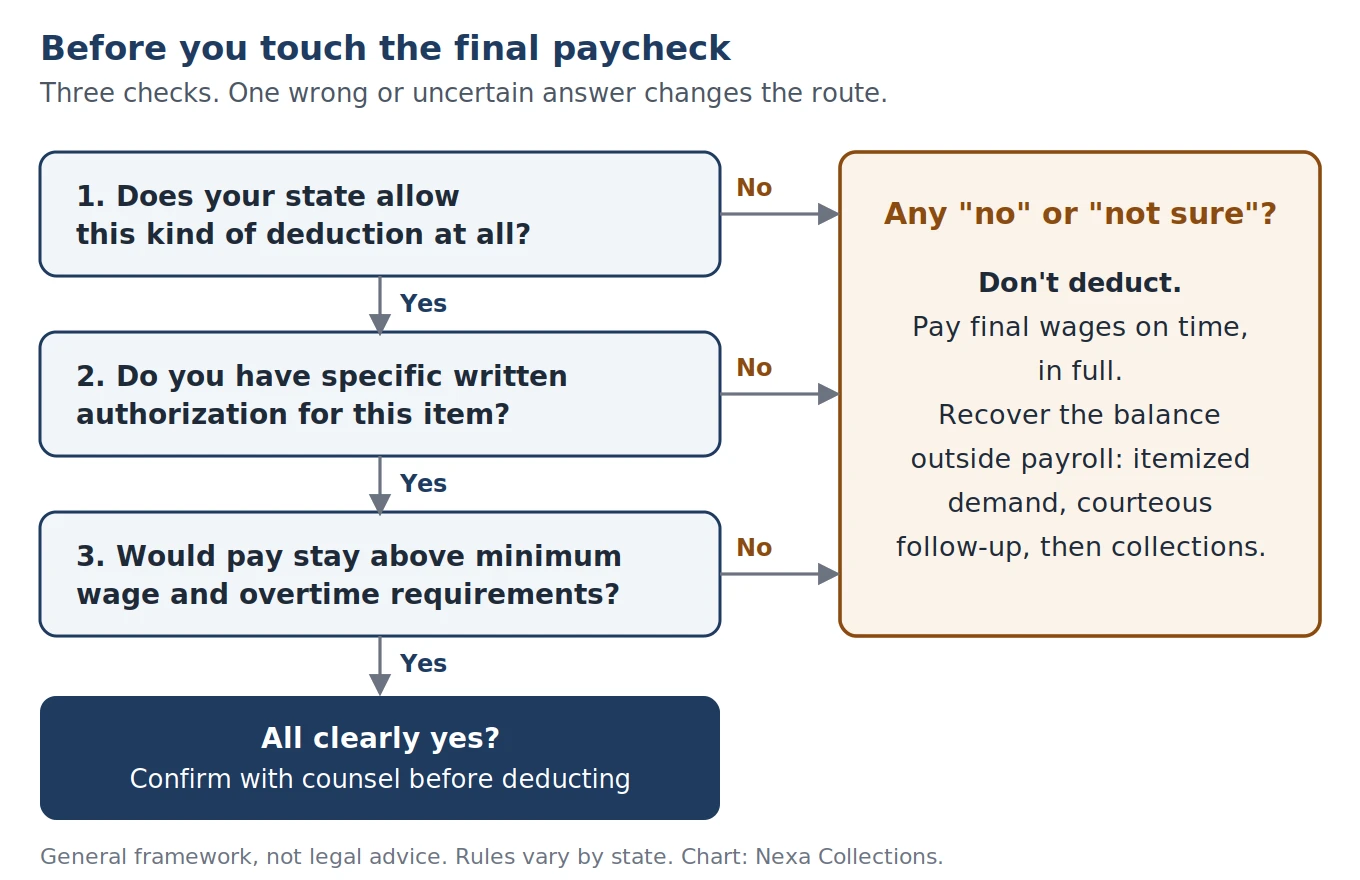
If any answer is no or unsure, don’t deduct: pay final wages on time and recover the balance outside payroll.
The fix is simple, even if it’s counterintuitive: pay final wages on time and in full, then recover the balance outside payroll. The debt doesn’t disappear because you can’t deduct it. It just needs a different route: an itemized written demand, a courteous follow-up and, when needed, a professional collection effort. Withholding or deducting wrongly can cost far more than the laptop.
Return First, Then Pay
When the debt is equipment, the goal isn’t a payment. It’s the device. A refund of its value is plan B.
- Make returning it easy. A prepaid label, a box, a deadline and a single contact person. Many unreturned laptops are just unreturned because shipping one is a hassle.
- Cut access on day one, separately from recovery. Revoke accounts, VPN and device management the day the person leaves. Don’t wait for the hardware. In the Capterra survey, only 55% of the HR professionals who reported unreturned equipment containing sensitive information said they could completely lock the employee out. Our guide to data privacy and security for collection agencies covers what to expect from a partner that handles personnel and device records.
- Offer both doors. Return the device by a date, or pay its documented value by a later one. People who won’t write a check will often ship a box.
- Put the escalation in writing. Each request should restate what’s owed, how it was calculated and what happens next.
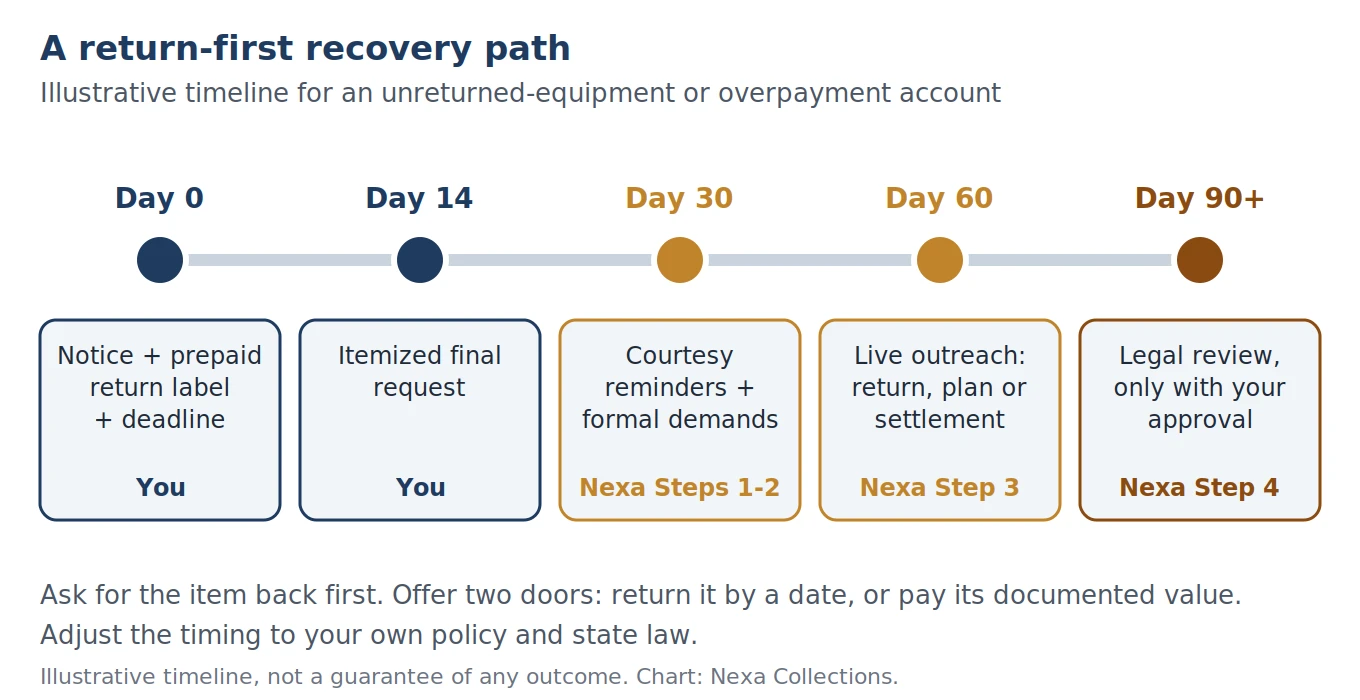
A return-first path: ask in writing, itemize, then add professional follow-up in steps. Timing is illustrative.
Not sure when an account is ready to leave your desk? These usually mean it is:
- Two written requests have gone unanswered.
- The balance is itemized and the documents are in one place.
- The employee hasn’t raised a specific dispute.
- Chasing it is costing your team more than it’s worth. (Our comparison of in-house collections vs. an agency walks through that math.)
If the person has simply gone quiet, see how skip tracing finds a current address and phone number and what changes when a debtor stops responding.
How Nexa Collections Recovers Ex-Employee Accounts
Nexa runs ex-employee accounts as a four-step ladder. The early steps are inexpensive and look like your own front desk. The later ones add persistence and, only with your approval, legal pressure.
| Step | What happens | Typical fee |
|---|---|---|
| 1. Courtesy reminders | Five soft reminders for fresher balances, sent as if they’re coming from you. Return the equipment or settle the balance | $15 per account |
| 2. Formal written demands | Five professional, itemized letters on Nexa letterhead | $15 per account |
| 3. Full collection | Persistent, polite phone and digital outreach. Negotiated returns, payment plans and settlements | 40% of amounts recovered. No recovery, no fee |
| 4. Legal collections | For large, unresponsive accounts, escalation to an attorney after review and only with your explicit approval | Up to 50% of amounts recovered. No recovery, no fee |

On every account Nexa also runs a free bankruptcy screening, a litigious-debtor check and address verification, so you aren’t chasing a person who’s protected by a bankruptcy stay or who has moved. For the full pricing picture, see our collection agency fees page, and for what happens after you upload an account, see what happens when a debt is assigned to a collection agency.
Need a Collection Agency? Contact us
One Departed Employee, One Itemized Demand
An illustrative composite, not a client result.
A remote operations coordinator leaves on short notice. Payroll processed two more days of pay after her last day. Her laptop and company phone never came back, and her company-card charges are still unreconciled after two reminders. The itemized demand looks like this:
| Item | Basis | Amount |
|---|---|---|
| Pay issued after separation | Payroll record, corrected calculation | $1,240.00 |
| Laptop (3 years old) | Asset log, depreciated ledger value | $640.00 |
| Company phone | Asset log, depreciated ledger value | $210.00 |
| Personal card charges | Card statements, signed card policy | $385.50 |
| Total | $2,475.50 |
The letter’s first ask isn’t the total. It’s the devices. Return both within 14 days and the balance drops by $850 to $1,625.50. That’s the return-first idea working: a smaller number, a faster yes, and no argument about valuation. And because the error was caught within the same tax year, the payroll correction is generally simpler. (If it had crossed into a prior year, ask your payroll provider whether the demand should be stated gross or net of withheld taxes before the invoice goes out.)
Bonus, Relocation and Training Repayments: Read the Clause First
This is the category where the rules are moving fastest.
- California’s AB 692, effective January 1, 2026, restricts “stay-or-pay” terms that require a worker to repay a debt to the employer, a training provider or a debt collector when the work relationship ends. It applies to agreements entered into, amended or renewed on or after that date and carves out narrow exceptions, such as signing bonuses that meet specific conditions.
- New York’s Trapped at Work Act was signed in December 2025 and amended in February 2026, delaying its effective date by one year. It takes a similar approach, with its own exceptions, and is enforced by the state labor department.
Returning employer-owned equipment raises different questions from repaying a bonus, but contracts sometimes bundle both, so the wording matters. Because these laws name debt collectors specifically, a responsible agency will ask to see the agreement before pursuing a bonus, relocation or training repayment. Have employment counsel confirm the clause is enforceable first.
Pursue It Cleanly: An Ex-Employee Compliance Checklist
A recovery that creates a wage claim, a privacy complaint or a hostile Glassdoor review isn’t a recovery. Keep it clean:
- Pay final wages on time and in full. Never hold the check hostage for the laptop.
- Itemize everything: what it is, when it was issued or paid, and exactly how the amount was calculated.
- Don’t contact their new employer, coworkers or family about the balance.
- Don’t threaten police or criminal charges unless counsel advises it.
- Treat a specific dispute as a reason to verify, not to push harder. “I shipped it in March” gets checked against your records.
- Check for bankruptcy before any contact.
- Share only the minimum personnel and device data a partner needs.
One more point worth knowing: whether federal consumer-collection law (the FDCPA) applies to a particular employer claim depends on how the underlying obligation arose, and state licensing and unfair-practices rules can apply either way. Nexa handles ex-employee accounts with the same FDCPA-aligned communication standards it uses elsewhere.
Who Sends Us Ex-Employee Accounts
- Remote-first and tech companies: laptops, monitors and security tokens scattered across states.
- Healthcare and dental practices: tablets, devices and payroll corrections after fast staff turnover.
- Schools and colleges: staff laptops, tablets and stipends when faculty and staff leave mid-year.
- Construction and trades: tools, vehicle fobs and fuel cards.
- Staffing agencies and franchises: high turnover and a long tail of small balances. See bulk account placement if you’re sitting on a backlog.
- Large balances: executive-level repayments and sizable overpayments often fit our large-balance collections process.
Make the Next Offboarding Boring
The cheapest recovery is the one you never need:
- Get a signed equipment acknowledgment at issue, with serial numbers, and keep an asset log.
- Put perk and stipend conditions in writing. If a stipend must be earned, say so.
- Send the return kit when someone gives notice, not on their last day.
- Document every advance, draw and repayment in a separate, plainly worded agreement.
- Send a final written statement of anything you believe is still owed.
- Review repayment clauses with counsel against current state law. Our small-business risk management strategy guide is a good companion.
Frequently Asked Questions
Can a collection agency recover money or equipment from a former employee?
In most cases, yes, when the obligation is documented and not genuinely disputed. An agency can send itemized demands, locate the person, negotiate a return or payment and, with your approval, escalate to legal action. It can’t take wages or property without a court judgment, and state law and the specific agreement determine what’s collectible.
Can an employer deduct unreturned equipment or an overpayment from a final paycheck?
It depends on the state. Federal law generally doesn’t allow deductions for non-exempt employees that cut pay below minimum wage or into overtime, and many states add written-authorization, notice or cap requirements or restrict the practice entirely. California is among the strictest. Pay final wages on time, check your state’s rules and consult counsel before deducting.
What can an employer recover from an ex-employee?
Documented amounts such as unreturned company equipment (or its value), overpaid wages, unearned advances and draws, company-card balances, certain repayments under valid agreements and perks that a written policy clearly conditions on continued employment. Trade-secret, non-compete and misconduct claims are legal matters for counsel.
How should you value an unreturned laptop?
Ask for the device back first. If you bill for it, a defensible basis, such as the depreciated value on your asset log or the device’s fair market value, is safer than a full new-for-old replacement price, which invites disputes. Check your signed equipment agreement for any agreed valuation terms.
Can an employer make a former employee repay a signing bonus or training costs?
Sometimes, but the rules are tightening. It depends on a valid written agreement and state law. California’s AB 692 and New York’s Trapped at Work Act restrict many repayment terms with narrow exceptions, and AB 692 names debt collectors specifically. Have employment counsel review the clause before you pursue it.
How much does it cost to hire a collection agency for an ex-employee balance?
With Nexa Collections, typical fees are a $15 fixed fee per account for each of the first two steps, 40% of amounts recovered for full collection (no recovery, no fee), and up to 50% for client-approved legal collections. See the pricing page for details.
The Bottom Line
A former employee who keeps a laptop or an overpayment isn’t a payroll footnote. It’s a receivable with a name on it, and it ages like every other one. Don’t reach for the final paycheck, and don’t let it sit. Pay what’s owed, itemize what isn’t, ask for the equipment back first, and put the rest in professional hands before the trail goes cold.
Have ex-employee balances, unreturned devices or a backlog of small accounts? Call Nexa Collections at +1-844-639-2123, email support@nexacollect.com or contact us. Not sure whether a balance is collectible? Our collection agency overview explains how recovery works, and our commercial collections team handles employer and B2B accounts.
Sources
- U.S. Bureau of Labor Statistics, Job Openings and Labor Turnover Survey news release (July 2026 data)
- Capterra, 2022 Employee Offboarding Survey; HCA Magazine, coverage of the survey’s security findings
- U.S. Department of Labor, Wage and Hour Division, “Last Paycheck” (dol.gov)
- Littler, Our Wandering Workers Have Wandered Off With Our Equipment and I Want My Money Back: A Primer on Recovering Inadvertent Overpayments
- California Department of Industrial Relations (DLSE), Opinion letter on final-wage deductions
- Morrison Cohen, The End of “Stay-or-Pay” Provisions: How New Laws in California and New York Affect Your Business (March 2026)
- IRS, Publication 15 (2026), Employer’s Tax Guide (wage repayments)
A general summary, not legal advice. State rules change and have exceptions.
Updated October 2026 | Nexa Collections Employer Recovery Guide
This article is for general information and isn’t legal or tax advice. Wage-deduction, final-pay, repayment-agreement and collection rules vary by state, agreement and individual facts. Consult qualified counsel before deducting from wages or enforcing a repayment clause.