• Skip to main content
  • Skip to primary sidebar

Nexa Collections

  • Home
  • Serving
    • Medical
    • Dental
    • Small Business
    • Large Business
    • Commercial Collections
    • Government
    • Utilities
    • Fitness Clubs
    • Schools
    • Senior Care Facility
  • Contact Us
    • About us
    • Cost

Medical

Dentist Burnout & Stress Control: 6 Modern Solutions for Chairside Fatigue

Dentist burnout is commonly driven by prolonged static posture, precision-heavy clinical work, patient anxiety, administrative workload and schedule pressure. Dentists can reduce daily fatigue through better ergonomics, strategic scheduling, AI-assisted documentation, short postural breaks, clearer patient boundaries and regular peer support.
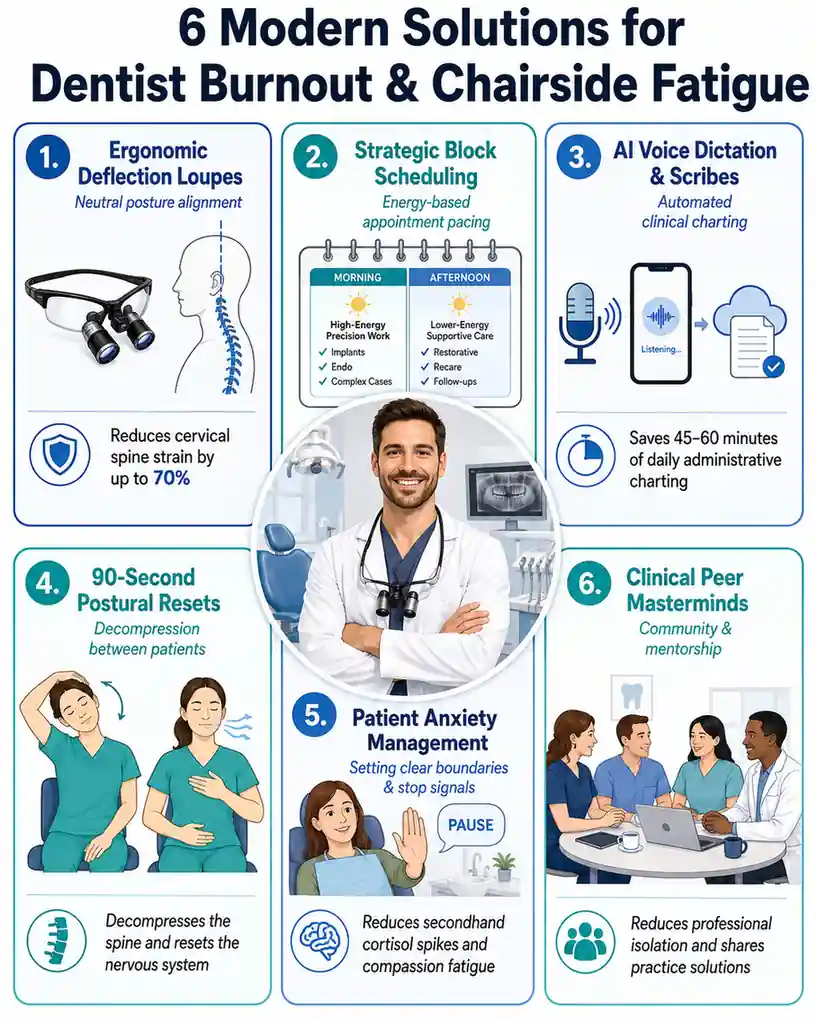
Infographic showing six modern solutions for dentist burnout and chairside fatigue, including ergonomic loupes, smart scheduling, AI dictation, posture resets, patient anxiety management, and peer mentorship.

Key Takeaways

  • Dentist burnout is unique: It stems from a combination of prolonged physical strain, micro-precision demands, and secondhand patient anxiety.

  • Physical health directly impacts mental focus: Chronic musculoskeletal strain in the neck, back, and shoulders accelerates mental exhaustion.

  • Modern practice workflows help: Implementing ergonomic loupes, AI-assisted clinical documentation, and strategic block scheduling significantly reduces daily pressure.

  • Micro-breaks prevent fatigue: A structured 90-second postural reset between patients prevents cumulative physical and mental strain.

Understanding Dentist Burnout: The Chairside Dilemma

Dentist burnout is a state of severe physical, mental, and emotional exhaustion caused by prolonged operational, physical, and interpersonal stress in a clinical setting.

Unlike generic workplace fatigue, burnout in dentistry is uniquely challenging. Clinicians operate within a tiny visual field with zero margin for error, manage fearful patients throughout the day, and maintain taxing physical postures for hours at a time.

The Dental Burnout Cycle

  • Physical Strain: Neck, back, shoulder, and wrist fatigue from static posture and micro-movements.

  • Mental Pressure: Sustained high precision demands with zero-fault tolerance on living tissue.

  • Emotional Toll: Absorbing secondhand anxiety and fear from phobic or resistant patients.

  • Operational Friction: Packed schedules, unexpected delays, and overwhelming administrative charting.

4 Main Drivers of Stress in Modern Dental Practices

1. Chronic Musculoskeletal Strain

Static postural loads—leaning over operatory chairs, twisting to view hard-to-reach surfaces, and performing repetitive micro-movements—cause chronic pain in the neck, upper back, and wrists. When your body hurts all day, your brain burns out faster.

2. Absorbing Secondhand Patient Anxiety

When a patient sits down and immediately says, “I hate being here,” your nervous system reacts. Over a 10-patient day, absorbing this anxiety triggers elevated cortisol levels and emotional depletion (compassion fatigue).

Real-World Example: Dr. Sarah, a general practitioner, noticed her heart rate spiking every time a patient gripped the armrests tightly during a routine crown prep. She wasn’t stressed about the procedure; she was involuntarily reacting to her patient’s fear.

3. Precision Fatigue & Zero Margin for Error

Working under high magnification on living tissue leaves little room for mistakes. Maintaining focused attention for hours at a time creates severe cognitive fatigue.

4. Administrative & Schedule Overload

Running behind schedule due to unexpected difficult extractions or complex root canals creates a domino effect of stress that lasts all day.

6 Practical, Modern Solutions to Control Dentist Burnout

Solution 1: Upgrade to Ergonomic Deflection Loupes

Traditional loupes force you to tilt your neck downward at angles exceeding 30–45 degrees. Modern refractive (ergonomic) deflection loupes project the image straight to your eyes while allowing your neck to remain completely neutral (0–10 degrees).

  • Impact: Reduces cervical spine compression by up to 70%, immediately lowering physical fatigue by mid-day.

Solution 2: Implement “Block Scheduling”

Stop mixing complex, high-stress procedures randomly throughout the afternoon. Use block scheduling to organize your day around natural energy levels:

  • Morning Block (High Energy): Complex procedures (crowns, endo, multi-unit restorations).

  • Mid-Day Buffer (30 Mins): Dedicated time for lab reviews, chart notes, and administrative tasks.

  • Afternoon Block (Lower Energy): Simpler, predictable procedures (fillings, consultations, follow-ups).

Solution 3: Use AI Dictation for Clinical Documentation

Manual chart writing at the end of a long day is a major source of administrative burnout. Modern voice-enabled AI clinical scribes convert natural conversation into formatted ambient SOAP notes in real time.

  • Impact: Saves 45–60 minutes of daily charting time, allowing you to leave the practice on time.

Solution 4: Perform the 90-Second Postural Reset Between Patients

Never jump directly from one operatory chair to another. Before entering the next room, perform this brief sequence:

  1. Chin Tucks: Pull your head back straight (creating a double chin) to decompress the upper spine (5 repetitions).

  2. Chest Openers: Interlace fingers behind your back and pull shoulders back for 15 seconds.

  3. Diaphragmatic Breaths: 3 deep, slow abdominal breaths (4 seconds in, 6 seconds out) to reset your parasympathetic nervous system.

Solution 5: Reset the Narrative with Anxious Patients

Address patient anxiety proactively before starting any treatment to reduce emotional tension:

“I know coming to the dentist isn’t your favorite activity. Our goal today is to keep you completely comfortable. If you need a break at any point, just raise your left hand, and I will stop immediately.”

Giving the patient explicit control reduces their anxiety—which immediately lowers your own stress levels.

Solution 6: Join a Clinical Peer Mastermind or Study Club

Solitary clinical work often leads to isolation. Joining a local or online dental study club allows clinicians to share difficult case experiences, discuss practice friction, and normalize daily challenges with peers who understand the work.


Dentist stress

Frequently Asked Questions (FAQ)

What are the earliest signs of burnout in a dentist?

Early warning signs include persistent physical exhaustion despite adequate sleep, physical irritability before the workday starts, feeling detached or cynical toward patients, chronic neck/back stiffness, and feeling overwhelmed by routine charting.

How does bad ergonomics contribute to mental stress?

Chronic physical pain signals the brain’s alarm system, maintaining elevated cortisol levels throughout the day. When you work in physical pain, your mental tolerance for clinical challenges and patient anxiety drops significantly.

How can a solo practitioner reduce admin stress without hiring more staff?

Solo practitioners can reduce administrative strain by adopting ambient AI clinical scribes for chart notes, setting up digital patient intake forms prior to appointments, and designating fixed 20-minute daily blocks for administrative work rather than squeezing it between patients.

How common is burnout among dentists?

Burnout and occupational stress are significant concerns in dentistry. The American Dental Association reports that more than 82% of dentists experience major career stress. Burnout rates vary considerably between studies depending on the population and assessment method, but prolonged workload, physical strain, staffing challenges and administrative pressures are recognized contributors.

Can ergonomic loupes help reduce dentist neck and back pain?

Yes. Modern refractive (deflection) ergonomic loupes allow clinicians to maintain a neutral upright head position (0–10 degree declination angle) rather than bending forward at 30–45 degrees. This neutral posture reduces neck strain and cervical spine compression by up to 70%, preventing chronic back and shoulder pain.

What is the fastest way to reduce stress between dental patients?

The fastest way to reset your nervous system is a 90-second micro-break using diaphragmatic breathing combined with a posture reset. Taking 3 deep abdominal breaths (4-second inhale, 6-second exhale) instantly activates your parasympathetic nervous system, while a quick chin tuck decompresses the upper spine before your next appointment.


dentist stress

Summary: Protect the Asset

The most valuable asset in your practice is not your CBCT scanner or your CAD/CAM mill. It is you. If you break, the practice stops.

Stop accepting high stress as “part of the job.” It is time to delegate the noise—the billing, the collections, the admin headaches—so you can fall in love with dentistry again.

Is unpaid revenue adding to your stress?

Don’t let bad debt burn you out. Let us handle the uncomfortable conversations.

Get a Free Quote for Dental Debt Recovery

Filed Under: Medical

Dental Malpractice Insurance: Types, Costs, and Lawsuit Risks Dentists Should Know

Dental malpractice insurance, also called professional liability insurance, covers legal defense costs and settlements when a patient sues over treatment. Coverage comes in two main forms — occurrence and claims-made policies — with premiums ranging from under $500 for new graduates to $2,000–$3,000+ annually for established practices. In 2025, the average dental malpractice payout was $144,000, making coverage worth carrying even for practices with strong patient relationships.

Dentist checking medical paperwork, representing the need for dental malpractice insurance coverage

Why Dental Malpractice Insurance Matters

“Dental Malpractice Insurance,” also called “Professional Liability Insurance,” protects dental practices against the financial fallout if a patient files a lawsuit. According to the National Practitioner Data Bank, the U.S. saw roughly 9,859 paid medical malpractice claims in 2025, totaling about $4.56 billion — an average of roughly $463,000 per payment nationwide. For dentistry specifically, 2025 saw 1,144 paid claims totaling $165 million, averaging $144,000 per claim — actually the lowest total dental-negligence payout in over two decades, even as the average payout per claim has climbed.

Even when a malpractice claim is dismissed, defense costs can be substantial. A dental malpractice policy typically covers attorney fees, expert witnesses, and trial and court costs, subject to policy terms and limits. Malpractice laws — statutes of limitations, damage caps, pre-suit requirements — also vary by state, so both premiums and claim outcomes differ by jurisdiction.

Most Common Reasons Patients Sue Dentists

  • Tooth extractions causing nerve damage, sinus membrane perforation, undiagnosed infections, or the wrong tooth being removed
  • Anesthesia and root canal complications
  • Lack of informed consent from the patient
  • Failure to diagnose gum disease, oral tumors, or cancers
  • Orthodontists failing to accurately monitor patients with braces, or incorrect application
  • Infections from an ill-fitted crown
  • Unexpected or adverse drug reactions
  • Failure to refer a patient to a specialist
  • Slip-and-fall injuries at the dental office (typically a premises/general-liability matter, not professional liability — see the FAQ on this below)
  • Complications from dental implants, bridges, or crowns
  • Death

Without malpractice coverage, a dental practice may struggle to mount a defense — and the reputational cost of an uninsured lawsuit can outlast the legal one.

Types of Dental Malpractice Insurance

State Patient Compensation Fund (PCF)

States including Pennsylvania, Wisconsin, Kansas, Indiana, Louisiana, New Mexico, Nebraska, South Carolina, and New York offer a provision limiting a dentist’s liability in a malpractice lawsuit. Dentists typically pay an annual amount to participate. A PCF isn’t a replacement for malpractice insurance — it only protects against claims demanding sums beyond what standard coverage provides, and rules vary significantly by state.

Occurrence Malpractice Insurance Policy

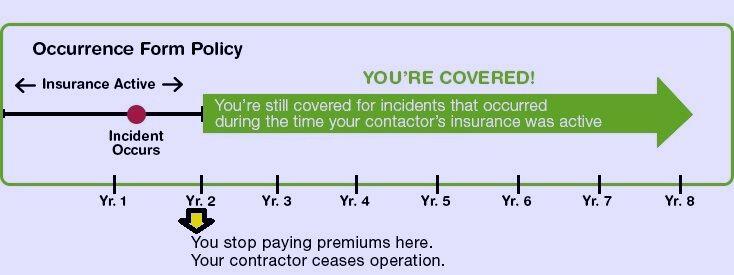
Occurrence dental malpractice insurance policy coverage timeline

An occurrence policy covers you for events that happened while the policy was active, regardless of whether the policy is still in effect when the claim is actually filed. The advantage: even after canceling the policy, you retain coverage for anything that occurred during its term.

Claims-Made Malpractice Insurance Policy

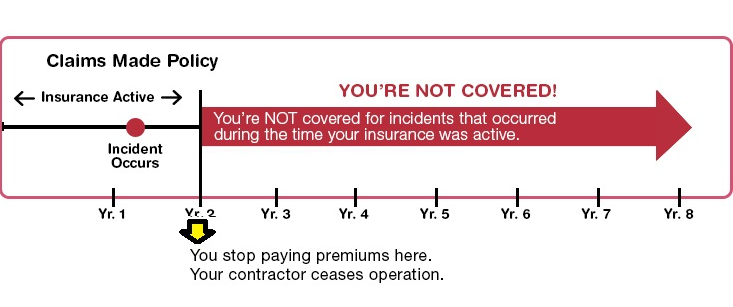
Claims-made dental malpractice insurance policy and tail coverage explained

A claims-made policy only covers claims filed while the policy is active. The tradeoff is that coverage must continue indefinitely to protect against claims filed later for past treatment — once the policy lapses, coverage generally lapses with it, unless an “Extended Reporting Endorsement” or tail coverage is purchased separately.

Illustrative Example: The Retirement Gap

Consider a composite scenario: a dentist retires after 25 years on a claims-made policy and lets the coverage expire, assuming their clean record means low risk. Two years later, a former patient files suit over a crown placed the year before retirement. Without tail coverage purchased at retirement, that claim would fall into an uncovered gap — exactly the scenario tail coverage exists to close, and exactly why the decision to buy it should happen at retirement, not after a claim shows up.

What Dental Malpractice Insurance Costs

Recent dental school graduates often pay very little in year one — sometimes $0 to $100 under new-grad promotional pricing on claims-made policies — with premiums typically ramping toward roughly $1,800 by year five as those discounts phase out. Some carriers quote a wider first-year range of $350 to $1,500 depending on procedures covered and coverage limits.

For general dentists with five or more years of practice, expect roughly $2,000 to $3,000 per year in many states, with large metro areas running higher and surgical or cosmetic specialties sometimes reaching $10,000–$25,000+.

Many insurers offer a risk-management seminar discount, typically around 5% for two policy years. Coverage add-ons like Employment Practices Liability Insurance (EPLI) — covering claims such as wrongful termination or sexual harassment — are often available as an endorsement to a professional liability policy, or through a separate business owner’s policy, for an additional premium.

Illustrative Example: Two Practices, Two Premiums

A newly licensed general dentist joining an established practice might pay close to nothing in their first year on a claims-made policy with new-grad pricing. Meanwhile, an oral surgeon ten years into solo practice, performing higher-risk procedures in a major metro area, could reasonably pay $10,000 or more annually for comparable protection. The gap isn’t really about the insurer — it’s about procedure risk, experience, and location, which is why comparing quotes across at least two or three carriers tends to be worth the time.

Where to Buy Dental Malpractice Insurance

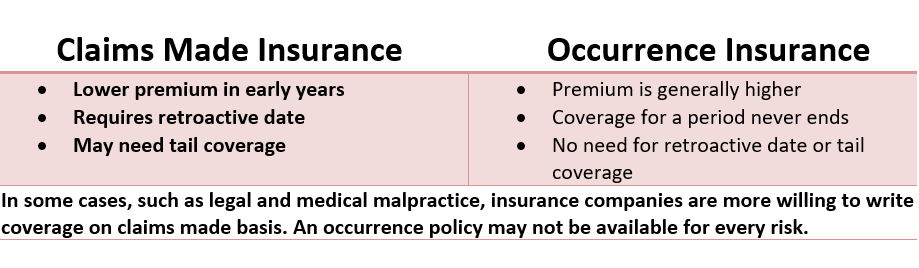
Comparison of dental malpractice insurance policy types and costs
  • American Dental Association (insurance.ada.org)
  • Mitchell & Mitchell Insurance (mitchellandmitchell.com/dental)
  • MedPro Group (medpro.com/practicing-dentists)
  • DentistCare by ProAssurance (proassurancedentistcare.com)
  • Fortress
  • CNA and Aon Affinity also offer nationwide dental malpractice coverage

Links to Buy Dental Malpractice Insurance

  • medpro.com/practicing-dentists
  • profsolutions.com/industries/dentists/insurance/malpractice
  • cna.com/web/guest/cna/industries/affinity/dentists
  • tdicinsurance.com/Find-Coverage/Professional-Liability

The Overlooked Connection Between Malpractice Risk and Unpaid Bills

Why Some Patients Sue After Being Asked to Pay

Plenty of malpractice suits surface after a patient is asked to pay an outstanding balance, not because of anything new about the treatment itself. When practice staff pursue an unpaid bill, some patients respond by looking for any debt-collection misstep they can use to countersue — and a meaningful share of these patients have a documented history of suing medical or dental practices before.

How a Litigious Scrub Protects Your Practice

It’s generally advisable to transfer an account to a collection agency once it’s been past due for 60–90 days. A properly trained collection partner understands debt collection law in detail and can run a litigious scrub — checking whether a given patient has a history of suing providers — before any collection activity begins, and adjusting the approach accordingly. Worth knowing separately: malpractice insurance itself generally doesn’t cover a billing or debt-collection complaint — that’s a different category of risk, typically addressed through documented billing procedures and, where applicable, a HIPAA business-associate agreement with whoever handles the collection.

Illustrative Example: The Collection Call That Almost Became a Lawsuit

Picture a composite scenario: a practice’s own billing staff calls a patient about a $600 balance, unaware the patient has previously sued two other providers over billing disputes. A litigious scrub run before that call would have flagged the pattern, allowing the practice to use a more documented, careful approach from the outset — the kind of small step that can be the difference between collecting a balance and defending an unrelated lawsuit.

Why Dental Practices Also Trust Nexa for Patient Billing

Malpractice insurance protects you from the legal risk of treatment. The other side of practice risk — unpaid patient balances — deserves the same level of care.

Easy to Use, Backed by Responsive Support

Placing an account doesn’t require a complicated process, and questions about a specific account get answered by a real point of contact rather than a support queue.

Licensed Nationwide, Secure and Compliant

Nexa operates with 50-state collection licensing and HIPAA-aligned, SOC 2 Type II-certified data handling, so patient billing information is treated with the same care as the clinical record it’s connected to.

Frequently Asked Questions

General Coverage Questions

Do I need dental malpractice insurance if I’ve never been sued?

Yes. Even dentists with a clean record and years of practice can face a first claim at any time, and defense costs alone — attorney fees, expert witnesses, court costs — can be substantial even if the claim is ultimately dismissed.

What’s the real difference between occurrence and claims-made coverage?

Occurrence coverage protects you for anything that happened while the policy was active, even after you cancel it. Claims-made coverage only protects you while the policy itself is active, which means you generally need tail coverage if you retire or switch insurers to stay protected against claims for past treatment.

Is a State Patient Compensation Fund the same as malpractice insurance?

No. A PCF supplements standard malpractice insurance for unusually large claims — it isn’t a substitute for it, and participation rules vary significantly by state.

How much should a new dentist expect to pay for malpractice insurance?

Often very little in the first year — sometimes close to $0 to $100 under new-grad promotional pricing — with premiums typically rising toward roughly $1,800 by the fifth year as introductory discounts phase out.

Is a patient slip-and-fall claim covered by dental malpractice insurance?

Usually not. A slip-and-fall claim is typically a premises or general-liability matter rather than professional dental negligence. A practice generally needs commercial general-liability coverage for non-dental injuries in the office; professional-liability insurance responds to allegations arising from dental treatment itself.

Does malpractice insurance cover a billing or collection complaint?

Not necessarily. Dental malpractice coverage generally concerns allegations arising from professional dental services. Issues involving debt-collection communications, privacy, credit reporting, or billing practices may fall under different insurance coverage or legal requirements entirely.

Associate Dentists & Advanced Coverage Questions

Can my employer’s group malpractice policy leave me without coverage after I leave the practice?

It can, if the policy is claims-made and no arrangement has been made for tail or prior-acts coverage. Associate dentists should get written proof of coverage under the group policy, confirm the retroactive date and limits, and determine upfront who’s responsible for tail coverage when employment ends.

Who pays for tail coverage when an associate dentist leaves a practice?

There’s no universal rule — the employment agreement may assign this to the practice, the associate, or both. Because tail coverage can be expensive, the contract should specify who pays after resignation, termination, retirement, disability, relocation, or a practice sale, and whether a new insurer could provide prior-acts coverage instead.

Do shared group-policy limits protect every dentist separately?

Not necessarily. Some group policies use shared aggregate limits, meaning a claim involving one dentist can reduce what’s available for other insured dentists during the same policy period. Ask whether limits are individual or shared, whether defense costs reduce them, and how you’d be notified if the policy is affected.

Does coverage extend to a second office, mobile clinic, or nursing home?

Don’t assume it does. Insurers typically underwrite based on every practice location and treatment setting, so notify the carrier before working at a second office, mobile unit, nursing home, correctional facility, school, or volunteer clinic — especially as an independent contractor.

Does malpractice insurance cover tele-dentistry with an out-of-state patient?

It depends on the policy and the laws of both states involved, including licensing, supervision, and standard-of-care requirements where the patient is located. Confirm the encounter is legally permitted and actually covered in both jurisdictions before treating an out-of-state patient remotely.

Are Botox, dermal fillers, or sleep-apnea appliances automatically covered?

Not always. Applications may ask specifically about cosmetic injectables, sleep-apnea treatment, and procedures performed without a physician referral. Disclose these services and get written confirmation of coverage rather than assuming every service performed in a dental office is automatically included.

Can my malpractice insurer settle a claim without my permission?

That depends on the policy’s consent-to-settle clause. Some require your approval before settling; others give the insurer more control, and some contain a “hammer clause” that can shift additional financial risk to you if you reject a recommended settlement. This clause is worth reviewing closely, since a paid settlement can affect reputation and licensing.

Do legal defense costs reduce my malpractice insurance limits?

It depends on the policy. Under “defense outside limits” policies, attorney fees and expert costs are paid separately from the liability limit. Under “defense within limits” policies, those costs reduce what’s left to pay a settlement or judgment — worth confirming for both your per-claim and annual aggregate limits.

Does coverage apply to a dental board investigation with no lawsuit filed?

Sometimes, but it’s not automatic. Some policies provide separate defense assistance for board complaints or licensing investigations, often at a lower sublimit than the main coverage. Check whether board defense is included and what triggers it — and notify your carrier as soon as a complaint or subpoena arrives.

Can waiving or refunding a patient’s bill create an NPDB report?

A debt waiver alone generally isn’t treated as a malpractice payment by the NPDB. However, a payment made by an insurer following a written malpractice demand can be reportable. Contact your carrier before offering money or signing a release in response to a written demand, since the reporting outcome depends on who pays and why.

Billing & Collections Questions

Can unpaid patient bills actually lead to a malpractice lawsuit?

Indirectly, yes. Some patients respond to a collection request by searching for any misstep to countersue over, and a portion of them have a documented history of suing providers. A litigious scrub before collection activity begins helps a practice approach these accounts more carefully.

Do you help dental practices with unpaid patient balances?

Yes. Patient billing accounts are handled under HIPAA-aligned procedures, with nationwide licensing and a fixed-fee or contingency option depending on how old the balance is.

Managing malpractice risk is only half the picture — unpaid patient balances carry their own risk if handled the wrong way. Contact us to talk through your practice’s billing and collection approach.

Filed Under: Medical

Pros & Cons of Free Universal Health Care System

The U.S. spends nearly double what other high-income countries spend on healthcare per capita, yet 28 million Americans remain uninsured and 36% of households carry medical debt. A universal, single-payer system could eliminate patient bad debt entirely, but would require substantial new taxes and likely bring the wait-time and reimbursement tradeoffs seen in countries like Canada and the UK. For now, a shift of that scale remains unlikely in the near term, which means providers are left managing today’s uncompensated-care risk rather than waiting for it to be solved by policy.

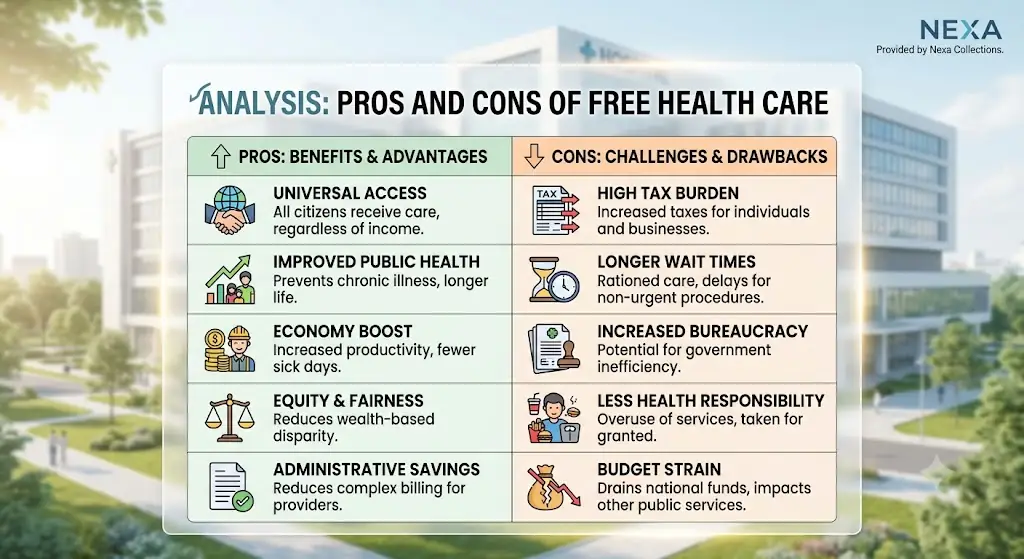
Table with pros and cons of universal healthcare.

Healthcare in the United States remains a financial anomaly compared to the rest of the world. As of 2025, the U.S. spends approximately 18% of its Gross Domestic Product (GDP) on healthcare—nearly double the average of other high-income nations—yet consistently ranks lower in life expectancy and chronic disease management.

The debate on whether to adopt a “Free Healthcare For All” system is not just political; it is financial. For patients, the system is a struggle against rising premiums and deductibles. For medical providers, the current system creates a crisis of uncompensated care and administrative burnout.

Below, we analyze the current state of the industry, the arguments for and against Universal Health Care (UHC), and what the current landscape means for medical practices trying to stay solvent.

The Current State of Health Care in the U.S. (2025-26 Stats)

The system is a complex patchwork of private insurance, Medicare, Medicaid, and self-pay patients. This structure has severe financial side effects:

  • Rising Uninsured Rates: In 2025, the national uninsured rate held at 8.3%, meaning roughly 28 million Americans lack coverage.
  • The ACA Subsidy Cliff: Enhanced ACA premium subsidies expired December 31, 2025. Without further congressional action, the Congressional Budget Office projects roughly 3.8 million additional people losing coverage annually going forward, with premium increases averaging 114% for the 22 million Americans currently receiving those subsidies — directly relevant to provider bad-debt exposure over the next several years.
  • Medical Debt Crisis: An estimated 36% of U.S. households carry medical debt. The total value of unpaid medical bills in the U.S. is estimated at over $220 billion.
  • Provider Strain: For hospitals and private practices, this translates into “bad debt.” Health systems have continued to see bad debt deductions rise, squeezing operating margins.

Pros of a Universal Health Care System

  1. Universal Coverage: The primary benefit is coverage for all. Under a universal system, the 27 million uninsured Americans would gain access to care, theoretically reducing emergency room reliance for basic needs.

  2. Healthier Society & Workforce: Preventive care becomes accessible. Countries with universal systems, such as Canada and Japan, consistently boast higher life expectancies than the U.S. A healthier workforce is more productive, potentially boosting the economy.

  3. Reduced Costs per Capita: Government-controlled pricing could lower the cost of services. Currently, U.S. healthcare costs are inflated by administrative complexity. A single-payer system eliminates the “middleman” costs of dealing with hundreds of private payers.

  4. Elimination of Medical Bankruptcy: Medical expenses are a leading cause of financial ruin. With 14 million adults currently owing more than $1,000 in medical debt, a universal system would virtually eliminate this specific economic burden.

  5. Business Growth: Companies could stop managing complex health benefit plans. This would lower labor costs (estimated reduction of ~10%) and encourage entrepreneurship, as employees wouldn’t be “locked” into jobs solely for insurance benefits.

  6. Accounts Receivable Solution: For doctors, the issue of patient default disappears. In a single-payer system, the government pays the bill. There is no “bad debt” from patients who cannot pay, solving a massive cash-flow problem for practices.

Cons of a Universal Health Care System

  1. Higher Tax Burden: Universal coverage requires funding. The U.S. National Debt has already surpassed $39 trillion. Financing a system like “Medicare for All” would require significant tax increases, potentially impacting the middle class and wealthy alike.

  2. Wait Times & Rationing: Universal systems often struggle with capacity. Canada and the UK famously face long wait times for non-emergency procedures (e.g., hip replacements or MRIs) as demand outstrips the government-set supply.

  3. Physician Burnout & Pay Caps: Government systems often control costs by capping provider reimbursements. With the average medical school cost hitting $59,720 per year (and private schools exceeding $67,000), lowering physician income could discourage students from entering the field.

  4. Innovation Stagnation: The U.S. drives a significant portion of global medical innovation (pharmaceuticals and medical devices) because of the profit potential in a free market. Price controls could reduce the capital available for R&D.

  5. Administrative Bottlenecks: While insurance admin disappears, government bureaucracy takes its place. In 2024, administrative burden was cited as the #1 cause of physician burnout, affecting 49% of doctors. Replacing private bureaucracy with federal bureaucracy may not solve the efficiency problem.

  6. Resource Overuse: When care is “free” at the point of service, patients may overuse resources for minor conditions, overcrowding clinics and delaying care for those with serious needs.


Frequently Asked Questions:

Has any U.S. state actually tried single-payer healthcare on its own?

Yes — Vermont. In 2011, the state passed Act 48, creating “Green Mountain Care,” a state-level single-payer system. It was never implemented: in December 2014, then-Governor Peter Shumlin abandoned the plan, citing the scale of new taxes required (estimates included an 11.5% employer payroll tax and a sliding-scale household tax up to 9.5% of income) and concerns about economic disruption. Whether that counts as single-payer “failing” or simply never being tried is itself a matter of ongoing debate.

Do doctors actually earn less in countries with universal healthcare?

It depends heavily on specialty. Primary care physician pay in countries like Canada and the UK isn’t dramatically lower than in the U.S. in some comparisons, but specialists and surgeons generally earn substantially less. What often gets left out of the comparison: physicians in those countries typically graduate with far less medical school debt, since education costs are heavily subsidized, which changes the lifetime financial picture even at a lower salary.

If healthcare isn’t free, why do emergency rooms have to treat you regardless of ability to pay?

That’s a separate federal law, not a feature of insurance or a free healthcare system. The Emergency Medical Treatment and Labor Act (EMTALA), passed in 1986, requires hospital emergency rooms to screen and stabilize anyone regardless of ability to pay. It doesn’t make the care free — the patient is still billed afterward — it just guarantees the treatment happens first.

Isn’t Medicare already “free” healthcare for seniors?

Not entirely. Medicare requires premiums for Part B and Part D, has deductibles and coinsurance, and doesn’t cover everything (dental, vision, and long-term care are common gaps). Many seniors purchase supplemental “Medigap” or Medicare Advantage plans to cover what original Medicare doesn’t — meaning even Medicare-covered patients can still end up with medical debt.

Would medical debt collection disappear overnight if the U.S. adopted universal healthcare?

Not immediately, and maybe not at all. Even single-payer systems abroad typically still allow billing for services outside the core covered package — cosmetic procedures, some dental and vision care, private rooms, elective upgrades. A transition would likely take years, and existing medical debt incurred under the current system wouldn’t automatically vanish; it would still need to be resolved under whatever rules applied at the time it was incurred.

What would happen to debt someone already owes if the system changed?

Almost certainly nothing automatic. Debt already incurred under today’s rules would likely remain the patient’s legal obligation unless a law specifically addressed it retroactively, which historically hasn’t been how these transitions work in other countries. It’s a detail that tends to get lost in the broader “healthcare for all” conversation.


The Reality for Medical Practices

Why Universal Healthcare isn’t coming to save your Accounts Receivable.

Despite the debates, a transition to a fully Universal Healthcare system in the U.S. is unlikely in the near future. Political resistance, the power of the insurance lobby, and the sheer scale of the transition make it a distant “dream.”

What does this mean for Medical Providers right now? It means you are stuck with the current challenges:

  • Rising Deductibles: Patients are now responsible for a larger portion of their bills.

  • Increasing Bad Debt: As mentioned, bad debt deductions are up 9.2%.

  • Collection Difficulty: The average recovery rate for medical debt collection is often between 15% and 25%—but that is significantly better than 0%, which is what you get if you do nothing.

The “Do-It-Yourself” Trap

Many practices try to handle collections internally to save money. This is often a mistake.

  1. Staff Burnout: Your front-office staff are trained to care for patients, not chase debts. Forcing them to make collections calls contributes to the 49% burnout rate in the industry.

  2. Legal Compliance: Debt collection laws (FDCPA, various state laws) are becoming stricter. One wrong move by an untrained staff member can lead to a lawsuit.

  3. Low Recovery: Without professional tracing tools and credit bureau reporting capabilities, internal collections rarely recover aged accounts.

The Strategic Solution for Healthcare Providers

Since the government isn’t going to pay 100% of your bills anytime soon, protecting your revenue cycle is up to you. Outsourcing to a professional collection agency is no longer just “cleaning up”—it is a vital part of financial hygiene for 2025.

Professional agencies offer:

  • Compliance: Insulation from legal liability.

  • Higher Recovery: Specialized tools to locate debtors and negotiate payment.

  • Patient Retention: A diplomatic third-party approach preserves the doctor-patient relationship better than an awkward confrontation at the front desk.

Don’t let uncompensated care eat your practice’s profits

Need a Collection Agency? Contact us

Filed Under: Medical

  • « Go to Previous Page
  • Page 1
  • Interim pages omitted …
  • Page 8
  • Page 9
  • Page 10

Primary Sidebar


accounts receivable

Need a Collection Agency?
Kindly fill this form.
We’ll get in touch with you

    Please prove you are human by selecting the tree.

    Compliance & Security

    • SOC 2 Type II Certified: Third-party audited data security and strict privacy controls.

    • HIPAA Compliant: Secure, legal processing of medical and municipal EMS accounts.

    • PCI-DSS Level 1: Highest tier of data encryption for secure payment processing.

    • FDCPA & FCRA Aligned: Full legal adherence to federal consumer protection laws.

    Recent Posts

    • Nationwide Debt Collection Agency Serving U.S. Cities
    • Chula Vista Collection Agency for Medical, B2B, Schools & Business Debt
    • Corpus Christi Collection Agency: Itemized Bill Rules for Practices
    • Riverside Collection Agency | For Logistics, Medical, Schools & Business Recovery
    • Collection Agency for Large Balances: High-Value B2B Debt Recovery
    • Baltimore Collection Agency | Medical, Commercial, Schools & More
    • Commercial and B2B Collection Agency in Detroit
    • Boston Medical Collection Agency | Serving Hospitals, Physicians & Dentists

    Featured Posts

    • The Silent Bankruptcy Trigger: Why Medical Debt Is Breaking U.S. Households
    • Standard RFP Requirements for Hiring a Collection Agency
    • Rent Collection Agency for Landlords and Apartment Managers

    Copyright © 2026 NEXACOLLECT.COM | This content is provided for general informational purposes only and should not be considered legal advice. Collection laws and requirements may vary by state, account type, documentation, debtor status, and specific facts. Please consult qualified legal counsel for guidance regarding your particular situation. Nexa and its authorized collection partners service accounts in accordance with applicable federal and state collection requirements. Visit our home page to know more about us.

    X
    Need a Collection Agency?
    Contact Us