The U.S. spends nearly double what other high-income countries spend on healthcare per capita, yet 28 million Americans remain uninsured and 36% of households carry medical debt. A universal, single-payer system could eliminate patient bad debt entirely, but would require substantial new taxes and likely bring the wait-time and reimbursement tradeoffs seen in countries like Canada and the UK. For now, a shift of that scale remains unlikely in the near term, which means providers are left managing today’s uncompensated-care risk rather than waiting for it to be solved by policy.
Healthcare in the United States remains a financial anomaly compared to the rest of the world. As of 2025, the U.S. spends approximately 18% of its Gross Domestic Product (GDP) on healthcare—nearly double the average of other high-income nations—yet consistently ranks lower in life expectancy and chronic disease management.
The debate on whether to adopt a “Free Healthcare For All” system is not just political; it is financial. For patients, the system is a struggle against rising premiums and deductibles. For medical providers, the current system creates a crisis of uncompensated care and administrative burnout.
Below, we analyze the current state of the industry, the arguments for and against Universal Health Care (UHC), and what the current landscape means for medical practices trying to stay solvent.
The Current State of Health Care in the U.S. (2025-26 Stats)
The system is a complex patchwork of private insurance, Medicare, Medicaid, and self-pay patients. This structure has severe financial side effects:
- Rising Uninsured Rates: In 2025, the national uninsured rate held at 8.3%, meaning roughly 28 million Americans lack coverage.
- The ACA Subsidy Cliff: Enhanced ACA premium subsidies expired December 31, 2025. Without further congressional action, the Congressional Budget Office projects roughly 3.8 million additional people losing coverage annually going forward, with premium increases averaging 114% for the 22 million Americans currently receiving those subsidies — directly relevant to provider bad-debt exposure over the next several years.
- Medical Debt Crisis: An estimated 36% of U.S. households carry medical debt. The total value of unpaid medical bills in the U.S. is estimated at over $220 billion.
- Provider Strain: For hospitals and private practices, this translates into “bad debt.” Health systems have continued to see bad debt deductions rise, squeezing operating margins.
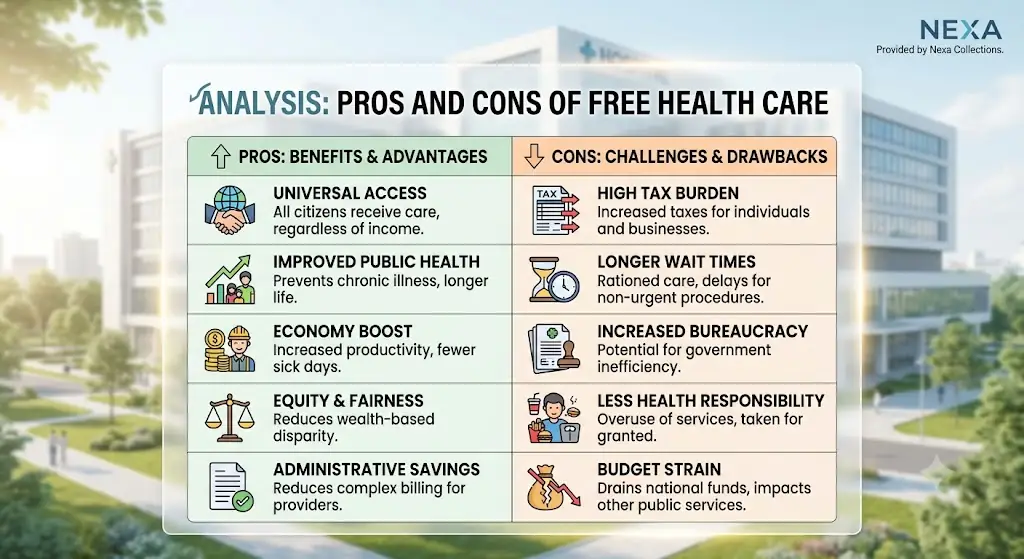
Pros of a Universal Health Care System
-
Universal Coverage: The primary benefit is coverage for all. Under a universal system, the 27 million uninsured Americans would gain access to care, theoretically reducing emergency room reliance for basic needs.
-
Healthier Society & Workforce: Preventive care becomes accessible. Countries with universal systems, such as Canada and Japan, consistently boast higher life expectancies than the U.S. A healthier workforce is more productive, potentially boosting the economy.
-
Reduced Costs per Capita: Government-controlled pricing could lower the cost of services. Currently, U.S. healthcare costs are inflated by administrative complexity. A single-payer system eliminates the “middleman” costs of dealing with hundreds of private payers.
-
Elimination of Medical Bankruptcy: Medical expenses are a leading cause of financial ruin. With 14 million adults currently owing more than $1,000 in medical debt, a universal system would virtually eliminate this specific economic burden.
-
Business Growth: Companies could stop managing complex health benefit plans. This would lower labor costs (estimated reduction of ~10%) and encourage entrepreneurship, as employees wouldn’t be “locked” into jobs solely for insurance benefits.
-
Accounts Receivable Solution: For doctors, the issue of patient default disappears. In a single-payer system, the government pays the bill. There is no “bad debt” from patients who cannot pay, solving a massive cash-flow problem for practices.
Cons of a Universal Health Care System
-
Higher Tax Burden: Universal coverage requires funding. The U.S. National Debt has already surpassed $39 trillion. Financing a system like “Medicare for All” would require significant tax increases, potentially impacting the middle class and wealthy alike.
-
Wait Times & Rationing: Universal systems often struggle with capacity. Canada and the UK famously face long wait times for non-emergency procedures (e.g., hip replacements or MRIs) as demand outstrips the government-set supply.
-
Physician Burnout & Pay Caps: Government systems often control costs by capping provider reimbursements. With the average medical school cost hitting $59,720 per year (and private schools exceeding $67,000), lowering physician income could discourage students from entering the field.
-
Innovation Stagnation: The U.S. drives a significant portion of global medical innovation (pharmaceuticals and medical devices) because of the profit potential in a free market. Price controls could reduce the capital available for R&D.
-
Administrative Bottlenecks: While insurance admin disappears, government bureaucracy takes its place. In 2024, administrative burden was cited as the #1 cause of physician burnout, affecting 49% of doctors. Replacing private bureaucracy with federal bureaucracy may not solve the efficiency problem.
-
Resource Overuse: When care is “free” at the point of service, patients may overuse resources for minor conditions, overcrowding clinics and delaying care for those with serious needs.
Frequently Asked Questions:
Has any U.S. state actually tried single-payer healthcare on its own?
Yes — Vermont. In 2011, the state passed Act 48, creating “Green Mountain Care,” a state-level single-payer system. It was never implemented: in December 2014, then-Governor Peter Shumlin abandoned the plan, citing the scale of new taxes required (estimates included an 11.5% employer payroll tax and a sliding-scale household tax up to 9.5% of income) and concerns about economic disruption. Whether that counts as single-payer “failing” or simply never being tried is itself a matter of ongoing debate.
Do doctors actually earn less in countries with universal healthcare?
It depends heavily on specialty. Primary care physician pay in countries like Canada and the UK isn’t dramatically lower than in the U.S. in some comparisons, but specialists and surgeons generally earn substantially less. What often gets left out of the comparison: physicians in those countries typically graduate with far less medical school debt, since education costs are heavily subsidized, which changes the lifetime financial picture even at a lower salary.
If healthcare isn’t free, why do emergency rooms have to treat you regardless of ability to pay?
That’s a separate federal law, not a feature of insurance or a free healthcare system. The Emergency Medical Treatment and Labor Act (EMTALA), passed in 1986, requires hospital emergency rooms to screen and stabilize anyone regardless of ability to pay. It doesn’t make the care free — the patient is still billed afterward — it just guarantees the treatment happens first.
Isn’t Medicare already “free” healthcare for seniors?
Not entirely. Medicare requires premiums for Part B and Part D, has deductibles and coinsurance, and doesn’t cover everything (dental, vision, and long-term care are common gaps). Many seniors purchase supplemental “Medigap” or Medicare Advantage plans to cover what original Medicare doesn’t — meaning even Medicare-covered patients can still end up with medical debt.
Would medical debt collection disappear overnight if the U.S. adopted universal healthcare?
Not immediately, and maybe not at all. Even single-payer systems abroad typically still allow billing for services outside the core covered package — cosmetic procedures, some dental and vision care, private rooms, elective upgrades. A transition would likely take years, and existing medical debt incurred under the current system wouldn’t automatically vanish; it would still need to be resolved under whatever rules applied at the time it was incurred.
What would happen to debt someone already owes if the system changed?
Almost certainly nothing automatic. Debt already incurred under today’s rules would likely remain the patient’s legal obligation unless a law specifically addressed it retroactively, which historically hasn’t been how these transitions work in other countries. It’s a detail that tends to get lost in the broader “healthcare for all” conversation.
The Reality for Medical Practices
Why Universal Healthcare isn’t coming to save your Accounts Receivable.
Despite the debates, a transition to a fully Universal Healthcare system in the U.S. is unlikely in the near future. Political resistance, the power of the insurance lobby, and the sheer scale of the transition make it a distant “dream.”
What does this mean for Medical Providers right now? It means you are stuck with the current challenges:
-
Rising Deductibles: Patients are now responsible for a larger portion of their bills.
-
Increasing Bad Debt: As mentioned, bad debt deductions are up 9.2%.
-
Collection Difficulty: The average recovery rate for medical debt collection is often between 15% and 25%—but that is significantly better than 0%, which is what you get if you do nothing.
The “Do-It-Yourself” Trap
Many practices try to handle collections internally to save money. This is often a mistake.
-
Staff Burnout: Your front-office staff are trained to care for patients, not chase debts. Forcing them to make collections calls contributes to the 49% burnout rate in the industry.
-
Legal Compliance: Debt collection laws (FDCPA, various state laws) are becoming stricter. One wrong move by an untrained staff member can lead to a lawsuit.
-
Low Recovery: Without professional tracing tools and credit bureau reporting capabilities, internal collections rarely recover aged accounts.
The Strategic Solution for Healthcare Providers
Since the government isn’t going to pay 100% of your bills anytime soon, protecting your revenue cycle is up to you. Outsourcing to a professional collection agency is no longer just “cleaning up”—it is a vital part of financial hygiene for 2025.
Professional agencies offer:
-
Compliance: Insulation from legal liability.
-
Higher Recovery: Specialized tools to locate debtors and negotiate payment.
-
Patient Retention: A diplomatic third-party approach preserves the doctor-patient relationship better than an awkward confrontation at the front desk.
Don’t let uncompensated care eat your practice’s profits