• Skip to main content
  • Skip to primary sidebar

Nexa Collections

  • Home
  • Serving
    • Medical
    • Dental
    • Small Business
    • Large Business
    • Commercial Collections
    • Government
    • Utilities
    • Fitness Clubs
    • Schools
    • Senior Care Facility
  • Contact Us
    • About us
    • Cost

Debt Recovery

Signs Your Client is Going Bankrupt Soon

Business Chapter 11 bankruptcy

During an unstable economic environment, companies must go to great lengths to ensure their market position, financial strength and durability. That means monitoring and controlling risks as much as possible. One of those risks consists of a company’s clients. B2B enterprises are particularly vulnerable because losing one large client can deal a significant blow to the company. The loss does not mean the future business, but if they file for bankruptcy, then even the current outstanding AR may turn into a complete loss.

It takes startups about 2 to 3 years to become successful and 7-10 to become truly profitable. Nowadays, businesses are shuttering left and right, so knowing what your partners and clients are up to is essential. Watching your business partners’ actions and indicators of financial health is not industrial espionage or lack of trust. It’s about understanding that the appearance of success can hide obstacles and failures that, if not tackled head-on, will negatively impact your partner and, ultimately your own company.

Here’s what to look out for when assessing whether your client is going to file for bankruptcy protection:

1. Delaying your payments:

If your client delays paying your bills on time, watch out. Tell your staff to take precautionary actions to prevent your AR from becoming too significant. Ensure that your account managers and liaisons understand the severity of the situation and all the steps of the process involved in reducing business losses. Start to send invoices and payment reminders more frequently, and instruct your staff to document all interactions with that client, especially promises to pay. Monitor the extent of account deficits. If possible, try to prevent delinquent clients from moving the goalposts of their financial obligations by imposing strict rules of repayment, and escalating as necessary. Don’t wait for too many of your clients to get perilously close to bankruptcy before taking measures to protect your company.

2. Layoffs or a High Turnover:

If the client is handing over too many pink slips, especially to those employees you feel are vital for their organization, that is a big red sign. Some turnover and layoffs are normal, but if you see it is way more than the average, try to find out what is happening.

People leave companies or are terminated for various reasons, and sometimes a company is healthier for it. That being said, a revolving door of employees and managers spells trouble to anyone watching. And the company wastes precious resources training new hires.
Excessive layoffs can be very demotivating. They are alarming because the remaining employees do not find enough reasons to stay, which means they have doubts about the direction the company is going. Employees almost always have some insider knowledge about company’s financial health; if they think that there is no future for them anymore, what does that say about the future survival of the company as a whole?

Employees can quit or be forcefully terminated because of low work volume. Even if that only happens behind closed doors, word will eventually get around that the company is struggling to sustain its operations and generate cash flow.

3. Borrowing too much

Having a bit of corporate debt can be beneficial because it allows a company to better use its cash resources. Having a disproportionate balance of cash and corporate debt can signify that your client is struggling to maintain their cash flow.

When a company applies for new credit to pay off old debts but has not been able to generate enough cash to pay them, it may signal to whoever is watching that an already dire situation may be accelerating. It is fine to refinance or restructure debts to free up some cash for growth or investments but to increase your corporate debt so much that it becomes impossible to pay it back is a financial disaster waiting to happen. The next step is often filing a Petition for Chapter 11 bankruptcy protection.

4. Starting to have a bad reputation.

Is your client’s reputation among investors, business partners, employees, and the community starting to take a hit?

A lot can be said about such a fluid concept in business, but reputation doesn’t just boil down to an image bolstered by successful marketing.

Instead, it is the credibility and respect created by your products’ quality, the professionalism of your leaders and employees, the honesty you show in your business relationships, and so much more. Those individual experiences by customers or clients of a business reinforce each other as strong strands in a web of trust when repeated by word-of-mouth, in writing, or on social media.

On the other hand, the more frail a reputation is, the more dangerous one blow can be. A data leak, discrimination against a minority, gossip inside the company that starts spilling into the public space, or any other action that may ruin your relationships within the industry and with your customers is a real threat to your company. Benjamin Franklin justifiably said:

“It takes many good deeds to build a good reputation, and only one bad one to lose it.”

In our world, where perception has become so important, bad reviews from clients and partners can lead to losing significant business, more so than the quality of the products and services a company offers. The image and pockets of huge companies are often impacted dearly due to insensitive or outdated posts on social media. Although unfair, some of their business partners may be negatively impacted by this, simply by association.

5. Expanding too quickly

Growth is the dream of every entrepreneur, but even in a good year, that can be dangerous. During an unfavorable economic environment, it can be fatal. Spreading yourself too thin, in too many directions, with resources and staff struggling to cover operations, could lead to an implosion. You don’t want to face a Chapter 7 bankruptcy filing where your assets are liquidated to pay off creditors.

Gradual expansion over several years is the more cautious approach, and now more than ever, making sure that what you already have is safe is the right way to go.

6. Lawsuits or problems with legal compliance in the form of complaints and inspections

A lawsuit may erode a company’s credibility, but it may also adversely rattle its partners and clients. However, when the primary regulatory agencies keep showing up for inspections or the number of complaints against the company increases, then the suspicion that there might be wrong-doing at the company rises. One of the most definitive ways to cease to exist as a business is to break the law. While you can turn around a company struggling with finances or bad management or other problems, the law is pretty unforgiving.

7. Losing big clients

Business owners tend to look out for new competitors as the big new threat to their market share. Big companies are slow to make dramatic decisions like cutting off a supplier or changing business partners, not only because of the sheer operational effort involved but also because of binding contracts, yet they will do it if a company doesn’t provide them what they need. With everyone trying to cut their losses and cut off unprofitable or optional sectors of their business, one has to be extra careful about how they treat all of their business clients. A pattern of behavior or failure to deliver will determine whether a client will stay with you or not.

Finally, one of the biggest problems or assets, depending on when and how you make use of it, is flexibility. Being able to weather the storm by changing your operations, prioritizing sources of reliable revenue, taking advantage of new opportunities and technological discoveries will help some business stay afloat or grow, while others will be left behind. The other side of the coin is when a business constantly changes, with unwarranted risks, and jeopardizes its stability. In a period of upheaval, as the one we’re experiencing this year, we need to pay attention to our clients’ decisions, whether it’s the reluctance to evolve, out-of-control splurging, expansion, or irrational changes.

Filed Under: Debt Recovery

Institutional Credit Recovery: Security-Hardened Solutions for Credit Card Issuers

In the high-stakes world of financial services, your recovery strategy is an extension of your brand’s integrity. For banks, credit unions, and FinTech issuers, a delinquent account is a manageable loss—but a data breach or a regulatory fine is a catastrophic liability. Nexa provides the “Velvet Hammer”: an institutional-grade recovery model that fuses elite cybersecurity with a diplomatic, white-labeled outreach strategy designed to protect your reputation and your bottom line.

Nexa provides a reputation-safe approach, equipped with all 50-state collections license, offering free credit reporting, free litigation, free bankruptcy scrubs, and zero onboarding fees. Secure – SOC 2 Type II & GLBA compliant. Over 2,000 online reviews rate us 4.85 out of 5. 

Need a Collection Agency? Contact us


Transparent Pricing: Strategic Paths to Capital Recovery

We believe that recovering institutional capital shouldn’t be a financial gamble. We offer a two-tiered pricing model designed to maximize ROI across the entire life cycle of a credit card account:

  • Phase 1: The $15 Fixed-Fee “Early-Out” Program:
    Ideal for pre-charge-off accounts (45–90 days past due). For a flat $15 per account, we provide professional outreach. Cardholders pay you directly, and you keep 100% of the recovered funds. This is the ultimate “administrative fix” for early-stage delinquency.

  • Phase 2: Contingency-Based Recovery (30%–40%):
    For post-charge-off portfolios or aged debt. This is a No Recovery, No Fee model. We utilize intensive skip-tracing and professional mediation, and you only pay a percentage of what is successfully deposited back into your institution.

Secure Your Institution’s Cash Flow – Contact Nexa Today


Bank-Grade Security & Infrastructure: Your Compliance Shield

For financial institutions, security is the primary barrier to entry. Nexa’s infrastructure is engineered to exceed the rigorous audit requirements of the banking industry.

  • SOC 2 Type II Certified: Our internal controls are independently audited to ensure the highest standards of security, availability, and confidentiality.

  • GLBA & Regulation F Compliance: We adhere strictly to the Gramm-Leach-Bliley Act and CFPB Regulation F, ensuring Non-Public Personal Information (NPI) is shielded and dunning frequency is strictly governed.

  • Hardened Connectivity: Mandatory high-level VPNs and Multi-Factor Authentication (MFA) are required for every employee. Data in transit is protected by PGP encryption.

  • PCI DSS Level 1 Standards: As a partner to credit card issuers, we maintain strict payment card industry standards to ensure secure transaction processing without storing sensitive card data.


Technical Integration: Zero-Latency Onboarding

We understand that for modern issuers, manual data entry is a relic. Nexa provides a scalable technical layer that integrates seamlessly with your core banking or Loan Origination System (LOS).

  • RESTful API Ecosystem: We offer secure API endpoints for real-time account placement and status updates, allowing your internal systems to “talk” to our recovery engine instantly.

  • Webhook Event Notifications: Receive automated “pings” the moment a payment is made or a dispute is raised, ensuring your internal ledgers are updated with zero latency.

  • Secure SFTP Batching: For traditional institutions, we support encrypted SFTP batch file transfers for high-volume portfolio management.


The “Velvet Hammer” Philosophy: Protecting Your Institutional Brand

Financial institutions are under constant scrutiny from regulators and the public. A single “rogue collector” can trigger a PR crisis or a regulatory audit. Nexa utilizes The Velvet Hammer approach to mitigate this risk.

We rebrand our specialists as “Account Reconciliation Concierges.” We don’t call to demand cash; we reach out to help your cardholders navigate billing confusion, insurance gaps, or temporary financial hurdles.

  1. 100% Call Recording: Every interaction is recorded and archived for audit transparency.

  2. Random Quality Audits: Our compliance team performs daily reviews to ensure our Concierges remain empathetic and helpful.

  3. Sentiment Analysis: We utilize AI-driven analysis to monitor call tone, ensuring your brand is always represented with the highest degree of professionalism.


Strategic Intervention: Beating the “90-Day Cliff”

Current industry data shows that the probability of recovering credit card debt drops by nearly 50% once the account passes the 90-day mark. Our strategy is built to intervene before the debt “goes cold.”

  • Pre-Charge-off Early Intervention: By using our $15 Fixed-Fee model at Day 45 or 60, we act as a white-labeled extension of your billing department. This “soft-touch” dunning cycle resolves confusion early and maintains cardholder loyalty.

  • Consumer Self-Service Portal: We provide a 24/7, SOC-compliant payment portal where cardholders can resolve debt, set up installment plans, or dispute charges privately—reducing friction and increasing recovery rates.


Recent Recovery Results: Institutional Case Studies

  • Regional Credit Union Recovery:
    A mid-sized CU had $144,500 in delinquent card balances. Using our Phase 1 ($15 Fixed-Fee) service, we recovered $97,800 within 90 days. The total cost to the CU was only $1,500, allowing them to retain 98.5% of the capital.

  • FinTech Issuer B2B Recovery:
    A digital lender was “ghosted” on a series of commercial card accounts totaling $9,800. Our Account Reconciliation Concierges successfully mediated payment plans, securing full settlements within 21 days while preserving the corporate rapport.


Frequently Asked Questions (FAQ)

Q: Can you collect from cardholders who have moved out of state?
Yes. We are licensed to collect in all 50 states, following the specific debt collection laws of the debtor’s residence.

Q: How do you handle account disputes?
Our specialists are trained in professional mediation. When a dispute is raised, it is immediately logged in our system, and a Webhook notification is sent to your team for review, ensuring full transparency.

Q: Is there a minimum portfolio size?
No. Our $15 fixed-fee model makes it cost-effective to recover even small balances or single-account delinquencies that traditional agencies would ignore.

Recovering Credit Card Debt Nationwide

Contact Us

Higher Recovery Rates: Top-Notch Customer Service


Filed Under: Debt Recovery

Dental Billing Secrets: How to Collect More at Checkout

blank

Smile-Ready Revenue: The Guide to Slashing Dental Accounts Receivable

In a modern dental practice, clinical excellence is only half the battle; the other half is maintaining a healthy financial heartbeat. High Accounts Receivable (AR) is a silent profit killer that drains resources, creates staff burnout, and puts your practice’s growth on hold.

To keep your cash flow as vibrant as your patients’ smiles, you need a proactive, data-driven system that stops delinquency before it ever hits the “90-day” bucket.


Modernize Your Financial Policy

A financial policy is only effective if it is understood and enforced. Every patient should review and sign a clear, one-page document outlining their responsibilities before treatment begins. Avoid burying the “payment due at time of service” clause in fine print. When expectations are set upfront, the “I forgot my wallet” excuse becomes a thing of the past.

Implement Real-Time & Predictive Verification

Waiting until a claim is denied to find out a patient’s coverage has changed is a recipe for high AR. Verify eligibility 48 to 72 hours before every appointment. In 2026, top practices go further by using AI-driven predictive eligibility to flag claims at high risk of denial before the patient sits in the chair, allowing you to request a larger down payment upfront.

Master the “Golden Hour” of Collections

The highest probability of collecting a payment is while the patient is physically in your office. Train your team to move from passive questions like “Would you like to pay today?” to confident statements: “Your total for today is $X; will you be using card or Apple Pay?“ Normalizing the transaction at checkout reduces the need for expensive, time-consuming billing statements later.

Leverage Frictionless Digital Payments

If your primary collection method is a stamped envelope, you are losing money. Modern patients rarely open paper mail. Implementing Text-to-Pay links and a robust online portal allows patients to settle their balances in seconds from their smartphones. Frictionless options lead to faster turnaround times and fewer accounts aging into the 60-day column.

Aggressive Denial & Claim Management

Speed is the enemy of delinquency. Establish a daily workflow where claims are “scrubbed” for errors—like missing X-rays or incorrect CDT codes—and electronically batched by the end of every business day. Additionally, keep a Denial Tracking Log to identify the “Top 3” recurring errors. Fixing the root cause at the front desk prevents future AR from ever existing.

Monitor the “AR Ratio” Benchmark

You cannot manage what you do not measure. A healthy practice should aim for an AR Ratio of 1.0 or less, meaning your total outstanding AR does not exceed your average one-month production. If your ratio climbs toward 1.5, your collection systems need an immediate audit.

Stick to the 30-60-90 Day Protocol

Debt does not age like fine wine. Establish a rigid, automated follow-up schedule:

  • 30 Days: First digital reminder and a friendly follow-up call.

  • 60 Days: A “Firm but Fair” letter stating the account is past due.

  • 90 Days: The Final Notice. Consistency is key. When patients know you are diligent about your finances, they prioritize your invoice over others.

Know When to Transition to Professionals

Your front-desk team members are the face of your practice; they should remain the “Good Cops.” Forcing them to aggressively harass patients can damage your local reputation and lead to staff turnover. When an account hits the 90-120 day mark, it is time to transition it to a professional collection agency. This preserves the patient-provider relationship while ensuring experts handle the recovery.

Secure Your Dental Office Revenue
Contact Nexa Collection Agency Today

Filed Under: Debt Recovery

How Effective Are Collection Agencies?

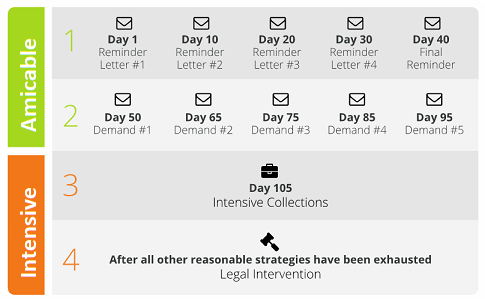
Collection Agency
Collecting outstanding debt isn’t an easy process. If a consumer has allowed their obligations to go into delinquency they’re usually either experiencing significant financial difficulty, they’re grossly irresponsible, or they have no intention of paying. None of these situations are amenable to fast debt recovery.

Companies will generally try to collect on their outstanding accounts internally before passing their most egregious cases on to an external debt collection agency. But how wise is this? Are collection agencies effective enough to warrant their fees?

Absolutely. Collection agencies are experts in debt recovery. The most effective agencies have perfected a proven process for their agents to follow that dramatically increases the chances of collecting a debt. Even after their contingency fees, a collection agency is typically able to recover lot more money than the client can do by themself. Plus they take away all the troubles that your staff has to undergo while chasing your unpaid bills.

Not only should companies trust collection agencies to handle their debt recovery, but they should also pass the debt on to the agency sooner than they do in many cases. That’s because debt collection success is a factor of time, skill, and reputation, all of which favor collection agencies.

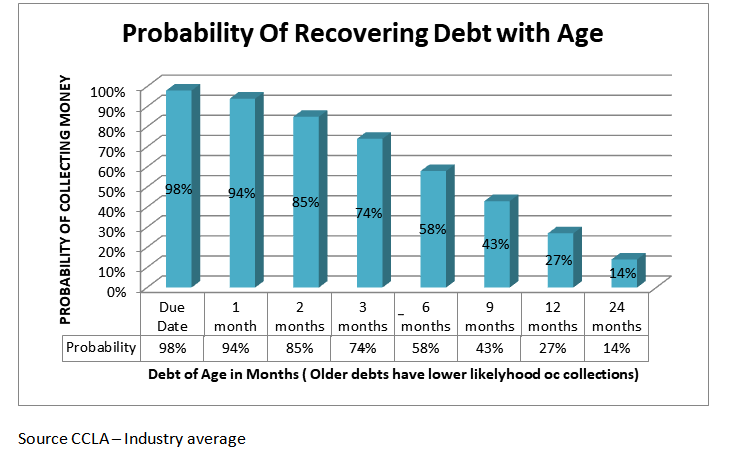
Recovery Rates Drop As Debts Age

Debt Recovery Chances

The longer an account remains delinquent, the less likely it is to be recoverable. An outstanding balance that’s one month old has a 94% chance of being collected. By two months that drops to 85%. It falls to 74% collectible at three months, and by six months, only 58% of debts remain viable. At a year, there’s only a 27% chance of recovering the debt.

These percentages assume skilled debt collectors with modern collection tools at their disposal, like those found at agencies. Internal collections departments fare even worse. It’s better not to wait too long to pass your outstanding debts on to a professional.

Collection Agencies Have Advanced Tools and Training

Debt collection is their business, after all. It’s how they make a living. This means collection agencies have just as much of an incentive to collect your debt as you do. It’s rare to find this sort of win-win relationship in business.

Agencies offer their agents rigorous training and access to advanced tools like skip tracing and bankruptcy scrub to improve the accuracy of their collections.

Skip tracing techniques allow agents to track down debtors that have “skipped” out on their debts and are no longer reachable. Bankruptcy scrubs alert agents when a bankruptcy filing occurs so they can move quickly to avail themselves of the proceedings as efficiently as possible.

These and other techniques aren’t always available to internal collections teams, reducing the effectiveness of their efforts.

Debtors Are More Likely to Pay A Collection Agency

When a debt passes from the original creditor to a collection agency, this escalation often makes debtors pay attention. There’s an implied threat when an agency gets involved that doesn’t exist with the original creditor. People that are having financial difficulties, or are just irresponsible will often string their creditor along. When a collection agency begins calling, the debt feels more palpable.

Collection agencies also know how to speak with debtors to motivate payment. That doesn’t mean they threaten them, because they generally don’t. Instead, they use a sophisticated arsenal of psychological tactics to push people toward payment.

As a third-party agent, they can have conversations with debtors that are difficult for the original creditors. They can act as an intermediary or position themselves as a helpful friend instead of an adversary. These are all benefits not afforded to the original creditor.

Collection Agencies Mitigate Legal Risks

Every state has laws governing how debts can be collected. Most creditors are unaware of these. And because they aren’t consistent, businesses that operate in multiple locations may have to follow different regulations depending on the customer.

Collection agencies are intimately familiar with all of these legal frameworks and operate within them daily. Using an agency can shield you from running afoul of these laws.

Collection Agencies Are The Most Effective Option

Quality agencies enjoy a higher success rate than original creditors, are more affordable than lawyers and legal proceedings, and use diplomatic techniques that allow companies to preserve their relationships with their customers.

You should undoubtedly attempt initial collection efforts, but once your delinquent accounts seem unrecoverable, you should trust a collection agency. Their fees might seem high, but keeping 70% of a debt you likely wouldn’t have collected otherwise is a net positive transaction. And if you don’t receive anything, the service costs you nothing. As stated earlier, it’s a win-win.

Need a Collection Agency? Contact Us

Filed Under: Debt Recovery

Calculating and Improving Accounts Receivable Turnover Ratio

account turnover ratio
The quicker your business is able to collect on outstanding invoices, the healthier it will be financially. It’s better for cash flow purposes and saves money and headaches associated with trying to collect delinquent debts.

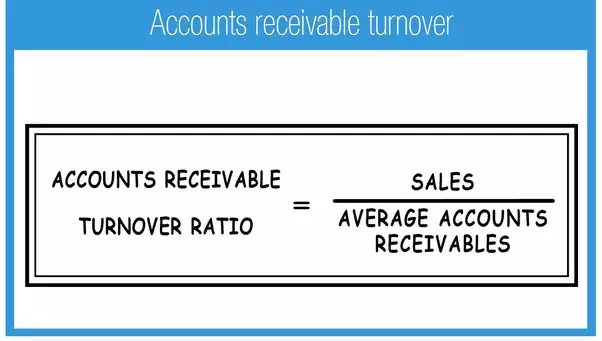
The AR turnover ratio is a standard metric used to determine the pace with which businesses are able to collect their debts. It isn’t difficult to compute and knowing your company’s ratio will give you a benchmark against which you can judge attempts to collect invoices more rapidly.

How To Compute Your Business’s Accounts Receivable Turnover Ratio

To compute this ratio you’ll need to know your company’s net credit sales and your average accounts receivable. These numbers are available on your company’s balance sheet.

To compute this ratio you’ll divide your net credit sales by your average AR. Here’s a bit more information on these two measures.

Net Credit Sales

This is the portion of your annual sales that are tied up in invoices. To compute your net credit sales you’ll take your total annual sales and subtract any cash sales, sales returns, and other allowances, such as price changes and discounts.

Average Accounts Receivable

This represents the average amount of money owed to your business as invoices at any given time. You’ll compute this by adding your accounts receivable amount from the beginning of the year to the amount from the end of the year. Then you’ll divide by two.

Let’s say you had $20,000 in AR at the start of the year and $35,000 at the end.

$20,000 + $35,000 = $55,000

$55,000 ÷ 2 = $27,500

This shows that your average AR is $27,500 for the year.

Computing Your Accounts Receivable Turnover Ratio

AR turnover ratio
Let’s say that you had $150,000 in net credit sales for the year. And we now know your average AR was $27,500. To compute your AR turnover ratio we’ll use formula detailed at the top of this section.

$150,000 ÷ $27,500 = 5.45

Your accounts receivable turnover ratio is 5.45. This means that your AR turned over 5.45 times in the last year. To put that in terms that are easier to understand, divide the total number of days in the year by your ratio.

365 ÷ 5.45 = 66.9

This tells you that it took an average of about 67 days for you to collect on an invoice. To collect invoices faster, you need a higher ratio. As an example, had you found your ratio was double what it is, or 10.9, you would know that you’re collecting invoices in half the time, or in 34 days.

Now that you know your AR turnover ratio, what can you do to improve it?

Improving Your Accounts Receivable Turnover Ratio

A low AR turnover ratio can indicate poor collections policies and/or a larger than ideal percentage of financially irresponsible customers. For the health of your business, you should try to increase low ratios. Here are a few things to try.

Invoice Immediately

In order to collect payments quickly, it’s best to invoice while your work is still fresh in your customer’s mind. Send out invoices as soon as the work is completed. This shows you’re serious about your credit collection policies.

Include Early Payment Discounts and Late Payment Penalties

You can offer a small discount to entice customers to pay their invoices earlier than required. You might also charge a penalty for late payments beyond a certain point. If your terms are normally net 30, you might offer a 3% discount for payments made within 15 days.

Penalties shouldn’t be onerous. You don’t want to punish your customers. You only want to motivate them to pay. 1.5% interest per month that the invoice is late might be appropriate.

Give Your Customers a Range of Payment Options

Let your customers pay you however they see fit. This helps their payment processes and can get you paid faster. Offer links to online payment options directly within your invoice and also allow for credit card payments, checks, bank drafts, and more.

Take Deposits Upfront

An upfront deposit ensures that you’ll receive at least some portion of your total invoice. A deposit also gets your customer to put skin in the game, which increases the likelihood that the remainder will be paid on time.

Send Out Regular Reminders

Use an automated invoicing system to send automatic emails when your customers become delinquent. Oftentimes a friendly reminder is all it takes to get paid.

Stop Working With Problematic Customers

Customers that pay egregiously late on a regular basis will drag down your AR turnover ratio and cause constant problems for your business. Consider whether you might be better off not working with them.

The longer invoices remain unpaid, the longer your business can’t use that money to pay its own bills. Try these suggestions to get your AR turnover ratio higher. Your business will thank you.

Important Conclusion:

The turnover ratio is a measure of current liabilities and an indicator of a low collections model.

If the ratio is too high, means a business has very aggressive collections practices, which may drive new customers or even loyal customers to the competition.

Finally, it’s good to keep records of different ratios over different periods (months, quarters, etc) so the business can adjust its collections practices accordingly.

Filed Under: Debt Recovery

Why Diplomacy is the Best Approach in Debt Collection

Diplomatic debt collections

Businesses that are faced with collecting on delinquent invoices often don’t know where to begin. They tend to react with anger, the assumption being that the customer is intentionally trying to rip off their business. While this may feel warranted, it isn’t an ideal approach. A better assumption to start your collections process with is this:

Very few people don’t pay their debts simply because they don’t want to.

Most people aren’t criminals trying to steal from you. They have reasons why they haven’t paid. It could be that someone in the household lost a job or some other source of revenue dried up. They may have gotten themselves into debt and are now having a difficult time digging out.

Instead of pursuing them out of anger, it’s better to use a diplomatic approach that treats them like human beings, not deadbeats. When you consider their circumstances and attempt to open up a friendly dialogue you’ll enjoy collections success far more often. There a number of other reasons why a diplomatic approach is better as well.

Diplomacy Preserves Your Relationship

If you demonize delinquent customers and pursue them in a combative manner you’ll almost certainly sour the relationship. You might be able to collect what you’re owed, but you’ll lose any future business. This can be a penny-wise, pound-foolish decision.

Your customer’s circumstances will likely change. If they lost their job, they’ll find a new one. They may be having difficulty paying bills now, but that won’t last. If you approach them in a friendly, understanding manner, and work with them to find a payment plan that works for them, they’ll actually appreciate you more. Not only will you get what you’re owed by you could have a customer for life, promising significant future revenues.

Diplomacy Gets Your Customer to Call You Back

Customers don’t respond to anger and threats. If you leave a menacing message in someone’s voicemail you may cause them to retreat in fear and ignore future messages. They know they owe you money and in many cases, they don’t know what to do. Adding threats only compounds their problems.

On the other hand, leaving a calm, understanding message that stresses your desire to work with them to find a solution that they can afford gives them hope. It helps them to see that there is a light at the end of the tunnel. Their fear of repercussions is replaced with an optimism that they’ll find a way out of debt.

When someone feels you’re on their side they’re much more likely to call you back.

Diplomacy Is Easier on Your Collections Staff

The way we treat other people has an effect on how we see ourselves. Imagine if you had to spend each workday stalking and yelling at people that you knew were already down on their luck. It would take a toll on your psyche.

Taking a diplomatic approach to debt collection allows your staff to have conversations with people instead of threatening them. It lets them get to know your customers better instead of treating them like delinquents.

Instead of feeling like they’re chasing people down, your staff will feel like they’re helping people. And that’s because they are. Diplomatic debt collection is about helping your late-paying customers find a solution to their situation. It’s a positive process that benefits you and them. When your staff approaches the situation in this way they’ll report higher job satisfaction and you’ll experience less churn.

In the end, a diplomatic approach to debt collection is better for your business, your staff, and your customers. You’ll collect more debts, faster, and you’ll retain those relationships into the future.

Filed Under: Debt Recovery

  • « Go to Previous Page
  • Page 1
  • Interim pages omitted …
  • Page 21
  • Page 22
  • Page 23
  • Page 24
  • Page 25
  • Interim pages omitted …
  • Page 51
  • Go to Next Page »

Primary Sidebar


accounts receivable

Need a Collection Agency?
Kindly fill this form.
We’ll get in touch with you

    Please prove you are human by selecting the heart.

    Recent Posts

    • Collection Agency in Cedar Rapids, IA | Compliant & Effective
    • Collection Agency in West Valley City | Compliant & Effective
    • Collection Agency in Stamford, CT | Compliant & Effective
    • Top Arizona Collection Agency for Patient Billing Solutions
    • Collection Agency in Fullerton, CA | Compliant & Effective
    • Collection Agency in Palm Bay, FL | Compliant & Effective
    • Texas Medical Debt Collection | HIPAA-Compliant Experts
    • Federal Government Shutdown: Impact on Collections

    Featured Posts

    • Myths about Female-to-Female Bullying
    • Your Collection Agency has Shut Down? What to do Next?
    • Lower Medical AR Days: 5 Proven Tactics

    Copyright © 2026 NEXACOLLECT.COM | All information on this website is for general information only and is not an experts advice. We do not own any responsibility for correctness or authenticity of the information, or any loss or injury resulting from it.

    X
    Need a Collection Agency?
    Contact Us