• Skip to main content
  • Skip to primary sidebar

Nexa Collections

  • Home
  • Serving
    • Medical
    • Dental
    • Small Business
    • Large Business
    • Commercial Collections
    • Government
    • Utilities
    • Fitness Clubs
    • Schools
    • Senior Care Facility
  • Contact Us
    • About us
    • Cost

business

Impact of Accounts Receivable on Cash Flow and Profit

Collections
Accounts receivable refers generally to money a business is owed for products or services that have been delivered or provided to customers. It is a crucial part of operations for many businesses, due to custom or routine in certain industries, where requiring immediate payment on delivery is unnecessary or could cause delays that strain a customer’s ability to run its business. If, however, the amount due increases to a figure that is unsustainable for the business that is owed, it can cause serious cash flow problems and ultimately impacts its profit.

Understanding how accounts receivable fits into your business is a basic, but important component of success, especially for smaller businesses or those that might not have excess cash to fund obligations while waiting for payment in full. Here are some key concepts relating to accounts receivable, and how they impact businesses.

Understanding the basics of accounts receivables

Some businesses might typically have low to zero in receivables, such as a restaurant where customers pay in full at the conclusion of their meals. In simplified accounting terms, these are cash basis transactions and represent the way most modern personal transactions transpire – a customer wants to purchase something so they pay cash upon delivery. This payment doesn’t necessarily have to be made in physical cash to be “cash basis,” as a check, credit or debit card transaction is, for the most part, the same as cash for a receiving business.

Often, however, business-to-business or B2B sales requires flexibility. Let’s stick with the dining example, but focus on the relationship between a food-service supplier and a restaurant. It is common for suppliers to have arrangements with the various accounts they service to enable quick and efficient delivery, with payment of the amount due not required upon delivery, but instead at some later date. 30 days is a common term for these transactions, which are called “on account” instead of on a cash basis. In this example, the supplier makes the delivery with the understanding that the restaurant will pay its bill in full within 30 days.

Why businesses permit “on account” transactions

At first glance, you might wonder why a business would give goods or services to a buyer without obtaining immediate payment. The restaurant supplier example illustrates a particular industry custom and the reality that many businesses might not have employees walking around with checks at the ready. Also, accounts receivable are more common in businesses that provide services. A business lawyer, for example, might provide advice or review contracts for another business and submit a bill when the legal matter is complete, or periodically, such as with a monthly invoice.

While we introduced the concept of accounts receivable with a B2B example, consumer transactions can involve accounts receivable too. Take, for instance, a lawn mowing service. It’s common practice for a landscaping company to provide service to customers when they are not home. Requiring immediate payment can cause many complications — the landscaper would either have to arrange to be paid in advance or mow the lawns only while the customer is home. The common thread between the B2B and consumer examples is the existence of an ongoing relationship between the parties.

We should not confuse cash flow with profit. Profit refers to the amount of money left after expenses, cash flow indicates the net flow of cash into and out of a business.

Avoiding out-of-control accounts receivable

While providing goods and services on account for both B2B and consumer transactions  It’s easy to see how accounts receivable can get out of hand if not managed properly. Accounts receivable are recorded as assets for accounting purposes. They are like cash but not as liquid, so they only positively affect cash flow when the account receivable is cleared through payment. Businesses must balance the sales and service value of catering to clients’ desire to pay on account with maintaining healthy cash flow for their business. There are several ways for a business to walk this line.

  • Protect your business from lean times. The first is having sufficient cash reserves to support your business model, including the delayed payments from your industry’s standard accounts receivable practices. If the standard is a 30-day window, you must have enough positive cash flow to support operations and restocking new inventory without immediate payment. This is one of the main reasons under-capitalized businesses fail.
  • If the sale is on credit, get the interest you are due. The next way to control accounts receivable is understanding the difference between “on account” and “on credit.” While the two terms may often be used interchangeably, “on credit” refers to the existence of a promissory note between the parties, and is used when a longer period than the standard “on account” period is necessary. If a customer needs more than 30 days, for example, you should protect their legal and financial interests with a promissory note, where a longer term is allowed in consideration for interest. Interest payments compensate for the delayed cash from a sale or transaction.
  • Underwrite your customers. A final method is to know your customers. Understand the pressures in their industry, and get a sense of their cash flow. Although you are not technically a lender when allowing customers to order on account, you can underwrite the ability to pay and better protect your business from late payments and potential loss of profit for nonpayment. This underwriting process should involve discussing fluctuations and keep you out of the dark when it comes to a customer’s potential cash flow problems. The information obtained will inform your accounts receivable policies such as the amount you will allow on account and terms.
  • Hire a Collection Agency. A customer who has not paid even after repeated reminders then – “there’s more to this than meets the eye”. There may be other businesses just like yours who are waiting to get paid. If someone has not paid for 90 days, then they will possibly not clear your accounts receivable easily and their financial situation is likely deteriorating with every passing day. Time is of the essence, and taking help from debt collection experts can be quite beneficial. It is safe to start with low cost “Collection Letters” service provided by collection agencies and later switch to more intensive collections service if required. 

In an ideal world, businesses would be paid immediately upon delivery, but this does not reflect the reality of doing business in many industries. With some understanding and a few tips, your business can keep cash flow positive and the likelihood of profit greater by leveraging accounts receivable as a tool to facilitate a strong, long-term relationship with your customers.

If you are looking to hire a debt Collection Agency to recover money from your past due accounts: Contact Us 


Filed Under: business

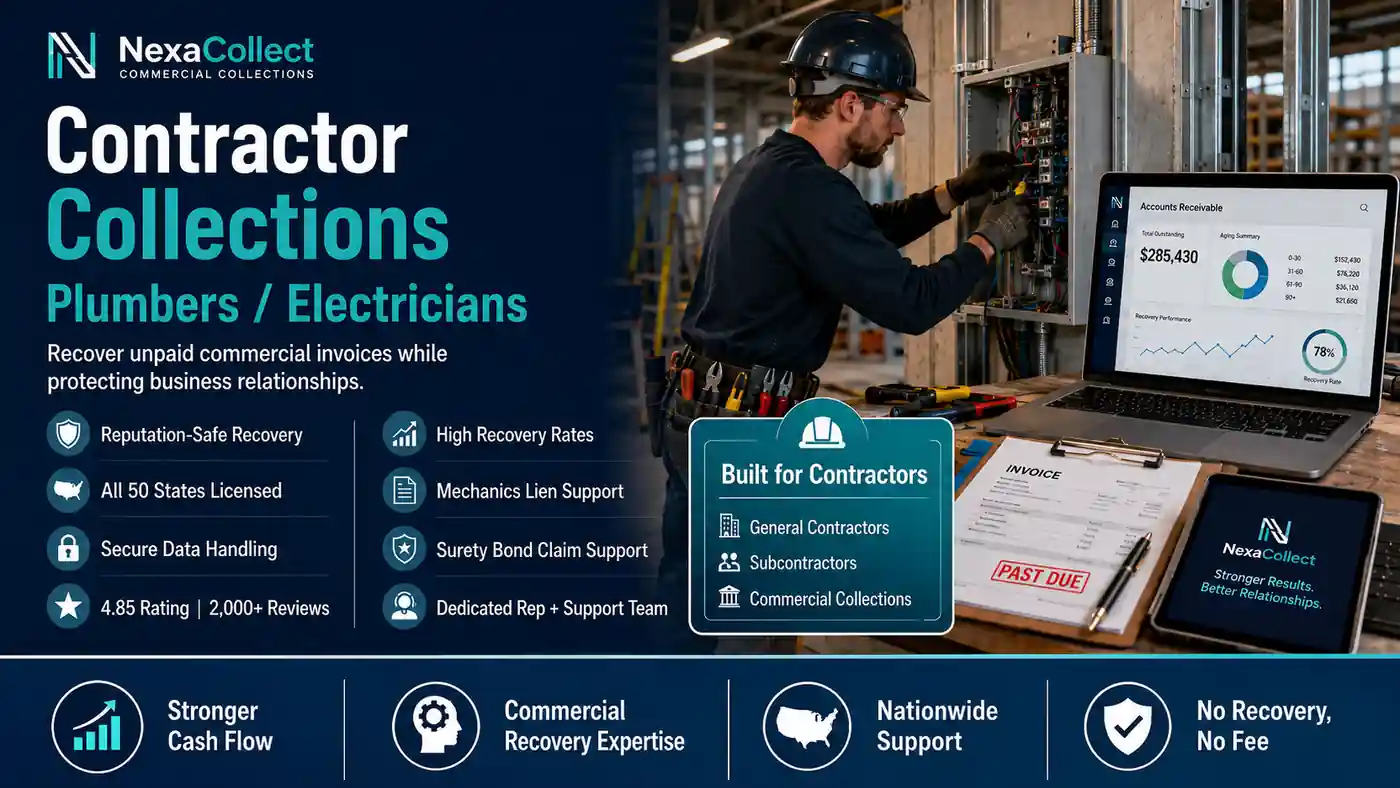
Collection Agency for Plumbers, Electricians and Contractors

You finished the job. The customer approved the work. Now the invoice is 30, 60, or 90 days overdue. For electricians, plumbers, HVAC contractors, roofers, painters, landscapers, carpenters, excavators, fabricators, and other contractors, every unpaid invoice ties up money you need for payroll, materials, equipment, and the next project.

Nexa helps contractors nationwide recover overdue residential and commercial accounts without turning every payment dispute into a legal battle. We combine professional follow-up, persistent negotiation, debtor research, and appropriate escalation—and when lien or bond rights may apply, timing matters. The goal is simple: recover the money you earned while protecting your time, cash flow, and valuable customer relationships.

Collection agency for electricians, plumbers, HVAC contractors, roofers, painters, landscapers, carpenters, excavators, fabricators, and other contractors.

In construction, a ‘gentleman’s agreement‘ on payment usually ends where the 90-day lien window expires—we ensure your right to get paid is legally secured before that door slams shut.


Nexa provides 100% reputation-safe, equipped with all 50-state collections license, offering free credit reporting, free litigious debtor check, free bankruptcy scrub, and zero onboarding fees. Secure – SOC 2 Type II & HIPAA compliant. Over 2,000 online reviews rate us 4.85 out of 5. 

Need a Collection Agency?Contact us

We are not a general debt collector. We are construction finance recovery specialists.


The Construction Cash Flow Epidemic: Your 94-Day DSO Solution

The greatest financial threat to the construction industry is not market volatility—it is payment delay. In 2024, the cost of slow payments reached a staggering $280 Billion in the U.S., driving cash flow instability across the supply chain.

If your firm’s average Days Sales Outstanding (DSO) exceeds 60 days, you are shouldering unnecessary risk. NexaCollect is a specialized commercial collection agency built to tackle the industry’s current average 94-Day DSO head-on.


The Problem (2024/2025 Data) The NexaCollect Solution
82% of Contractors face payment delays exceeding 30 days. We initiate legal and financial pressure at Day 31 to maximize recovery velocity.
Delays are masked by excuses like “Pay-When-Paid” clauses. We immediately deploy Mechanics Liens and Surety Bond Claims—legal tools that supersede contract excuses.
Traditional collection rates are poor (20-30% average). Our specialized B2B focus delivers proven recovery rates that can reach 70% on viable commercial debt.

Specialized Recovery for General Contractors & Subcontractors

Your debt collection process must be an extension of your legal department. We specialize in the two most powerful collection levers in the construction field:

A. Mechanics Lien Strategy & Enforcement

A lien is the ultimate form of payment leverage. We don’t just file paperwork; we manage the complex, state-specific legal timeline to ensure your claim is valid and enforceable.

  • Preliminary Notice Management: We guarantee the timely service of all statutory notices (Notice of Furnishing, Notice to Owner) to secure your lien rights from the first day of work.

  • Lien Triage: We evaluate your project documentation (AIA Contracts, Change Orders, Pay Applications) to build an irrefutable claim before the lien is filed, preventing costly legal counter-disputes.

  • Deadlines Secured: We ensure your claim is filed and served before the state’s stringent deadlines expire (often 90 days from the last day of work), protecting you from an automatic write-off.

B. Surety Payment Bond Claims

For public or bonded projects, the payment bond is your guarantee. We know how to navigate the complex Miller Act (federal) and Little Miller Act (state) requirements:

  • We manage the strict deadlines for serving the Notice of Non-Payment to the General Contractor and the Surety.

  • We file the formal bond claim against the financial institution guaranteeing payment, bypassing the GC’s cash flow entirely and accelerating the recovery process.

Financial Institutions: NPL Portfolio Management & Compliance

We partner with banks, asset-based lenders (ABLs), and construction factoring companies to manage Non-Performing Loan (NPL) portfolios and high-volume commercial receivables.


The AI-Driven Advantage

Banks demand a modern, compliant, and predictable recovery workflow. NexaCollect leverages AI and predictive analytics to transform your recovery outcomes:

Metric Why it Matters to Lenders NexaCollect’s Impact (Based on Industry Benchmarks)
Predictive Scoring Identify high-risk accounts early in the collection cycle. Accounts are prioritized based on likelihood of payment, not just age, leading to faster case resolution.
Compliance Automation Mitigate reputational and regulatory risk. Real-time monitoring against all FDCPA/state regulations, leading to a significant reduction in potential legal exposure.
Operational Efficiency Reduce the cost of collections (Cost to Collect). Technology-driven processes can lead to a 40% reduction in operational expenses compared to manual collection efforts.

Frequently Asked Questions (FAQ)

1. Can a contractor send an unpaid customer invoice to a collection agency?

Yes. Electricians, plumbers, HVAC contractors, roofers, landscapers, painters, carpenters, fabricators, and other contractors can refer legitimate unpaid invoices to a collection agency after their normal billing and follow-up efforts have failed. Providing the signed contract, invoice, work authorization, change orders, payment history, and customer communications can make the account easier to verify and pursue.

2. How long should a contractor wait before sending an overdue invoice to collections?

Contractors generally should not allow an unpaid invoice to sit indefinitely. Once an account has passed its agreed payment terms and reasonable internal follow-up has produced no result, early referral can preserve more recovery options. This can be especially important when mechanics-lien, preliminary-notice, or bond-claim deadlines may apply, because those deadlines vary by state and project type.

3. What documents should I provide to collect an unpaid contractor invoice?

Strong documentation can significantly strengthen a contractor collection claim. Useful records include the signed contract or estimate, invoices, purchase orders, work authorizations, change orders, completion records, delivery receipts, emails or text messages approving the work, payment history, and any notices already sent. For construction or subcontractor accounts, lien notices and project information may also be relevant.

4. Can Nexa help if a customer disputes the quality of the work or refuses to approve a change order?

Yes. Contractor debts frequently involve disputes over workmanship, scope, change orders, completion dates, or what the customer believes was included in the original price. Nexa reviews the account documentation and works to separate legitimate disputes from payment-delay tactics, then pursues resolution through professional negotiation and appropriate escalation rather than simply repeating payment demands.

5. Can a collection agency help contractors with mechanics liens or payment bond claims?

Potentially, yes. Mechanics liens and payment bond claims can provide important leverage on qualifying private, public, or bonded projects, but eligibility, notice requirements, and filing deadlines vary significantly by state. Nexa can identify accounts where lien or bond rights may be relevant and help coordinate the appropriate recovery path before critical deadlines are lost.

6. Will sending a customer or general contractor to collections hurt my business relationship?

It does not have to. A professional contractor collection agency acts as a third-party buffer between your company and the customer, allowing you to step away from repeated payment conversations. Nexa uses firm but professional communication designed to recover the balance without unnecessary confrontation—particularly important for contractors who depend on referrals, repeat customers, general contractors, property managers, and long-term commercial relationships.

Serving Contractors Nationwide

Need a Collection Agency for contractors? Contact Us

Contractor Collection Agency

So if you are a Small business owner,  Electrician, Plumber, Heating and Ductwork, Drywaller, Painter, Finish Carpenter, Tree Cutter, Mason, Roofer, Excavator, Landscaper, Cabinet maker, Fabricator, Architect and Interior design consultant; contact us to recover your unpaid bills.

RELATED ARTICLE: Will a Collection Agency Ruin My Business Relationship? 

Filed Under: business

7 Reasons Why Working Capital is Essential for Small Businesses

Small Business Collection Agency
Adequate working capital is critical for businesses of any size but, it is doubly so for small businesses and start-ups. Working capital represents a business’s ability to pay its short-term expenses. It’s a measure of cash flow and is computed by subtracting the company’s current liabilities from its current assets.

When a business has negative working capital — meaning that its current liabilities outstrip its current assets, there’s a chance that current expenses could overwhelm the business’s ability to settle them. For a small business that depends on healthy relationships with their vendors and debt partners, this can be a serious problem. Here are six reasons why it’s so important.

Working Capital Is Crucial for Day-To-Day Company Operations

Small businesses generally have both short-term and long-term financial obligations. The short-term obligations, those involved in maintaining proper inventory levels, paying vendors, employee salaries, and the myriad other expenses that factor into the day-to-day operations of the company must be kept current in order to maintain smooth business operations.

When a business falls behind on its current obligations they risk interruptions to their supply chain, employee churn, and a loss of critical vendor relationships. This makes it more difficult to satisfy customer demand adequately, which can lead to angry customers, stress and a loss of income, further decreasing working capital.

If this spiral is allowed to get out of hand, financial insolvency is likely, as day-to-day operations are no longer supportable. Having sufficient working capital is the best way to prevent this sort of negative result.

Small Businesses May Not Have Access to Financial Markets

When large businesses are faced with working capital shortfalls they can borrow money under attractive terms to help settle short term expenses or convert short-term debt into long-term debt.

Many small businesses don’t have the credit history, or the assets required to qualify for this sort of financing, at least not at interest rates that the business can afford. Because they lack this safety net, small businesses must keep a keen eye on their working capital to be certain their current expenses can be satisfied.

Proper, consistent management of working capital can have a secondary benefit, however. When a business is a good steward of current assets versus liabilities, paying all expenses, particularly its debt service payments, on time month after month it builds corporate credit, and can, in the long run, open up credit markets for help in the future.

Businesses Have Access to Better Purchase Options from Vendors

Businesses that have proper working capital and satisfy their liabilities on time will qualify for better terms from their vendors. This often translates to smaller purchase minimums, lower short-term financing rates, and better bulk pricing.

Better vendor terms allow for more effective inventory management practices, which further enhances working capital, setting up a positive feedback loop.

Businesses Are More Resilient Against Unexpected Shocks

If a business is already struggling with debt service or is having trouble satisfying other short-term obligations because of inadequate working capital levels, unexpected expenses or sudden reductions in income can have devastating results.

These shocks are much easier to weather when the business has the resources necessary to cover its normal expenses. It then only needs to worry about the new circumstances.

Competitive Advantages are Possible

Solid companies with proper working capital levels will operate more efficiently than less stable companies. They’ll have better-developed supply chains, preferred financing terms, and a more resilient production process.

This creates savings that can be passed on to the customer. Better prices at similar quality levels undercut the competition and represent a significant competitive advantage.

Working Capital Allows a Small Business to Grow

Having enough working capital to satisfy current obligations is critical, but just as important is what a company does with excess working capital. Maintaining levels in excess of what it takes to maintain day-to-day operations precludes a business from making the investments required to grow. To use working capital efficiently, overages should be invested back into the company.

Excess working capital allows a business to scale its operations, investing in new equipment, new lines of business, extra staff and other positive business investments. Growth is important for the long term health of the organization as it increases future opportunities and makes the company more valuable. It’s also a key factor in assuring financial stability in the face of long-term financial obligations.

Working Capital Is a Signal to Investors

While adequate levels signal that a business is able to satisfy its current expenses, it’s not a guarantee. However, many investors still use it as a signal for financial stability because it’s a generally strong indicator of financial health. If a business wants to appear healthy and be healthy, it should make certain to keep proper working capital levels.

Using a debt collection agency is crucial to recover those unpaid bills. Hire a Collection Agency for a better cash-flow.

Filed Under: business

How to Spot a Litigious Client (or a Litigious Patient)

litigious customer
It isn’t uncommon for patients or clients to sue. Unjust as their claims may be, a litigious client will throw out the word “sue” as much as they are willing to write an online review. According to Rocket Lawyer, the chances of a small business owner getting sued is pretty high with over 100 million cases being filed every year.  

Some business owners are under the assumption that a client who threatens them with legal action is just using it as a scare tactic or out of anger. After all, isn’t consulting a lawyer going to cost them more time and money than they can’t afford?

This is one of the more common misconceptions. A good deal of personal injury and other types of lawyers work on a contingency fee basis if they believe their client has a high chance of winning the case. This makes legal actions all the more attainable, even for those who are financially strapped. And statistically speaking, your more affluent clients are the ones you should be concerned with, anyway.

Because small business owners hold immense liability (no matter their practice), it is vital that you learn the signs of a potential litigious patient or client. It’s also practical to know the positive steps to take in order to stop someone from suing you and the overall appropriate method on how to handle a litigious patient. One wrong move can land you in a lawsuit that can cost you upwards of $100,000, according to the Court Statistics Project.

Here is some useful intel on how to spot a litigious client or risky patient.

Common Litigious Clients or Patients

The good news is, when it comes to clients who are likely to sue, you can usually see the writing on the wall. These people are typically troublesome from the beginning so that you know to start protecting yourself early on or you can dismantle the collaboration altogether.

Here are a few signs that point to litigious patients or clients:

They have Sued in the Past: Some people/patients are habitual troublemakers. If someone has sued a business owner or a doctor in the past, they have already gone through the legal process once and are fairly comfortable in pursuing the legal path again against your business. Once you suspect a potential trouble maker, it may be wise to check him in the National Litigation or Civil Litigation database. Even entities like the debt collection agencies often do this check before trying to recover debt from a client to protect their clients and them self.

They’re Affluent: Educated people and those with high paying jobs are more likely to sue than your Average Joe or Jane. The reason for this is because they have the resources to expand on these situations, or simply because they feel the need to have care without qualms because of their stature.

 They’re Nit-Picky: Whether you are a doctor, a lawyer, a dentist, or some type of contractor, a client who seems unwilling to compromise may end up causing you bigger problems later on. Chances are, these clients are unlikely to be fully satisfied, meaning they’ll ask for extra work outside the scope of your contract or they will try to get a refund of some sort. When this fails to work in their favor (owing to the legality of your contract), they might claim “lawyer” and try to get their money back by means of a court date.

 They’re Confrontational: Clients or patients that cause chaos in their wake are more likely to become litigious. According to Alston & Bird, some behavior of litigious people include:

  • Complains about every aspect of their visit (forms, payments, long wait times, etc)
  • Is demanding, rude, or hostile towards your staff members
  • Challenges or criticizes your initial diagnosis with their own layperson research

Their Age and Healthcare History: In a study, it was reported that women ages 41-60 are the 39% more likely to file for a lawsuit. Those with an ongoing health history are also more likely to pull the trigger on court proceedings if they feel their service was not up to par.

Unrealistic Expectations: If the client has unreasonable expectations given the nature of the service, timeline, or budget, it could indicate a higher likelihood of disputes down the line.

High Turnover of Service Providers: If a client has changed service providers frequently without good reason, it could be a sign that they’re difficult to work with or that they have a tendency to get into disputes.

Non-compliance with Agreements: Clients who repeatedly fail to adhere to agreements or contracts, or who try to change the terms after they’ve been agreed upon, may be more likely to involve in legal disputes.

How To Stop Someone From Suing You

Several measures may be taken in order to prevent someone from suing you. Anticipating litigious patients or clients from the start should play a role in putting together your Standard Operating Procedures. That way, you aren’t worried about the potential for this to happen daily because you’ll know that you’re already covered.

Here are a few preemptive methods you can take to stop someone from suing you:

Keep Records of Everything: This includes emails, phone calls, and in-person visits. You will want to install security cameras in your office space and sign up for a voice recording system to “ensure quality assurance.” These methods simultaneously work to prove your case should you be sued by a disgruntled client. It’s also important to follow up any phone calls with an email (a.k.a a paper trail) with the basis of your conversation that asks your client to confirm what was discussed. 

Have an Arbitration Agreement: An ADR or an alternate dispute resolution is an agreement that states issues can only be resolved by means of an arbitrator. This disables the litigious person to seek legal action because they have already agreed in the contract to have resolutions made outside of court. In other words, having this clause in your contract makes clients give up their right to sue. An arbitrator will hear both sides of the issues to come to a binding decision. 

Have insurance: Get a small business malpractice insurance or a medical malpractice insurance which covers your legal expenses and also covers the amount that you may be held liable in case the judgement is pronounced against your business and a compensation/penalty needs to be paid.

Sign Up for an LLC: If you’re not already, consider having your business established as an LLC. A Limited Liability Company ensures that only your business will be sued instead of you personally. Without it, your personal finances and assets are at stake in the event that you lose your case.

Have a Collection Agency handle your Accounts Receivable: Good collection agencies are insured against such events and they also run a “Litigious Debtor” scrub on accounts assigned to them. 

How To Handle A Litigious Patient

If you haven’t already set up the aforementioned precautions, there are still measures you can take to handle a litigious patient. Here are a few methods on how you can handle a patient or client who seems like they may be aiming to sue:

Do Background Checks: If you have spotted any of the signs of a litigious client (affluent, confrontational, etc), you will probably want to do a background check on them before you proceed with your arrangement. Have they sued before? Have they made multiple claims against an insurance provider? Who have they previously worked with? This should be another preemptive measure, but knowing their history of complaints could help you out in the long run, if only to prove their tendency to seek compensation. 

Try To Resolve Their Issue: Generally speaking, litigious clients will be complainers. To combat their desire to take you to court, try to ease their concerns outright. You can assure them of your services with statements from other clients, encourage them to get a second opinion, or slowly walk them through your strategies to explain your methods. The key is to keep them at ease and have them trust you so they know you have their best interests at heart.

If these clients seem beyond retribution, it might be best to cut off the arrangement before things get ugly. 

Hire a Lawyer: And if worst comes to worst, hire a lawyer. Gather all documents and communications with this specific client to help your lawyer design your defense. As a business owner, it’s your job to take precautions, but it will be your lawyer’s job to find loopholes in your arrangement. If a litigious patient or client has served you, stop all communication with them until you have a lawyer on your team.

Filed Under: business

Customer Relationship Management for Small Business

crm small business
As a small business owner, you are probably aware that your customer satisfaction is a top priority when it comes to being successful. When you are first starting out as a business, this relationship might be easy to dictate because the customer pool starts off small. But as your business grows, it will become harder to facilitate your customer needs, goals, and overall interaction which means a steady decline in your customers view of your business.

Whether you own an online B2B operation or have a brick and mortar boutique shop, the communication between a customer and an employee is relevant to your success. A positive interaction increases the likelihood of them becoming a repeat customer, while a negative one will have them walking out the door and leaving a roaring online review.

The best way to ensure customer satisfaction is to implement a Customer Relationship Management system or CRM. CRM’s have become steadily popular amongst entrepreneurs, but it’s important to know your options. CRM software can be free or they can cost thousands of dollars. Some systems are better for B2C and others are excessively more difficult to navigate.

To give you get the full scope, here is everything small businesses need to know about Customer Relationship Management.

What Is Customer Relationship Management?

Customer Relationship Management (CRM) is a tool that helps manage all interactions your customer has with your business. There can (and should be) multiple CRM systems in place to organize all of these interactions, from online marketing to face-to-face encounters. The goal of CRMs is to help determine where customer service is thriving so that you can expand on those practices to enhance all customer experiences. Likewise, it also works as a tool that points out the flaws in your business-client communication so that you can learn to adjust when need be.

CRM’s can be used through various aspects of your business. Your sales team and your day-to-day employees will also need to be acquainted with this system. Your CRM will reveal your customer’s habits, including purchasing history, customer requests, and more. Knowing these statistics can increase sales by up to 29%, according to SalesForce. Which means that if you are proactive about familiarizing your company with these management gears, then you are already ten steps ahead of the competition for your small business.

CRM Strategies For Small Businesses

Now that you are aware of the undeniable benefits of a CRM, it is time to put this practice to work. Before you actually set up the software for your Customer Relationship Management, you need to formulate a strategy.

It is important to do this just like it was vital to write down your business plan before inquiring for a small business loan. It directly identifies your own goals and previous customer interactions so that you are intricately aware of the progress of your customer’s journey as well as the missteps. Here are just a few small strategies that you should consider before you start the process of managing and increasing your customer interaction.

Reevaluate Your Business Plan and Goals

You set up your small business because you believe that you have a product or service that satisfies a need. You are so confident in your process, in fact, that you believe your company provides something that your competition doesn’t. While this eager approach is admirable, it may leave your blindsided by your customer’s actual experience.

Reevaluate your business plan and goals to make sure these ideals are still being practiced in your current day-to-day. Identify your company slogan and values and make sure that you are still holding fast to your promises. Can you still claim to be the “Best BBQ in the North?” or can you still provide “The Fastest AC Installation”? If not, try reworking your plans and goals to fit realistic expectations so that your customers don’t walk away feeling robbed.

Identify Your Customer

One of the most practiced strategies for any small business is outlining the “ideal” customer. This is a customer identification chart that clarifies the specifics of what your typical customer might be like. Creating a customer persona will help in identifying their wants and needs so that you can better prep your CRM. This strategy is thorough, as you will need to designate your customer’s online behavior, their general lifestyle, their financial situation, education, location and more.

Set Up Interviews

Another way to retain a better grasp of your customer behavior is by setting up interviews. No one will know your client like your employees, so start by managing interviews with your employees to ask about their customer interactions. What do most customers look for? What questions do they ask? What are some positive and negative experiences you’ve encountered? How did the employee solve problems? And so on.

You can also implement interviews or surveys specifically for customers. Many companies, such as Dunkin Donuts, offer free products (in this case, a doughnut) in exchange for taking these surveys. This is when your customer can tell the business what they thought of their experience. It should also allow them to leave recommendations for improvement or highlight their positive interaction with your business.

Map the Customer Journey

This advice comes from Fit Small Business. Their suggested strategy to map the customer journey helps dictate who interacts with your company and where. This includes social media mentions, online reviews, paid ads, and more.

You can use a CRM to map out the customer’s journey to see what enticed them to come to your business in the first place. It will also show where they stop their journey instead of buying. If they went to your website through a paid ad but left at the landing page, you can surmise that the landing page didn’t sell them. Then you can rework the page to be more inviting until your CRM reflects that the page is working to drive higher sales.

CRM Software For Small Businesses

CRM software was initially marketed towards large corporations, but now there are CRM’s that are targeted specifically for small businesses. There is a lot of software to choose from, which can make it hard to determine which one will best suit your business needs.

In short, here are five CRM software that we recommend for small businesses:

Zoho CRM: Free-$35 per month
Nimble: $19-$25 per month
Salesforce: $25-$1,250 for small businesses
Sugar CRM: $45-$100 per month
Less Annoying CRM: $10 per user per month

Filed Under: business

How to Prevent your Business from Losing Customers

lose customer
It is always essential to acquire new customers, but repeat business is what keeps the lights on. Losing customers can quickly erode your business income. Actually, for most businesses, keeping existing customers is almost more important than seeking new ones.

Repeat customers tend to spend more money over time and promote your business among their friend circle. 

Better Customer Service

The way you interact with your customers will determine if they will stay with you or not. Customer loyalty is very important; you want to build a bond of trust and understanding. You should connect to your patrons on a personal level. Try to find some common ground and build on it. A business that interacts with customers in a cold and robotic manner is driving away from a reliable income source. Simply smiling and asking a customer about their day is a good start. 

One bad encounter can damage a relationship, so always handling customer inquiries quickly and professionally is important. Always treat the customer with respect, even if they are not being too nice to you. Try to see the issue from the customer’s point of view and empathize.

The most critical aspect of customer service is to listen. You should not tell a customer that you will “keep that in mind.” Instead, discuss with them how they would prefer the issue to be addressed and try to work it out. No one wants to feel like they are being given less importance or ignored. 

If a customer has an issue with your product or service, resolve it as quickly as possible. The faster and more effectively you can solve a problem, the more likely the customer will remain loyal.

Regularly seek feedback from your customers about your products or services. This will make them feel valued and help you understand their needs and preferences better.

Quality of Product/Service

The quality of the product or service determines your business success. If you fail to show value, they are unlikely to return. Of course, every company has a budget and it is impossible to add bells and whistles to what you offer.

Look at how you advertise your product or service and ask, “Could it be better or is there something important that I’m not telling customers?” Improper marketing can lead to a lot of confusion. For example, sometimes, they fill bags of potato chips halfway with air to keep them from being crushed. However, most customers feel ripped off as they expected more chips inside. If you blatantly trick a customer, they will never come back.

Attitude/Culture

Establishing a healthy workplace culture will have a positive impact on your sales. It is important that you treat you employees with as much respect as you would a customer. When employees are happier and more energized, customers tend to notice it. Likewise, happy workers will pass along good vibes to the customers. Having happy employees will also result in a lower turnover rate.

Your employees should share the same value as you do, rather than simply being employed to make money. Being honest to a customer can build a lot of trust.

Competition

You can lose customers to competition if they offer superior service, especially if you have not established trust and brand loyalty. If your competition has a superior product or service, you must revise your offer. In the end, what you offer will be vastly improved because you were forced to adapt. Competition can keep your business fresh and alive.

Ensure your pricing is competitive while still allowing your business to be profitable. If your prices are significantly higher than your competitors, customers may choose to switch. Implement a loyalty program that rewards customers for repeat business. This could involve discounts, exclusive offers, or points that can be redeemed for products or services.

You should constantly re-evaluate how your business interacts with customers. Taking criticism positively and customer feedback will help your business grow stronger. More importantly, it will show the customers that you listen. 


Filed Under: business

  • « Go to Previous Page
  • Page 1
  • Interim pages omitted …
  • Page 11
  • Page 12
  • Page 13
  • Page 14
  • Go to Next Page »

Primary Sidebar


accounts receivable

Need a Collection Agency?
Kindly fill this form.
We’ll get in touch with you

    Please prove you are human by selecting the heart.

    Compliance & Security

    • SOC 2 Type II Certified: Third-party audited data security and strict privacy controls.

    • HIPAA Compliant: Secure, legal processing of medical and municipal EMS accounts.

    • PCI-DSS Level 1: Highest tier of data encryption for secure payment processing.

    • FDCPA & FCRA Aligned: Full legal adherence to federal consumer protection laws.

    Recent Posts

    • Nationwide Debt Collection Agency Serving U.S. Cities
    • Chula Vista Collection Agency for Medical, B2B, Schools & Business Debt
    • Corpus Christi Collection Agency: Itemized Bill Rules for Practices
    • Riverside Collection Agency | For Logistics, Medical, Schools & Business Recovery
    • Collection Agency for Large Balances: High-Value B2B Debt Recovery
    • Baltimore Collection Agency | Medical, Commercial, Schools & More
    • Commercial and B2B Collection Agency in Detroit
    • Boston Medical Collection Agency | Serving Hospitals, Physicians & Dentists

    Featured Posts

    • Get a Free Quote from Collection Agency
    • Importance of selecting an Ethical Debt Collection Agency
    • Managing Stress when Running a Small Business

    Copyright © 2026 NEXACOLLECT.COM | This content is provided for general informational purposes only and should not be considered legal advice. Collection laws and requirements may vary by state, account type, documentation, debtor status, and specific facts. Please consult qualified legal counsel for guidance regarding your particular situation. Nexa and its authorized collection partners service accounts in accordance with applicable federal and state collection requirements. Visit our home page to know more about us.

    X
    Need a Collection Agency?
    Contact Us