• Skip to main content
  • Skip to primary sidebar

Nexa Collections

  • Home
  • Serving
    • Medical
    • Dental
    • Small Business
    • Large Business
    • Commercial Collections
    • Government
    • Utilities
    • Fitness Clubs
    • Schools
    • Senior Care Facility
  • Contact Us
    • About us
    • Cost

Search Results for: the bureaus

Strategies to Collect Unpaid Rent from Tenant?

Collecting unpaid rent from tenants can be a challenging task for many reasons, often requiring a delicate balance between legal obligations, ethical considerations, and financial imperatives. Several factors contribute to the difficulty:

  1. Legal Restrictions: Landlords must adhere to strict laws that protect tenants. Eviction processes can be lengthy and complicated, requiring ample proof, notifications, and adherence to specific procedures before taking steps to remove a tenant or collect unpaid dues.
  2. Financial Instability of Tenants: Tenants may fall behind on rent due to unforeseen financial hardships like job loss, medical emergencies, or economic downturns. In these cases, even well-intentioned tenants might find it difficult to pay their dues, and pushing too hard for collections can be ethically challenging.
  3. Poor Tenant Screening: Inadequate screening processes can lead landlords to accept tenants who might have a history of delinquent payments, leading to predictable issues down the line.
  4. Communication Barriers: Sometimes, lack of effective communication between tenants and landlords can result in misunderstandings regarding due dates, amounts owed, or other lease terms, contributing to unintentional delinquencies.
  5. Costly and Time-Consuming Legal Processes: Pursuing eviction or collection actions in court not only takes time but also money. Landlords often have to weigh the cost of legal action against the unpaid rent to determine if it’s worth the effort.
  6. Lack of Proper Documentation: Without a comprehensive lease agreement or detailed records of payments and communication, landlords may find it difficult to prove their case in court or during arbitration.
  7. Emotional and Personal Complications: Personal attachments or relationships can complicate these situations. If a tenant is going through a known rough patch, or if there’s a familial relationship, landlords may find it emotionally taxing to enforce strict policies.
  8. Economic Conditions: In times of economic uncertainty, such as recessions or widespread unemployment, tenants may be protected by temporary government-imposed restrictions on evictions, further complicating collection efforts.

How do you collect unpaid rent?

Recovering unpaid rent requires a multi-faceted approach that combines legal compliance, effective communication, and strategic negotiation. Below are steps and strategies landlords can consider:

1. Clear Communication and Understanding:

  • Reach out to the tenant through a formal means of communication, such as an email or a written letter, to understand their situation better.
  • Politely remind them of their obligations under the lease agreement and ask for an explanation for non-payment.
  • Document all communications for future reference.

2. Arrange a Payment Plan:

  • If the tenant is facing temporary financial difficulties, consider working out a payment plan that allows them to pay back rent over time.
  • Ensure any agreement is in writing and clearly stipulates the revised payment terms.

3. Send a Formal Demand Letter:

  • If initial communications fail, send a ‘demand for rent’ letter that formally requests the payment of delinquent rent by a specific date.
  • This letter serves as an official notice that further action may be taken if the rent is not paid.

4. Mediation or Arbitration:

  • Consider using a third-party mediator or arbitrator to find a mutually agreeable solution. This step can help avoid the cost and hassle of court proceedings.

5. Legal Action – Eviction Notice:

  • If other avenues fail, landlords may resort to eviction proceedings. Begin with an official eviction notice, adhering to local laws about the process.
  • This notice is typically the first step in the legal process to reclaim property.

6. Small Claims Court:

  • For unpaid rent, landlords can file a suit in small claims court (if the amount aligns with the financial limits of the court).
  • Prepare for this step by gathering all necessary documentation, including the lease agreement, records of payment, communication attempts, and notices sent to the tenant.

7. Hiring a Collection Agency:

  • If the tenant has left the property and you’re unable to collect unpaid rent, consider hiring a collection agency.
  • These agencies specialize in debt recovery, though they charge a percentage of the collected amount.

8. Reporting to Credit Bureaus:

  • Report the debt to credit bureaus, which could incentivize the tenant to pay as it affects their credit score.
  • This action should be a last resort and communicated to the tenant beforehand, giving them the opportunity to avoid credit repercussions.

Throughout this process, it’s important to always comply with local and federal laws regarding tenancy and eviction proceedings. Mistakes can not only delay recovery but might also lead to legal actions against the landlord. To navigate these legal waters, consider consulting with a lawyer specializing in tenancy laws in your jurisdiction. This professional guidance can be invaluable in successfully recovering unpaid rent while adhering to legal obligations.
 

Filed Under: Debt Recovery

Debt Recovery Strategies for Utility Companies

Biggest Recovery Challenges of Utility Companies

Utility companies face a myriad of challenges when trying to recover unpaid bills. Addressing these challenges requires strategic planning, understanding of customer behavior, and regulatory adherence. Here are some of the most prominent challenges:

  1. Economic and Financial Challenges:
    • Recessionary Periods: During economic downturns, many customers might face financial hardships, leading to a surge in unpaid bills.
    • Rising Costs: As operational and resource costs increase, utilities might need to increase their tariffs, leading to customer resistance and potential non-payment.
  2. Regulatory and Compliance Issues:
    • Legal Restrictions: There might be legal limits on actions utility companies can take, such as disconnection limitations.
    • Consumer Protection Laws: These can limit aggressive recovery tactics, ensuring that consumers are not unduly harassed or treated unfairly.
  3. Operational Constraints:
    • Inadequate Systems: Outdated billing and customer management systems might not be efficient in tracking unpaid bills or setting up timely alerts.
    • Limited Staffing: Recovery departments might be understaffed, affecting their efficiency.
  4. Customer Behavior and Perceptions:
    • Unintentional Oversights: Sometimes, customers might simply forget or overlook a bill.
    • Willful Defaults: Some customers intentionally avoid paying, either due to disagreements or hoping to exploit system inefficiencies.
    • Perceived Injustice: If customers feel that they’re being charged unfairly or erroneously, they might resist payment.
  5. Communication Barriers:
    • Ineffective Communication: Bills, reminders, or warnings that are not clearly communicated can result in non-payment.
    • Language and Cultural Differences: Especially in diverse regions, language or cultural barriers might hinder effective communication.
  6. Infrastructure Challenges:
    • Outdated Infrastructure: Aging infrastructure might lead to inaccuracies in meter readings or bill calculations.
    • Remote Areas: Inaccessible or remote locations might hinder meter reading or bill delivery, leading to delays or disputes.
  7. Fraud and Tampering:
    • Customers might tamper with meters or employ other fraudulent methods to reduce or eliminate their bills, leading to revenue losses.
  8. Alternative Energy Sources:
    • With the rise of decentralized and renewable energy sources like solar panels, some customers might rely less on the grid, complicating billing and recovery processes.
  9. Data Privacy and Security Concerns:
    • Utility companies need to ensure that customer data is protected, especially when engaging third-party collection agencies, to avoid potential breaches and legal consequences.
  10. Negative Publicity and Reputation Damage:
    • Aggressive recovery measures or perceived unfairness can lead to negative publicity, affecting a company’s reputation and customer trust.

Need a Collection Agency? Contact Us

Addressing these challenges requires a multi-faceted approach, including updating infrastructure, refining communication strategies, enhancing customer service, and ensuring compliance with all regulatory requirements.

Best Debt Recovery Strategies for Utility Companies

Ensuring effective debt recovery is crucial for utility companies to maintain a healthy cash flow and ensure continued provision of essential services. Achieving this requires striking a balance between firmness and understanding, and ensuring consistent compliance with regulatory requirements. Below are strategies that utility companies can implement to improve compliance and optimize recovery rates during the debt recovery process:

  1. Enhanced Data Management and Analytics:
    • Utilize sophisticated data management systems to maintain accurate records of customers’ payment histories.
    • Implement predictive analytics to identify potential defaulters in advance and customize recovery approaches accordingly.
  2. Transparent Communication:
    • Clearly communicate payment terms, due dates, and consequences of non-payment to customers from the outset.
    • Establish regular reminders through various communication channels, such as SMS, email, and phone calls, as due dates approach.
  3. Flexible Payment Options:
    • Offer various payment methods such as direct debits, online transfers, mobile payments, and payment plans to accommodate customers’ preferences and financial situations.
    • Consider implementing installment plans or deferred payment options for customers facing genuine financial difficulties.
  4. Empathy and Customer-Centricity:
    • Train recovery agents to approach customers with empathy, understanding that some may be facing genuine financial hardships.
    • Encourage agents to listen to customers’ concerns, offering solutions that can help them meet their obligations without further distress.
  5. Regular Training and Skill Enhancement:
    • Continually train recovery staff on best practices, regulatory compliance, and soft skills.
    • Ensure that staff understands the legal and regulatory frameworks governing debt recovery in the utility sector.
  6. Strengthening Feedback Mechanisms:
    • Create avenues for customers to provide feedback on the recovery process.
    • Use feedback to refine and improve recovery strategies and to ensure fair treatment of all customers.
  7. Collaboration with External Entities:
    • Partner with credit bureaus to get a comprehensive understanding of a customer’s creditworthiness.
    • Engage reputable third-party collection agencies when internal recovery efforts are unsuccessful. Ensure these agencies uphold the company’s values and adhere to regulatory standards.
  8. Regular Compliance Audits:
    • Periodically review and audit the recovery processes to ensure they are in line with industry regulations and best practices.
    • Address any identified gaps or shortcomings promptly to maintain the integrity of the recovery process.
  9. Utilizing Advanced Technologies:
    • Employ technologies like artificial intelligence and machine learning to refine customer segmentation, optimizing recovery strategies for different customer segments.
    • Use automation for repetitive tasks, allowing human agents to focus on complex cases and fostering customer relationships.
  10. Transparent Reporting:
    • Maintain a transparent reporting system where stakeholders can track recovery rates, compliance breaches, and other relevant metrics.
    • Use these insights to make informed decisions and strategy adjustments.

By implementing these strategies, utility companies can ensure that their debt recovery processes are efficient, compliant, and respectful of their customers’ circumstances.

Filed Under: Debt Recovery

When “Please Pay” Becomes “See You in Court”: The Litigation Option

You have sent the invoices. You have made the polite phone calls. You have listened to the excuses about “checks in the mail” and “temporary cash flow issues.” Now, you are met with silence.

In the world of debt recovery, there comes a point where diplomacy fails and legal enforcement begins.

However, most business owners hesitate to pull the trigger on a lawsuit. They picture expensive hourly lawyers ($350/hour), massive retainers, and months of distraction. So, they write off $15,000 or $30,000 as “bad debt.”

This is a mistake. Modern debt litigation is efficient, data-driven, and—with NexaCollect—designed to minimize your financial risk.

We bridge the gap between standard collections and the courtroom. We provide access to a nationwide network of debt litigation attorneys who work on a Contingency Basis, meaning you don’t pay legal fees unless they collect.

The Strategic Advantage: Why “Agency First” Matters

Some businesses want to skip straight to a lawsuit. We advise against that. Utilizing our standard collection phase first is a crucial tactical move:

  • Kill the “Counter-Suit”: If you sue a customer out of the blue, they often panic and file a counter-lawsuit claiming they “never received the bill” or were “blindsided.” By letting us work the file first, we create a documented, compliant paper trail of communication. This destroys their defense in court.

  • The Credit Bureau Lever: Before a suit is even filed, we report the debt to major credit bureaus (Equifax, Experian, TransUnion). Often, the mere drop in their credit score—impacting their ability to buy a car or refinance a home—forces payment without a single court filing.

  • Filter Before You File (The “Asset Scrub”): The only thing worse than not getting paid is paying a lawyer to sue someone who is bankrupt. Before we recommend legal action, we conduct a deep investigation into the debtor’s assets (bank accounts, real property, W-2 employment). We only sue if the data shows they can pay.

No Retainers, No Hourly Billing

Traditional law firms require $3,000–$5,000 upfront just to open a file. That model is broken.

  • Our Model: Our network attorneys work on a 50% contingency fee. If the lawsuit yields zero dollars, you owe zero legal fees.

  • The Filing Fee Reality: You are responsible for the hard court filing costs (typically $250 to $600, depending on the state/county).

  • The Reimbursement: Here is the good news—these filing fees are added to the final Judgment amount. When the debtor starts paying, you get reimbursed for these costs first.

Recent Legal Victories: Enforcing Creditor Rights

We are actively securing judgments and settlements for clients who thought their money was gone.

The “Wholesale Inventory” Breach (Illinois)

  • The Scenario: An electronics distributor shipped $42,000 worth of components to a retailer. The retailer sold the goods but refused to pay the invoice, citing “cash flow tightness” before cutting off contact.

  • The Action: Our asset scrub revealed the retailer was still operating and had active merchant processing accounts. We filed suit.

  • The Result: Facing a bank levy that would freeze their operations, the retailer settled 3 days after being served. They paid $38,000 immediately to dismiss the case.

The “Architectural Service” Ghost (California)

  • The Scenario: An architecture firm completed final blueprints for a commercial renovation ($18,500 balance). The developer stalled payment for 8 months.

  • The Action: We reported the debt to credit bureaus first (Step 3), then moved to litigation (Step 4) when the developer ignored the hit. We obtained a Default Judgment.

  • The Result: The judgment lien prevented the developer from closing financing on a new project. They were forced to wire the full balance plus interest and court costs to clear the title.

Q&A: The Reality of Debt Lawsuits

Q: If I sue, do I have to go to court?

A: Rarely. Statistics show that 90-95% of debt collection lawsuits are resolved before trial. Most end in either a settlement (because the debtor doesn’t want to pay their own lawyer) or a Default Judgment (because they don’t show up). You would only need to appear if the debtor files a contest and it goes all the way to a trial.

Q: How long does a lawsuit take?

A: It varies by state court backlog, but generally:

  • 30-60 Days: To serve the debtor and wait for their answer window.

  • 3-6 Months: To obtain a Default Judgment.

  • 6-12 Months: If the debtor fights the case. Note: While slower than a phone call, a judgment is valid for 10-20 years and accrues statutory interest (often 5-10% per year).

Q: What is a “Default Judgment”?

A: This is the most common outcome (occurring in roughly 70% of cases). If the debtor fails to file a legal response to the lawsuit within the time limit (usually 20-30 days), the judge automatically rules in your favor. You win everything you asked for, without a trial.

Q: Can you sue a debtor in another state?

A: Yes. This is why you need us. If you are in Texas but your debtor is in New York, you generally need a lawyer licensed in New York. Our network covers all 50 states, ensuring jurisdiction is never an issue. This allows you to stretch your internal team further without hiring extra staff or searching for out-of-state counsel.

Stop Letting Debtors Bluff You

If they have the money but refuse to pay, they are betting on your inaction. Call their bluff. Using our legal network allows you to protect your name on Google while still getting paid, as the attorneys handle the hard conversations professionally.

Click here to Contact Us and review your legal options.

Filed Under: Debt Recovery

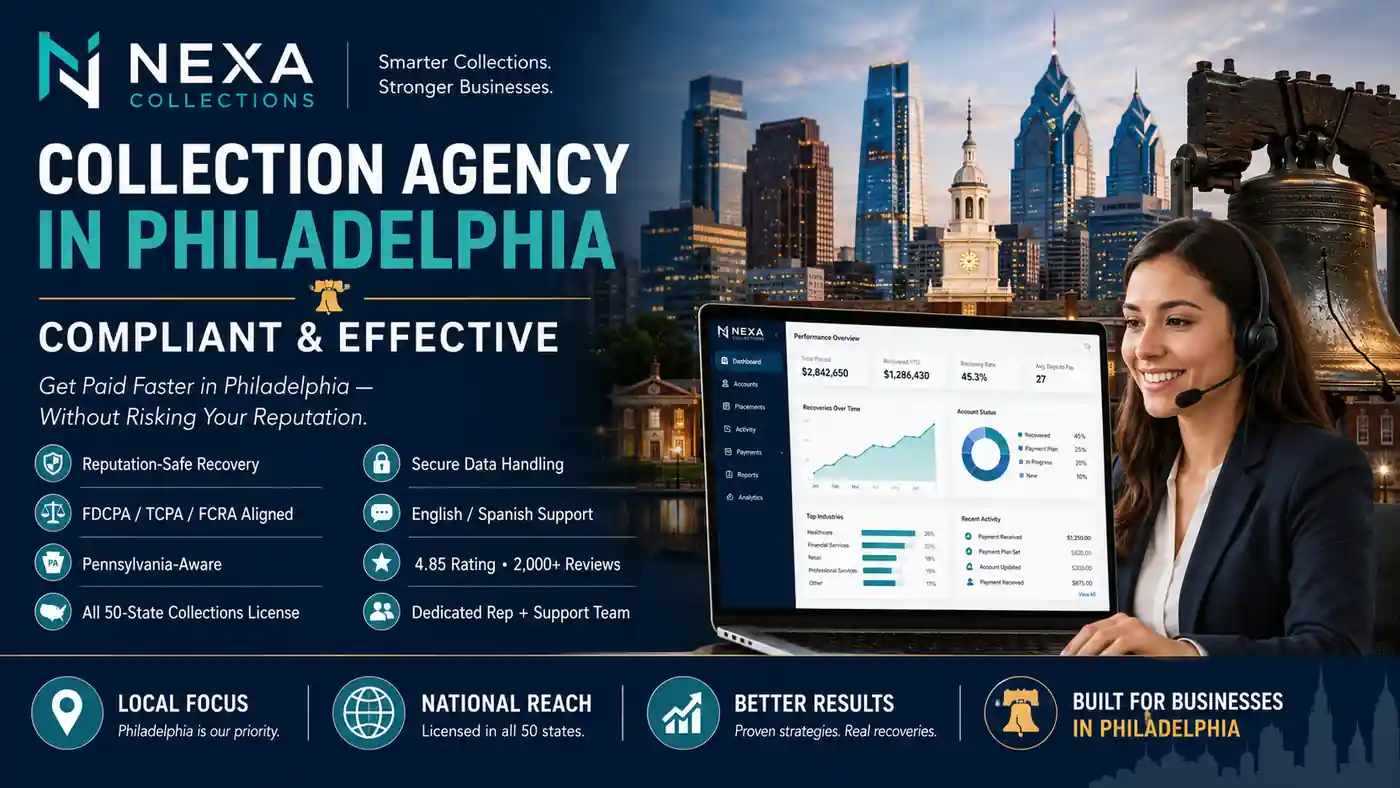
Philadelphia Collection Agency for Businesses, Healthcare & Schools

✅ A Philadelphia collection agency should recover overdue accounts without putting your reputation at risk.

Nexa helps Philadelphia businesses, medical practices, property managers and contractors collect past-due balances through Pennsylvania-aware, reputation-safe recovery, with secure data handling, bilingual support and nationwide coverage. Choose low-cost fixed-fee collection letters for fresher accounts or contingency collections for harder debts—with no aggressive tactics and clear reporting throughout the process.

Philadelphia collection agency offering reputation-safe debt recovery, secure data handling, Pennsylvania-aware compliance, bilingual support, nationwide licensing, and dedicated account assistance.

Nexa provides a reputation-safe approach, equipped with all 50-state collections license, offering free credit reporting, free litigious debtor check, free bankruptcy scrub, and zero onboarding fees. Secure – SOC 2 Type II & HIPAA compliant. Over 2,000 online reviews rate us 4.85 out of 5. Easy to use and a responsive client support team.

Need a Philadelphia Collection Agency? Contact us


Why Philadelphia Organizations Choose Us

  • Cost control: Low fixed-fee options for fresher balances; contingency for older/harder accounts.

  • Reputation first: No harassment, empathetic scripts, and solution-oriented calls.

  • Compliance built-in: FDCPA/TCPA/FCRA aligned, Pennsylvania-aware processes, data-privacy safeguards.

  • Transparent tech: Client portal, real-time notes, call QA, digital pay links.

  • Local fit: Bilingual (English/Spanish). Familiar with Center City, University City, Old City, Manayunk, Fishtown, City Ave, Roosevelt Blvd, I-95/I-76 corridors.


Industries We Serve (Philadelphia & Statewide)

Medical & Dental • Senior Living • Education (K-12 & Higher Ed) • Property Management/HOA • Utilities • Trades/Contractors (HVAC, Plumbing, Electric) • Fitness & Memberships • Auto Services • Professional Services • Retail/E-commerce • Technology & SaaS • Government/Municipal.


Recent Results in Philadelphia

  • Group dental practice (Market St/Center City): 0–120 day self-pay — 31% recovered in 60 days via low-friction reminders.

  • Specialty clinic (University City): aged balances clean-up — $12K recovered in 90 days; complaint-free.

  • Multifamily property manager (Manayunk/Roxborough): move-out finals — average $405/account on 120+ day debt.

  • Commercial contractor (Northeast/Byberry Rd): small-ticket B2B — first-pass resolution 38% using digital pay links.

Your outcomes will vary; these examples show what we’re currently delivering around Philadelphia.


How We Work (Simple 4-Step Path)

  1. Send accounts (CSV/portal) with basic documentation.

  2. Verify & segment (skip-trace, address/email fixes, right-party scoring).

  3. Reach out respectfully (letters, SMS where permitted, courteous calls, online payment).

  4. Report & refine (weekly progress, dispute handling, settlements, and next-step guidance).


Service Types & Pricing (Choose Any Step)

Step 1 — First-Party Courtesy Reminders (Fixed-Fee)
Five soft-touch reminders as your team’s extension; ideal for 0–60 days past due.
Typical: $15 per account.

Step 2 — Third-Party Written Demands (Fixed-Fee)
Five professional letters that nudge payment while preserving relationships.
Typical: $15 per account.

Step 3 — Full Third-Party Collections (Contingency)
Polite, persistent phone + digital outreach; payment plans and settlements when appropriate.
Typical: 40% of amounts recovered.

Step 4 — Legal Collections (Contingency, client-approved)
Attorney escalation only when warranted; nominal court filing costs initiated and reimbursed upon recovery.
Typical: 50% of amounts recovered.

collection agency fee

For Steps 1–2, payments go directly to you and there are no additional fees. Start at any step (1–3) based on balance age/amount.


Reputation Protection (Non-Negotiable Standards)

  • No aggressive tactics. Courteous, solution-oriented calls; QA and call recording.

  • Dispute-smart. Fast validation, clear explanations, quick correction of errors.

  • Brand-safe scripts. We sound like you—polite, consistent, culturally aware.

  • Privacy-first. Role-based access, encryption, secure portals.


Pennsylvania Rules (In Short — Practical Takeaways, Not Legal Advice)

  • Statute of limitations: Generally 4 years on most written contracts/credit cards. Early, cooperative outreach is best practice.

  • Wage garnishment: Highly limited for consumer debts in Pennsylvania (typically unavailable for ordinary consumer obligations). Expect voluntary payment plans and alternative remedies to matter more.

  • Judgments & interest: Post-judgment recovery can involve liens/levies subject to exemptions; simple statutory interest may apply if not otherwise specified.

  • Medical debt & credit reporting: Major bureaus no longer show paid medical collections and typically exclude medical balances under $500; national policy is trending away from using medical bills on credit reports. We emphasize resolution, not credit damage.


Philadelphia Collections Agency FAQs

1. What types of Philadelphia businesses and organizations can Nexa help with collections?

Nexa helps medical and dental practices, hospitals, schools and universities, senior living providers, contractors, property managers, HOAs, professional firms, utilities, technology companies, and other businesses recover overdue accounts. Whether you operate in Center City, University City, Manayunk, Fishtown, Northeast Philadelphia, or elsewhere in the Philadelphia region, the collection strategy can be tailored to your industry and the type and age of the debt.

2. When should a Philadelphia business send an unpaid invoice or account to collections?

Earlier action is usually better than allowing receivables to age indefinitely. Nexa offers lower-cost fixed-fee collection options for newer accounts, while older or more difficult balances can move to full contingency collections. Philadelphia organizations can therefore start professional recovery before an unpaid account becomes a long-term write-off.

3. Can Nexa collect unpaid medical and dental bills for Philadelphia healthcare providers without damaging patient relationships?

Yes. Nexa works with medical practices, dental offices, specialty clinics, senior living providers, and other healthcare organizations using professional, reputation-conscious communication. For providers in healthcare-heavy areas such as University City and Center City, the goal is to resolve legitimate patient balances through courteous follow-up and payment solutions rather than unnecessary confrontation.

4. Can Nexa recover unpaid commercial invoices for Philadelphia contractors and B2B companies?

Yes. Nexa handles commercial and B2B receivables for contractors, HVAC companies, plumbers, electricians, professional firms, technology companies, suppliers, and other Philadelphia businesses. Strong documentation—such as signed contracts, invoices, purchase orders, change orders, delivery records, and prior correspondence—can help establish the debt and support a more effective recovery strategy. Nexa’s Philadelphia page specifically includes trades, contractors, professional services, technology, and other commercial industries.

5. Why does Pennsylvania collection experience matter for a Philadelphia collection agency?

Philadelphia creditors operate under Pennsylvania and federal collection requirements, and Pennsylvania’s rules can materially affect the recovery strategy used for consumer accounts. For example, Pennsylvania’s Fair Credit Extension Uniformity Act establishes state standards governing debt-collection conduct. A collection partner familiar with Pennsylvania requirements can pursue payment while avoiding tactics that create unnecessary compliance or reputational risk.


Get a Free Quote & Free Consultation: Contact us


About Philadelphia

  • Hub: Healthcare & life sciences, education, telecom/media, finance, logistics.

  • Notables: Comcast, Aramark, FMC, Independence Blue Cross, Urban Outfitters, Cencora (region).

  • Big employers: Penn Medicine, Jefferson Health, CHOP, City of Philadelphia, School District, University of Pennsylvania, Temple, Drexel.

  • Famous for: Liberty Bell & Independence Hall, “Rocky Steps”/Art Museum, cheesesteaks, Eagles/Phillies/76ers/Flyers.


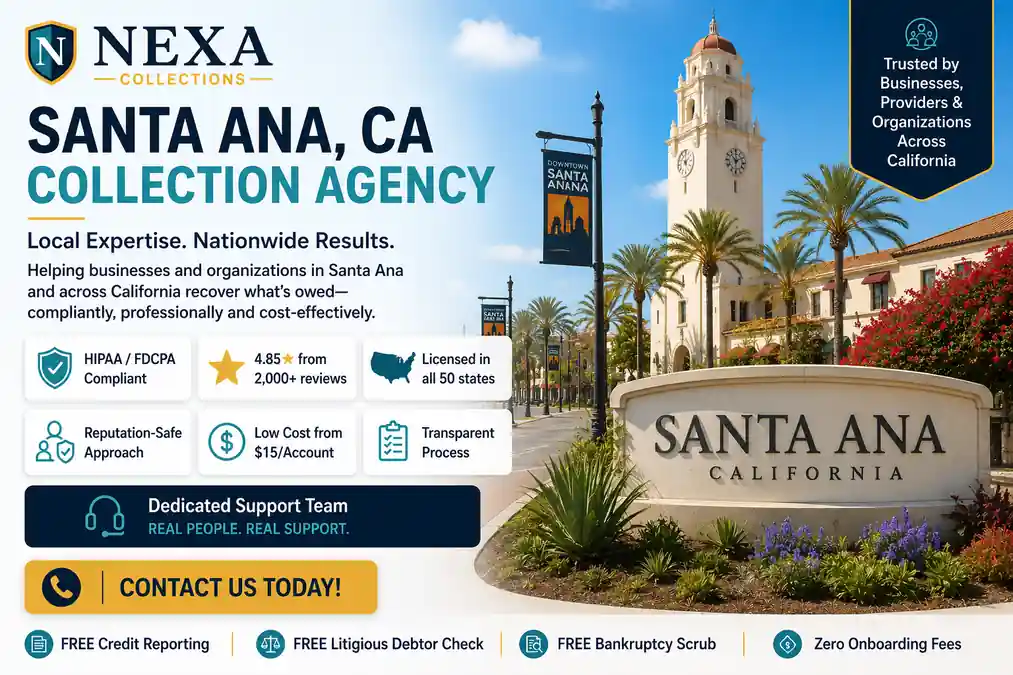
Santa Ana Collection Agency for Business, Medical & B2B Debt

In Santa Ana, an unpaid account is not always a customer refusing to pay. It may be a language barrier, a disputed repair bill, a confusing patient balance, missing B2B documentation—or a customer who simply stopped responding. Treating every account the same is where collections go wrong.

Santa Ana is especially diverse: 77.6% of residents age 5+ speak a language other than English at home. Nexa helps local businesses, healthcare providers, auto-service companies, professional firms, schools, and commercial creditors recover overdue balances with professional outreach tailored to the account—not a one-script-fits-all approach. The goal is to solve the payment problem without creating a reputation problem.

Santa Ana collection agency helping local businesses, healthcare providers and auto-service companies recover overdue accounts

Nexa provides a reputation-safe approach, equipped with all 50-state collections license, offering free credit reporting, free litigious debtor check, free bankruptcy scrub, and zero onboarding fees. Secure – SOC 2 Type II & HIPAA compliant. Over 2,000 online reviews rate us 4.85 out of 5. Easy to use and a good client support team.

Need an Santa Ana Collection Agency? Contact us


How We Work: A Simple, Scalable Process

We offer flexible steps to match your needs. Most of our Santa Ana clients find success starting with Step 2, followed by Step 3 for tougher accounts.

  1. Step 1 — First-Party Courtesy Reminders (Fixed-Fee)
    We act as your extension with five soft reminders for fresher balances (0–60 days), sent as if these reminders are coming from you.

    • Typical Fee: $15 per account.
  2. Step 2 — Third-Party Written Demands (Fixed-Fee)
    Five professional letters on our letterhead that prompt action while preserving goodwill. We may also mix in digital contacts where permitted by law.

    • Typical Fee: $15 per account.
  3. Step 3 — Full Third-Party Collections (Contingency)
    Persistent, polite phone and digital outreach. We negotiate payment plans and settlements to get you paid.

    • Typical Fee: 40% of amounts recovered. No Recovery, No Fee.
  4. Step 4 — Legal Collections (Contingency, Client-Approved)
    For the most difficult accounts, we escalate to an attorney after an in-depth review, and only with your explicit approval. Nominal filing fees are initiated and reimbursed upon recovery.

    • Typical Fee: 50% of amounts recovered. No Recovery, No Fee.

collection agency fee


Your In-Depth Q&A Guide to Santa Ana Collections

1. Why can bilingual debt collection make a real difference in Santa Ana?

In Santa Ana, language should be part of the collection strategy, not an afterthought. Census data shows that 77.6% of residents age 5 and older speak a language other than English at home, making clear bilingual communication particularly relevant for healthcare providers, schools, landlords, auto businesses, and other consumer-facing organizations.

California law also has language-specific requirements for certain covered collection notices. When a language other than English is principally used during the initial oral contact on qualifying delinquent debt, the required notice must generally be provided in that language within five business days.

The objective is not simply translation—it is making sure the person understands who is contacting them, what balance is being discussed, and what options exist to resolve it. Nexa also provides Spanish-speaking and multilingual collection services.

2. What can a Santa Ana auto repair shop do when a customer does not pay the repair or storage bill?

California gives qualifying vehicle repair, towing, and storage businesses lien rights that can be much more powerful than repeatedly sending an invoice.

The California DMV states that businesses lawfully providing repairs, towing, or vehicle storage may use California’s vehicle lien-sale process when legally entitled to unpaid compensation. For vehicles valued over $4,000, the DMV lien-sale authorization application generally must be submitted within 30 days after the lien arises. California also requires a valid Bureau of Automotive Repair registration to obtain certain motor-vehicle repair lien rights.

For a Santa Ana repair shop, body shop, towing company, or vehicle-storage business, an overdue account should therefore be reviewed before statutory lien-sale deadlines disappear. Collection of the money and enforcement of a vehicle lien are different processes, so legal or DMV requirements should be handled appropriately.

Nexa also has a dedicated auto and vehicle debt recovery service.

3. Does California’s Rosenthal Act apply to every unpaid B2B invoice in Santa Ana?

No—and this distinction has become particularly important in 2026.

California expanded portions of the Rosenthal Fair Debt Collection Practices Act to certain covered commercial debts beginning July 1, 2025. However, California’s current definition specifically excludes “trade credit.” Trade credit generally includes credit extended by a business in connection with providing its own goods, materials, equipment, or services.

That means an ordinary unpaid supplier or service invoice should not automatically be classified the same way as covered small-business financing. The underlying transaction matters.

This is especially relevant for Santa Ana manufacturers, distributors, wholesalers, professional firms, equipment companies, and other B2B creditors. Contracts, purchase orders, invoices, delivery records, and guaranties should be reviewed before deciding which California collection rules apply.

For B2B accounts, also see Nexa’s commercial and distribution debt collection approach.

Important page update: Nexa’s current Santa Ana page broadly states that the Rosenthal Act was extended to commercial B2B debt. I would revise that language because the current 2026 statute expressly excludes trade credit from “covered commercial debt.”

4. Can Santa Ana doctors and dentists still collect unpaid patient balances if medical debt cannot be reported to credit bureaus?

Yes. California’s medical-debt credit-reporting ban does not erase a legitimate patient balance or prohibit lawful collection.

California generally prohibits medical debt from appearing on consumer credit reports, and the California Attorney General reaffirmed in November 2025 that the state prohibition remains in effect.

For Santa Ana medical practices, dentists, surgery centers, urgent care providers, imaging centers, ophthalmologists, and senior living providers, that makes the collection approach more important. Recovery should focus on accurate patient-responsibility balances, understandable communication, payment resolution, secure handling of PHI, and respectful follow-up rather than relying on credit-reporting pressure.

Nexa’s dedicated California medical collection service provides additional information on HIPAA-conscious patient debt recovery.

5. What should a Santa Ana creditor do if the customer files bankruptcy while the account is in collections?

Ordinary collection activity should generally stop once a bankruptcy filing triggers the automatic stay.

This question is unusually relevant locally because the U.S. Bankruptcy Court’s Santa Ana Division serves Orange County and is located at the Ronald Reagan Federal Building in Santa Ana.

Depending on the bankruptcy chapter and the creditor’s position, recovery may shift from ordinary collection activity to the bankruptcy process. A creditor may need to file a Proof of Claim, monitor court notices, or—in limited situations—ask the court for relief from the automatic stay. The Central District of California Bankruptcy Court specifically provides procedures for creditors filing proofs of claim and seeking relief from stay.

Nexa’s existing Santa Ana process also states that accounts receive a bankruptcy scrub before collection, helping identify accounts that require different handling.

6. Can a Santa Ana business use Orange County Small Claims Court for an unpaid invoice?

Yes, when the amount and circumstances fit Small Claims rules—and Santa Ana is home to Orange County’s Central Justice Center, where Small Claims filings can be submitted.

An individual or sole proprietor can generally seek up to $12,500, while corporations, partnerships, and most other business entities are generally limited to $6,250. Venue rules still matter, so the fact that the creditor is located in Santa Ana does not automatically mean every case belongs there. For certain consumer purchases, Orange County specifically looks at factors such as where the buyer lived, where the contract was signed, or where the purchased items were installed or kept.

Small Claims can be useful for a clear, documented balance, but winning the judgment and collecting the judgment are two separate problems. Larger commercial disputes or difficult enforcement may justify involving a California collection attorney.


Recent Recovery Results

Santa Ana Auto Repair Shop — Fixed Fee
Past-due balance: $6,800
Recovered: $4,828 — 71% recovery
A professional third-party demand reopened communication and resolved the account before further escalation.

Medical Practice — Contingency
Patient balances: $21,400
Recovered: $12,198 — 57% recovery
Respectful outreach and payment negotiations recovered the majority of collectible balances without aggressive tactics.

Commercial Supplier — Fixed Fee + Contingency
Outstanding invoices: $31,500
Recovered: $14,805 — 47% recovery
The early fixed-fee stage produced partial payment; the remaining viable accounts were escalated for deeper follow-up.


Stop Wondering. Start Recovering.

You have the facts. The logical next step is to take action. Stop letting unpaid invoices clog your cash flow and create stress. Let’s get your money back in your bank.

Need a Collection Agency? Contact Us

Negative Impact of Buy Now Pay Later Schemes

“Buy Now, Pay Later” (BNPL) schemes have gained popularity as an alternative to traditional credit, offering consumers the ability to purchase items immediately and pay for them over time. While these services can be convenient, they also have several potential negative impacts on consumers:

  1. Overspending: BNPL schemes can encourage impulsive buying and overspending by creating the illusion that consumers are not actually spending money. This can lead to consumers purchasing items they don’t really need or can’t afford.
  2. Debt Accumulation: These services can contribute to the accumulation of debt. If a consumer uses BNPL for multiple purchases without a clear repayment plan, it might result in a pile of debts that become unmanageable.
  3. Interest and Fees: While many BNPL services advertise as interest-free, some may charge interest or late fees if the consumer fails to meet the repayment schedule. These can accumulate quickly and add to the cost of the purchase.
  4. Negative Impact on Credit Score: Some BNPL services report to credit bureaus. Missing payments can negatively affect a consumer’s credit score, making it harder to qualify for loans or credit cards in the future. In some cases, even making payments on time with BNPL can impact credit utilization ratios, which can affect credit scores.
  5. Retailer Incentives: Retailers sometimes receive incentives or commissions from BNPL providers for promoting their service. This might cause some retailers to aggressively push BNPL as the preferred payment option even when it might not be in the best interest of the consumer.
  6. Complexity of Terms: BNPL services often have terms and conditions that might be difficult for the average consumer to understand. People might not be fully aware of what they are agreeing to, especially regarding fees and interest.
  7. False Sense of Affordability: BNPL schemes can create a false sense of affordability. Consumers might think they can afford more expensive items because the cost is spread out, without considering the total amount they will have to pay back.
  8. Short Repayment Periods: Some BNPL services have relatively short repayment periods. This can put pressure on consumers to repay large amounts in a short time, potentially causing financial strain.
  9. Impact on Loan Applications: Some lenders view the use of BNPL services as a red flag. If a consumer applies for a loan, having several BNPL agreements could imply that they rely too much on credit, making lenders less likely to approve the loan.
  10. Decreased Financial Awareness: Regular use of BNPL can decrease consumers’ awareness of their financial situation. Since payments are deferred, users may lose track of how much they owe.
  11. Psychological Burden: Knowing that a debt is pending payment can create stress and anxiety, especially if a consumer is struggling financially. The psychological burden of debt can have a significant impact on mental health.
  12. Gateway to More Risky Financial Products: Regular use of BNPL might also serve as a gateway to more risky financial products, as consumers get accustomed to using credit as a means of managing their finances.

Consumers should exercise caution and be fully informed of the terms and conditions before using BNPL services. It is also important to have a clear understanding of one’s financial situation and ability to repay the debt within the specified period.

Filed Under: money

  • « Go to Previous Page
  • Page 1
  • Interim pages omitted …
  • Page 6
  • Page 7
  • Page 8
  • Page 9
  • Page 10
  • Interim pages omitted …
  • Page 27
  • Go to Next Page »

Primary Sidebar


accounts receivable

Need a Collection Agency?
Kindly fill this form.
We’ll get in touch with you

    Please prove you are human by selecting the star.

    Compliance & Security

    • SOC 2 Type II Certified: Third-party audited data security and strict privacy controls.

    • HIPAA Compliant: Secure, legal processing of medical and municipal EMS accounts.

    • PCI-DSS Level 1: Highest tier of data encryption for secure payment processing.

    • FDCPA & FCRA Aligned: Full legal adherence to federal consumer protection laws.

    Recent Posts

    • Nationwide Debt Collection Agency Serving U.S. Cities
    • Chula Vista Collection Agency for Medical, B2B, Schools & Business Debt
    • Corpus Christi Collection Agency: Itemized Bill Rules for Practices
    • Riverside Collection Agency | For Logistics, Medical, Schools & Business Recovery
    • Collection Agency for Large Balances: High-Value B2B Debt Recovery
    • Baltimore Collection Agency | Medical, Commercial, Schools & More
    • Commercial and B2B Collection Agency in Detroit
    • Boston Medical Collection Agency | Serving Hospitals, Physicians & Dentists

    Featured Posts

    • Nursing Home & SNF Collection Agency: Private Pay, Patient Liability & Estate Recovery
    • Collision Repair Debt: Recovering “Pocketed Checks” & Deficiency Balances
    • How Collection Agencies Can Impact Your Credit Scores

    Copyright © 2026 NEXACOLLECT.COM | This content is provided for general informational purposes only and should not be considered legal advice. Collection laws and requirements may vary by state, account type, documentation, debtor status, and specific facts. Please consult qualified legal counsel for guidance regarding your particular situation. Nexa and its authorized collection partners service accounts in accordance with applicable federal and state collection requirements. Visit our home page to know more about us.

    X
    Need a Collection Agency?
    Contact Us