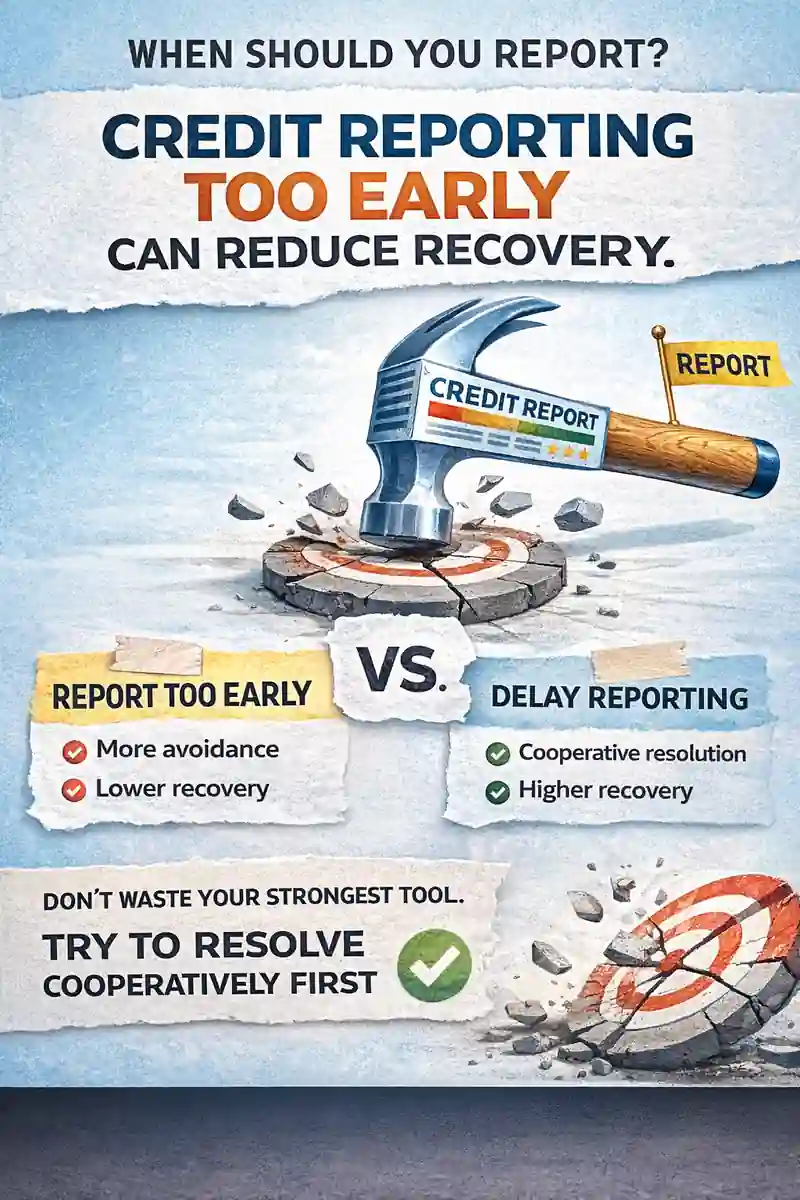
Credit reporting is powerful. That’s exactly why you shouldn’t waste it too soon.
If you report an unpaid balance immediately, you may accidentally kill the best reason the account holder had to resolve it quickly.
The Simple Truth
When an unpaid account hits a credit report, the situation “feels final” to the person on the other side.
And once something feels final, urgency drops.
Most people don’t think: “I should fix this right now.”
They think: “It already happened… so what’s the point?”
That’s why timing matters more than anger.
Why “Delayed Reporting” Often Collects More
Credit reporting is not just a punishment mechanism.
It’s a late-stage lever.
If you use it first, you have fewer tools left later.
Delayed reporting keeps pressure in reserve—while you attempt higher-yield recovery methods first:
-
professional outreach
-
structured negotiation
-
email + text follow-ups
-
settlement options
-
payment plans where appropriate
This approach protects your recovery rate and your reputation.
The Better Order of Operations (What Works in the Real World)
Here’s the sequence that typically produces the most money:
Step 1: Resolve with calm pressure
Reach out professionally. Create urgency without hostility.
Make it easy to say “yes” before people get defensive.
Step 2: Escalate structure, not emotion
More documentation. More firmness. Clear deadlines.
Still respectful. Still controlled.
Step 3: Credit reporting (only if needed)
When the account holder refuses to cooperate, reporting becomes the final non-legal lever.
That’s the win: you don’t spend your strongest tool on the weakest moment.
“But Isn’t Credit Reporting the Fastest Way?”
It’s fast.
But speed isn’t the same as recovery.
If your goal is to collect, reporting too early can backfire.
It turns a negotiation into a locked room.
And once the other side mentally checks out, you’re left with fewer options:
-
legal escalation (often not practical for smaller balances)
-
months of no response
-
“pay only if you delete it” behavior
You want the opposite:
A clear path to resolution that feels fair, doable, and final.
The One Thing You Should Never Do
Never use credit reporting like revenge.
It makes your process look emotional, not professional.
Credit reporting works best when it’s positioned as:
✅ a documented business step
✅ used after attempts to resolve
✅ based on verified account accuracy
That’s how you keep credibility—and keep recoveries high.
“Pay for Delete” Sounds Tempting (But It’s a Trap)
Some agencies push a “pay and we’ll remove it” style deal.
That strategy causes problems because it trains the account holder to think:
“I’ll pay only if I get something special.”
And it can create disputes, complaints, and reputation risk.
In many industries, credit bureaus expect accurate reporting to remain accurate—not used as a bargaining chip.
Better approach:
Delay reporting until reconciliation fails.
Then use reporting as the last lever—not the first threat.
The Exception: Medical Debt Rules Are Different
Medical debt is treated differently by the major credit reporting agencies in multiple ways, including timing and removal rules once paid.
That’s exactly why medical accounts require a more careful strategy from day one.
(If you’re collecting medical balances, you should be using a patient-friendly approach first anyway.)
What You Should Do Instead (If You Want Higher Recovery)
If the account is unpaid and you want maximum recovery:
✅ Start with structured outreach
Short messages. Clear amounts. Clear options.
✅ Use professional negotiation
Payment plan options can outperform pressure when the person is cooperative.
✅ Document everything
Bad documentation kills leverage. Clean documentation closes accounts.
✅ Hold credit reporting as the final lever
That’s where it does the most damage to avoidance—not to your recovery rate.
Quick Takeaway
Credit reporting works best when it’s delayed—not rushed.
Use professional reconciliation first.
Save reporting for the moment when the account holder is choosing avoidance over resolution.
Reconcile → Negotiate → Final Notice → Credit Reporting → Legal Review
FAQs
Should I report every unpaid balance to credit bureaus?
Not always. Many accounts resolve faster through structured outreach before reporting is used.
When does reporting make sense?
When the account holder stops cooperating, ignores notice, or repeatedly breaks resolution commitments.
Does reporting guarantee payment?
No. It increases leverage, but recovery is highest when you use it at the correct stage—not on day one.