Orchestrating Financial Harmony: Recovery for the Local Music Scene
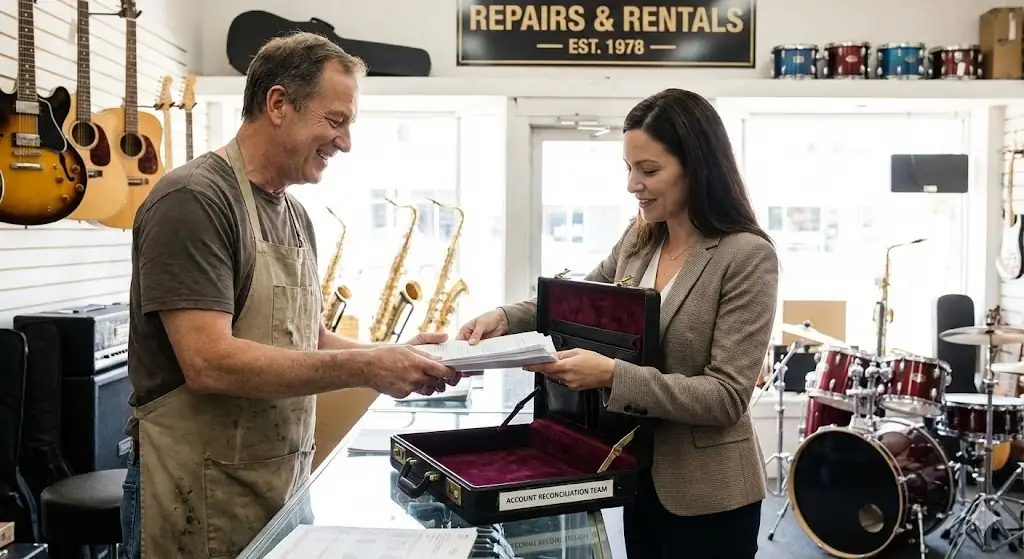
Your store provides the soundtrack to our community, from the first screechy violin lesson to the local jazz trio’s Friday night set. We understand that when a high-end saxophone rental goes missing or a vintage amplifier repair bill goes unpaid, it’s not just a line item—it’s a disruption of your rhythm. Our Account Reconciliation Team ensures that your shop stays in tune while we handle the difficult conversations with the “Velvet Hammer” touch.
Nexa provides a reputation-safe approach, equipped with all 50-state collections license, offering free credit reporting, free litigious debtor check, free bankruptcy scrub, and zero onboarding fees. Secure – SOC 2 Type II compliant. Over 2,000 online reviews rate us 4.85 out of 5.
We are serving over 50 music stores nationwide.
Need a Collection Agency? Contact us
Pricing Designed for Every Octave
We believe in transparent recovery that scales with your needs. Whether you are dealing with a bulk of small lesson fees or a single high-value instrument rental, our current rates remain consistent:
-
Fixed-Fee Option: Only $15 per account. You retain 100% of the recovered funds. This is ideal for early-stage delinquency where a firm, professional nudge is all that’s required.
-
Contingency Option: 40% fee—if we don’t recover your money, you don’t pay a cent.
-
Equipment Recovery Discount: We recognize that a returned instrument may have suffered wear and tear. If the customer returns the merchandise rather than paying the full balance, our contingency fee drops to 25% to account for the depreciation of the equipment.

Money Saver Tip: Most of our partners effectively receive our fixed-fee service for free. By consulting your CPA, you can often declare these costs as a necessary Business Expense on your current tax filings, neutralizing the overhead.
🚩 Local Pitfalls: 3 Red Flags for Music Retailers
-
The “Grace Period” Trap: Waiting until the end of a semester to chase unreturned school rentals often leads to “skip” situations where families move without notice.
-
The Handshake Repair: Performing high-value repairs without a signed “authorization to work” that includes collection cost clauses makes recovery harder.
-
Employee Outreach: Asking your master luthier or floor manager to make collection calls wastes their talent and often results in awkward, ineffective confrontations that damage your shop’s reputation.
A Note from the Account Reconciliation Team
We view ourselves as an extension of your front office. Our goal isn’t just to “get the money”—it’s to resolve the friction that stops a customer from coming back. We use empathetic, bilingual communication (Spanish and English) to navigate these sensitive waters. By the time an account reaches us, we know the “will to pay” is often buried under life’s distractions. We dig it back out without the noise.
Why Cooperative Mediation Wins: The Velvet Hammer
We recover more because we work with the debtor, not against them. Our “Velvet Hammer” approach is firm enough to secure a commitment but soft enough to protect your 5-star online reputation. By treating the customer with respect, we move your bill to the top of their priority list.
Before we ever dial a number, we perform a litigation scrub to ensure we aren’t chasing “judgment-proof” individuals or those with a history of litigious behavior. This protects you from risk and keeps our recovery rates significantly higher than the industry average. When appropriate, we leverage text and email to speed up responses, meeting customers on the platforms they actually use.
Recent Success Stories
Case 1: The “Vanished” Cello Rental
A customer stopped payments on a professional-grade cello and ceased all communication.
-
Step 1: We performed a skip trace and USPS address check, locating the debtor in a neighboring county.
-
Step 2: Our Spanish-speaking collector reached out, discovering a family medical emergency had caused the lapse.
-
Result: The cello was returned within 48 hours, and a settlement for the past-due rental fees was reached, billed at the 25% equipment recovery rate.
Case 2: The Studio Repair Bill
A local recording studio owner owed a significant balance for a console repair but was disputing the final labor hours.
-
Step 1: We acted as a neutral third party to review the invoice and the studio’s concerns.
-
Step 2: Using diplomatic mediation, we negotiated a three-part payment plan that secured the full balance without litigation.
-
Result: 100% recovery achieved within 30 days.
Comprehensive Debt Segmentation Checklist
-
Band & Orchestra Instrument Rentals: Unreturned or defaulted rent-to-own (RTO) contracts for flutes, trumpets, saxophones, clarinets, violins, and cellos rented for school music seasons.
-
Pro-Audio & Backline Gear: Outstanding balances or missing serialized equipment from event/studio rentals, including PA systems, powered mixers, tube amplifiers, drum kits, microphones, and DJ packages.
-
Luthier & Repair Invoices: Abandoned instruments or unpaid labor and parts invoices for guitar setups, brass chem-cleans, woodwind repads, and structural violin restorations.
-
Private Lesson Tuition: Past-due music academy, vocal coaching, and instrumental lesson tuition that fell behind payment schedules.
Compliance and Modern Logistics
We navigate the complexities of federal rules, including the Fair Debt Collection Practices Act (FDCPA), to ensure your business is never at legal risk. Our process includes:
-
Skip Tracing & USPS Checks: Finding customers who have moved.
-
Bankruptcy & Litigation Scrubs: Identifying risk before we engage.
-
Credit Reporting: Available where permitted and chosen by you.
-
Quality Control: All calls are recorded and randomly reviewed to prevent “rogue collector” behavior and protect you from review-bombing.
Frequently Asked Questions
1. Can a music store send an unpaid instrument rental account to a collection agency?
Yes. Music stores can refer legitimate past-due rental accounts for professional collection when the customer has stopped paying and normal reminders have failed, subject to the rental agreement and applicable state law. Nexa handles instrument rentals, repair balances, lesson fees, and other music-store receivables, with a $15 fixed-fee option for appropriate early-stage accounts and a 40% contingency option for full collections.
For the strongest account, provide the signed rental agreement, payment history, customer and parent/guardian information, instrument description and serial number, and copies of previous notices. Actual music-store rental contracts commonly document these details because they establish who rented the equipment and what obligations apply.
2. What happens if a customer stops paying and refuses to return the rented instrument?
This creates two potential recovery goals: the overdue balance and the merchandise itself. Depending on the rental contract and applicable law, the store may pursue payment, return of the instrument, or an appropriate combination of both.
Nexa specifically offers a lower rate when the merchandise is recovered. If an instrument is returned during Step 3 instead of the full balance being paid, the contingency rate is 25% rather than the standard 40%. Nexa’s current music-store page gives the example of a cello rental that was located through skip tracing and ultimately returned.
3. If a customer returns an instrument, do they still owe the past-due rental balance?
Often, yes. Returning the instrument generally stops future rental obligations according to the terms of the particular agreement, but it does not automatically erase rent, repair charges, late amounts, or other balances already due. Music-store agreements reviewed for this article commonly distinguish between returning the merchandise and paying amounts that accrued before the return.
Nexa can therefore work toward getting the instrument back while also resolving the legitimate outstanding balance. When merchandise is returned in Step 3, Nexa’s equipment-recovery contingency rate is 25% instead of 40%.
4. What if a parent says the rented instrument was returned to the school?
Do not automatically assume the rental has been closed. This is a surprisingly important issue in school-band rentals. Some music-store agreements specifically state that leaving an instrument with a school or music teacher does not end the customer’s responsibility until the store receives it or has authorized that return method.
Music stores should therefore document the instrument serial number, school, student, authorized return procedure, date received, and condition upon return. Clear documentation can prevent a “we returned it months ago” dispute from becoming an unresolvable collection problem.
5. Can a collection agency recover unpaid instrument repair bills and music lesson fees?
Yes. Nexa’s music-store collection service covers more than rental payments. It is designed for unpaid instrument and equipment repairs, lesson fees, and other legitimate music-business receivables as well. Nexa specifically identifies high-value repairs performed without signed work authorization as a common recovery problem.
For repair accounts, keep the signed estimate or authorization, parts and labor invoice, communications approving additional work, pickup records, and payment terms. Clear written authorization can make it much easier to resolve a later dispute over what work the customer agreed to pay for.
6. Can Nexa locate a music-store customer who moved while still owing money or holding an instrument?
Yes. This is particularly important for school-year instrument rentals, where families may move after a semester or school year while an account remains unpaid. Nexa specifically warns music retailers that waiting too long on unreturned school rentals can lead to customers becoming harder to locate.
Nexa uses skip tracing and USPS address checks to locate customers who have moved, along with English and Spanish outreach when appropriate. Once contact is re-established, the objective can be payment of the balance, return of the instrument, or an appropriate resolution of both.