Most creditors picture legal escalation as a single event, “we sued them.” In practice it’s a multi-stage process with several off-ramps along the way, most accounts that enter legal review still resolve without ever reaching a courtroom. Knowing where those off-ramps are changes what a creditor should actually expect once an account moves past standard collections.
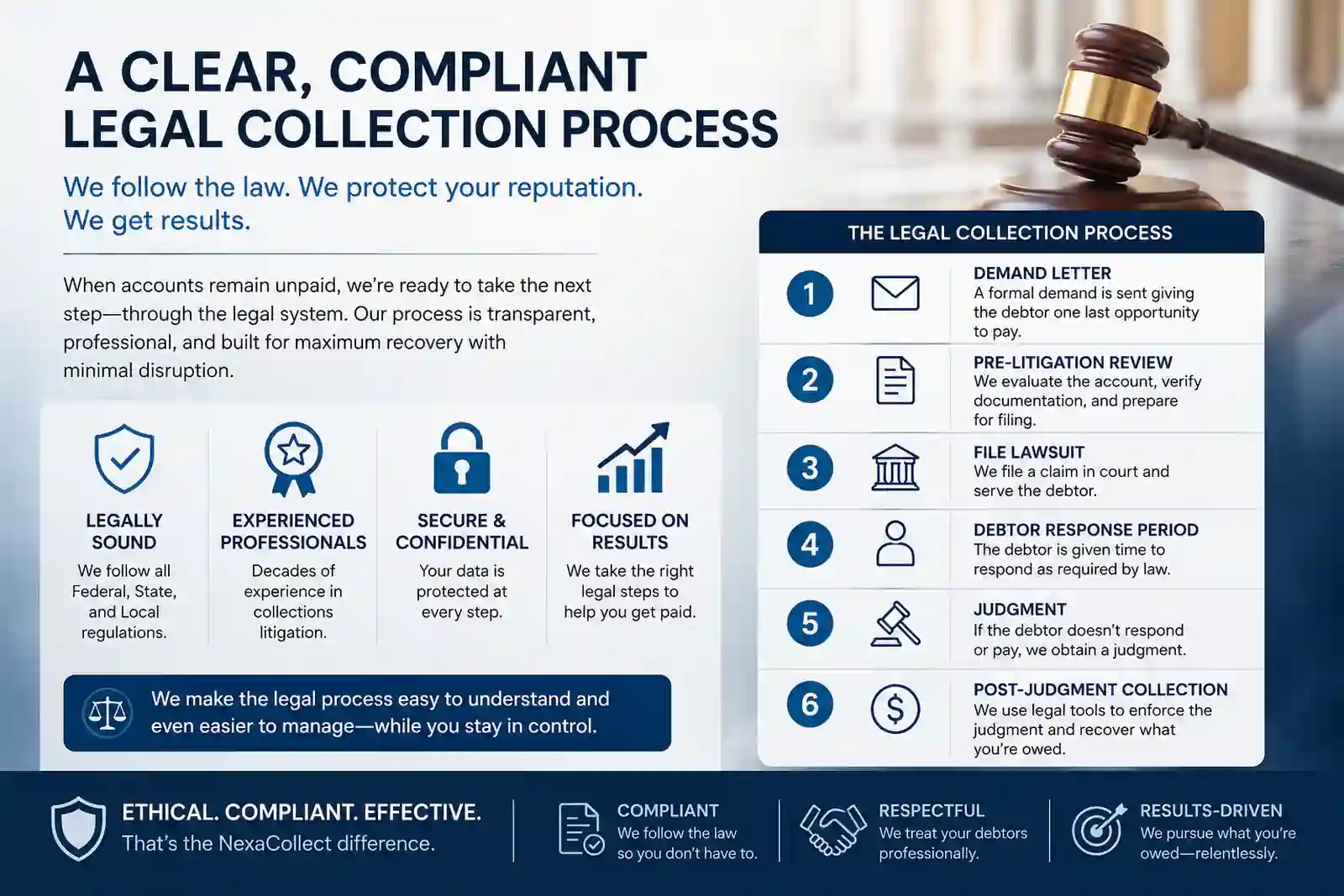
Quick answer: Legal collections operate on a contingency basis with the fee disclosed upfront, and an account only enters this track after standard collection efforts fail and the client gives written consent. The process runs through a Pre-Litigation demand, documentation verification, attorney assignment in the correct jurisdiction, and, only with further client consent, an actual lawsuit. Most cases resolve through settlement before trial; where a lawsuit does proceed, outcomes are typically a default judgment (debtor doesn’t respond) or a standard judgment, followed by enforcement tools like wage garnishment or asset liens, both of which vary significantly by state.
Nexa provides a reputation-safe approach, equipped with all 50-state collections license, offering free credit reporting, free litigious debtor check, free bankruptcy scrub, and zero onboarding fees. Secure – SOC 2 Type II & HIPAA compliant. Over 2,000 online reviews rate us 4.85 out of 5.
Need help with an account that needs legal escalation? Contact us
Before Anything Legal Happens: Three Ground Rules
- Legal collections run on contingency, and the fee is disclosed before anything starts. There’s no separate legal add-on fee sprung on a client mid-process.
- Legal escalation only happens after standard collection has failed. An account doesn’t skip straight to attorneys, it moves there only once internal collection efforts have been exhausted.
- Written client consent is required before proceeding. Nothing legal happens on an account without the client’s explicit, documented go-ahead, and some clients choose to prohibit legal escalation entirely, that choice is respected.
Stage 1: Pre-Litigation Review
When an account transfers to the legal collections track, it first enters what’s called the Pre-Litigation phase. The agency’s in-house legal team reviews the account and issues a firm demand notifying the debtor that the account is now under legal review. This is genuinely the debtor’s last opportunity to resolve the balance before formal legal steps begin, and a meaningful share of accounts do settle right here, once a debtor sees “legal review” in writing, it changes the calculation.
Stage 2: Documentation Verification
If the debtor doesn’t resolve the account during Pre-Litigation, the next step is verifying that backup documentation actually supports the balance being claimed. This typically involves several rounds of communication with the client, updates on the account’s status, and requests for any additional supporting documents (the original contract, invoices, correspondence) that will matter if the case proceeds to a courtroom. A case is only as strong as its paper trail, this stage exists to make sure that trail is solid before anyone spends money filing suit.
Stage 3: Attorney Assignment
Once documentation is in order, the account is assigned to an attorney. Collection agencies typically maintain networks of hundreds of affiliated attorneys nationwide, and the case goes specifically to one licensed in the jurisdiction where it needs to be handled, jurisdiction matters here, an attorney licensed in the wrong state can’t file the case.
Stage 4: Attorney Contact and the Pre-Suit Window
What happens next depends on whether the attorney can negotiate a settlement or determines a lawsuit is the better path. Reaching the debtor remains the hardest part of this stage, and there’s no fixed universal timeline. Attorneys generally extend the debtor a courtesy window to respond following initial contact, this is a professional practice, not a court-imposed deadline, and it’s separate entirely from the formal answer period a debtor gets after a lawsuit is actually filed (which is set by state law, commonly somewhere in the 14-to-30-day range depending on jurisdiction, not a fixed number across every state).
Stage 5: Assessing Whether a Lawsuit Is Actually Worth Filing
If the attorney determines the case is viable for a lawsuit, based on the likelihood of winning a judgment and whether the debtor actually has assets or income worth pursuing, they’ll consult the client before proceeding. The client is typically asked to cover the court’s filing fee, which is reimbursed from the first funds recovered. This viability check matters: a technically winnable case against a debtor with nothing to collect from isn’t worth filing, and a good attorney network says so before spending the client’s money.
Stage 6: The Lawsuit Itself
Moving to an actual lawsuit requires the client’s consent. The process involves serving the debtor, preparing an affidavit, and waiting for a court date, and it can run long, court processing times have been notably slower since the pandemic in many jurisdictions. Two typical outcomes: a default judgment if the debtor doesn’t show up to respond, or a standard judgment if they do appear and the case is heard on its merits. With solid documentation in hand (which is exactly what Stage 2 was for), the odds of a favorable outcome are generally strong.
Stage 7: Judgment, Settlement, or Enforcement
Even after judgment, the story isn’t always over. Depending on whether the debtor is willing to settle, there may be an additional court hearing. If the debtor agrees to payment terms, the case moves to monitoring for payment. If they refuse to pay voluntarily, the attorney may pursue wage garnishment or asset liens, though which of these tools is actually available depends heavily on the state; several states restrict or outright prohibit wage garnishment for ordinary consumer debt. See our guide to collecting on a judgment for a full breakdown of enforcement options, judgment expiration and renewal, and what “judgment-proof” actually means for a debtor with no currently collectable assets.
Once funds are recovered, the amount is remitted to the client after deducting the agreed legal-contingency fee, disclosed to the client from the very start of the process, per the ground rules above. See the full pricing structure for how legal-contingency rates compare to standard collection fees.
Frequently Asked Questions
Does transferring an account to legal collections mean it will definitely go to court?
No. Legal escalation opens the door to a lawsuit, it doesn’t guarantee one. A meaningful share of accounts resolve during the Pre-Litigation demand stage alone, once a debtor receives formal notice that legal review has begun, and among cases that do proceed further, many settle through attorney negotiation before ever reaching a courtroom.
How long does a debtor actually have to respond once contacted by the attorney?
There are two different timeframes here, worth not confusing. Before any lawsuit is filed, the attorney generally extends a courtesy response window as a matter of professional practice, not a fixed legal deadline. Once a lawsuit is actually filed and the debtor is formally served, a separate, state-mandated answer deadline applies, typically somewhere between 14 and 30 days depending on the jurisdiction, and missing it can result in a default judgment.
Who pays the court filing fee, and is it refundable?
The client is typically asked to cover the court’s filing fee before a lawsuit proceeds. That fee is reimbursed from the first funds recovered on the account, so it isn’t a permanent out-of-pocket cost if the case succeeds, though it is a real upfront expense the client should budget for regardless of outcome.
Can a client stop an account from going to legal collections at all?
Yes. Written client consent is required before an account moves into the legal track in the first place, and some clients choose to prohibit legal escalation entirely as a matter of policy. Nothing legal happens on an account without that explicit, documented authorization.
What’s the difference between a default judgment and a standard judgment?
A default judgment is entered when the debtor fails to respond or appear after being properly served, the court rules in the creditor’s favor without the case being contested on its merits. A standard judgment results when the debtor does appear and the case proceeds to be heard, evaluated on the evidence and arguments both sides present. Both are enforceable judgments, but a default judgment can sometimes be reopened if the debtor later shows a valid reason for not responding, which a contested standard judgment generally cannot.
Once a judgment is obtained, is collecting on it automatic?
No, and this is one of the most commonly misunderstood parts of the process. A judgment is a legal ruling establishing the debt is owed, it doesn’t compel immediate payment on its own. Enforcement tools like wage garnishment and asset liens still have to be pursued separately, and their availability varies significantly by state, some states broadly restrict wage garnishment for consumer debt, for instance. Our guide to judgment collection covers this stage in full detail.
When should a creditor transition an account from standard collections to legal action?
Transitioning an account to legal action is typically recommended when a debtor has demonstrated the capacity to pay but refuses to cooperate, when standard agency skip-tracing and commercial mediation have stalled, or when the debt is approaching the state statute of limitations. Legal forwarding should be weighed against the size of the balance and the likelihood of asset recovery post-judgment.
Who covers court costs and legal fees when filing a debt collection lawsuit?
Upfront court costs (such as filing fees, process server costs, and local attorney court appearances) are typically coordinated with the creditor prior to filing, or handled through specialized legal forwarding arrangements. In many commercial contracts containing attorney-fee provisions, or depending on state statutes, legal fees and court costs can be formally added to the total judgment amount demanded from the debtor.
Does winning a debt collection lawsuit guarantee immediate payment?
Not automatically. Securing a legal judgment establishes a formal court-ordered debt, but enforcement steps are often required to collect funds. Depending on state laws, post-judgment enforcement remedies include bank-account attachments, corporate or personal asset liens, debtor examinations, and wage garnishments (where legally permitted for commercial guarantees or applicable consumer debts).
How long does the legal debt collection process take?
The timeline varies significantly based on court dockets, whether the debtor contests the suit, and state jurisdiction. A straightforward suit where the debtor fails to respond may result in a default judgment within 30 to 90 days, whereas contested litigation involving formal discovery and defense motions can extend across several months.