A tow goes out, the vehicle sits in your yard, and the invoice sits unpaid, sometimes because the owner disputes it, sometimes because a motor club shorted you on the dispatch fee, sometimes because there’s no owner to even call. Every day that balance ages, it gets harder to collect, and chasing it yourself pulls you away from the trucks. Nexa Collections recovers what’s owed through a diplomatic process built specifically for towing, recovery, and impound operators.
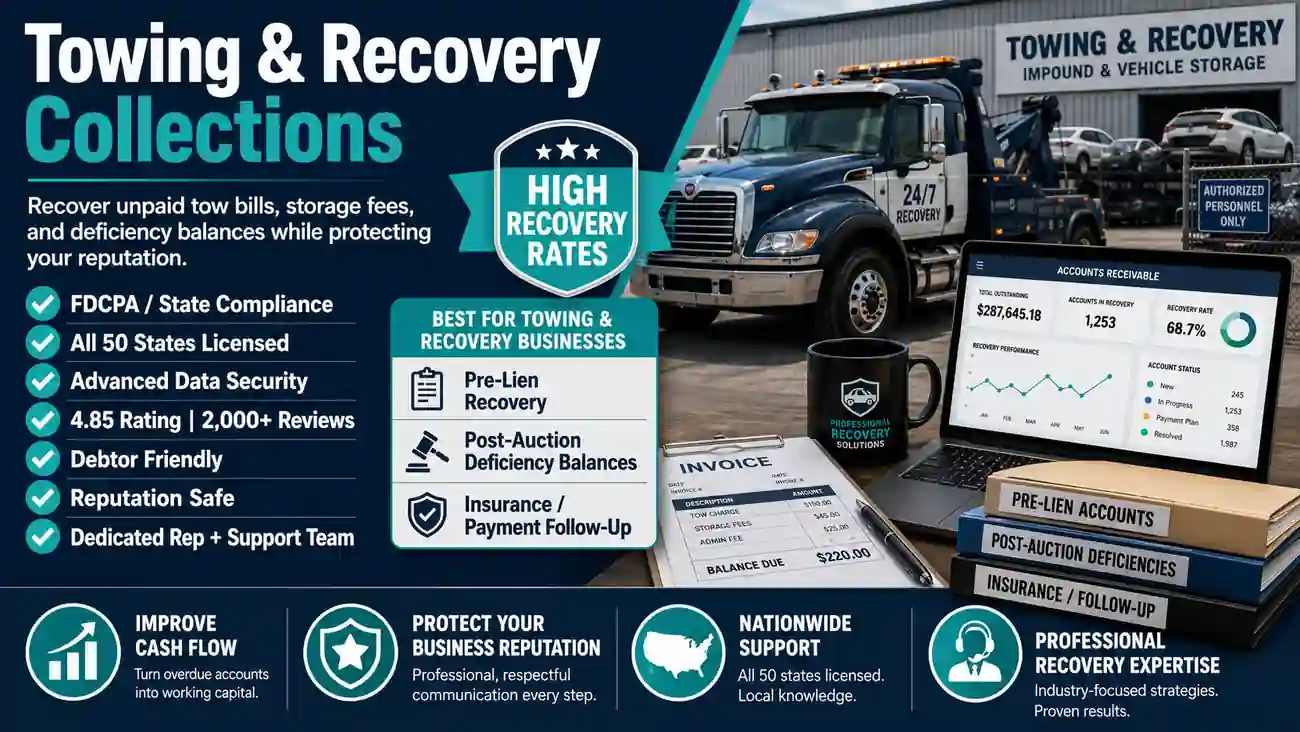
Quick Answer: Towing and impound debt recovery requires navigating state possessory lien laws, abandoned vehicle processing, motor club short-pays, and insurance carrier disputes. Nexa provides 50-state licensed, FDCPA-compliant towing debt collection starting at a $15 Fixed Fee Service per account. Backed by SOC 2 data security, a dedicated support team, and a 4.85/5 rating across 2,000+ reviews, our soft Fixed Fee approach helps towing operators recover impound deficiency balances, storage fees, and commercial fleet invoices while retaining 100% of recovered principal.
Nexa provides reputation-safe, equipped with all 50-state collections license, offering free credit reporting, free litigation/bankruptcy scrubs, and zero onboarding fees. Secure – SOC 2 Type II & FDCPA compliant, backed by a specialized transportation support team, not a call center.
Need a Collection Agency? Contact us
Serving Towing and Recovery Operators Nationwide
Operating a towing business involves real, constant overhead: truck payments, fuel, insurance, maintenance, and a fleet that has to be somewhere, working, to make money. A past-due account is a direct drag on that math, and towing operators rarely have an in-house expert who can chase payment while staying inside federal and state collection rules, getting that wrong risks a lawsuit from the very vehicle owner you’re trying to collect from.
Our Pricing

Nexa $15 Fixed Fee Service.
$15 flat fee per account, 0% commission, you retain 100% of recovered principal. Ideal for impound deficiency balances post-auction and motor club short-pays, typically under 120 days past due.
Contingency Recovery (Late-Stage Defaults).
Performance-based recovery for hard-to-locate debtors, skip-tracing cases, or aged commercial defaults. No fee unless funds are recovered.
What $40,000 in Uncollected Towing A/R Actually Nets You
A simple static example on a $40,000 towing accounts receivable portfolio, an 80% eventual recovery rate ($32,000 collected):
| Nexa $15 Fixed Fee Service | Traditional 35% Contingency | |
|---|---|---|
| Amount recovered | $32,000 | $32,000 |
| Fee | ~$600 (40 accounts × $15) | $11,200 (35% of recovered) |
| You keep | $31,400 (98.1%) | $20,800 (65%) |
Specialized Towing & Impound Product Portfolio Expertise
Post-Auction Impound Deficiency Balances.
Recovering the remaining unpaid balance after an abandoned vehicle is sold at a possessory lien auction and the sale price didn’t cover the full towing and storage debt.
Motor Club & Third-Party Dispatch Short-Pays.
Resolving unpaid or underpaid bills from roadside assistance providers and motor clubs, where the negotiated dispatch rate falls short of the actual job cost.
Private Property Impound (PPI) Balances.
Collecting unpaid drop fees and unauthorized-parking towing fees, an area under real scrutiny in many states, so documentation (signage, authorization, notice to police where required) matters more here than on a standard consensual tow.
Heavy-Duty & Collision Recovery Disputes.
Recovering high-dollar winch-out and storage fees disputed by insurance carriers or commercial fleet owners.
In-House Staff Chasing Balances vs. Aggressive Agency vs. Nexa’s $15 Fixed Fee Service
| Factor | In-House Staff Chasing Balances | Aggressive Agency | Fixed Fee Service |
|---|---|---|---|
| Upfront cost | Staff time, no direct cash outlay | Often 35-50% contingency regardless of account age | Nexa’s $15 flat fee, you keep 100% of what’s recovered |
| Online review & local reputation protection | Depends entirely on driver/staff tone under pressure | Low, aggressive tactics risk retaliatory reviews and complaints | Higher, diplomatic outreach designed to avoid triggering a public dispute |
| Lien law & FDCPA/CFPB compliance | Depends on internal familiarity with state possessory lien procedures | Varies, generic scripts may miss towing-specific lien mechanics entirely | Built around state lien law, FDCPA, and Regulation F from account intake |
| Account management | Whoever’s available between calls | Often a standard call center | Dedicated account executive backed by a specialized transportation support team |
Recent Recovery Results
Regional Towing & Storage Operator — Impound Deficiency Balances:
A regional impound yard placed 140 post-auction deficiency accounts totaling $98,000 in uncollected storage and towing fees. Using Nexa’s $15 Fixed Fee Service, the operator recovered $68,600 within 40 days while keeping 100% of recovered principal for under $2,100 in total fixed fees.
Heavy-Duty Towing & Recovery Fleet — Commercial Short-Pays:
A commercial heavy-duty towing company faced $54,000 in defaulted invoices across 18 motor club and fleet accounts. Nexa’s soft Fixed Fee diplomatic outreach resolved 14 of the accounts in under 30 days, recovering $42,000 without a single legal action or damaged commercial relationship.
Frequently Asked Questions
Can you collect an impound deficiency balance if the vehicle auction price didn’t cover the full towing and storage fee?
Yes, provided the possessory lien auction itself was conducted according to your state’s exact notice and procedural requirements. This is worth double-checking before placement: an improperly noticed or conducted lien sale can undermine a deficiency claim, not just create separate liability exposure, so we confirm the auction followed the required steps before pursuing what’s left owed.
How does Nexa handle unpaid invoices and short-pays from motor clubs and third-party roadside dispatchers?
These are pursued as commercial (B2B) receivables under the dispatch agreement’s terms, distinguishing a genuine rate dispute from a short-pay that’s simply gone unaddressed. Documentation, the dispatch confirmation, job details, and the agreed rate schedule, is reviewed before escalating.
Is Nexa licensed to collect if a debtor or vehicle owner lives out of state?
Yes. Nexa is licensed to collect in all 50 states, which matters for towing specifically, since vehicle owners are often just passing through and return home to a different state before the bill is ever resolved.
How do soft diplomatic demand letters protect our towing company from negative Google reviews?
By resolving the balance through a professional, third-party notice rather than a confrontational call from your own staff. Most negative towing reviews stem from a heated in-person or phone exchange, not from receiving a formal letter, so shifting that first firm contact to a neutral third party removes the friction point entirely.
Do we need a signed tow ticket or rate sheet to submit a towing debt for collection?
It’s the strongest form of documentation, but not always strictly required to begin. A signed tow ticket, rate sheet, or dispatch confirmation makes an account move faster and strengthens the claim if disputed, though other records, photos, GPS/dispatch logs, or an insurance claim reference, can support a claim where a signed ticket wasn’t obtained at the scene.
Turn Your “Scrap” Into Cash
Stop accepting scrap value for your hard work. Enforce your invoices and get paid for the service you provided.