A Kansas creditor considering whether to sell an old account outright to a debt buyer or place it with a collection agency on contingency is making a bigger decision than it looks like. Kansas law draws a real distinction between the two: sell or assign an account, and the buyer loses access to wage garnishment as an enforcement tool entirely. Most creditors never learn this until it’s already too late to matter.
Kansas City businesses don’t all get paid the same way—Nexa helps healthcare providers, schools, contractors, and commercial businesses across the metro recover overdue accounts without putting valuable relationships at risk.
Quick answer: Kansas City sits on a Kansas legal framework most collections content oversimplifies: a 5-year statute of limitations for written contracts (K.S.A. 60-511), 3 years for oral agreements (K.S.A. 60-512), and a wage garnishment restriction that specifically bars anyone who purchased or was assigned an account from using garnishment as a remedy, unlike standard contingency collection. Add Kansas City’s genuinely unique bi-state complexity, split across the Kansas-Missouri line, and getting the framework right matters more here than in most single-state metros. Nexa recovers Kansas City accounts starting at a $15 fixed fee per account, with contingency options for older balances.
Nexa provides 100% reputation-safe, equipped with all 50-state collections license, offering free credit reporting, free litigious debtor check, free bankruptcy scrub, and zero onboarding fees. Secure – SOC 2 Type II & HIPAA compliant. Over 2,000 online reviews rate us 4.85 out of 5.
Need a Collection Agency in Kansas City? Contact us
Two Recent Recovery Results
Regional Agricultural Supplier — $54,300 Recovered at 78%.
A grain and feed supplier serving the Kansas City agricultural corridor carried $69,600 across 11 aged accounts tied to seasonal purchase terms. With correct SOL categorization applied at intake, 9 of 11 accounts resolved within 70 days, recovering $54,300 (78%) through direct negotiation.
Multi-Location Dental Practice — $33,100 Recovered at 72%.
A Kansas City dental group carrying $46,000 in self-pay balances across 91 accounts placed them on a Step 1/Step 2 fixed-fee sequence. 64 accounts resolved within 45 days, with the remainder moving to contingency, bringing total recovery to $33,100 (72%) within 85 days.
What Makes Kansas City Different
Selling a debt and placing it for collection are not the same thing here.
K.S.A. 60-2310 specifically states that a creditor who sells or assigns an account to a collection agency or third party makes that assignee ineligible for wage garnishment as a remedy. This matters directly when deciding how to handle an aged Kansas account: standard contingency collection preserves the full range of enforcement tools, while selling the debt outright can foreclose garnishment specifically, a distinction worth understanding before choosing either path.
Illness genuinely pauses garnishment here, with real documentation.
Under K.S.A. 60-2310, if a debtor or family member has been unable to work due to illness for two or more weeks, garnishment is barred until two months after recovery, provided a doctor’s note or affidavit is filed. It’s a real, humane protection worth knowing exists on both sides of an account.
Being split across two states is a genuine, ongoing complexity.
Kansas City straddles the Kansas-Missouri line, and which state’s law governs a given account can depend on the debtor’s specific address or where the underlying contract was formed. A collections approach that assumes one uniform framework across the whole metro risks applying the wrong state’s statute of limitations or garnishment rule to the wrong account.
The Kansas Legal Landscape
| Statute of Limitations (written contracts) | 5 years — K.S.A. 60-511 |
| Statute of Limitations (oral contracts) | 3 years — K.S.A. 60-512 |
| Wage Garnishment | Lesser of 25% of disposable earnings, or amount above 30x federal minimum wage (~$217.50/week floor) — K.S.A. 60-2310 |
| Debt Buyer Garnishment Restriction | Assignees of sold/assigned accounts are not entitled to wage garnishment — K.S.A. 60-2310 |
| Illness-Based Garnishment Pause | Barred for 2+ weeks of illness, until 2 months post-recovery, with documentation — K.S.A. 60-2310 |
| Repossession/Acceleration | “Right to Cure” notice generally required before certain actions |
What This Costs
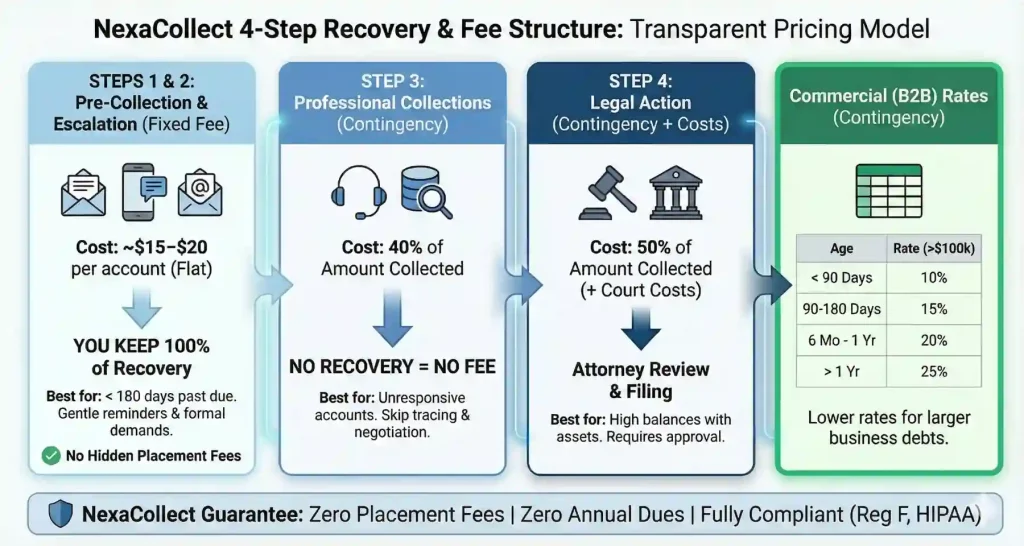
Step 1 & 2: Fixed-Fee Recovery (~$15/account). Professional demand sequences for accounts under roughly 60-90 days. Payments go directly to you. See the full pricing breakdown.
Step 3: Contingency Collection (~40%). For older or unresponsive accounts, no recovery, no fee, and importantly, contingency placement preserves garnishment eligibility in a way an outright debt sale would not.
Step 4: Legal Referral (client-approved, ~50%). Filing fees reimbursed from the first recovery.
Who We Collect For Across Kansas City
- Agriculture & Manufacturing: B2B and commercial receivables for the grain, feed, and manufacturing suppliers tied to Kansas City’s long-standing agricultural trading corridor.
- Hospitals, Dental & Medical: HIPAA-compliant patient balance recovery for practices and health systems across the metro.
- Colleges & Universities: Tuition and fee recovery for the region’s higher education institutions.
- K-12 Private & Charter Schools: Tuition and activity fee recovery handled with the diplomatic, reputation-first approach these communities require, alongside meal and fee recovery for public districts.
- Accountants & CPA Firms: Commercial receivables for the professional services firms supporting Kansas City’s substantial accounting and tax-services presence.
- Banks & Credit Unions: Recovery for the region’s financial institutions and lending partners.
- Construction & Trades: B2B recovery for contractors and suppliers across the metro’s building trades.
- B2B Commercial, Restoration & Waste Management: Commercial receivables for general B2B accounts, restoration contractors, and waste management service providers.
Frequently Asked Questions
If we sell an old Kansas account to a debt buyer instead of placing it for collection, what changes?
A meaningful amount. K.S.A. 60-2310 specifically states that a party who purchases or is assigned an account is not entitled to wage garnishment as a remedy, unlike standard contingency collection, which preserves that option. This is worth weighing carefully before choosing between an outright debt sale and placing the account with a collection agency.
How long does a Kansas City business have to collect on a written contract?
Generally five years under K.S.A. 60-511, and three years for an oral agreement under K.S.A. 60-512.
How much of a debtor’s wages can be garnished in Kansas?
Generally the lesser of 25% of disposable earnings, or the amount exceeding 30 times the federal minimum wage, protecting roughly $217.50 per week, under K.S.A. 60-2310.
Does illness actually pause wage garnishment in Kansas?
Yes, under specific conditions. If a debtor or family member has been unable to work due to illness for two or more weeks, garnishment is barred until two months after recovery, generally requiring a doctor’s note or affidavit filed with the court.
Since Kansas City spans two states, how do we know which state’s law applies to a given account?
It generally depends on the debtor’s specific address and, in some cases, where the underlying contract was formed or performed, rather than simply which side of the metro the business itself is on. Confirming this at intake, rather than assuming uniform treatment across the whole metro, avoids applying the wrong state’s statute of limitations or garnishment framework.
Does Kansas require any notice before a business can repossess property or accelerate a loan?
Generally yes, a “Right to Cure” notice is typically required before certain repossession or full-balance-acceleration actions on secured consumer debt, giving the debtor an opportunity to remedy the default before that escalation occurs.
Talk to Us About Your Kansas City Receivables to get a free quote or speak with our Kansas City intake team. Let NexaCollect handle the difficult conversations so you can get back to running your business.
Don’t let unpaid bills hurt your cash flow any longer.