• Skip to main content
  • Skip to primary sidebar

Nexa Collections

  • Home
  • Serving
    • Medical
    • Dental
    • Small Business
    • Large Business
    • Commercial Collections
    • Government
    • Utilities
    • Fitness Clubs
    • Schools
    • Senior Care Facility
  • Contact Us
    • About us
    • Cost

education

School District Accounting Trends After the ESSER Cliff

Most “accounting trends” content is interchangeable, cloud software, AI, automation, the same five points recycled across every industry with a different example bolted on. School district finance right now doesn’t need that. It needs an honest accounting of what’s actually reshaping district budgets: a $190 billion federal funding cliff that’s already forcing real cuts, a new accounting standard that changes how leases show up on the balance sheet, and enrollment trends that are compounding both.
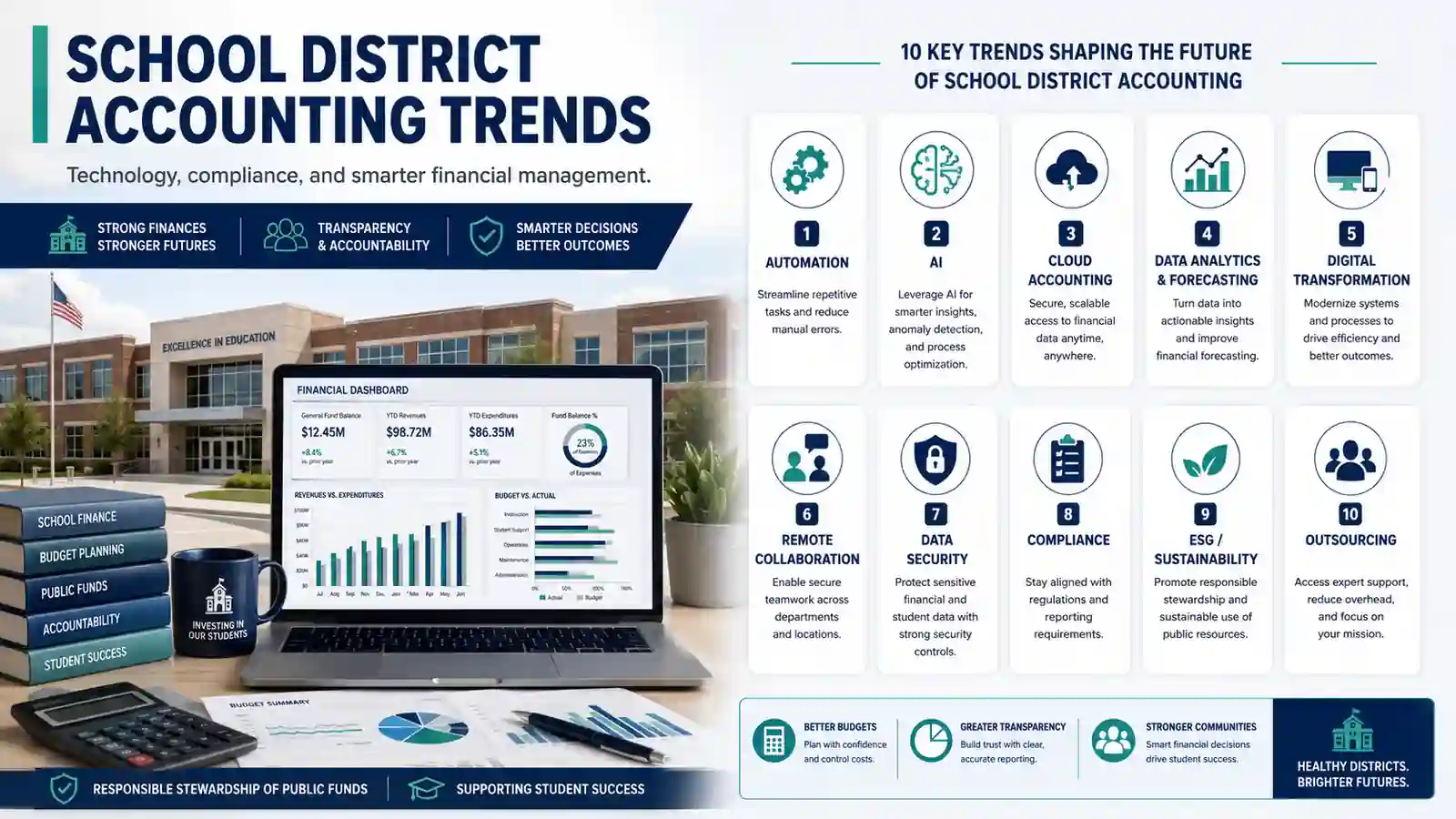
School district accounting trends infographic highlighting automation, AI, cloud accounting, data analytics, cybersecurity, compliance, sustainability, outsourcing, and smarter financial management.

Quick answer: School district accounting in 2025-2026 is dominated by the ESSER funding cliff, $190 billion in federal COVID relief that districts had to fully commit by September 2024 and spend down by March 2026, forcing an estimated $1,200 per-student budget cut nationally. Layered on top: GASB Statement No. 87 now requires districts to recognize lease assets and liabilities on the balance sheet, and declining enrollment in many districts is compounding the funding pressure rather than easing it.

Need help managing district receivables during a tight budget year? Contact us


The ESSER Cliff: What Actually Happened, and What’s Still Happening

Between 2020 and 2021, Congress issued three rounds of Elementary and Secondary School Emergency Relief (ESSER) funding totaling roughly $190 billion, the largest one-time federal investment in K-12 education in US history. Districts used it to hire staff, fund learning-recovery programs, and cover pandemic-era operational costs, with 44% of spending going toward staffing alone, additional support staff, administrators, and professional development that many districts wouldn’t otherwise have been able to afford.

That funding was always temporary. Districts had to formally obligate ARP ESSER funds, the largest and final tranche, by September 30, 2024, and spend (liquidate) them by January 28, 2025, with extensions available to March 30, 2026 for districts that applied. Once the money is gone, it’s gone, unspent or unobligated funds have to be returned to the federal government.

The practical impact is what education finance researcher Marguerite Roza, director of Georgetown University’s Edunomics Lab, has quantified: districts nationally need to cut roughly $1,200 in per-student spending for the 2024-25 school year to offset the loss. The districts hit hardest are typically those that used ESSER funds for recurring commitments, permanent staff additions, ongoing raises, and fixed assets like buses that require continued maintenance, rather than one-time investments.

Worth knowing: this isn’t a universally agreed-upon crisis. Some analysts, including the Heritage Foundation, have argued the “fiscal cliff” narrative overstates the danger, pointing to states’ growing rainy-day fund balances (a median of roughly 12.3% of spending in FY2023, projected toward 15% in FY2025 budgets) as evidence most states can absorb the transition. The facts about the funding deadlines and dollar figures are well-documented; how severe the resulting budget pain actually is remains a genuinely debated question, and the answer likely varies significantly by district.

A second cliff may be coming regardless. McKinsey’s 2025 School Funding Model projects that in a recession scenario, state K-12 funding could drop by up to 6.5% in the 2026-27 school year, a loss of roughly $29 billion nationally, a fiscal shock similar in scale to the ESSER expiration itself. Per-pupil spending is projected to stay roughly flat in nominal terms through 2026-27 before resuming inflation-adjusted growth in 2027-28.


GASB 87: Leases Now Live on the Balance Sheet

School districts follow standards set by the Governmental Accounting Standards Board (GASB), not the Financial Accounting Standards Board (FASB), which governs private, for-profit entities. This distinction matters directly for one of the more significant recent changes: GASB Statement No. 87, which took effect for most districts starting in fiscal year 2021-2022, established a single model for lease accounting based on the principle that a lease is effectively a financing arrangement for the right to use an asset.

The practical effect: a district leasing school buses, portable classrooms, copiers, or technology equipment now generally has to recognize a lease liability and a right-to-use asset on its balance sheet, rather than treating the lease as a simple recurring operating expense. This changes how a district’s financial position actually looks on paper, even when nothing about the underlying lease arrangement has changed. Districts and their auditors have had to review existing lease agreements specifically to determine which now require this treatment.


Enrollment Decline Is Compounding the Pressure, Not Offsetting It

In many districts, particularly urban ones, declining enrollment is landing at the same time as the ESSER cliff, not after it. Since most state funding formulas allocate money on a per-pupil basis, falling enrollment directly reduces a district’s baseline funding even before accounting for the loss of federal relief dollars. The two pressures compound rather than substitute for each other: a shrinking student population doesn’t proportionally reduce fixed costs like building maintenance and administrative overhead, so per-pupil cost pressure often rises even as total enrollment falls.


Where Technology Actually Helps, Beyond the Generic Pitch

Cloud-based financial systems and automation genuinely do reduce manual workload in areas like purchase order processing, bank reconciliation, and routine reporting, that part of the conventional trends list isn’t wrong, it’s just underspecified. In a budget environment this tight, the more concrete value is usually in forecasting accuracy: districts modeling multi-year budget scenarios against enrollment projections and the ESSER spend-down timeline are better positioned to make staffing and program decisions proactively rather than reactively, which matters more this year than in a typical budget cycle.

Outsourcing specific functions, payroll processing, certain audit-adjacent tasks, remains a genuine cost lever for districts trying to avoid adding permanent headcount during a period when per-pupil funding is under this much pressure.


What This Means for District Revenue, Not Just Spending

Budget pressure this significant also puts a premium on the revenue side of a district’s ledger, not just cost control. Outstanding balances, meal debt, device and technology fees, activity and facility fees, that might have been written off as immaterial in a flush budget year carry more weight when every dollar has to be accounted for. Nexa’s school district collection services are built specifically for this: reputation-safe, FERPA-aware recovery designed for public education, not generic commercial collections.

School District Accounting Trends Vary Sharply by State

State 2025–26 School Finance Trend What It Means for District Accounting & Budgets
California California funded a 2.3% LCFF cost-of-living adjustment for 2025–26, while also creating a $1.9 billion LCFF deferral from 2025–26 into 2026–27. Finance teams need to separate revenue entitlement from cash timing. A district can recognize expected state support while still facing short-term liquidity pressure from deferred payments. Multi-year cash-flow forecasting matters as much as the adopted budget.
Texas HB 2 added $8.5 billion in new public-education funding over the biennium and created an Allotment for Basic Costs of $106 per enrolled student beginning in 2025–26. Texas districts have new funding streams to incorporate into Foundation School Program estimates. Business offices should separately track new allotments, compensation commitments and recurring operating costs rather than treating the funding increase as one unrestricted pool.
New York The enacted 2025–26 budget increased total School Aid by about $1.74 billion, or 4.9%, to $37.4 billion, including roughly $1.43 billion more in Foundation Aid. The Foundation Aid formula was also revised. New York districts should pay close attention to Foundation Aid assumptions, pupil counts and expense-based reimbursements. State-aid growth can vary considerably by district even when the statewide total rises substantially.
Pennsylvania Pennsylvania’s 2025–26 budget added $565 million in adequacy funding and another $105 million for Basic Education Funding. Districts—particularly historically underfunded systems—need to model adequacy supplements separately from ordinary Basic Education Funding. This can materially alter multi-year revenue assumptions and the affordability of recurring staffing or programs.
Massachusetts Massachusetts continued the Student Opportunity Act phase-in, with the FY2026 budget proposal providing about $7.32 billion in Chapter 70 aid, a roughly $420 million increase from FY2025. Massachusetts districts should distinguish recurring Chapter 70 formula aid from targeted reimbursements and other funding streams. Enrollment, student-need factors and local contribution requirements remain central to district forecasting.
Washington Beginning in 2025–26, Washington eliminated the 16% resident-enrollment cap used for state special-education funding, an important change for districts serving larger shares of students with disabilities. Districts previously constrained by the cap may see a meaningful change in special-education revenue estimates. Finance teams should revisit special-ed revenue projections, expenditure allocations and local-fund assumptions rather than simply carrying prior-year ratios forward.

The takeaway: there is no single U.S. school-district budget story. California districts are managing state-payment timing, Texas districts are incorporating new allotments, Pennsylvania is shifting more money through adequacy funding, and Washington has changed special-education funding mechanics. For school business officials, national trends like ESSER and GASB matter—but state funding formulas often determine what actually hits the ledger.


Frequently Asked Questions

What is the ESSER funding cliff, and is it actually over?

The ESSER funding cliff refers to the expiration of roughly $190 billion in federal COVID-era relief funding for K-12 schools. Districts had to commit the final tranche by September 30, 2024, and spend it down by January 28, 2025, with extensions available to March 30, 2026. The formal deadlines have largely passed, but the budget impact, an estimated $1,200 per-student cut nationally, according to Georgetown’s Edunomics Lab, is still working through district budgets as of the 2025-26 school year.

Do school districts follow FASB or GASB accounting standards?

School districts, as government entities, follow standards set by the Governmental Accounting Standards Board (GASB), not the Financial Accounting Standards Board (FASB), which governs private, for-profit companies. This distinction matters specifically for recent changes like GASB Statement No. 87 on lease accounting, which has no FASB equivalent requirement for districts.

What does GASB 87 actually require districts to do differently?

GASB 87 requires most leases, buses, equipment, portable classrooms, and similar arrangements, to be recognized as a lease liability and a right-to-use asset on the district’s balance sheet, rather than treated purely as a recurring operating expense. Districts generally needed to review existing lease agreements with their auditors to determine which arrangements are affected and how to reclassify them under the new standard.

Is the “fiscal cliff” narrative around ESSER funding accurate, or is it overstated?

This is genuinely debated. The core facts, the funding amounts and expiration deadlines, are well-documented and not in dispute. How severe the resulting budget impact actually is varies by analysis: some researchers point to real, documented staffing cuts already underway, while others, including the Heritage Foundation, argue states’ growing reserve funds mean many can absorb the transition more easily than the “cliff” framing suggests. The honest answer is that impact likely varies significantly by individual district’s specific financial position.

How does declining enrollment affect a district’s budget beyond the ESSER cliff?

Since most state funding formulas allocate money per-pupil, falling enrollment directly reduces baseline funding independent of federal relief expiring. The two pressures tend to compound rather than offset each other, since fixed costs like facilities and administrative overhead don’t shrink proportionally with a smaller student population, which often increases cost pressure on a per-pupil basis even as total enrollment declines.

Should a district with a tight budget be more aggressive about collecting unpaid fees and balances?

Generally yes, though “aggressive” is the wrong word for how it should be done. Balances that were reasonable to write off as immaterial in a well-funded year carry more weight now, but public school districts also carry outsized reputational risk from heavy-handed collection tactics. A structured, diplomatic recovery process tends to outperform either ignoring balances entirely or pursuing them too forcefully.



Talk to Us About Your District’s Budget and Receivables

Filed Under: education

Difference Between Training, Education and Learning

The terms “training,” “education,” and “learning” often intersect but represent distinct concepts within the spectrum of skill, knowledge acquisition, and personal development. Understanding the nuances between them is crucial in various domains, such as human resource management, education, and professional development. Here’s a detailed differentiation:

  1. Training:
    • Definition: Training refers to the process of acquiring specific skills or types of behavior through practice, instruction, or hands-on experience. It is often goal-oriented, designed to enable learners to perform specific tasks or functions proficiently.
    • Scope: The scope is usually narrow and targeted, focusing on particular competencies or skills. It’s commonly used for professional development and job preparedness.
    • Methodology: Training often involves a hands-on approach and can include workshops, simulations, on-the-job training, or exercises that aim to replicate real-life scenarios. The objective is to create a direct link between the training and its practical application.
    • Assessment: Success is typically measured by the trainee’s ability to effectively demonstrate the skill or competency in a practical context or work environment.
  2. Education:
    • Definition: Education is a broader, more holistic process encompassing the systematic teaching and training by which people learn knowledge, skills, and habits. It is often imparted through formal instructions, like schooling, and is traditionally broader in scope than training.
    • Scope: The scope of education is wide and foundational, often structured within a curriculum, aiming to impart a comprehensive understanding of a subject or field. It’s less about immediate applicability and more about establishing a basis for intellectual growth and future learning.
    • Methodology: Education methodologies are diverse and can include lectures, discussions, exams, assignments, and projects. These methods test understanding, memory, and application of theory, encouraging critical thinking and problem-solving.
    • Assessment: Educational assessment is usually formal and can include tests, exams, and qualifications that signify a certain level of competence or understanding. Success is often determined by academic performance and achievement.
  3. Learning:
    • Definition: Learning is the most overarching concept, referring to the process of gaining knowledge, skills, behaviors, or competencies and can occur consciously or unconsciously. It encompasses a wide range of human experience, from formal learning to self-directed and experiential learning in daily life.
    • Scope: The scope is inherently boundless, occurring at all stages of life and in various contexts. It includes both formal and informal processes – everything from academic learning to personal development and life experiences.
    • Methodology: Learning methods are highly varied, as they can be experiential, self-initiated, incidental, or formal. They can also be social, occurring through interaction with others, or solitary, as individuals pursue personal interests or hobbies.
    • Assessment: Often, especially in informal learning, there is no formal assessment. The indications of successful learning can include the ability to recall information, apply skills in different contexts, adapt to new situations, or modify behavior based on new insights.

In summary, training is about acquiring specific skills for practical application, often in a professional context. Education is broader, referring to the formal process of acquiring knowledge and competencies, not always immediately applicable. Learning, the most extensive concept, involves the acquisition of new competencies, understanding, or knowledge, which can occur in myriad formal or informal, intentional or incidental contexts. Each plays a critical role in personal and professional development and contributes to a person’s ability to navigate various aspects of life, work, and personal growth.

Filed Under: education

Impact of Student Loan Forgiveness Strike Down

On 30 June 2023, the Supreme Court of USA ( SCOTUS), strikes down the Student Loan Forgiveness program proposed by the Biden administration. This could have tremendously helped borrowers but was unfair to taxpayers and students who paid their fees on time. 

The striking down of a student loan relief plan will have various impacts on individuals and the economy at large. Here are some potential impacts:

  1. Increased Financial Burden on Borrowers: Since the student loan relief plan has been struck down, borrowers expecting to benefit from it may face the full burden of their student loans, which can be financially straining.
  2. Impact on Credit Scores: Without relief, borrowers who struggle to make payments may end up missing them, which can negatively affect their credit scores. A lower credit score can make it more difficult to qualify for mortgages, car loans, or other forms of credit.
  3. Reduced Consumer Spending: Individuals saddled with student debt may cut back on spending in order to make their loan payments. This reduction in consumer spending can have ripple effects throughout the economy.
  4. Delayed Life Milestones: Many individuals with student debt may delay life milestones such as getting married, buying a home, or starting a family due to the financial burden of their loans. This can have long-term demographic and economic impacts.
  5. Mental Health and Well-being: The stress of handling student debt without relief can significantly impact mental health and well-being. People may experience increased levels of stress, anxiety, and depression.
  6. Workforce Decisions: Some individuals might have taken certain jobs or made career decisions based on the expected loan relief. With the striking down of the relief plan, they may find themselves in positions that they wouldn’t have chosen otherwise.
  7. Impact on Higher Education: If students perceive that the burden of student loans is too high without relief options, they might opt for cheaper educational options, delay education, or avoid higher education altogether. This can impact colleges and universities, especially those with higher tuition fees.
  8. Political Implications: The striking down of a student loan relief plan can have political ramifications. Depending on public sentiment, it could lead to protests, affect election outcomes, and pressure lawmakers to come up with alternative solutions.
  9. Inequality Issues: Student loan debt disproportionately affects certain demographic groups, particularly low-income individuals and racial and ethnic minorities. Striking down a relief plan could exacerbate these disparities.
  10. Increased Default Rates: Some borrowers may default on their loans without relief. This can have consequences for the financial sector and may ultimately require government intervention if the default rates reach critical levels.
  11. Effect on Innovation and Entrepreneurship: With the burden of student debt, individuals are less likely to take risks such as starting their own business. This can suppress innovation and entrepreneurship.

It’s important to note that the impact of the strike down of a student loan relief plan would vary based on specific circumstances, including the scale of the relief that was proposed, and how entrenched expectations for relief had become among borrowers and institutions.

Filed Under: education

Aged Student Receivables: Ethical Tuition Recovery & Retention Strategy

For University CFOs, Bursars, and accounting teams, 2026 has introduced a perfect storm of financial pressure. Recent sector analysis reveals that nearly 45% of higher education institutions are facing operational deficits in the 2025–2026 academic year. With the national student debt burden exceeding $1.54 trillion, the challenge isn’t just “collecting money”—it’s maintaining institutional liquidity while fulfilling an educational mission.

The most significant hurdle today is the July 2024 Department of Education ban on transcript withholding. Historically, withholding transcripts was the primary tool for encouraging students to resolve their balances. With that lever removed for all Title IV-funded terms, many institutions have seen their “aged student receivables” swell.

At NexaCollect, we don’t view delinquent accounts as “bad debt.” We view them as interrupted enrollment. Our 4-step “Waterfall” model is designed to function as a seamless extension of your Bursar’s office, protecting your reputation while utilizing professional recovery mechanics.


The Higher Ed Revenue Waterfall: A 4-Step Solution

University accounting teams are often short-staffed and wary of the PR risks associated with traditional collections. Our phased approach minimizes friction and prioritizes the student-university relationship.

4-Step Higher Education Tuition Recovery Process

Step 1: The “Financial Counseling” Phase (Fixed Fee ~$15)

The first 60–90 days are critical. Our initial outreach is performed in your institution’s name.

  • The Strategy: We frame the contact as an administrative nudge or a “Financial Aid Opportunity.” Our team works to identify if the student simply missed a FAFSA filing or requires a Financial Aid Appeal due to a change in family circumstances.

  • The Benefit: You keep 100% of the funds recovered. Payments go directly to your student information system (SIS), ensuring no delay in updating the student’s status.

Step 2: Formal Agency Transition (Fixed Fee ~$15)

If the student remains unresponsive, the account transitions to NexaCollect’s name. This shift signals a formal boundary: the internal billing grace period has ended. However, the tone remains professional and diplomatic, serving as a “wake-up call” before any impact on the student’s credit profile.

Step 3: Intensive Recovery (40% Contingency)

For students who have permanently withdrawn or become “inactive,” our specialists initiate intensive recovery. We utilize advanced skip-tracing to locate graduates and former students who have relocated.

  • No Risk: This tier operates on a “No Recovery, No Fee“ basis. We take on the operational cost of finding and negotiating with the debtor; you only pay a percentage of what is actually returned to your coffers.

Step 4: Legal Review & Resolution

For high-value tuition defaults—particularly common in professional schools (Law, Medicine, MBA)—we offer attorney-vetted escalation. This ensures that substantial financial losses are pursued through formal legal channels to obtain a judgment, protecting the institution’s fiscal integrity.


The ROI of Retention: Converting Debtors into Students

A student who drops out due to a $2,000 balance is a loss of potential tuition revenue for the next three years. At NexaCollect, we use the recovery process as a re-enrollment engine.

Statistics show that students who complete their FAFSA are 84% more likely to enroll immediately. Our collectors are trained to guide inactive students through their Federal Student Aid documentation. We educate them on the “financial cliff”: dropping out makes them 100% liable for the debt, whereas re-enrolling may unlock Pell Grants or subsidized loans that cover 90% of the balance.

Student debt is often a “gold” asset for collectors. Unlike a car that depreciates, a graduate’s earning potential typically grows as they establish their career. Our long-term recovery approach is designed to help you recover balances over time—so as your alumni succeed, your institution is ultimately made whole.

We specialize in student accounts, and we’re ready for them—send them our way.


Bulletproof Compliance: FERPA, HIPAA, & TCPA

Higher education is one of the most heavily regulated sectors in the United States. A single PR mistake or a FERPA (Family Educational Rights and Privacy Act) violation can lead to a federal audit or a devastating hit to your recruitment numbers.

We safeguard your university with:

  • FERPA & HIPAA Literacy: Total confidentiality for educational and medical billing records from campus health centers.

  • TCPA & FDCPA Compliance: Rigorous adherence to communication laws to prevent lawsuits and institutional liability.

  • 50-State Licensing: We can legally pursue and resolve debts across all 50 states, crucial for students who move after leaving your campus.

  • 4.85-Star Google Rating: We are the only agency in the industry with a reputation verified by the people we collect from. We treat your students with the dignity that keeps your institution’s name out of the headlines.


The Bursar’s “Retention-First” Template

University accountants often struggle to find the right balance between “firm” and “helpful.” This template, used during Step 1, is designed to bridge that gap.

Subject: Important: Your Enrollment Status & Financial Aid Options

Dear [Student Name],

Our records at [University Name] indicate an outstanding balance of $[Amount] for the [Term] semester. We want to ensure you are able to continue your academic journey without interruption.

Have you finalized your FAFSA? Many students are eligible for grants or aid that can resolve this balance entirely. Please visit StudentAid.gov immediately to check your status.

Please remit payment or contact the Financial Aid Office by [Date] to ensure your registration for the upcoming term remains secure. We are here to help you find a path forward.

Sincerely, [University Billing / NexaCollect on behalf of University Name]

Don’t let your aging receivables become a budget deficit. Once a tuition account passes the 90-day mark, the probability of a full recovery drops to 69%. By the one-year mark, it falls below 30%. Moving early and diplomatically is the only way to protect your institution’s cash flow while honoring its mission to the student.

Contact NexaCollect Today for a Higher Ed Revenue Strategy Session

Filed Under: education

How to Minimize Student Dropout Rate from Colleges

Minimizing student dropout rates from colleges requires a multi-faceted approach, as the factors contributing to student dropout are diverse and often interconnected. Implementing these strategies requires a concerted effort from educators, administrators, policy-makers, and students themselves. Here are some strategies that can be employed:

  1. Early Intervention and Monitoring: Implement early warning systems to identify students at risk of dropping out. Intervene through academic counseling, social support, and other resources. Clearly explain to students that if they drop out, they may no longer qualify for government aid programs like the Pell Grant, so they will be liable for the full fee. 
  2. Academic Support: Establish educational support services, including tutoring, study groups, and skill-building workshops. Offering supplemental instruction and remedial courses can also be beneficial.
  3. Financial Support and Counseling: Financial challenges are a common reason for dropping out. Providing scholarships, grants, work-study opportunities, and financial counseling can mitigate this issue.
  4. Flexible Scheduling: Offer flexible course schedules, including evening and weekend classes, to accommodate students who have work or family responsibilities.
  5. Mentorship Programs: Pair students with mentors who can provide guidance, support, and encouragement. These mentors can be faculty members, alumni, or upperclassmen.
  6. Career Counseling and Guidance: Helping students understand the potential career paths that can result from their studies can keep them motivated. Integrate career counseling early in the academic journey.
  7. Fostering a Sense of Belonging: Create an inclusive campus culture where students feel valued and part of the community. Establish clubs, organizations, and events that cater to diverse interests and backgrounds.
  8. Addressing Mental Health: Provide mental health services and counseling. The stress of college can be overwhelming, and addressing mental health can be a key factor in retaining students.
  9. Enhancing Teaching Quality: Engage faculty in professional development to ensure that teaching methods are engaging and effective. Small class sizes and active learning techniques can also be beneficial.
  10. Online and Hybrid Learning Options: Providing online and hybrid learning options can help accommodate students who may have barriers to attending traditional in-person classes.
  11. Childcare Services: For students with children, offering on-campus childcare can be a game changer, allowing them to attend classes without worrying about the safety and well-being of their children.
  12. Transportation Assistance: For students commuting to campus, provide subsidized transportation passes or establish carpooling programs to reduce the burden of commuting.
  13. Feedback Mechanisms: Encourage students to provide feedback on their college experience. Use this information to make data-driven decisions on how to improve student retention.
  14. Learning Communities: Create cohorts of students who take courses together. This creates a sense of community and allows students to have familiar faces in their classes.
  15. Family Engagement: Engage families in the college experience. Encouraging family support can be critical for student retention, especially among first-generation college students.

Remember that no one-size-fits-all approach will work for every institution, so it is important for colleges to continually evaluate the efficacy of these strategies and adapt them to their unique contexts and student populations.

Filed Under: education

Lean Management for Universities

Lean management education
The five key principles of lean management are value, the value stream, flow, pull, and perfection. Some of these words may sound like instructions from a workout instructor but the only thing they have in common with physical effort is the workout part of it. Implementing leaner processes requires assiduous analysis and execution that continually asks “why?” when inefficiencies are found. Business management and development is already demanding, given project planning and management, human resource management, and bi-directional communication between delegators and the delegated. The lean tool-set can help cut through complexity to see with new eyes the familiar processes around us and find new insights on practical improvements.

In the case of higher education institutions, these lean principles are intertwined with academic ambitions and performance and the creation of a communal and educational value that transcends the financial aspect. Due to the multi-faceted and fluid challenges universities face, a rigid list of best practices is not enough for good governance. Purist financial managers may clash with academic goals and staff, educational and financial compliance regulations, as well as donor and student needs. The organization must provide the highest quality education to attract students and academia, while exploiting opportunities to increase income and manage its financial risks.

The principles of lean management can contribute to financial accounting and control in balance with the educational activities at the core of a learning institution.

When we think about value in terms of higher education, what comes to mind is a win-win scenario for students and the institution, where financial stability undergirds quality learning and teaching that, in turn, increases the reputation and income of the school.

The main sources of income for university are grants, tuition fees, investments, residences and catering, and endowments, donations and subscriptions. Lean analysis focuses on different kinds of waste, generally anything that doesn’t bring value to students or the school, that gets in the way and slows down value-producing activities from getting to the finish line.  Forms of waste include decisions affecting money, such as inefficient management and complicated bureaucracy that justifies redundant positions (the so-called ‘administrative bloat’), research and patents that lead nowhere, excessively expensive new wings and other construction projects, irrational investments in losing sports teams, decline in enrollment due to competition, antiquated facilities and teaching methods, PR problems, and bad investments in the stock market.

Time and money waste also prevent delivery of value. In order to make a system efficient and self-sustaining, the system needs a design that allows it to function exactly as intended with the resources it already has, in order to provide the highest output possible. Making university administration efficient involves removing redundant players and shortening the value stream, i.e. cutting down the number of stages and the time at each stage involved in providing the university’s services to the students, to free up procedures to be executed in the fastest and most productive possible way. In this case, an honest quantitative and qualitative analysis of the value stream across the board is necessary, to fulfill the university’s primary function as an educational body and to achieve every other endeavor it seeks.

The ‘flow’ principle can help the institution optimize processes across the board, where any item or activity that delays or blocks the process is removed or improved.  A steady, constant, even flow is the fastest possible flow. Little’s Law illustrates how objects or items within a system move within a process, prolonging or shortening the work-in-progress. When a number of items or tasks arrive within a closed system, they either follow a well-organized, predetermined flow, at a steady, measurable rate, until they’re processed and exit the system, or form a queue that keeps becoming longer and longer, until they start delaying and overwhelming the system.

Take, for example, the life cycle of students’ entrance application, from the moment the initial forms are filled out until they are either approved for or denied admission. As more applications come in, they form a queue, which needs to move forward and free up more space for more incoming applications. Little’s Law can be used in any situation where volume and resolution rate go hand-in-hand in order to increase efficiency and prevent systemic overload. In practical terms, delays can translate into students picking other schools because they received the acceptance letter too late, or never. The school’s reputation also suffers.

A lean perspective offers a different look at the financial side of educational supply and demand.  In terms of expenditures for new wings, research and patents, sports teams and facilities, the university’s management must look at the availability of funds, their allocation, their use as projects progress, and the levels of risk that would attach to any such project. A school can diversify its funding base with outside investments, but educational investments succeed mostly when the education quality is high, for which there is a high market demand. Income flows from students who want to attend the university and investors who want to put their money into such an institution. This demand is the ‘pull’ value of the school, an index of desirability translated into profitability, and it is the function of the university to shape and hone a lean system to efficiently and fully deliver that value that matches exactly the demand that exists for it.

Some other key parts of lean practice include detecting problems as early as possible rather than doing the same (and probably more) work later and reducing the waiting time before work continues to the next step in the process. Finally, an essential part of improving overall system productivity is to look where people or equipment need help to boost their own individual performance while they participate in some process stage.

The important thing about ‘perfection’ is not dwelling on its impossibility but taking it seriously enough as a goal, to continuously measure and question wasted time or non-value effort when delivering any kind of educational or institutional service, to work in small, hard-won steps toward a better, more sustainable process. It takes time, but inevitably, consistently shaving away imperfections where it makes sense to do so will lead to concrete results.

Filed Under: education

Primary Sidebar


accounts receivable

Need a Collection Agency?
Kindly fill this form.
We’ll get in touch with you

    Please prove you are human by selecting the truck.

    Compliance & Security

    • SOC 2 Type II Certified: Third-party audited data security and strict privacy controls.

    • HIPAA Compliant: Secure, legal processing of medical and municipal EMS accounts.

    • PCI-DSS Level 1: Highest tier of data encryption for secure payment processing.

    • FDCPA & FCRA Aligned: Full legal adherence to federal consumer protection laws.

    Recent Posts

    • Nationwide Debt Collection Agency Serving U.S. Cities
    • Chula Vista Collection Agency for Medical, B2B, Schools & Business Debt
    • Corpus Christi Collection Agency: Itemized Bill Rules for Practices
    • Riverside Collection Agency | For Logistics, Medical, Schools & Business Recovery
    • Collection Agency for Large Balances: High-Value B2B Debt Recovery
    • Baltimore Collection Agency | Medical, Commercial, Schools & More
    • Commercial and B2B Collection Agency in Detroit
    • Boston Medical Collection Agency | Serving Hospitals, Physicians & Dentists

    Featured Posts

    • Turning Past Due Accounts into Gold: Debt Collection for Jewelers
    • GLBA Compliance: The Crisis for Small Collection Agencies
    • How Debt Collection Lawyers Work: Step-by-Step Process

    Copyright © 2026 NEXACOLLECT.COM | This content is provided for general informational purposes only and should not be considered legal advice. Collection laws and requirements may vary by state, account type, documentation, debtor status, and specific facts. Please consult qualified legal counsel for guidance regarding your particular situation. Nexa and its authorized collection partners service accounts in accordance with applicable federal and state collection requirements. Visit our home page to know more about us.

    X
    Need a Collection Agency?
    Contact Us