Most “accounting trends” content is interchangeable, cloud software, AI, automation, the same five points recycled across every industry with a different example bolted on. School district finance right now doesn’t need that. It needs an honest accounting of what’s actually reshaping district budgets: a $190 billion federal funding cliff that’s already forcing real cuts, a new accounting standard that changes how leases show up on the balance sheet, and enrollment trends that are compounding both.
Quick answer: School district accounting in 2025-2026 is dominated by the ESSER funding cliff, $190 billion in federal COVID relief that districts had to fully commit by September 2024 and spend down by March 2026, forcing an estimated $1,200 per-student budget cut nationally. Layered on top: GASB Statement No. 87 now requires districts to recognize lease assets and liabilities on the balance sheet, and declining enrollment in many districts is compounding the funding pressure rather than easing it.
Need help managing district receivables during a tight budget year? Contact us
The ESSER Cliff: What Actually Happened, and What’s Still Happening
Between 2020 and 2021, Congress issued three rounds of Elementary and Secondary School Emergency Relief (ESSER) funding totaling roughly $190 billion, the largest one-time federal investment in K-12 education in US history. Districts used it to hire staff, fund learning-recovery programs, and cover pandemic-era operational costs, with 44% of spending going toward staffing alone, additional support staff, administrators, and professional development that many districts wouldn’t otherwise have been able to afford.
That funding was always temporary. Districts had to formally obligate ARP ESSER funds, the largest and final tranche, by September 30, 2024, and spend (liquidate) them by January 28, 2025, with extensions available to March 30, 2026 for districts that applied. Once the money is gone, it’s gone, unspent or unobligated funds have to be returned to the federal government.
The practical impact is what education finance researcher Marguerite Roza, director of Georgetown University’s Edunomics Lab, has quantified: districts nationally need to cut roughly $1,200 in per-student spending for the 2024-25 school year to offset the loss. The districts hit hardest are typically those that used ESSER funds for recurring commitments, permanent staff additions, ongoing raises, and fixed assets like buses that require continued maintenance, rather than one-time investments.
Worth knowing: this isn’t a universally agreed-upon crisis. Some analysts, including the Heritage Foundation, have argued the “fiscal cliff” narrative overstates the danger, pointing to states’ growing rainy-day fund balances (a median of roughly 12.3% of spending in FY2023, projected toward 15% in FY2025 budgets) as evidence most states can absorb the transition. The facts about the funding deadlines and dollar figures are well-documented; how severe the resulting budget pain actually is remains a genuinely debated question, and the answer likely varies significantly by district.
A second cliff may be coming regardless. McKinsey’s 2025 School Funding Model projects that in a recession scenario, state K-12 funding could drop by up to 6.5% in the 2026-27 school year, a loss of roughly $29 billion nationally, a fiscal shock similar in scale to the ESSER expiration itself. Per-pupil spending is projected to stay roughly flat in nominal terms through 2026-27 before resuming inflation-adjusted growth in 2027-28.
GASB 87: Leases Now Live on the Balance Sheet
School districts follow standards set by the Governmental Accounting Standards Board (GASB), not the Financial Accounting Standards Board (FASB), which governs private, for-profit entities. This distinction matters directly for one of the more significant recent changes: GASB Statement No. 87, which took effect for most districts starting in fiscal year 2021-2022, established a single model for lease accounting based on the principle that a lease is effectively a financing arrangement for the right to use an asset.
The practical effect: a district leasing school buses, portable classrooms, copiers, or technology equipment now generally has to recognize a lease liability and a right-to-use asset on its balance sheet, rather than treating the lease as a simple recurring operating expense. This changes how a district’s financial position actually looks on paper, even when nothing about the underlying lease arrangement has changed. Districts and their auditors have had to review existing lease agreements specifically to determine which now require this treatment.
Enrollment Decline Is Compounding the Pressure, Not Offsetting It
In many districts, particularly urban ones, declining enrollment is landing at the same time as the ESSER cliff, not after it. Since most state funding formulas allocate money on a per-pupil basis, falling enrollment directly reduces a district’s baseline funding even before accounting for the loss of federal relief dollars. The two pressures compound rather than substitute for each other: a shrinking student population doesn’t proportionally reduce fixed costs like building maintenance and administrative overhead, so per-pupil cost pressure often rises even as total enrollment falls.
Where Technology Actually Helps, Beyond the Generic Pitch
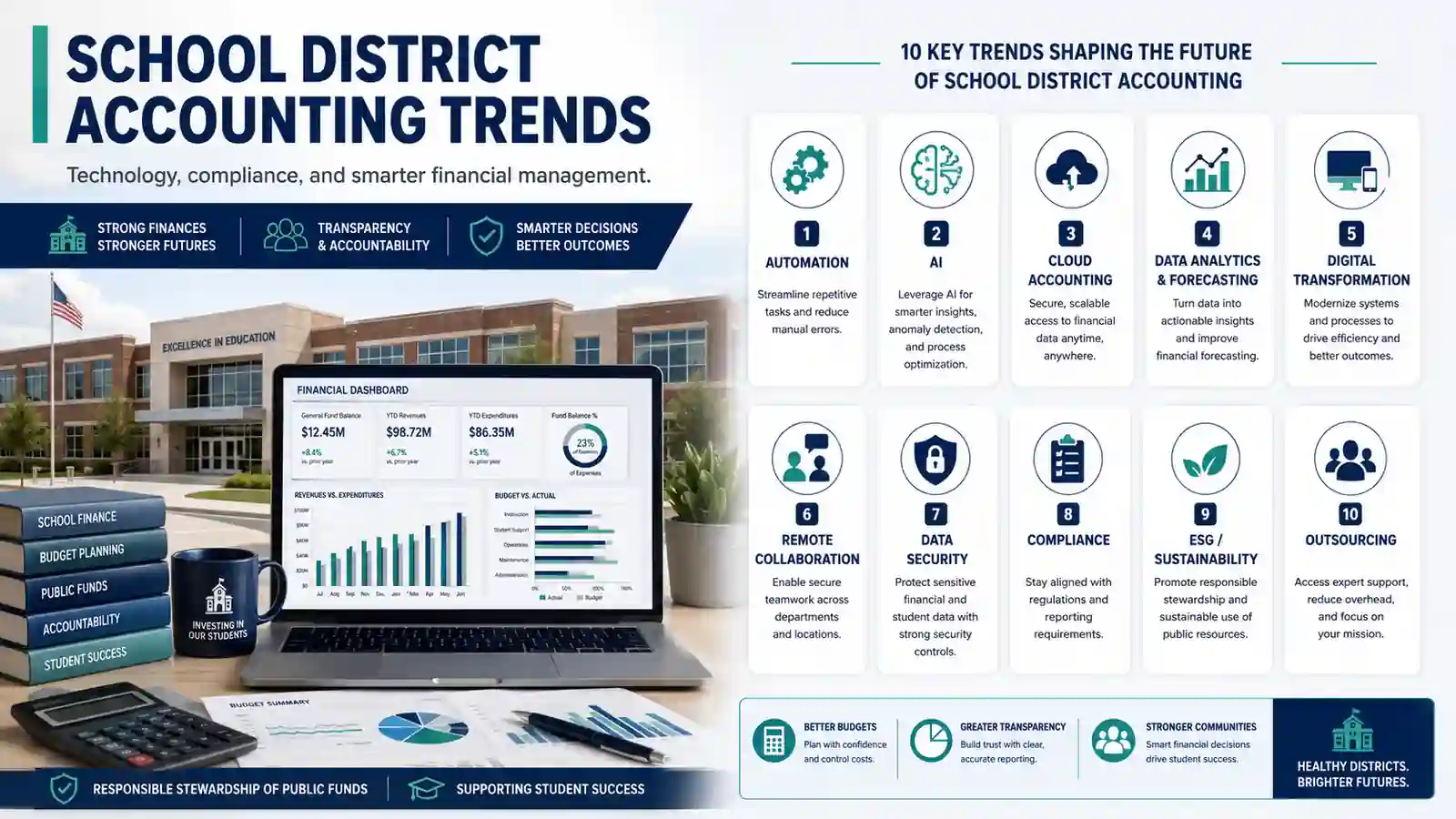
Cloud-based financial systems and automation genuinely do reduce manual workload in areas like purchase order processing, bank reconciliation, and routine reporting, that part of the conventional trends list isn’t wrong, it’s just underspecified. In a budget environment this tight, the more concrete value is usually in forecasting accuracy: districts modeling multi-year budget scenarios against enrollment projections and the ESSER spend-down timeline are better positioned to make staffing and program decisions proactively rather than reactively, which matters more this year than in a typical budget cycle.
Outsourcing specific functions, payroll processing, certain audit-adjacent tasks, remains a genuine cost lever for districts trying to avoid adding permanent headcount during a period when per-pupil funding is under this much pressure.
What This Means for District Revenue, Not Just Spending
Budget pressure this significant also puts a premium on the revenue side of a district’s ledger, not just cost control. Outstanding balances, meal debt, device and technology fees, activity and facility fees, that might have been written off as immaterial in a flush budget year carry more weight when every dollar has to be accounted for. Nexa’s school district collection services are built specifically for this: reputation-safe, FERPA-aware recovery designed for public education, not generic commercial collections.
School District Accounting Trends Vary Sharply by State
| State | 2025–26 School Finance Trend | What It Means for District Accounting & Budgets |
|---|---|---|
| California | California funded a 2.3% LCFF cost-of-living adjustment for 2025–26, while also creating a $1.9 billion LCFF deferral from 2025–26 into 2026–27. | Finance teams need to separate revenue entitlement from cash timing. A district can recognize expected state support while still facing short-term liquidity pressure from deferred payments. Multi-year cash-flow forecasting matters as much as the adopted budget. |
| Texas | HB 2 added $8.5 billion in new public-education funding over the biennium and created an Allotment for Basic Costs of $106 per enrolled student beginning in 2025–26. | Texas districts have new funding streams to incorporate into Foundation School Program estimates. Business offices should separately track new allotments, compensation commitments and recurring operating costs rather than treating the funding increase as one unrestricted pool. |
| New York | The enacted 2025–26 budget increased total School Aid by about $1.74 billion, or 4.9%, to $37.4 billion, including roughly $1.43 billion more in Foundation Aid. The Foundation Aid formula was also revised. | New York districts should pay close attention to Foundation Aid assumptions, pupil counts and expense-based reimbursements. State-aid growth can vary considerably by district even when the statewide total rises substantially. |
| Pennsylvania | Pennsylvania’s 2025–26 budget added $565 million in adequacy funding and another $105 million for Basic Education Funding. | Districts—particularly historically underfunded systems—need to model adequacy supplements separately from ordinary Basic Education Funding. This can materially alter multi-year revenue assumptions and the affordability of recurring staffing or programs. |
| Massachusetts | Massachusetts continued the Student Opportunity Act phase-in, with the FY2026 budget proposal providing about $7.32 billion in Chapter 70 aid, a roughly $420 million increase from FY2025. | Massachusetts districts should distinguish recurring Chapter 70 formula aid from targeted reimbursements and other funding streams. Enrollment, student-need factors and local contribution requirements remain central to district forecasting. |
| Washington | Beginning in 2025–26, Washington eliminated the 16% resident-enrollment cap used for state special-education funding, an important change for districts serving larger shares of students with disabilities. | Districts previously constrained by the cap may see a meaningful change in special-education revenue estimates. Finance teams should revisit special-ed revenue projections, expenditure allocations and local-fund assumptions rather than simply carrying prior-year ratios forward. |
The takeaway: there is no single U.S. school-district budget story. California districts are managing state-payment timing, Texas districts are incorporating new allotments, Pennsylvania is shifting more money through adequacy funding, and Washington has changed special-education funding mechanics. For school business officials, national trends like ESSER and GASB matter—but state funding formulas often determine what actually hits the ledger.
Frequently Asked Questions
What is the ESSER funding cliff, and is it actually over?
The ESSER funding cliff refers to the expiration of roughly $190 billion in federal COVID-era relief funding for K-12 schools. Districts had to commit the final tranche by September 30, 2024, and spend it down by January 28, 2025, with extensions available to March 30, 2026. The formal deadlines have largely passed, but the budget impact, an estimated $1,200 per-student cut nationally, according to Georgetown’s Edunomics Lab, is still working through district budgets as of the 2025-26 school year.
Do school districts follow FASB or GASB accounting standards?
School districts, as government entities, follow standards set by the Governmental Accounting Standards Board (GASB), not the Financial Accounting Standards Board (FASB), which governs private, for-profit companies. This distinction matters specifically for recent changes like GASB Statement No. 87 on lease accounting, which has no FASB equivalent requirement for districts.
What does GASB 87 actually require districts to do differently?
GASB 87 requires most leases, buses, equipment, portable classrooms, and similar arrangements, to be recognized as a lease liability and a right-to-use asset on the district’s balance sheet, rather than treated purely as a recurring operating expense. Districts generally needed to review existing lease agreements with their auditors to determine which arrangements are affected and how to reclassify them under the new standard.
Is the “fiscal cliff” narrative around ESSER funding accurate, or is it overstated?
This is genuinely debated. The core facts, the funding amounts and expiration deadlines, are well-documented and not in dispute. How severe the resulting budget impact actually is varies by analysis: some researchers point to real, documented staffing cuts already underway, while others, including the Heritage Foundation, argue states’ growing reserve funds mean many can absorb the transition more easily than the “cliff” framing suggests. The honest answer is that impact likely varies significantly by individual district’s specific financial position.
How does declining enrollment affect a district’s budget beyond the ESSER cliff?
Since most state funding formulas allocate money per-pupil, falling enrollment directly reduces baseline funding independent of federal relief expiring. The two pressures tend to compound rather than offset each other, since fixed costs like facilities and administrative overhead don’t shrink proportionally with a smaller student population, which often increases cost pressure on a per-pupil basis even as total enrollment declines.
Should a district with a tight budget be more aggressive about collecting unpaid fees and balances?
Generally yes, though “aggressive” is the wrong word for how it should be done. Balances that were reasonable to write off as immaterial in a well-funded year carry more weight now, but public school districts also carry outsized reputational risk from heavy-handed collection tactics. A structured, diplomatic recovery process tends to outperform either ignoring balances entirely or pursuing them too forcefully.