• Skip to main content
  • Skip to primary sidebar

Nexa Collections

  • Home
  • Serving
    • Medical
    • Dental
    • Small Business
    • Large Business
    • Commercial Collections
    • Government
    • Utilities
    • Fitness Clubs
    • Schools
    • Senior Care Facility
  • Contact Us
    • About us
    • Cost

Search Results for: the bureaus

California Medical & Healthcare Debt Collection Agency

Given California’s strict medical debt collection regulations, it is crucial to hire a specialist well-versed in state laws. Attempting do-it-yourself collection carries a high risk of legal non-compliance and potential litigation.

While the rules get stricter every year, medical debt keeps growing:

  • More than 1 in 3 Californians (around 35–40%) report having some form of medical debt.

  • A significant share of those with medical debt owe $5,000 or more.

  • In large counties like Los Angeles, total personal medical debt is estimated in the billions of dollars.

  • Nationally, Americans owe well over $200 billion in medical debt.

For hospitals, physician groups, surgery centers, behavioral health providers, and ancillary services, this translates into swollen A/R, more write-offs, and tighter margins. A California-savvy, HIPAA-compliant recovery partner can help you improve collections while protecting your reputation.

Need a Medical Collection Agency in CA: Contact us


Why California Medical A/R Is So Hard to Control

Providers across California report similar A/R headaches:

  • High deductibles and self-pay balances even for insured patients, making it expensive to chase smaller balances internally.

  • Complex payer mix (Medi-Cal, exchange plans, employer plans, HMOs/PPOs), which leads to denials, underpayments, and confusing EOBs that patients don’t understand.

  • Inconsistent financial-assistance screening, so some patients who may qualify for charity care or discounts still end up in collections, creating complaint and compliance risk.

  • Short staffing in billing and front-office teams, leaving limited time for systematic follow-up calls, appeals, and payment-plan management.

  • Reputation risk in a state where many residents already delay or skip care because of cost; a single bad interaction on a past-due bill can quickly turn into negative online reviews or regulatory complaints.

Because of this, many providers now use a structured approach: early in-house reminders for a short period, then timely placement with a specialized medical collection team once internal efforts are no longer productive.


Key California Rules That Shape Medical Collections

Any California medical collection strategy has to respect both federal and state law:

  • FDCPA (federal) – Governs third-party debt collectors and bans harassment, misrepresentation, and unfair practices.

  • Rosenthal Fair Debt Collection Practices Act (California) – Extends many FDCPA-style protections to original creditors, including medical offices. Even your own staff can create liability if they use overly aggressive or misleading language.

  • Statute of limitations – For most written contracts (which includes the typical medical bill), California generally allows about 4 years from the date of breach to file suit. After that, the debt is usually time-barred for litigation, even if it still appears on your internal A/R.

  • Surprise-billing protections – California law and the federal No Surprises Act limit what you can bill in many out-of-network emergency or facility scenarios, and in some cases you may not be allowed to pursue certain amounts from the patient at all.

With rules evolving and enforcement getting stricter, many providers deliberately keep their in-house approach “soft” and rely on specialists for later-stage collections.


HIPAA-Compliant Medical Collections

Past-due accounts still contain PHI. Any collection team working your medical A/R should be fully HIPAA compliant, including:

  • Signing and honoring Business Associate Agreements (BAAs)

  • Using secure, encrypted methods for data transfer and storage

  • Training staff on minimum-necessary access to PHI and proper handling of sensitive information

  • Maintaining detailed audit trails of every contact and action taken on the account

This protects patients, limits the risk of a reportable breach, and demonstrates that your revenue-cycle process respects privacy from end to end.


The Credit-Reporting Reality for Medical Debt

Credit reporting has become one of the most confusing and sensitive parts of medical collections.

1. Government Direction Is Unclear

Regulators have repeatedly raised concerns about the use of medical bills in credit decisions, and at one point a nationwide rule was finalized to remove medical bills entirely from credit reports. That rule was later struck down in court, and the situation remains unsettled.

In simple terms:

  • The government has not provided a clear, stable path on credit reporting of medical accounts.

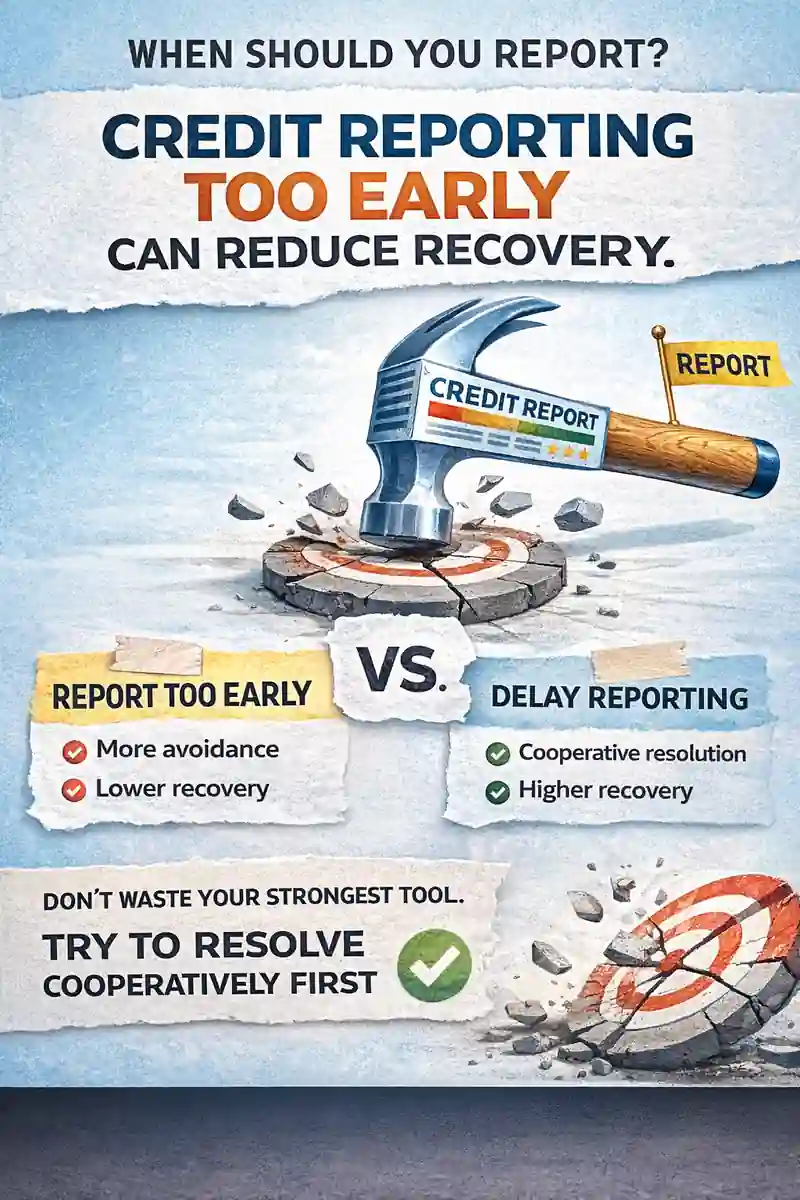
  • Because of this uncertainty and legal risk, most collection agencies are now avoiding credit reporting on medical debt or using it only in very narrow, carefully reviewed situations, and often only when the client insists and legal counsel is comfortable.

2. Credit Bureaus’ Own Restrictions (The Numbers)

Separately from regulators, the three major credit bureaus (Equifax, Experian, TransUnion) have their own strict limits on medical collections. In general:

  • A medical collection account typically cannot be reported until it is at least 365 days old (one full year from the date of first delinquency), to allow time for insurance and billing issues to be resolved.

  • Medical collection accounts with an original reported balance below $500 are not included on consumer credit reports.

  • When a reported medical collection debt is paid in full, it is removed from consumer credit files.

This means that only older, larger, still-unpaid balances are even eligible to appear on reports — and many providers decide that using credit reporting for those accounts still isn’t worth the risk to their brand and patient relationships.

Note: This section is for general information only and is not legal advice. Always consult your attorney before setting or changing your credit-reporting policy.


What to Look For in a California Medical Collection Partner

Given all of this, a strong California-focused medical collection team should provide:

  • Strict compliance with HIPAA, FDCPA, the Rosenthal Act, surprise-billing rules, and your own financial-assistance policy.

  • Reputation-safe outreach – calm, respectful, solution-oriented conversations that reduce complaints and protect online reviews.

  • Clear stance on credit reporting – including when they do not report, and how they handle:

    • The $500 minimum balance rule

    • The 365-day waiting period before reporting

    • Removal of paid medical collections

  • Tight dispute handling – documented workflows to manage disputes, validation requests, and insurance issues quickly and accurately.

  • Flexible patient payment options – structured payment plans, digital payments, reminders, and coordination with your charity-care and discount policies.

  • Useful analytics – reporting that shows placement volumes, recovery rates, aging trends, and patient-experience indicators by service line and location.

The right partner should improve net collections and reduce risk — not just increase the number of calls.


When to Place California Medical Accounts

Policies vary by organization, but many California providers follow a pattern like this:

  • 0–45 days from first statement: Internal statements, email/text reminders, and friendly reminder calls.

  • 45–120 days: Accounts that are still unpaid, not in active dispute, and not in charity-care review are placed with a specialized medical collection team for structured follow-up.

  • Later stages: Only a limited set of high-balance, well-documented accounts are considered for stronger actions. If credit reporting is used at all, it is generally reserved for these, in line with bureau rules and legal advice.

This staged approach helps you reduce bad-debt write-offs while maintaining a patient-friendly image and complying with evolving regulations.

What a Medical Collection Agency must Offer:

  • Compliance Assurance: Adherence to California state and federal laws, including HIPAA and FDCPA.

  • Patient-Friendly Tactics: Use compassionate, respectful language with patients.

  • Regular Reporting: Provide consistent updates on collection activities.

  • Custom Payment Plans: Flexible options to help patients settle their balances.

  • High Recovery Rates: Efficiently collect outstanding debts.

  • Medical Collection Expertise: Knowledge of healthcare billing and insurance.

  • Secure Data Handling: Ensure patient data confidentiality.

  • Technology Integration: Use advanced systems for tracking and reporting.

  • Multilingual Support: Cater to patients with different language preferences.

  • Dispute Resolution Skills: Handle any payment disputes effectively.

  • Transparent Fee Structure: Clear and upfront pricing without hidden costs.

  • Tailored Strategies: Customized approaches for different types of debts.

  • Positive Reputation: Good standing with local medical providers.

  • Legal Support if Needed: Assistance with legal processes when required.

 
Need a Medical Collection Agency in California: Contact us


Filed Under: Medical

Texas Medical & Healthcare Debt Collection Agency

To run a successful medical practice or hospital, you need to be able to get paid in full for the services you provide. If you are a doctor or work on the business side in a hospital in the state of Texas, you know the aggravation of medical debt collection. This is a problem the medical community all over the country faces but in Texas, there are state-specific challenges to deal with. Here is the current state of Texas medical debt collection.

Medical Debt in Texas

Debt, in general, is a problem in the United States and Texas is one of the “leaders” in this issue. 71 million Americans have debts that are currently in collection. Texas is second, only to Louisiana, in the percentage of residents who have debts in collection. A hefty 44% of all Texans face collection which equates to approximately 12.7 million Texas residents or, almost 18% of the total number of Americans with pending dent collection. A big portion of this debt is related to medical bills. The overall median medical debt in collections for a person in Texas is $850.

Need a Medical Collection Agency in Texas: Contact us

Texas Medical Collection Laws

Medical debt collectors in Texas are beholden to the Federal laws on the books that relate to debt collection. These can be found by looking at the Federal Trade Commission website. There are some Texas-specific laws that creditors need to know. One is that Texas is a homestead state which means, in most cases, a debtor’s home cannot be taken away to pay a debt. Also, wages can only be garnished in Texas in certain cases and unpaid medical bills are not one of them. These and other Texas laws relating to medical debt collection can be found on the Texas Attorney General’s website.

There is another, lesser-known, law in Texas that applies specifically to the timing of medical billing. A Texas civil statue states that you must “bill a patient or other responsible person for services provided to the patient not later than the first day of the 11th month after the date the services are provided.” This makes the timing of medical billing even more crucial in Texas.

Bond Requirement: In Texas, third-party debt collectors and credit bureaus must post a $10,000 bond with the secretary of state.

Communication: Under the TDCA, a debtor has the right to request in writing that a debt collector or creditor cease communication with them. Once a cease communication request has been made, the collector is limited to filing a lawsuit or discontinuing their collection efforts.

Statute of Limitations: Texas law sets forth a four-year statute of limitations for many types of debt, including credit card debt and medical debt. This means a debt collector cannot sue a consumer for a debt that is more than four years old.

Texas provides protections to consumers through state laws that align with the federal Fair Debt Collection Practices Act (FDCPA), along with some additional provisions under the Texas Debt Collection Act (TDCA)

Problems Faced by Doctors and Hospitals Texas

 While the issue of medical debt collection is not unique to Texas, many of the problems it causes here are. One of the biggest problems facing Texas doctors and hospitals is the financial viability of hospitals located in the most rural areas of the state. 131 rural hospitals across the country have closed their doors since 2010 and 23 of them (or just under 18%) have been in Texas. In addition to these hospitals that have closed, about 50% of Texas’ 150 or so rural hospitals are in financial danger.

Another challenge facing Texas doctors and hospitals is that the state has some of the largest amounts of uninsured residents in the country. There are more uninsured people in Texas than California even though the west coast state has 40% more people. These two factors are big challenges for doctors and hospitals in Texas and a major reason why medical debt is such a huge concern.

Filed Under: Medical

Will a Collection Agency Ruin My Business Relationship?

It isn’t uncommon for people to have unpaid debt wind up at a Collection Agency. Sometimes they forget that they have an outstanding balance and other times, they simply don’t have the money to pay the lump sum.

If you are a business owner, you may have been forced to make the difficult decision to send your delinquent customer or a business partner to a debt collector.

Most B2C debt is transferred to a collection agency after 60-90 days of non-payment. Most B2B partners try to postpone making this move, but if they are dodging your requests for payments, you may have not have had any other choice. The question is, will this move ruin your business relationship?

Debt collectors are often met with a negative connotation. Your delinquent customer or a business partner probably won’t be happy to learn that you sent their balance to a collector. The good news is, debt collectors use a diplomatic approach specifically so that your business relationship remains in good standing. They understand the importance of business relationships and work hard to preserve it. They will work with the debtor in order to consolidate or get rid of their debt entirely.

To get a full grasp of this concept, let’s look at how a collection agency works in order to determine how it affects your business relationship.

Understanding How Debt Collectors Work

If you decide to send someone’s unpaid balance to a collection agency, they will be immediately notified; usually via phone call or a collection letter. These contacts are often met with apprehension because being sent to collections can possibly effect the debtor’s credit score if the creditor has requested the collection agency to report the debt to the credit bureaus. And, naturally, this can ruin their chances of getting a car, a house, or a business loan.

When Debt Is Sent To Collections

It’s difficult to know when it is time to write off the unpaid debt as a loss. If you have been working with your business partner for some time, you may wait for months or even years before you decide to send their debt to collections. However the chances of recovering the past due amount go down by about 10% each month. The longer you wait, higher the chances are that you will never recover your money.

There is no set dollar amount or time frame that depicts when it’s time to write off unpaid balances. If you get the impression that your partner isn’t going to pay off their capital or they haven’t made an effort to set up payments, you should absolutely cut your losses.

Debt can be sent to a collection agency 31 days past the due date, though many wait until after three to six months of nonpayment. It is recommended to use Debt Collection Letters after 60 days past due date. If the debt is over 120 days or more past due then go for the Collection Calls service.

How It Affects The Debtor’s Credit Score

Not everyone’s credit score is affected unless the original creditor instructs the collection agency to report the debt to the credit bureaus. Generally speaking, those with higher credit scores are often penalized more points than those who have a lower credit score. The amount owed will also determine how many points will be shaved off their credit score.

How A Collection Agency Will Approach Your Delinquent Customer or Business Partner

If someone owes you money, knowing how collection agencies approach debtors can help you rest easy about your decision. In the past, the tact of a debt collector was to make relentless phone calls demanding payment. And if you’re looking to maintain your business relationship, having put your partner in this situation is obviously going to cause some tension.

However, now with the Fair Debt Collection Practices Act (FDCPA), agencies use a more subdued approach when contacting your partner or associate.

Talk To Your Associate First

As the original creditor, you can only send someone to collections 31 days after the payment is past due. The best practice to maintain your business relationship is to talk with your associate first. Have a system in place to send out reminders that payment is due. This includes regular emails, phone calls, and other points of contact.

Approaching your associate about their late payment first can help preserve your relationship. This is recommended instead of sending them straight to collections without warning or notice of this action.

 The Fair Debt Collection Practices Act

This act was created once it had been made clear that, “Abusive debt collection practices contribute to the number of personal bankruptcies, to marital instability, to the loss of jobs, and to invasions of individual privacy.” Along with other reasoning established in this act, debt collectors may not be abusive or vexatious when approaching debtors.

Instead, collection agencies will approach your partner in an amicable way. They may even give guidance on setting up payments to their debt. With these practices, you can rest assured that sending someone’s debt to an agency should not ruin your business relationship. We only recommend notifying your business associate first and educate them on your impending decision to write off their debt. Once you’ve made your decision, the debt agency will take the reins to help settle the outstanding balance.

Conclusion

No Collection Agency can guarantee that your business relationship with the debtor will remain intact during the collection process. However, this article simply conveys you that all good collection agencies use diplomatic and an amicable way to collect a debt, rather than the common notion that debt collectors are intensive, abusive or threatening. This drastically ups the chances to retain your business relationship. If any agency uses threat tactics, it just violated the debt collection laws.

Filed Under: Debt Recovery

Direct Credit Control (DCC) – Debt Collection

Directory >> USA >> California >> Los Angeles >> Direct Credit Control

Direct Credit Control, Inc. (DCC) is a full-service, third-party collection agency with over 30 years of combined collection experience. Each month, DCC reports all valid collection debts to TransUnion LLC and Experian, the National Credit Bureaus. DCC works only in the state of California.

Contact Address:
Direct Credit Control, Inc.
2512 Artesia Blvd
Suite 140-D
Redondo Beach CA 90278

Headquarters Address:
3333 Wilshire Boulevard,
7th Floor
Los Angeles, CA 90010

Phone:

Client Services
(888) 860-2950

Collection Office
(310) 937-3333,
(877) 673-6337

Fax:
(310) 861-1818

Email/Contact:
PBishop@DirectCreditControl.com

Additional Information:

We collect on ALL types of consumer debts. Medical, Dental, Student Tuition, Property Management, Auto Dealerships and judgments.

DCC is not a letter service; each account is assigned to one of our “in-house”, telephone demand collectors. Of course we use collection notices and demands sent by mail, but all collection dun notices are sent by the collector in charge of the account. Collection notices and telephone calls may be directed to a debtor’s place of employment.

Website:
DirectCreditControl.com

Source of information / References:
Information emailed to us by: PBishop@DirectCreditControl.com on 09/24/2019

Make changes to this page? or Add a new collection agency listing?
If you own this collection agency and there is a need to update information presented on this page, kindly email us at “directory@NexaCollect.com“

Information presented about this collection agency may not be 100% accurate or may have changed since we created this page. Kindly visit the agency’s website for the most up to date information.

US Debt Collection Laws: A Guide for Business Owners

debt recovery laws

The Ultimate Guide to USA Debt Collection Laws: Compliance, Statutes, and Recovery

Navigating the landscape of debt recovery in the United States is like walking through a minefield. For business owners and creditors, the goal is simple: recover overdue revenue. However, the path to payment is governed by a complex web of federal acts and state-specific regulations.

One misstep—an accidental call too early in the morning or a letter sent to the wrong address—can result in lawsuits that cost far more than the original debt.

At NexaCollect, we believe that knowledge is leverage. This guide breaks down the essential collection laws you must know and explains why partnering with a nationwide, licensed agency is your best defense against liability.


1. The Federal Framework: The “Big 6” Collection Laws

Federal laws set the baseline for debt collection across all 50 states. While these primarily target third-party collection agencies (like us), original creditors must adhere to many of these standards to avoid “Unfair, Deceptive, or Abusive Acts or Practices” (UDAAP) claims.

A. The Fair Debt Collection Practices Act (FDCPA)

This is the “constitution” of debt collection. Enacted in 1977, it prohibits abusive practices.

  • Communication Limits: Collectors cannot call before 8:00 AM or after 9:00 PM (local time).

  • Harassment: No threats of violence, use of profane language, or repeated calling to annoy.

  • False Statements: Collectors cannot claim to be attorneys or government officials if they are not, nor can they threaten legal action they do not intend to take.

  • Validation: The debtor must be sent a written “Validation Notice” within 5 days of initial contact, detailing the debt and their right to dispute it.

B. The Fair Credit Reporting Act (FCRA)

This law governs how debt is reported to bureaus (Equifax, Experian, TransUnion).

  • Accuracy: Creditors and agencies must report accurate information.

  • Disputes: If a consumer disputes a debt, the furnisher of information must investigate and correct errors within 30 days.

  • 7-Year Rule: Most negative credit information must be removed after seven years.

C. The Telephone Consumer Protection Act (TCPA)

In the modern era, this act is a major source of litigation.

  • Robocalls: It strictly restricts the use of auto-dialers and pre-recorded messages to cell phones without express consent.

  • Revocation: Consumers can revoke consent to be called at any time.

D. Servicemembers Civil Relief Act (SCRA)

This protects active-duty military personnel.

  • Interest Caps: Interest on pre-service debts is often capped at 6%.

  • Legal Protections: It creates high hurdles for obtaining default judgments against active servicemembers.

E. Gramm-Leach-Bliley Act (GLBA)

While primarily for financial institutions, this affects collection by mandating strict privacy rules regarding how non-public personal information (NPI) is shared and protected.

F. HIPAA (Medical Debt):

For healthcare providers, the Health Insurance Portability and Accountability Act (HIPAA) mandates that collection agencies must sign a Business Associate Agreement (BAA) and strictly limit the use of Protected Health Information (PHI) to the minimum necessary for recovery.


2. State-Specific Nuances: Where It Gets Tricky

Federal law is the floor, not the ceiling. Many states have enacted “mini-FDCPAs” that are stricter than federal law.7 A nationwide agency must use software that automatically adjusts to these local rules.

California: The Rosenthal Act

  • Scope: Unlike the federal FDCPA, California’s Rosenthal Act applies to original creditors as well as third-party agencies.

  • Recording: California is a “two-party consent” state, meaning you cannot record a collection call unless the debtor agrees.

New York: Consumer Credit Fairness Act

  • Statute of Limitations: Recently reduced from 6 years to 3 years for consumer credit transactions.

  • Notice: Requires specific, detailed notices to be mailed to debtors before and during the legal process.

Texas: Texas Debt Collection Act (TDCA)

  • Bonding: Third-party agencies must file a surety bond with the Texas Secretary of State.

  • Fee Limits: Strict limits on adding collection fees unless explicitly authorized by the contract and state law.

Massachusetts: Frequency Limits

  • Strict Contact: Collectors generally cannot initiate a communication with a debtor (via phone or text) more than twice within a seven-day period.

Florida: FCCPA

  • Consumer Protection: Prohibits communicating with a debtor if the creditor knows the debtor is represented by an attorney. Violations carry statutory penalties even without actual damages.


3. The Statute of Limitations (SOL) Guide

The Statute of Limitations is the time period a creditor has to file a lawsuit to collect a debt. Once this expires, the debt is “time-barred.” You can still ask for payment, but you cannot sue.

Note: B2B (Written Contracts) often have longer SOLs than Open Accounts (Credit Cards).

State Open Account (Credit Card) Written Contract Oral Contract
California 4 Years 4 Years 2 Years
Florida 4 Years 5 Years 4 Years
Georgia 4 Years 6 Years 4 Years
Illinois 5 Years 10 Years 5 Years
New York 3 Years 3 Years 3 Years
Texas 4 Years 4 Years 4 Years
Pennsylvania 4 Years 4 Years 4 Years

(Disclaimer: Laws change frequently. Always consult a legal professional for specific case advice.)


4. Why You Need a Full-Spectrum, Licensed Agency

Given the complexity of the laws above, managing collections in-house is risky. Here is why partnering with NexaCollect is the smartest move for your bottom line and your brand.

A. Nationwide Coverage & Licensing

We are licensed and bonded to collect in all 50 states. If your debtor moves from Texas to New York, you don’t need a new agency. We follow them, adjusting our compliance protocols automatically to match their new jurisdiction.

B. Protecting Your Reputation (High Google Ratings)

The old “break their knees” approach to collections is dead. It results in lawsuits and 1-star reviews that kill your future sales.

  • Our Approach: We view ourselves as an extension of your customer service. We use diplomatic, firm, and respectful mediation to recover funds. This is why our agency maintains high Google ratings—we treat people with dignity.

C. The Full Spectrum Model: Fixed-Fee to Legal

Most agencies force you into a 40% contingency fee immediately. We don’t. We offer a tiered approach designed to save you equity:

  1. Step 1 & 2 (Fixed-Fee): For a low flat rate (e.g., $15/account), we act as a third-party intervention. You keep 100% of the money recovered here.

  2. Step 3 (Contingency): If they don’t pay, we escalate to intensive calls. We only charge a percentage (typically 40%) if we collect.

  3. Step 4 (Legal): If the debtor has assets but refuses to pay, our network of specialized attorneys can litigate.

D. Commercial vs. Consumer Expertise

Laws for collecting B2B (Commercial) debt differ vastly from Consumer debt. The FDCPA primarily protects consumers. Commercial collections allow for more aggressive strategies. Our team is trained to distinguish between the two, maximizing pressure on businesses while staying compliant with consumers.


Summary

Debt collection in the USA is not just about persistence; it’s about precision. With the FDCPA, TCPA, and state laws like the Rosenthal Act watching every move, you need a partner who understands the rules of the game.

NexaCollect offers the compliance shield you need with the recovery results you deserve.

Ready to recover your revenue without the risk?

Contact Us Today for a Free Quote

Filed Under: Debt Recovery

Collection Agency for Towing and Recovery Business

Tow-recovery-collection

Past-due accounts are a significant drag for towing operators.  This hurts their cash flow and profitability. This situation arises because of dishonored checks, payment disputes, damages, or just because a car owner did not fulfill their obligation to pay as promised.

Is Your Impound Lot Becoming a Free Parking Garage?

If you run a towing or vehicle storage business, you know the reality: The lien sale is a broken system.

You tow a vehicle, store it for 30, 60, or 90 days, sending out certified letters that get ignored. By the time you finally get the legal right to auction it, the car is often a non-runner or a total loss. You sell it for scrap value—maybe $300—but the outstanding bill for towing, storage, and admin fees is $2,500.

Most towing companies write off that $2,200 difference as a loss. This is a massive mistake.

In 2024, with the FTC targeting “junk fees” and insurance companies fighting every storage invoice, relying on auctions to pay your bills is a strategy for bankruptcy. You need a recovery partner that understands Deficiency Balances and how to collect them without triggering a “predatory towing” lawsuit

The “Auction Trap”: Why Selling the Car Doesn’t Pay the Bills

The mathematics of a lien sale rarely work in your favor.

  • The Valuation Gap: You are legally required to auction the vehicle, often to the highest bidder. If that bidder is a scrap dealer, you get pennies on the dollar.

  • The “Abandonment” Mindset: Many vehicle owners want you to keep the car. They are using you as a free disposal service for their totaled or broken-down vehicle.

  • The Operational Cost: Between certified mailings, newspaper ads, and auctioneer fees, many tows result in a net negative cash flow.

Why switch to Nexa?

  • Recover the “Deficiency Balance”: State laws generally allow you to pursue the remaining balance after the auction proceeds are applied. We specialize in collecting this specific debt.

  • Stop the “Insurance Runaround”: We know how to handle insurance adjusters who delay payment hoping you’ll give up.

  • Protect Your License: With the FTC cracking down on towing practices, our strict adherence to Regulation F ensures you recover funds ethically, protecting your state operating license.

A Recovery Strategy Built for Towing & Recovery

We don’t use a generic retail collection model. We use a system designed for the unique lifecycle of an impound.

Phase 1: The “Pre-Lien” Pressure (Days 10-45)

  • The Goal: Get paid before you are stuck with a worthless car.

  • The Tool: Step 1 & 2 Flat-Fee ($15/account).

  • The Action: We send official, third-party demands to the registered owner (and insurance carrier, if applicable). This signals that you are not just a storage lot; you are a creditor who will impact their credit score.

  • The Result: Owners often pay to avoid collections, or insurance companies finally cut the check. You keep 100% of the money.

Phase 2: The “Deficiency” Pursuit (Post-Auction)

  • The Goal: Recover the $2,000+ balance left after the car is sold for scrap.

  • The Tool: Step 3 Contingency (40% fee).

  • The Action: The car is gone. The owner thinks they are free. We use skip-tracing to locate them and enforce the debt. We report the unpaid balance to credit bureaus, preventing them from financing their next car until they pay you.

  • The Result: You recover “lost” revenue that goes straight to your bottom line.

Recent Results: Real Recovery Scenarios

The “Total Loss” Abandonment (Florida)

  • The Problem: A towing firm recovered a sedan from an accident scene. The owner had no collision coverage, and the car was totaled. He abandoned it at the lot. Total bill: $3,200. Auction proceeds: $450.

  • The Fix: We pursued the $2,750 deficiency balance. Using skip-tracing, we found the owner at a new job.

  • The Outcome: Facing a credit hit that would ruin his chances of financing a replacement vehicle, the owner agreed to a monthly payment plan. The towing company recovered $2,100 of the deficiency.

The Commercial Trucking “Ghost” (Texas)

  • The Problem: A heavy-duty tower hauled a breakdown semi-truck. The trucking company (debtor) ignored the $5,800 invoice, betting the tower wouldn’t sue.

  • The Fix: We ran a Litigious Defaulter Check and confirmed the trucking company was still active and solvent. We sent Step 2 demands to their Accounts Payable department.

  • The Outcome: The trucking company paid in full immediately to avoid a “collection” flag on their Dun & Bradstreet business credit profile. Cost to client: $15.

FAQ: Navigating Towing Collections

Q: Can I really collect money after I’ve sold their car?

A: Yes. In most jurisdictions, the proceeds from the lien sale are applied to the debt. If the debt was $2,000 and the car sold for $200, the owner still legally owes you $1,800. This is the “Deficiency Balance,” and it is a valid, collectible debt.

Q: What if the debtor blocks your calls?

A: They can block calls, but they cannot block the US Postal Service. Our demand letters are delivered directly to their mailbox (or their new address via NCOA scrubbing). This creates the “paper trail” required for legal enforcement, which cannot be blocked or ignored like a voicemail.

Q: Do you handle insurance claims that are “pending”?

A: We handle the debt. If an insurance company is dragging its feet, assigning the account to us often motivates the policyholder (your customer) to pressure their insurer to pay up.

Q: Is there a risk of being sued for “Predatory Towing”?

A: Not if you follow the law. We are experts in the FDCPA and FCRA. We do not harass; we validate and enforce. By using a licensed third-party agency, you actually reduce your liability compared to having your own staff make angry demands.

Collection Letters Service
  • The upfront cost for 5 Collection Letters is about $15 per account.
  • Debtors pay directly to you, no other fees. Low-cost option.
  • Good for accounts less than 120 days past due.
Collection Calls Service
  • Contingency fee only. No upfront or other fees.
  • Agency gets paid a portion of money they recover.  No recovery-No fees.
  • Best for accounts over 120 days. A debt collector calls a debtor many times.
  • If everything fails, a possible Legal Suit if recommended by the attorney.

Turn Your “Scrap” Into Cash

Stop accepting scrap value for your hard work. Enforce your invoices and get paid for the service you provided.

Need a Collection Agency? Contact Us

Filed Under: Debt Recovery

  • « Go to Previous Page
  • Page 1
  • Interim pages omitted …
  • Page 8
  • Page 9
  • Page 10
  • Page 11
  • Page 12
  • Interim pages omitted …
  • Page 17
  • Go to Next Page »

Primary Sidebar


accounts receivable

Need a Collection Agency?
Kindly fill this form.
We’ll get in touch with you

    Please prove you are human by selecting the tree.

    Recent Posts

    • Federal Government Shutdown: Impact on Collections
    • 2025-2026 ROI & Opportunity Matrix for Collection Agencies
    • Collection Agency to Recover Timeshare Unpaid Bills
    • When Should I Send Dental Accounts to Collections? A Guide for a Healthy Practice
    • 10 Signs You Need to Hire a Medical Debt Collection Agency
    • Debt Collection for Telehealth Providers: Proven Strategies & Best Practices
    • The Rise of Mobile Payment Solutions in Debt Collection
    • Why Cybersecurity Matters for Collection Agencies

    Featured Posts

    • How to Reduce Medical Billing and Receivables Complications
    • How to Write an Effective Credit Policy for Your Company?
    • Collection Agency: Home and Office Security Industry
    Directory of collection agencies
    Collections

    Featured Agencies

    • Credit & Collection Recovery Service (CCRSI) – Collection Agency
    • Personal Collectors of Arizona (PCA) – Debt Collection
    • Rapid Collection Systems (RCS) – Debt Collection

    Copyright © 2025 NEXACOLLECT.COM | All information on this website is for general information only and is not an experts advice. We do not own any responsibility for correctness or authenticity of the information, or any loss or injury resulting from it. NexaCollect is not a collection agency.

    X
    Need a Collection Agency?
    Contact Us