Nashville isn’t just Music City, it’s arguably the healthcare industry’s headquarters city. HCA Healthcare, the largest hospital operator in the country, is based here, alongside Vanderbilt University Medical Center and a dense layer of healthcare management, staffing, and services companies most cities don’t have. A collections partner that doesn’t understand medical billing specifically, and Tennessee’s particular rules around it, is missing the account type that defines a meaningful share of this city’s commercial receivables.
Quick answer: Nashville collections require Tennessee-specific compliance, a 6-year statute of limitations for written and oral contracts, 4 years for goods sales under the UCC, and a wage garnishment cap that behaves differently than in states with their own minimum wage: Tennessee defers to the federal $7.25/hour floor, so the garnishment-exempt income threshold sits lower than in states like California or Washington. Nexa recovers Nashville accounts starting at a $15 fixed fee per account, with contingency options for older balances, built around this city’s healthcare-heavy economy and Tennessee’s specific medical billing rules.
Nexa provides a reputation-safe approach, equipped with all 50-state collections license, offering free credit reporting, free litigious debtor check, free bankruptcy scrub, and zero onboarding fees. Secure – SOC 2 Type II & HIPAA compliant. Over 2,000 online reviews rate us 4.85 out of 5.
Need a Collection Agency in Nashville? Contact us
What Makes Nashville Different
This is genuinely a healthcare headquarters city, not just a healthcare-adjacent one.
Beyond HCA and Vanderbilt, Nashville hosts a dense concentration of healthcare management, staffing, and services companies that manage receivables for practices and facilities well beyond the city itself. A collections partner without real medical billing depth, HIPAA-compliant handling, familiarity with insurance denial patterns, awareness of financial-assistance screening requirements, is working with the wrong toolkit for a meaningful share of this market.
Tennessee’s garnishment floor works differently than in higher-minimum-wage states.
Under T.C.A. § 26-2-106, garnishment is capped at the lesser of 25% of disposable earnings, or the amount exceeding 30 times the applicable minimum hourly wage. Because Tennessee has no state minimum wage of its own, that calculation runs off the federal $7.25/hour rate, protecting roughly $217.50 per week. In a state like California or Washington with a substantially higher local minimum wage, that same formula protects considerably more income. Neither is objectively better, but the practical effect for a creditor is that Tennessee’s garnishment floor generally leaves more of a judgment reachable against a lower-wage debtor than it would in those states.
Medical debt garnishment isn’t restricted here, unlike some neighboring approaches.
Several states, including Texas, Pennsylvania, and New York, place specific restrictions on garnishment for medical debt. Tennessee doesn’t carve out that exception, medical debt judgments follow the general garnishment rule. Tennessee does separately cap uninsured hospital billing at 175% of cost and bars medical debt from appearing on consumer credit reports, real protections, just structured differently than a garnishment restriction.
The Tennessee Legal Landscape
| Statute of Limitations (written & oral contracts) | 6 years — T.C.A. § 28-3-109 |
| Statute of Limitations (sale of goods, UCC) | 4 years |
| Wage Garnishment | Lesser of 25% of disposable earnings, or earnings above 30x the applicable minimum wage (federal $7.25/hr, no state minimum) — T.C.A. § 26-2-106 |
| Dependent Child Exemption | Additional $2.50/week per dependent child under 16 — T.C.A. § 26-2-107 |
| Medical Debt Garnishment | Not specifically restricted (unlike TX, PA, NY) |
| Uninsured Hospital Billing Cap | 175% of cost |
| Medical Debt Credit Reporting | Generally barred |
| Judgment Life | 10 years, renewable |
What This Costs
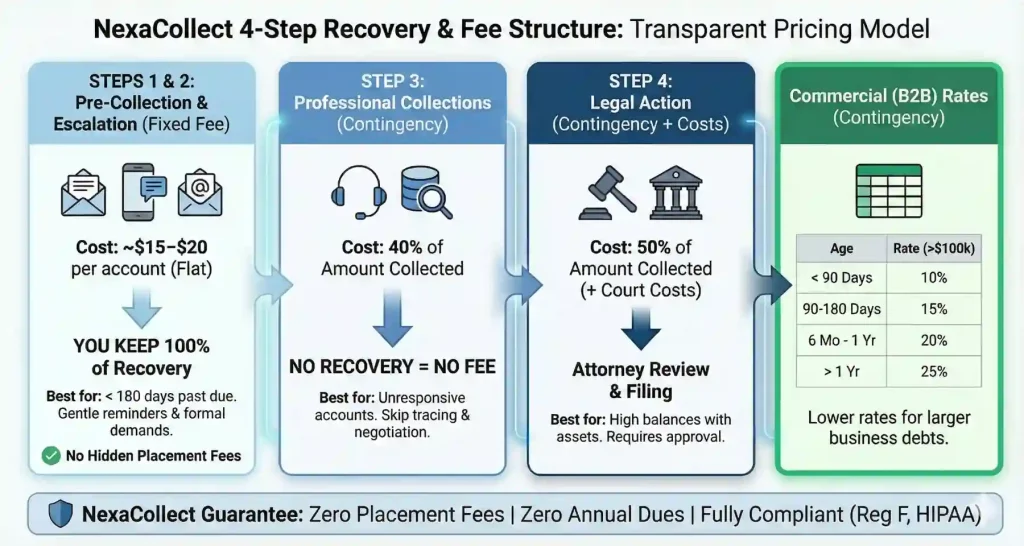
Step 1 & 2: Fixed-Fee Recovery (~$15/account). Five professional demand touches for accounts under roughly 60 days. Payments go directly to you. See the full pricing breakdown.
Step 3: Contingency Collection (20~40%). For older or unresponsive accounts, no recovery, no fee.
Step 4: Legal Referral (client-approved, ~50%). Only where the balance and circumstances justify it, filing fees reimbursed from the first recovery.
Who We Collect For Across Nashville & Middle Tennessee
- Medical & Healthcare Systems: HIPAA-compliant patient balance recovery for the practices, clinics, and healthcare management companies concentrated around the Vanderbilt medical corridor and beyond.
- Dental: Patient-first dental debt recovery for practices across Green Hills, Brentwood, and the wider metro.
- Music & Entertainment Business Services: B2B and commercial receivables for the professional services, production, and licensing firms clustered around Music Row and The Gulch.
- Property Management: Move-out and lease-end balance recovery for the metro’s fast-growing residential market.
- Fitness & Membership Businesses: Recurring billing recovery for studios and gyms across the city.
- Schools & Education: Tuition and program fee recovery for the region’s private schools and training programs.
Recent Results in Nashville
-
Medical practice near Vanderbilt / West End: 135 accounts → 24% cleared on Step 1; +15% settled on Step 3—no complaints.
-
Property manager (The Gulch / Midtown move-outs): 72 balances → $16k recovered in ~60 days using Step 2 → Step 3.
-
B2B supplier (Donelson / Elm Hill Pike): 58 invoices → 27% same-month on Step 2; +12% via Step 3 plans.
Frequently Asked Questions
Why does Nashville’s healthcare industry concentration matter for collections specifically?
Because it changes what a typical account actually looks like. With HCA Healthcare, Vanderbilt University Medical Center, and a dense layer of healthcare management and staffing companies based here, a meaningful share of Nashville’s commercial receivables are medical accounts requiring HIPAA-compliant handling, familiarity with insurance denial patterns, and awareness of financial-assistance screening requirements, not the generic B2B approach a non-specialized agency might default to.
Does Tennessee restrict wage garnishment for medical debt the way some other states do?
No. Several states, including Texas, Pennsylvania, and New York, place specific restrictions on garnishment for medical debt. Tennessee doesn’t carve out that exception, medical debt judgments follow the general garnishment formula under T.C.A. § 26-2-106. Tennessee does separately cap uninsured hospital billing at 175% of cost and bars medical debt from consumer credit reports.
How does Tennessee’s lack of a state minimum wage affect wage garnishment?
Tennessee’s garnishment cap under T.C.A. § 26-2-106 protects earnings up to 30 times the applicable minimum hourly wage. Since Tennessee has no state minimum wage of its own, that calculation runs off the federal $7.25/hour rate, protecting roughly $217.50 per week, a lower floor than in states with their own higher minimum wage, which generally means more of a judgment is reachable against a lower-wage debtor here than it would be in those states.
How long does a Nashville business have to collect on an unpaid account?
Generally six years for most written and oral contracts under T.C.A. § 28-3-109, and four years for claims involving the sale of goods under the UCC. Recovery odds decline well before either legal deadline arrives, so placing an account early produces meaningfully better outcomes than waiting until it nears the statutory limit.
Are there extra protections for debtors with children in Tennessee garnishment cases?
Yes, a modest one. Tennessee law adds an exemption of $2.50 per week for each dependent child under 16 residing in the state, on top of the standard garnishment protections, under T.C.A. § 26-2-107. It’s a small adjustment but worth factoring into a precise garnishment calculation.
Does Nashville’s music and entertainment industry create different collections dynamics than other cities?
Somewhat. The professional services layer supporting the music industry, licensing, production, management, and related business services, tends to involve project-based and royalty-adjacent payment structures that can create timing disputes distinct from a standard invoice-and-terms relationship. Understanding the difference between a genuinely disputed royalty timing issue and simple non-payment matters for choosing the right collection approach.