Your collection agency is making the calls, sending the letters, and following up on overdue accounts. Yet the money coming back isn’t what it used to be. What’s changed?
Quite a lot, actually.
Consumers are harder to reach. Credit reporting has lost much of its influence in medical collections. Disputes are easier to initiate, laws are becoming more restrictive, and the cost of collecting even a modest balance keeps rising.
If you’ve noticed your collection agency’s recovery rate declining, it doesn’t necessarily mean the agency has become less effective. Some of the traditional methods agencies once relied upon are simply less productive—or less available—than they were several years ago.
But there’s another side to this story.
Businesses still have considerable control over their collection results. When accounts are submitted, how well they’re documented, and how much flexibility collectors have to resolve them can make a meaningful difference.
Let’s look at what’s changing and what you can do about it.
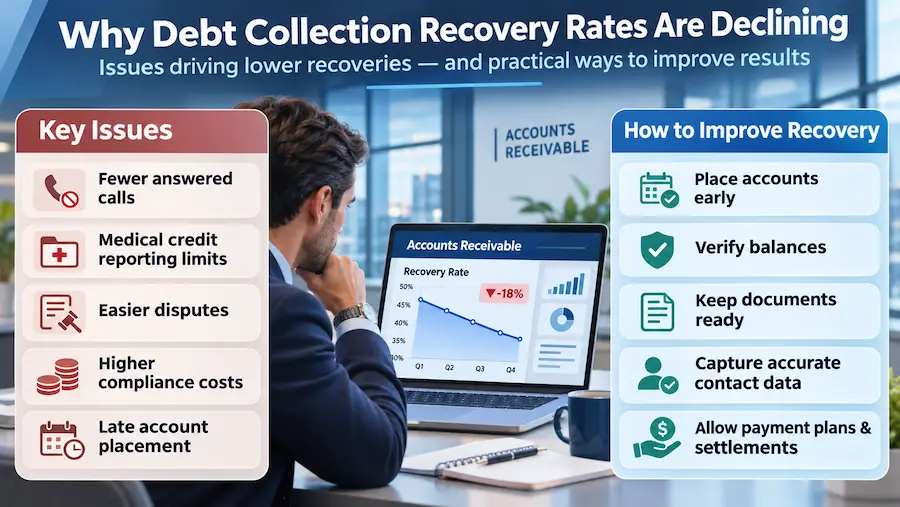
Why Are Debt Collection Recovery Rates Going Down?
The short answer: Debt recovery is becoming more difficult because consumers are less reachable, financial pressure is increasing, credit-reporting options are shrinking, and collection regulations are growing more complex. Meanwhile, creditors increasingly expect agencies to recover payments without damaging customer relationships.
Here are 12 important factors behind these challenges.
1. Fewer People Answer Collection Calls
Think about your own phone habits. Do you answer every unfamiliar number?
Most people don’t. Smartphones identify unknown callers, spam filters block suspected unwanted calls, and caller identification applications may display a collection agency’s name before the phone even rings.
A legitimate collection call can easily be mistaken for spam.
For collectors, fewer answered calls mean fewer opportunities to negotiate payments, explain balances, or resolve disputes. Making more calls doesn’t necessarily solve the problem.
Furthermore, many YouTubers mislead consumers by advising them to ignore collection calls altogether, without understanding the consequences themselves. Collection agencies should not be confused with debt buyer agencies. Ignoring a legitimate debt does not make it disappear. Depending on the account and applicable laws, unresolved debts may still result in credit reporting or legal collection activity.
2. Consumers Have Less Money Available to Pay
Sometimes, the problem isn’t willingness. It’s affordability.
The Federal Reserve Bank of New York reported that U.S. household debt reached $19.1 trillion in the third quarter of 2026, with 5% of outstanding balances in some stage of delinquency.
When consumers are struggling with mortgages, credit cards, car payments, and everyday expenses, older medical bills or service invoices can fall to the bottom of their payment priorities.
A collection agency can persuade someone to pay. It cannot create money that isn’t there.
3. Businesses Want Their Reputations Protected
This is one of the biggest changes in how creditors approach collections.
A dental practice doesn’t want a patient leaving angry reviews. A school doesn’t want a dispute spreading through its parent community. A local business doesn’t want aggressive collection activity damaging relationships it spent years building.
Understandably, clients increasingly expect agencies to be firm about recovering money but respectful toward the people who owe it.
That means fewer pressure-oriented tactics, greater emphasis on communication, and more opportunities for amicable resolution.
The trade-off? Some accounts may take longer to resolve, and certain short-term recovery opportunities may be sacrificed to protect long-term goodwill.
That’s not necessarily a bad business decision. Reputation has value, too.
4. Medical and Dental Credit Reporting Has Lost Much of Its Leverage
Credit reporting was once a powerful incentive for patients to resolve overdue balances.
Under policies adopted by Equifax, Experian, and TransUnion:
- Paid medical collection debts no longer appear on their consumer credit reports.
- Medical collection accounts with initial reported balances below $500 are excluded.
- Other eligible unpaid medical collections generally face a one-year reporting delay.
For many medical and dental accounts, a traditional reason to prioritize repayment has therefore disappeared.
Importantly, a debt being excluded from a credit report doesn’t mean it has been forgiven. It may still be collectible through lawful methods.
5. State Laws Are Adding Further Medical Collection Restrictions
Several states have introduced restrictions on medical debt credit reporting, collection procedures, waiting periods, and legal enforcement.
The rules aren’t identical everywhere, and some state credit-reporting restrictions are being challenged in court.
For healthcare providers operating across multiple states, an account that can be handled one way in one jurisdiction may require a completely different approach in another.
This makes medical collections more complicated and, in some situations, less effective.
6. Consumers Can Dispute Debts More Easily
Regulation F introduced a standardized model debt-validation notice with straightforward ways for consumers to challenge an account.
When a consumer submits a qualifying written dispute within the validation period, the agency generally must suspend collection efforts until it provides verification.
These safeguards are important, particularly when a bill is incorrect.
However, even legitimate balances can become difficult to collect when the original creditor cannot quickly produce invoices, payment records, or supporting documents.
An account that should take one conversation to resolve can turn into weeks of administrative work.
7. Federal Rules Limit Repeated Collection Calls
Under Regulation F, collectors generally face a presumption of violating the law if they call more than seven times about a particular debt in seven consecutive days, or call within seven days following a telephone conversation about that debt, subject to exceptions.
Consumers can also request restrictions on certain communication methods.
These protections discourage excessive contact, but they also mean collection agencies must make every permissible interaction count.
Accurate phone numbers and properly authorized digital communication options are more valuable than ever.
8. New York City Is Introducing Even Stricter Rules
New York City accounts for roughly 2.5% of the U.S. population, making it a significant market for consumer collections.
Its new SHIELD debt collection rule, scheduled to take effect January 1, 2027, introduces stronger documentation requirements and generally limits covered collection contacts to three attempts per seven days across communication channels, with exceptions.
New York State also has existing restrictions, including a three-year statute of limitations for many consumer credit actions.
For agencies working nationwide, complying with increasingly different local rules means more expense, more complex workflows, and fewer traditional collection options.
9. Legal Recovery Options Are Becoming More Limited
Taking legal action isn’t always practical, even when the creditor has a valid claim.
Some states restrict garnishment, liens, or litigation involving certain medical debts. Statutes of limitations can also restrict how long legal remedies remain available.
Add attorney fees, court costs, service expenses, and the possibility that a judgment may never be paid, and many smaller accounts simply aren’t worth litigating.
Legal collections remain an option in appropriate cases, but they’re not a universal solution.
10. Accounts Are Often Sent to Collections Too Late
This is one challenge creditors can directly influence.
A business sends a reminder, waits a month, sends another reminder, makes a few calls, and then allows the balance to sit for several more months.
By the time the account reaches a professional agency, the customer may have moved, changed phone numbers, accumulated other debts, or stopped responding entirely.
The longer a delinquent account remains unresolved, the more difficult it can become to collect.
Waiting too long is often more expensive than involving a collection agency early.
11. Compliance Costs Keep Rising
Collection agencies must navigate applicable FDCPA, Regulation F, FCRA, TCPA, GLBA-related security requirements, state licensing laws, and other consumer-protection rules. Healthcare collections can introduce additional HIPAA-related obligations.
They also need secure systems, employee training, call monitoring, legal oversight, and appropriate recordkeeping.
Some jurisdictions impose additional operational requirements. Nevada, for example, generally requires covered agencies handling client funds to maintain a trust account at a Nevada-based financial institution.
All these compliance expenses continue whether an agency collects $100 or $10,000.
12. Small-Balance Accounts Are Becoming Less Economical
Consider a $60 overdue bill.
The agency may need to verify the balance, send notices, make permitted contact attempts, handle a dispute, arrange payment, and maintain compliance records.
Even if the entire amount is eventually recovered, the cost of collecting it can consume much of the agency’s revenue.
This is particularly challenging in medical, dental, utility, subscription, and other industries with large numbers of relatively small balances.
Five Things You Can Do to Improve Your Debt Collection Recovery Rate
The industry is changing, but creditors aren’t powerless.
In fact, some of the most important improvements begin before an account ever reaches a collection agency.
1. Submit Accounts Earlier — Before They Become Stale
Don’t allow unpaid accounts to sit for six or nine months simply because your internal billing team is still hoping for payment.
For many ordinary commercial and consumer accounts, reviewing unresolved balances for professional placement around 60–90 days past due can be a sensible starting point. The right timing depends on the account, your collection policy, and applicable laws.
Start with polite internal reminders. When those efforts stop producing results, consider a structured early-stage collection program rather than waiting until the debt becomes seriously aged.
For medical accounts, complete required insurance processing, financial-assistance review, and legally required waiting periods first.
Practical tip: Compare recovery rates for accounts placed at 60–90 days, 91–180 days, and more than 180 days. You may discover that placement timing has a greater influence on results than the collection agency itself.
2. Make Sure the Balance Is Accurate Before Placement
An incorrect balance is one of the fastest ways to create a dispute.
Before sending an account, confirm that all payments, credits, insurance adjustments, refunds, and applicable discounts have been properly applied.
For medical and dental practices, make sure the patient’s actual responsibility is established and any required financial-assistance process is completed.
For commercial accounts, resolve obvious invoice errors and document agreed credits.
Practical tip: Send the customer a clear final statement identifying the original amount, payments received, adjustments, and remaining balance. A recognizable, accurate bill is easier to resolve.
3. Keep Supporting Documentation Ready
You don’t necessarily need to send every document with every account placement. But you should be able to produce supporting evidence quickly when requested.
Keep contracts or service agreements where applicable, itemized invoices, payment histories, delivery confirmations, and relevant correspondence.
For medical accounts, retain appropriate documentation establishing the patient’s responsibility, subject to privacy and disclosure requirements.
When a debtor disputes a balance, documentation may determine whether collection activity can resume promptly or remains stalled.
Practical tip: Maintain an organized electronic account record. Even if your agency initially needs only basic placement information, have supporting documents ready for secure transfer.
4. Capture Accurate Contact Information — and Appropriate Consent
An agency cannot recover a balance if it cannot reliably reach the responsible person.
Collect and regularly update mobile numbers, email addresses, mailing addresses, and appropriate account contact details while you still have an active relationship with the customer.
Where relevant, capture and maintain legally appropriate communication consent and preferences. Consent for collection calls, texts, and emails is governed by different requirements; it cannot simply be assumed to transfer automatically to every agency or communication method.
For commercial accounts, properly documented personal guarantees may provide additional recovery options where lawful and applicable.
Practical tip: Verify contact information during customer registration, appointment scheduling, contract signing, and regular account reviews—not only after payment becomes overdue.
5. Give Your Collection Agency Flexibility — and Stay Involved
Sometimes, a collector finally reaches the debtor and learns that the customer can pay $700 today toward a $1,000 balance.
If every settlement requires several days of approval, that opportunity may disappear.
Establish reasonable settlement authority, installment-payment guidelines, and escalation preferences with your agency in advance.
Stay responsive when the agency requests information, report payments made directly to your business, and avoid unnecessary interruptions to active collection work.
Most importantly, measure results by account age, balance size, and debt type—not just one overall recovery percentage.
Practical tip: Review collections every 60–90 days and compare similar groups of accounts. A recovery rate of 20% on very old accounts may represent a different level of performance from 20% on recently overdue accounts.
Is Your Collection Agency Underperforming, or Have Your Accounts Become Harder to Collect?
Before replacing an agency because recoveries have dropped, consider a few questions.
Are you submitting accounts later than you used to? Has the average balance changed? Are more accounts medical debts with limited credit-reporting options? Are you placing a higher proportion of already-disputed accounts?
For example, an agency receiving mostly 30–90-day-old balances may achieve a very different recovery rate from one receiving accounts that are already 18 months overdue.
A meaningful recovery comparison should examine similar accounts over the same collection period.
For clearer reporting, track both the percentage of accounts resolved and the percentage of placed dollars recovered, as well as the net amount returned after collection costs.
A lower headline recovery rate does not automatically mean your agency is doing a worse job.
The Right Collection Strategy Balances Recovery, Cost, and Reputation
Successful collections aren’t just about getting someone to pay. They’re about recovering the money owed at a reasonable cost, within the law, and without unnecessarily damaging customer relationships.
That often calls for a graduated approach.
Newer accounts may respond to professional written reminders and lower-cost early-stage collection programs. Older or more difficult balances may justify persistent, lawful third-party collection efforts. Selected accounts may warrant legal review where appropriate.
At NexaCollect, our approach emphasizes respectful communication, persistence, and reputation-safe recovery. Nexa and its authorized collection partners service accounts nationwide, with options ranging from fixed-fee early-stage collections to contingency-based recovery for more difficult accounts.
The objective is straightforward: recover what can reasonably be recovered while treating people fairly and protecting the reputation you’ve worked to build.
Frequently Asked Questions
1. Why is my collection agency recovering less money than before?
Lower recovery rates can result from older account placements, inaccurate contact information, consumer financial difficulties, fewer answered calls, medical credit-reporting restrictions, and tighter collection regulations. Compare recovery results by account age, balance size, and debt type before concluding that your agency is underperforming.
2. What is the best time to send an unpaid account to collections?
For many ordinary accounts, reviewing placement around 60–90 days past due is a reasonable starting point after appropriate internal reminders. There is no universal deadline. Medical debts and certain other accounts may be subject to mandatory notices, waiting periods, or financial-assistance requirements.
3. Can a collection agency still recover medical debts under $500?
Yes. Exclusion from Equifax, Experian, and TransUnion credit reports does not automatically eliminate the underlying debt. Eligible balances may still be collected through lawful notices, communications, payment plans, and other permitted methods, subject to applicable state laws and account-specific restrictions.
4. Do I need a signed contract for every account sent to collections?
Not necessarily. The documentation needed depends on the type of debt, transaction, and applicable law. Invoices, account statements, service records, payment histories, and customer communications can help substantiate balances. Agencies may need additional evidence when an account is disputed or legal action is considered.
5. Can I improve recoveries without damaging customer relationships?
Yes. Accurate billing, early professional reminders, respectful communication, convenient payment options, and reasonable settlement arrangements can improve the chances of resolution without unnecessary confrontation. A reputation-safe approach may also reduce disputes and protect future business relationships.
6. Should I let my collection agency accept partial settlements?
Reasonable settlement authority can help resolve accounts when consumers cannot afford full payment. Establish acceptable discount limits and payment-plan terms in advance, and evaluate offers against the account’s age, collectability, and likely recovery expenses.
7. How can I tell whether my collection agency’s recovery rate is good?
Compare accounts of similar age, value, debt type, and placement period. Review dollars recovered, accounts resolved, collection expenses, time to payment, and dispute or complaint rates. A single overall recovery percentage rarely tells the whole story.
Final Thoughts
Debt collection isn’t becoming easier. Consumers are harder to reach, regulations are more demanding, and agencies must often choose between maximizing immediate recoveries and preserving customer relationships.
But creditors can still make a difference.
Place accounts before they become too old. Verify balances. Keep documentation ready. Maintain accurate customer information. And give your collection agency reasonable room to negotiate.
The most effective recovery strategy isn’t necessarily the most aggressive one.
It’s the one that starts early, works consistently, follows the rules, and gives people a realistic opportunity to resolve what they owe.
Looking for a collection agency that takes recovery seriously without putting your reputation at risk? Learn more about NexaCollect’s nationwide collection services.